



 by
Tom Gurney
Tom Gurney BSc (Hons) is an art history expert with over 20 years experience
Email:
tomgurney1@gmail.com
/ Phone:
+44 7429 011000
The Ambassadors by Hans Holbein the Younger: Introduction
Two young men stand beside a collection of things that seem to promise an understanding of the world. There are globes for earth and sky, instruments for measuring time, a book of calculations and music waiting to be played. Their clothes occupy almost as much of our attention as their faces. Soft fur, pink satin, a heavy patterned gown and a carpet spread across the shelves make this a wonderfully substantial world. Then a pale streak cuts across the floor. Its scale and slant seem incompatible with everything around it. Seen obliquely, it becomes a human skull. [1]
Hans Holbein the Younger painted The Ambassadors in 1533. The men are Jean de Dinteville, the French ambassador in England, and his friend Georges de Selve, Bishop of Lavaur, who visited him there. The National Gallery in London owns the painting, a nearly square oak panel more than two metres high. Even before its objects begin to disclose their associations, the picture establishes a relationship between three bodies: the two men standing within it and the person standing outside, trying to see. [1] [2]
That experience is more rewarding than a hunt for a single hidden message. A date on a dagger, an open hymnbook, a broken string and a crucifix almost lost behind the curtain offer different kinds of evidence. Some tell us who the men were. Some place them within the troubled Christianity and diplomacy of their age. Others remain open to interpretation. The painting combines the intimacy of remembering a friend's visit with the public bearing of men accustomed to representing other people. Its visual pleasures survive every explanation: the weight of a sleeve, the slight separation between fingers, the sudden curve of a musical instrument. We can follow those details closely without expecting them all to speak in one voice.
At a Glance
- Artist Hans Holbein the Younger.
- Full title Jean de Dinteville and Georges de Selve ('The Ambassadors') .
- Date 1533; signed and dated.
- Medium Oil on oak.
- Dimensions 207 × 209.5 cm.
- Collection National Gallery, London, NG1314; bought in 1890. [1]
- Sitters Jean de Dinteville, French ambassador to England, and Georges de Selve, Bishop of Lavaur and a visiting friend.
- Age inscriptions 29 on Dinteville's dagger sheath and 25 on the book beneath de Selve's elbow. [2]
- Distinctive feature An anamorphic skull, recognisable from an oblique viewpoint. [1]
This work across Hans Holbein the Younger’s career
Dead Christ in the Tomb
1521–22 [4]Sir Thomas More
1527 [5]Georg Giese
1532 [6]Contents
- A friend's visit in a difficult year
- Standing together, looking out
- Measuring the heavens
- A world with Polisy at its centre
- Music, broken strings and a divided Church
- The floor, the curtain and the small crucifix
- The skull and the moving viewer
- Paint, damaged wood and the work of repair
- How the men recovered their names
- Annotated details
A friend's visit in a difficult year
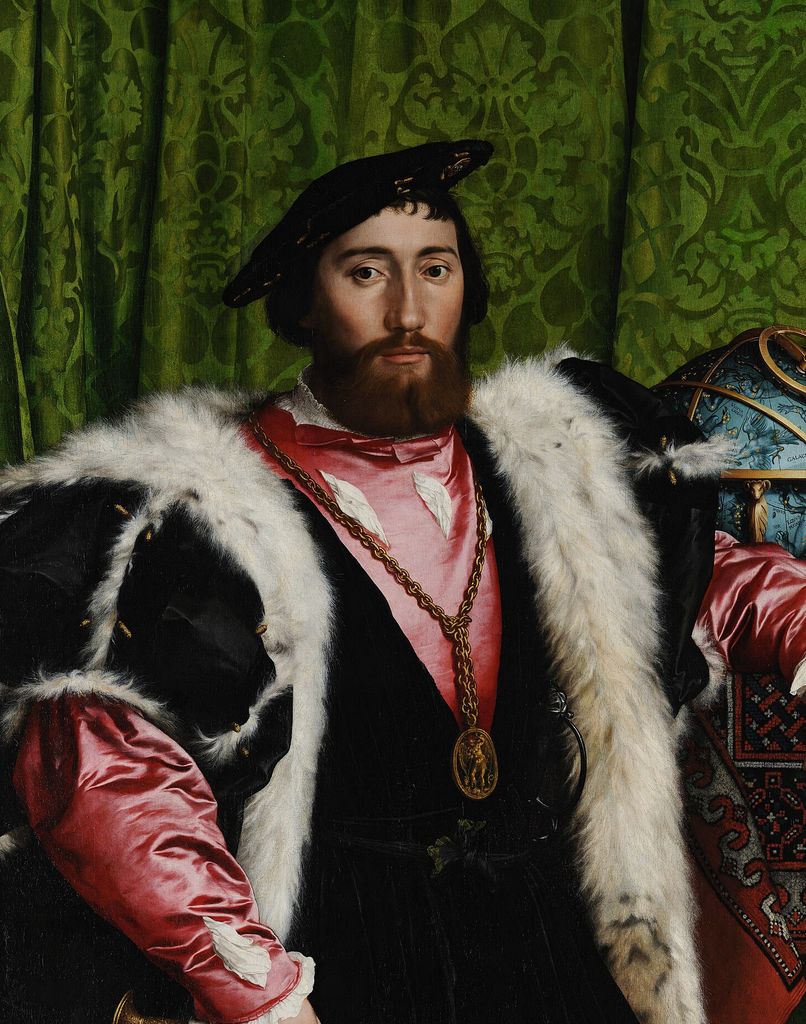
Dinteville stands on the left. The jewellery, weapons and broad silhouette suit a man whose life belonged to aristocratic service. De Selve, on the right, carries the quieter distinction of a scholar and churchman. Both had diplomatic experience, but the familiar title can give a misleading impression of their circumstances. Dinteville was the French king's representative in England during 1533; de Selve came to see him. They were not a pair of resident French ambassadors sharing the same English appointment. [2]
Dinteville's home was Polisy, near Bar-sur-Seine in the region of Champagne. He belonged to a family deeply involved in royal service, and his English responsibilities linked a French household and estate to the rapidly changing court of Henry VIII. Distance mattered. Letters carried instructions and explanations across the Channel; they also carried the small, impatient concerns of an absent landowner. In the correspondence printed by Mary Hervey, Dinteville asks about building and pictures, exchanges news with his brother and tries to understand an unusual oval compass. The man surrounded here by instruments was interested enough in an actual instrument to ask for a drawing of it. [2]
The distinction between a letter and a portrait becomes especially revealing in his complaints about England. Writing to his brother during May 1533, Dinteville describes himself as the most melancholy, weary and tiresome ambassador imaginable. He had been ill and wanted to return to France. In the same letter, his attention moves from international negotiations to archery, the puzzling compass, his hoped-for departure and de Selve's visit. The mixture is wonderfully human: official business and private life arrived together on the same sheet. [2]
His words about his friend are affectionate. De Selve had done him the honour of coming to see him, and the visit had given him considerable pleasure. There is also a request that the Grand Master, Anne de Montmorency, need not hear about it. That detail leaves room for political business behind the meeting. Friendship and confidential diplomacy could coexist. By early June de Selve had left again. The visit is secure; its precise arrival date and complete purpose are less clear. [2]
It is tempting to search Dinteville's painted face for the melancholy of his letter. That temptation should be resisted long enough to notice what the portrait actually does. He looks towards us steadily, with neither the open complaint of the correspondence nor an obvious performance of cheerfulness. His left arm rests on the shelf; his right hand holds the dagger. The picture gives his body breadth and his position stability. Whether he felt miserable on a particular day cannot be recovered from a cheek or eyelid. What we can compare is the tired voice preserved in writing with the composed presence preserved in paint.
De Selve's life supplies another reason to look beyond first impressions. The sobriety of his appearance can make him seem older than his companion, although the inscription gives his age as twenty-five, four years younger than Dinteville's. He was the son of Jean de Selve, a senior French judicial officer and diplomat. Educated in Greek and Latin, Georges translated lives by Plutarch into French and acknowledged the help of his teacher Pierre Danès. A church career, classical scholarship and service to the French crown were closely intertwined in his early life. [2]
He had been nominated to Lavaur while still a teenager, but his consecration followed only in 1534. Thus the absence of episcopal insignia in a painting dated 1533 requires no dramatic explanation about a rejection of Church authority. His title and the stages by which he could exercise his office were not identical things. Hervey's documentary discussion of his youth helps restore that distinction. His subsequent diplomatic career included Venice and Rome, while his writings repeatedly returned to the divisions of Christian Europe. [2]
The year of the painting gave such divisions an immediate English setting. Henry VIII had married Anne Boleyn, and the effort to end his marriage to Katherine of Aragon had drawn England into a confrontation with papal authority. Anne's coronation and the birth of Elizabeth belonged to Dinteville's embassy. France wanted useful relations with England while pursuing its own interests with the papacy and the Emperor Charles V. An ambassador had to make those incompatible pressures sound manageable in conversation. Hervey's account follows Dinteville through the resulting exchanges and the long wait for permission to leave. [2]
This context does not turn every object on the shelves into a reference to Henry's marriage. It does make their presence beside two diplomats more charged. A broken musical string, for example, can suggest a relationship that no longer holds together; a book of religious songs can raise questions about a shared faith expressed in conflicting forms. Those associations need not have been remote abstractions for these men. Much of their work consisted of dealing with people whose alliances, beliefs and demands refused to fall into harmony.
The double portrait probably grew from the pleasure and significance of the visit, although no surviving commission sets out the agreed design. Its scale suggests a considerable investment in remembering this particular encounter. There is a quiet poignancy in that choice. A visit ends, letters move on to other business, and the two men return to separate duties. In the painting their arms will continue to rest on the same carpet, with the same interval between them.
Standing together, looking out
Holbein gives the two figures a shared horizontal support but different ways of occupying it. Dinteville's stance spreads towards the viewer. One foot comes forward; the pale fur opens around the dark centre of his clothing; the pink sleeves form conspicuous bridges between his body and his hands. De Selve gathers himself more closely. His long gown descends almost to the floor, and its folds make his outline read as one continuous weight. Neither man turns to speak to the other. Their relationship is shown through their position together, while their attention remains directed outwards.
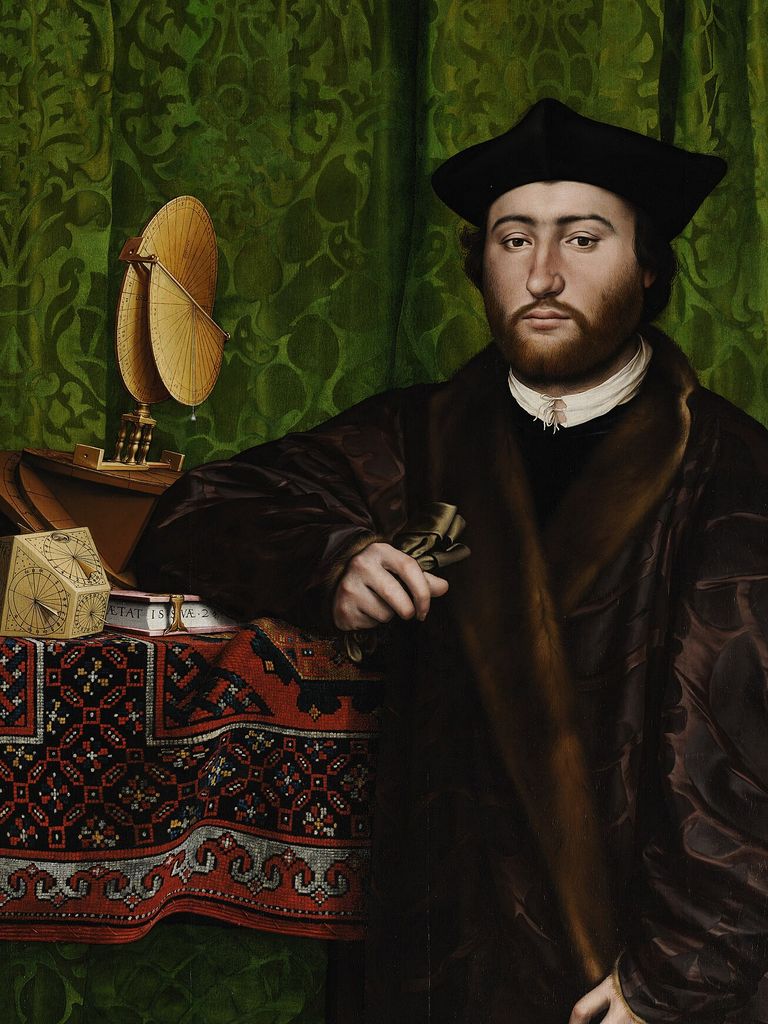
The difference is strongest around the arms. Dinteville's sleeve billows, narrows at the wrist and releases a relaxed hand over the carpet's edge. His companion's elbow is supported by a closed book. In one figure there is a visible softness and drop; in the other, an angled brace. The shelf holds these two gestures at a comparable height, allowing the eye to pass between them. A simple piece of furniture performs much of the work that an embracing arm or exchanged glance might have done in another double portrait.
Neither figure quite fills a separate half of the picture. The celestial globe rises behind Dinteville's sleeve, and the instrument at the far right stands close to de Selve. Both men seem connected to the display, yet there is space enough between them for it to acquire an independent presence. Our attention moves through a triangle: a face on either side and a gathering of objects below and between them. The objects delay the return to the faces. They make looking slower than a quick recognition of two important sitters.
The composition also works through unequal kinds of brightness. Dinteville has the conspicuous light and colour of fur, shirt and satin. De Selve's white collar is a much smaller interruption in an expanse of dark cloth. His face therefore carries a particular concentration of attention. Look from the broad white opening around the left figure to the narrow white closure at the right figure's throat. The two garments offer different visual accounts of how a person can appear substantial.
The patterned gown rewards a second look. Its design is not immediately legible at a distance: it emerges through changes within the brown and purplish tones. We begin by reading a sober surface and then discover intricacy. Dinteville's pink sleeve reverses that process. It attracts us at once with bright ridges and dark creases, before the arrangement of the cloth begins to make sense. Holbein distributes his demands on our attention. Some materials call across the room; others ask us to approach.
The hands are comparably varied. De Selve's lower hand rests against his gown. Dinteville's dagger hand sits near his waist, while the other hangs higher and more openly. These are hands resting, holding and supporting, not hands demonstrating the devices beside them. The distinction matters to the mood. The painting does not illustrate a lesson in progress. Its books and instruments have been arranged for inspection, and the men's stillness allows us to become the active examiner.
Their ages are written on objects rather than set out in a large explanatory label. Dinteville's appears on the dagger sheath, de Selve's on the page edges of the book beneath his elbow. Hervey used these inscriptions among the clues to their identities. [2] They also create an elegant pairing within the image. A weapon and a book mark two young lives without reducing either man to the thing supporting his age. Dinteville was interested in learning; de Selve worked in politics. Their possessions establish associations, rather than impermeable boundaries between action and thought.
That mixture prevents the differences in costume from becoming a simple moral contest. It would be easy to call the left figure worldly and the right figure spiritual, as though splendour belonged to one and seriousness to the other. The picture is more interesting when both are allowed their dignity. De Selve's gown has weight, pattern and sheen of its own. Dinteville's concentration is as evident as his finery. We see two carefully presented forms of distinction brought into a common space.
Annotated Details from The Ambassadors
The numbered points identify visible features discussed in this article. Return from each detail to the whole composition. Jean de Dinteville and Georges de Selve stand beside globes, instruments and music in Holbein’s double portrait of 1533. National Gallery, London; Google Arts & Culture/Wikimedia Commons. Image source . Public domain .
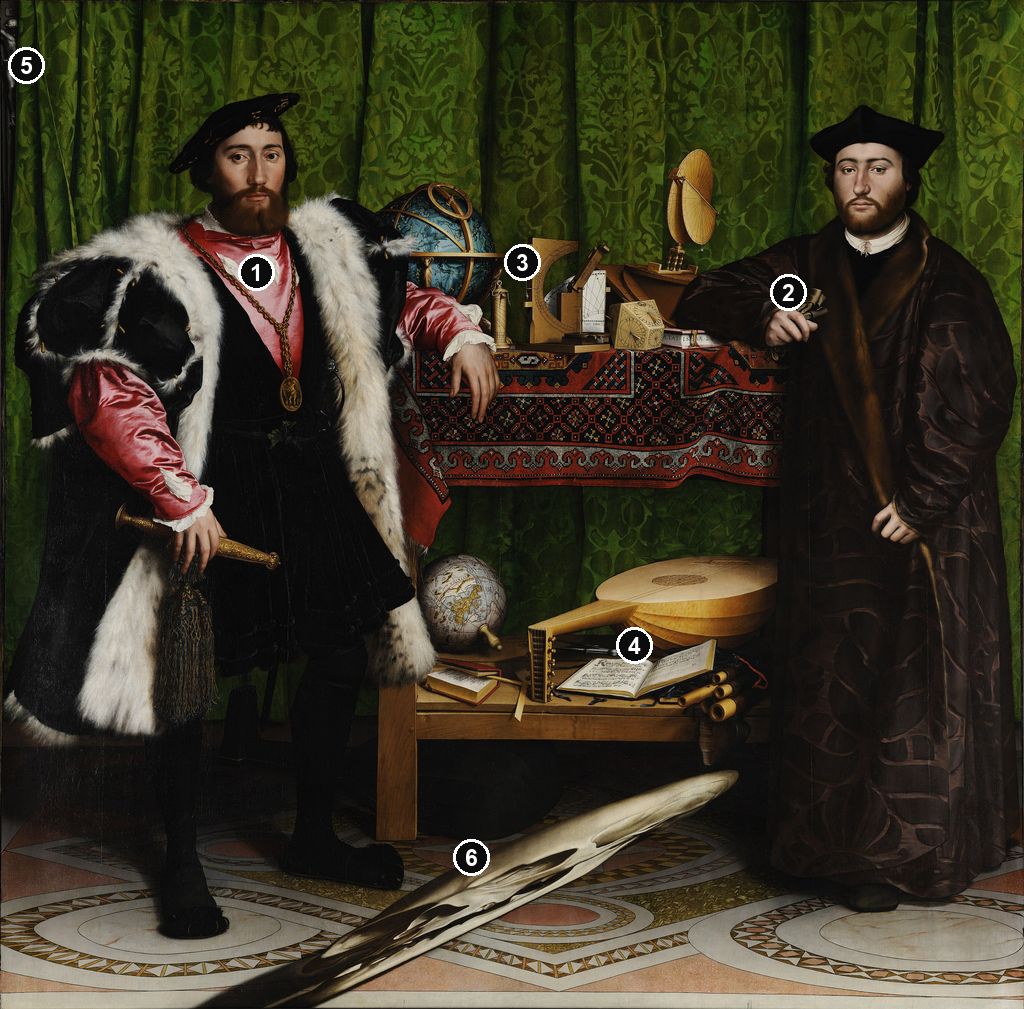
Details from THE AMBASSADORS
Compare the cropped details with the complete images above. Notice how their colours, shapes and positions contribute to the larger compositions.
Dinteville and court dress
The pale fur and red sleeves give Dinteville a wide, substantial silhouette. Follow the different edges of fur, fabric and bare skin.
De Selve and the book
De Selve rests his elbow on a book. The dark coat and its soft fur border make a quieter pattern beside Dinteville’s bright dress.
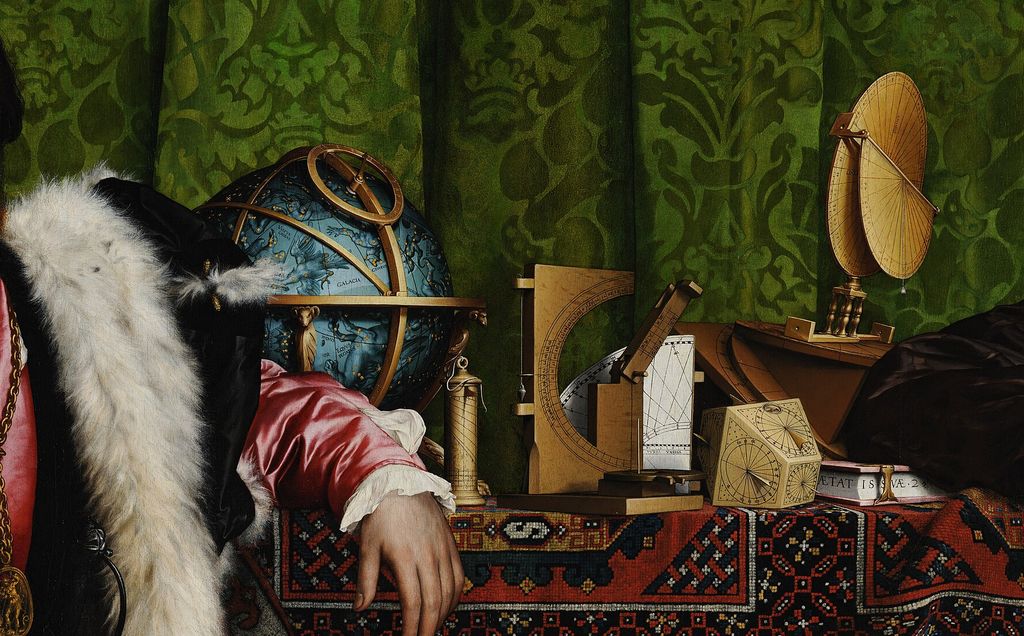
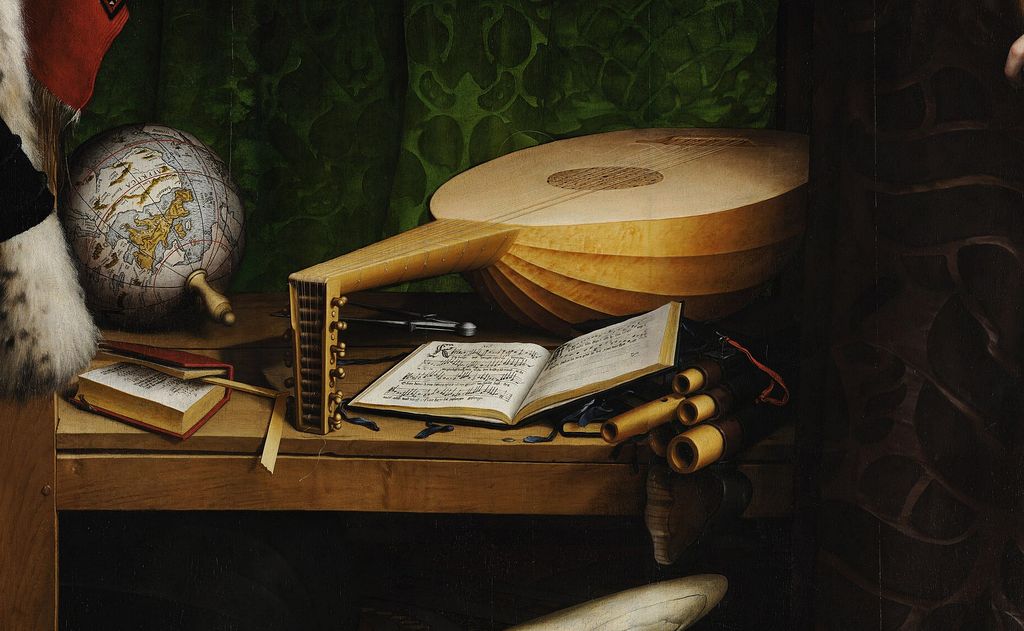
Instruments on the upper shelf
The globe and measuring instruments share a narrow shelf above the carpet. Compare their circles, straight edges and changing orientations.
Music and counting
The open music book lies near the lute and the case of flutes. The cropped view brings their different scales and angled positions together.
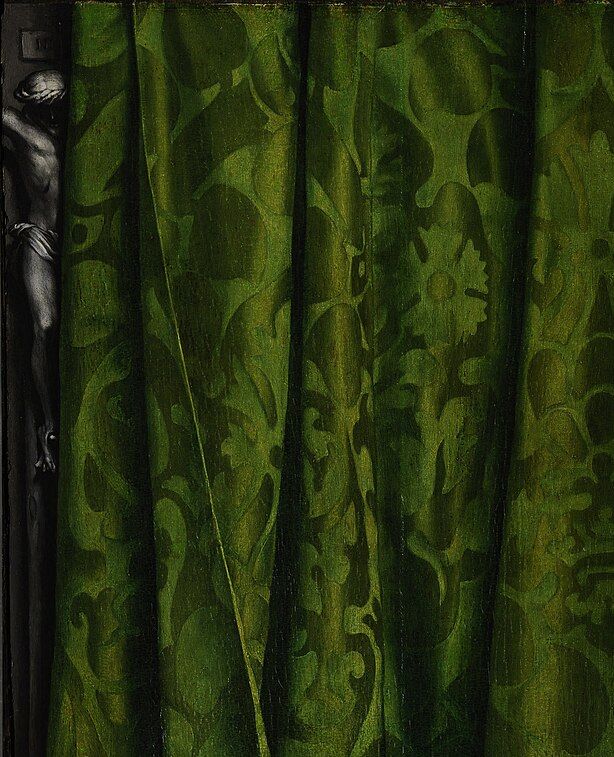
The partly hidden crucifix
The crucifix is partly concealed at the curtain’s edge. Return to the whole painting to see how easily this small feature can escape a first glance.
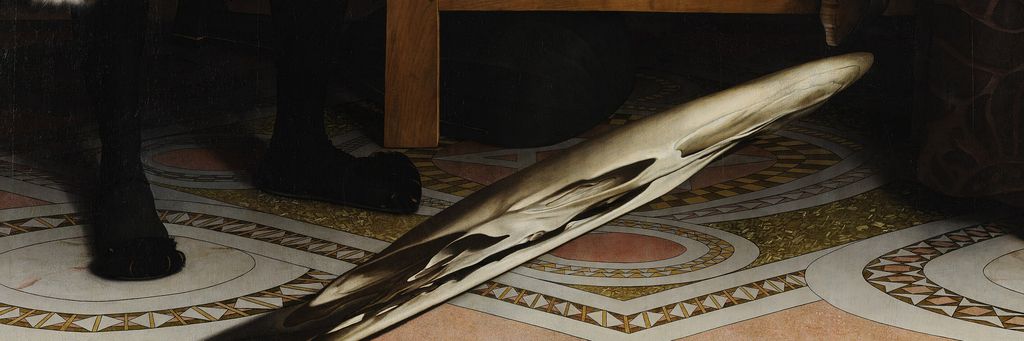
The elongated skull
The skull crosses the foreground at an oblique angle. This detail preserves the painting’s distortion; it has not been stretched into a corrected view.
Measuring the heavens
The upper shelf can initially look like a collection of unfamiliar ornaments. Start with its most recognisable object, the blue globe at the left. This represents the heavens, with figures associated with the constellations arranged over its surface. An earthly globe maps land and sea; a celestial globe organises the apparent positions of stars. The difference explains why one belongs high in the display and the other below. Hervey discussed both globes as part of the painting's learned setting, while also considering political associations that she found in their markings. [2]
The celestial globe is visually generous. Rings enclose its curved surface, alternately covering and exposing portions of blue. Its tilted construction resists a simple view of a complete sphere. The framework gives the globe the appearance of something adjustable, a model to be turned and set. The small figure of a constellation occupies a place that, on the globe beneath, might belong to a continent. Knowledge takes a pictorial form in both: a viewer must understand what kind of image a particular mark represents.
Several devices near the globe use the sun to tell time. The upright cylinder has a projecting pointer; the faceted block near de Selve carries more than one dial face. A sundial makes a shadow useful by placing it against a scale. Its reading depends on the relationship between a surface, a pointer, the sun and the position of the observer on earth. Once that principle is understood, the strange shapes become less remote. They are attempts to turn changing light into something that can be measured.
The quadrant, disassembled equinoctial dial and torquetum supply different ways of measuring angles, time and celestial positions. [7] Each name describes a different way of organising a problem. A quadrant makes an angle into a reading. An adjustable dial accommodates a relationship between location and the sun. The torquetum's intersecting planes make the dependence of one orientation on another visible even before its operation is understood.
At the right, the torquetum looks almost like a small piece of architecture. Its supports, sloping platform and upright circular part build a sequence of surfaces facing in different directions. The object interrupts the curtain's continuous pattern and rises towards de Selve's head. At the left, the globe answers it with a more enclosed shape. Between these two conspicuous ends, the smaller instruments create a changing skyline. Holbein makes a horizontal shelf feel varied without losing its overall order.
The Louvre's Portrait of Nicolas Kratzer , painted by Holbein in 1528, offers a helpful comparison. Kratzer, Henry VIII's astronomer and an instrument maker, is shown working on a many-sided sundial, with tools and other devices around him. There, the sitter's hands and the unfinished object help explain an occupation. In The Ambassadors , comparable things have become a display between two people whose principal occupation was elsewhere. The comparison connects the shelves to an actual culture of skilled making, without proving that Kratzer supplied every object or designed the portrait's entire programme. [9]
It is worth lingering over the material modesty of the instruments as they appear. Much of the display is coloured like wood, with pale faces, dark markings and occasional metallic parts. These things do not compete with Dinteville's clothes by glittering. Their attraction lies in construction and complication. A line, a hinge or a sharply cut edge can register intelligence as powerfully as a chain registers expense. The carpet beneath them brings those two kinds of attraction together: patient manufacture and conspicuous display.
There is also a difference between possessing a model and mastering what it represents. The globes make earth and heaven seem portable; the scales make a moving sky appear available to calculation. Yet a painted instrument cannot be adjusted in the viewer's hands. We are offered the appearance of access while remaining dependent on the image. The painting's clarity can make that limitation easy to overlook. Fine marks persuade us that a system is comprehensible before we have understood how it works.
The inconsistent readings and problematic calibrations frustrate attempts to establish one date; Good Friday, 11 April 1533, remains a hypothesis. [7] A precisely painted object does not automatically provide a precise historical answer. The visual conviction with which Holbein paints a scale and the reliability of a reading taken from it are separate questions.
The instruments can still matter without synchronising to a particular hour. They introduce duration into an image of people holding still. They imply the shifting sun and stars beyond the curtain, although the painted space remains enclosed. Between a young man's age on a dagger and a skull on the floor, the capacity to measure time acquires an obvious emotional weight. The shelf invites admiration for human ingenuity while giving us reasons to consider what ingenuity cannot prevent.
A world with Polisy at its centre
The terrestrial globe occupies a much lower, more intimate position. It rests near Dinteville's legs, partly sheltered beneath the overhanging carpet. It has less blue and more mottled earth colour than its celestial counterpart. Our eye has to travel down from the public height of faces and shoulders to find it. That movement changes the register of the painting. Heaven appears beside a head; the earth sits close to a knee and an open book.
Among its place names is Polisy, Dinteville's home. Hervey recognised the importance of this small word when investigating the sitter's identity. It tied the geographic object to a particular estate and, in combination with the age, date and French order, strengthened the identification of the left-hand figure. [2] A grand image of the globe thus contains a surprisingly domestic address. The owner of the portrait could find his own place within the world it displayed.
For a homesick man abroad, that connection is especially suggestive, although the picture does not tell us how often Dinteville thought about it. The contrast is available to us without inventing his thoughts: the ambassador worked in England, the picture was intended for his possession, and the globe names a place in France. A tiny inscription brings a distant location into the same visual space as his body. Diplomatic travel and landed identity meet on a surface that can be covered by a hand.
The device also challenges the apparently impersonal character of a map. Names and positions make a globe useful, but selection makes it meaningful to particular people. Polisy deserves its place here because of Dinteville, even though it is a small settlement in a much larger world. The question becomes less “How much geography can this globe contain?” than “Whose world does it help us enter?” The picture offers a global setting and a personal point of attachment at the same time.
Hervey pursued the globe's political implications in considerable detail, linking names and additions to French diplomatic interests. Some of that reconstruction depended on a proposed printed model and on assumptions about why individual locations were included. Her work remains valuable for the questions it raised and the evidence it assembled. It need not oblige us to treat every place name as a separate instruction from the patron. The conspicuous presence of Polisy does its work without requiring the entire surface to become a coded diplomatic map. [2]
Nearby, an open book is held at an angle by a measuring tool. Hervey identified it as Peter Apian's German manual of merchants' arithmetic, first published in 1527, and located the passage in Book III, Q8 verso. [2] This is a satisfyingly specific identification: a particular arrangement of printed words and calculations connects a painted book with an actual publication. The numbers belong to the practical business of calculation, bringing the learned display into contact with work that merchants and other readers could use.
The physical presentation of the book is part of its interest. Its pages lift slightly, the cover is strongly coloured, and the object laid across it combines reading with measuring. We do not see an abstract number floating in a symbolic diagram. We see a book that has to be kept open. Even as an emblem of arithmetic, it retains the familiar inconvenience of paper wanting to close. Holbein lets an intellectual category remain a handled thing.
The passage concerns division. The National Gallery relates that choice to the broader possibility of discord in the painting. [1] The association is easy to understand: the same word can name a mathematical operation and a separation between people. Its strength lies in that suggestive overlap. An arithmetic example does not carry the urgency of a broken agreement in itself; its surroundings give it that possibility. Beside a diplomat, music and a religious book, division can begin to sound like more than a classroom instruction.
The measuring implements introduce another kind of relation. A pair of dividers compares intervals; a rule or square establishes an edge or angle. Their shapes can be understood even by someone unfamiliar with Renaissance instruments. They propose that differences can be set alongside one another and measured. The contrast with diplomacy is available without becoming a fixed allegory: distances between points are easier to establish than distances between beliefs or demands.
Across the shelves, the objects bring together the four mathematical studies traditionally called the quadrivium: arithmetic, geometry, astronomy and music. Hervey made this connection in her discussion of the liberal arts. [2] Music belonged within that group because harmony could be considered through number and proportion. The proximity of the calculation book and the lute is therefore intellectually coherent as well as visually attractive. Numbers move across the shelf from a printed operation to an instrument designed to be heard.
Watch: Holbein’s portraits and working methods
Explore museum films on Holbein’s drawings, painted portraits and close-looking details.
Hans Holbein at the court of Henry VIII
A Royal Collection Trust film exploring Holbein’s work at Henry VIII’s court.
Watch on YouTubeMusic, broken strings and a divided Church
The lute is one of the painting's most inviting objects. Its pale, rounded body lies at an angle on the lower shelf, its neck stretching towards the globe and book. The soundhole forms a dark patterned centre in the light wood. Beside the flat pages, straight tools and complicated astronomical devices, the instrument introduces a broad, swelling curve. Its apparent readiness to be lifted contrasts with the stillness of everything around it.
One string is broken. That small interruption has attracted attention for generations, because a musical instrument depends on relationships between its parts. Each string contributes to an instrument that must be tuned and played as a whole. A break is both a visible defect and an imaginable failure of sound. It allows the viewer to move from what can be seen to something absent: the harmony that these particular strings cannot now produce as intended. [2]
There is a useful contemporary comparison in Andrea Alciato's emblem Foedera Italorum , published in 1531. The woodcut shows a lute, and the Latin poem offers it to a duke entering alliances. Many strings require skilled tuning; if one is badly tuned or broken, the harmony is lost. Alciato then makes the political comparison explicit: Italian leaders must remain united, since a single defection can dissolve their concord. The University of Glasgow's edition supplies both the text and an English translation. [10]
This is stronger evidence for a sixteenth-century association than a modern intuition that broken strings simply feel sad. It shows how an instrument could furnish a language for alliances. Hervey drew a connection between Alciato's emblem and the lute in The Ambassadors , going further to relate the break to events in French relations with Milan. [2] The comparison is illuminating, although the painting does not name that episode. Alciato gives us a contemporary way of thinking with a lute; he does not supply a missing caption written for Holbein's picture.
The difference between an emblem and this portrait is also productive. In Alciato, a motto and poem direct the interpretation of the woodcut. Here the damaged string appears among many objects beside actual people. No explanatory poem fixes its reference. It may call up political discord, the vulnerability of worldly pleasures, mortality, or several of these together. Its neighbours keep the association active. They do not allow the lute to settle into the simplicity of a single labelled illustration.
Below and beside it are the dark lute case, the open hymnbook and a case of flutes; one flute appears to be absent. [2] [7] The contrast between container and contents adds another play of presence and lack. Music is everywhere suggested, but nobody performs. A case can protect an instrument, a book can preserve a musical part, and a portrait can preserve a person. None produces living sound or speech by itself. The picture holds the means of an activity in suspension.
The hymnbook is particularly consequential. Its German texts identify it with the Lutheran musical tradition associated with Johann Walter's Geystliche Gesangbüchlein . One hymn invokes the Holy Spirit; the other concerns the Ten Commandments. Hervey examined the wording and musical parts in detail, connecting the choice to de Selve's concern for Christian reunion. [2] The two hymns are not consecutive in the 1525 edition; Holbein has brought separate pages together. [7]
This deliberate-looking conjunction makes the book more than a general indication that the men enjoyed music. It places religious words where a viewer might try to read them. The prayer for the Spirit and the instruction of the Commandments concern belief and conduct that extended across confessional disagreements. Yet the German Lutheran form was itself a charged choice. The book brings a shared Christian inheritance into view through a publication connected with the divisions of the Reformation. [2]
De Selve's writing makes the question of reunion especially relevant. Hervey describes his appeals to the Germans and his repeated reliance on Scripture in urging an end to religious conflict. She also prints and discusses the evidence for a Catholic churchman whose scholarly friendships crossed some of the lines that might otherwise seem to separate people neatly into camps. [2] A Lutheran hymnbook beside him need not announce a private conversion. It can be considered in relation to the difficult problem of finding words that divided Christians might still share.
Read in that light, the open pages and the broken string create a compelling tension. The book offers words and musical notation through which several voices might act together; the damaged instrument presents an obstacle to harmony. This is a reading of their relationship within the composition, not a reconstruction of instructions dictated by de Selve. Its attraction comes from the visible arrangement and from the contemporary concerns documented around the men.
The painting also grants music a sensuous life beyond those associations. The lute's rounded body seems to press upwards against the space beneath the carpet. Its long neck directs the eye across the shelf, while the open book faces out at a different angle. We can almost imagine the movement needed to free the instrument from the arrangement. A hand would have to enter the space the painter has so carefully filled. The promise of music survives as a possibility, even though the gathering remains silent.
The floor, the curtain and the small crucifix
The pavement gives the men somewhere definite to stand. Circles, squares, coloured stone and patterned borders spread beneath their feet, their repeated shapes compressed by perspective. Looking down from the shelves, the eye seems to enter a more open region of the painting. Large pale roundels contrast with the dense carpet above. Then the skull crosses that apparent openness and interferes with our confidence in the floor as ordinary space.
The pattern has long been compared with the Cosmati pavement at Westminster Abbey. Hervey explored the resemblance and printed diagrams of the two designs. [2] The Abbey's pavement was laid in 1268 by craftsmen from Rome. It uses differently shaped pieces of coloured stone and glass, and its medieval inscriptions connect the pattern with the world and its eventual end. Its geometry belongs to a larger vision of creation and duration, rather than serving as decoration alone. [11]
Holbein's floor resembles this tradition without being an exact copy of the surviving Abbey pavement. [7] The distinction matters when we imagine the setting. We are not looking at a dependable record of two men standing in the sanctuary at Westminster. The picture combines a richly patterned floor with a curtain and a shelf of objects. It does not give us the surrounding architecture that would locate such an encounter. The floor can evoke a place and a tradition without turning the whole painting into a view of that place.
It also offers a very immediate visual pleasure. Notice how a broad circle can become a shallow oval on the painted plane, while the border supplies enough repeated marks to keep it recognisable. Near the men's shoes, the stone patterns make their weight and position clearer. Dinteville's forward foot occupies a light roundel; de Selve's gown overlaps another region at the right. The clothing seems to rest within the design, although neither figure looks down to acknowledge it.
Above them, the curtain prevents the eye from travelling into a deep interior. Its folds and large repeated motifs form a continuous green field, interrupted by heads, hats and instruments. A curtain is a useful object for a portrait painter: it can make a space feel enclosed while giving colour and pattern an independent life. Here its scale is important. Small motifs might dissolve into texture; these large shapes remain present enough to compete with the things standing in front of them.
The folds make a patient exercise in looking. A pattern seems to continue from a lit passage into shadow, then become difficult to follow. Our eye tries to flatten the hanging cloth mentally so that the repeated design will make sense. We perform a modest act of reconstruction without leaving our position. That is a useful preparation for the more demanding reconstruction of the skull, where a stable frontal view no longer suffices.
At the extreme upper left, the curtain draws back just far enough to reveal part of a crucifix. It can be missed even after the central objects have received considerable attention. The placement does not match the prominence we might expect from the central object of a devotional painting. Its smallness gives discovery a particular force. Once it has been seen, the space behind the curtain becomes consequential: something existed there before our attention reached it.
The National Gallery reads the crucifix as an indication of hope in redemption through Christ. [1] Together with the skull, it gives the painting a recognisable Christian horizon. Death may limit the men's lives and possessions, while the cross directs thought beyond that limit. The relationship is available in the image without requiring us to know the exact theological views of the artist. Holbein has made the sign difficult to see, but he has not removed its identity.
The crucifix is also a body of a very different kind from those occupying the foreground. Dinteville and de Selve stand upright in substantial clothing. Christ appears small, partly concealed and fixed to the cross. The contrast in visibility can make the portrait feel spiritually unsettled: the material world is immediately persuasive, while the religious image asks to be found at its margin. The picture allows that imbalance to remain part of the encounter.
Foister discusses Jeanne Nuechterlein's interpretation of imperfect measurement as an expression of the limits of human knowledge. [7] Such arguments help explain why precision and uncertainty can coexist here. The painting displays things made to measure and understand, while also making the act of seeing unstable. The small cross does not turn the shelves into a mistake. It gives their ambitions a different scale.
The skull and the moving viewer
The skull first arrives as a failure of recognition. From in front, it looks too long, too slanted and too pale to belong comfortably to the floor. The grey and brown openings may suggest features without settling into a face. Because the surrounding objects are so readily convincing, this one asks for another explanation. We have to consider that the difficulty lies in our position, rather than in an inability to identify an ordinary painted thing.
Anamorphosis makes that change of position part of the image's design. A form is stretched so that it resolves when seen from a particular oblique viewpoint. Think of a shape seen along a flat surface instead of directly facing it: distances extending away from the eye appear compressed. A painter can take advantage of that compression, distributing an image over the surface so that the angled view brings its parts back into an intelligible relation. The distortion and its correction belong to the same geometry.
Holbein's skull is easier to resolve from the right. [7] In a reproduction, it can be helpful to look across the image from that side, keeping the surface sharply angled to the line of sight. The long pale form contracts; the dark openings become eye socket and nasal cavity; teeth and jaw take their places. A discovery that sounded abstract in an explanation becomes immediate. The streak was a skull all along, but it required a different relationship between picture and observer.
The method differs from simply hiding a recognisable skull among other things. There is no gap behind a globe in which to spot it. It occupies an enormous portion of the foreground and remains conspicuous even when it is incomprehensible. Concealment works through deformation. The painting can therefore show death prominently while allowing a viewer to overlook its meaning. That is a more disconcerting achievement than placing a small warning in a corner.
When the skull becomes clear, the rest of the portrait suffers. Faces and bodies are compressed by the same oblique view that gives the skull coherence. We cannot hold both experiences at their best from one fixed position. Return to the front, and the men recover their breadth while the skull loses its familiar proportions. The change is reversible, but it cannot be cancelled. Knowing what the elongated shape represents changes the next frontal encounter.
This makes mortality an experience of looking as well as an iconographic subject. The men appear complete and assured from the position that frustrates our recognition of the skull. Shift to the position that makes death plain, and their assured world contracts. We do not need to imagine an allegorical speech from either sitter to feel that exchange. The viewer's own movement supplies it. Our body performs the change that interpretation tries to describe.
The small skull badge on Dinteville's cap makes an intriguing comparison. Hervey connected it strongly with a personal device and with Holbein's Dance of Death . Her identification of a relationship between skull imagery and remembrance of death remains useful. There is, however, no proof that this badge was Dinteville's unique personal emblem. [2] [7] Visually, its scale is almost the opposite of the great skull below: one is a tiny wearable sign, the other an interruption too large to ignore.
Anamorphosis was not confined to this painting. A later portrait of the young Edward VI, dated 1546 and attributed by the National Portrait Gallery to William Scrots, elongates the prince's profile across a wide panel. Its original frame has a notch through which the surface could be seen from the resolving position; an associated viewing apparatus is lost. That surviving evidence makes the social pleasure of such pictures tangible. They could demonstrate skill and offer an astonished spectator the reward of finding the correct view. [12]
With The Ambassadors , the original arrangement is much less secure. A memorable modern account imagines the painting beside a staircase, so that someone leaving the room would suddenly see the skull. The picture supplies the optical effect, but not proof of that architectural story. Its first frame and original viewing conditions are unknown. [13] A convincing demonstration of what a viewer can see is different from evidence of how a sixteenth-century visitor was expected to move.
Several rhythms for the encounter remain possible. Someone approaching from the side might recognise death before enjoying the full frontal splendour. Someone approaching directly might admire the men first. A host might explain the trick, or a guest might discover it. We cannot recover the event precisely. The surviving painting still permits us to test the essential contrast for ourselves: one field of vision yields the portrait, another yields the skull.
Paint, damaged wood and the work of repair
The surface that makes these experiences possible has a substantial material history. Wyld describes ten oak planks, chalk-and-glue ground, grey priming and linseed oil paint. Small touches build the carpet's knots; layered greens create the curtain; selected details contain real gold. [13]
The effect is an absorbing exchange between paint and imitation. Dinteville's satin looks mobile because light seems to break over ridges that are, on the panel, changes of colour. The rug looks thick because tiny adjacent marks accumulate into a surface. A beard requires the eye to read fine dark strokes as separate hairs while also seeing the volume of the face beneath. At a comfortable viewing distance these different kinds of work come together. Close inspection starts to separate them again.
The black clothing is particularly instructive. It could easily become an empty silhouette, yet small changes in value suggest the turn of a leg, the fall of cloth and the position of a shoe. Brightness is relative. A subdued grey can become a convincing highlight when it lies within a sufficiently dark passage. The painting's luxury is sustained by these restrained transitions as well as by its conspicuous colours.
The left half has suffered more loss than the right; the Saint Michael medallion is an old reconstruction. In 1891 the panel was thinned, flattened and cradled; subsequent movement caused problems. The 1993–96 treatment removed varnish and reconsidered repairs. Surviving paint and digitally transformed model photographs guided reversible repairs to the skull. Wyld acknowledges the limits of exact recovery. [7] [13]
These findings alter the confidence with which we should inspect small details. Dinteville's membership of the French order can be documented, but the present pendant cannot be treated as an untouched specimen of Holbein's miniature painting. A surviving contour, an old filling and a modern repair can occupy the same apparently continuous form. The distinction is especially significant in a work whose small particulars have been asked to carry so much meaning.
The conservation photographs are consequently valuable companions to the finished image. The view after cleaning and before restoration shows how scattered losses interrupt the lower left figure and the skull. It also reveals how much coherent original painting remains around those interruptions. [13] Neither the idea of a wholly pristine masterpiece nor that of an image invented by restorers describes this combination well. The painting survives through particular areas, in particular conditions, with repairs that can be identified and discussed.
For the viewer, conservation has an optical consequence as well as a material one. Dark passages must remain readable enough for a foot or a case to have its place. The skull must retain the relationships through which a lateral view resolves it. A very small change within an anamorphic image can have a surprisingly large effect when compressed by the resolving viewpoint. Caring for this painting therefore involves the relationships between marks, not merely the visibility of isolated details.
There is a certain fitness in that history. The Ambassadors repeatedly asks us to distinguish an immediate impression from the conditions that produce it. Conservation does the same in another way. An apparently continuous surface becomes a record of original work, wear and intervention. Learning this need not diminish the pleasure of the portrait. It makes the achievement more specific: a painted encounter has crossed centuries in vulnerable wood and oil, and it still persuades us to move closer.
How the men recovered their names
The painting's history contains another kind of disappearance and recovery. The two figures never ceased to look individual, but their names became uncertain. A portrait can preserve a face more successfully than the knowledge that once accompanied it. Once a picture travels away from its household, a plausible label can replace a remembered identity. With The Ambassadors , the exactness of the painted people coexisted for a long time with confusion over who they were.
The earliest known inventory reference is at Polisy in 1589, where the picture was in the great hall. It confusingly names Polisy and Auxerre, suggesting Dinteville and his bishop brother, rather than de Selve. [7] Later family documents provide the more useful identification. In the seventeenth-century parchment published by Hervey, Jean de Dinteville and Georges de Selve are named, their careers described, and de Selve's visit to his friend in England connected with their employment of the painter. The document also states that the picture remained at Polisy until 1653. [2]
That record was not contemporary with the sitting, so it must be read as family testimony preserved later, rather than a transcript of the commission. Even so, it supplies a remarkably useful conjunction: two names, an English meeting and the painting. Hervey checked its information against other documents, including evidence for de Selve's age and ecclesiastical career. The age on the book could then be compared with a person whose life was independently recorded. Separate kinds of evidence began to agree. [2]
By the late eighteenth century, a different association had attached itself to the picture. The 1787 sale description named de Selve and d'Avaux, while also noticing the distorted death's-head. Jean-Baptiste-Pierre Lebrun repeated the names with the engraving he published in 1792. The useful survival of de Selve's name was entangled with a wrong companion. Later attempts to identify English figures included Thomas Wyatt and John Leland. Such guesses show how easily a setting associated with Tudor England could make French sitters seem English. [2]
The painting came to Longford Castle in 1808–9 and was bought by the National Gallery in 1890. The £55,000 acquisition included two other paintings. [2] [7] Public ownership brought a much larger audience to the problem of its identity. Sidney Colvin proposed Dinteville for the left figure, supported by his age, career and connection with Polisy. Hervey's discovery and examination of the family evidence then secured the identification of the pair. Her book, published in 1900, gave their recovered names an extensive documentary setting. [2]
Her achievement deserves to be kept distinct from complete agreement with all her interpretations. She could be highly confident about an emblematic connection where a later reader would see a hypothesis. Her account of the pavement, the globe and the supposed personal skull device includes arguments that need qualification. The value of her research lies partly in making such distinctions possible. She provided documents and comparisons that other scholars could inspect, challenge and use differently.
The different readings considered here leave us with a friendship portrait, a meditation on death, a response to Christian division and a reflection on measurement. None supplies a statement by Holbein explaining the whole. Together, they draw attention to the different ways its elements operate: a name identifies, a book cites a publication, a broken string suggests, and the skull transforms the act of viewing.
Return, finally, to the space between the men. It is filled with things that link remote places, celestial movements, calculated quantities and imagined sounds. Their hands rest at its edges. The picture offers an extraordinary abundance of information, yet the relationship between these two people is expressed with great economy. They stand together and look towards us. The record of a visit has become a lasting invitation to look, to move and to look again.
Artworks directory
Explore paintings, drawings, prints and designs, including works without a separate article. Related studies and versions have their own entries; workshop works and copies are labelled. Print designs and series are grouped rather than repeated for every impression.
Frequently Asked Questions
Jean de Dinteville is on the left and Georges de Selve on the right. Dinteville was the French ambassador in England in 1533; de Selve, Bishop of Lavaur, was a friend visiting him. Both undertook diplomatic work, but they were not two resident French ambassadors holding the same English appointment. [1] [2]
Look at the image from a sharply oblique angle on the right, rather than directly in front. The long shape compresses into a recognisable skull. This deliberate perspective distortion is called anamorphosis. With a reproduction, angling the surface towards your line of sight can help demonstrate the change. [1] [7]
That is a proposed reconstruction of its viewing conditions, not an established fact. The original frame and precise first arrangement are unknown. A lateral viewpoint reveals the skull, but that optical fact does not establish a particular architectural setting. [13]
Discussion
Look again at the images and ideas explored in The Ambassadors by Hans Holbein the Younger. These editorial prompts invite your observations.
Reader Insights
The shared shelf links the men without a gesture of greeting. Compare the relaxed fall of Dinteville's hand with the support beneath de Selve's elbow.
The age inscriptions help identify real people. The broken string opens associations. Which details seem most secure to you, and which remain suggestive?
Once you have recognised the skull, return to the full portrait. Does the men's stillness now feel more assured, more fragile, or simply more mysterious?
Join the Conversation
Which part first drew you into The Ambassadors : the two faces, the abundance of objects, or the strange shape on the floor? Share how your response changed after looking again from another angle.
References
- National Gallery , Jean de Dinteville and Georges de Selve ('The Ambassadors') , Hans Holbein the Younger, 1533, NG1314; collection record and painting image. View source .
- Mary F. S. Hervey , Holbein's “Ambassadors”: The Picture and the Men: An Historical Study , London: George Bell & Sons, 1900; especially Part I, chapter I; Part II, chapters III–IV; Part III, chapters I–II; and Part IV, chapters I–II. Public-domain text with original page markers and documentary transcriptions. View source .
- Kunstmuseum Basel, Bildnis des Bonifacius Amerbach, 1519, inventory 314 (in German) . View source .
- Kunstmuseum Basel, Der tote Christus im Grab, 1521–22, inventory 318 (in German) . View source .
- The Frick Collection, Sir Thomas More, 1527, accession 1912.1.77, collection record . View source .
- Gemäldegalerie Berlin, Georg Gisze . View source .
- Susan Foister , “The Ambassadors”, in The German Paintings before 1800 , London: National Gallery Global and Yale University Press, 2024; especially “Technical Notes”, “The Sitters”, “The Setting”, “The Chateau of Polisy”, “The Making of the Portrait”, “Interpretation of the Composition” and “Meanings of the Objects”. View source .
- Susan Foister, Christina of Denmark, Duchess of Milan (2024) . View source .
- Musée du Louvre , Portrait de Nicolas Kratzer (vers 1486–après 1550), astronome du roi d'Angleterre Henri VIII , Hans Holbein the Younger, 1528, INV1343; collection record (in French). View source .
- Andrea Alciato , “Foedera Italorum”, Emblematum liber , Augsburg: Heinrich Steyner, 28 February 1531, A2v–A3r; University of Glasgow emblem edition, Latin text with English translation. View source .
- Westminster Abbey , “Cosmati Pavement”; history, construction and medieval inscriptions. View source .
- National Portrait Gallery , King Edward VI , attributed to William Scrots, 1546, NPG1299; collection record and account of its original frame and viewing arrangement. View source .
- Martin Wyld , “The Restoration History of Holbein's ‘The Ambassadors’”, National Gallery Technical Bulletin , 19, 1998, pp. 4–25; especially the technical account, treatment history and skull reconstruction, pp. 22–24. View source .
- Würth Collection, Holbeins Schutzmantelmadonna, inventory 14910, current owner account (in German) . View source .
- Metropolitan Museum, Dance of Death series . View source .
- Kunstmuseum Basel, Bildnis der Frau des Künstlers mit den beiden ältesten Kindern, about 1528–29, inventory 325 (in German) . View source .
- Kunsthistorisches Museum Wien, Next Generation, Jane Seymour, about 1536–37, inventory 881 (in German) . View source .
- Splash image , Jean de Dinteville and Georges de Selve stand beside globes, instruments and music in Holbein’s double portrait of 1533. National Gallery, London; Google Arts & Culture/Wikimedia Commons. Image source . Public domain .


