 by
Tom Gurney
Tom Gurney BSc (Hons) is an art history expert with over 20 years experience
Email:
tomgurney1@gmail.com
/ Phone:
+44 7429 011000
Margaret, Lady Elyot: Introduction
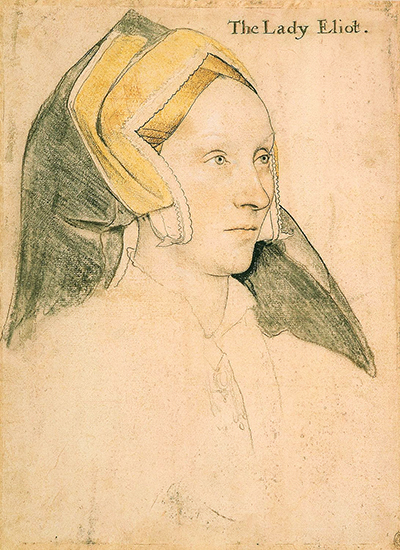
The dark cloth around Margaret Elyot’s head gives this small portrait much of its strength. It spreads into broad, pointed shapes on either side of her face, while a yellow band and a pale, finely edged border lead the eye towards her forehead. Below, the drawing becomes faint: shoulders, neckline and jewellery barely disturb the pink surface.
Made around 1535, the sheet belongs with his drawing of her husband, Sir Thomas Elyot . Seen together, the two portraits also raise a small puzzle about which came first. [1] [2]
At a Glance
- Artist Hans Holbein the Younger.
- Subject Margaret, Lady Elyot, née à Barrow, who died in 1560.
- Date About 1535.
- Medium Black and coloured chalks with black ink and white heightening on pink prepared paper.
- Dimensions 27.8 × 20.8 cm, sheet of paper.
- Collection Royal Collection, RCIN 912204.
- Companion Sir Thomas Elyot , RCIN 912203. [1] [2]
This work across Hans Holbein the Younger’s career
Dead Christ in the Tomb
1521–22 [4]Sir Thomas More
1527 [5]Georg Giese
1532 [6]The Ambassadors
1533 [7]Margaret, Lady Elyot (current article)
About 1535Contents
- A face framed by cloth
- Chalk, ink and small touches of white
- Margaret and Thomas
- Why the date is approximate
A face framed by cloth
Margaret turns three-quarters towards the right. The near eye, the bridge and tip of her nose, and the closed line of her mouth are clearly defined. Softer shading beneath the chin gives the head weight. There is little need for a surrounding room or a solidly drawn body: the face seems to occupy space.
Her gable hood has one lappet lifted. [1] That uneven arrangement gives the headwear an angular, almost architectural shape. On the left of the image, layers rise and fold back; on the right, the dark fabric descends in a long triangular sweep. The sides balance without matching. Follow the outer edges and the hood seems substantial; look within them and individual strokes remain easy to see.
The pale border beside her cheek is especially delicate against these dark areas. Its repeated small curves establish a different scale of detail from the broad shading of the cloth. At the top, yellow passages introduce warmth and separate the hood’s overlapping parts. The costume surrounds the head with a lively sequence of planes, edges and folds.
Margaret’s gaze remains steady, but its meaning is open. The image gives us a particular angle of the head and a carefully recorded face; it cannot tell us what she thought about being drawn.
Watch: Holbein’s portraits and working methods
Explore museum films on Holbein’s drawings, painted portraits and close-looking details.
Hans Holbein at the court of Henry VIII
A Royal Collection Trust film exploring Holbein’s work at Henry VIII’s court.
Watch on YouTubeChalk, ink and small touches of white
The pink colour is part of the prepared paper, beneath the portrait’s marks. Royal Collection conservators Rachael Smith and Victoria Button explain that Holbein often used a dried pink coating as a starting tone for faces. Shadows and highlights could then shape the features without covering the entire surface. Chalk allowed quick adjustments, while liquid colour could strengthen selected details. [9]
In this sheet, look at the difference between a crisp facial contour and the rougher accumulation of strokes in the hood. Both belong to the same portrait, yet they ask us to look at different speeds. The dark cloth declares its shape immediately; the quieter transitions across the cheek take longer to register.
Button’s technical study identifies small strokes of opaque white on Margaret’s brow, around her eyes and on her nose. [10] These tiny additions matter because so much of the face is softly coloured. A light touch can bring a feature forward without a heavy outline. White heightening is therefore an active part of the modelling, alongside the darker marks.
The lightly indicated dress also helps us see the sheet as a working portrait study. The neckline and hanging ornament are present, but the lower portion remains open and airy. Holbein’s portrait drawings could supply information for later paintings or miniatures. [9] Here, the contrast in finish lets us distinguish what has been closely developed from what has only been set down.
Margaret and Thomas
Margaret à Barrow married Thomas Elyot in 1520, and both belonged to the learned circle around Thomas More. [1] Thomas was a writer and diplomat; his The Boke named the Governour appeared in 1531. [2] That connection gives the portraits a place within a particular social world without turning Margaret’s likeness into an illustration of her husband’s career.
The companion sheets have matching dimensions. Margaret faces right and Thomas faces left, so placing them opposite one another puts her on the viewer’s left. The Royal Collection notes that this reverses the more usual arrangement, in which the man occupies that side. It reports Susan Foister’s proposal that Margaret’s drawing was made first, and Thomas’s subsequently added as a companion. [2]
This remains a suggested sequence. The paired arrangement does not establish that the couple sat together, nor does it reveal an exchange between them during a sitting. It does, however, change the experience of looking. Alone, Margaret’s face directs attention beyond the edge of her sheet. Beside Thomas, that same turn acquires a partner.
Why the date is approximate
The Royal Collection’s dating rests partly on paper evidence: Margaret’s sheet, and perhaps Thomas’s, shares the paper used for Holbein’s portrait of Sir Nicholas Poyntz. This supports a date around 1535. [2] The inscription naming her at the upper right is eighteenth-century, copied from an earlier, mid-sixteenth-century inscription. [1]
The distinction matters when looking at the sheet. The written name helps identify the woman, but it belongs to a later stage in the object’s history. Margaret’s face, the abbreviated dress and the firmly worked hood carry the encounter with Holbein; the lettering carries part of the portrait’s subsequent remembrance.
Artworks directory
Explore paintings, drawings, prints and designs, including works without a separate article. Related studies and versions have their own entries; workshop works and copies are labelled. Print designs and series are grouped rather than repeated for every impression.
Frequently Asked Questions
She was Margaret à Barrow, wife of Sir Thomas Elyot and a member of Thomas More’s learned circle. She died in 1560. [1]
It is a drawing on pink prepared paper, combining chalks, black ink and white heightening. The use of colour and liquid media gives some details a painterly finish. [1]
Susan Foister has suggested that her likeness was drawn first and her husband’s later added to make a pair. The Royal Collection presents this as a proposal, rather than a documented order of sittings. [2]
Discussion
Look again at the images and ideas explored in Margaret, Lady Elyot. These editorial prompts invite your observations.
Reader Insights
Trace the hood from its raised lappet to the pointed fall on the opposite side. Where does the direction of the cloth become clearest?
Move from the eyes to the faint ornament below the neckline. How does that change in detail guide your attention?
Imagine Margaret’s sheet beside Thomas’s. Does the turn of her head feel different once another portrait faces her?
Join the Conversation
Which detail holds your attention longest: the angular hood, the small lights around Margaret’s eyes, or the almost disappearing lines of her dress?
References
- Royal Collection Trust , Margaret, Lady Elyot (d. 1560) , c.1535, RCIN 912204, collection record. View source .
- Royal Collection Trust , Sir Thomas Elyot (c.1490–1546) , c.1535, RCIN 912203, collection record. View source .
- Kunstmuseum Basel, Bildnis des Bonifacius Amerbach, 1519, inventory 314 (in German) . View source .
- Kunstmuseum Basel, Der tote Christus im Grab, 1521–22, inventory 318 (in German) . View source .
- The Frick Collection, Sir Thomas More, 1527, accession 1912.1.77, collection record . View source .
- Gemäldegalerie Berlin, Georg Gisze . View source .
- Susan Foister, The Ambassadors, The German Paintings before 1800 (2024) . View source .
- Susan Foister, Christina of Denmark, Duchess of Milan (2024) . View source .
- Rachael Smith and Victoria Button, Royal Collection Trust , Holbein’s portrait drawings , sections on prepared paper, chalk, watercolour, clothing and jewellery. View source .
- Victoria Button , The portrait drawings of Hans Holbein the Younger: function and use explored through materials and techniques , PhD thesis, Royal College of Art, 2013, p.140, with related discussion on pp.187 and 193. View source .
- Würth Collection, Holbeins Schutzmantelmadonna, inventory 14910, current owner account (in German) . View source .
- Metropolitan Museum, Dance of Death series . View source .
- Kunstmuseum Basel, Bildnis der Frau des Künstlers mit den beiden ältesten Kindern, about 1528–29, inventory 325 (in German) . View source .
- Kunsthistorisches Museum Wien, Next Generation, Jane Seymour, about 1536–37, inventory 881 (in German) . View source .