 by
Tom Gurney
Tom Gurney BSc (Hons) is an art history expert with over 20 years experience
Email:
tomgurney1@gmail.com
/ Phone:
+44 7429 011000
Portrait of Jane Seymour: Introduction
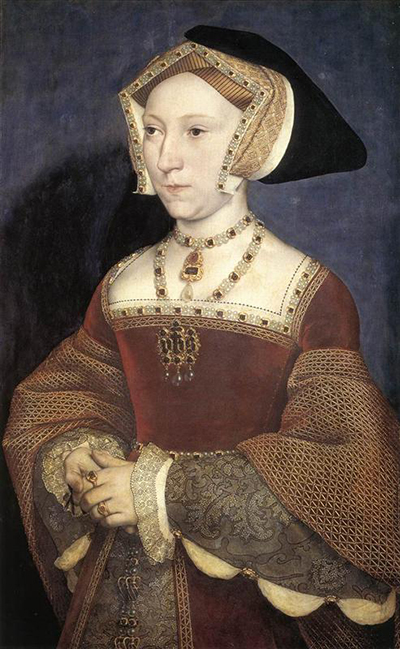
The jewels catch the eye first, then the face emerges from their enclosure. In Hans Holbein the Younger’s Portrait of Jane Seymour , the queen’s angular headdress frames pale skin with gold, pearls and dark fabric. Her sleeves swell towards the edges of the picture; her hands meet quietly in front of her. Almost every surface invites close inspection, yet the whole figure remains remarkably still.
Painted about 1536–37 and now in the Kunsthistorisches Museum in Vienna, this is a portrait of Henry VIII’s third wife. The museum identifies its support as oak and records a height of 65.5 centimetres: a concentrated panel portrait, far smaller than the life-size royal figures Holbein painted at Whitehall Palace. [1] [2]
Jane’s brief queenship gives the image a particular historical weight. She married Henry on 30 May 1536, gave birth to the future Edward VI on 12 October 1537 and died twelve days later. [3] But her portrait deserves more than a hurried passage through those dates. It preserves an extraordinary arrangement of face, fabric and ornament, supported by a surviving preparatory drawing that lets us follow something of the practical work behind the royal image.
At a Glance
- Artist Hans Holbein the Younger.
- Title Portrait of Jane Seymour , also known as Jane Seymour .
- Date about 1536–37.
- Medium oil on oak panel.
- Dimensions 65.5 × 47 cm.
- Collection Kunsthistorisches Museum, Vienna, Gemäldegalerie.
- Inventory number 881. [1] [2]
- Related drawing Queen Jane Seymour (1508/9–1537) , about 1536–37, Royal Collection, RCIN 912267; 50.0 × 28.5 cm. [4]
- Separate composition Holbein’s Whitehall mural of 1537 is lost; Remigius van Leemput’s reduced copy dates from 1667. [5]
This work across Hans Holbein the Younger’s career
Dead Christ in the Tomb
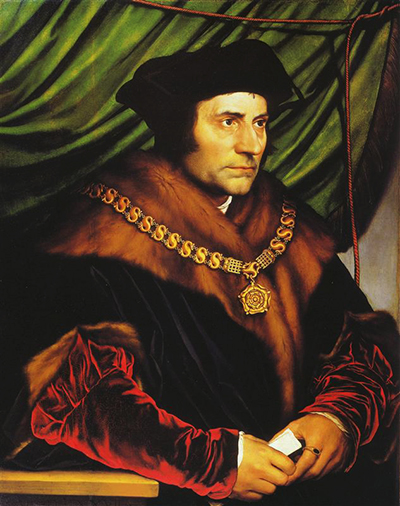
1521–22 [7]Sir Thomas More
1527 [8]Georg Giese
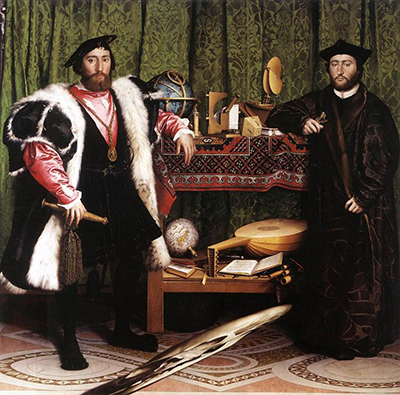
1532 [9]The Ambassadors
1533 [10]Portrait of Jane Seymour (current article)
about 1536–37Contents
- A Queen in 1536–37
- The Face Within the Headdress
- Cloth, Jewellery and the Work of Looking
- The Hands and the Shape of the Figure
- The Surviving Drawing
- What Technical Examination Reveals
- Jane at Whitehall
- Copies, Survival and Jane’s Later Image
A Queen in 1536–37
Jane became queen within a court that had just undergone another violent change. Anne Boleyn was executed on 19 May 1536; Jane married Henry eleven days afterwards. She had served as a lady-in-waiting to both Anne and Katherine of Aragon. The familiar division of Henry’s wives into contrasting personalities can obscure this continuity of experience: Jane knew the household into which she married. [3]
The usual dating associates the portrait with Jane’s brief queenship. It does not establish a particular sitting day, or tell us whether each passage was completed before or after Edward’s birth. The circumstances of its commission remain open. [1]
Her clothes already make the change in status visible. The bodice is a substantial area of dark red, bordered by elaborate ornament. A bright, square neckline sets off the bare upper chest, while necklaces and a pendant occupy the space beneath the chin. Rank is expressed through things worn close to the body, carefully distinguished from one another.
Historic Royal Palaces connects Jane’s dress with the construction of her public identity. Its account notes that Henry supplied rich fabrics when she became queen and that she required the women of her household to wear English gable hoods. [3] The headdress in Holbein’s portrait therefore belongs to a courtly language of appearance. Its exact edges and costly decoration help establish a queen whose position was new, however familiar she already was with court life.
The Face Within the Headdress
Look first at the shape around Jane’s face. The gable hood rises to an angled peak, then descends in two firm, decorated strips beside her cheeks. Behind it, black fabric spreads out towards the right. That dark extension gives the head a larger silhouette without distracting from the light face at its centre.
The arrangement is asymmetric. The nearer side of the hood opens more fully to view; the farther side is compressed by the turn of the head. Holbein keeps the frame intelligible even where its lines shift away from us. A narrow band of brown hair appears across the forehead, adding another layer between skin and ornament.
Jane looks towards the left of the picture, past the viewer. Her eyes do not initiate the direct encounter found in some of Holbein’s portraits. The mouth is closed and the lips lightly defined. Small changes of tone around the nose, cheeks and chin describe the head without competing with the crisp boundaries of the hood.
There is a useful change of pace between face and dress. Around the face, repeated jewels mark out separate points; within it, the transitions are quieter. The forehead is broad and uninterrupted, the cheek gently rounded. Looking back and forth between the two makes the different kinds of attention apparent: measured ornament alongside the less regular forms of a particular person.
The portrait’s composure has often encouraged character judgements. A closed mouth and folded hands can readily be made to illustrate an obedient or retiring Jane. Yet they are also decisions about how a royal sitter is presented. We can describe their visual effect with confidence; they give us much less secure access to her temperament. The KHM’s exhibition account places particular emphasis on the relationship between close description and the organisation of the whole figure. [1]
Cloth, Jewellery and the Work of Looking
The sleeves offer one of the painting’s richest passages. The red upper fabric carries a dense golden lattice, its small divisions following the curved volume of the arms. Beneath this, grey patterned fabric spreads into broad turned-back cuffs. Light lining appears along the lower folds, and white wrist ruffles intervene between the costly dress and the hands.
Each material has its own visual behaviour. The lattice is regular and insistent; the grey pattern moves in larger, curling shapes. The white edges are softer and more broken. Together they make the clothing feel assembled from distinct layers, rather than decorated with a single continuous design.
The jewellery is equally carefully distributed. A short necklace sits high around the neck; a longer chain descends towards the squared neckline. The pendant beneath the throat has a dark central stone and a pale hanging drop. Lower down, the brooch attached to the front of the dress introduces a cluster of suspended ornaments. Gold and pale highlights connect these separate points across the upper body.
None of them needs to become a secret code to matter. The necklaces describe the curve of the neck, the bodice border clarifies the angle of the chest, and the lower brooch draws attention to the central axis of the dress. Ornament both advertises expense and helps us understand the form beneath it.
The Royal Collection’s account of the preparatory drawing singles out Jane’s pear-shaped pendant and notes its apparent recurrence in a portrait associated with Katherine Howard. [4] Such connections deserve care: jewellery could have a history beyond one sitter, while the identification of another portrait is a separate question. What the Vienna painting plainly offers is a detailed representation of royal adornment, not an inventory that names every stone or proves who designed every setting.
A bright red jewel is visible as colour; identifying its mineral requires further evidence. The same applies to the apparent gold and silver of the costume. Holbein makes us recognise luxurious substances through light, pattern and colour, but a reproduction alone cannot provide a chemical analysis of the panel.
Watch: Holbein’s portraits and working methods
Explore museum films on Holbein’s drawings, painted portraits and close-looking details.
Hans Holbein at the court of Henry VIII
A Royal Collection Trust film exploring Holbein’s work at Henry VIII’s court.
Watch on YouTubeThe Hands and the Shape of the Figure
Jane’s hands gather the composition near its lower left. One crosses the other, and the overlapping fingers create a small knot of forms between the enormous cuffs. Their pale colour links them to the face, giving the eye a second area of exposed skin beneath the glittering neckline.
The hands are especially effective because they are enclosed without disappearing. Sleeves approach from either side; the wrist ruffles form pale boundaries; the fingers remain individually legible. Rings add hard accents to the softer modelling of the flesh. The surrounding ornament makes the smooth surfaces of the hands more noticeable.
Follow the outer contour and the figure has a broad, almost bell-like expansion below the shoulders. The arms project sideways before returning towards the hands. Above them, the head is comparatively small and precisely framed. The shoulders, neckline and lower meeting of the sleeves give the picture a stable structure without producing perfect symmetry.
The background allows that silhouette to hold. Its subdued blue-grey field supplies little narrative information. A darker area behind the left side of the figure adds depth, while the black of the headdress stands sharply against the lighter space on the right. Nothing asks us to leave Jane for an anecdote in the distance.
This makes the painting rewarding at two scales. From farther away, the queen appears as an ordered shape of red, black and pale flesh. Closer up, the intervals between fingers, the repeated pearls and the tiny divisions of the sleeves become absorbing. The small details remain attached to the larger form, so the eye can keep moving without losing its bearings.
The Surviving Drawing
A preparatory portrait in the Royal Collection brings us closer to the making of this likeness. Catalogued as Queen Jane Seymour , about 1536–37, it combines black and coloured chalks with pen and ink and green watercolour on pink prepared paper. The current collection record measures the whole sheet at 50.0 × 28.5 centimetres and identifies it as a study used for several portraits, including the Vienna painting. [4]
Coloured drawing materials helped record information that a later painted likeness would need. A prepared pink surface also gave the artist a starting tone instead of requiring him to build every part of the flesh on white paper.
The sheet carries a horizontal join close to the bottom, where an additional strip extends it. The Royal Collection’s exhibition labels connect its changes in length and horizontal markings with repeated use, and identify it as the basis for Jane’s appearance in the Whitehall mural. [2] One study could therefore serve more than a single rectangular panel: it could preserve a likeness while the surrounding composition changed.
The name written on the sheet is another layer in its history. The Royal Collection assigns the inscription identifying Jane as queen to an eighteenth-century hand. [4] It should not be mistaken for Holbein’s own written declaration. The distinction between the drawing, its later naming and its subsequent use helps us read it as a surviving working object, rather than a transparent record of one untouched moment.
What Technical Examination Reveals
Victoria Button’s study of Holbein’s portrait drawings gives the Jane sheet particular attention. Her examination describes an evenly applied, pale pink preparation containing vermilion and calcium carbonate. She also distinguishes the coloured chalk modelling from fine applications of black liquid medium and the blue-green watercolour used for the irises. These findings concern the drawing; they do not identify the pigments of the Vienna painting. [12]
Button records wear that makes parts of the sequence difficult to reconstruct. She finds indented contours associated with transfer, including around details of the headdress and face, while treating the function of other lines more cautiously. Her measurements include the lower strip, which she regards as contemporary because drawing materials continue across the join. [12]
These are small observations with a substantial consequence. The study was handled and adapted as part of making portraits. An indentation can preserve evidence of a practical operation; a paper join can show where a composition needed more space. Neither is mere damage to be mentally erased when we imagine the artist at work.
The technical evidence also changes how we understand precision. A convincing painted likeness did not have to depend on repeatedly summoning the sitter for every new version. A carefully retained study could carry proportions and selected colour information forward. At the same time, tracing evidence should not tempt us to imagine that the whole process was automatic. Decisions about scale, clothing, background and finish remained substantial parts of producing a portrait.
Jane at Whitehall
In 1537 Holbein placed Jane within a much larger assertion of Tudor continuity. His mural in the Privy Chamber at Whitehall showed Henry VIII and Jane with Henry’s parents, Henry VII and Elizabeth of York. [2] The original was destroyed in the palace fire of 4 January 1698. Its complete composition is preserved in Remigius van Leemput’s oil painting of 1667, made for Charles II; Holbein’s surviving cartoon records only the left half, containing the two kings. [5]
The inscription on the central plinth makes the mural’s dynastic purpose unusually explicit. In the Royal Collection’s translation, it asks “whether father or son is the victor”. [5] This is an invitation to compare generations of rulers, their achievements and their authority. The paired queens belong within that structure of descent.
Jane’s place in this company helps explain why her likeness could matter beyond her own lifetime. A court portrait represented a person who also occupied an office and a position within the succession. The Vienna panel concentrates on the individual figure; the mural expanded the claim into a family, a monumental setting and an inscribed argument.
It is easy to let the famous Whitehall image swallow every related portrait. The distinctions matter. The Vienna painting is a surviving panel by Holbein, not a fragment cut from the mural. Van Leemput’s canvas is a later copy, valuable for the arrangement it preserves. The portrait drawing is another object again, with its own materials and evidence of use. Their relationships are close, but they answer different questions about Holbein’s portraits of Henry VIII and his court.
Copies, Survival and Jane’s Later Image
Two other paintings show how widely the likeness travelled. The Mauritshuis catalogues its small Portrait of Jane Seymour , about 1540, as the work of Holbein’s studio. Measuring 26.4 × 18.7 centimetres, it offers a substantially reduced version of royal portraiture. The museum acknowledges its exceptional quality while retaining the studio attribution in the object record. [13]
A larger, unfinished portrait in the National Portrait Gallery raises different questions. Charlotte Bolland’s account of Laura Hinde’s conservation research reports that it is the same scale as the Vienna picture, with a wooden support from a tree felled in the 1530s. Its underdrawing and handling support an association with Holbein’s studio. [14]
Some costume passages await, or have lost, their intended metallic finish. Bolland describes preparatory areas for gold and silver decoration and emphasises that the reason for abandonment remains unknown. [14] The incomplete surface makes stages of manufacture visible that a richly finished portrait can conceal. It also warns us against assuming that a plainer passage always reflects a different dress.
Henry’s own surviving bust portrait in Madrid offers a useful comparison of scale. The Museo Nacional Thyssen-Bornemisza dates it to about 1537 and records dimensions of only 28 × 20 centimetres. [15] Holbein could make a royal presence convincing in a small panel as well as in monumental decoration. Size alone does not determine the strength or purpose of the image.
With Jane, later knowledge can be especially intrusive. Because we know how soon she died, her stillness may seem retrospective, almost memorial. Yet the dating of the Vienna portrait does not justify reading every pale tone or quiet gesture as an anticipation of death. The image gives us a queen presented with extraordinary material specificity. Its later associations with maternity, succession and loss grew around a likeness whose immediate visual life still lies in the angle of a hood, the meeting of hands and the different ways light touches cloth and skin.
Artworks directory
Explore paintings, drawings, prints and designs, including works without a separate article. Related studies and versions have their own entries; workshop works and copies are labelled. Print designs and series are grouped rather than repeated for every impression.
Frequently Asked Questions
Her folded hands and reserved presentation create composure, but they cannot establish her private character. They should be considered alongside the formal purpose of a royal likeness and the emphatic display of dress and jewellery.
It is a separate panel. The mural included Jane, Henry VIII and Henry’s parents, and was destroyed in 1698. Its complete composition survives through Van Leemput’s reduced copy of 1667. [5]
Discussion
Look again at the images and ideas explored in Portrait of Jane Seymour. These editorial prompts invite your observations.
Reader Insights
Step back from the jewels and follow the black hood, broad sleeves and small head. Which part first establishes the queen’s presence?
Choose a passage of skin, patterned cloth and jewellery. How does Holbein make each seem different within the same still figure?
The drawing was extended and reused. How does knowing this change your understanding of a seemingly settled royal image?
Join the Conversation
Which detail holds your attention longest: the angular hood, the layered sleeves or the overlapping hands? Share how it affects your experience of Jane’s portrait.
References
- Kunsthistorisches Museum Wien , Next Generation , exhibition section on Jane Seymour, about 1536/37, oak, 65.5 × 47 cm, Gemäldegalerie inventory 881 (in German). View source .
- Royal Collection Trust , Holbein at the Tudor Court , Nash Gallery large-print labels, PDF pages 49–50, Jane Seymour drawing and Vienna painting; pages 23–26, Whitehall mural and copy. View source .
- Historic Royal Palaces , Jane Seymour: Henry VIII’s favourite queen? , historical account of her marriage, queenship, dress, Edward’s birth and her death. View source .
- Royal Collection Trust , Hans Holbein the Younger, Queen Jane Seymour (1508/9–1537) , about 1536–37, RCIN 912267, collection record. View source .
- Royal Collection Trust , Remigius van Leemput, Henry VII, Elizabeth of York, Henry VIII and Jane Seymour , 1667, RCIN 405750, collection record and translation of the mural inscription. View source .
- Kunstmuseum Basel, Bildnis des Bonifacius Amerbach, 1519, inventory 314 (in German) . View source .
- Kunstmuseum Basel, Der tote Christus im Grab, 1521–22, inventory 318 (in German) . View source .
- The Frick Collection, Sir Thomas More, 1527, accession 1912.1.77, collection record . View source .
- Gemäldegalerie Berlin, Georg Gisze . View source .
- Susan Foister, The Ambassadors, The German Paintings before 1800 (2024) . View source .
- Susan Foister, Christina of Denmark, Duchess of Milan (2024) . View source .
- Victoria Button , The Portrait Drawings of Hans Holbein the Younger: Function and Use Explored through Materials and Techniques , PhD thesis, Royal College of Art, 2013, printed pp. 105, 139 and 298–99, especially Table 21. View source .
- Mauritshuis , studio of Hans Holbein the Younger, Portrait of Jane Seymour (1509?–1537) , about 1540, inventory 278, collection record. View source .
- Charlotte Bolland / National Portrait Gallery , Jane Seymour: The Gallery’s first painting of Henry VIII’s third wife , 23 August 2019, including Laura Hinde’s conservation findings. View source .
- Mar Borobia / Museo Nacional Thyssen-Bornemisza , Retrato de Enrique VIII de Inglaterra , about 1537, inventory 191 (1934.39), collection record and essay (in Spanish). View source .
- Würth Collection, Holbeins Schutzmantelmadonna, inventory 14910, current owner account (in German) . View source .
- Metropolitan Museum, Dance of Death series . View source .
- Kunstmuseum Basel, Bildnis der Frau des Künstlers mit den beiden ältesten Kindern, about 1528–29, inventory 325 (in German) . View source .