 by Tom Gurney
Tom Gurney BSc (Hons) is an art history expert with over 20 years experience
Published on June 19, 2020 / Updated on November 6, 2026
Email: tomgurney1@gmail.com / Phone: +44 7429 011000
Introduction
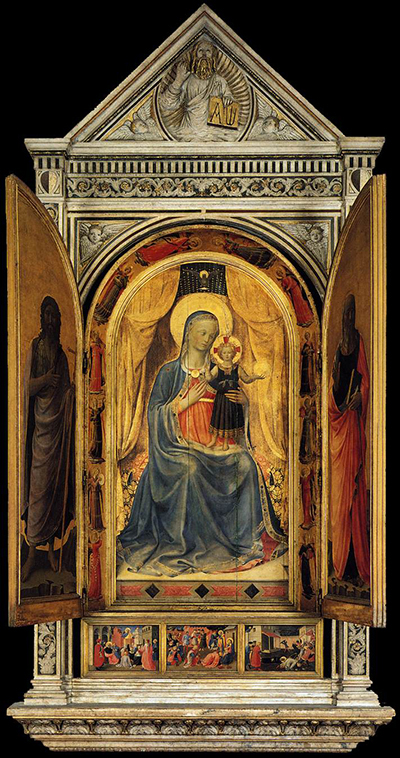
Fra Angelico’s Tabernacle of the Linaioli, painted between 1433 and 1435, is one of the most securely documented commissions of his career and one of the clearest examples of painting, sculpture, architecture and guild patronage working together in the Early Renaissance. The commission came from the Arte dei Linaioli, Florence’s guild of linen workers. The Museo di San Marco notes that the dates 1433–35 are documented directly in the guild’s records.
Fra Angelico painted the sacred images. Lorenzo Ghiberti designed the elaborate marble architectural frame, which was sculpted, painted and gilded. The object therefore belonged from the beginning to more than one artistic medium. This is important because modern museum habits can make panel painting seem autonomous. The Linaioli Tabernacle was not one panel in one frame. It was a designed public object in which painted saints and Virgin, marble architecture, gilding and guild identity formed one whole.
Its later history made that unity difficult to see. The painted tabernacle entered the Uffizi in 1777 after the suppression of the guilds. The marble frame remained elsewhere and was removed during demolition of Florence’s old city centre in 1890. It reached San Marco separately. Only in 1924 were painting and frame reunited. The modern object is therefore itself a reconstruction of a Renaissance ensemble. [1]
At a Glance
- ArtistFra Angelico [1]
- TitleTabernacle of the Linaioli [1]
- Date1433–35 [1]
- PatronArte dei Linaioli, Florence’s linen workers’ guild [1]
- Painted componentFra Angelico [1]
- Architectural framedesigned by Lorenzo Ghiberti [1]
- Frame materialsculpted, painted and gilded marble [1]
- Current locationMuseo di San Marco, Florence [2]
- Painting entered Uffizi1777 [1]
- Frame removed from guild residence1890 [1]
- Painting and frame reunited1924 [1]
- Key significancemixed-media guild commission documenting Angelico’s public professional reputation [1]
Contents
- Introduction
- The Arte dei Linaioli
- Documentary Security
- Lorenzo Ghiberti
- Painting and Sculpture
- The Virgin and Child
- A Transforming Object
- Textile Patronage and Painted Fabric
- Reunion in 1924
- Why the Linaioli Tabernacle Matters
The Arte dei Linaioli
The Arte dei Linaioli represented workers and merchants involved with linen and related textile trades. Florence’s economy depended heavily upon textiles. Guilds were therefore not marginal associations. They were major civic institutions. A prestigious commission from the Linaioli placed Angelico within the professional and public world of Florence beyond his Dominican order. The commission demonstrates that the friar-painter was sought by secular corporate patrons as well as churches and convents. [1]
Guild patronage carried several functions. A work could express devotion. It could protect the guild through sacred association. It could demonstrate wealth, status and taste. It could become a visible statement within civic space. The Linaioli commission therefore belongs to the wider history of Florentine institutions using art to construct identity. [1]
Documentary Security
One of the great strengths of this object is the documentation. The Museo di San Marco states that the work’s date can be read from the registers of the Arte dei Linaioli. This gives the commission unusual chronological firmness. For Angelico’s career, that matters enormously. 1433–35 places the work directly in the period when he was moving between late-Gothic inheritance and increasingly confident Renaissance unification. [1]
Lorenzo Ghiberti
Ghiberti’s involvement is fundamental. He was one of the most important sculptors and designers in Florence. His Baptistery doors had already established extraordinary prestige. By designing the Linaioli frame, Ghiberti helped turn the object into a collaboration between two leading Early Renaissance masters. This gives the tabernacle significance beyond Angelico alone. [1]
Painting and Sculpture
The frame does not merely surround the painting neutrally. It creates architectural meaning. Marble, carving, gilding and painted image interact. This demonstrates how artificial the modern distinction between “painting” and “decorative arts” can be. Renaissance commissions often crossed media naturally. The object was designed to be experienced as one whole. [1]
The frame takes the form of an architectural aedicule. This creates a sacred threshold. The painted figures appear within a structure that resembles real architecture. Ghiberti’s design therefore mediates between physical room and sacred image. Angelico’s painted space begins where the marble architecture ends. [1]
The Virgin and Child
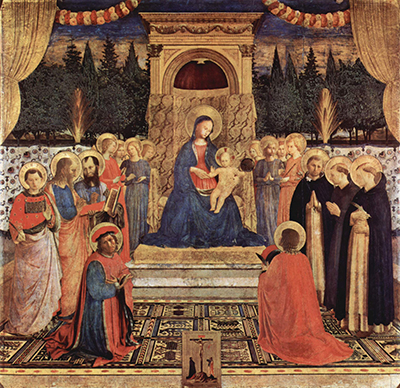
The Virgin and Child occupy the central sacred position. Their relationship combines majesty and tenderness. Angelico had already developed a refined Marian language by the early 1430s. In the Linaioli commission, that language is given a public guild setting. The Virgin becomes both devotional image and civic protector. [2]
The tabernacle included saintly imagery on its shutters or exterior elements. These figures expanded the object’s sacred programme. Closed and open states could create different visual experiences. The object was therefore not static. Its meaning could change according to whether the painted doors were opened. [2]
A Transforming Object
This ability to open and close is conceptually important. A modern museum display often fixes an object into one visible state. A Renaissance tabernacle could reveal and conceal. Sacred imagery became performative. Opening the object changed what could be seen. This dynamic function connects painting with ritual. [2]
Gold appears both within the painted imagery and on the architectural frame. This creates material unity across media. The sacred preciousness does not stop at the boundary of the panel. Painting and sculpture share a luminous visual language. [1]
Textile Patronage and Painted Fabric
A commission from linen workers also makes Angelico’s treatment of cloth especially interesting. Renaissance Florentine painting often displayed extraordinary sensitivity to textiles. Drapery could communicate wealth, status and sacred dignity. The patrons would have been unusually alert to fabric. This gives the painted garments another layer of professional resonance. [1]
The Linaioli commission demonstrates that by the mid-1430s Angelico’s reputation had moved far beyond his Dominican convent. A major guild could choose him for a prestigious public object. This professional success helps explain why the Medici would soon entrust him with major work at San Marco. He was already one of Florence’s established masters. [3]
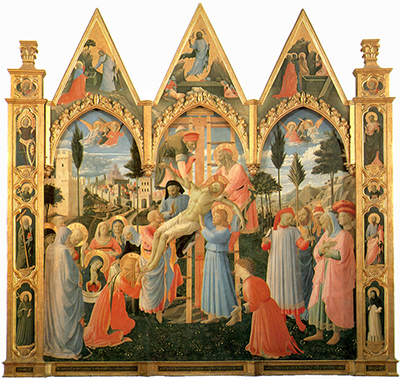
The Annalena Altarpiece belongs to roughly the same period and explores unified rectangular pala design. The Linaioli object is different because its architecture remains physically elaborate. The comparison demonstrates that Angelico did not adopt one new format universally. He could work with a sculpted architectural enclosure in one commission and a more unified painted field in another. [1]
The San Marco Altarpiece expands Angelico’s public and institutional scale dramatically. The Linaioli Tabernacle helps show the path towards that achievement. Both combine strong patronal identity with sacred function. Both depend upon architecture. The later work becomes much larger and more complex. [3]
After suppression of the guilds, the painted component entered the Uffizi in 1777. This changed its identity. A corporate devotional object became museum art. The frame remained behind. The ensemble was broken conceptually even before the physical frame entered museum collections. [1]
The marble frame was removed during demolition of the old centre of Florence in 1890. That urban transformation destroyed many historic contexts. The survival of the Linaioli frame is therefore fortunate. It preserves evidence for a building and civic institution that changed radically. [1]
Reunion in 1924
Painting and frame were reunited in 1924. This restored the work’s mixed-media identity after more than a century of separation. The event is an important chapter in museum reconstruction. Art historians and conservators recognised that the painting alone was not the complete object. [1]
The reunited tabernacle demonstrates a broader principle. An artwork can survive materially while its original relationships disappear. Reconstruction attempts to recover those relationships. The result is not literally untouched fifteenth-century experience. But it can restore essential structure. [1]
Why the Linaioli Tabernacle Matters
The Tabernacle of the Linaioli matters because it reveals Fra Angelico operating at the intersection of several Florentine systems. Dominican painter. Guild commission. Ghiberti architecture. Textile economy. Marble sculpture. Gold. Public devotion. The work is therefore a perfect example of Early Renaissance collaboration. It also has unusually strong documentary value. The 1433–35 date is secure. The patron is known. The frame designer is known. Its later separation and 1924 reunion can be traced. The object allows us to see Angelico not as an isolated holy painter but as one professional master working inside Florence’s civic artistic network. [1]
Frequently Asked Questions
Discussion
How does the Linaioli Tabernacle change when it is understood as a designed guild object rather than an isolated panel painting?
Reader Insights
What did linen workers gain by commissioning such an ambitious devotional object?
How do Angelico’s painting and Ghiberti’s architectural frame create a single sacred threshold?
What can a museum reunion restore after an artwork’s original civic setting has disappeared?
Join the Conversation
Share your reading of the Tabernacle of the Linaioli below.
References
- Direzione regionale Musei nazionali Toscana, “Tabernacolo dei Linaioli.” Direzione regionale Musei nazionali Toscana object record.
- Museo di San Marco, collection and display resources. Museo di San Marco institutional collection page.
- National Gallery, London, Fra Angelico biography and Early Renaissance context. National Gallery Fra Angelico biography.
.jpg)
 Fra Angelico.jpg)