 by Tom Gurney
Tom Gurney BSc (Hons) is an art history expert with over 20 years experience
Published on June 19, 2020 / Updated on November 6, 2026
Email: tomgurney1@gmail.com / Phone: +44 7429 011000
Introduction
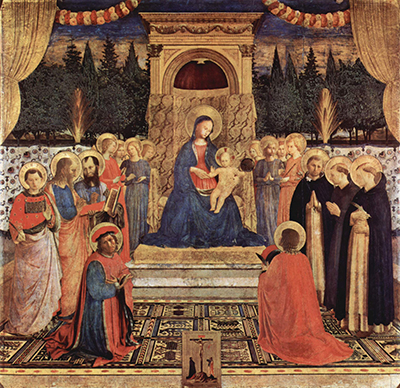
Fra Angelico’s San Marco Altarpiece was one of the most ambitious panel-painting projects of his career and the great liturgical centrepiece of the Dominican church rebuilt under Medici patronage. The surviving principal panel shows the Virgin and Child enthroned with angels and saints. Yet this familiar image represents only part of the original object. The Museo di San Marco describes the altarpiece as a complex wooden machine approximately three and a half metres high and consisting of at least twenty-six individual paintings.
These included the central pala, saints on architectural elements and a long predella devoted principally to Saints Cosmas and Damian. The original ensemble therefore cannot be understood as one framed picture. It was an architectural, liturgical and narrative structure designed for the high altar of San Marco. The commission emerged directly from the Medici rebuilding of the church and convent. In 1438 Cosimo de’ Medici and his brother Lorenzo obtained patronage of the principal chapel.
Michelozzo was entrusted with architectural renewal. Fra Angelico was commissioned to create a new high-altarpiece dedicated to Saint Mark, the titular saint of the church, and Saints Cosmas and Damian, who held particular significance for the Medici family. The work was completed before the church and high altar were consecrated at Epiphany in 1443 in the presence of Pope Eugene IV and the cardinal college.
This date and setting make the San Marco Altarpiece much more than a devotional painting. It was the culminating visual statement of Medici investment in one of Florence’s most important new Dominican institutions. At the same time, it belonged to the liturgical life of a reformed religious community. The painting therefore had to reconcile magnificence and Dominican identity, family patronage and communal worship, Renaissance innovation and sacred tradition. Angelico’s solution was one of the defining altarpieces of the Early Renaissance. [1]
At a Glance
- ArtistFra Angelico [7]
- TitleSan Marco Altarpiece / Pala di San Marco [1]
- Date1438–43 [1]
- Original locationhigh altar, church of San Marco, Florence [1]
- PatronsCosimo and Lorenzo de’ Medici [1]
- Architectural contextMichelozzo’s rebuilding of the principal chapel [1]
- High altar dedicationSaint Mark and Saints Cosmas and Damian [6]
- Completionbefore Epiphany 1443 [1]
- Consecrationattended by Pope Eugene IV and the cardinal college [1]
- Original heightapproximately 3.5 metres [1]
- Original componentsat least 26 paintings [1]
- Main subjectVirgin and Child enthroned with angels and saints [2]
- Predellastories principally of Saints Cosmas and Damian [6]
- Current principal locationMuseo di San Marco, Florence [4]
- Important modern historydismantling, dispersal and major restoration [8]
- Key significancelandmark unified Renaissance altarpiece tied directly to Medici patronage and Dominican identity [1]
Contents
- Introduction
- The Medici Patronage of San Marco
- From Polyptych to Pala
- The Virgin and Child
- Saints Cosmas and Damian
- The Predella
- Perspective
- Dispersal
- The 2019 Restoration
- Why the San Marco Altarpiece Matters
The Medici Patronage of San Marco
The San Marco Altarpiece cannot be separated from the larger Medici project at the convent. Cosimo de’ Medici supported the reconstruction of San Marco as a major centre of Observant Dominican life. His brother Lorenzo also participated in the patronage. The church’s principal chapel became a particularly important focus of family investment. When Cosimo and Lorenzo obtained patronage rights in 1438, they were not simply purchasing decorative space. They were associating the Medici name permanently with the high altar of a major Florentine church. The commission therefore operated through religion, family memory and civic status at once. [1]
Michelozzo redesigned the principal architectural setting. This mattered because Angelico’s altarpiece was conceived for a newly ordered Renaissance environment rather than an inherited medieval frame. Painting and architecture therefore developed in dialogue. The new altar required a work capable of matching the scale and clarity of the rebuilt church. Angelico’s central pala responded through a unified sacred space rather than a conventional series of Gothic compartments. This was one of the major changes taking place in Florentine altarpiece design during the 1430s. [1]
From Polyptych to Pala
Earlier Italian altarpieces frequently divided saints into separate pointed compartments. Each figure occupied its own architectural niche. By the 1430s, Florentine painters increasingly brought figures together into one continuous rectangular field. Angelico was one of the artists helping develop this form. The San Marco Altarpiece belongs to the new unified pala tradition. Mary, Christ and saints share one pictorial environment. The sacred community becomes spatially coherent. This formal change reflects the broader Renaissance interest in continuous space. [1]
The Virgin and Child
The Virgin occupies the central throne. Christ sits upon her. Their position establishes hierarchy immediately. The sacred group is monumental but not isolated. Angels and saints gather around them. The arrangement belongs to the sacra conversazione tradition in which holy figures from different historical periods coexist within a timeless sacred assembly. Angelico’s innovation lies partly in making that assembly inhabit one believable space. [2]
Mary’s throne is not simply furniture. It marks the central axis of the entire pala. Architecture, floor and surrounding figures organise themselves around it. The throne transforms Mary into the visual focus while Christ remains the theological centre. The structure also gives the painting a ceremonial dignity appropriate to a high altar funded by one of Florence’s most powerful families. [2]
Saint Mark appears because he is the titular saint of the church. His presence is therefore institutional rather than merely devotional. The church itself is dedicated to him. This is a useful reminder that saint selection in Renaissance altarpieces often responds directly to location. A modern museum viewer can see an assembly of famous saints. The original Dominican congregation saw figures tied to the identity of their own church and patrons. [1]
Saints Cosmas and Damian
Cosmas and Damian are among the most important figures in the altarpiece because of their connection with the Medici. The twin physician saints were celebrated for healing without payment and for martyrdom. Their names and cult had long associations with Medici family devotion. Including them on the high altar therefore made family identity sacredly visible without requiring secular portraiture to dominate the painting. The saints functioned almost as heavenly representatives of the patrons. [6]
This strategy is important. The Medici did not need to appear physically in every commission. Patronal saints could represent them indirectly. Cosmas evokes Cosimo. Damian belongs to the paired devotional identity surrounding the family. The saints are therefore both universal Christian martyrs and specifically meaningful Medici patrons. The altarpiece works at both levels simultaneously. [1]
The original patronage involved both Cosimo and his brother Lorenzo. Lorenzo died on 23 September 1440 before the altarpiece was completed. Cosimo lived to see the finished ensemble. The Museo di San Marco has suggested that the contrasting attitudes of Cosmas and Damian may preserve an echo of this family history. Cosmas turns towards the viewer and gestures into the sacred scene. Damian appears prostrate and turned away. The interpretation is intriguing but remains a hypothesis rather than a securely documented reading. The secure historical fact is the change in family circumstance during production. [1]
Completion before 1443
The altarpiece was completed before Epiphany 1443. This gives the work a strong chronological anchor. The church and high altar were consecrated at that time. Pope Eugene IV attended with the cardinal college. The ceremony placed the altarpiece at the centre of a major public religious event. The object therefore had a ceremonial life from the beginning. It was not created merely for private Medici contemplation. [1]
The papal presence also reflects San Marco’s wider ecclesiastical importance. Eugene IV had strong connections with Florence during periods of papal residence and political difficulty. His attendance at the consecration elevated the status of the rebuilt Dominican complex. Angelico’s altarpiece was therefore seen in a setting where Medici patronage, Dominican reform and papal authority visibly converged. [1]
The original structure rose approximately three and a half metres above the altar. This scale is difficult to grasp from modern reproductions. The pala was not a domestic painting enlarged. It was architecture in painted form. Viewers encountered it across liturgical space. Figures had to remain legible from a distance. Colour, scale and hierarchy all responded to this function. [1]
The museum’s estimate of at least twenty-six paintings radically changes how the ensemble is understood. The principal panel was only the visual centre. Smaller saints occupied side or vertical structural elements. Predella scenes unfolded below. Every component belonged to a larger devotional system. Modern fragmentation therefore hides the original complexity. [8]
The Predella
The predella ran beneath the main image. It told stories connected principally with Saints Cosmas and Damian. This lower narrative register changed the pace of viewing. The main pala presents timeless sacred presence. The predella presents action through time. One part of the altarpiece is contemplative. The other is narrative. Together they connect saintly identity with saintly biography. [6]
Cosmas and Damian were traditionally understood as brothers and physicians who offered healing without accepting payment. Their Christian faith led to persecution and martyrdom. The predella explores these narratives through multiple episodes. Individual surviving scenes include healing, accusations before authorities, miraculous survival and eventual martyrdom. The saints’ refusal of payment was especially relevant to their reputation as anargyroi, physicians without silver. Healing therefore carried both charitable and spiritual meaning. [6]
One surviving predella scene now in the National Gallery of Art represents the healing of Palladia by Saints Cosmas and Damian. The episode is important because it expresses the saints’ identity as healers directly. The small format required Angelico to communicate narrative efficiently. Architecture, figures and gesture make the miracle understandable without the scale of the principal pala. The panel also demonstrates why predellas are so valuable for studying Angelico’s narrative technique. [5]
Another episode concerns Damian accepting a payment from Palladia after healing. This creates moral tension because the saints were celebrated for refusing payment. The story tests the principle of charitable healing. Such episodes give the predella more depth than a simple series of miracles. The saints are not merely miracle-working icons. Their lives dramatise choices about service, money, faith and obedience. [6]
Cosmas and Damian are also shown brought before the Roman authority Lycias. The episode introduces persecution. The narrative shifts from healing towards martyrdom. This progression is structurally important. The predella tells a life story rather than presenting disconnected anecdotes. Charity leads to conflict because Christian identity becomes public. [6]
Miraculous Survival
According to legend, repeated attempts to kill the saints failed. They survived water, fire or other punishments through divine intervention. These episodes gave Angelico opportunities to represent dramatic action in miniature. They also emphasised divine protection before final martyrdom. The predella therefore alternates between human violence and supernatural preservation. [6]
The final narrative culminates in death. The healer saints become martyrs. This gives the high-altarpiece another layer of meaning. The saints standing serenely beside the Virgin above are understood through the suffering represented below. Timeless sanctity is explained by temporal biography. The structure makes theology narrative. [6]
Because Cosmas and Damian carried Medici significance, their stories also functioned within the family’s patronal programme. The Medici did not merely select saints with matching names. They funded an extended visual account of those saints’ virtues. Healing, charity, endurance and martyrdom became the sacred ideals associated with the patronal identity. The predella therefore made Medici devotion narratively explicit. [6]
Above the predella, the central pala returns to stillness. Mary and Christ dominate. Saints gather around them. This contrast between action below and contemplation above is fundamental. The viewer moves from story to presence. The saints’ historical lives lead towards their eternal place within the sacred court. [1]
Angels contribute to the ceremonial atmosphere. They help establish heavenly hierarchy and liturgical beauty. Music, colour and gesture reinforce the sense that the Virgin and Child are surrounded by sacred worship. Angelico’s angels also connect the altarpiece with his long history as an illuminator, where angelic figures and brilliant decorative detail were central to sacred imagery. [2]
Rich textile surfaces help define the throne and sacred zone. Such details contribute material splendour without requiring a gold background to dominate the entire space. Textiles also had strong associations with elite Florentine visual culture. Painted fabric could signal luxury while remaining subordinate to the holy figures. [2]
The main panel incorporates naturalistic spatial elements rather than relying entirely upon abstract gold. This gives the sacred assembly a world. The saints inhabit a shared environment. The use of landscape also distinguishes the pala from more traditional compartmentalised altarpieces. Nature participates in the Renaissance unification of space. [2]
Perspective
Perspective helps organise the central panel. The throne, floor and surrounding figures belong to one coherent spatial system. This technical achievement is important but not ostentatious. Angelico does not use perspective simply to demonstrate mathematical mastery. It allows saints to share one believable sacred environment. Theology benefits from spatial unity. [2]
The San Marco Altarpiece belongs to the broader development of the pala quadrata, the rectangular unified altarpiece that became increasingly important in Florence. The form responds naturally to Renaissance architecture. It also changes relationships between figures. Saints no longer need separate Gothic niches. They can interact visually within one field. Angelico’s work became one of the influential examples of this transformation. [2]
Although the Medici were crucial patrons, the altarpiece belonged to a Dominican church. Its programme therefore had to satisfy the religious community as well as the family. Saint Mark represented the church. Dominican saints and institutional themes appeared within the wider complex. The high altar stood at the centre of liturgy. The painting’s meaning cannot therefore be reduced to Medici self-promotion. [1]
Liturgy
The altarpiece was seen during Mass. The Eucharist was celebrated directly below it. This relationship gives the image a function no museum can fully reproduce. Christ represented on Mary’s lap and Christ encountered sacramentally at the altar belonged to the same devotional environment. The painting therefore participated in ritual rather than merely illustrating belief. [1]
The original high placement affected viewing. Predella panels were closer to eye level than the principal sacred figures above. This allowed small narratives to be inspected more closely. The main pala communicated across greater distance. Different scales within the object corresponded to different forms of seeing. The original ensemble was carefully hierarchical. [1]
The museum’s description of the altarpiece as a complex wooden machine reminds us that carpentry was essential. Panels, frames and architectural components had to be designed and constructed before painting could function. The object was therefore collaborative from the beginning. Carpenters, gilders, assistants and painters all contributed to the final altar. Renaissance painting was material production. [1]
An ensemble of at least twenty-six painted elements required workshop organisation. Fra Angelico designed and supervised the project, but assistants contributed. This should not be treated as a problem. The master’s responsibility included maintaining coherence across many pieces. Workshop participation was normal for projects of this scale. The key question is how effectively the ensemble communicates one programme. [7]
Dispersal
Over later centuries, parts of the San Marco Altarpiece were removed and dispersed. Predella panels and smaller components entered different collections. This fragmentation transformed how the work was understood. A small scene that once belonged beneath a high altar could become an independent museum painting. The relationship between image and sequence disappeared. Modern scholarship has had to reconstruct it. [8]
Fragments are now distributed among San Marco and other museums. The National Gallery of Art in Washington holds the Healing of Palladia. Other scenes and saint panels have followed different collection histories. This dispersal is typical of Renaissance altarpieces, especially once their architectural frames were dismantled. The San Marco Altarpiece is therefore both a masterpiece and an art-historical reconstruction problem. [8]
Reconstructing the original object depends on documents, dimensions, surviving frames, early descriptions and comparison between fragments. No modern reconstruction can restore every lost relationship with complete certainty. But the broad structure is clear enough to transform interpretation. The central pala, saints and predella must be imagined together. Without reconstruction, the work becomes artificially simple. [8]
Giorgio Vasari praised Angelico’s work at San Marco and identified the predella stories of Cosmas and Damian. His account is valuable because it preserves evidence from a period closer to the intact ensemble than modern museum viewing. Vasari should still be used critically. He wrote more than a century after the commission and shaped material through his own historical narrative. Yet his testimony remains important to the altarpiece’s reception history. [9]
The 2019 Restoration
The San Marco Altarpiece underwent a major restoration by the Opificio delle Pietre Dure. The restored work returned to the museum in 2019 as part of celebrations marking the institution’s 150th anniversary. The conservation brought renewed attention to colour, surface and structural history. It also encouraged the museum to emphasise the original scale and complexity of the ensemble. [3]
Restoration changes interpretation when it clarifies original paint or later intervention. Colours recover relationships. Details become visible. Structural evidence can suggest how panels were joined. The San Marco restoration therefore matters not simply because the painting looks brighter. It contributes to reconstruction of the object’s original identity. [1]
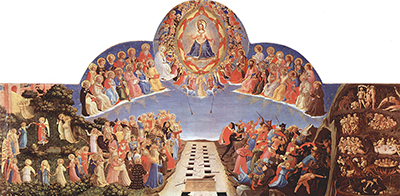
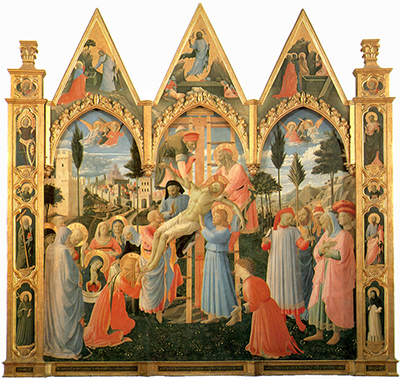
Today the surviving principal elements are displayed within the Sala del Beato Angelico at the Museo di San Marco. The modern gallery brings the altarpiece into dialogue with the Last Judgement, Annalena Altarpiece, Deposition and other major panels. This allows exceptional comparison across Angelico’s career. It also removes the work from the high altar for which it was designed. Modern museum access therefore gains chronology while losing liturgy. Both perspectives are valuable. [4]
The Annalena Altarpiece provides an important earlier comparison. It also helped develop the unified rectangular pala. The San Marco commission expands this idea on much greater scale and within an ambitious Medici-Dominican programme. The comparison demonstrates how rapidly Angelico moved from formal experiment towards monumental institutional application. [1]
The Fiesole high altarpiece began within an older polyptych tradition. Its later transformation by Lorenzo di Credi demonstrates how Renaissance taste eventually altered medieval structure. San Marco is different. Angelico himself conceived the main sacred assembly within the new unified language. The comparison gives a powerful measure of change across his career. [1]
The Guidalotti Polyptych in Perugia shows that Angelico did not abandon traditional formats permanently after San Marco. For a different patron and region, he could return to gold ground and divided structure. This makes the San Marco pala an artistic choice rather than an inevitable stage of progress. Angelico possessed multiple languages. [1]
The San Marco Altarpiece combines rich colour with a more naturalistic spatial environment. Gold remains present in halos, details and sacred accents rather than replacing all visible space. This demonstrates Angelico’s mature balance between precious material and Renaissance illusion. The sacred world can be luminous without abandoning physical depth. [2]
A Medici Monument
The altarpiece was unquestionably a major Medici statement. The family financed the chapel. Its saints were embedded in the programme. The high altar became one of the visual centres of Medici patronage in Florence. Yet the object succeeded precisely because patronal identity was translated into religious language. The painting does not simply advertise wealth. It turns family association into saintly devotion. [1]
It was equally a Dominican monument. The work belonged to a church serving a reformed religious community. Its high altar structured liturgy. Its saintly imagery supported institutional devotion. The altarpiece’s success therefore lies in satisfying two overlapping worlds. Medici magnificence and Dominican purpose become visually compatible. [1]
The central panel is often discussed as an early landmark in the history of the sacra conversazione. The term is modern, but it describes a real visual change. Saints from different historical periods appear together with the Virgin and Child in one continuous sacred space. They do not act out a narrative event. They exist in devotional time. This format allowed patrons and institutions to assemble a tailored sacred community. Saint Mark represents the church. Cosmas and Damian represent Medici devotion. Other saints connect the altar with Dominican and wider Christian identity. The unified space makes these relationships appear natural rather than assembled. [2]
The new spatial arrangement therefore has theological consequences. Separate Gothic compartments emphasise distinction. A unified pala emphasises community. Angelico’s saints share floor, light and atmosphere. Their physical coexistence visualises their spiritual coexistence. Perspective becomes a tool for constructing the communion of saints. This is one reason the shift from polyptych to pala matters beyond style. Formal unity becomes sacred unity. [2]
The high altar was the most important liturgical point in the church. Mass was celebrated directly before Angelico’s ensemble. The Eucharist therefore formed part of the painting’s original meaning. Christ appears visibly as the child on Mary’s lap while the Eucharistic rite presents Christ sacramentally at the altar below. The relationship between image and liturgy was immediate. The painting did not merely decorate the Mass. It created a sacred visual environment around it. This function helps explain the hierarchy of the ensemble. Christ and Mary occupy the highest visual authority. Narratives and saints support the central sacramental axis. [1]
The Consecration as First Audience
The Epiphany 1443 consecration gives us an unusually vivid sense of the altarpiece’s first major public audience. Pope Eugene IV, cardinals, Dominicans, Medici patrons and Florentine elites encountered the rebuilt high altar together. This means the work was immediately embedded within overlapping communities. For the pope, it belonged to ecclesiastical ceremony. For the Dominicans, it belonged to their church and liturgy. For the Medici, it represented patronal achievement. For Angelico, it was one of the most visible demonstrations of his professional standing. The ceremony brought all these meanings into one room. [1]
Cosmas and Damian also demonstrate a sophisticated mechanism of Renaissance patronage. The Medici did not need to insert secular likenesses prominently beside the Virgin in order to claim the altar. Their chosen saints performed the relationship more appropriately. This is patronage translated into sacred language. The family’s identity becomes embedded within the religious structure rather than placed outside it. Such strategies could be more durable than donor portraiture. A saint remains meaningful to future worshippers even after the patron’s individual biography fades. [1]
The physician saints carried values especially useful for patronal self-representation. They healed. They refused payment. They endured persecution. A banking dynasty associated with wealth could identify itself devotionally with saints famous for medical charity without silver. This does not mean the predella was cynical political propaganda. It does mean saint selection could create idealised moral associations. Patronal devotion and patronal image were intertwined. [1]
The predella also created a different physical relationship with viewers. Because it sat lower, its scenes could be inspected more closely than the monumental main panel. Angelico’s background in illumination made him exceptionally suited to this scale. Small figures remain readable. Architecture clarifies action. Colour separates groups. The predella turns the high altar into an object that works at more than one viewing distance. From far away, the central pala dominates. At closer range, narrative unfolds. [6]
The Cosmas and Damian cycle is strongest when read as progression. The saints begin through acts of healing and charitable identity. Their faith attracts the attention of authorities. They are arrested and tested. Miraculous survival demonstrates divine favour. Eventually martyrdom confirms ultimate fidelity. The sequence therefore explains why they deserve the serene eternal position shown above. Narrative history produces sacred status. [6]
The Meaning of Fragmentation
When predella panels were separated, this sequence disappeared. A museum visitor may now encounter one healing scene without knowing what came before or after. The painting becomes aesthetically complete but narratively incomplete. This is a crucial distinction. The individual panel survives physically. The original object does not. Reconstruction is therefore not antiquarian trivia. It restores the work’s logic. [8]
Today, no single visitor can see the entire San Marco Altarpiece exactly as a fifteenth-century worshipper did. Parts remain at San Marco. Others are in Washington and elsewhere. Some components have been lost. The original frame has disappeared. The object has become geographically distributed. Digital reconstruction and scholarly catalogues therefore perform an increasingly important role. They allow fragments to be understood relationally even when physical reunion is impossible. [8]
The Opificio delle Pietre Dure is one of the world’s leading conservation institutions. Its work on the San Marco Altarpiece brought technical expertise to an object already complicated by age, dismantling and earlier intervention. Conservation can reveal the distinction between original paint, later restoration and structural change. Such work is especially important for Angelico because his colour and surface refinement are central to interpretation. A dulled or altered surface can fundamentally change perception of sacred luminosity. [3]
Chronologically, San Marco sits at the centre of Angelico’s mature Florentine achievement. The early Fiesole works had already demonstrated major invention. The Annalena Altarpiece had explored unified pala form. San Marco combines these developments with unprecedented patronal scale. Soon afterwards, Rome would expose Angelico to a different monumental and humanist environment. The high altarpiece therefore marks a culmination of the Florentine phase before papal classicism becomes more prominent. [7]
The high altar should also be compared with Angelico’s frescoes throughout the convent. The contrast is dramatic. The pala is elaborate, colourful and materially rich. The cell frescoes are often sparse. This is not evidence for different levels of commitment. It is evidence for different functions. The church required liturgical magnificence. The cells required meditative focus. San Marco contains both and thereby reveals the full range of Angelico’s mature visual intelligence. [1]
Why the San Marco Altarpiece Matters
The San Marco Altarpiece matters because it represents one of the clearest moments when new Renaissance pictorial form, elite Florentine patronage and Dominican religious identity converge. Angelico was not simply painting a beautiful Madonna. He was designing the central visual object of a rebuilt church. The commission had to respond to Michelozzo’s architecture. It had to represent Saint Mark. It had to incorporate Medici patron saints.
It had to support liturgy. It had to communicate magnificence. It had to coordinate at least twenty-six painted components within an object approximately three and a half metres high. The resulting work demonstrates Angelico’s maturity as organiser as much as painter. Its unified central pala belongs to the new Renaissance language of shared sacred space. Its predella retains the storytelling precision of an illuminator.
Its saints carry patronal and institutional meaning. Its original consecration links it with pope, cardinals, Medici and Dominicans. Its later dispersal reminds us how radically Renaissance ensembles can be fragmented. Its modern restoration and reconstruction allow that lost complexity to become visible again. For these reasons the San Marco Altarpiece is not simply one major painting among many. It is the liturgical and patronal heart of Fra Angelico’s San Marco. [10]
Frequently Asked Questions
Discussion
Which feature of the San Marco Altarpiece best joins Medici patronage to Dominican worship?
Reader Insights
How does the pala’s shared setting alter the relationship among the saints?
What do the Cosmas and Damian narratives add to the main sacred assembly?
How should we imagine the work before its dismantling and dispersal?
Join the Conversation
Share your reading of the San Marco Altarpiece below.
References
- Direzione regionale Musei nazionali Toscana, “Il museo festeggia i 150 anni con il ritorno della Pala di San Marco,” institutional history of the altarpiece. San Marco Altarpiece institutional history.
- Direzione regionale Musei nazionali Toscana, “Beato Angelico visto da… La Pala di San Marco.” San Marco Altarpiece research.
- Direzione regionale Musei nazionali Toscana, presentation of the 2019 Opificio delle Pietre Dure restoration. 2019 restoration presentation.
- Museo di San Marco, Sala del Beato Angelico collection and display resources. Museo di San Marco collection.
- National Gallery of Art, Washington, Fra Angelico, The Healing of Palladia by Saint Cosmas and Saint Damian. National Gallery of Art collection record.
- National Gallery of Art, Fra Angelico artist and provenance records for San Marco predella material. National Gallery of Art provenance research.
- Metropolitan Museum of Art, Fra Angelico chronology and San Marco period. Metropolitan Museum exhibition overview.
- Metropolitan Museum of Art, Fra Angelico, 2005 exhibition resources on surviving San Marco fragments. Metropolitan Museum San Marco reconstruction record.
- Giorgio Vasari, Lives of the Artists, historical account of Fra Angelico and the San Marco predella, used critically. Vasari evidence discussed in the NGA provenance record.
- Palazzo Strozzi / Museo di San Marco, Beato Angelico, 2025 exhibition and restoration research. Palazzo Strozzi Fra Angelico exhibition; San Marco Altarpiece reconstruction.
.jpg)
 Fra Angelico.jpg)