 by Tom Gurney
Tom Gurney BSc (Hons) is an art history expert with over 20 years experience
Published on June 19, 2020 / Updated on November 6, 2026
Email: tomgurney1@gmail.com / Phone: +44 7429 011000
Introduction
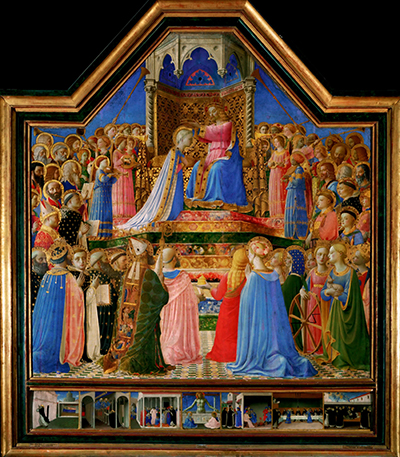
Fra Angelico’s Coronation of the Virgin in the Louvre is one of the great Dominican altarpieces of his career and one of the most important surviving works originally made for San Domenico at Fiesole. The precise date remains less certain than that of the Prado Annunciation. The Louvre currently catalogues the work broadly to the second quarter of the fifteenth century, 1425–50. Modern scholarship often places it more narrowly around the mid-1430s. The broad Louvre dating and the narrower scholarly proposals are best kept distinct.
The painting presents Christ crowning the Virgin within a brilliantly ordered heavenly assembly. Angels and saints gather in hierarchical groups. The predella below contains a remarkable sequence of Dominican narratives, including episodes from the life of Saint Dominic. This gives the altarpiece a dual identity. The principal panel celebrates Mary. The predella celebrates the institutional history of Angelico’s own order. The work was originally associated with San Domenico in Fiesole, though the precise altar and patronal arrangements remain partly debated.
The Louvre notes a possible location in the rood-screen area and possible financial involvement of the Gaddi family. These points are plausible but remain proposals rather than fully documented facts. The painting’s subsequent history is unusually dramatic. It remained at San Domenico until the Napoleonic era, when it was removed to France and entered the Louvre. The work therefore carries both Dominican devotional history and the history of Napoleonic collecting. [1]
At a Glance
- ArtistFra Angelico [1]
- TitleCoronation of the Virgin [1]
- DateLouvre: second quarter of the fifteenth century, 1425–50; often dated more narrowly c. 1434–35 [1]
- Mediumtempera and gold on panel [1]
- Current locationMusée du Louvre, Paris [1]
- Original locationSan Domenico, Fiesole [1]
- Probable original positionpossibly an altar in the rood-screen area [2]
- Possible patronal supportGaddi family, but not fully certain [1]
- Principal subjectChrist crowning the Virgin [1]
- PredellaDominican narratives including episodes from Saint Dominic’s life [1]
- Historical removaltaken from San Domenico during the Napoleonic period [2]
- Louvre entry1812 [2]
- Key significancecombines Marian glorification with Dominican institutional identity [1]
Contents
- Introduction
- San Domenico at Fiesole
- Dating
- The Coronation Theme
- The Heavenly Court
- Hierarchies of Vision
- The Predella
- Dominican Identity
- Entry into the Louvre
- Why the Louvre Coronation Matters
San Domenico at Fiesole
The Coronation belongs to the same Dominican environment as the Prado Annunciation and Fiesole high altarpiece. These three works form one of the most important surviving groups from Angelico’s early career. Together they demonstrate his remarkable ability to vary format and iconography within one religious institution. The Coronation is especially important because the Dominican predella makes the order’s own history part of the altarpiece. [3]
Dating
The exact date has generated debate. Many scholars place the work around 1434–35. The Louvre’s current collection record is broader, assigning it to the second quarter of the fifteenth century. This discrepancy should not be “resolved” artificially. The responsible formulation is that the work is commonly placed around the mid-1430s but museum cataloguing remains more cautious. [1]
The Coronation Theme
The Coronation of the Virgin developed through medieval theology and devotional tradition rather than one direct Gospel account. Mary is exalted as Queen of Heaven. Christ crowns her. Angels and saints witness the event. The subject offered artists an opportunity to represent the heavenly Church as ordered community. Angelico uses that opportunity magnificently. [1]
Christ occupies the sacred centre with Mary. His act establishes the Virgin’s exalted status. Mary receives rather than claims the crown. The hierarchy remains theological. Her glory derives from divine grace. [1]
Mary’s posture is humble despite the splendour of the event. This combination is fundamental to Marian imagery. The woman who accepted the Annunciation in humility is now exalted in heaven. The beginning and end of her sacred story therefore correspond. [1]
The Heavenly Court
Saints and angels surround the central pair. Their arrangement is hierarchical but not rigid. The celestial community expands outward. The painting therefore creates a visual theology of ordered heaven. Different forms of sanctity coexist around one central act. [1]
Hierarchies of Vision
Modern scholarship, including Patricia Rubin’s important study, has emphasised “hierarchies of vision” within the painting. The idea is particularly useful. Figures occupy different positions and relationships to the central mystery. Viewing becomes structured. Some saints see directly. Others participate within wider ranks. The spectator outside the painting is placed at another distance still. The altarpiece therefore organises not only bodies but access to sacred vision. [5]
Angelico’s angels contribute movement, music and colour. They are among the figures through which his illuminator background remains especially visible. Brilliant wings and garments enrich the heavenly environment. Yet their placement remains controlled. Decoration supports hierarchy. [1]
Gold dominates the celestial setting. This is not evidence that Angelico had failed to understand Renaissance space. The heavenly subject benefits from material abstraction. Gold removes ordinary earthly environment and replaces it with precious light. At the same time, figure arrangement creates depth. Traditional material and Renaissance organisation coexist. [1]
The Predella
The predella is one of the most important parts of the altarpiece. It contains Dominican narratives rather than simply continuing Marian scenes. This directly links the celestial Virgin with the institutional identity of San Domenico. The friars’ own sacred history appears beneath the heavenly court. [1]
One predella episode represents Pope Innocent III’s dream in which Saint Dominic supports the collapsing Lateran basilica. The story became one of the key legends of Dominican institutional identity. Dominic is imagined as supporting the Church itself. For a Dominican convent, the subject had obvious significance. [1]
Another scene shows Dominic encountering Saints Peter and Paul. According to tradition, the apostles give him symbols connected with preaching. The episode legitimises the Dominican mission through apostolic authority. The order’s founder is represented as receiving mandate from the earliest Church. [1]
Resurrection of Napoleone Orsini
A miracle involving the resurrection of Napoleone Orsini demonstrates Dominic’s sanctity through divine power. The scene introduces dramatic narrative into the predella. Small scale intensifies Angelico’s need for clarity. The miracle must be understood quickly. [1]
The miracle of the book tested by fire represents doctrinal truth. Dominic’s book survives while rival teaching fails. This episode is especially suitable for an order devoted to preaching and theological argument. Truth becomes visible through miraculous survival. [1]
Another episode shows Dominican friars fed by angels. The miracle emphasises divine provision for the community. It also creates an intimate image of institutional life. The order is not represented only through heroic preaching. Ordinary communal need becomes sacred history. [1]
The predella culminates in Dominic’s death. The founder’s life therefore moves towards heavenly destiny. This creates a conceptual relationship with the Coronation above. Mary is glorified. Dominic’s story leads towards the same celestial community. [1]
Dominican Identity
The predella makes clear that the altarpiece was not simply a generic Marian commission. It belonged deeply to San Domenico. The Dominican community saw its founder and institutional legends embedded within a great heavenly image. The altarpiece therefore creates continuity between order, Virgin and universal Church. [1]
The Louvre suggests the work may have stood at an altar in the rood-screen area of San Domenico. This placement is plausible but not fully certain. If correct, the painting would have operated near the architectural division between friars and laity. This would make its Dominican narrative especially meaningful. [2]
Possible Gaddi family financial support has also been suggested. The evidence remains suggestive rather than conclusive. The point is useful as part of patronage research but should not be hardened into certainty. The work is a useful example of why museum catalogues and scholarly proposals need to be distinguished. [2]
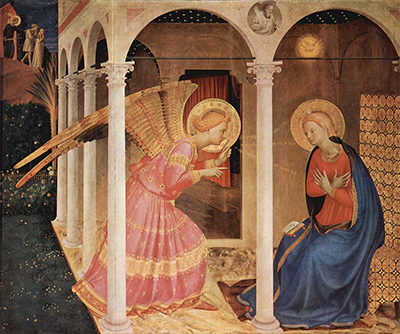
Both works were made for San Domenico. The Prado Annunciation is securely dated 1425–26. The Coronation is less precisely dated. The earlier painting centres salvation history through Gabriel, Mary, Adam and Eve. The Coronation centres heavenly fulfilment. Together they form a remarkable theological span from Incarnation to exaltation. [4]
Comparison with the Fiesole High Altarpiece
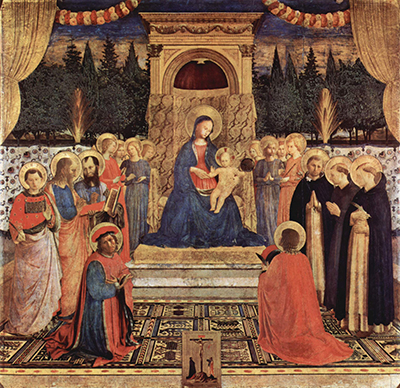
The high altarpiece predella also emphasises Dominican sacred identity. In one ensemble, Christ is glorified among the heavenly court and Dominican Blessed. In the Coronation, Mary is exalted while Dominic’s stories appear below. Fiesole therefore repeatedly connects universal sacred hierarchy with the order’s institutional self-understanding. [3]
The Coronation is particularly important for rejecting a simplistic chronology in which gold disappears as Renaissance space develops. Angelico can create depth through figure scale and arrangement while retaining gold. The heavenly world does not need a perspectival Florentine room. Material gold is appropriate to the subject. [1]
The predella demonstrates Angelico’s extraordinary ability at small scale. Tiny architectural settings, crowds and miracles remain legible. His early training in illumination is especially evident. The altarpiece therefore combines monumental celestial vision with miniaturist narrative precision. [1]
The painting remained at San Domenico for centuries. Its removal belongs to the upheaval of the Napoleonic period. Works from churches and religious institutions across Europe were transferred into French collections. The Coronation became one of the many Italian masterpieces displaced through conquest and state collecting. [2]
Entry into the Louvre
The work entered the Louvre in 1812. Its function changed fundamentally. A Dominican altarpiece became a museum masterpiece. The predella’s institutional narratives now required explanation for an international audience far removed from San Domenico. This is one of the clearest examples of how museum history changes meaning. [2]
The removal also raises broader questions about cultural heritage. Napoleonic collecting assembled extraordinary works in Paris but did so through political and military power. Some objects were later returned. Others remained. The Coronation’s presence in the Louvre is therefore part of European political history as well as art history. [2]
The painting has generated substantial scholarship. John Pope-Hennessy and later scholars helped establish Angelico’s modern catalogue. Patricia Rubin’s study of hierarchies of vision has been especially influential for interpretation. The Louvre’s bibliography reflects the work’s continuing centrality to Angelico research. [5]
Why the Louvre Coronation Matters
The Louvre Coronation matters because it combines three worlds within one altarpiece. Marian devotion occupies the principal panel. Dominican institutional history occupies the predella. Gold, colour and ordered figure hierarchy create a celestial world that is both medieval in material splendour and Renaissance in visual organisation. The work is equally important for what remains uncertain. Its precise date is debated.
Its exact Fiesole altar and patronage are not documented with the same security as the Prado Annunciation. A strong history should preserve these distinctions. The painting’s later removal to France adds another layer. A work created for a Dominican convent became part of the Louvre through Napoleonic collecting. The modern viewer therefore sees an object shaped by Dominican devotion, Renaissance innovation and European political history. [1]
Frequently Asked Questions
Discussion
How does the Louvre Coronation organise a heavenly vision for viewers from different positions and ranks?
Reader Insights
How do tiers, gestures and lines of sight guide attention toward Christ and Mary?
What does the predella add to the celestial assembly above it?
How does the work’s removal to Paris change the way its institutional meaning is encountered?
Join the Conversation
Share your reading of the Louvre Coronation below.
References
- Musée du Louvre, Fra Angelico, Le Couronnement de la Vierge, collection record. Louvre collection record INV 314.
- Musée du Louvre, bibliography and provenance for the Coronation. Louvre object history, provenance and bibliography.
- National Gallery, London, Fra Angelico Fiesole San Domenico research. National Gallery Fiesole San Domenico Altarpiece catalogue.
- Museo Nacional del Prado, Fra Angelico Annunciation and San Domenico context. Museo del Prado Annunciation collection record.
- Patricia Rubin, “Hierarchies of Vision: Fra Angelico’s Coronation of the Virgin from San Domenico, Fiesole,” Oxford Art Journal. Patricia Rubin, Hierarchies of Vision.
.jpg)
 Fra Angelico.jpg)