 by Tom Gurney
Tom Gurney BSc (Hons) is an art history expert with over 20 years experience
Published on June 19, 2020 / Updated on November 6, 2026
Email: tomgurney1@gmail.com / Phone: +44 7429 011000
Introduction
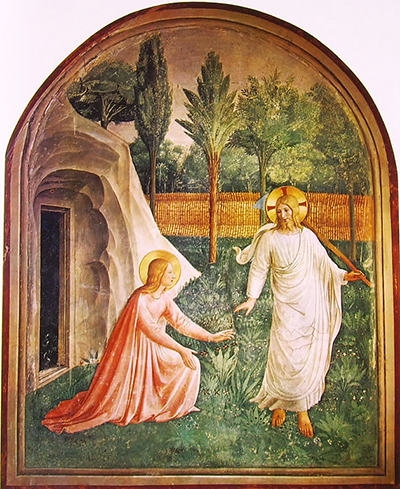
Fra Angelico’s Noli me Tangere in cell 1 of the Dominican dormitory at San Marco is one of the most intimate frescoes in the entire convent. The scene represents the risen Christ appearing to Mary Magdalene after the Resurrection. Mary kneels and reaches towards him. Christ moves away while turning towards her. Their gestures almost meet. That small space between them carries the emotional meaning of the fresco.
The subject comes from the Gospel of John. Mary Magdalene discovers the empty tomb and initially mistakes Christ for a gardener. When he calls her by name, she recognises him. Christ then tells her not to hold him. The Latin phrase traditionally associated with this command, Noli me tangere, gave the scene its familiar title. Angelico reduces this complex episode to a quiet encounter in a garden. There are no apostles.
No guards. No angels crowd the composition. The cell contains only the essential elements required for meditation. This restraint reflects the original purpose of the fresco. Cell 1 was not a public chapel. It was a small room inside the Dominican dormitory. A friar encountered the image repeatedly and privately. The painting therefore needed to sustain prolonged contemplation rather than deliver narrative information quickly to a large congregation.
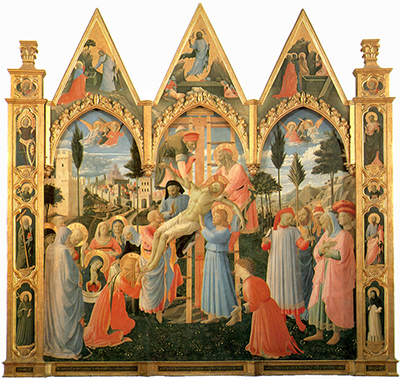
The present Museo di San Marco also highlights Mary Magdalene’s unusually important role across Angelico’s San Marco cycle. She appears at the Deposition, Crucifixions, the women at the tomb and here as the first witness to the risen Christ. This repeated presence reflects the special devotion accorded to Mary Magdalene within the Dominican order. The Noli me Tangere is therefore both a Resurrection image and a distinctly Dominican meditation on recognition, penitence and transformed relationship. [1]
At a Glance
- ArtistFra Angelico and workshop context [5]
- TitleNoli me Tangere [1]
- Datebroadly within Angelico’s San Marco campaign, late 1430s–1440s [1]
- Mediumfresco [1]
- Locationcell 1, dormitory, Museo di San Marco, Florence [3]
- Subjectrisen Christ appearing to Mary Magdalene [1]
- Biblical sourceGospel of John 20 [1]
- Key actionMary reaches towards Christ; Christ withdraws while addressing her [1]
- Settingenclosed garden [1]
- Dominican significanceMary Magdalene was especially revered within the order [2]
- Original functionprivate devotional meditation inside a friar’s cell [4]
Contents
- Introduction
- The Gospel Story
- “Noli me Tangere”
- Christ as Gardener
- The Garden
- The Cross-Shaped Hoe
- The Space between the Hands
- Cell 1
- Private Devotion
- Why Noli me Tangere Matters
The Gospel Story
The episode follows immediately after the discovery of Christ’s empty tomb. Mary Magdalene remains near the tomb weeping. She sees angels and then encounters a man she believes to be the gardener. Only when he speaks her name does she recognise Christ. The moment therefore turns on recognition. Sight alone is insufficient. Mary sees but does not understand. Hearing transforms perception. The story is particularly powerful because it presents Resurrection not first as public triumph but as one person discovering that loss has changed into presence. [1]
“Noli me Tangere”
The traditional Latin title means approximately “do not touch me” or “do not hold on to me”. The wording has generated centuries of theological interpretation. Christ is not simply rejecting Mary. The Resurrection has transformed the mode of relationship. Mary cannot retain him in the same physical way as before the Passion. The scene therefore combines recognition with separation. She finds him and loses the possibility of holding him at the same instant. Angelico makes this contradiction visible through bodies. Mary moves forward. Christ moves away. [1]
Mary occupies the lower left portion of the encounter. She kneels close to the ground. Her body reaches. Her gesture is active but controlled. This is not an abstract emblem of penitence. Angelico presents a person responding urgently to recognition. Yet the fresco remains calm because her movement is contained within the sparse garden. The emotion comes from gesture rather than facial theatricality. [1]
Christ stands opposite Mary and turns while stepping away. He carries the signs of his resurrected identity. At the same time, his appearance is sufficiently ordinary to make Mary’s earlier mistake understandable. The Gospel’s reference to the gardener has long encouraged painters to connect Christ with cultivated nature. Angelico takes advantage of that association. The risen figure belongs visually within the garden. [1]
Christ as Gardener
The gardener motif has rich symbolic possibilities. The Resurrection occurs in a garden. Christ can therefore be understood as the cultivator of a renewed spiritual world. The association recalls Eden. The first garden was the site of humanity’s fall. The Resurrection garden becomes a site of restored life. Angelico does not need to make this symbolism explicit through inscriptions or extra figures. The cultivated landscape carries it quietly. [1]
The Garden
The garden is one of the fresco’s defining elements. Small flowers spread across the grass. Trees and plants organise the enclosed space. The natural setting is far more than decorative. It establishes rebirth. Christ’s Resurrection is represented within living nature. The garden also creates the intimate enclosure necessary for private meditation. The world feels protected from ordinary activity. [1]
The enclosed garden was especially associated with the Virgin Mary through the tradition of the hortus conclusus. In the Noli me Tangere, Mary Magdalene rather than the Virgin occupies the garden. The setting therefore carries layered sacred associations. Angelico repeatedly uses enclosed gardens to create spaces of purity, revelation and contemplation. At San Marco, garden imagery also resonates with the convent’s own cloistered environment. [1]
The Cross-Shaped Hoe
One of the most discussed details is Christ’s gardening tool. Its form can suggest the Cross. The ordinary tool of cultivation therefore echoes the instrument of the Passion. This visual pun links death and renewed life. The Cross has led to Resurrection. The gardener’s implement becomes a transformed sign of sacrifice. Care is useful here. The object need not be treated as a secret code requiring one exclusive interpretation. Its power lies in the visual resonance. [1]
Christ’s wounds identify the risen body with the crucified body. Resurrection does not erase the Passion. The same body that suffered is now alive. This continuity is essential to Christian theology. For the Dominican viewer, contemplation therefore moves backwards and forwards in sacred time. The living Christ recalls the Cross. The Cross is understood through Resurrection. [1]
The Space between the Hands
The emotional centre of Angelico’s fresco may be the gap between Mary’s reaching hand and Christ’s withdrawing body. Nothing physically occupies that interval. Yet the whole scene depends upon it. The gap represents a changed relationship. Mary desires contact. Christ redirects her. Angelico turns empty space into theology. This is one of the strongest examples of his ability to make restraint meaningful. [1]
Recognition is another central theme. Mary first fails to know Christ. Then she knows him because he calls her by name. The story therefore distinguishes seeing from understanding. This distinction would have resonated within a contemplative religious culture. Sacred truth requires more than eyesight. It requires inward recognition. The friar looking at the fresco is therefore placed in a parallel position. He sees a painted Christ and is invited to move from looking towards understanding. [1]
The Museo di San Marco’s recent interpretation emphasises how frequently Mary Magdalene appears across the convent cycle. She is present at multiple Crucifixions. She attends Christ after death. She witnesses Resurrection. This prominence reflects Dominican devotion to her. Medieval Dominican authors treated Mary Magdalene as an especially honoured witness and preacher of Christ. Her traditional title Apostola Apostolorum—Apostle to the Apostles—reflects her role in announcing the Resurrection. This made her particularly meaningful to an order centred on preaching. [2]
Mary Magdalene also carried a long penitential tradition. She could represent conversion, grief, devotion and proclamation. At San Marco, these identities converge. She mourns. She seeks. She recognises. She receives instruction. She becomes witness. The Noli me Tangere therefore presents transformation through relationship with Christ. This gives the fresco special relevance to religious formation. [2]
Cell 1
The physical setting matters. Cell 1 belonged to the dormitory rather than a public worship space. Its small dimensions create an encounter impossible to reproduce in a large gallery. The viewer stands close to the fresco. Christ and Mary occupy the same narrow architectural world. The room itself becomes part of the contemplative image. [3]
Private Devotion
A private cell image does not need to explain everything. The friar already knew the Gospel narrative. Angelico could therefore remove secondary information. This is a major difference between monastic fresco and public altarpiece. The fresco assumes familiarity. Its job is not instruction at the most basic level. Its job is meditation. [4]
A friar living with the Noli me Tangere might encounter it every day. This changes artistic priorities. The image needed to reward familiarity. Small details such as flowers, wounds and the cross-like garden tool could become increasingly meaningful through repetition. The composition’s simplicity prevented visual fatigue. Quietness became durable. [4]
San Marco’s dormitory was structured around disciplined religious life. Silence and prayer were important. Angelico’s fresco does not disturb this environment. It visually participates in it. The scene is emotional without being noisy. Movement remains restrained. Landscape remains ordered. The painting behaves like the room. [4]
Comparison with the San Marco Annunciation
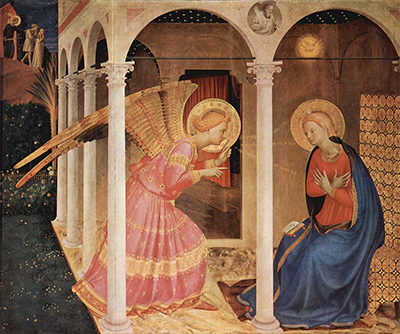
The corridor Annunciation and the Noli me Tangere share remarkable visual restraint. Both centre on two principal figures. Both use controlled architectural or natural space. Both represent a transformative moment through gesture. Yet their functions differ. The Annunciation was encountered communally in the corridor. The Noli me Tangere belonged to a private cell. The comparison shows how Angelico could preserve contemplative language while adjusting scale and setting. [4]
Another San Marco fresco shows the women at Christ’s tomb. Together with Noli me Tangere, it creates a broader Resurrection sequence within the convent. The empty tomb emphasises absence. Noli me Tangere emphasises recognition. The two images therefore present different stages in the understanding of Resurrection. [4]
Mary Magdalene’s appearance in multiple Crucifixion scenes makes the Noli me Tangere emotionally richer. The same devotional figure who witnesses death now witnesses renewed life. For a Dominican moving through the convent, these repeated appearances could create continuity between different rooms. San Marco becomes a network of sacred memory rather than isolated pictures. [4]
The fresco was painted directly onto prepared wall plaster. This makes the image inseparable from the cell. The technique also encourages broad clarity. Minute corrections are difficult. Forms must be planned and executed efficiently. Angelico’s composition suits the medium. The figures are clearly separated. Landscape is simplified. Colour remains legible. [1]
Colour
Mary’s garment and Christ’s robes provide concentrated colour against the green garden and pale background. The colour relationships are gentle rather than spectacular. This suits the intimate room. Angelico’s panel paintings could use brilliant gold and highly precious surfaces. At San Marco, fresco allows beauty without material luxury. [1]
The fresco is modelled through soft light. Bodies have enough volume to feel present. The garden remains luminous. Light therefore connects Angelico’s Renaissance naturalism with devotional calm. The supernatural is not represented through violent illumination. Resurrection appears within a world already filled with light. [1]
The composition requires less architectural perspective than the Annunciation. Yet space remains coherent. Figures occupy a believable garden. Mary kneels within the ground plane. Christ moves across it. The relationship feels bodily and spatially real. This realism intensifies the emotional meaning of separation. [1]
Workshop and Attribution
The larger San Marco cycle involved Angelico’s workshop. Individual frescoes have generated long-standing debates over autograph execution and assistance. For the Noli me Tangere, the most useful approach is to preserve its place within Angelico’s designed programme without pretending that every technical question about hand is settled permanently. The intellectual conception and visual language belong securely to the Angelico environment at San Marco. [5]
Today the cell belongs to the Museo di San Marco. Visitors move through a sequence that differs from fifteenth-century Dominican life. The cell is no longer a private dwelling. It has become public heritage. This changes the viewing experience dramatically. A room designed for one friar may now receive thousands of visitors. The challenge for the museum is to preserve both material surface and contemplative atmosphere. [3]
San Marco has occasionally used Angelico’s cells for carefully controlled dialogues with modern artists. Recent projects have placed contemporary works within or near selected cells. Such interventions are temporary and modern. They should not be confused with the fresco’s historical context. They do, however, demonstrate the continuing power of Angelico’s meditative spaces to generate artistic response. [3]
Why Noli me Tangere Matters
The Noli me Tangere matters because it turns one of Christianity’s most emotionally complicated Resurrection encounters into an image of extraordinary economy. Mary recognises the person she believed dead. She reaches. Christ withdraws. The moment contains joy and distance simultaneously. Angelico does not explain this through words. He gives the contradiction physical form. The garden carries another transformation. Death has given way to life.
The apparent gardener is the risen Christ. The instrument of cultivation echoes the Cross. Flowers surround a body that still bears wounds. The fresco also belongs specifically to Dominican San Marco. Mary Magdalene’s repeated presence across the convent reflects the order’s special devotion to her. Her transformation from penitent to Resurrection witness made her a powerful model for an order devoted to preaching.
Finally, the fresco demonstrates why Angelico’s San Marco art cannot be judged by the standards of monumental altarpieces. The cell needed no spectacle. The friar needed an image capable of being seen repeatedly in silence. Angelico responds by making empty space, restrained movement and small details carry the theology. That is the achievement of the Noli me Tangere. It makes the Resurrection intimate enough to inhabit a cell. [5]
Frequently Asked Questions
Discussion
Which visual detail most clearly turns recognition into restraint in Noli me Tangere?
Reader Insights
How does the space between Mary’s and Christ’s hands carry the story?
What does the enclosed setting contribute beyond the Gospel’s mistaken gardener?
How would repeated private viewing inside Cell 1 change the fresco’s meaning?
Join the Conversation
Share your reading of Noli me Tangere below.
References
- Direzione regionale Musei nazionali Toscana, Museo di San Marco institutional collection resources. Museo di San Marco collection.
- Direzione regionale Musei nazionali Toscana, reopening of Cell 44 and research on Mary Magdalene across the San Marco fresco cycle. Cell 44 and Mary Magdalene research.
- Direzione regionale Musei nazionali Toscana, Without Time, Without Place, Without Body, identifying the Noli me Tangere in cell 1. Without Time, Without Place, Without Body; Museo Novecento Cell 1 record.
- Museo di San Marco, resources on the dormitory fresco cycle and Dominican devotional context. San Marco dormitory cycle.
- National Gallery, London, Fra Angelico artist biography and workshop context. National Gallery artist and workshop record; Workshop catalogue example.
.jpg)
 Fra Angelico.jpg)