 by Tom Gurney
Tom Gurney BSc (Hons) is an art history expert with over 20 years experience
Published on June 19, 2020 / Updated on November 6, 2026
Email: tomgurney1@gmail.com / Phone: +44 7429 011000
Introduction
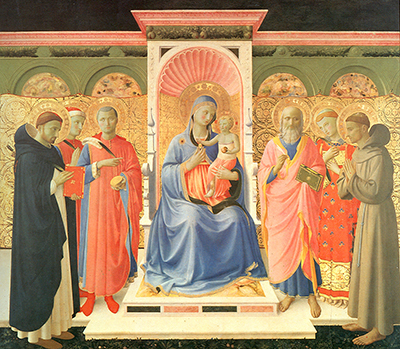
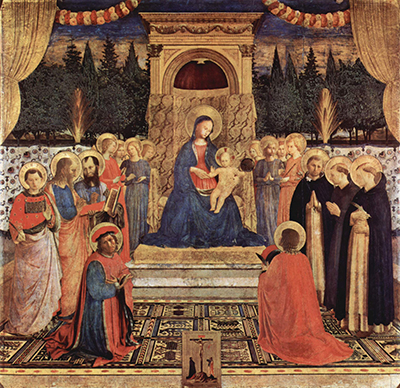
Fra Angelico’s so-called Annalena Altarpiece, now in the Museo di San Marco, is one of the most important works in the development of the unified Renaissance altarpiece. The painting is commonly dated around 1435. It presents the Virgin and Child with saints in one continuous rectangular sacred space. This format is crucial. Earlier polyptychs frequently divided saints into separate Gothic compartments. The Annalena Altarpiece brings them together.
The Museo di San Marco describes it as one of the first examples of a unified Renaissance pala. Its modern name is potentially misleading. The painting later belonged to the convent associated with Annalena Malatesta, but current scholarship does not treat that as secure evidence for the original commission. Instead, the museum considers it likely that the work was commissioned by the Medici for their chapel in San Lorenzo, probably connected with Saints Cosmas and Damian.
This distinction transforms the painting’s history. “Annalena” describes a later home rather than necessarily the original patron. The work also underwent a significant modern restoration completed in 2017. The treatment addressed both painted surface and wooden support and restored colour relationships that had been obscured. The museum itself described the altarpiece as a problematic work, acknowledging unresolved issues in its history and interpretation. That complexity makes it especially valuable. [1]
At a Glance
- ArtistFra Angelico [1]
- TitleAnnalena Altarpiece / Pala di Annalena [1]
- Datecommonly c. 1435 [1]
- Mediumtempera on panel [1]
- Current locationMuseo di San Marco, Florence [2]
- Principal subjectMadonna and Child with saints in sacra conversazione [4]
- Key formal significanceone of the earliest unified Renaissance altarpieces [4]
- Traditional namederived from later association with Annalena Malatesta’s convent [2]
- Probable original patronageMedici family [3]
- Probable original contextMedici chapel at San Lorenzo, often linked to Saints Cosmas and Damian [3]
- Restorationcompleted and presented in 2017 [1]
- Provenance notethe original commission remains probable rather than absolutely documented [3]
Contents
- Introduction
- The Problem of the Name
- Probable Medici Patronage
- San Lorenzo
- The Unified Pala
- Sacra Conversazione
- Saints Cosmas and Damian
- Perspective
- Restoration
- Why the Annalena Altarpiece Matters
The Problem of the Name
The title “Annalena Altarpiece” encourages a natural assumption. A viewer might think Annalena Malatesta commissioned it. The museum’s research warns against this. The name comes from later provenance. The altarpiece was eventually associated with the convent founded by Annalena. That does not prove she commissioned the painting originally. This is a good example of how later names can rewrite art history unintentionally. [3]
Annalena Malatesta belonged to a later institutional history of the work. Her convent became an important home for the altarpiece. That association was strong enough to give the painting its modern name. The later connection remains historically important even if original patronage lies elsewhere. Provenance has multiple stages. [2]
Probable Medici Patronage
Current San Marco interpretation considers Medici patronage likely. The proposed original setting is a Medici chapel in San Lorenzo. This would connect the altarpiece with the family’s devotion to Saints Cosmas and Damian. The identification is highly plausible but remains probable rather than certain. The distinction between evidence and reconstruction matters. [3]
San Lorenzo
San Lorenzo was deeply connected with Medici family identity. A major altarpiece there would have carried enormous patronal significance. Brunelleschi’s architectural transformation of the church also makes it an especially meaningful setting for a new unified pala format. Painting and architecture were changing together. [3]
The Unified Pala
The Annalena Altarpiece is significant above all because sacred figures occupy one continuous field. The old polyptych logic of separate compartments is abandoned. Mary and Christ sit at the centre. Saints gather around them. Space creates community. This is one of the defining transformations of Renaissance altarpiece design. [4]
Sacra Conversazione
The modern term sacra conversazione describes a sacred gathering in which figures from different times coexist around the Virgin and Child. The saints are not acting out one historical episode. They belong to devotional eternity. The unified pala makes this idea visually convincing. One shared space corresponds to one sacred community. [4]
Mary and Christ establish the central hierarchy. Their throne anchors the composition. The surrounding saints relate to them through position and gaze. The central group remains monumental yet approachable. Angelico balances sacred authority with emotional tenderness. [1]
Saints Cosmas and Damian
If the Medici-San Lorenzo reconstruction is correct, Cosmas and Damian become particularly important to the painting. They were major Medici patron saints. Their presence would connect family identity with the sacred assembly. This relationship would later become even more explicit in the San Marco Altarpiece. [3]
The Annalena Altarpiece therefore provides a compelling bridge to San Marco. Around the mid-1430s, Angelico explores a unified pala associated with Medici patronage. A few years later, the San Marco high-altarpiece expands the same formal and patronal problems on a much larger scale. The earlier work becomes an important developmental milestone. [1]
The rectangular shape matters. Without Gothic pinnacles dividing the upper silhouette, the painting corresponds more naturally to Renaissance architectural order. The frame becomes a single architectural boundary. The sacred world reads as one field. This formal simplification has enormous consequences. [4]
The museum relates the new format to the broader Brunelleschian transformation of Florentine art and architecture. This does not require Brunelleschi to have designed the panel personally. The important point is cultural. Painters increasingly responded to architecture based on clear rectangular fields, rounded arches and measured space. The pala becomes part of that new environment. [4]
Perspective
Unified space also encourages coherent perspective. Saints occupy one ground rather than separate symbolic niches. Bodies relate spatially. The viewer can imagine the sacred gathering as a shared presence. Perspective therefore strengthens the theology of communion. [4]
Angelico still uses precious materials and luminous colour. The movement towards Renaissance spatial unity does not require austere naturalism. The altarpiece remains sacredly rich. This synthesis is characteristic of Angelico. [1]
The Fiesole high altarpiece originally belonged to an older polyptych structure. Its later transformation by Lorenzo di Credi demonstrates how strongly taste changed. The Annalena Altarpiece is important because Angelico himself was already exploring unified pala form before di Credi’s later renovation of Fiesole. This complicates any simple “Gothic Angelico versus Renaissance di Credi” narrative. [4]
Comparison with the San Marco Altarpiece
San Marco develops the unified sacred assembly much more ambitiously. The Medici connection becomes secure and monumental. Cosmas and Damian dominate the patronal logic. The comparison helps explain why Annalena has such an important place in Angelico’s development. [4]
The Guidalotti Polyptych comes later but returns to a divided gold-ground form. This chronological reversal proves that unified pala and polyptych were choices rather than irreversible evolutionary stages. Angelico adapts to patron and place. [4]
The Annalena Altarpiece also possessed a predella. Smaller narrative scenes expanded the principal sacred assembly through episodes. The lower register creates the familiar Angelico combination of monumental stillness and miniaturist storytelling. [1]
Restoration
The altarpiece underwent a major conservation project presented publicly in 2017. The work involved the painted surface and wooden support. Scientific investigation accompanied treatment. The museum described the project explicitly as research into a problematic work. This language is significant. Restoration was not merely cosmetic. It addressed unresolved historical questions. [1]
Cleaning recovered colour relationships dulled by age and previous interventions. This is especially important for Angelico. His reputation as a colourist depends upon delicate tonal balance. A darkened surface can distort style. [1]
Panel conservation also addressed the support. Wood moves with changes in environment. Cracks, joins and warping can affect paint. Understanding the structure therefore contributes directly to preserving the image. The altarpiece is a wooden object before it is a painted surface. [1]
Modern imaging and analysis help distinguish original technique from later restoration. They can also reveal changes made during production. For a painting with uncertain early provenance, material evidence becomes especially valuable. The object itself can supply information lost from documents. [1]
“A Problematic Work”
The museum’s description of the altarpiece as problematic should not be seen negatively. It reflects responsible scholarship. Questions about original patronage, date and history remain open. The painting is important enough to generate debate. Certainty is not a requirement for significance. [1]
The altarpiece’s movement into the convent associated with Annalena Malatesta gave it the name by which it is still known. This later chapter belongs to the work’s biography. A painting can acquire new identities as it moves. The modern title preserves one of those identities even when scholarship reconstructs an earlier Medici context. [2]
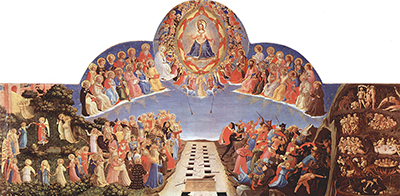
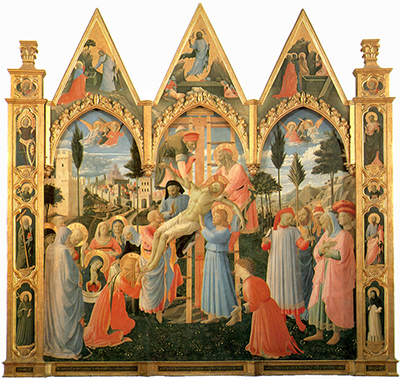
Today the altarpiece is displayed in the Sala del Beato Angelico. It can be compared directly with the Last Judgement, San Marco Altarpiece and Deposition. This arrangement makes its formal importance easy to see. The move from early polyptych structures towards unified pala becomes visible across one room. [2]
Why the Annalena Altarpiece Matters
The Annalena Altarpiece matters because it captures a fundamental shift in Renaissance painting. Saints cease to inhabit separate Gothic compartments. They become one community. Mary and Christ occupy one shared sacred world with them. This is a formal innovation and a theological one. Spatial unity makes spiritual unity visible. The painting is equally important because its name teaches caution.
“Annalena” reflects later provenance. Probable original Medici patronage points instead towards San Lorenzo and Cosmas-Damian devotion. Modern restoration has reinforced that the object still contains unresolved questions. For Angelico’s career, the work stands between the early Fiesole experiments and the monumental San Marco Altarpiece. It demonstrates that by around 1435 he was already helping define the unified Renaissance pala. [1]
Frequently Asked Questions
Discussion
How does the Annalena Altarpiece change the relationship between traditional sacred splendour and a newly unified Renaissance space?
Reader Insights
How persuasive is the proposed Medici and San Lorenzo origin when the documentation remains incomplete?
What does the single shared setting make possible that a divided polyptych cannot?
How should restoration evidence influence our reading of colour, structure and chronology?
Join the Conversation
Share your reading of the Annalena Altarpiece below.
References
- Direzione regionale Musei nazionali Toscana, “Presentazione del restauro della Pala di Annalena.” Direzione regionale Musei nazionali Toscana restoration record.
- Direzione regionale Musei nazionali Toscana, Sala del Beato Angelico collection resources. Museo di San Marco institutional collection page; Museo di San Marco collection-history context.
- Direzione regionale Musei nazionali Toscana, research on probable Medici / San Lorenzo origin of the Annalena Altarpiece. Tuscan museum research on the probable Medici and San Lorenzo origin.
- National Gallery, London, Fra Angelico and Early Renaissance altarpiece context. National Gallery Fra Angelico and Early Renaissance context.
.jpg)
 Fra Angelico.jpg)