 by Tom Gurney
Tom Gurney BSc (Hons) is an art history expert with over 20 years experience
Published on June 19, 2020 / Updated on November 6, 2026
Email: tomgurney1@gmail.com / Phone: +44 7429 011000
Introduction
Fra Angelico’s life spans one of the most transformative periods in Florentine art. Born Guido di Pietro around 1395, probably in the Mugello north of Florence, he began his career in the world of manuscript illumination and late-Gothic painting. By the time of his death in Rome in 1455, he had become one of the principal painters of the Early Renaissance, responsible for major commissions in Fiesole, Florence, Perugia and papal Rome. His biography is unusual because professional painting and Dominican religious life were inseparable.
Guido was already active as a painter before he became a Dominican friar. After joining the order he adopted the religious name Fra Giovanni da Fiesole and continued working at the highest professional level. The familiar name Fra Angelico was posthumous. This distinction matters because it reminds us that the historical painter was not simply born into the identity later legend gave him. He developed through workshops, commissions, institutional relationships and artistic experimentation like other successful Renaissance masters. [1]
At a Glance
- Birth nameGuido di Pietro [2]
- Religious nameFra Giovanni da Fiesole [2]
- Posthumous nameFra Angelico [1]
- Bornprobably c. 1395 [2]
- BirthplaceMugello, near Florence [2]
- First documented as painter1417 [2]
- Dominican professionby 1423 [2]
- Early Dominican homeSan Domenico, Fiesole [5]
- Major Florentine centreSan Marco [6]
- Major Roman patronPope Nicholas V [8]
- Died1455, Rome [1]
Contents
- Introduction
- Birth in the Mugello
- Entering the Dominican Order
- San Domenico at Fiesole
- San Marco and the Medici
- The Dormitory Frescoes
- Rome
- The Niccoline Chapel
- Final Roman Period
- Legacy
Birth in the Mugello
Guido di Pietro was born in the Mugello, the region north of Florence. The precise year is not documented securely, but modern museum biographies generally place his birth around 1395. The Mugello was closely connected with Florence economically and politically. Guido later moved into the city’s professional artistic world, where painters, illuminators, sculptors, architects and craftsmen worked through guilds and workshops. His brother Benedetto also pursued manuscript-related work. The two brothers therefore belonged to a family environment in which written and visual culture overlapped. [2]
Guido’s earliest formation was connected with manuscript illumination. This background helps explain several lifelong features of his art: brilliant colour, fine detail, controlled use of gold and exceptional ability to organise complex sacred imagery within confined formats. Illuminators had to work with extreme precision. A page allowed little room for correction. Figures needed to remain legible at very small scale. Gold and expensive pigments had to be handled carefully. These skills later transferred naturally into predella painting, small devotional panels and the detailed surfaces of major altarpieces. [3]
Guido’s early artistic environment has long been associated with Lorenzo Monaco. Modern scholarship treats the precise relationship with some caution. A conventional documented apprenticeship is not completely secure, but Guido was clearly formed within the late-Gothic painter-illuminator culture in which Lorenzo Monaco was a leading figure. This artistic world prized elegant line, brilliant colour, gold and graceful sacred figures. Angelico never abandoned those qualities completely. Instead, his biography becomes the story of how he combined them with the new Florentine Renaissance. [3]
By 1417 Guido was documented as an active painter. This is one of the most important chronological anchors in his biography. The record demonstrates that professional artistic activity preceded his mature Dominican career. In 1418 he was paid for an altarpiece for Santo Stefano al Ponte in Florence. That work is now lost. The loss is a useful reminder that the surviving oeuvre represents only part of his production. Important commissions known through documents may have disappeared entirely. [2]
Entering the Dominican Order
By 1423 Guido had professed as a Dominican friar at San Domenico in Fiesole. He adopted the religious name Fra Giovanni da Fiesole. The Dominican Observant environment became one of the defining structures of his life. The order emphasised preaching, study, disciplined communal life and spiritual reform. Painting within this context could function as more than decoration. Images could support prayer, liturgy, instruction and institutional memory. Fra Giovanni’s artistic profession therefore continued inside a religious vocation rather than being replaced by it. [2]
San Domenico at Fiesole
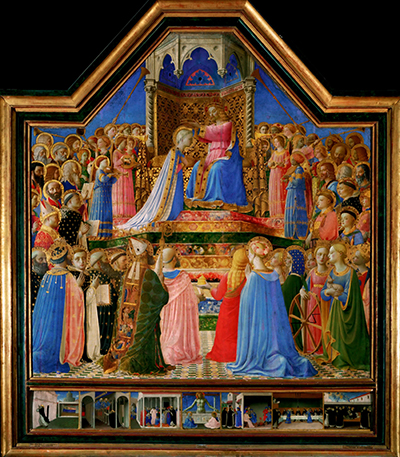
San Domenico became the first great centre of Fra Giovanni’s mature activity. Several major works were produced for the convent church. The high altarpiece, the Annunciation now in the Prado and the Coronation now in the Louvre all belonged to this environment. These works establish an important fact about his biography. The Dominican friar was already an ambitious professional painter in the 1420s. He could design large altarpieces, organise workshop participation and respond to rapidly changing Florentine artistic ideas. [5]
The high altarpiece was probably begun in the early 1420s. Its surviving predella dates to approximately 1423–24. The later history of the object complicates its appearance because Lorenzo di Credi radically altered the main ensemble in 1501. The original Angelico polyptych structure was transformed into a more unified Renaissance pala. This means the biography of the artist must sometimes be reconstructed through objects that themselves changed after his death. The Fiesole predella also demonstrates early workshop organisation. Not every section appears to have been executed entirely by the master. Fra Giovanni was already functioning as a designer working with assistants. [5]
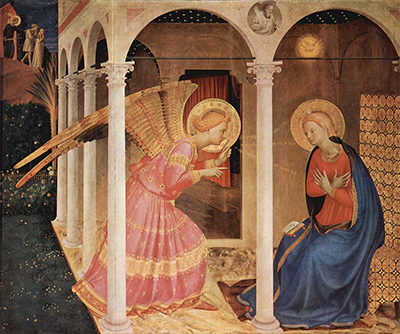
The Prado Annunciation of 1425–26 marks another major stage. The painting shows how rapidly Angelico absorbed the new language of Renaissance architecture, volume and spatial organisation. Gabriel and Mary occupy a coherent loggia. Adam and Eve are expelled from Paradise beyond. The work combines traditional gold and exquisite surface refinement with a new sense of measurable space. This is one of the clearest moments at which the biography of the Dominican painter intersects with the wider revolution of Florentine art. [4]
During the 1420s and early 1430s, Florence was transformed by artists such as Brunelleschi, Ghiberti, Donatello and Masaccio. Angelico responded to these developments closely. He increasingly gave bodies weight. Architecture became perspectivally coherent. Figures occupied unified spaces. Yet he never simply became another Masaccio. His mature identity developed through synthesis. Late-Gothic colour and sacred splendour survived inside Renaissance spatial systems. [3]
The Last Judgement
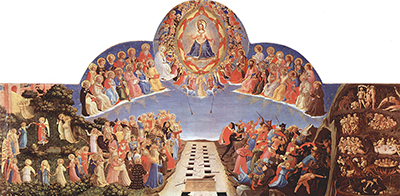
Around 1425–28 Angelico painted the great Last Judgement now associated with San Marco. The work demonstrates ambitious spatial planning and a highly original image of Paradise. Open tombs recede through the centre. Angels and saved souls dance in the heavenly garden. The panel shows that the painter was already capable of large theological invention early in his career. Modern restoration has further demonstrated the brilliance of his materials and the complexity of the original design. [7]
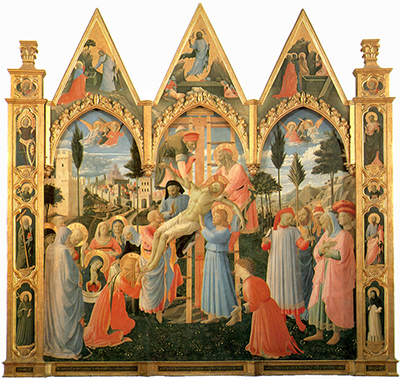
Around 1429–32 Angelico became involved with the great Deposition for the Strozzi chapel at Santa Trinita. The commission had been begun by Lorenzo Monaco. Palla Strozzi commissioned the work in honour of his father Onofrio. After Monaco’s death, Angelico took over the project. He did not simply fill an empty space. He reorganised the central composition into a more unified Renaissance scene while incorporating the older Gothic elements already completed. This commission demonstrates his growing standing among elite Florentine patrons. [7]
During the 1430s Angelico’s reputation expanded substantially. He worked on important altarpieces and public commissions. His artistic language also became increasingly confident. The Annalena Altarpiece belongs to this moment and is often treated as one of the earliest unified Renaissance altarpieces of its type. The rectangular pala abandons the divided pinnacles of older polyptychs. Sacred figures occupy one continuous space. This formal change placed Angelico directly within the architectural thinking transforming Florence. [3]
The Tabernacle of the Linaioli was commissioned by Florence’s linen workers in 1433–35. Lorenzo Ghiberti designed the architectural marble frame. Angelico painted the sacred images. The project demonstrates how far his professional career extended beyond Dominican houses. A major Florentine guild trusted him with a prestigious public commission. It also placed him in collaboration with one of the defining sculptors of the Early Renaissance. [7]
Throughout these years the artist worked as Fra Giovanni da Fiesole. The later label “Fra Angelico” did not yet define him. This historical name is worth preserving because it reflects how contemporaries understood his identity. He was a Dominican from Fiesole who was also an outstanding painter. The “angelic” legend belonged to reception after his death. [2]
San Marco and the Medici
The greatest change in Angelico’s Florentine career came with the rebuilding of the Dominican convent of San Marco. Cosimo de’ Medici supported the reconstruction. Michelozzo designed the architecture. The project unfolded from the late 1430s into the early 1440s. Angelico became the principal painter associated with the new Dominican environment. The scale of the undertaking was exceptional. Panel paintings, communal frescoes and dozens of cell images together created one of the most complete artistic-religious environments of the Renaissance. [6]
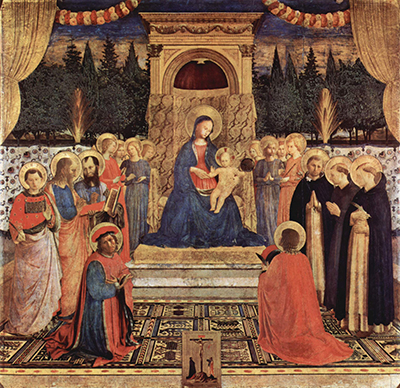
The high-altarpiece commission belonged directly to the Medici reconstruction. The altar was dedicated to Saint Mark and Saints Cosmas and Damian. Cosmas and Damian were especially important to Medici family devotion. The great altarpiece was completed by the time of the church’s consecration in 1443. Its original structure contained numerous painted components and a long predella devoted to the healer saints. The commission demonstrates Angelico operating as a major master coordinating a large workshop enterprise. [7]
The Dormitory Frescoes
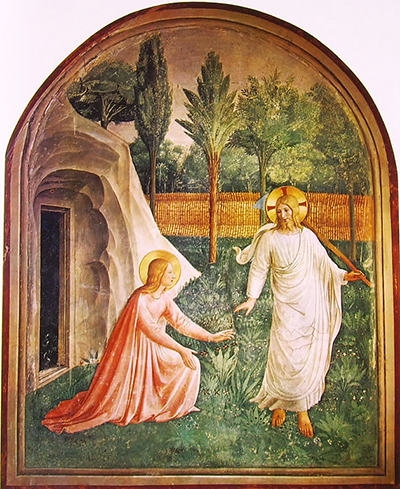
The cell frescoes at San Marco became the works most closely associated with Angelico’s religious identity. They were designed for Dominican meditation rather than public spectacle. Different corridors served different groups within the community. The images vary accordingly. Some concentrate on the Crucifixion. Others narrate episodes from Christ’s life. Saint Dominic frequently appears as meditative witness. The programme is associated with Angelico and his workshop under his overall design and supervision. It would be misleading to insist that the master personally executed every passage. [6]
The famous Annunciation at the head of the dormitory staircase became the emblematic image of San Marco. Its placement was crucial. Friars encountered it as they ascended towards the cells. The scene responds visually to the convent’s own architecture. Gabriel and Mary occupy a sparse loggia. The effect is one of extraordinary stillness. This work shows the mature Angelico simplifying imagery according to devotional purpose. [6]
Cosimo’s role at San Marco extended beyond financing the convent. He maintained a double cell where he could retreat. This personal use complicates the normal distinction between patron and religious community. Cosimo invested publicly in architecture and art while also using the institution privately for spiritual withdrawal. The convent library likewise connected Medici patronage with Dominican study and Florentine humanism. [6]
The Chapter House Crucifixion
The Chapter House Crucifixion belongs to a different part of Dominican life. It was monumental and communal. Friars gathered beneath an immense image of Christ and a company of saints. The contrast with the cell frescoes demonstrates Angelico’s adaptability. Private meditation called for visual reduction. Communal memory called for scale and solemnity. [6]
Angelico’s religious career also developed during these years. He was not simply an artist permitted to live inside Dominican houses. He participated fully in the order’s institutional life. His reputation for discipline and piety became an important part of later biography. Modern scholarship should distinguish documented religious identity from later hagiographic embellishment, but there is no reason to doubt that Dominican vocation was central to how he understood his work. [6]
Angelico’s reputation extended beyond Florence. The Guidalotti family commissioned a major polyptych for San Domenico in Perugia in the later 1440s. The work is important biographically because it demonstrates regional adaptability. Angelico had already helped pioneer unified Renaissance altarpieces. In Perugia he returned deliberately to a more traditional gold-ground polyptych form. This was not artistic regression. It was a response to patronal and local expectations. [9]
Rome
The next decisive move took Angelico to Rome. The papal court offered a very different cultural environment from Fiesole or San Marco. Pope Nicholas V was one of the great humanist patrons of the century. Angelico’s arrival placed a Dominican painter shaped by Florentine reform and Renaissance innovation within the centre of papal humanism. [8]
The Niccoline Chapel
The Niccoline Chapel became the greatest surviving work of Angelico’s Roman period. Payments from February and March 1448 securely document his involvement. The chapel belonged to Nicholas V’s private apartments. Its walls tell parallel stories of Saints Stephen and Lawrence. The vault includes Evangelists and the architectural programme includes Doctors of the Church. The Vatican describes the ensemble as a summit of Angelico’s Christian humanism. The phrase captures the transformation of his late career. Classical architectural dignity and heroic figure types now support early Christian martyr narratives. [8]
Stephen’s cycle moves from ordination through preaching and confrontation towards martyrdom. The scenes give the saint civic and rhetorical dignity. Angelico’s Roman architecture is more expansive than the quiet spaces of San Marco. The difference reflects patron and function. A papal chapel demanded another visual register. [8]
Lawrence’s cycle parallels Stephen’s. His service to the Church, distribution of wealth and martyrdom create a second model of Christian witness. The two narratives are deliberately coordinated. The chapel therefore functions as one intellectual programme rather than a collection of frescoes. [8]
Benozzo Gozzoli was closely associated with Angelico during the 1440s. The old description of Benozzo simply as Angelico’s pupil is too narrow for the surviving evidence. What is secure is collaboration. Benozzo worked with him on important projects and followed him to Rome. This relationship demonstrates how Angelico’s workshop and influence extended beyond anonymous assistants. [11]
Angelico returned to Florence and worked on the Armadio degli Argenti around 1449–52. Piero de’ Medici commissioned the painted cycle for a treasury cabinet associated with Santissima Annunziata. The scenes tell a broad history of Christ. The project again involved collaboration. Most of the surviving panels belong to Angelico’s design and production, while at least one section was completed by Alesso Baldovinetti after his departure. The work therefore belongs to a mature workshop system rather than a solitary master’s output. [10]
Final Roman Period
Angelico returned to Rome in the final phase of his life. By this point he had worked across most of the major artistic environments available to a fifteenth-century Florentine painter. He had served his own Dominican communities. He had worked for guilds and elite families. The Medici had trusted him with major commissions. A pope had employed him in the Apostolic Palace. His professional reputation and religious identity were by then inseparable. [8]
Fra Giovanni da Fiesole died in Rome in 1455. He was probably around sixty years old. His burial in Rome gave the career a geographically appropriate conclusion. The painter who began in Florentine manuscript culture died after working within the papal court. The transformation from illuminator to Roman fresco master had taken less than four decades. [1]
The name Fra Angelico appeared after his death. It reflected a reputation for unusual spirituality. Later biographies emphasised his prayerfulness and holiness. Those traditions became extremely influential. They also encouraged later viewers to treat artistic excellence as if it emerged automatically from sanctity. A more balanced biography recognises both. Angelico’s spiritual identity was real. So was his professional discipline. He mastered materials, workshops, perspective, patronage and large-scale design. [1]
Vasari and the Angelic Painter
Giorgio Vasari helped fix the image of Angelico as a uniquely devout artist. His account contributed enormously to later reception. Such biographies are best read as historical literature shaped by their authors’ moral and artistic aims, rather than as neutral documentary transcripts. Vasari wrote with moral and artistic purposes of his own. The legend nevertheless tells us something important about reputation. Angelico’s paintings were already perceived as unusually suited to an ideal of religious art. [1]
Pope John Paul II beatified Fra Angelico in 1982. This formal ecclesiastical recognition came more than five centuries after his death. It should not be projected backward into fifteenth-century documents. But it demonstrates the extraordinary durability of the spiritual reputation attached to his work. Few major Renaissance painters have an afterlife in which artistic and devotional identities remain so closely intertwined. [1]
Angelico’s artistic standing was substantial during and after his lifetime. His commissions alone demonstrate this. Guilds, Medici patrons, Dominican houses and a humanist pope did not employ him merely because he was pious. They employed one of the leading painters available. His ability to work across different formats and institutional cultures helped sustain that reputation. [1]
Legacy
Angelico’s legacy continued through workshop associates, collaborators and later artists. Benozzo Gozzoli carried aspects of his language forward. Zanobi Strozzi was closely associated with his circle. His compositions were copied and adapted. Later painters responded to works such as the Last Judgement. His influence cannot be reduced to one stylistic school. He helped establish a model in which Renaissance innovation could serve intense Christian devotion. [11]
Why Fra Angelico’s Biography Matters
Fra Angelico’s biography matters because it overturns the easy story of a holy monk painting beautiful pictures outside ordinary artistic life. Guido di Pietro was already a professional painter before his Dominican profession. Fra Giovanni da Fiesole remained an active professional artist after it. He worked with assistants. He accepted major commissions.
He responded to artistic rivals and innovations. He adapted to patrons. He travelled. He worked for the papacy. At the same time, Dominican identity genuinely shaped what he painted, where he painted and how images were used. The strongest biography therefore does not choose between friar and artist. It explains how one person could be both. [3]
Frequently Asked Questions
Discussion
Which stage of Fra Angelico’s biography most changed your understanding of his art?
Reader Insights
How did manuscript culture remain visible in his later paintings and frescoes?
Which mattered more to his development: Fiesole, San Marco or Rome?
How should biography balance Angelico’s religious vocation with his professional workshop practice?
Join the Conversation
Share your reading of Fra Angelico’s life below.
References
- National Gallery, London, “Fra Angelico (active 1417, died 1455),” artist biography and collection records. National Gallery artist record.
- Museo Nacional del Prado, Fra Angelico artist biography. Prado biography and exhibition research.
- Museo Nacional del Prado, Fra Angelico and the Rise of the Florentine Renaissance. Prado exhibition research.
- Museo Nacional del Prado, Fra Angelico, The Annunciation, 1425–26. Prado collection record.
- National Gallery, London, Fiesole San Domenico Altarpiece catalogue and predella records. National Gallery catalogue.
- Museo di San Marco / Direzione regionale Musei nazionali Toscana, institutional history and collection resources. Museo di San Marco.
- Museo di San Marco, research on the Last Judgement, Santa Trinita Deposition, Annalena Altarpiece, Linaioli Tabernacle and San Marco Altarpiece. Last Judgement research; Deposition restoration; Annalena Altarpiece research; Linaioli Tabernacle record; San Marco Altarpiece research.
- Vatican Museums, Niccoline Chapel and history of Pope Nicholas V. Vatican Museums Niccoline Chapel.
- Galleria Nazionale dell’Umbria, Guidalotti Polyptych. Galleria Nazionale dell’Umbria collection record.
- Museo di San Marco, Armadio degli Argenti research. Museo di San Marco Armadio research.
- Museo Benozzo Gozzoli, documentary research on Benozzo’s collaboration with Fra Angelico. Museo Benozzo Gozzoli collaboration research.
.jpg)
 Fra Angelico.jpg)