 by Tom Gurney
Tom Gurney BSc (Hons) is an art history expert with over 20 years experience
Published on June 19, 2020 / Updated on November 6, 2026
Email: tomgurney1@gmail.com / Phone: +44 7429 011000
Introduction
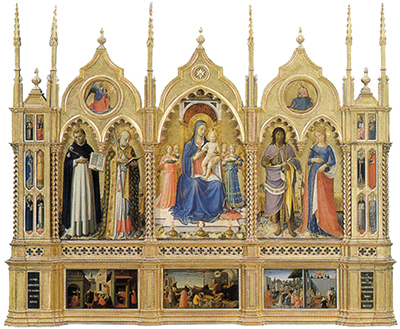
Fra Angelico’s Guidalotti Polyptych, painted around 1447–49 for San Domenico in Perugia, is one of the most important works for understanding his mature adaptability. By the late 1440s, Angelico had already helped develop unified Renaissance altarpiece formats in Florence. He had painted the San Marco Altarpiece. He had worked in Rome. Yet for Elisabetta Guidalotti’s family altar in Perugia, he deliberately returned to the visual language of a traditional gold-ground polyptych.
The Galleria Nazionale dell’Umbria makes the reason unusually clear. Angelico adapted format and gold ground to the tastes of a patron who remained more traditional. At the same time, the painting incorporates innovations derived from Masaccio, Domenico Veneziano, Ghiberti and Flemish art. The work therefore destroys a simplistic evolutionary model. Angelico did not progress from gold to perspective and then leave gold behind. He possessed several visual languages and could choose among them.
The polyptych is also significant as a major female patronage commission. Elisabetta Guidalotti commissioned the work for her family altar in the basilica of San Domenico. The museum interprets her choice of one of the greatest painters of the age partly as an attempt to restore and promote the social reputation of a family damaged by political disorder. Art therefore becomes devotion and social rehabilitation simultaneously. [1]
At a Glance
- ArtistFra Angelico [1]
- TitleGuidalotti Polyptych [1]
- Datec. 1447–49 [1]
- Mediumtempera and oil on panel [2]
- Dimensionsapproximately 318 × 280 cm [2]
- Current locationGalleria Nazionale dell’Umbria, Perugia [2]
- Original locationGuidalotti family altar, San Domenico, Perugia [1]
- PatronElisabetta Guidalotti [1]
- Main subjectMadonna and Child enthroned with angels and saints [2]
- Principal saintsDominic, Nicholas of Bari, John the Baptist and Catherine of Alexandria [1]
- Upper registerAnnunciating Angel and Virgin Annunciate [1]
- PredellaStories of Saint Nicholas of Bari [2]
- Stylistic significancemature Angelico deliberately retaining gold ground and polyptych form for a traditional patron [1]
- Modern framereconstructed in the twentieth century [1]
Contents
- Introduction
- Elisabetta Guidalotti
- San Domenico in Perugia
- The Polyptych Format
- Madonna and Child
- The Predella of Saint Nicholas
- Dispersal and Reconstruction
- Patronal Conservatism versus Artistic Conservatism
- The 2025 Exhibition
- Why the Guidalotti Polyptych Matters
Elisabetta Guidalotti
Elisabetta Guidalotti is central to the history of the work. Her commission demonstrates the importance of women within Renaissance patronage. She selected one of the leading artists of the period for the family altar. The Galleria Nazionale dell’Umbria interprets this patronage as part of a strategy of social rehabilitation. Several family members had been involved in political disturbances. Prestigious religious art could help rebuild lineage reputation. [1]
The commission therefore belonged to more than private devotion. A major altarpiece in San Domenico made family status publicly visible. The quality of the artist mattered. Choosing Fra Angelico communicated wealth, taste and connection to leading artistic culture. The sacred object became a social instrument without losing religious function. [1]
San Domenico in Perugia
The original location was the Guidalotti family altar in the Dominican basilica of San Domenico. This Dominican setting also created continuity with Angelico’s own order. The painter was therefore working outside Florence but within a familiar institutional tradition. San Domenico provided a setting in which Dominican saints and values were immediately meaningful. [1]
The Polyptych Format
The work retains a multi-panel structure. This was more traditional than the unified pala increasingly favoured in Florence. The format should not be treated as an artistic failure to modernise. The museum explicitly interprets it as adaptation to patronal taste. Angelico could return to traditional structure deliberately. [1]
The gold background is equally significant. By this stage Angelico had demonstrated mastery of coherent naturalistic space. He did not need gold because he lacked perspective. He chose it because the commission called for traditional sacred splendour. Gold therefore becomes evidence of adaptability. [1]
Madonna and Child
Mary and Christ occupy the principal central position. Their enthroned presence gives the altarpiece monumental sacred authority. The surrounding saints define the Dominican and patronal environment. The central group remains emotionally accessible despite the formal gold-ground setting. [2]
Dominic represents the order and the basilica’s institutional identity. His presence connects the Guidalotti altar directly with Dominican spirituality. For Angelico, painting Dominic outside Florence also reinforced a lifelong visual relationship with his own order. [2]
Nicholas is especially important because his stories dominate the predella. The saint was celebrated for charity, miracles and protection. His prominent role likely reflects chapel or family devotion. The predella turns his sacred identity into narrative biography. [2]
Saint John the Baptist
John carries associations with prophecy, penitence and Christ’s public mission. For a Florentine artist he was also deeply familiar as the patron saint of Florence. In Perugia, however, he participates within a different local and patronal programme. The same saint can shift meaning according to location. [2]
Catherine brings another prestigious saintly identity. Her legends emphasise learning, faith and martyrdom. Her presence contributes to the balanced sacred court around Mary and Christ. [2]
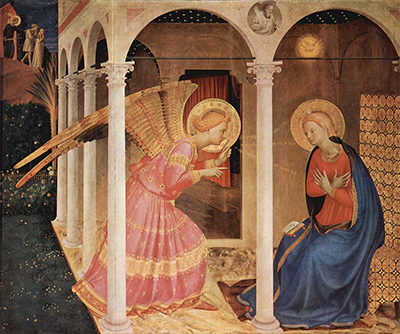
The upper register includes Gabriel and Mary in Annunciation form. This creates another theological layer above the enthroned Virgin. The Incarnation announced above is fulfilled in Christ present at the centre below. The altarpiece therefore links narrative beginning with devotional presence. [2]
The Predella of Saint Nicholas
The predella contains stories from Nicholas’s life. These include charitable and miraculous episodes. Some original panels are now divided between collections. The first two sections in the Perugia reconstruction are nineteenth-century copies. This is an important modern-history caution. The current ensemble is not entirely original material. [3]
Dispersal and Reconstruction
Like many complex altarpieces, the Guidalotti Polyptych was altered and fragmented. Some predella scenes left Perugia. The Vatican preserves important originals. Later reconstruction sought to restore the overall appearance. Modern viewers therefore encounter a historically reconstructed object. [3]
One famous Nicholas legend concerns his secret gifts to impoverished girls whose family could not provide dowries. The story established him as a saint of charity. Such narratives made Nicholas particularly suitable to family devotion. Material wealth is presented as something to be used compassionately. [3]
Other predella scenes represent miracles and protection. The saint’s identity unfolds through action. This narrative register makes the static heavenly saints above more intelligible. Holiness has a biography. [3]
The museum identifies both tempera and oil on panel. This mixed technique belongs to Angelico’s mature material practice. Oil-rich effects could increase depth and saturation. Tempera retained crisp precision. Again, the technical modernity of the painting coexists with traditional gold-ground format. [2]
Masaccio
The Galleria Nazionale dell’Umbria specifically identifies Masaccio among the artistic sources Angelico had absorbed. This is important because the painting’s traditional appearance could otherwise be misread. The figures carry mature volumetric understanding. Gold does not erase Renaissance bodies. [1]
Domenico Veneziano’s influence points towards light and colour. Angelico’s later work engages with a broader Florentine network than his early Lorenzo Monaco connections alone. The Perugia polyptych therefore brings several generations of artistic experience together. [1]
Ghiberti remains another important source. His sculptural elegance and spatial intelligence had influenced Angelico for years. The Guidalotti commission demonstrates that these innovations could be incorporated even inside a traditional polyptych. [1]
The museum also notes Angelico’s interest in Flemish painting. Northern art offered different approaches to light, objects and material description. This reinforces the cosmopolitan nature of his mature style. Perugia’s gold-ground commission is therefore visually traditional but culturally sophisticated. [1]
Patronal Conservatism versus Artistic Conservatism
This distinction is essential. The patron preferred a traditional format. Angelico complied. That does not make the artist conservative in a simple chronological sense. Style is negotiated between artist, patron and place. The Guidalotti Polyptych is one of the strongest case studies of this principle in Renaissance art. [1]
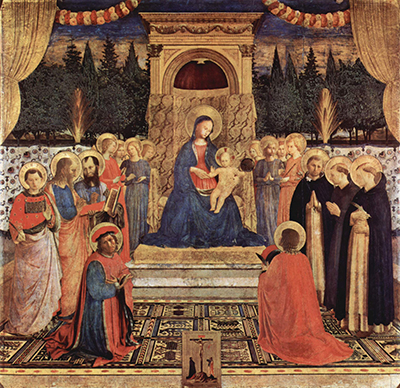
The San Marco Altarpiece uses a unified pala form. The Guidalotti returns to polyptych structure. Chronologically, the more “traditional” Perugia work comes later. This reverses the simplistic expectation that later always means more Renaissance. The comparison is extremely valuable. [1]
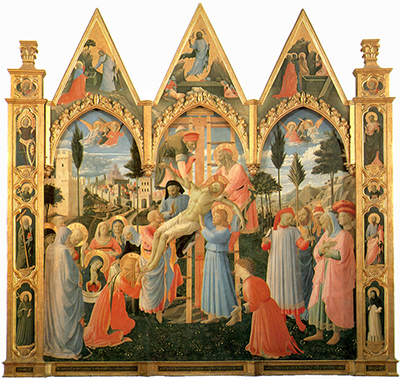
The Annalena Altarpiece had already demonstrated the unified rectangular pala around the mid-1430s. A decade later, Angelico could return to divided structure. This confirms that his visual vocabulary expanded rather than progressed along one irreversible line. [1]
The 2025 Exhibition
The Guidalotti Polyptych was included in the major 2025 Fra Angelico exhibition in Florence. Its temporary absence from Perugia was marked through a contemporary response by Mimmo Paladino. This modern dialogue demonstrates the continuing cultural importance of the work. [4]
Why the Guidalotti Polyptych Matters
The Guidalotti Polyptych matters because it gives perhaps the clearest proof that Fra Angelico’s style was adaptive rather than simply evolutionary. By 1447–49 he knew the latest Florentine innovations. He had used unified space. He had worked for the Medici. He had experienced Rome. Yet he could create a gold-ground polyptych when a Perugian patron wanted one.
The result is not backward-looking imitation. Mature bodies, colour, light and international artistic influences inhabit a traditional sacred structure. The commission also highlights Elisabetta Guidalotti as a significant female patron using art for devotion and family social rehabilitation. The painting therefore reveals the Renaissance as negotiation: between new and old; artist and patron; Florence and Perugia; Dominican identity and family ambition. [1]
Frequently Asked Questions
Discussion
How does the Guidalotti Polyptych balance a patron’s preference for traditional splendour with Fra Angelico’s mature Renaissance interests?
Reader Insights
How does Elisabetta Guidalotti’s commission use sacred art for family memory and social standing?
What makes the gold ground and polyptych format feel purposeful rather than merely conservative?
How should we read an ensemble whose originals, copies and reconstructed frame come from different moments?
Join the Conversation
Share your reading of the Guidalotti Polyptych below.
References
- Galleria Nazionale dell’Umbria, “Guidalotti Polyptych.” Galleria Nazionale dell’Umbria Guidalotti Polyptych record.
- Galleria Nazionale dell’Umbria, digital archive record, dimensions, medium and subject list. Galleria Nazionale dell’Umbria collection data and subject list.
- Vatican Museums, Fra Angelico, Stories of Saint Nicholas of Bari. Vatican Museums Stories of Saint Nicholas of Bari.
- Palazzo Strozzi / Museo di San Marco, 2025 Fra Angelico exhibition context. Fondazione Palazzo Strozzi Fra Angelico exhibition.
.jpg)
 Fra Angelico.jpg)