


 Ford Madox Brown.jpg)
 by
Tom Gurney
Tom Gurney BSc (Hons) is an art history expert with over 20 years experience
Published on June 19, 2020 / Updated on October 30, 2026
Email:
tomgurney1@gmail.com
/ Phone:
+44 7429 011000
Ford Madox Brown Biography: Introduction
Ford Madox Brown's career joined the ambitions of a history painter to the daily business of earning a living. He spent years building pictures around English poetry, religion and contemporary society, while accepting portraits, producing illustrations, designing stained glass and teaching. Friends and family supplied models, criticism and practical help; collectors supplied advances as well as purchases. The independence for which he is remembered depended on these relationships. [1]
Born in Calais in 1821 to a British family, Brown received his formal training in Belgium before working in Paris and travelling to Italy. He settled in England in 1846, became a close friend of Dante Gabriel Rossetti and helped shape the artistic world around the Pre-Raphaelites without joining their Brotherhood. His later association with William Morris expanded his work into decorative art, while the Manchester Town Hall commission occupied much of the final fifteen years of his life. He died in London in 1893, having completed its twelve murals. [1]
His life is sometimes told as a long struggle ending in vindication. The record is more uneven and more interesting. Recognition, disappointment, loyalty, financial anxiety and new opportunities repeatedly coexisted. Following them chronologically brings the famous paintings into a wider account of a working artist. For an introduction to the pictures themselves, see the Ford Madox Brown overview and the paintings guide .
At a Glance
- Born 16 April 1821, Calais, France, to British parents. [1]
- Died 6 October 1893, London. [1]
- Education Academies in Bruges, Ghent and Antwerp; subsequent study in Paris and Italy. [1]
- Pre-Raphaelite relationship Rossetti's brief teacher and lifelong friend; never a member of the original Brotherhood. [1]
- Major commitments Chaucer at the Court of Edward III , The Last of England , Work , the Morris partnership and the Manchester murals. [1]
- Writing Diaries, correspondence, an essay on designing historical pictures and a late essay on mural painting. [1]
Ford Madox Brown in context
Continental academic formation
c. 1835–1846Pre-Raphaelite dialogue
From 1848Arts and Crafts collaboration
From 1861Civic history painting
1878–1893Gustaf Wappers
1803–1874Dante Gabriel Rossetti
1828–1882William Morris
1834–1896Edward Burne-Jones
1833–1898William Holman Hunt
1827–1910Manfred on the Jungfrau
1841; retouched 1861Pretty Baa-Lambs
1851–1859The Last of England
1852–1855Work
1852–1865King René’s Honeymoon
Tate watercolour, 1864Manchester Murals
1878–1893Contents
- Calais, Family and a Belgian Education
- Paris, Elisabeth and the Ambition to Paint History
- Italy, Bereavement and the Return to England
- Rossetti and the Pre-Raphaelite Circle
- Emma and the Household Behind the Pictures
- Modern Life, Slow Work and Financial Pressure
- Teaching and the Morris Partnership
- The 1865 Exhibition and a Family of Artists
- Friendship, Illness and Oliver's Death
- Manchester and the Demands of Public Painting
Calais, Family and a Belgian Education
Brown's father, Ford Brown, was a retired naval purser; his mother was Caroline Madox. The family lived principally on the Continent because their income went further there, moving between northern France and the Low Countries and making visits to Britain. Calais was therefore his birthplace within a mobile British household. His later absorption in English subjects grew out of an upbringing that crossed the Channel repeatedly. [1]
The stories of his childhood come largely through his grandson, Ford Madox Hueffer, who published a biography in 1896. Hueffer drew on letters, surviving papers, personal knowledge and recollections dictated by Brown during his final illness. His account preserves invaluable evidence, but its affectionate character and reliance on retrospective memory require care. Brown's statements about a particular work are especially useful when their original context can be identified: a diary entry, a letter or his own exhibition catalogue. [1]
Drawing became a sustained interest early. Hueffer records that the child copied illustrated wall decorations and prints, and that his father briefly considered a naval career for him. The family ultimately supported professional training instead. At fourteen Brown entered the academy at Bruges, studying under Albert Gregorius; he continued at Ghent under Pieter van Hanselaer and then at Antwerp under Gustave Wappers. These were successive stages of a formal education, involving drawing, work from models and the example of established painters. [1]
The Antwerp years also brought a lasting friendship with the painter Daniel Casey. Hueffer's account describes academy classes followed by further studio work, with theatre, opera and inexpensive meals forming the surrounding student life. Brown painted portraits as well as historical and literary subjects. A letter from his sister, written in December 1839 while he was away painting portraits in Luxembourg, reports Wappers's concern that a promising student should not absent himself unnecessarily. Professional opportunities and concentrated study were already competing for his time. [1]
The Belgian training deserves a place of its own in his biography. The Museum voor Schone Kunsten Gent made this point when presenting the 2012 retrospective: it supplemented the Manchester-organised exhibition with Belgian contemporaries, setting Brown's work beside the artistic culture in which he had studied. The familiar British movement label can otherwise hide the institutions that trained him. [2]
Four stages of Ford Madox Brown’s career
These periods group related developments; painting, travel and local work overlap across their boundaries.
Training and historical imagination
Born in Calais, Brown trained in the Low Countries and worked in Paris before travelling in Italy. Literary subjects and ambitious historical compositions formed an early basis for his practice. [3]

Figures, observation and the Pre-Raphaelite circle
London friendships and sustained work from models accompanied paintings of modern experience, religious stories and landscape. Brown’s relationship with the Brotherhood developed through exchange while he retained his independence. [3]
A composition in several forms
The Morris partnership, illustrated books and northern patrons opened different routes for Brown’s designs. He revisited subjects in new media while continuing portraits and independent oil paintings. [3]

 Ford Madox Brown.jpg)
History for a public room
The Town Hall murals brought historical research and lively subsidiary incidents into a civic setting. Large cartoons, studies, wall paintings and canvases served different roles within this extended commission. [3]


Paris, Elisabeth and the Ambition to Paint History
Brown married his cousin Elisabeth Bromley in 1841 and moved to Paris that year. Laura MacCulloch's account distinguishes this chronology from Hueffer's earlier account, which placed the move in 1840. His attendance at the Antwerp academy continued into 1840; Paris became his base after the marriage. [4]
He did not enter a Paris atelier. According to Hueffer, he studied Rembrandt and the Spanish masters at the Louvre, copying paintings and developing a dark, dramatic manner in his own work. Paris also kept him among Continental friends, including Casey. It was an education through paintings and artistic company after the more structured academy years. [1]
Byron supplied subjects for the early pictures. Manfred on the Jungfrau , conceived in 1840 and painted in Paris, brought a human crisis into an imagined mountain setting. Brown's later description is unusually candid: he called it an early attempt at outdoor light, while admitting that he had not studied glaciers. He also explained that substantial repainting in 1861 had obliterated its original colour scheme. An early composition could remain part of his working life for decades. [1]
His daughter Lucy was born in 1843. William Michael Rossetti identifies her in his edition of Brown's letters to Elisabeth, where professional news appears beside concern for wife and child. These letters reveal an ambitious young painter expecting recognition and reporting progress, rather than only the embittered outsider of later legend. In a letter tentatively dated May 1845, Brown tells Elisabeth that artists have noticed his exhibited picture, while describing the pressure of studies and preparations for a cartoon. [5]
The Westminster Hall competitions for decorating the new Houses of Parliament offered an opportunity to work on a public scale. Brown submitted designs including The Body of Harold , Adam and Eve and The Spirit of Justice during the mid-1840s. They won him no commission. Nevertheless, the enterprise shows how early he hoped to connect historical subjects with architecture and a national audience. Manchester would eventually provide such an opportunity under different circumstances. [1]
His King Lear designs of 1844 belong to the same search for expressive historical action. Shakespeare offered bodies in conflict, gestures of refusal and recognition, and relationships whose meaning could change within a moment. Brown returned to the play throughout his career. The later Lear and Cordelia and Cordelia's Portion developed different episodes rather than illustrating a single unchanging idea. [1]
Ford Madox Brown, Manfred on the Jungfrau, conceived in 1840 and painted in Paris; substantially repainted in 1861.
Italy, Bereavement and the Return to England
Elisabeth's worsening health shaped the family's movements. After a period in England, Brown travelled with her and Lucy to Italy in 1845, reaching Rome that autumn. The journey brought him into contact with Italian painting and with the German artists Overbeck and Cornelius. His later recollections distinguish their approaches: he admired the feeling of Overbeck's religious designs while noticing his avoidance of study from the living body. Brown's account records both attraction and reservation. [1]
The art he remembered was broader than one school. Writing to the collector George Rae on 3 January 1865, Brown singled out Giotto's wall paintings, Masaccio's frescoes and Fra Angelico's work in Florence, together with paintings by Holbein seen at Basel and works by later Italian masters. The letter looks back across almost twenty years. It gives a record of durable impressions, rather than a precise diary of every encounter during the journey. [1]
The large English-poetry project began to take shape in this period. Brown's diary of September 1847 traced its conception to reading English history in 1845 and imagining Chaucer addressing the court. In Rome he investigated Chaucer's life and poetry and developed the design. He experimented with the idea of a triptych before settling on The Seeds and Fruits of English Poetry . The project connected literary ancestry, historical research and the ambition to address a public through a complex composition. [5]
The Italian stay ended when Elisabeth's condition deteriorated further. The family left Rome in May 1846; she died in Paris on the journey back to England and was buried at Highgate. Brown returned with their young daughter. Hueffer's account of this journey is moving, but his interpretation of its effect on Brown's later temperament is a grandson's judgement. The loss itself is securely part of the biography without becoming an explanation for every subsequent expression or choice of subject. [1]
Brown's own diary offers a more particular connection between grief and work. Recalling the poetry picture in September 1847, he wrote that Elisabeth had approved the project and urged him to finish it after her death. He also described the pleasure that working on it had given him during an anxious time. This is his stated relationship to one undertaking. It allows us to hear his experience without assuming that all the pictures were coded responses to bereavement. [5]
After several changes of address, he resumed sustained work in London, eventually occupying a studio in Clipstone Street. The poetry project continued, alongside Wycliffe Reading his Translation of the Bible to John of Gaunt . The latter was shown at the Free Exhibition in 1848. Brown was seeking ways to bring ambitious paintings before viewers despite the failure of the Westminster competitions. [1]
Rossetti and the Pre-Raphaelite Circle
In March 1848 Dante Gabriel Rossetti wrote asking Brown for instruction. His enthusiastic letter listed earlier pictures he admired and described the sustained attention he had given them in exhibitions. The admiration therefore extended beyond the latest Wycliffe . Brown's teaching began with still-life exercises and copying, a discipline that Rossetti soon abandoned. The brief pupilship became a friendship lasting until Rossetti's death in 1882. [1]
Brown entered a widening circle of artists, writers and models. His studio became a place for discussing work, and the Rossetti family became closely connected with his own. William Michael later remembered his practical advice: Brown could identify what was going wrong in a painting and explain a possible remedy. The relationship was reciprocal. After Gabriel's death Brown acknowledged how constantly, even half-consciously, he had painted with his friend's possible approval in mind. [1]
The Pre-Raphaelite Brotherhood was founded later in 1848. Brown was never one of its seven members. His older age, Continental education and already established ambitions gave him a different position from the younger founders, including Rossetti, William Holman Hunt and John Everett Millais . William Morris and Edward Burne-Jones belonged to later developments in the circle, rather than to that original seven. [1] [5]
Later testimony about an invitation to Brown disagrees. His own uncertain recollection, Hunt's account and Frederic George Stephens's later statement do not yield one consistent story. Hueffer printed the competing versions and recognised the secure conclusion: Brown had never formally joined. The everyday exchanges of advice, models, pictures and friendship explain his importance more clearly than a disputed invitation. [1]
He did contribute to the group's periodical, The Germ . His essay “On the Mechanism of a Historical Picture,” published in February 1850, set out a practical sequence for beginning painters: research the period and its material surroundings, imagine the action, test poses, make an oil sketch, study models and prepare a cartoon. The advice grew from a trained artist's experience of bringing an elaborate invention into visible form. [6]
The essay also identifies the audience he hoped to reach. Artists might admire execution, he wrote, but “the clearness, truth, and sentiment” would affect the wider public. The formulation helps connect his historical pictures with the modern subjects that followed. Detailed research and vivid colour had to contribute to a human situation a spectator could understand. [6]
Emma and the Household Behind the Pictures
Emma Hill first modelled for Brown in 1848. Their daughter Catherine, usually called Cathy, was born in 1850; Brown and Emma married in 1853. MacCulloch explains how later research corrected Hueffer's misleading account of an earlier marriage. [4]
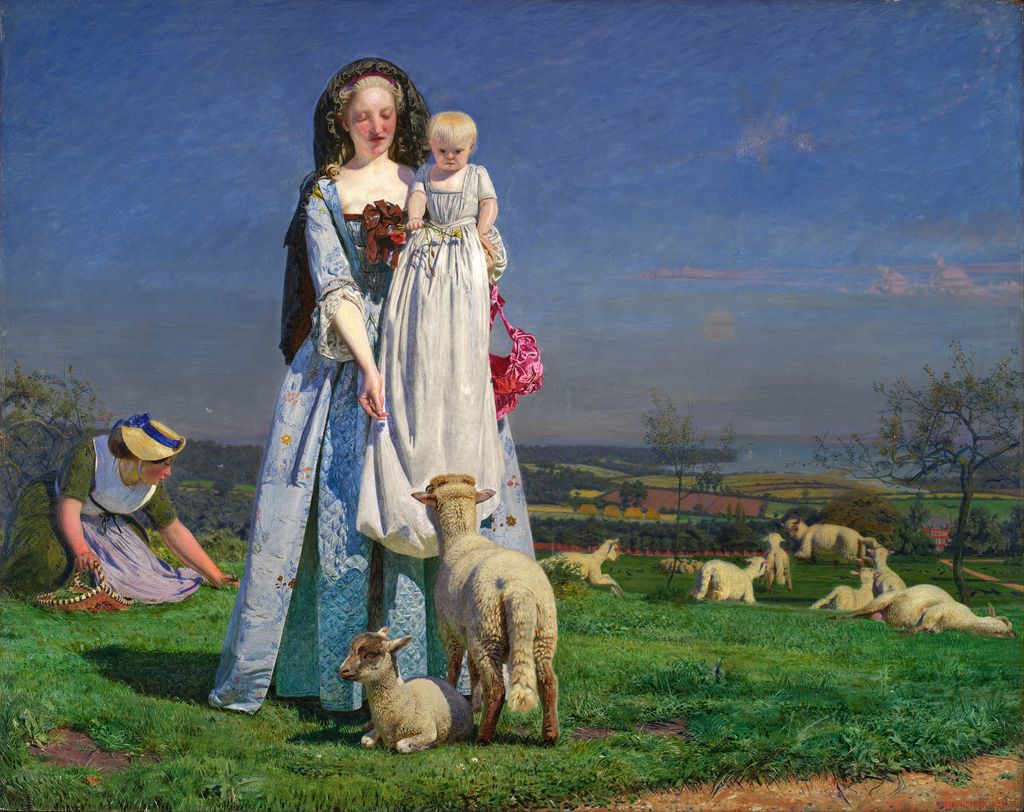
Emma became a recurring presence in the art. Brown's diary identifies her and Cathy as models for Pretty Baa-Lambs , which he began in 1851 after completing the central portion of the large poetry picture as Chaucer at the Court of Edward III . His account describes moving a lay figure in and out of the garden and arranging for sheep and lambs to be brought from Clapham Common. The apparently effortless outdoor scene depended on considerable preparation and repeated sittings. [5]
The household also appears in pictures whose subjects exceeded private life. Emma could become a woman in historical costume or an emigrant at sea. A familiar sitter's body gave Brown material to observe, while costume, setting and arrangement changed the role. Identifying a model is therefore one stage of understanding a painting, rather than proof that its narrative happened to that person.
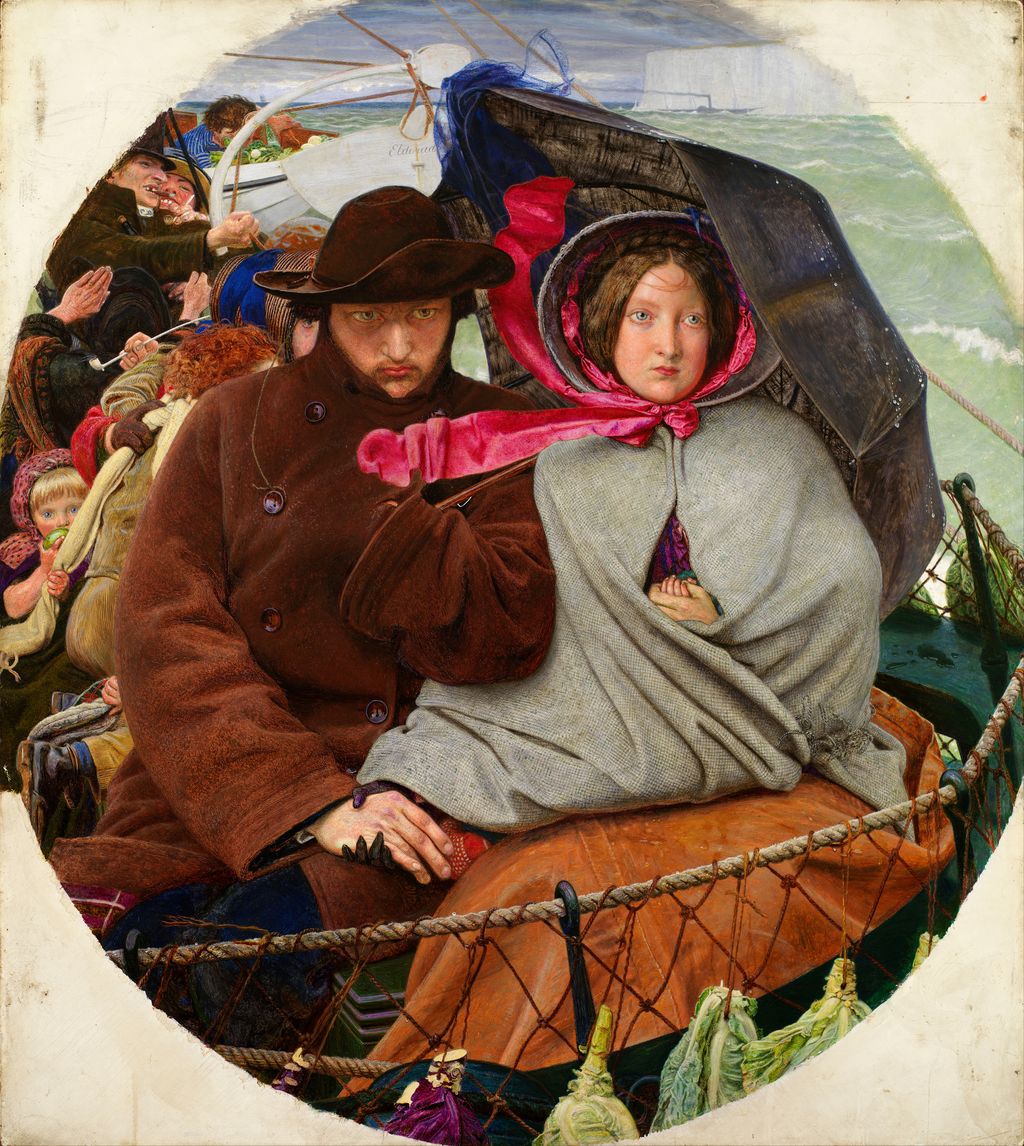
Oliver Madox Brown was born in 1855. The diary records expenditure on his clothes and the registration of his name during the period when his father was trying to complete The Last of England . Another son, Arthur, died in infancy in 1857. In the retrospective entry of January 1858, Brown recalled the child's brief final illness and his own need to request an advance from Plint towards the burial. Family loss and the practical need for money occupy the same painful passage. [5] [1]
Arthur had supplied a model for more than one work. Brown's March 1857 diary describes painting him on an enlarged canvas bearing an earlier study of Emma's head, associated with Take your Son, Sir . The January 1858 recollection separately describes drawing his head for a baby in Work . These are different accounts of different pictures. Neither statement, by itself, establishes why Take your Son, Sir remained unfinished. [1]
The diaries preserve self-reproach, pleasure, irritation and uncertainty alongside working hours and accounts. They allow a more varied view of Brown than the familiar severe face suggests. They are also edited records: William Michael Rossetti explicitly described his 1900 publication as a selection from the earlier diaries, rather than a complete edition. His footnotes and Brown's own words must be kept distinct. [5]

Ford Madox Brown, Pretty Baa-Lambs. Emma and Cathy supplied the principal models for a constructed outdoor scene.
Modern Life, Slow Work and Financial Pressure
During the early 1850s Brown began the paintings that became his best-known accounts of contemporary experience. The Last of England developed between 1852 and 1855; Work began in 1852 and reached completion in 1863, before its major public showing in 1865. These long spans overlapped with portraits, landscapes, religious subjects and other means of earning money. [1]
The emigrants in The Last of England are an imagined family, although Brown and Emma supplied the principal models. Thomas Woolner's departure for Australia in 1852 helped prompt the subject. Brown himself considered going to India during financial difficulties, but stayed in England. His diary shows the possibility receding when purchases offered renewed hope. The picture belongs to a real culture of departure without recording an actual voyage by its painter's household. [1] [5]
Brown's own catalogue description called the subject historical in the strict sense: mass emigration was a major event of his time. Instead of showing a panoramic embarkation, he concentrated its implications in a couple and a concealed infant. The joined hands hold the group together while the oval framing presses their bodies close. Personal dependence becomes the means of imagining a much larger movement of people. [1]
Work expanded the field of attention. Brown painted the Hampstead background on the spot and placed excavators at the centre of a street shared by prosperous passers-by, poor vendors, children and observers. His explanation identified the navvy as worthy of the attention more conventionally given to picturesque foreign workers. Carlyle and Frederic Denison Maurice represented intellectual labour. Brown's imagined biographies for the other figures reveal both social concern and the class assumptions through which he interpreted their lives. [1]
Religious painting remained equally active. Brown's Jesus Washing Peter's Feet , first exhibited in 1852, made the master's voluntary service to the disciple its central action. His explanation placed historical detail beneath the spiritual meaning of the event. The picture also underwent a striking physical revision: in June 1856 he recorded cutting out the painted legs of Christ, inserting fresh canvas and preparing to clothe the figure. The finished appearance concealed both reconsideration and difficult manual work. [1]
The concern with particular conditions of light continued in smaller pictures. Brown described painting the brilliant sun of Pretty Baa-Lambs , the dull, cold daylight of the emigrant scene, the twilight colours of the Hendon hayfield and the late-afternoon atmosphere seen from his Hampstead window. These were different experiments, conducted alongside one another. His career cannot be divided neatly into a historical period followed by an exclusively modern one. [1]
Such work was expensive in time. The diary's accounts of low auction prices, borrowed money and unpaid labour explain why completing a substantial picture did not guarantee security. His relations with dealers were often uncomfortable, and his letters could be combative. Yet a narrative of universal rejection would erase buyers, friends and teachers who supported him, as well as the artist's continued efforts to find workable arrangements. [1]
Thomas Plint's commission for Work supplied payments while the painting developed. After Plint died in 1861, dealings with his trustees introduced further uncertainty. George Rae and James Leathart became important purchasers and correspondents. Brown could be impatient with expectations of speed, but his letters also explain the problem: a design did not remove the need to arrange costumes, find models and repaint passages that failed to satisfy him. [1]
Rosie Jarvie's catalogue of the Leathart portrait documents this patronage in a particularly concrete form. Commissioned in 1863 and paid for in 1864, the portrait places a reduced Work behind its purchaser. Later alterations followed discussion between artist and sitter. Collecting involved continuing negotiation as well as an initial act of purchase. [7]

Ford Madox Brown, Work, Manchester version, begun in 1852, completed in 1863 and exhibited independently in 1865.
Teaching and the Morris Partnership
Brown's practical knowledge also found an audience through teaching. Late in 1858 he took over Rossetti's class at the Working Men's College and taught there through 1859 and much of 1860. The college brought him into an educational setting associated with Maurice and Ruskin, extending his contact with people whose interest in drawing could serve professional, personal or artistic purposes. [1]
The former student J. Phillips Emslie left a detailed account, printed by Hueffer. He contrasted Brown's insistence on a definite outline and measured proportions with Rossetti's freer teaching. Brown demonstrated the use of a plumb line and the comparison of measurements taken with a pencil. He asked what students hoped to gain from learning and tried to help them pursue those particular aims. The testimony gives substance to his reputation as a practical adviser. [1]
Emslie also remembered being invited to the studio to see paintings in progress. Teaching was connected with the artist's own work, allowing students to encounter pictures before their final appearance. Brown made him a pupil-teacher and placed his name beside his own in the college prospectus. Such acts complicate the image of a solitary painter absorbed entirely in personal disappointment. [1]
In 1861 Brown became a founding partner of Morris, Marshall, Faulkner & Co., alongside Morris, Rossetti, Burne-Jones, Philip Webb, Peter Paul Marshall and Charles Faulkner. The undertaking brought artists and designers together to supply furnishings and decoration. Brown had already designed stained glass for Powell's; the partnership gave that activity a more sustained setting. Figure design now served buildings and domestic interiors as well as framed paintings. [1]
The King René's Honeymoon Cabinet illustrates the collaboration. The V&A identifies John Pollard Seddon as the desk's designer and the Seddon family firm as maker. Brown proposed the theme and painted Architecture , while other panels were supplied by Burne-Jones, Rossetti and Prinsep, with decorative backgrounds by Morris. The cabinet was exhibited in 1862. Brown contributed a specific part to a jointly produced object. [8]

King René’s Honeymoon Cabinet, designed by John Pollard Seddon, with painted decoration by several artists. Brown contributed Architecture.
Watch: Ford Madox Brown
Choose a film exploring the people, stories and visual details in two of Brown’s best-known paintings.
Pre-Raphaelites: Ford Madox Brown – Work
Curator Tim Barringer explores the figures and stories within Work.
Watch on YouTubeThe 1865 Exhibition and a Family of Artists
Brown nevertheless sought greater control over exhibition conditions. He resented paintings being hung where light or height prevented them from being properly seen. In 1865 he organised an independent exhibition in Piccadilly, bringing Work together with paintings, drawings and decorative designs from across his career. Preparing the display involved finishing and retouching pictures, borrowing works and arranging publicity. He wrote the catalogue explanations himself. [1]
The artist became his own interpreter, making explicit connections between technique, narrative and modern experience. This was an opportunity to explain a range of activity that a single contribution to a group exhibition could scarcely convey. It also exposed him to the costs of hiring a gallery and attracting an audience. Independence required administration as well as conviction.
His letter of 19 April 1865 gives a measured assessment. There had been visitors and favourable press, and he believed his reputation was benefiting; expenditure had already exceeded £300, however, and he doubted that receipts would cover it. The exhibition was a significant assertion of his position, with benefits that did not translate simply into a financial triumph. [1]
Easel painting continued. The later 1860s brought renewed Shakespearean subjects, including Romeo and Juliet and Cordelia's Portion , alongside biblical compositions and repeated versions of existing designs. Brown's correspondence moves between these projects and the demands of patrons. Different pictures progressed at different speeds; an older invention could return to the easel while a new commission waited. [1]
Private teaching continued alongside these activities. Marie Spartali, later Stillman, studied with Brown during the 1860s. His letters and diary place her visits within the same schedule of painting, working with models and keeping up with fellow artists. Teaching remained a practical exchange carried on in a working studio. [1]
The children were also making art. In letters of the late 1860s Brown reported on Lucy's, Cathy's and Oliver's pictures, their exhibition treatment and their sales. Oliver worked on ambitious literary subjects, with his father offering advice. Their careers belonged within the household's artistic conversations, while remaining work made by the children themselves. [1]
For the 1870 Byron volume Brown supplied six illustrations and Oliver two; Herbert Bourne engraved them. Painted versions developed from several designs, including The Finding of Don Juan by Haidée and Byron's Dream . Illustration supplied further subjects and commissions, giving the same invention a life in different formats. [1] [4]
Cathy married the music critic Francis Hueffer in 1872. Lucy married William Michael Rossetti on 31 March 1874, joining two already closely connected families. The grandson who later wrote Brown's biography was Cathy's son, Ford Madox Hueffer. His book consequently tells the story from inside the family that had provided so many of the painter's models, pupils and companions. [1]
Friendship, Illness and Oliver's Death
The early 1870s combined sustained professional activity with responsibilities that could interrupt it. Brown helped Rossetti during his serious illness in 1872, accompanying him to Scotland and dealing with matters in London. Their letters record practical assistance as well as affection. Brown also organised aid for artists' dependants, an activity that Rossetti sometimes urged him to limit because it consumed time needed for painting. [1]
Paid portrait work remained part of his livelihood. In 1872 he painted Henry and Millicent Fawcett for Sir Charles Dilke. That year also brought The Convalescent , his pastel portrait of Emma during recovery from illness. Hueffer records her dangerous illness and Brown's contribution of a Convalescent to the fund for the family of the artist Holding. A family likeness could enter the wider network of practical support among artists. [1]
Emma reclines against pillows, her loose hair spreading beside the head and a small bunch of flowers resting in her hand. The pale bedding surrounds her face, while the curled fingers give the resting body a quiet point of activity. The arrangement is intimate without explaining the sitter's thoughts.
Oliver, meanwhile, had begun writing fiction. Brown's letters express intense pride in his ability; Rossetti discussed the young writer's novel Gabriel Denver . Oliver's prospects mattered as those of a developing artist and author within an already creative family. He died on 5 November 1874, aged nineteen. Brown's letter to Rae of 8 November supplies the date and conveys the immediate difficulty of writing about the loss. [1]
The correspondence also records care during the illness. Brown described spending nights in Oliver's room, the employment of a nurse and the repeated uncertainty over recovery. In later letters he spoke of trying to work again while finding that pleasure had drained from the undertaking. The letters preserve a father's movement between hope, bedside care and the effort to resume a working life. [1]
Nor did work cease. Cromwell on His Farm , a design with roots in the 1850s, was completed in 1874; the following years brought further portraits, religious pictures and Cromwell, Protector of the Vaudois . The long development of the farm subject is characteristic of Brown's practice: conception, commission and completion might belong to widely separated moments in his life. [1]
The Morris partnership changed in 1875 when Morris reorganised the business. Harvard's account of Brown's Self-Portrait connects his departure from the firm with legal proceedings in which Theodore Watts-Dunton represented him. Brown painted the portrait as a gift to Watts-Dunton in 1877. Palette, brushes and painting clothes identify the profession at the centre of the image; the gift also records a relationship of assistance. [9]
Ford Madox Brown, Self-Portrait, 1877. A gift to Theodore Watts-Dunton, who assisted him during the Morris firm reorganisation.
Manchester and the Demands of Public Painting
The Manchester Town Hall project emerged in 1878–79. Brown and Frederick Shields were initially to paint six scenes each for the Great Hall. Brown's earlier hopes for a public commission thus found a substantial outlet in his late fifties. The task demanded research, designs, full-size cartoons and large painted surfaces, with discussion and approval from civic authorities. [1]
He first travelled between London and Manchester. In 1881 Brown and Emma took lodgings in Manchester; the more complicated removal of their possessions followed. They lived first at Crumpsall and then in Victoria Park. The commission increasingly governed the rhythm of his working life. Hueffer describes the movable booth and platform used to secure some privacy in the public hall, while Brown's letters complain of interruptions and the expenditure of time. [1]
The developing cycle combined religious change, manufacture, commerce, civic institutions and scientific enquiry. The Baptism of Edwin came first in execution, rather than in the order of scenes on the walls. Its studies and cartoons formed part of an extended process. As with earlier pictures, preparation and later revisions cannot be collapsed into the date of the first painted surface. [1]
The history represented was selective and argumentative. An early programme included Peterloo; the completed cycle did not. Questions about whether events had actually happened in Manchester also provoked discussion. Brown defended the inclusion of religious turning points that could stand for larger changes affecting the city. His correspondence shows a painter negotiating what could be made into a legible scene, while local critics questioned the historical grounds of the selection. [1]
When Shields withdrew from his part of the scheme, Brown took responsibility for the remaining six murals. Negotiation over payment followed. Hueffer prints Brown's calculations of expenditure beyond the original fee and records the additional payments agreed by the corporation. The public commission offered continuity of employment, but its scale and duration did not remove the familiar tension between labour performed and money received. [1]
Brown's own 1893 essay distinguishes the materials. Seven Manchester paintings were executed directly on the walls using spirit fresco, the Gambier-Parry process. The remaining five were painted on canvas for attachment to the wall. The twelve-part cycle therefore contains different forms of construction, rather than twelve examples of painting into wet plaster. His essay discusses these choices as practical responses to climate, materials and the advantages of working on a movable support. [10]
The change also affected where he could work. Brown returned to London in 1887 and continued the later canvases there. Emma's failing health formed part of the circumstances of the move, and the family settled at St Edmund's Terrace near Regent's Park. The Manchester murals remained the central public undertaking even after his residence in the city ended. [1]
 King of Northumbria and Deira Ford Madox Brown.jpg)
Ford Madox Brown, cartoon for The Baptism of Edwin, 1879–1891. Pastel, coloured chalks and grey gouache on paper. National Gallery of Victoria.
Manchester Beyond the Town Hall
Brown's Manchester life extended beyond the commission. He lectured, attended musical events and formed friendships with figures including Charles Rowley and C. P. Scott. The Manchester Literary and Philosophical Society's recent account distinguishes the Literary Club, with which he was involved, from its own institution: its membership records provide no evidence that he joined the Society. Similar institutional names should not conceal the particular networks in which he participated. [11]
The most direct evidence of his social activity comes from a letter to Shields dated 16 April 1886. Brown described addressing a large gathering of unemployed men at Pomona Gardens and explained the labour bureau he and others had established. It registered people seeking work and invited employers to contact it. Applicants had appeared in large numbers; employers had proved much less responsive. Brown angrily suspected that manufacturers benefited from a surplus of desperate labour. [1]
This was a specific intervention in unemployment, joining his earlier teaching and efforts to help artists' families. It gives substance to the social concerns associated with Work . Across decades, painting, education, charitable organisation and the search for employment had brought him into different forms of engagement with other people's needs.
He continued to need commissions himself. The large family portrait for Henry Boddington and further decorative work accompanied the murals. Boddington also bought earlier pictures, providing support late in Brown's life. The relation between an artist's social criticism and his dependence on wealthy purchasers was complicated in practice, involving particular friendships and transactions rather than two entirely separate worlds. [1]
Brown also remained attached to older friendships and helped shape their remembrance. After Rossetti's death in 1882, he worked on memorial projects and continued discussing the treatment of his friend's pictures. The poet Mathilde Blind was another important companion in his later years; Hueffer records her visits, literary conversations and continuing contact during his last illness. The surviving family account establishes that intellectual companionship without fully resolving the private relationships behind it. [1]
The Last Years and an Uneven Reception
Late work did not proceed as a simple retirement from invention. Brown completed Stages of Cruelty in 1890, returning to a composition begun in the 1850s. The remaining Manchester paintings advanced, while designs for Henry Irving's production of King Lear renewed his contact with the drama that had occupied him in Paris almost fifty years earlier. The old subjects remained active resources. [1]
There were further family losses. Francis Hueffer died in 1889 and Emma in 1890. Cathy and her children became more closely involved in Brown's late household, and the William Rossettis lived nearby. Hueffer's recollections describe a sociable older man, welcoming younger visitors and talking with longstanding friends, as well as an artist coping with recurring physical difficulties. This is an affectionate family recollection, shaped by the grandson's familiarity with the household. [1]
The final Manchester scenes met with criticism as well as appreciation. Hueffer records controversy over the Bridgewater Canal panel and the corporation's demand to see the last composition before installation. He also describes Brown's displeasure at reports portraying him as destitute. The painter valued his London home and did not recognise that picture of his circumstances. Neither universal neglect nor comfortable public triumph fits all the evidence. [1]
The cycle was completed in 1893. Brown then worked on a full-size repetition of Wycliffe on Trial , commissioned by supporters for presentation to the nation. It remained unfinished when he died at home on 6 October. His funeral followed on 10 October, with Moncure Conway delivering the farewell address. He was seventy-two. [1]
His posthumous reputation developed through exhibitions and renewed research. MacCulloch records the early memorial displays of 1896 and 1897, the Leicester Galleries exhibition of 1909 and Mary Bennett's important Liverpool retrospective in 1964. The changing visibility of paintings and drawings helped reshape the account of his career. [4]
More recent interpretation has widened attention to the murals. In the University of Manchester's account of Colin Trodd's research, he emphasises their mixture of comedy and seriousness, their dynamic human action and the encounter between ordinary people and larger social powers. This is a modern interpretation of the cycle, rather than a claim that its Victorian audience all understood it in the same way. [12]
Brown's own late statement gives the public relationship a different emphasis. In “Of Mural Painting” he recalled visitors mistaking a wounded Danish chieftain for a man being carried off by the police. They had misunderstood the historical event, but recognised misfortune and care. He considered that response meaningful. Across a career concerned with history, literature, contemporary life and design, he continued to value the human action that enabled a viewer to enter a picture. [10]
Books for further study
These scholarly publications offer routes into more detailed study.
Ford Madox Brown: A Catalogue Raisonné. Mary Bennett. Yale University Press / Paul Mellon Centre, 2010.
A detailed scholarly reference for versions, provenance and catalogue entries. Publisher information.
Ford Madox Brown: The Manchester Murals and the Matter of History. Colin Trodd. Manchester University Press, 2022.
A study of the Manchester mural cycle, historical interpretation and civic setting. Publisher information.
Artworks directory
Explore paintings, drawings, cartoons, illustrations and decorative designs documented in museum collections and specialist research. Distinct versions are listed separately; repeated print impressions are grouped. The coverage includes studies and works without a dedicated article and remains open to further research.
| Name | Date | Medium |
|---|---|---|
| Work (Manchester) | 1852–1865 | Oil on canvas |
| The Last of England (Birmingham) | 1852–1855 | Oil on panel |
| Jesus Washing Peter’s Feet | 1852–1856 | Oil on canvas |
| Pretty Baa-Lambs | 1851–1859 | Oil on panel |
| Take Your Son, Sir | ?1851–1892 | Oil on canvas |
| Lear and Cordelia | 1849–1854 | Oil on canvas |
| Cordelia’s Portion | 1867–1875 | Oil on canvas |
| Walton-on-the-Naze | 1859–1860 | Oil on canvas |
| Chaucer at the Court of Edward III (Tate) | 1856–1868 | Oil on canvas |
| Carrying Corn | 1854–1855 | Oil on mahogany |
| The Hayfield (The Hay Harvest) | 1855–1856 | Oil on mahogany |
| Stages of Cruelty | 1856–1890 | Oil on canvas |
| The Irish Girl | 1860 | Oil on canvas laid on board |
| Romeo and Juliet (Delaware) | 1869–1870 | Oil on canvas |
| The Seeds and Fruit of English Poetry | 1845–1853 | Oil on canvas |
| Self-Portrait | 1877 | Oil on canvas |
| The Bromley Children | Probably 1844 | Oil on canvas |
| The Bromley Family | 1844 | Oil on canvas |
| Byron’s Dream (Manchester) | 1874; worked on into 1875 | Oil on canvas |
| Cartoon for The Baptism of Edwin | 1879–1891 | Pastel, coloured chalks and grey gouache |
| The Coat of Many Colours | 1864–1866 | Oil on canvas |
| The Convalescent (Birmingham) | Dated October 1872 | Pastel |
| Crabtree Watching the Transit of Venus (reduced painting) | 1881–1888 | Tempera on panel |
| Cromwell on His Farm (Lady Lever) | Completed 1874 | Oil on canvas |
| Cromwell Protector of the Vaudois | 1877 | Oil on canvas |
| Dalton Collecting Marsh-Fire Gas (Town Hall mural) | 1886–1887 | Mural on canvas |
| The Establishment of the Flemish Weavers (reduced painting) | 1881; completed 1888 | Tempera on panel |
| The Finding of Don Juan by Haidée (NGV) | 1869–1870; later retouched | Watercolour and gouache over pencil |
| Henry and Millicent Fawcett | 1872 | Oil on canvas |
| Jacob and Joseph’s Coat (Ponce) | c.1868–1871 | Oil on canvas |
| James Leathart | 1863–1864; altered 1869 | Oil on canvas |
| King René’s Honeymoon (Tate watercolour) | 1864 | Graphite, watercolour, gouache and gum arabic on card |
| King René’s Honeymoon Cabinet (collaborative work) | 1861; exhibited 1862 | Oak, inlaid woods, painted panels and metal mounts; Brown designed Architecture |
| Manfred on the Jungfrau | 1841; retouched 1861 | Oil on canvas |
| Millie Smith | 1846 | Oil on paper laid on panel |
| William Michael Rossetti by Lamplight | 1856–1857 | Oil on panel |
| The Traveller (Manchester oil) | 1868–1884 | Oil on panel |
| Waiting: An English Fireside of 1854–55 | 1851–1855 | Oil on panel |
| An English Autumn Afternoon | 1852–1853; finished c.1854 | Oil on canvas |
| Alfred the Great: Sketch of Alfred drawing in the Sand | 1843–1845 | pencil |
| Historical Notes and Sketches of Alfred the Great | 1843–1850 | brown ink writing over pencil |
| Angels watching the Crown of Thorns: Study of clasped Hands | 1846 | black chalk |
| Architecture: Study of Gothic Arches and 14th Century Vaulting | c. 1847 | brown pen and ink over pencil on grey paper |
| The Ascension: Study of Angels and Hands | 1844 | brown pen and ink over pencil |
| The Ascension: Study of a Group of Angels | 1844 | brown pen and ink over pencil |
| The Ascension: Study of a Group of six flying Angels | 1844 | brown pen and ink over pencil |
| The Ascension: Two nude Angels holding onto each other | 1844 | brown brush and ink over pencil |
| The Ascension: Study for a kneeling Apostle | 1844 | black chalk touched with white on brown-toned paper |
| Head of a Child | c. 1844 | black chalk touched with white on brown toned paper |
| The Ascension: Drapery Study of a praying Apostle | 1844 | black chalk |
| The Spirit of Justice: Seated Figure in ecclesiastical Robes, gripping a Staff with left Hand raised in a Blessing | 1844 | black chalk |
| The Ascension: Study for an Apostle | 1844 | black chalk |
| The Spirit of Justice: Body of seated Figure in ecclesiastical Robes holding a Staff and a Book | 1844 | black chalk |
| The Ascension: Study of an Apostle | 1844 | black chalk on toned paper |
| Full-length Sketch of a standing, naked Child | 1844 | black chalk on toned paper |
| The Ascension: Study for Christ | 1844 | brown pen and ink over pencil |
| Caricature: Composite Drawing: A Stunner | 1861–1863 | pencil |
| A Victorian Woman in her Underwear | 1861–1863 | pencil |
| Caricature: Composite Drawing: Bewigged Head | 1861–1863 | pencil |
| Bowed Head of a bearded Man | 1861–1863 | pencil |
| Chaucer at the Court of Edward III: Early compositional Study | 1845 | pencil with brown pen and ink |
| Chaucer at the Court of Edward III: Study for Milton and two Designs for Tombstones | c.1845–c.1846 | pencil with brown frame outline |
| Chaucer at the Court of Edward III: Tracing of the Figure of Milton | c.1845–c.1849 | brown pen and ink with pencil on tracing paper |
| Chaucer at the Court of Edward III: Tracing of a Gothic Arch | c.1845–c.1849 | brown pen and ink with pencil on tracing paper |
| Chaucer at the Court of Edward III: Early compositional Study | 1845 | pencil with brown pen and ink |
| Chaucer at the Court of Edward III: Nude Studies of two Boys | 1845 | pencil, laid down |
| Chaucer at the Court of Edward III: Nude Studies of four Figures | 1845 | pencil |
| Chaucer at the Court of Edward III: Eight early Studies of Figures and Hands | 1845 | pencil |
| Chaucer at the Court of Edward III: Nude Studies for the Figures of Byron, Shakespeare and Burns | 1845 | black chalk |
| Chaucer at the Court of Edward III: Drapery Study for Burns | 1847 | black chalk |
| Chaucer at the Court of Edward III: Study of a right Leg and left Foot for Milton | 1847 | black chalk |
| Chaucer at the Court of Edward III: Study of a left Leg for Shakespeare | 1847 | black chalk |
| Chaucer at the Court of Edward III: Study of Drapery for Milton | 1847 | black chalk |
| Chaucer at the Court of Edward III: Drapery Study for Shakespeare | 1847 | black chalk |
| Chaucer at the Court of Edward III: Study of a Man in a medieval Hood | 1847 | black chalk |
| Chaucer at the Court of Edward III: Study for the Cardinal | 1847 | black chalk |
| Chaucer at the Court of Edward III: Drapery Study in Profile for Courtier | 1847 | black chalk |
| Chaucer at the Court of Edward III: Drapery Study | 1847 | black chalk |
| Chaucer at the Court of Edward III: Female Nude Study of a Muse holding onto a Rail | 1847 | pencil |
| Chaucer at the Court of Edward III: Female Nude: Study of a Muse | 1847 | pencil |
| Chaucer at the Court of Edward III: Nude Study for seated Lady | 1847 | pencil |
| Chaucer at the Court of Edward III: Nude Study of a Woman with right Arm raised | 1847 | pencil |
| Chaucer at the Court of Edward III: Two Studies of Back of a seated Woman's Head | 1847 | pencil |
| Chaucer at the Court of Edward III: Two Studies of a seated Woman in lost Profile Pose and from the Back | 1847 | pencil |
| Chaucer at the Court of Edward III: Nude Study of a Woman | 1847 | pencil |
| Chaucer at the Court of Edward III: Sketch of a Woman supporting another Figure | 1847 | pencil |
| Chaucer at the Court of Edward III: Study of the Heads and Shoulders of two Women | 1847 | pencil |
| Chaucer at the Court of Edward III: Drapery Study for Edward III with Outline of a Child | 1847 | black chalk |
| Chaucer at the Court of Edward III: Foreshortened Study for Head of a Jester | 1847 | pencil |
| Chaucer at the Court of Edward III: Head of Alexander Pope | 1847 | black chalk |
| Chaucer at the Court of Edward III: Two Hand Studies | 1847 | black chalk |
| Chaucer at the Court of Edward III: Study of Head of Milton copied from Sculpture | 1848 | black chalk |
| Chaucer at the Court of Edward III: Nude Studies for the Squire and the Courtier talking to Gower | 1848 | pencil |
| Chaucer at the Court of Edward III: Drapery Study for the Black Prince | 1848 | black chalk with touches of white |
| Chaucer at the Court of Edward III: Three Studies of Hands | 1848 | Black chalk |
| Chaucer at the Court of Edward III: Four Studies of Hands | 1848 | black chalk touched with white |
| Chaucer at the Court of Edward III: Study of a clasped right Hand for one of the Poets | 1848 | black chalk |
| Chaucer at the Court of Edward III: Study of a left Hand for Burns | 1848 | black chalk heightened with touches of white |
| Chaucer at the Court of Edward III: Study of Drapery for Burns | 1848 | black chalk |
| Chaucer at the Court of Edward III: Drapery Study | 1848 | black chalk |
| Chaucer at the Court of Edward III: Drapery Study for the Black Prince | 1851 | black and white chalks on brown-toned paper |
| Chaucer at the Court of Edward III: Study for Squire's Legs | 1851 | black chalk heightened with white |
| Chaucer at the Court of Edward III: Two Head Studies of an old Woman | 1851 | black chalk |
| Costume Study: Five Sketches of Armour and Costume | 1844 | brown pen and ink over pencil |
| Costume Study: Archbishop's Dress | 1845 | brown pen and ink on tracing paper |
| Costume Studies: French and Italian thirteenth and fourteenth-century Costumes (seven Drawings) | 1845 | brown pen and ink on tracing paper |
| Costume Study: Seigneur de Rimini | 1845 | brown pen and ink on tracing paper |
| Dalziels' Bible Gallery: The Death of Eglon | 1863–1865 | engraved woodblock; designed by Brown, engraved by the Dalziel Brothers |
| Dalziels' Bible Gallery: The Death of Eglon | 1881 | wood engraving; designed by Brown, engraved by the Dalziel Brothers |
| Dalziels' Bible Gallery: Elijah and the Widow's Son | 1863–1865 | engraved woodblock; designed by Brown, engraved by the Dalziel Brothers |
| Dalziels' Bible Gallery: Elijah and the Widow's Son | 1881 | wood engraving; designed by Brown, engraved by the Dalziel Brothers |
| Dalziels' Bible Gallery: Joseph’s Coat (Compositional Sketch and four Studies for Jacob's Granddaughter) | 1863–1865 | pencil on paper |
| Dalziels' Bible Gallery: Joseph's Coat | 1863–1865 | engraved woodblock; designed by Brown, engraved by the Dalziel Brothers |
| Dalziels' Bible Gallery: Joseph’s Coat | 1881 | wood engraving; designed by Brown, engraved by the Dalziel Brothers |
| Decorative Sketches: Venus Reclining on a Shell in the Midst of the Sea | 1848–1849 | brown pen and ink over pencil |
| Decorative Design: Ornamental Pattern | 1850 | watercolour and bodycolour over pen and ink, and pencil on two sheets of paper |
| Down Stream: Main Illustration (Last Year's First of May) | 1871 | wood engraving; designed by Brown, print execution by an engraver |
| Down Stream: Tailpiece to the Poem (This Year's First of June) | 1871 | wood engraving; designed by Brown, print execution by an engraver |
| The Establishment of Flemish Weavers in Manchester A.D. 1363: Four Studies of Parts of a Horse | 1879–1882 | black, white and red chalk on rough brown paper |
| Female: Two Studies of young Woman in eighteenth-century Costume | 1849 | pencil |
| Infant's Repast: Study of Mother and Child | 1848 | black and white chalk |
| Infant's Repast: Study of Mother and Child with separate Arm and Leg Studies of the Child | 1848 | black chalk with grey wash |
| King Lear: Sketch of Lear questioning Cordelia | 1844 | brown pen and ink over pencil |
| Alfred the Great: Compositional Sketches | 1843–1845 | pencil |
| King Lear: Sketches of Lear imagining his unfaithful Daughters’ Trial and Lear in the Storm | 1844 | brown pen and ink over pencil |
| Alfred the Great: Compositional Studies and Sketches and Chaucer at the Court of Edward III: Study of Cherubs | 1843–1849 | pencil |
| King Lear: Kent accuses Oswald | 1844 | brown pen and ink with pencil underneath |
| King Lear: Lear recounts his Wrongs to Regan | Undated | Brown pen and ink over pencil |
| King Lear: Cordelia at Lear's Bedside (Lear's Awakening) | 1844 | brown pen and ink over pencil |
| Cordelia Parting from Her Sisters (The Germ) | 1850; reprinted 1901 | Etching; designed by Brown, print execution by an engraver |
| King René's Honeymoon: Study for Architecture | 1861 | brush and brown ink, with watercolour, over pencil on brown paper |
| The Last of England: Cartoon | 1852 | pencil, image edged with brown ink |
| The Last of England: Portrait of Emma Hill | December 1852 | chalks with scratching out on two sheets of paper |
| Lear and Cordelia and The Infant’s Repast: Four Studies of Hands | 1849 | black chalk |
| Lyra Germanica - the Christian Life: Abraham and Isaac | 1868 | wood engraving; designed by Brown, print execution by an engraver |
| Lyra Germanica - the Christian Life: Finished Design for The Entombment | 1867 | black pen and ink |
| Lyra Germanica - the Christian Life: The Entombment | 1868 | wood engraving; designed by Brown, print execution by an engraver |
| Male: Sketch of Man reclining on Steps with Hands bound together | 1844 | brown pen and ink over pencil |
| Male: Academic nude Study, half-length with Moustache and Arms folded | 1846–1849 | black chalk |
| Male: Academic Study of Nude holding a Staff | 1847 | pencil |
| Male: Academic Study of Nude posed as a Sculptor | 1847 | chalk with grey wash |
| Male: Academic Study, three-quarter length Nude, with a Moustache and clenched Fists | 1847 | black chalk |
| Oure Ladye of Saturday Night: Seven Sketches | 1846 | pencil |
| Oure Ladye of Saturday Night: Four Studies for Angel holding Child | 1847 | pencil |
| Oure Ladye of Saturday Night: Study of Angel holding Child | 1847 | black chalk |
| Oure Ladye of Saturday Night: Study of Arm and Hands for Angel holding Bowl of Water | 1847 | black chalk |
| Oure Ladye of Saturday Night: Drapery Study for Angel holding Bowl of Water | 1847 | black chalk |
| Oure Ladye of Saturday Night: Study of Head for Angel holding Bowl of Water | 1847 | black chalk with rubbing and grey wash |
| Oure Ladye of Saturday Night: Study of Child seated on Knees of the Virgin and two separate Studies of the Child's Legs | 1847 | pencil on brown-toned paper |
| Oure Ladye of Saturday Night: Frieze Design | c. 1847 | pencil and black pen and ink |
| Oure Ladye of Saturday Night: Three Studies of Arms and Legs of Child | 1847 | pencil |
| Oure Ladye of Saturday Night: Three Studies of Child's Legs on Virgin's Knees | 1847 | pencil |
| Oure Ladye of Saturday Night: Studies of Right Foot and Left Hand of Child | 1847 | pencil on light brown paper |
| Oure Ladye of Saturday Night: Drapery Study for Virgin | 1847 | black chalk |
| Oure Ladye of Saturday Night: Study for Head of Virgin | 1847 | black chalk with wash |
| Parisina’s Sleep: Study for Prince Azo and Parisina | 1842 | black chalk with pencil side drawing |
| Parisina's Sleep: Study for Head of Prince Azo | 1842 | black chalk with grey wash |
| Parisina's Sleep: Study for the Head of Parisina | 1842 | black and white chalk with grey wash |
| Poets of the Nineteenth Century: The Prisoner of Chillon: Compositional Sketch | 1856 | pencil |
| Profile of a Man's left Eye and Nose | c.1856 | pencil |
| Poets of the Nineteenth Century: The Prisoner of Chillon: Study of a Corpse | 1856 | pencil |
| Designs for Decoration | c.1856 | pencil |
| Poets of the Nineteenth Century: The Prisoner of Chillon | 1857 | wood engraving; designed by Brown, print execution by an engraver |
| Portrait: Head Study of Daniel Casey (three-quarter view) | 1848 | black chalk |
| Portrait: Head Study of Daniel Casey (full-face) | 1848 | black chalk |
| Portrait: Miss Iza Duffus Hardy | 1872 | pastel and coloured chalks on brown paper |
| Portrait: Emma Hill (later Mrs Madox Brown) | 1848 | black chalk |
| Portrait: Emma Hill (later Mrs Madox Brown) | 1852 | pencil |
| Portrait: Mrs Madox Brown (neé Emma Hill) | 9 May 1854 | pencil |
| The Repose in Egypt: Compositional Sketch | 1847 | pencil |
| Study of a Statue of the Discobolus | 1845 | Black chalk |
| William Shakespeare: Study | 1849–1850 | pencil |
| William Shakespeare: Invitation Card | 1850 | wood engraving; designed by Brown, print execution by an engraver |
| The Spirit of Justice: Study for Baron and his Advisor, with Sketches of Erudition and Wisdom | 1844–1845 | brown pen and ink over pencil |
| The Spirit of Justice: Drapery Study for Erudition | 1844–1845 | black chalk |
| Drapery Study and Sketch of Two Legs | Undated | Black chalk |
| The Spirit of Justice: Study for Wisdom | 1844–1845 | black chalk with grey wash |
| The Spirit of Justice: Study for Head of the Baron | 1844–1845 | black chalk |
| The Spirit of Justice: Study for the Head of central Bishop | 1844–1845 | black chalk |
| The Spirit of Justice: Study for the Head of a Bishop | 1844–1845 | black chalk with grey wash |
| The Spirit of Justice: Study for the uplifted left Arm of Justice | 1844–1845 | black chalk |
| The Spirit of Justice: Study for Head of Counsellor in a Coronet | 1844–1845 | black chalk with touches of blue chalk |
| The Spirit of Justice: Study for Head of Counsellor | 1844–1845 | black chalk |
| The Spirit of Justice: Drapery Study for the Central Bishop | 1844–1845 | Black chalk |
| Part of a Drapery Study | 1844–1845 | black chalk |
| The Spirit of Justice: Study for Head of Widow | 1844–1845 | black chalk |
| Stages of Cruelty: Study for the Child (Catherine Madox Brown) | 1857 | black chalk on pale grey paper |
| Stained Glass Design: Cartoon for Zachariah, The High Priest | 1872 | black chalk |
| Stained Glass Design: Cartoon for The Young Milton | 1874 | black chalk |
| Stained Glass Design: Cartoon for St Simon | 1874 | black chalk |
| Sterne's 'Sentimental Journey': Study for Yorick and La Fleur talking to Maria’s Mother | 1842 | brown pen and ink over pencil |
| The Body of Harold brought before William the Conqueror: Eight Sketches of Figure Groups | c.1844 | pencil |
| Sterne's 'Sentimental Journey' : Yorick (Laurence Sterne) and Maria Walking | 1842 | pen and ink, watercolour and bodycolour over pencil |
| Study of Tree Trunk with Roots | c.1847 | black chalk, heightened with white chalk on buff paper |
| Two Studies of Tree Trunks | c.1846 | black chalk |
| Unknown Subject: Compositional Sketch | 1843–1850 | pencil |
| Wycliffe reading his Translation of the Bible: Nude Study for Chaucer | 1847 | pencil |
| Wycliffe reading his Translation of the Bible: Study for Chaucer | 1847 | pencil |
| Wycliffe reading his Translation of the Bible: Nude Study of Gower | 1847 | pencil |
| Wycliffe reading his Translation of the Bible: Study for Gower | 1847 | pencil |
| Wycliffe reading his Translation of the Bible: Nude Study for John of Gaunt and Chaucer's right Hand | 1847 | pencil and black chalk |
| Wycliffe reading his Translation of the Bible: Study of John of Gaunt and Chaucer's Left Hand | 1847 | pencil and black chalk |
| Wycliffe reading his Translation of the Bible: Study for Wycliffe | 1847 | black chalk |
| Wycliffe reading his Translation of the Bible: Nude Study for Wycliffe | 1847 | pencil |
| Wycliffe reading his Translation of the Bible: Drapery Study for Wycliffe | 1847 | black chalk |
| Wycliffe reading his Translation of the Bible: Drapery Study for Chaucer | 1848 | black chalk |
| Wycliffe reading his Translation of the Bible: Study of Legs for John of Gaunt and two Studies of Feet for Wycliffe | 1848 | black chalk |
| Wycliffe Reading his Translation of the Bible: Studies of Hands for John of Gaunt and Gower | 1847 | black chalk |
| Wycliffe reading his Translation of the Bible: Study for Head of Wycliffe | 1847 | pencil |
| Wycliffe reading his Translation of the Bible: Study for Constance and Child | 1847 | pencil |
| Wycliffe reading his Translation of the Bible: Unfinished Study for Head of Constance | 1847–48 | pencil |
| Wycliffe reading his Translation of the Bible: Portrait of Elizabeth Bamford modelling for Constance | 1848 | pencil |
| Wycliffe reading his Translation of the Bible: Study for Head of Constance | 1848 | chalk over pencil |
| Wycliffe reading his Translation of the Bible: Study for Head of Chaucer | 1848 | pencil |
| Wycliffe reading his Translation of the Bible: Study of Monk representing the Catholic Faith | 1848 | black chalk with brown pen and ink, squared up |
| Wycliffe reading his Translation of the Bible: Study of young Woman representing the Protestant Faith | 1848 | black chalk |
| Cathy Madox Brown at the Age of Three (Tate N01356) | 1853 | Graphite on paper |
| King René‘s Honeymoon (Tate N02409) | date not known | Ink on paper |
| Sheepshearing (Tate N02410) | c.1887 | Ink and graphite on paper |
| Studies for ‘Work’ (Tate N02411) | 1855 | Graphite and ink on paper |
| Design for Badge for Gillum’s Homes (Tate N02412) | date not known | Ink and graphite on paper |
| Arkwright’s Mill (Tate N02413) | 1878 | Graphite on paper |
| Study for ‘John Kay’ (Tate N02414) | 1889 | Graphite on paper |
| Study for ‘Southend’ (Tate N02415) | date not known | Graphite on paper |
| ‘Where are you going, my pretty maid?’ (Tate N02416) | date not known | Graphite on paper |
| Section of the Bridgewater Canal (Tate N02417) | 1890 | Ink on paper |
| A Barge on the Bridgewater Canal (Tate N02418) | 1890 | Graphite on paper |
| Study of the Tow-Path on the Bridgewater Canal (Tate N02419) | 1890 | Graphite on paper |
| Our Lady of Good Children (Tate N02684) | 1847–61 | Pastel, watercolour and gold paint on paper |
| Arkwright’s Mill (Tate N02791) | 1881 | Graphite on paper |
| The Bridgewater Canal (Tate N02792) | 1890 | Ink on paper |
| The Bridgewater Canal (Tate N02793) | date not known | Chalk and graphite on paper |
| The Last of England (Tate N03064) | 1864–6 | Watercolour on paper |
| Mauvais Sujet (Tate N03228) | 1863 | Watercolour on paper |
| Study of a Man Painting (Tate N03472) | 1839 | Graphite on paper |
| The Brent at Hendon (Tate N03528) | 1854–5 | Oil paint on board on mahogany |
| Study for the Dean in the ‘Execution of Mary Queen of Scots’ (Tate N04280) | c.1840 | Oil paint on paper |
| Sketch for ‘Jesus Washing Peter’s Feet’ (Tate N04281) | 1852 | Graphite on paper |
| Sketch for ‘Cromwell on his Farm’ (Tate N04282) | c.1853 | Graphite on paper |
| The Coat of Many Colours (Tate N04584) | 1867 | Watercolour and gouache on paper |
| Stages of Cruelty (Tate N04625) | c.1856 | Watercolour on paper |
| Head of a Girl (Tate N04803) | date not known | Oil paint on paper |
| Portrait of Dykes Barry as a Child (Tate N04866) | 1853 | Oil paint on mahogany |
| Jesus Washing Peter’s Feet (Tate N05301) | 1857–8 | Watercolour on paper |
| Platt Lane (Tate N05383) | 1884 | Oil paint on canvas |
| Study of F.G. Stephens for ‘Jesus Washing Peter’s Feet’. Verso: A Head Crowned with Laurels (Tate T00571) | 1852 | Graphite on paper. Verso: graphite on paper |
| Sketch for ‘Jesus Washing Peter’s Feet’ (Tate T01035) | c.1851 | Ink and graphite on paper |
| Chaucer at the Court of Edward III (Sydney) | 1845–1851 | Oil on canvas |
| Wycliffe Reading His Translation of the Bible to John of Gaunt (Bradford) | 1848 | Oil on canvas |
| Work (Birmingham replica) | 1859–1863 | Oil on canvas |
| The Spirit of Justice (Book of Art reproduction) | Published 1846 | Wood engraving after Brown’s cartoon; engraver unknown |
| The Execution of Mary Queen of Scots | 1840–1842 | Oil on canvas |
| The Prisoner of Chillon (Manchester oil) | 1843 | Oil on canvas |
| The Parting of Cordelia from Her Sisters (oil) | 1853 | Oil on canvas |
| Cordelia’s Portion (Lady Lever) | 1866–1872 | Watercolour, gouache and pastel |
| The Ascension | 1844–1845 | Oil on canvas |
| Manfred in the Chamois Hunter’s Hut (oil sketch) | 1840 | Oil on canvas |
| Dr Primrose and His Daughters (The Vicar of Wakefield) | 1840–1841 | Oil on canvas |
| The Body of Harold Brought before William the Conqueror | 1844–1861 | Oil on canvas |
| The Seeds and Fruits of English Poetry (Bedford cartoon) | 1845 | Black chalk on paper |
| Wycliffe Reading His Translation of the Bible (oil sketch) | 1847–1848 | Oil on board |
| Cromwell Discussing the Protection of the Vaudois (Nottingham) | 1877–1878 | Oil on canvas |
| Two Drawings of Men in Hoods | c.1845 | Pencil on paper |
| The Seeds and Fruits of English Poetry: Study of the Right Side | c.1845 | Brown pen and ink with pencil |
| Chaucer: A Man in a Hood with a Liripipe and Two Drapery Studies | 1848 | Oil on canvas |
| The Prisoner of Chillon Entreating His Jailors (Yale watercolour) | 1858 | Watercolour heightened with bodycolour |
| Elijah and the Widow’s Son (Birmingham oil) | 1864 | Oil on panel |
| He That Soweth (Lyra Germanica) | Published 1868 | Wood engraving by the Dalziel Brothers after Brown |
| The Entombment (NGV) | 1871–1878 | Watercolour, gouache, gold paint and gum arabic over pencil |
| The Sower (Morris firm tile) | c.1864–1873 | Tile; design by Brown, workshop execution |
| Childe Harold’s Pilgrimage (Byron illustration) | Published 1870 | Steel engraving by Herbert Bourne after Brown |
| The Two Foscari (Byron illustration) | Published 1870 | Steel engraving by Herbert Bourne after Brown |
| The Corsair (Byron illustration) | Published 1870 | Steel engraving by Herbert Bourne after Brown |
| Sardanapalus (Byron illustration) | Published 1870 | Steel engraving by Herbert Bourne after Brown |
| Don Juan (Byron illustration) | Published 1870 | Steel engraving by Herbert Bourne after Brown |
| Byron’s Dream (roundel title-page design) | Published 1870 | Steel engraving by Herbert Bourne after Brown |
| The Finding of Don Juan by Haidée (Birmingham oil) | 1870–1873 | Oil on canvas |
| The Dream of Sardanapalus (Delaware) | 1871–1872 | Watercolour on paper |
| The Traveller (Once a Week) | Published 1869 | Wood engraving by Joseph Swain after Brown |
| The Infant’s Repast | 1848 | Oil on board |
| Oliver Madox Brown Aged Four (Dwale Bluth frontispiece) | Published 1876 | Etching |
| Oliver Madox Brown as a Young Man (Dwale Bluth frontispiece) | Published 1876 | Etching |
| A Beggar and Other Fantasies: Title-page Illustration | Published 1889 | Photo-engraving after Brown |
| Dramas in Miniature: Title-page Illustration | Published 1891 | Photo-engraving after Brown |
| The Brown Owl: Frontispiece | Published 1892 | Photo-engraving after Brown |
| The Brown Owl: Central Illustration | Published 1892 | Photo-engraving after Brown |
| The Feather: Frontispiece | Published 1892 | Photo-engraving after Brown |
| The Ascension: Study for Christ | 1844 | Pen and ink |
| King Lear: Lear Questions Cordelia (Whitworth) | 1844 | Pencil, pen and brown ink |
| King Lear: France Claims the Dispossessed Cordelia (Whitworth) | 1844 | Pencil, pen and brown ink |
| King Lear: Cordelia Parts from Her Sisters (Whitworth) | 1844 | Pencil, pen and brown ink |
| King Lear: Goneril and Regan Together (Whitworth) | 1844 | Pencil, pen and brown ink |
| King Lear: Goneril Tells Oswald How to Treat Lear (Whitworth) | 1844 | Pencil, pen and brown ink |
| King Lear: Oswald’s Insolence to Lear (Whitworth) | 1844 | Pencil, pen and brown ink |
| King Lear: Lear Rebukes Oswald (Whitworth) | 1844 | Pencil, pen and brown ink |
| King Lear: Kent Trips Oswald (Whitworth) | 1844 | Pencil, pen and brown ink |
| King Lear: Goneril’s Complaint to Lear (Whitworth) | 1844 | Pencil, pen and brown ink |
| King Lear: Lear Curses Goneril’s Infidelity (Whitworth) | 1844 | Pencil, pen and brown ink |
| King Lear: Kent Challenges Oswald (Whitworth) | 1844 | Pencil, pen and brown ink |
| King Lear: Kent in the Stocks (Whitworth) | 1844 | Pencil, pen and brown ink |
| King Lear: Lear Recounts His Wrongs to Regan (Whitworth) | 1844 | Pencil, pen and brown ink |
| King Lear: Lear Parts from Regan and Goneril (Whitworth) | 1844 | Pencil, pen and brown ink |
| King Lear: Lear and the Fool in the Storm (Whitworth) | 1844 | Pencil, pen and brown ink |
| King Lear: Lear Mad on the Beach at Dover (Whitworth) | 1844 | Pencil, pen and brown ink |
| King Lear: Alternative Study: Lear Curses Goneril (Whitworth) | 1844 | Pencil, pen and brown ink |
| King Lear: Lear Imagines His Daughters’ Trial (Whitworth) | 1844 | Pencil |
| King Lear: Alternative Study: Lear in the Storm (Whitworth) | 1844 | Pencil, pen and brown ink |
| The Last of England (Fitzwilliam) | 1860 | Oil on canvas |
| The Convalescent (Metropolitan Museum) | Dated 1872 | Pastel |
| Self-Portrait (Walker drawing) | 1850; retouched 1853 | Black chalk |
| Byron’s Dream (Whitworth) | 1889 | Watercolour over graphite |
| Cordelia Parting from Her Sisters (Cleveland sketch) | 1854 | Pen and oil on paper mounted on panel |
| David and Goliath: Cartoon for Stained Glass Window at Jesus College, Cambridge | 1872 | Charcoal and graphite on Japanese paper |
| The Virgin Swooning (recto) | 1844 | Black chalk on laid paper |
| Two Drapery Studies (verso) | c.1844 | Black chalk |
| Architecture: King René’s Honeymoon (stained glass) | 1862 | Stained glass; designed by Brown, made by Morris, Marshall, Faulkner & Co. |
| The Romans Building a Fort at Mancenion (Town Hall mural) | 1880 | Spirit fresco |
| The Baptism of Edwin (Town Hall mural) | 1879–1880 | Spirit fresco |
| The Expulsion of the Danes (Town Hall mural) | 1880–1881 | Spirit fresco |
| The Establishment of the Flemish Weavers (Town Hall mural) | 1881–1882 | Spirit fresco |
| Crabtree Watching the Transit of Venus (Town Hall mural) | 1882–1883 | Spirit fresco |
| The Proclamation Regarding Weights and Measures (Town Hall mural) | 1883–1884 | Spirit fresco |
| Wycliffe on Trial (Town Hall mural) | 1885–1886 | Spirit fresco |
| Chetham’s Life’s Dream (Town Hall mural) | 1885–1886 | Mural on canvas |
| Bradshaw’s Defence of Manchester (Town Hall mural) | 1892–1893 | Mural on canvas |
| John Kay, Inventor of the Fly Shuttle (Town Hall mural) | 1888–1890 | Mural on canvas |
| The Opening of the Bridgewater Canal (Town Hall mural) | 1891–1892 | Mural on canvas |
Frequently Asked Questions
He was a British artist born in Calais to British parents. His upbringing and formal education were largely Continental, followed by a career principally in England. The distinction between nationality and place of birth matters to understanding both his identity and his wide artistic formation. [1]
No. Brown was closely associated with the artists and briefly taught Rossetti, but he never became one of the original seven members. Later accounts disagree about whether an invitation was made. His work and friendships establish his importance without settling that disputed detail. [1]
Brown's long friendship with Dante Gabriel Rossetti brought the households together. His daughter Lucy later married Gabriel's brother, William Michael, on 31 March 1874. William Michael also edited Brown's early letters and selected diary passages, preserving a substantial part of the written record. [1] [5]
No. His income also came from commissioned portraits, smaller pictures, repeated compositions, illustration and decorative design. Support from collectors could include advances paid while a painting developed. His letters show how several kinds of work sustained the household while ambitious projects remained unfinished. [1]
No. After first travelling there for the Town Hall commission, he settled in Manchester in 1881 and returned to London in 1887. He continued the later mural canvases there and died in London in 1893. Residence in Manchester and work on its commission were overlapping but different spans. [1]
Discussion
Look again at the images and ideas explored in Ford Madox Brown Biography. These editorial prompts invite your observations.
Reader Insights
Consider the different forms of support in Brown's career: a friend's advice, a model's time, a collector's advance, a teaching appointment or a public commission. Which offered freedom, and which introduced obligations? His independence becomes more tangible when considered through these particular exchanges.
Compare Emma's presence in The Convalescent with her role in The Last of England . One presents an intimate likeness; the other places a familiar model within an invented historical situation. Consider what biographical knowledge adds to looking, and where the painted role asks us to look beyond it.
Brown revisited Shakespeare, earlier designs and unfinished compositions throughout his life. Consider how that continuity changes an account organised only around successive movements or styles. An old idea could remain open to new patrons, materials, performers and audiences.
Join the Conversation
Share a detail, comparison or question about Ford Madox Brown Biography below.
References
- Ford Madox Hueffer , Ford Madox Brown: A Record of His Life and Work (London: Longmans, Green, 1896), selected passages on pp.9–24, 28–46, 47–54, 62–66, 80–83, 98–102, 130, 148–159, 174–181, 189–195, 203–215, 242–244, 249–256, 271–278, 280–283, 289–296, 311–314, 326–343, 355–363, 369–383, 384–400 and 425–429; Brown's quoted letters, diary and 1865 catalogue statements distinguished from Hueffer's narrative and contributed recollections. View source .
- Museum voor Schone Kunsten Gent , “Ford Madox Brown: Pionier van de prerafaëlieten,” exhibition account, 26 February–3 June 2012; Belgian training and the retrospective's inclusion of Belgian contemporaries. View source .
- Ford Madox Hueffer, Ford Madox Brown: A Record of His Life and Work, 1896; selected career, object and mural passages. View source.
- Laura MacCulloch , Ford Madox Brown: Works on Paper and Archive Material at Birmingham Museums and Art Gallery , PhD thesis, University of Birmingham, 2009, vol.1, pp.8–10, 20–21 (especially note 5) and 179–181; corrected marriage and Paris chronology, Emma chronology, retrospective exhibitions and the Byron illustration commission. View source .
- William Michael Rossetti, editor , Præraphaelite Diaries and Letters (London: Hurst and Blackett, 1900), pp.58–65, 106–115 and 165–169; Brown's letters and diary extracts, with Rossetti's editorial framing; introduction to The P.R.B. Journal , pp.205–209, for original membership. View source .
- Ford Madox Brown , “On the Mechanism of a Historical Picture: Part I. The Design,” The Germ , February 1850, pp.70–73. View source .
- Rosie Jarvie , Portrait of James Leathart , Martin Beisly Fine Art catalogue, pp.2 and 8–9; commission, payment, pictured collection and later alterations, with quoted correspondence. View source .
- Victoria and Albert Museum , King René's Honeymoon Cabinet , W.10:1 to 28-1927, collection record, summary and object history; design and making responsibilities and 1862 exhibition. View source .
- Harvard Art Museums , Self-Portrait , 1877, 1943.185, gallery text and provenance; Morris reorganisation, Watts-Dunton and the recorded gift. View source .
- Ford Madox Brown , “Of Mural Painting,” in Arts and Crafts Essays , with a preface by William Morris (London: Rivington, Percival, 1893), complete essay. View source .
- Andrew Welch / Manchester Literary and Philosophical Society , “Ford Madox Brown,” 31 July 2026; Manchester cultural life and the distinction between the Literary Club and the Society's membership. View source .
- Joe Stafford / University of Manchester , “12 stunning murals which reveal a remarkable Victorian vision of Manchester,” 8 November 2022; report of Colin Trodd's interpretation, rather than the full monograph. View source .
- John P. Seddon, The King René’s Honeymoon Cabinet, The Magazine of Art20, 1897, pp323–324. View source.
- Laura MacCulloch, Ford Madox Brown: Works on Paper and Archive Material at Birmingham Museums and Art Gallery, 2009, volumeI; catalogue entries. View source.
- Tim Barringer, Ford Madox Brown, Work, MAVCOR, 2014. View source.
- Tate, official historical collection dataset; Ford Madox Brown accession records. View source.
- National Portrait Gallery, Henry Fawcett and Millicent Garrett Fawcett, NPG1603; portrait and frame record. View source.
- Laura MacCulloch, Ford Madox Brown: Works on Paper and Archive Material at Birmingham Museums and Art Gallery, 2009, volumeII; illustration lists, pp1–24. View source.
- Fitzwilliam Museum, The Last of England, M.Add.3. View source.
- Metropolitan Museum of Art, The Convalescent, 10.46. View source.
- Carol Blackett-Ord / National Portrait Gallery, Ford Madox Brown: all known portraits. View source.
- The Whitworth / Art UK, Byron’s Dream, 1889 watercolour. View source.
- Cleveland Museum of Art, Cordelia Parting from Her Sisters, 2013.261. View source.
- Cleveland Museum of Art, David and Goliath: Cartoon for Stained Glass Window at Jesus College, Cambridge, 1872, 2013.247. View source.
- National Gallery of Art, The Virgin Swooning, recto, 1987.73.1.a. View source.
- National Gallery of Art, Two Drapery Studies, verso, object70237. View source.
- Victoria and Albert Museum, Architecture: King René’s Honeymoon, CIRC.516-1953. View source.
- Manchester City Council, The Ford Madox Brown Murals; cycle and individual scenes. View source.
- Splash image, Ford Madox Brown, The Convalescent, 1872. Emma Madox Brown resting after illness; closely related pastel versions survive.
- Gustaf Wappers: life dates. Vlaamse Kunstcollectie.
- Dante Gabriel Rossetti: life dates. National Portrait Gallery.
- William Morris and Edward Burne-Jones: life dates. The Metropolitan Museum of Art, The Pre-Raphaelite Legacy.
- William Holman Hunt: life dates. National Portrait Gallery.


