



 by Tom Gurney
Tom Gurney BSc (Hons) is an art history expert with over 20 years experience
Published on June 19, 2020 / Updated on November 3, 2026
Email: tomgurney1@gmail.com / Phone: +44 7429 011000
William Morris: Introduction
William Morris made the decoration of a room into a question about how to live. A printed cotton such as Strawberry Thief, designed in 1883, brings a story about fruit-stealing birds into the house. Its colour also records practical work: experiments in dyeing, the preparation of cloth and the skill needed to print a complicated pattern. Morris's achievement lies in that connection between an attractive surface and the knowledge that makes it possible. His interests extended from wallpaper and embroidery to woven cloth, carpets, stained glass, furniture, poetry and books. [1]
For Morris, beauty belonged among ordinary necessities. In his lecture The Lesser Arts, he gave decoration two connected purposes: pleasure for people using things and pleasure for people making them. The chair, knife, cup or cloth mattered because it occupied someone's daily life, and because someone had spent part of a life producing it. His later conservation and socialist arguments extended that concern with the experience of everyday life. [2]
The career of William Morris (1834–1896) is consequently best approached through relationships: between nature and pattern, the designer and the workshop, historical objects and new inventions, imaginative writing and public action. The familiar name also needs careful handling. A product sold by his firm might involve his design, another artist's figures, a specialist manufacturer's equipment and several makers' hands. Understanding those contributions makes the work more interesting, and gives a fuller account of the Victorian enterprise behind it. [1] [2]
Watch: William Morris Designs
A short visual introduction to Morris’s wallpaper and textile patterns.
TheHistoryOfArt. A selection of wallpaper and textile patterns. Watch on YouTube.
At a Glance
- Lived1834–1896 [1] [2]
- Early firmFounded April 1861; reorganised under Morris’s sole ownership in 1875 [3] [4]
- First poetry collectionThe Defence of Guenevere, and Other Poems, 1858 [5] [6]
- ConservationHelped found SPAB in 1877 [7]
William Morris: artistic connections
Explore influences, collaboration and later reception. Each connection has its own evidence and does not imply the same kind of relationship.
- John Ruskin: Morris’s own account of becoming a socialist connects Ruskin’s art criticism with questions about work and society. [8]
- Medieval and Gothic arts: Morris studied historical design as a resource for materials, structure and invention across the decorative arts. [9]
- Edward Burne-Jones: Their Oxford friendship developed through shared stories, decorative commissions and the Kelmscott Chaucer. [10]
- Arts and Crafts: Morris’s work and arguments became central reference points for a wider movement concerned with making and daily life. [11]
- The private-press revival: Later fine presses shared the ambition to consider a book as a whole, while developing different visual languages. [12]
William Morris in context
William Morris
1834–1896 [10]Medieval and Gothic arts
Historical models [9]Pre-Raphaelite Brotherhood
Original Brotherhood founded 1848 [13]Arts and Crafts Exhibition Society
Founded 1887 [11]Edward Burne-Jones
Oxford friendship from 1853 [10]Dante Gabriel Rossetti
Painting circle, 1856 [10]Philip Webb
Red House commission, 1859 [10]May Morris
Embroidery department leadership, 1885 [14]La Belle Iseult
1858 (conventional date) [15]Peacock and Dragon
Design 1878 [18]Strawberry Thief
Design 1883 [19]The Attainment or Vision of the Holy Grail
Designs 1890–1891; Birmingham repeat 1895–1896 [21]The Kelmscott Chaucer
Issued 1896 [22]Contents
- Learning to make a life in art
- A firm with many kinds of maker
- How a plant becomes a pattern
- Colour, cloth and the work of experiment
- What a beautiful room asks of its owner
- Poetry, storytelling and other possible worlds
- From the workshop to socialist politics
- Protecting the work of earlier generations
- The book as a designed object
- The work carried forward
Learning to make a life in art
Morris was born at Elm House in Walthamstow on 24 March 1834. His family later occupied Water House, now the home of the William Morris Gallery; the two houses should be distinguished. He began residence at Exeter College, Oxford, in 1853, where he met Edward Burne-Jones and a circle of friends whose reading and conversation helped direct his future. John Ruskin's The Stones of Venice and Thomas Carlyle's Past and Present brought the condition of contemporary society into their enthusiasm for medieval buildings and literature. [5]
The importance of the Middle Ages was practical as well as imaginative. Gothic architecture offered a model of art in which carving, colour, furniture and building belonged together. Ruskin's discussion of the workman in The Nature of Gothic gave Morris a way of thinking about the intelligence exercised in making. When Morris later acknowledged that debt in The Lesser Arts, he was explaining why the quality of an object could not be separated from the experience of its maker. [2] [3]
Visits to France brought the young men into contact with the buildings they admired. Morris abandoned plans for the Church and entered the office of the architect George Edmund Street in 1856. There he met Philip Webb. By the end of that year he had turned towards painting, encouraged by Dante Gabriel Rossetti; in 1857 he joined work on the Oxford Union murals. Architecture, painting and writing were overlapping possibilities at this stage. [5]
His surviving easel painting, La Belle Iseult, offers a particularly revealing glimpse of that period. Jane Burden, whom he married in April 1859, modelled for the figure. The painting is usually dated 1858, but its history complicates the familiar description of it as his only completed oil painting. Jan Marsh's reconstruction shows that it was still described as unfinished in 1874, and that another projected Tristram painting is documented although no longer known. Calling La Belle Iseult his only surviving easel painting is more accurate. Its detailed furnishings also connect the attempt to paint a medieval story with his developing interest in the decorated room. [23]
Marriage supplied an opportunity to explore that room in three dimensions. Morris commissioned Webb to build Red House at Bexleyheath in 1859, and William and Jane moved there in June 1860. The house combined medieval associations with decisions about how rooms would be used. Webb designed furniture, while the circle contributed painting and decoration. Jane's embroidery formed part of the textiles made for the house. Colour and ornament were considered alongside the building and the activities it would accommodate. [24] [1]
Red House was also a demanding experiment. A proposal to extend it for the Burne-Jones family and workshops failed to materialise. The Morrises left in 1865, and the National Trust dates the subsequent sale to 1866. The attempt to join friendship, family life and making continued to shape Morris's work, although the particular household arrangement had ended. This episode in his biography had consequences for the objects: the ideal interior became a collaborative undertaking, requiring a range of skills that the firm would develop commercially. [24]

William Morris, portrayed by George Frederic Watts. The painted likeness sets his face against dark foliage. Scanned by PKM ; portrait by George Frederic Watts. Image source. Public domain.
Four stages of William Morris’s career
These overlapping groups help navigate the career. Later work continued to develop earlier materials, friendships and questions.
Oxford, painting and Red House
Oxford friendships, medieval reading and an early ambition to paint led towards the collaborative making of a home. Webb designed Red House; its furnishings brought painting, architecture and needlework together. [10]
Many skills within one enterprise
The partnership founded in 1861 supplied glass, furniture, tiles and patterned surfaces. In 1875 Morris took sole ownership, while the practical work continued to involve designers and specialist makers. [10]
Workshops, design and social questions
Woven furnishings, printed cloth and tapestry expanded through technical experiment and the Merton Abbey workshops. Morris’s public arguments about labour developed alongside that manufacturing activity. [14]
A late project and its completion
The Kelmscott Press began printing in 1891. Type, paper, ornament and illustrations became parts of a designed whole. After Morris’s death in 1896, Cockerell and colleagues completed the remaining programme in 1898. [25]
A firm with many kinds of maker
In April 1861 Morris and six partners founded Morris, Marshall, Faulkner & Co.. The others were Burne-Jones, Rossetti, Webb, Ford Madox Brown, Charles Faulkner and Peter Paul Marshall. Their association grew out of the same artistic friendships that had furnished Red House. It also became a commercial concern, winning commissions and showing work at the 1862 International Exhibition. Morris took sole ownership when the business was reorganised as Morris & Co. in 1875. [3] [4]
The distinction between those two business names helps with chronology, but neither name tells the whole story of an object's authorship. In furniture, Webb supplied much of the early design. The St George Cabinet, made for the 1862 exhibition, combined his design with Morris's painted scenes. The cabinet's historical character therefore arose from a conjunction of construction and narrative decoration. Morris's own painting on furniture belongs within his output even though his career as an easel painter was brief. [3]
Other products reveal a longer sequence of work. The William Morris Gallery's Alceste tile, dated about 1862, was designed by Burne-Jones and painted by Lucy Faulkner on a bought earthenware blank. The Gallery describes Dutch blanks entering the workshop to be decorated by people including Lucy and her sister Kate. This is a useful way into Morris ceramics: a design, its painted interpretation and the manufacture of the tile were separate contributions. The firm coordinated them. [26]
The simplicity of a Sussex chair presents another kind of design. The Gallery's armchair G29 has a turned, ebonised wooden frame and a rush seat, and is widely attributed to Webb. Its familiar country-chair construction could serve an artistic interior without the painted stories of a grand cabinet. Yet even here the exact chair matters. The Sussex range included variants, and a general label such as “Morris chair” should not turn a tentative attribution for one model into certainty about all of them. The history of furniture sold by the firm includes both showpieces and repeatable domestic goods. [27]
In stained glass, Morris frequently worked with other figure designers, particularly Edward Burne-Jones. He also drew figures himself. His 1864 working drawing of Eve and the Virgin for Middleton Cheney includes an instruction identifying red glass for part of Mary's robe. That small annotation is valuable evidence of a drawing intended for translation into material. The arrangement of figures and foliage had to become a window assembled from coloured glass and lead, with painted detail added where needed. [28]
Such examples make collaboration concrete. An artist might provide figures, another a background or border; someone else prepared materials or executed the design. Morris's technical involvement was substantial, but the firm was never a single pair of hands. Jane Morris, Lucy Faulkner, May Morris and the workshop's trained staff belong inside the account of its achievement. Their work also gives substance to the question running through Morris's lectures: what opportunities did production offer people to exercise judgement and skill? [1] [26] [28]
How a plant becomes a pattern
Morris's wallpapers reward attention at two distances. Close up, leaves, flowers and birds offer recognisable forms. Across a wall, their arrangement must make a coherent surface. A successful repeat has to sustain both experiences: it needs enough order to hold together and enough variation of movement to keep the repeated unit from becoming tiresome. Morris explained this balance in his 1881 lecture Some Hints on Pattern-Designing, linking beauty and imagination with order. [29]
The lecture is unusually helpful because it explains the problem from the working designer's side. A paper stretched flat over a wall cannot use folds or the lustre of cloth to interrupt its geometry. Morris advised designers to distribute ornament evenly, disguise the repeat sufficiently to discourage counting and avoid accidental lines that emerge when units are joined. A pleasing individual spray is therefore only a beginning. The decisions between and around the sprays determine whether the pattern works over the whole room. [29]
Trellis gives this abstract problem a readily understood form. The V&A records its design in November 1862, its registration in February 1864 and manufacture in 1864. Roses grow against a wooden lattice, with birds supplied by Webb. The trellis associated with Red House became an organising structure for a paper, while Webb's contribution placed the design within the same collaborative practice as the furniture. The lattice makes the relationship between vegetation and geometry explicit: growth moves through a framework that holds the surface together. [30]
In later patterns the organising framework can be harder to trace. The V&A points to the increasing interplay of foreground and background in papers such as Jasmine and Willow. Their complexity is controlled through recurring stems and intervals. The reader's eye can follow a branch or turn towards a flower without being forced immediately to identify the entire repeated unit. Morris's aim was a surface that could remain satisfying through prolonged familiarity, an important requirement for something encountered every day. [31] [29]
His use of nature was selective. In the pattern lecture he warned against taking a natural spray and bending it into an arbitrary decorative outline. The larger idea should come first: an impression of growth or an imagined rose hedge, followed by the flowers and leaves needed to realise it. He welcomed familiar plants such as the rose, lily, tulip, oak and vine. Familiarity supplied associations and recognisable vitality; design transformed them into forms appropriate to the material. This is why his flowers can feel convincing without behaving like botanical illustrations. [29]
Historical art supplied another store of solutions. Morris studied illuminated books, old textiles and other objects for their ways of organising growth and colour. The V&A connects the winding structure of Wandle, a printed textile of 1884, with an Italian velvet acquired by the museum the previous year. Such borrowing involved adaptation: an older arrangement became a resource for a different pattern and material. His work drew upon gardens and collections together. A surviving drawing for African Marigold also records alterations and rubbed-out lines: the apparently fluent finished pattern developed through revision. These working sheets reveal judgement in progress, before printer or weaver translated the design into another material. [3]
The papers did not arrive to universal approval. Their stylisation differed from fashionable illusionistic floral decoration, and the V&A traces their gradual acceptance among artistic and middle-class buyers. Later large patterns could still be criticised as too demanding for ordinary rooms. That reception helps recover their original force. What now looks like an established decorative tradition once represented a conspicuous choice about the character of an interior. [31]
Colour, cloth and the work of experiment
Morris treated printed fabrics as a related but different art. Cloth folds, hangs and wraps around furniture, breaking up the repeat and changing its exposure to light. His pattern lecture allowed the designer more freedom with structure and colour in cotton than in flat wallpaper. It also imposed a practical discipline: every additional process should contribute enough beauty to justify the work and cost it required. Ornament had to earn its production. [29]
The early printed textiles show why the making could not be left as an afterthought. Morris's Jasmine Trellis of 1868–70 was adapted to the dyes available from an outside producer. He remained dissatisfied with the blue achieved in Tulip and Willow, designed in 1873. In 1875 he began working with the dyer Thomas Wardle at Leek to investigate natural dyes. Wardle's experience was essential to a project in which a desired appearance required specialised knowledge of fibres, colour and processing. [1]
The move to Merton Abbey in 1881 enlarged the possibilities. The River Wandle supplied water, and the site offered space for washing and drying cloth as well as workshops and dye vats. Morris could bring substantial textile production together there. The works brought dyeing, printing and weaving into a manufacturing site while outside specialists remained part of the business. Wallpaper, for example, was printed by Jeffrey & Co.; the V&A's Trellis record explicitly names Jeffrey as printer. [1] [30]
Strawberry Thief joined observation and process with particular success in 1883. The familiar story of thrushes taking fruit from the garden at Kelmscott Manor explains the subject, but the colour depended on indigo-discharge printing. The Cleveland Museum of Art explains the sequence as dyeing the cloth blue, bleaching parts of it and block printing. Success depended on the relationship between those operations, so the desired colour and the manufacture had to be considered together. Its expense was connected to the work involved, and the V&A identifies it as a successful design despite that cost. [1] [32]
Weaving created a different relationship between pattern and substance. In a printed cotton, colour is applied to an existing cloth; in figured weaving, the pattern develops with the structure of the fabric. Morris investigated several fibres and historical weaves, while furnishing textiles such as Peacock and Dragon used emphatic repeating forms. These woven furnishings should be distinguished from the slower, separately worked images of tapestry. Both belong within textiles, but the differences in manufacture help explain their appearance and use. [1]
Floor coverings show an equally broad range of production. Morris designed for machine-woven Kidderminster and Wilton carpets as well as the hand-knotted rugs marketed as Hammersmith carpets. The former could serve different budgets and uses from the latter. Hand-knotting began at his London home before moving to Merton Abbey; the large Bullerswood carpet, associated with Morris and Dearle, belonged to a commission for a wealthy household. A preference for particular qualities of material did not produce one uniform method across the firm's catalogue. The practical history of its products is more varied than a general description of Morris as an enemy of machinery suggests. [1]
Morris also learned tapestry through weaving it himself. In 1879 he designed and wove Acanthus and Vine, also known as Cabbage and Vine, on an upright, high-warp loom at Kelmscott House, his Hammersmith home. G. Pratt's research note quotes an October 1879 letter in which Morris reported that the tapestry was standing idle until he had drawn more of the design. The interruption makes the relationship between design and execution practical: work at the loom depended on further work on paper. This personal experiment also provides a useful comparison with the later division of labour at Merton Abbey, where specialist weavers interpreted his designs. [33]
The 1885 Woodpecker Tapestry shows what a narrative hanging involved. Morris designed the complete composition; W. H. Knight and William Sleath wove it at Merton Abbey, and May Morris with assistants embroidered the inscription. The Gallery identifies a fruit tree, birds, scrolling acanthus and honeysuckle borders, together with a verse referring to the transformation of King Picus into a woodpecker. Writing, ornament and weaving share the object. Its production also supplies names for makers whom a broad “by William Morris” label can conceal. [34]
Larger narrative tapestries extended this division of work. The Holy Grail project for Stanmore Hall brought together Burne-Jones, Morris and John Henry Dearle with the firm's weavers. The Arthurian world of Morris's youth could now be realised through an established workshop and a wealthy client's commission. The continuity of subject is striking, but so is the distance between an early attempt at easel painting and the collective labour required for a large woven cycle. [1]
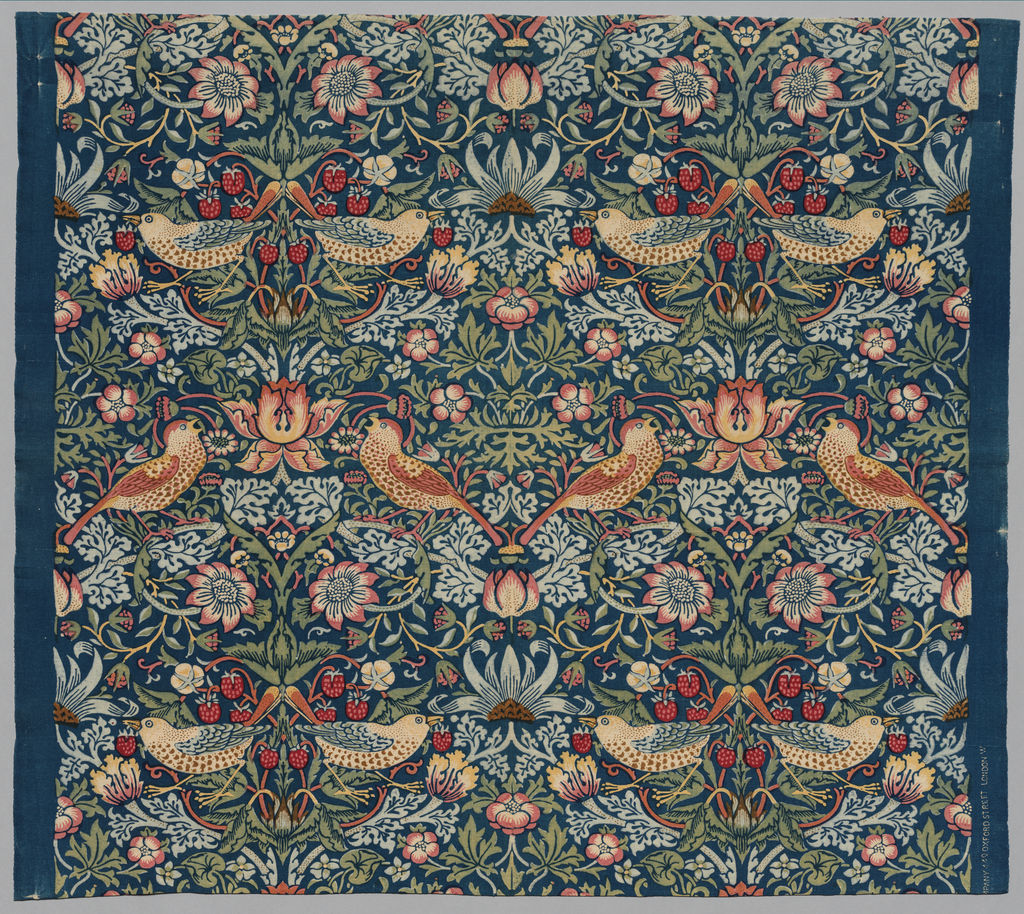
Strawberry Thief furnishing fabric, Cleveland Museum of Art 1937.696. This later manufactured textile preserves Morris’s design of 1883. Image source. CC0 / Public domain.
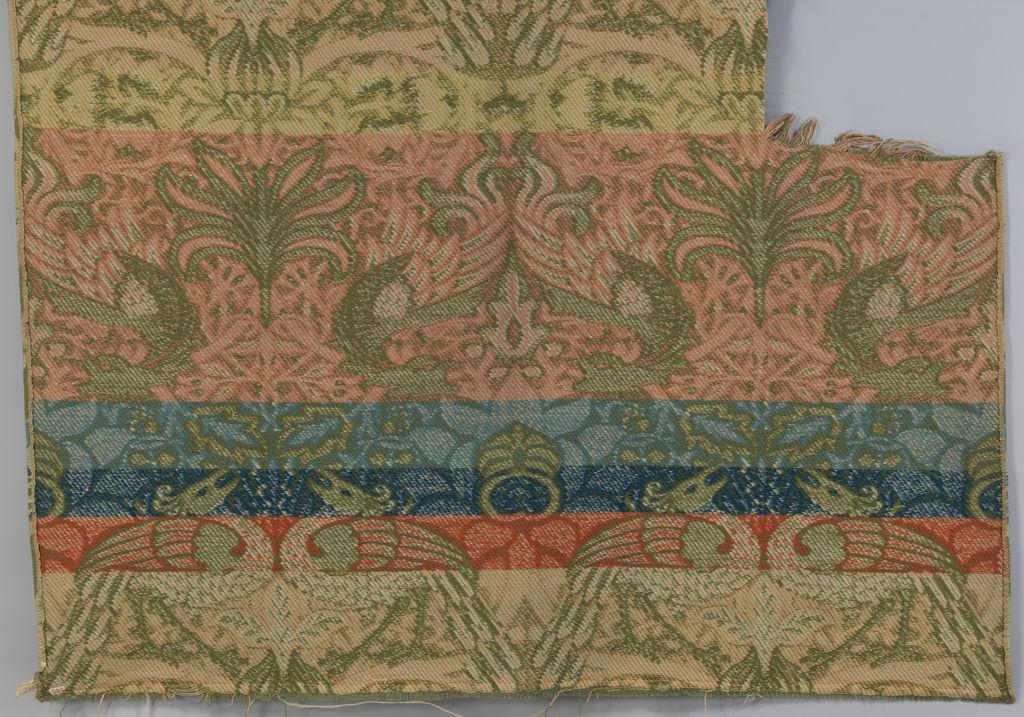
Peacock and Dragon, reverse of the same Metropolitan Museum of Art textile fragment. The Metropolitan Museum of Art. Image source. CC0 / Public domain.
What a beautiful room asks of its owner
The abundance of Morris patterns can obscure his insistence on restraint. In The Beauty of Life, delivered in 1880 and collected in Hopes and Fears for Art in 1882, he offered his much-quoted rule: “Have nothing in your houses that you do not know to be useful or believe to be beautiful.” Its alternatives matter. An object could justify its place through use or through beauty; the rule did not demand that every possession be both, or that all ornament disappear. [2]
Morris immediately made the advice more concrete. His sitting room required books, a steady table, movable chairs, a bench, storage and a hearth. Pictures or a restful wall pattern, flowers and perhaps a small carpet could contribute to it. The room was to support working, thinking and resting. He objected to things that obstructed those activities, created unnecessary labour or supplied a pretence of luxury. Simplicity, in this passage, concerns the quality of occupation as much as the quantity of furniture. [2]
He could consequently permit an expensive tapestry, mosaic or painted wall when it was valued for its beauty. The problem was display for its own sake and the social burden carried by superfluous goods. This helps explain why a richly patterned room and a demand for simplicity could coexist in his thought. The relevant question was whether each thing contributed to a worthwhile life, including the lives of the people who produced and maintained it. [2]
His later essay Useful Work versus Useless Toil, collected in Signs of Change in 1888, made that last requirement more demanding. Worthwhile work should offer sufficient rest, a product worth having and pleasure in the work itself. Employment alone was no guarantee of usefulness. A society could keep people exhaustingly busy while directing their effort towards waste or the enrichment of others. [35]
The implication reaches beyond a preference for handmade goods. Morris questioned an organisation of production in which an improvement in machinery could increase wealth without delivering leisure or security to workers. The decisive issue was how productive power was controlled and whose lives it improved. His own business supplied a visible test of the difficulty: excellent and labour-intensive goods could command high prices, while the people for whom he wanted a fuller life often lacked the means to buy them. The tension between demanding craftsmanship and broad access remained central to his work. [35] [1]
Poetry, storytelling and other possible worlds
Morris's literary career developed alongside the business. His first poetry collection, The Defence of Guenevere, and Other Poems, appeared in 1858. The Life and Death of Jason followed in 1867, and The Earthly Paradise in 1868–70. These substantial undertakings established Morris as a poet while he was developing the firm. They also show shifts in ambition, from compressed dramatic voices and medieval scenes towards sustained storytelling across different legendary worlds. [5] [6]
The Earthly Paradise has an elaborate social structure of its own. Twenty-four classical and medieval tales are paired across the twelve months, within a framework of tellers and listeners. Florence S. Boos emphasises how this organisation makes memory, grief and the sharing of stories part of the poem's meaning. Her reading challenges a view of Morris as merely escaping into picturesque legend: the poem asks what the repeated telling of old stories can do for people who remain subject to loss and time. [6]
The connection with design is suggestive without requiring every poem to be treated as a verbal pattern. Morris worked with inherited forms in both fields, and tested what they could still make possible. A familiar legend could support a new arrangement of voices, just as an old textile could suggest a new structure of leaves. His literature has its own rhythms, narrative choices and difficulties, giving these shared interests a different form of expression. [6] [3]
Iceland opened another field of study. Morris began learning Icelandic with Eiríkr Magnússon in 1868, and their translations formed a sustained collaboration. He travelled to Iceland in 1871 and again in 1873. Martin Stott's introduction to the journals stresses both the literary engagement and the encounters with landscape. The journals were initially a private record for Georgiana Burne-Jones and were published only in 1911. Their original audience differs from the readership of the poems, published translations and later romances. [5] [36]
The best-known meeting of his fiction and politics is News from Nowhere. Its narrator leaves a socialist discussion, sleeps and awakens to a transformed world. The opening makes change tangible through familiar surroundings: the Thames, a morning swim, the appearance of a bridge and the behaviour of a boatman. The surprise is felt through the body and the senses before it becomes an extended argument about social arrangements. A reader encounters the future through ordinary transactions and observations. [37]
The ending prevents the journey from becoming a comfortable permanent retreat. Returned to Hammersmith, the narrator must carry the possibility he has seen back into the struggles of his own time. The future offers a reason to act in the present. The book's publication history likewise crosses several parts of Morris's career: it appeared in Commonweal in 1890, in book form from Reeves & Turner in 1891 and in a Kelmscott Press edition in 1893. That edition's frontispiece, designed by Charles March Gere and engraved by William Hooper, shows Kelmscott Manor. Political fiction, a particular house and the making of a book meet in one publication. [37] [38]
From the workshop to socialist politics
Morris's socialism developed from his dissatisfaction with the conditions of everyday life into organised political activity. He joined the Democratic Federation in 1883, left the renamed Social Democratic Federation with colleagues at the end of 1884 and worked through the Socialist League and its paper Commonweal. In 1890 he left the League and formed the Hammersmith Socialist Society. These changes show a sustained engagement with organisation, arguments and tactics. [5]
His retrospective essay How I Became a Socialist, published in Justice in June 1894, is especially clear about his motives. Morris describes art and history as routes into discontent, while the possibility of collective change gave that discontent a practical direction. He also admits his initially limited knowledge of economics and the difficulty he experienced with parts of Marx. Conversation, meetings and collaboration were part of his political education. This is his own late account of the development, and its self-explanation should be read as such. [39]
The essay places freedom from insecurity alongside cultural life. Morris rejected the idea that art should take priority over the immediate need to eat; art required the ground of a secure and untroubled existence. But he also rejected the confinement of working people to bare survival. A full life should include the enjoyment and creation of beauty. The two demands supported each other: deprivation restricted what people could imagine, while art could help make a better life imaginable. [39]
This explains why his political activity belongs in an account of the designs. The patterns were one outcome of his desire to improve things encountered daily; socialism addressed the conditions under which people made and used those things. His explicit arguments about work, shared resources, time and pleasure supply that connection; they give no reason to read every flower or bird as a coded political message. [39] [35]
It also leaves room to see contradictions. Morris was a prosperous business owner whose customers included wealthy households. A beautifully organised workshop could not by itself remove inequality across society. His late account acknowledges the distance between his comfortable position and the pressures faced by working people. His political conclusion was that better taste and exemplary objects needed a larger change in social relations if their benefits were to become general. [39]
Protecting the work of earlier generations
The concern with labour also reached backwards. In 1877 Morris helped found the Society for the Protection of Ancient Buildings. Its manifesto, written by Morris, Webb and other founders, attacked restoration that stripped away a building's accumulated history in order to recreate a chosen earlier appearance. A structure altered over several centuries could preserve evidence of several generations. Removing later work and supplying conjectural medieval replacements risked destroying precisely the historical life its restorers claimed to recover. [7]
The proposed alternative involved daily care, support for failing walls and repair of leaking roofs, with additions recognisable as the work needed to protect the fabric. Its scope extended to buildings of different periods and styles. That breadth matters for a designer so closely associated with medieval art: the manifesto did not restrict protection to examples matching his preferred aesthetic. It asked people to value the evidence surviving in the building before imposing their own ideal of how it ought to look. [7]
This position helps distinguish learning from the past from reconstructing it. Morris could study an old weave or letterform in order to design something new, while resisting the replacement of an old building by an apparently perfected historical version. In each case, the surviving thing was a source of knowledge. Its irregularities and changes could carry information that a cleaner or more uniform result would erase. [7] [3]
His relationship with the V&A, then the South Kensington Museum, extended that interest into collecting and education. The firm decorated the museum's Green Dining Room; Morris later became an examiner at its art school and an adviser on acquisitions. He supported purchases including a Tournai tapestry and the Ardabil carpet, and in 1893 donated a small loom used to teach carpet weavers at Merton Abbey. The museum was thus a client, a resource for study and a place in which knowledge of materials could be transmitted. [4]
The book as a designed object
Morris had been making decorated books long before he established a press. In 1870 he completed A Book of Verse as a gift for Georgiana Burne-Jones, and he continued to work on illuminated texts alongside the commercial designs. Such projects brought handwriting, ornament and poetry into the same object for a small private audience. [5]
Printed illustration had also occupied him much earlier. Cockerell recalled a projected illustrated Earthly Paradise in 1866, for which Burne-Jones made designs and Morris cut many of the woodblocks. Others involved in cutting included Elizabeth Burden. Specimen pages were set, but the edition did not proceed. The later press therefore grew from practical experience with unfinished projects as well as admiration for old books. Illustration brought another problem of coordination: a compelling drawing needed to work as a block, beside type, within the scale of a particular page. [40]
The Kelmscott Press brought his longstanding interest in writing and historical books into a new manufacturing project. Printing began in Hammersmith in 1891, with The Story of the Glittering Plain as its first book. Morris's account of his aims, written in 1895, starts with the pleasure and ease of reading. Paper, letterforms, spacing and the position of type on the page were its essential components. The celebrated borders were part of a larger design. [5] [40]
Morris treated an opening as a pair of pages. Inner, upper, outer and lower margins had different functions in balancing the block of text, and spaces between letters, words and lines needed the same care as the letters themselves. His objection to irregular white channels through type resembles his concern with accidental lines in a wallpaper repeat: small decisions become conspicuous when extended across a surface. In the book, however, those decisions had to support the movement of reading. [40] [29]
His Golden roman type drew on fifteenth-century printing associated with Nicolas Jenson; the Troy gothic and smaller Chaucer types offered other possibilities. Edward Prince cut the punches that turned Morris's letter designs into the means of casting type. J. Batchelor and Son supplied handmade paper. Compositors and pressmen undertook the printing, while illustrators and engravers contributed to particular books. The press reproduced repeated ornament from electrotypes and used photography in preparing some designs. Its historical inspiration coexisted with selective use of contemporary reproductive methods. [40]
The 1896 Works of Geoffrey Chaucer assembled these resources on an exceptional scale. Morris designed the type, layout and ornament, and Burne-Jones supplied eighty-seven illustrations. The University of Maryland's account follows the translation of the drawings through photographs, Robert Catterson-Smith's redrawing and William Hooper's wood engraving. The finished illustration therefore embodies a chain of interpretation, with changes needed to make a shaded pencil drawing effective as printed lines. [41]
This was also a late return to an old friendship and shared reading. Morris and Burne-Jones had encountered Chaucer as young men at Oxford; their book emerged after decades of work together in other media. Its dense relationship of text, pictures and ornament can be understood as another complete interior, scaled to an opening held before a reader. The comparison brings attention to the coordination of the parts and their shared task of supporting the act of reading. [41] [40]
Morris died on 3 October 1896, four months after the first completed copies of the Chaucer were delivered to the two friends. The press continued until 1898. Its final printed book was A Note by William Morris on His Aims in Founding the Kelmscott Press, accompanied by Sydney Cockerell's history and annotated list. The volume joined an explanation of design to a record of production. Even the press's account of itself retained the distinction between the ambitions of its founder and the work of the enterprise. [5] [41] [42]
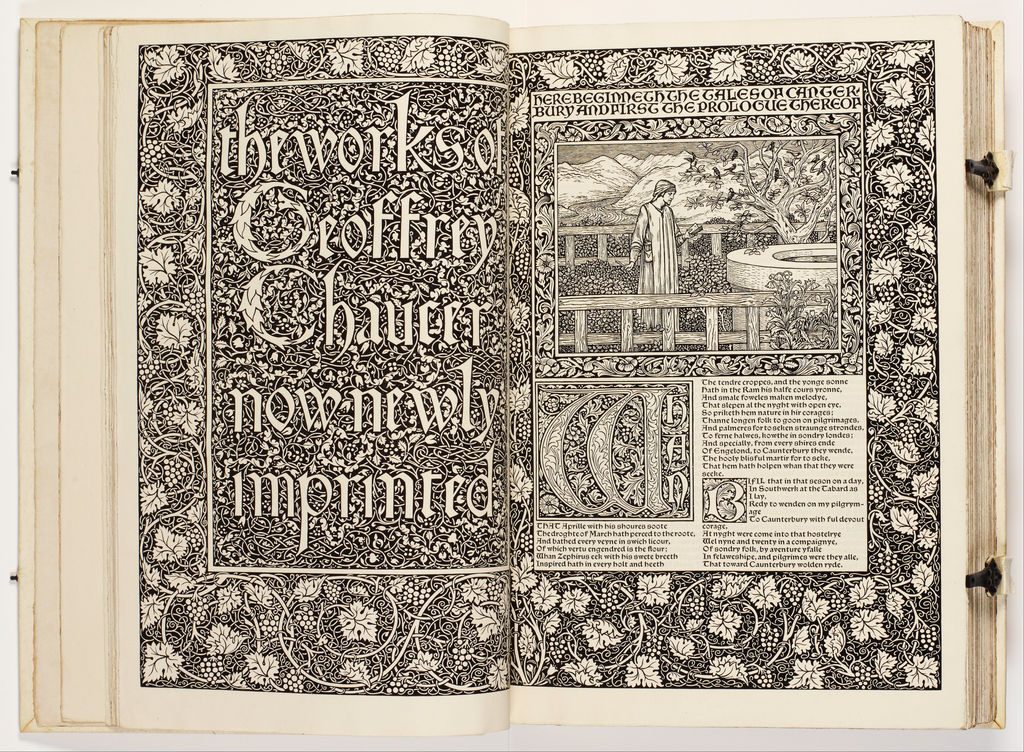
The Kelmscott Chaucer, 1896: a complete opening brings the decorated title page together with the facing illustration, initial and text. William Morris. Image source. Public domain.
The work carried forward
Morris's example helped shape the Arts and Crafts movement, which brought new public attention to the decorative arts and to how things were made. It embraced different workshops, organisations and styles. The Arts and Crafts Exhibition Society, founded in 1887, supplied an important forum; its first exhibition took place in 1888. Morris's influence preceded and extended beyond his formal involvement. The movement's interest in complete interiors, material knowledge and the maker's experience offers a more useful measure of that influence than the presence of a particular flower or medieval motif. [43]
The continuation of his own firm requires equal attention to individual designers. May Morris took responsibility for embroidery in 1885 and pursued an independent career as a designer, teacher and writer. Her Horn Poppy wallpaper, designed about 1885, belongs to her output. Its production by Jeffrey & Co. and sale by Morris & Co. do not turn it into a design by her father. Her professional work extends the family's contribution while retaining its own authorship. [4] [44]
John Henry Dearle likewise contributed designs that continued and developed the firm's repertory. Blackberry is his work, and Hyacinth dates from about 1900–12, after William's death. Later surviving prints introduce another layer of history: the Gallery's Hyacinth sample was printed by Sanderson in 1968 using original Morris & Co. blocks. A pattern's creation, a firm's publication of it and the manufacture of a particular sample can fall in different decades. Recognising that sequence gives the continuing tradition real people and dates. [45] [46]
May also helped determine what later generations could study. Her 1938 bequest to the V&A included working designs for wallpaper, textiles and embroidery, preserving evidence of decisions behind finished products. This was an active contribution to his reputation: the papers retained the marks of thinking and revision that a finished printed surface can conceal. Her preservation of the designs helped make the work available as something to investigate and learn from. [4]
Other institutions developed distinct ways of carrying that work forward. The William Morris Gallery opened in 1950 in Water House, his adolescent family home. Gifts associated with Frank Brangwyn and Arthur Mackmurdo broadened its collections beyond Morris's own output to the circle and traditions around it. The William Morris Society, established in 1955, made publication and discussion part of its purpose. Its museum occupies lower rooms and the coach house of Kelmscott House in Hammersmith, the adult home associated with his manufacturing, printing and socialist activity. Kelmscott Manor, the Oxfordshire retreat that gave the London house and press their names, is a different place. The distinction preserves several settings for the life: a family home turned gallery, a working London household and a country house remembered in both pattern and fiction. [47] [48] [38]
Essential William Morris works

Strawberry Thief
Design 1883 · Birds and fruit join a pattern developed through indigo-discharge printing.

Trellis
Design 1862; registered 1864 · Morris’s climbing roses and framework meet birds drawn by Philip Webb.

La Belle Iseult
1858 (conventional date) · A surviving easel painting whose furnishings make the room part of the subject.
 William Morris.jpg)
The Kelmscott Chaucer
Issued 1896 · Morris’s page design joins Chaucer’s text and Burne-Jones’s illustrations.

The Attainment or Vision of the Holy Grail
Designs 1890–1891; Birmingham repeat 1895–1896 · Figure design, ornament and weaving bring several contributors into one cycle.
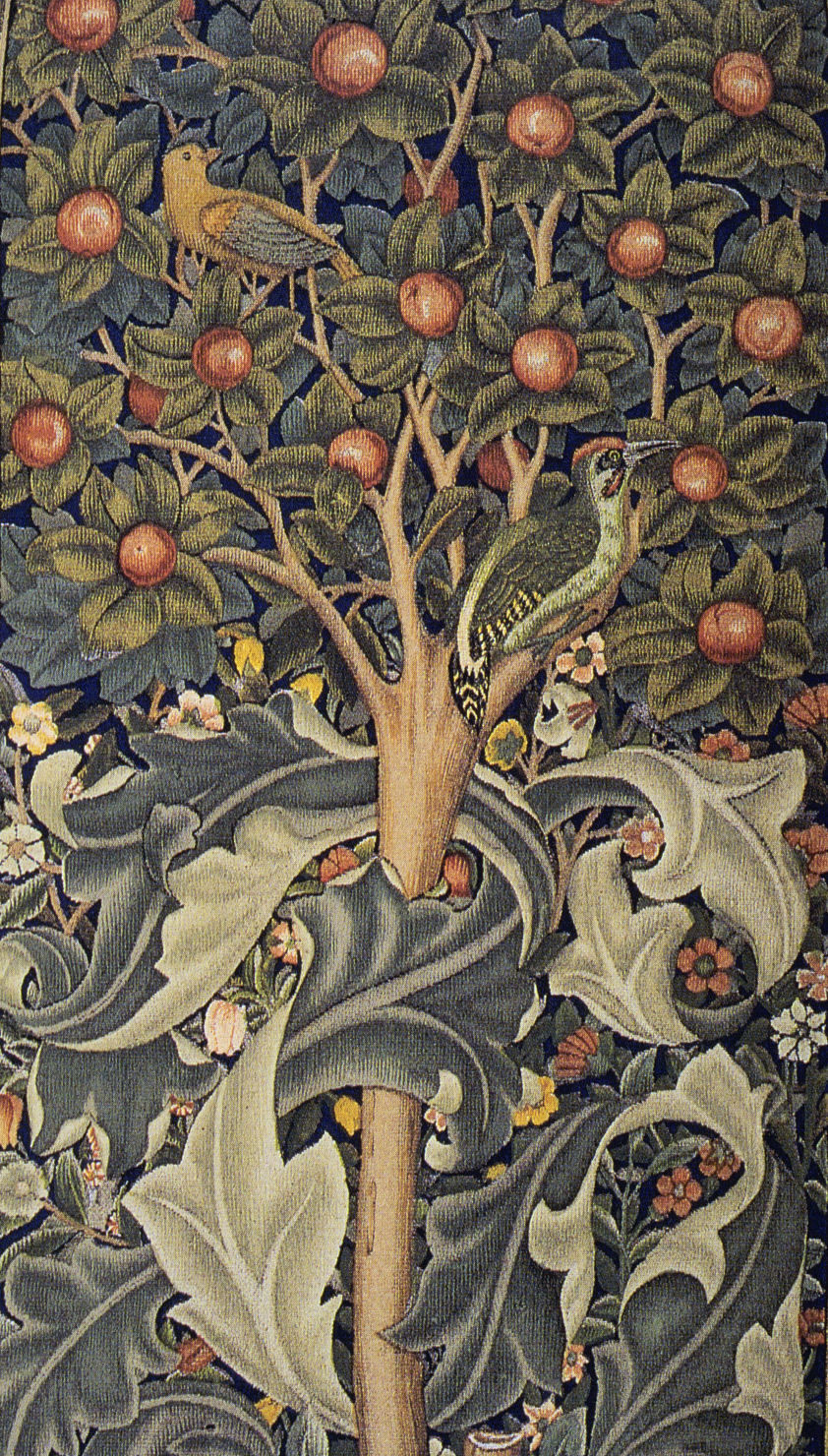
Woodpecker Tapestry
1885 · Morris’s whole design was realised by named weavers and embroiderers.

Peacock and Dragon
Design 1878 · A large woven-wool repeat joins stylised birds, dragons and foliage.

Pimpernel
Design 1876 · Curling tulip leaves organise large flowers and smaller pimpernels.
Further reading
Continue with historical writing and institutional research available to read online.
Morris on art and everyday life. William Morris, Hopes and Fears for Art (1882), in a transcription of the 1919 edition.
Read the lectures behind his arguments about decoration, useful objects and the pleasure of making. Read the historical text.
The workshop behind the book. William Morris and Sydney Cockerell, The Art and Craft of Printing (Elston Press, 1902).
This reprint joins Morris’s Note with Cockerell’s history and catalogue of the Kelmscott Press. Read the historical account.
Stories in the decorative work. William Morris: Story, Memory, Myth, Two Temple Place exhibition catalogue (2011).
The catalogue studies storytelling across Morris’s images, objects and collaborations. Read the exhibition catalogue.
Works and designs directory
This directory brings together 365 design, edition and collection records, plus 208 individually listed samples from three historical sample books. Design families, surviving objects, later printings and book editions have separate entries. It covers the research assembled for these articles, rather than the full output of Morris and his associates. Dates and attributions follow the named catalogues; differences are retained where they matter. Search by title, designer, material, collection, accession or colourway.
| Name | Date | Medium |
|---|---|---|
| Blackberry | Design: early twentieth century; specimens catalogued 1903 | Wallpaper |
| Hyacinth | Design: c.1900–12 | Wallpaper |
| Horn Poppy | Design: c.1885 | Wallpaper |
| Chrysanthemum | Design: 1877; some later catalogues say 1876 | Wallpaper |
| Fruit or Pomegranate | Design dates reported: 1862 / 1865–66 | Wallpaper |
| Jasmine | Design: 1871–72; wallpaper issued 1872 | Wallpaper |
| Larkspur | Design/issue dates reported: 1872–75 | Wallpaper |
| Marigold | Design: 1873–75; registered 1875 | Wallpaper |
| Pimpernel | Design/registration: 1876 | Wallpaper |
| Willow | Design: 1874 | Wallpaper |
| Wreath | Design: c.1876 | Wallpaper |
| Trellis | Design: November 1862; registered 1864 | Wallpaper |
| Bird | Design: 1877–78; registered 1878 | Textile |
| Bird — Met 23.163.15 | Design: 1877–78; registered 1878; specimen: unknown | Textile |
| Bird — DIA F1986.48 | Specimen: 1878 | Textile |
| Bird — WMG F283b | Design: 1877–78; registered 1878; specimen: unknown | Textile |
| Bird — Orsay OAO 1249 1 | Design: 1877–78; registered 1878; specimen: unknown | Textile |
| Cabbage and Vine | Design: 1879 | Textile |
| Cabbage and Vine — SAL KM032 | Specimen: 1879 | Textile |
| Cabbage and Vine — V&A E.45-1940 | Drawing/cartoon: 1879 | Drawing |
| Cabbage and Vine — V&A E.3472-1932 | Drawing/cartoon: 1879 | Drawing |
| Evenlode | Registered: 2 September 1883 | Textile |
| Evenlode — WMG F325a | Registered: 2 September 1883; specimen: unknown | Textile |
| Evenlode — Cincinnati 1993.144 | Specimen: 1883–1900 | Textile |
| La Belle Iseult | Painting: conventionally dated 1858 | Painting |
| Study for La Belle Iseult — Christie’s lot 5807506 | Study date: unknown | Drawing |
| Membland Hall Tile Panel | Design: 1876; Orsay model c.1876–77 | Drawing |
| Membland Hall Tile Panel — V&A C.36-1972 | Design/panel: 1876 | Ceramics |
| Membland Hall Tile Panel — WMG C176 | Design/panel: 1876 | Ceramics |
| Design for Membland Hall tile panel — WMG A31 | Drawing: 1876 | Drawing |
| Membland Hall Tile Panel — Orsay OAO 1210 | Model: c.1876–77; specimen: unknown | Ceramics |
| Membland Hall Tile Panel — Cologne E04941 | Design: 1876; specimen: unknown | Ceramics |
| Peacock and Dragon | Design: 1878 | Textile |
| Peacock and Dragon — WMG F26cii | Design: 1878; specimen: unknown | Textile |
| Peacock and Dragon — Met 30.95.52 | Design: 1878; specimen: unknown | Textile |
| Snakeshead | Design: 1876 | Textile |
| Snakeshead — WMG F345 | Design: 1876; specimen: unknown | Textile |
| Snakeshead — Huntington 2000.5.525 | Specimen: c.1876 | Textile |
| Snakeshead — Birmingham 1941M398 | Specimen: 1876–77 | Textile |
| Snakeshead — WMG F366 | Design: 1876; specimen printed after 1917 | Textile |
| Strawberry Thief | Design: 1883 | Textile |
| Strawberry Thief — WMG F422b | Design: 1883; specimen: unknown | Textile |
| Strawberry Thief — Huntington 2000.5.523 | Specimen: c.1883 | Textile |
| Strawberry Thief — Cleveland 1937.696 | Specimen: c.1936 | Textile |
| Tulip and Willow | Design: 1873 | Textile |
| Tulip and Willow — WMG F3 | Design: 1873; specimen printed after 1883 | Textile |
| Tulip and Willow — V&A CIRC.91-1933 | Catalogue date: 1873; manufacture unknown | Textile |
| The Attainment or Vision of the Holy Grail | Design cycle: 1890–91 | Textile |
| The Attainment or Vision of the Holy Grail — Birmingham 1907M131 | Specimen: 1895–96 | Textile |
| The Attainment or Vision of the Holy Grail — Stanmore original Attainment | Woven by 1893 (original Attainment) | Textile |
| The Attainment or Vision of the Holy Grail — McCulloch repeat group | Specimen: 1898–99 | Textile |
| The Attainment or Vision of the Holy Grail — Beecham Attainment/Summons | Specimen: 1927–32 | Textile |
| Wandle | Design: 1884 | Textile |
| Wandle — WMG F50 | Design: 1884; specimen: unknown | Textile |
| The Kelmscott Chaucer | Edition: 1896; issued 26 June | Book |
| The Kelmscott Chaucer — WMG K20 | Specimen: 1896 | Book |
| The Kelmscott Chaucer — Morgan PML76849 | Edition: 1896; issued 26 June; specimen: unknown | Book |
| The Kelmscott Chaucer — Birmingham special-bound copy | Edition: 1896; issued 26 June; specimen: unknown | Book |
| The Kelmscott Chaucer — UMD2010acquisition | Edition: 1896; issued 26 June; specimen: unknown | Book |
| Woodpecker Tapestry | Design/tapestry: 1885 | Textile |
| Woodpecker Tapestry — WMG F139 | Specimen: 1885 | Textile |
| Larkspur — V&A E.468-1919 | Design/issue dates reported: 1872–75; specimen: unknown | Wallpaper |
| Marigold — V&A E.478-1919 | Design: 1873–75; registered 1875; specimen: unknown | Wallpaper |
| Willow — V&A E.488-1919 | Specimen: 1874 (Produced) | Wallpaper |
| Pimpernel — V&A E.497-1919 | Design/registration: 1876; specimen: unknown | Wallpaper |
| Wreath — V&A E.501-1919 | Specimen: 1876 (Produced) | Wallpaper |
| Chrysanthemum — V&A E.802-1915 | Specimen: 1877 (made) | Wallpaper |
| Fruit — V&A E.2210-1913 | Specimen: 1866 (produced) | Wallpaper |
| Blackberry — V&A E.2793-1980 | Specimen: 1903 (made) | Furniture |
| Blackberry — V&A E.2794-1980 | Specimen: 1903 (made) | Furniture |
| Blackberry — V&A E.2839-1980 | Specimen: 1903 (made) | Furniture |
| Blackberry — V&A E.1415-1979 | Specimen: c. 1955 (printed) | Wallpaper |
| Hyacinth — V&A E.1416-1979 | Specimen: c. 1955 (printed) | Wallpaper |
| Trellis — V&A E.452-1919 | Specimen: 1864 (manufactured) | Wallpaper |
| Willow Bough | Design: 1887 | Wallpaper |
| Willow Bough — V&A E.558-1919 | Specimen: 1887 (made) | Wallpaper |
| Blackberry — B179 | Specimen: c.1960s | Wallpaper |
| Hyacinth — B101 | Specimen: 1968 | Wallpaper |
| Horn Poppy — B155 | Specimen: 1885–1920 | Wallpaper |
| Horn Poppy — B112b | Design: c.1885; specimen: unknown | Wallpaper |
| Chrysanthemum — B172 | Specimen: c.1960 | Wallpaper |
| Fruit — B9a | Design dates reported: 1862 / 1865–66; specimen: unknown | Wallpaper |
| Larkspur — B11c | Design/issue dates reported: 1872–75; specimen: unknown | Wallpaper |
| Marigold — B40 | Specimen: before 1940 | Wallpaper |
| Pimpernel — B13 | Specimen: before 1940 | Wallpaper |
| Willow — B69 | Specimen: before 1940 | Wallpaper |
| Willow Bough — B22 | Specimen: after 1940; presented 1950 | Wallpaper |
| Poppy or Wreath — B15 | Specimen: c.1950 | Wallpaper |
| Wreath — 20032D1 | Specimen: c.1876 | Drawing |
| Design for Chrysanthemum — A33 | Drawing: 1877 | Drawing |
| Design for Trellis — BLA472 | Drawing: 1862 | Drawing |
| Trellis — B31 | Specimen: before 1940 | Wallpaper |
| Larkspur printing block — R253 | Design/issue dates reported: 1872–75; specimen: unknown | Printing block |
| Jasmine — 23.163.4j | Catalogue date: 1872; manufacture unknown | Wallpaper |
| Marigold — 23.163.4c | Catalogue date: 1875; manufacture unknown | Wallpaper |
| Willow Bough — 23.163.4k | Catalogue date: 1887; manufacture unknown | Wallpaper |
| Larkspur — 23.163.4i | Catalogue date: 1875; manufacture unknown | Wallpaper |
| Fruit or Pomegranate — 23.163.4g | Catalogue date: c.1866; manufacture unknown | Wallpaper |
| Chrysanthemum drawing — 2000.5.61 | Specimen: c.1877 | Drawing |
| The Pimpernel — HH3016 | Specimen: c.1876 | Wallpaper |
| Marigold — M.2003.6.2 | Design: 1873–75; registered 1875; specimen: unknown | Wallpaper |
| Marigold textile — 1937.699 | Specimen: twentieth century | Textile |
| An Angel with a Harp — Tate A00815 | Work date: unknown | Drawing |
| An Angel with a Pipe — Tate A00816 | Work date: unknown | Drawing |
| A Girl with a Flute — Tate A00817 | Work date: unknown | Drawing |
| Design for Tapestry — Tate A00818 | Work date: unknown | Drawing |
| The Archangel Raphael — Tate A00819 | Work date: unknown | Drawing |
| The Archangel Gabriel — Tate A00820 | Work date: unknown | Drawing |
| La Belle Iseult — Tate N04999 | Work: 1858 | Painting |
| The Archangel Gabriel — Tate N05219 | Work date: unknown | Drawing |
| Figure of Guinevere — Tate N05221 | Work: c.1858 | Drawing |
| Guinevere and Iseult: Cartoon for Stained Glass — Tate N05222 | Work: 1862 | Drawing |
| Angel of the Resurrection: Cartoon for Stained Glass — Tate N05223 | Work: 1862 | Drawing |
| Daisy tile | Specimen: c. 1870 | Ceramics |
| Alceste tile | Specimen: c. 1862 | Ceramics |
| The Labours of the Month | Specimen: 1862 | Ceramics |
| Trellis — Met 23.163.4h | Catalogue date: 1864; manufacture unknown | Wallpaper |
| Trellis — William Morris Gallery B132a | Design: November 1862; registered 1864; specimen: unknown | Wallpaper |
| Trellis — Standen NT1213907 | Design: November 1862; registered 1864; specimen: unknown | Wallpaper |
| Trellis — loose sample-book page B133 | Specimen: printed before 1917 | Wallpaper |
| Sussex armchair — G29 | Design: c.1860s; specimen: unknown | Furniture |
| Sussex chair — G51 | Specimen: c.1868 | Furniture |
| Round-seated Sussex chair — 1214043.2 | Specimen: c.1870 | Furniture |
| Oval centre table — 1213993 | Specimen: c.1870 | Furniture |
| The Backgammon Players — 26.54 | Specimen: 1861 | Painting |
| Table de travail — OAO450 | Specimen: c.1860–68 | Furniture |
| King David the Poet — 1998.231 | Specimen: 1863 | Stained glass |
| Eve and the Virgin cartoon — A8 | Drawing: 1864 drawing; window installed 1865 | Drawing |
| Design for Mermaid woven fabric — A32b | Drawing: c.1880; mermaid figures 1875 | Drawing |
| Wreath carpet point paper — BlA477 | Drawing: c.1870 | Drawing |
| A Note by William Morris on His Aims in Founding the Kelmscott Press — K260 | Edition: March 1898; exact date statements differ | Book |
| Oak cabinet for Kelmscott Press books — no accession supplied | Design: unknown; specimen: unknown | Furniture |
| Stained-glass quarry design, Diplacus punicus / Nihil Desperandum — WMG BLA444 | Drawing date: unknown | Drawing |
| House of Retreat, Crowborough: rose window design — WMG BlA405 | Drawing: c.1913 | Drawing |
| Circular embroidery design with flower and butterfly — WMG A993 | Drawing date: unknown | Drawing |
| Aquilegia quarry design — WMG BLA447 | Drawing date: unknown | Drawing |
| Carnation textile design — WMG A1070 | Drawing: c.1875 | Drawing |
| Wallpaper design with roses and acanthus — WMG BlA503 | Drawing: c. 1880-1900 | Drawing |
| Rottingdean Grail cartoon, fourth panel — WMG A208.4 | Drawing: 1886 | Drawing |
| Rottingdean Grail cartoon, second panel — WMG A208.2 | Drawing: 1886 | Drawing |
| Rottingdean Grail cartoon, third panel — WMG A208.3 | Drawing: 1886 | Drawing |
| Thisbe embroidery design — WMG A211 | Drawing: c. 1863-4 | Drawing |
| Prophet predella cartoon for Jesus College Chapel — WMG A256 | Drawing: 1877 | Drawing |
| Rottingdean Grail cartoon, first panel — WMG A208.1 | Drawing: 1886 | Drawing |
| Designs for embroidery frames — WMG A307 | Drawing: c.1910s | Drawing |
| Flower Garden embroidery design — WMG A218 | Drawing: c.1892 | Drawing |
| Design possibly for painted panelling — WMG A476 | Drawing: 2.1.1886 | Drawing |
| Annunciation cartoon for St Michael and All Angels, Brighton — WMG A4 | Drawing: 1862 | Drawing |
| Design for reversible embroidered table cover — WMG BlA456 | Drawing: c. 1880 | Drawing |
| Combe Court panelled ceiling design — WMG A294 | Drawing: 1890s | Drawing |
| Circular embroidery design with flowers and leaves — WMG A249 | Drawing: 1880-90s | Drawing |
| Carpet design for Miss Beardmore — WMG BLA458 | Drawing: 1875-1877 | Drawing |
| Acanthus embroidery design — WMG A459 | Drawing: 1870s | Drawing |
| Stained-glass quarry design for Jesus College, Cambridge — WMG BlA439 | Drawing: 1873 | Drawing |
| Stained-glass quarry design for Duke of Westminster — WMG BlA440 | Drawing: 1876 | Drawing |
| Stained-glass roundel design with seated young man — WMG BLA487a | Drawing: c. 1930s | Drawing |
| Design for tapestry sofa upholstery — WMG A34 | Drawing: 1880s/early 1900s | Drawing |
| King Arthur and Sir Lancelot stained-glass design — WMG A262 | Drawing: 1862 | Drawing |
| Peacock embroidery-frieze design — WMG A209 | Drawing: c.1875 | Drawing |
| Drawing-room cornice, 9 Chesterfield Gardens — WMG A301 | Drawing: 1880s | Drawing |
| The Flight into Egypt stained-glass design — WMG A260 | Drawing: 1872 | Drawing |
| Lily and Pomegranate wallpaper design — WMG A30 | Drawing: 1886 | Drawing |
| Sideboard inlay design — WMG A1071 | Drawing: c1890 | Drawing |
| Pelican design from the Brampton east window — WMG A136 | Drawing: c.1880 | Drawing |
| African Marigold textile design — WMG BLA464 | Drawing: 1876 | Drawing |
| Medway textile design — WMG A38 | Drawing: 1885 | Drawing |
| East-window canopy, St John the Apostle — WMG BLA413 | Drawing: 1865 | Drawing |
| Window canopy for Christ Church — WMG BLA416 | Drawing: 1865 | Drawing |
| Canopy tracery design — WMG BlA410 | Drawing: 1863 | Drawing |
| Architectural canopy for All Saints Church — WMG A429 | Drawing: 1862 | Drawing |
| The Orchard embroidery design — WMG D294vi | Drawing: 1888 | Drawing |
| Medway working design for block cutters — WMG BLA453 | Drawing: 1885 | Drawing |
| Swivel woven-textile design — WMG BLA465 | Drawing: 1877 | Drawing |
| Red House corridor stained-glass panel designs — WMG BLA436a & b | Drawing: c.1861 | Drawing |
| Two-light window scale drawing — WMG BLA342 | Drawing date: unknown | Drawing |
| Dundee Parish Church memorial-window design — WMG BLA371 | Drawing: c.1874 | Drawing |
| Good Shepherd and Caritas cartoon — WMG BLA364 | Drawing date: unknown | Drawing |
| St Paul’s Montreal window design — WMG BLA354 | Drawing date: unknown | Drawing |
| Honeycomb carpet design — WMG A39 | Drawing: 11.02.1876 | Drawing |
| Wreath three-ply Kidderminster carpet design — WMG BLA480 | Drawing: 1875-1880 | Drawing |
| St Cecilia, Halewood window design — WMG A519 | Drawing: 1881 | Drawing |
| Stained-glass quarry design for 17 Charles Street — WMG BlA438 | Drawing: 1874 | Drawing |
| Parable of the Vineyard cartoon, A268 — WMG A268 | Drawing: 1861 | Drawing |
| Sailing-ship embroidery design — WMG A250 | Drawing date: unknown | Drawing |
| Parable of the Vineyard cartoon, A267 — WMG A267 | Drawing: c.1861 | Drawing |
| Formal net pattern with leaves and flowers — WMG BLA483 | Drawing date: unknown | Drawing |
| Wallpaper design and tracing with pink flowers — WMG A1424:1 | Drawing: 1908-1910 | Drawing |
| Panel-and-tile scheme for 1 Palace Green — WMG A25 | Drawing: c. 1879-80 | Drawing |
| Frieze scheme for 1 Palace Green — WMG A26 | Drawing: 1868-81 | Drawing |
| The Story of the Glittering Plain (first Kelmscott edition) — A1 | Edition: 1891 | Book |
| Poems by the Way — A2 | Edition: 1891 | Book |
| The Love-Lyrics and Songs of Proteus — A3 | Edition: 1892 | Book |
| The Nature of Gothic — A4 | Edition: 1892 | Book |
| The Defence of Guenevere and Other Poems — A5 | Edition: 1892 | Book |
| A Dream of John Ball and A King's Lesson — A6 | Edition: 1892 | Book |
| The Golden Legend — A7 | Edition: 1892 | Book |
| The Recuyell of the Historyes of Troye — A8 | Edition: 1892 | Book |
| Biblia Innocentium — A9 | Edition: 1892 | Book |
| The History of Reynard the Fox — A10 | Edition: 1892 | Book |
| The Poems of William Shakespeare — A11 | Edition: 1893 | Book |
| News from Nowhere — A12 | Edition: 1893 | Book |
| The Order of Chivalry, and L'Ordene de Chevalrie — A13 | Issued: 12 April 1893; catalogue year 1892 | Book |
| The Life of Thomas Wolsey, Cardinal Archbishop of York — A14 | Issued: 3 May 1893; catalogue year 1892 | Book |
| The History of Godefrey of Boloyne and of the Conquest of Iherusalem — A15 | Issued: 24 May 1893; catalogue year 1892 | Book |
| Utopia. — A16 | Edition: 1893 | Book |
| Maud: A Monodrama — A17 | Edition: 1893 | Book |
| Gothic Architecture: A Lecture for the Arts and Crafts Exhibition Society — A18 | Edition: 1893 | Book |
| Sidonia the sorceress — A19 | Edition: 1893 | Book |
| Ballads and Narrative Poems by Dante Gabriel Rossetti — A20 | Edition: 1893 | Book |
| Sonnets and Lyrical Poems — A20a | Edition: 1894 | Book |
| Of King Florus and the fair Jehane — A21 | Edition: 1893 | Book |
| The Story of the Glittering Plain (illustrated edition) — A22 | Edition: 1894 | Book |
| Of the Friendship of Amis and Amile — A23 | Edition: 1894 | Book |
| The Poems of John Keats — A24 | Edition: 1894 | Book |
| Atalanta in Calydon: a Tragedy — A25 | Edition: 1894 | Book |
| The Tale of the Emperor Coustans and of Over Sea — A26 | Edition: 1894 | Book |
| The Wood Beyond the World — A27 | Edition: 1894 | Book |
| The Book of Wisdom and Lies — A28 | Edition: 1894 | Book |
| The Poetical Works of Percy Bysshe Shelley — A29 | Edition: 1895 | Book |
| Psalmi penitentiales — A30 | Edition: 1894 | Book |
| Epistola de contemptu mundi — A31 | Edition: 1894 | Book |
| The tale of Beowulf — A32 | Edition: 1895 | Book |
| Syr Perecyvelle of Gales — A33 | Edition: 1895 | Book |
| The Life and Death of Jason. A Poem — A34 | Edition: 1895 | Book |
| Child Christopher and Goldilind the Fair — A35 | Edition: 1895 | Book |
| Hand & Soul — A36 | Edition: 1895 | Book |
| Poems Chosen Out of the Works of Robert Herrick — A37 | Edition: 1895 | Book |
| Poems Chosen Out of the Works of Samuel Taylor Coleridge — A38 | Edition: 1896 | Book |
| The Well at the World's End — A39 | Edition: 1896 | Book |
| The Earthly Paradise — A41 | Edition: 1896 | Book |
| Laudes Beatae Mariae Virginis — A42 | Edition: 1896 | Book |
| The Floure and the Leafe / The Boke of Cupide — A43 | Issued: 2 November 1896 | Book |
| The Shepheardes Calendar — A44 | Edition: 1896 | Book |
| The Water of the Wondrous Isles — A45 | Edition: 1897 | Book |
| Froissart Chronicles: specimen pages — A46 | Edition: 1896, 1897 | Book |
| Sire Degrevaunt — A47 | Edition: 1896 | Book |
| Syr Ysambrace — A48 | Edition: 1897 | Book |
| Some German Woodcuts of the Fifteenth Century — A49 | Edition: 1898 | Book |
| The Story of Sigurd the Volsung and the Fall of the Niblungs — A50 | Issued: 25 February 1898 | Book |
| The Sundering Flood — A51 | Issued: 25 February 1898; catalogue year 1897 | Book |
| Love is Enough, or the Freeing of Pharamond — A52 | Issued: 24 March 1898; catalogue year 1897 | Book |
| A Note on Aims / A Short Description of the Press — A53 | Issued: 24 March 1898 | Book |
| Wandle — 23.163.10 | Specimen: printed 1917–23 | Textile |
| Snakeshead — 1937.695 | Specimen: early twentieth century | Textile |
| Evenlode curtain — F325b | Registered: 2 September 1883; specimen: unknown | Textile |
| Snakeshead — 1972.395 | Specimen: manufactured 1925–40 | Textile |
| Helen (Flamma Troiae) drawing — E.571-1940 | Caption date: c. 1860; manufacture date unknown | Drawing |
| Lotus wall hanging — T.192-1953 | Caption date: 1875–1880; manufacture date unknown | Textile |
| Wall hanging made by Ada Phoebe Godman — T.166-1978 | Caption date: 1877; manufacture date unknown | Textile |
| Acanthus wall hanging — T.153-1979 | Caption date: c. 1880; manufacture date unknown | Textile |
| Flowerpot embroidered picture — T.68-1939 | Caption date: 1878–1880; manufacture date unknown | Textile |
| Small Stem furnishing textile — T.37-1979 | Caption date: c. 1868; manufacture date unknown | Textile |
| Jasmine Trellis — T.70-1953 | Caption date: 1868–1870; manufacture date unknown | Textile |
| Marigold textile — CIRC.496-1965 | Caption date: 1875; manufacture date unknown | Textile |
| Honeysuckle textile — CIRC.491-1965 | Caption date: 1876; manufacture date unknown | Textile |
| Rose and Thistle — T.634-1919 | Caption date: 1881; manufacture date unknown | Textile |
| Strawberry Thief — T.586-1919 | Caption date: 1883; manufacture date unknown | Textile |
| Cray — CIRC.82-1953 | Caption date: 1884; manufacture date unknown | Textile |
| Tulip and Rose — CIRC.390A-1970 | Caption date: 1876; manufacture date unknown | Textile |
| Peacock and Dragon curtains — T.64&A-1933 | Caption date: 1878; manufacture date unknown | Textile |
| Granada — T.4-1919 | Caption date: 1884; manufacture date unknown | Textile |
| The Forest — T.111-1926 | Caption date: 1887; manufacture date unknown | Textile |
| The Orchard tapestry — 154-1898 | Caption date: 1890; manufacture date unknown | Textile |
| Tulip and Lily — T.101-1953 | Caption date: 1875; manufacture date unknown | Textile |
| Artichoke carpet — T.188-1984 | Caption date: 1875–1880; manufacture date unknown | Textile |
| Floral tile — C.58-1931 | Caption date: 1862; manufacture date unknown | Ceramics |
| Sleeping Beauty tile panel — CIRC.520-1953 | Caption date: 1862–1865; manufacture date unknown | Ceramics |
| Table designed by Philip Webb — W.45-1926 | Caption date: c. 1865; manufacture date unknown | Furniture |
| St George Cabinet — 341:1–8-1906 | Caption date: 1861–1862; manufacture date unknown | Furniture |
| Sideboard — CIRC.540:1–5-1963 | Caption date: c. 1862; manufacture date unknown | Furniture |
| Sunflower — E.513-1919 | Caption date: 1879; manufacture date unknown | Wallpaper |
| St James’s — E.528-1919 | Caption date: 1881; commission 1880; manufacture date unknown | Wallpaper |
| Balmoral — CIRC.16-1961 | Work date: unknown | Wallpaper |
| Pink and Rose — E.708-1915 | Caption date: c. 1890; manufacture date unknown | Wallpaper |
| Compton — CIRC.290-1959 | Caption date: 1896; manufacture date unknown | Wallpaper |
| Tulip frieze (wallpaper design) | Design: unknown | Wallpaper |
| Branch (wallpaper design) | Design: unknown | Wallpaper |
| Daisy (wallpaper design) | Design: 1862 | Wallpaper |
| Scroll (wallpaper design) | Design: c. 1872 | Wallpaper |
| Lily (wallpaper design) | Design: unknown | Wallpaper |
| Powdered (wallpaper design) | Design: c. 1874 | Wallpaper |
| Vine (wallpaper design) | Design: c. 1873 | Wallpaper |
| Acanthus (wallpaper design) | Design: unknown | Wallpaper |
| Honeysuckle (wallpaper design) | Design: 1883 | Wallpaper |
| Wild Tulip (wallpaper design) | Design: unknown | Wallpaper |
| Garden Tulip (wallpaper design) | Design: 1885 | Wallpaper |
| Iris (wallpaper design) | Design: c. 1887 | Wallpaper |
| Autumn Flowers (wallpaper design) | Design: unknown | Wallpaper |
| Norwich (wallpaper design) | Design: c. 1862-96 | Wallpaper |
| Double Bough (wallpaper design) | Design: c. 1884 | Wallpaper |
| Flora (wallpaper design) | Design: late nineteenth century | Wallpaper |
| Blackthorn (wallpaper design) | Design: unknown | Wallpaper |
| Compton (wallpaper design) | Design: 1896 | Wallpaper |
| Celandine (wallpaper design) | Design: late nineteenth century | Wallpaper |
| Golden Lily (wallpaper design) | Design: c. 1880-1917 | Wallpaper |
| Orchard (wallpaper design) | Design: unknown | Wallpaper |
| Seaweed (wallpaper design) | Design: early twentieth century | Wallpaper |
| Daffodil (wallpaper design) | Design: unknown | Wallpaper |
| Meadow Sweet (wallpaper design) | Design: c. 1904 | Wallpaper |
| Persian (wallpaper design) | Design: late 19th century | Wallpaper |
| Sweet Pea (wallpaper design) | Design: c. 1908 | Wallpaper |
| Harebell (wallpaper design) | Design: c. 1911 | Wallpaper |
| Leicester (wallpaper design) | Design: c. 1911-12 | Wallpaper |
| Sweet Briar (wallpaper design) | Design: c. 1912 | Wallpaper |
| Arbutus (wallpaper design) | Design: unknown | Wallpaper |
| Bird and Pomegranate (wallpaper design) | Design: unknown | Wallpaper |
| Brentwood (wallpaper design) | Design: unknown | Wallpaper |
| Indian (wallpaper design) | Design: c. 1868-70 | Wallpaper |
| Morris & Co. Ltd. Wallpaper Pattern Book (post 1917) — B46 | Specimen: after 1917 | Wallpaper |
| Christchurch (wallpaper design) | Design: c. 1882 | Wallpaper |
| Rambler (wallpaper design) | Design: late nineteenth/early twentieth century | Wallpaper |
| Rose (wallpaper design) | Design: 1877 | Wallpaper |
| Brocade (wallpaper design) | Design: late nineteenth century | Wallpaper |
| Triple Net (wallpaper design) | Design: late nineteenth century | Wallpaper |
| Lechlade (wallpaper design) | Design: late nineteenth century | Wallpaper |
| Woodland Weeds (wallpaper design) | Design: late 19th century/early twentieth century | Wallpaper |
| Granville (wallpaper design) | Design: late nineteenth century | Wallpaper |
| Bower (wallpaper design) | Design: c. 1870s | Wallpaper |
| Clover (wallpaper design) | Design: 1903 | Wallpaper |
| Morris & Co. Ltd Wallpaper Pattern Book (c.1913–17) — BlB90 | Specimen: c.1913–17 | Wallpaper |
| Bruges (wallpaper design) | Design: c.1887 (catalogue states 1887–87) | Wallpaper |
| Planet (wallpaper design) | Design: late nineteenth century | Wallpaper |
| Net ceiling (wallpaper design) | Design: 1895 | Wallpaper |
| Sunflower (wallpaper design) | Design: 1879 | Wallpaper |
| Bachelor’s Button (wallpaper design) | Design: 1892 | Wallpaper |
| Bird and Anemone (wallpaper design) | Design: 1881 | Wallpaper |
| Michaelmas Daisy (wallpaper design) | Design: 1912 | Wallpaper |
| Queen Anne (wallpaper design) | Design: c.1868–70 | Wallpaper |
| Borage ceiling (wallpaper design) | Design: 1888-89 | Wallpaper |
| Pink and Rose (wallpaper design) | Design dates reported: c.1890 / 1891 | Wallpaper |
| Poppy (Pink and Poppy) (wallpaper design) | Design: 1880 | Wallpaper |
| Mallow (wallpaper design) | Design: 1879 (Sanderson sample-book catalogue) | Wallpaper |
| Acorn (wallpaper design) | Design: 1879 | Wallpaper |
| Sanderson & Sons Wallpaper Pattern Book (1964) — B89 | Specimen: 1964 | Wallpaper |
| Design for Honeysuckle wallpaper — D7 | Specimen: 1881 (current collection title) | Drawing |
| Arcadia | Design: 1886 | Wallpaper |
| Study of yellow-horned poppy | Specimen: 1882 | Drawing |
| Lily carpet sample — CIRC.65B-1959 | Caption date: c. 1875; manufacture date unknown | Textile |
| Bullerswood carpet — T.31-1923 | Caption date: c. 1889; manufacture date unknown | Textile |
| Design for Oxford Union Ceiling (curved rib of roof) — William Morris Society highlight | Index date: unknown | Drawing |
| Design for Bird, woven wool — William Morris Society highlight | Index date: 1878 | Drawing |
| Design for Windrush printed cotton — William Morris Society highlight | Index date: c.1881 | Drawing |
| Strawberry Thief printed cotton — William Morris Society highlight | Index date: design 1883 | Textile |
| Hammersmith rug — William Morris Society highlight | Index date: 1879 | Textile |
| Design for St Radagunda stained-glass window — William Morris Society highlight | Index date: 1866 | Drawing |
| Design for Ecce Agnus Dei embroidered altar frontal — William Morris Society highlight | Index date: 1868 | Drawing |
| Design for Lamb and Flag embroidered altar frontal — William Morris Society highlight | Index date: 1868 | Drawing |
| Westward Ho! embroidery — William Morris Society highlight | Index date: 1885 | Textile |
| Minstrel with Cymbals embroidery — William Morris Society highlight | Index date: 1885 | Textile |
| Sussex chair — William Morris Society highlight | Index date: c.1865 | Furniture |
| Socialist League membership card — William Morris Society highlight | Index date: 1885 | |
| Stained-glass quarries for Sandroyd — William Morris Society highlight | Index date: 1861 | Stained glass |
| Sussex chair — 2003.14 | Specimen: c.1870 | Furniture |
| Violet and Columbine reclining chair — 2005.2 | Specimen: c.1880 | Furniture |
| Cinderella tile panel — 2000.5.1872 | Specimen: 1862–65 | Ceramics |
| David Healey memorial window, Heywood — 2000.5.530 | Specimen: 1898 | Stained glass |
| Invitation for tapestry viewing — 2000.5.1554 | Design: unknown; specimen: unknown | |
| Pink and Rose printing block — 2000.5.1874 | Design: unknown; specimen: unknown | Printing block |
| Flower Garden embroidered panel — 1983.160a | Commissioned: 30 May 1892 | Textile |
| Flower Garden companion panel — 1983.160b | Commissioned: 30 May 1892 | Textile |
| Fruit Garden pair — Boston accession reported as 1893.160c & d | Design: before 1890; commissioned 30 May 1892 | Textile |
| The Orchard embroidered panel — CIRC.206-1964 | Specimen: 1894 | Textile |
| Peacock embroidery frieze — F430 | Design: unknown; specimen: unknown | Textile |
| Hammersmith rug belonging to Dorothy Walker — 02344 | Design: unknown; specimen: unknown | Textile |
| Garden Tulip original design — 1941p412 | Drawing date: unknown; related textile design 1885 | Drawing |
| Tulip frieze — B46, sample 1 | Sample book: after 1917 | Wallpaper |
| Tulip frieze — B46, sample 2 | Sample book: after 1917 | Wallpaper |
| Willow — B46, sample 3 | Sample book: after 1917 | Wallpaper |
| Willow — B46, sample 4 | Sample book: after 1917 | Wallpaper |
| Willow — B46, sample 5 | Sample book: after 1917 | Wallpaper |
| Willow — B46, sample 6 | Sample book: after 1917 | Wallpaper |
| Willow — B46, sample 7 | Sample book: after 1917 | Wallpaper |
| Willow — B46, sample 8 | Sample book: after 1917 | Wallpaper |
| Willow — B46, sample 9 | Sample book: after 1917 | Wallpaper |
| Willow — B46, sample 10 | Sample book: after 1917 | Wallpaper |
| Willow Bough — B46, sample 11 | Sample book: after 1917 | Wallpaper |
| Willow Bough — B46, sample 12 | Sample book: after 1917 | Wallpaper |
| Willow Bough — B46, sample 13 | Sample book: after 1917 | Wallpaper |
| Willow Bough — B46, sample 14 | Sample book: after 1917 | Wallpaper |
| Branch — B46, sample 15 | Sample book: after 1917 | Wallpaper |
| Daisy — B46, sample 16 | Sample book: after 1917 | Wallpaper |
| Daisy — B46, sample 17 | Sample book: after 1917 | Wallpaper |
| Daisy — B46, sample 18 | Sample book: after 1917 | Wallpaper |
| Daisy — B46, sample 19 | Sample book: after 1917 | Wallpaper |
| Fruit (Four Fruits or Pomegranate) — B46, sample 20 | Sample book: after 1917 | Wallpaper |
| Fruit (Four Fruits or Pomegranate) — B46, sample 21 | Sample book: after 1917 | Wallpaper |
| Fruit (Four Fruits or Pomegranate) — B46, sample 22 | Sample book: after 1917 | Wallpaper |
| Fruit (Four Fruits or Pomegranate) — B46, sample 23 | Sample book: after 1917 | Wallpaper |
| Fruit (Four Fruits or Pomegranate) — B46, sample 24 | Sample book: after 1917 | Wallpaper |
| Trellis — B46, sample 25 | Sample book: after 1917 | Wallpaper |
| Scroll — B46, sample 26 | Sample book: after 1917 | Wallpaper |
| Scroll — B46, sample 27 | Sample book: after 1917 | Wallpaper |
| Jasmine — B46, sample 28 | Sample book: after 1917 | Wallpaper |
| Jasmine — B46, sample 29 | Sample book: after 1917 | Wallpaper |
| Lily — B46, sample 30 | Sample book: after 1917 | Wallpaper |
| Larkspur — B46, sample 31 | Sample book: after 1917 | Wallpaper |
| Larkspur — B46, sample 32 | Sample book: after 1917 | Wallpaper |
| Larkspur — B46, sample 33 | Sample book: after 1917 | Wallpaper |
| Powdered — B46, sample 34 | Sample book: after 1917 | Wallpaper |
| Vine — B46, sample 35 | Sample book: after 1917 | Wallpaper |
| Acanthus — B46, sample 36 | Sample book: after 1917 | Wallpaper |
| Acanthus — B46, sample 37 | Sample book: after 1917 | Wallpaper |
| Pimpernel — B46, sample 38 | Sample book: after 1917 | Wallpaper |
| Chrysanthemum — B46, sample 39 | Sample book: after 1917 | Wallpaper |
| Honeysuckle — B46, sample 40 | Sample book: after 1917 | Wallpaper |
| Honeysuckle — B46, sample 41 | Sample book: after 1917 | Wallpaper |
| Honeysuckle — B46, sample 42 | Sample book: after 1917 | Wallpaper |
| Wild Tulip — B46, sample 43 | Sample book: after 1917 | Wallpaper |
| Wild Tulip — B46, sample 44 | Sample book: after 1917 | Wallpaper |
| Wild Tulip — B46, sample 45 | Sample book: after 1917 | Wallpaper |
| Wild Tulip — B46, sample 46 | Sample book: after 1917 | Wallpaper |
| Garden Tulip — B46, sample 47 | Sample book: after 1917 | Wallpaper |
| Garden Tulip — B46, sample 48 | Sample book: after 1917 | Wallpaper |
| Garden Tulip — B46, sample 49 | Sample book: after 1917 | Wallpaper |
| Iris — B46, sample 50 | Sample book: after 1917 | Wallpaper |
| Iris — B46, sample 51 | Sample book: after 1917 | Wallpaper |
| Autumn Flowers — B46, sample 52 | Sample book: after 1917 | Wallpaper |
| Autumn Flowers — B46, sample 53 | Sample book: after 1917 | Wallpaper |
| Norwich — B46, sample 54 | Sample book: after 1917 | Wallpaper |
| Norwich — B46, sample 55 | Sample book: after 1917 | Wallpaper |
| Double Bough — B46, sample 56 | Sample book: after 1917 | Wallpaper |
| Double Bough — B46, sample 57 | Sample book: after 1917 | Wallpaper |
| Double Bough — B46, sample 58 | Sample book: after 1917 | Wallpaper |
| Flora — B46, sample 59 | Sample book: after 1917 | Wallpaper |
| Blackthorn — B46, sample 60 | Sample book: after 1917 | Wallpaper |
| Compton — B46, sample 61 | Sample book: after 1917 | Wallpaper |
| Compton — B46, sample 62 | Sample book: after 1917 | Wallpaper |
| Celandine — B46, sample 63 | Sample book: after 1917 | Wallpaper |
| Golden Lily — B46, sample 64 | Sample book: after 1917 | Wallpaper |
| Golden Lily — B46, sample 65 | Sample book: after 1917 | Wallpaper |
| Golden Lily — B46, sample 66 | Sample book: after 1917 | Wallpaper |
| Orchard — B46, sample 67 | Sample book: after 1917 | Wallpaper |
| Seaweed — B46, sample 68 | Sample book: after 1917 | Wallpaper |
| Daffodil — B46, sample 69 | Sample book: after 1917 | Wallpaper |
| Meadow Sweet — B46, sample 70 | Sample book: after 1917 | Wallpaper |
| Persian — B46, sample 71 | Sample book: after 1917 | Wallpaper |
| Sweet Pea — B46, sample 72 | Sample book: after 1917 | Wallpaper |
| Harebell — B46, sample 73 | Sample book: after 1917 | Wallpaper |
| Harebell — B46, sample 74 | Sample book: after 1917 | Wallpaper |
| Leicester — B46, sample 75 | Sample book: after 1917 | Wallpaper |
| Sweet Briar — B46, sample 76 | Sample book: after 1917 | Wallpaper |
| Arbutus — B46, sample 77 | Sample book: after 1917 | Wallpaper |
| Bird and Pomegranate — B46, sample 78 | Sample book: after 1917 | Wallpaper |
| Bird and Pomegranate — B46, sample 79 | Sample book: after 1917 | Wallpaper |
| Brentwood — B46, sample 80 | Sample book: after 1917 | Wallpaper |
| Indian — B46, sample 81 | Sample book: after 1917 | Wallpaper |
| Indian — B46, sample 82 | Sample book: after 1917 | Wallpaper |
| Indian — B46, sample 83 | Sample book: after 1917 | Wallpaper |
| Christchurch — BlB90, sample 1 | Sample book: c.1913–17 | Wallpaper |
| Powdered — BlB90, sample 2 | Sample book: c.1913–17 | Wallpaper |
| Powdered — BlB90, sample 3 | Sample book: c.1913–17 | Wallpaper |
| Powdered — BlB90, sample 4 | Sample book: c.1913–17 | Wallpaper |
| Celandine — BlB90, sample 5 | Sample book: c.1913–17 | Wallpaper |
| Rambler — BlB90, sample 6 | Sample book: c.1913–17 | Wallpaper |
| Blackberry — BlB90, sample 7 | Sample book: c.1913–17 | Wallpaper |
| Blackberry — BlB90, sample 8 | Sample book: c.1913–17 | Wallpaper |
| Blackberry — BlB90, sample 9 | Sample book: c.1913–17 | Wallpaper |
| Meadow Sweet — BlB90, sample 10 | Sample book: c.1913–17 | Wallpaper |
| Meadow Sweet — BlB90, sample 11 | Sample book: c.1913–17 | Wallpaper |
| Willow — BlB90, sample 12 | Sample book: c.1913–17 | Wallpaper |
| Willow — BlB90, sample 13 | Sample book: c.1913–17 | Wallpaper |
| Willow — BlB90, sample 14 | Sample book: c.1913–17 | Wallpaper |
| Willow — BlB90, sample 15 | Sample book: c.1913–17 | Wallpaper |
| Willow — BlB90, sample 16 | Sample book: c.1913–17 | Wallpaper |
| Willow — BlB90, sample 17 | Sample book: c.1913–17 | Wallpaper |
| Willow Bough — BlB90, sample 18 | Sample book: c.1913–17 | Wallpaper |
| Willow Bough — BlB90, sample 19 | Sample book: c.1913–17 | Wallpaper |
| Willow Bough — BlB90, sample 20 | Sample book: c.1913–17 | Wallpaper |
| Willow Bough — BlB90, sample 21 | Sample book: c.1913–17 | Wallpaper |
| Willow — BlB90, sample 22 | Sample book: c.1913–17 | Wallpaper |
| Daisy — BlB90, sample 23 | Sample book: c.1913–17 | Wallpaper |
| Daisy — BlB90, sample 24 | Sample book: c.1913–17 | Wallpaper |
| Daisy — BlB90, sample 25 | Sample book: c.1913–17 | Wallpaper |
| Willow — BlB90, sample 26 | Sample book: c.1913–17 | Wallpaper |
| Sweet Briar — BlB90, sample 27 | Sample book: c.1913–17 | Wallpaper |
| Daisy — BlB90, sample 28 | Sample book: c.1913–17 | Wallpaper |
| Sweet Pea — BlB90, sample 29 | Sample book: c.1913–17 | Wallpaper |
| Sweet Pea — BlB90, sample 30 | Sample book: c.1913–17 | Wallpaper |
| Iris — BlB90, sample 31 | Sample book: c.1913–17 | Wallpaper |
| Iris — BlB90, sample 32 | Sample book: c.1913–17 | Wallpaper |
| Iris — BlB90, sample 33 | Sample book: c.1913–17 | Wallpaper |
| Rose — BlB90, sample 34 | Sample book: c.1913–17 | Wallpaper |
| Larkspur — BlB90, sample 35 | Sample book: c.1913–17 | Wallpaper |
| Larkspur — BlB90, sample 36 | Sample book: c.1913–17 | Wallpaper |
| Garden Tulip — BlB90, sample 37 | Sample book: c.1913–17 | Wallpaper |
| Honeysuckle — BlB90, sample 38 | Sample book: c.1913–17 | Wallpaper |
| Hyacinth — BlB90, sample 39 | Sample book: c.1913–17 | Wallpaper |
| Brocade — BlB90, sample 40 | Sample book: c.1913–17 | Wallpaper |
| Leicester — BlB90, sample 41 | Sample book: c.1913–17 | Wallpaper |
| Honeysuckle — BlB90, sample 42 | Sample book: c.1913–17 | Wallpaper |
| Rose — BlB90, sample 43 | Sample book: c.1913–17 | Wallpaper |
| Harebell — BlB90, sample 44 | Sample book: c.1913–17 | Wallpaper |
| Harebell — BlB90, sample 45 | Sample book: c.1913–17 | Wallpaper |
| Scroll (or Scroll and Flower) — BlB90, sample 46 | Sample book: c.1913–17 | Wallpaper |
| Garden Tulip — BlB90, sample 47 | Sample book: c.1913–17 | Wallpaper |
| Garden Tulip — BlB90, sample 48 | Sample book: c.1913–17 | Wallpaper |
| Triple Net — BlB90, sample 49 | Sample book: c.1913–17 | Wallpaper |
| Lechlade — BlB90, sample 50 | Sample book: c.1913–17 | Wallpaper |
| Persian — BlB90, sample 51 | Sample book: c.1913–17 | Wallpaper |
| Persian — BlB90, sample 52 | Sample book: c.1913–17 | Wallpaper |
| Woodland Weeds — BlB90, sample 53 | Sample book: c.1913–17 | Wallpaper |
| Chrysanthemum — BlB90, sample 54 | Sample book: c.1913–17 | Wallpaper |
| Double Bough — BlB90, sample 55 | Sample book: c.1913–17 | Wallpaper |
| Scroll (or Scroll and Flower) — BlB90, sample 56 | Sample book: c.1913–17 | Wallpaper |
| Honeysuckle — BlB90, sample 57 | Sample book: c.1913–17 | Wallpaper |
| Garden Tulip — BlB90, sample 58 | Sample book: c.1913–17 | Wallpaper |
| Granville — BlB90, sample 59 | Sample book: c.1913–17 | Wallpaper |
| Granville — BlB90, sample 60 | Sample book: c.1913–17 | Wallpaper |
| Flora — BlB90, sample 61 | Sample book: c.1913–17 | Wallpaper |
| Flora — BlB90, sample 62 | Sample book: c.1913–17 | Wallpaper |
| Bower — BlB90, sample 63 | Sample book: c.1913–17 | Wallpaper |
| Bower — BlB90, sample 64 | Sample book: c.1913–17 | Wallpaper |
| Clover — BlB90, sample 65 | Sample book: c.1913–17 | Wallpaper |
| Compton — B89, sample 1 | Sample book: 1964 | Wallpaper |
| Norwich — B89, sample 2 | Sample book: 1964 | Wallpaper |
| Pimpernel — B89, sample 3 | Sample book: 1964 | Wallpaper |
| Golden Lily — B89, sample 4 | Sample book: 1964 | Wallpaper |
| Seaweed — B89, sample 5 | Sample book: 1964 | Wallpaper |
| Fruit (Four Fruits or Pomegranate) — B89, sample 6 | Sample book: 1964 | Wallpaper |
| Honeysuckle — B89, sample 7 | Sample book: 1964 | Wallpaper |
| Vine — B89, sample 8 | Sample book: 1964 | Wallpaper |
| Celandine — B89, sample 9 | Sample book: 1964 | Wallpaper |
| Chrysanthemum — B89, sample 10 | Sample book: 1964 | Wallpaper |
| Persian — B89, sample 11 | Sample book: 1964 | Wallpaper |
| Garden Tulip — B89, sample 12 | Sample book: 1964 | Wallpaper |
| Garden Tulip — B89, sample 13 | Sample book: 1964 | Wallpaper |
| Harebell — B89, sample 14 | Sample book: 1964 | Wallpaper |
| Sweet Briar — B89, sample 15 | Sample book: 1964 | Wallpaper |
| Bruges — B89, sample 16 | Sample book: 1964 | Wallpaper |
| Bruges — B89, sample 17 | Sample book: 1964 | Wallpaper |
| Planet — B89, sample 18 | Sample book: 1964 | Wallpaper |
| Planet — B89, sample 19 | Sample book: 1964 | Wallpaper |
| Indian — B89, sample 20 | Sample book: 1964 | Wallpaper |
| Indian — B89, sample 21 | Sample book: 1964 | Wallpaper |
| Net ceiling — B89, sample 22 | Sample book: 1964 | Wallpaper |
| Net ceiling — B89, sample 23 | Sample book: 1964 | Wallpaper |
| Sunflower — B89, sample 24 | Sample book: 1964 | Wallpaper |
| Sunflower — B89, sample 25 | Sample book: 1964 | Wallpaper |
| Sunflower — B89, sample 26 | Sample book: 1964 | Wallpaper |
| Willow Bough — B89, sample 27 | Sample book: 1964 | Wallpaper |
| Willow — B89, sample 28 | Sample book: 1964 | Wallpaper |
| Willow — B89, sample 29 | Sample book: 1964 | Wallpaper |
| Horn Poppy — B89, sample 30 | Sample book: 1964 | Wallpaper |
| Horn Poppy — B89, sample 31 | Sample book: 1964 | Wallpaper |
| Marigold — B89, sample 32 | Sample book: 1964 | Wallpaper |
| Marigold — B89, sample 33 | Sample book: 1964 | Wallpaper |
| Marigold — B89, sample 34 | Sample book: 1964 | Wallpaper |
| Bachelor’s Button — B89, sample 35 | Sample book: 1964 | Wallpaper |
| Bachelor’s Button — B89, sample 36 | Sample book: 1964 | Wallpaper |
| Bird and Anemone — B89, sample 37 | Sample book: 1964 | Wallpaper |
| Bird and Anemone — B89, sample 38 | Sample book: 1964 | Wallpaper |
| Bird and Anemone — B89, sample 39 | Sample book: 1964 | Wallpaper |
| Michaelmas Daisy — B89, sample 40 | Sample book: 1964 | Wallpaper |
| Michaelmas Daisy — B89, sample 41 | Sample book: 1964 | Wallpaper |
| Queen Anne — B89, sample 42 | Sample book: 1964 | Wallpaper |
| Queen Anne — B89, sample 43 | Sample book: 1964 | Wallpaper |
| Indian — B89, sample 44 | Sample book: 1964 | Wallpaper |
| Indian — B89, sample 45 | Sample book: 1964 | Wallpaper |
| Indian — B89, sample 46 | Sample book: 1964 | Wallpaper |
| Larkspur — B89, sample 47 | Sample book: 1964 | Wallpaper |
| Larkspur — B89, sample 48 | Sample book: 1964 | Wallpaper |
| Larkspur — B89, sample 49 | Sample book: 1964 | Wallpaper |
| Larkspur — B89, sample 50 | Sample book: 1964 | Wallpaper |
| Borage ceiling — B89, sample 51 | Sample book: 1964 | Wallpaper |
| Borage ceiling — B89, sample 52 | Sample book: 1964 | Wallpaper |
| Pink and Rose — B89, sample 53 | Sample book: 1964 | Wallpaper |
| Pink and Rose — B89, sample 54 | Sample book: 1964 | Wallpaper |
| Poppy (Pink and Poppy) — B89, sample 55 | Sample book: 1964 | Wallpaper |
| Poppy (Pink and Poppy) — B89, sample 56 | Sample book: 1964 | Wallpaper |
| Poppy (Pink and Poppy) — B89, sample 57 | Sample book: 1964 | Wallpaper |
| Mallow — B89, sample 58 | Sample book: 1964 | Wallpaper |
| Mallow — B89, sample 59 | Sample book: 1964 | Wallpaper |
| Acorn — B89, sample 60 | Sample book: 1964 | Wallpaper |
Frequently Asked Questions
Discussion
Look again at the images and ideas explored in William Morris. These editorial prompts invite your observations.
Which part of Morris’s work makes you most curious: the patterned surface, the skill of making it or the ideas about everyday life?
Reader Insights
Follow a stem through Strawberry Thief. How does it join the birds into a repeating surface?
Compare a woven furnishing with the Chaucer opening. How does each organise a large field of detail?
How might pleasure for the maker affect the way we judge a finished furnishing?
Join the Conversation
Share a detail, comparison or question about William Morris below.
References
- Victoria and Albert Museum, “William Morris textiles”, updated 23 March 2026; sections on embroidery, printed and woven fabrics, tapestry and carpets. V&A. Accessed 29 October 2026. View source.
- William Morris, Hopes and Fears for Art: Five Lectures, first published Ellis & White, 1882; transcription of the Longmans, Green and Co. pocket edition, 1919. “The Lesser Arts” (delivered 4 December 1877) and “The Beauty of Life” (delivered 19 February 1880), especially the domestic furnishing discussion, pp. 108–113. Project Gutenberg, no. 3773. Accessed 29 October 2026. View source.
- William Morris Gallery, “About William Morris”; sections on early development, Red House and the original partnership. William Morris Gallery; and Victoria and Albert Museum, “William Morris and historical design”, updated 17 April 2024, including St George Cabinet, museum no. 341:1 to 8-1906, and Wandle. V&A. Accessed 29 October 2026. The 1875 reorganisation is documented in references 3 and 7. View source 1. View source 2.
- Victoria and Albert Museum, “William Morris and the V&A”, updated 23 March 2026. V&A. Exact teaching function follows the Loom, 293-1893, object record, consulted through the museum API. Accessed 29 October 2026. View source 1. View source 2.
- Norman Kelvin, ed., The Collected Letters of William Morris, vol. III, 1889–1892 (Princeton University Press, 1996), “Morris Chronology”, pp. xlvii–lii; publisher-distributed preview. Princeton volume preview. Accessed 29 October 2026. For the departure from and sale of Red House, see reference 24. View source.
- Florence S. Boos, “General Introduction to The Earthly Paradise”, especially “Among Morris's Works” and discussion of narrative framework. University of Iowa, William Morris Archive. Accessed 29 October 2026. View source.
- William Morris, Philip Webb and other founding members, “The SPAB Manifesto” (1877), with institutional introduction. Society for the Protection of Ancient Buildings. Accessed 29 October 2026. View source.
- William Morris, “How I Became a Socialist”, Justice, 16 June 1894; text and publication introduction. Marxists Internet Archive text, publication introduction. Accessed 29 October 2026. View source.
- Victoria and Albert Museum, “William Morris and historical design”, updated 17 April 2024; stained glass, tiles, pattern and furniture sections, including St George Cabinet, museum no. 341:1–8-1906, and Sleeping Beauty, CIRC.520-1953. Accessed 29 October 2026. View source.
- Norman Kelvin, ed., The Collected Letters of William Morris, vol. III, 1889–1892 (Princeton University Press, 1996), “Morris Chronology,” pp. xlvii–liii, consulted in the publisher-distributed preview. Chronology consulted, not the volume's complete letters. Accessed 29 October 2026. View source.
- Victoria and Albert Museum, “Arts and Crafts: an introduction”, updated 30 September 2026; movement ideals, the Exhibition Society and the relationship with Morris. Accessed 29 October 2026. View source.
- University of Glasgow Library, “Kelmscott Press”, Private Press Books in Special Collections, historical overview and selected-book index. Accessed 29 October 2026. View source.
- Jennifer Meagher, “The Pre-Raphaelites”, Heilbrunn Timeline of Art History, The Metropolitan Museum of Art, October 2004. Accessed 29 October 2026. View source.
- Victoria and Albert Museum, “William Morris textiles”, updated 23 March 2026; embroidery, printed and woven fabrics, tapestry and carpet sections. Accessed 29 October 2026. View source.
- Tate, La Belle Iseult, William Morris, 1858, N04999, oil paint on canvas. Historical Tate collection metadata, record n04999-10322, including acquisition year and credit line. This is Tate’s published collection dataset, not a consultation of its current online catalogue or conservation file. Accessed 29 October 2026. View source.
- Victoria and Albert Museum. “Trellis.” Wallpaper, museum no. E.452-1919, system no. O78220. Detailed collection record: pattern designed November 1862; registered 1 February 1864; manufactured 1864. Collection entry; complete museum catalogue data. Accessed 28 October 2026. View source.
- William Morris Gallery, Pimpernel wallpaper, B13, designed 1876, manufactured before 1940. Object record and its quotation from May Morris's 1936 recollection; the original book passage has not been independently consulted. Accessed 29 October 2026. View source.
- The Metropolitan Museum of Art, “Peacock and Dragon”, designed by William Morris, manufactory Morris & Company, designed 1878, wool, 133.3 × 170.8 cm, object 30.95.52; Theodore M. Davis Collection, Bequest of Theodore M. Davis, 1915. Collection record, Open Access API metadata and four object photographs. Accessed 29 October 2026. View source.
- Cleveland Museum of Art, Strawberry Thief, c.1936, accession 1937.696; plain-weave cotton, discharge printed; object details, description and image. Accessed 29 October 2026. The account quotes May Morris retrospectively; her original publication has not been independently checked here. View source.
- William Morris Gallery, “Woodpecker Tapestry”, 1885, catalogue F139. Complete collection text and object fields; source for the inscription transcription and the gallery’s report of the 1888 exhibition catalogue, no. 50h. Accessed 29 October 2026. View source.
- Birmingham Museums Trust, 1907M131 Quest for the Holy Grail Tapestries — Panel 6 — The Attainment, object description, maker fields, dimensions and credit line. Accessed 29 October 2026. View source.
- William Morris Gallery, The Works of Geoffrey Chaucer, 1896, K20; full object description and catalogue fields. Accessed 29 October 2026. View source.
- Jan Marsh, “La Belle Iseult”, The Journal of William Morris Studies 19.2 (Summer 2011), pp. 9–19. William Morris Society journal. Accessed 29 October 2026. View source.
- National Trust, “The artistic history of Red House”, sections from the 1859 commission to the family's departure and subsequent sale. National Trust. Accessed 29 October 2026. View source.
- William Morris and Sydney C. Cockerell, The Art and Craft of Printing (Elston Press, 1902), Project Gutenberg transcription; Morris's “Note” dated 11 November 1895, Cockerell's history of the Kelmscott Press, and catalogue entries 52–53. A later reprint of the press account, not an independently inspected final colophon. Accessed 29 October 2026. View source.
- William Morris Gallery, Alceste tile, c.1862, C175a, collection record. William Morris Gallery. Accessed 29 October 2026. View source.
- William Morris Gallery, Sussex armchair, designed c.1860s, G29, collection record. William Morris Gallery. Accessed 29 October 2026. View source.
- William Morris Gallery, Eve and the Virgin; cartoon for stained glass; All Saints, Middleton Cheney, 1864, A8, collection record. William Morris Gallery. Accessed 29 October 2026. View source.
- William Morris, “Some Hints on Pattern-Designing”, lecture delivered at the Working Men's College, Queen Square, 10 December 1881; report published in The Architect, 17 December 1881, later collected in Collected Works, vol. XXII, pp. 175–205. Marxists Internet Archive transcription. Accessed 29 October 2026. The published report differs from the surviving lecture manuscript. View source.
- Victoria and Albert Museum, Trellis, E.452-1919, object record O78220; design, registration and manufacture fields, maker credits and historical description. V&A collection record. Accessed 29 October 2026. View source.
- Victoria and Albert Museum, “William Morris and wallpaper design”, updated 4 August 2026; design principles and historical reception. V&A. Accessed 29 October 2026. View source.
- Cleveland Museum of Art, Strawberry Thief, later print c.1936, accession 1937.696, collection record; explanation of the indigo-discharge process. Cleveland Museum of Art. Accessed 29 October 2026. View source.
- Society of Antiquaries of London, Acanthus and Vine; Cabbage and Vine, 1879, KM032, collection record. Society of Antiquaries collections; G. Pratt, “KM032 Acanthus/Cabbage and Vine Tapestry” (2019), pp. 2–4, especially discussion of the work diary and the letter to May Morris of 18 October 1879. Society of Antiquaries research note. Accessed 29 October 2026. The letter and diary are consulted through Pratt's account, not the originals. View source 1. View source 2.
- William Morris Gallery, Woodpecker Tapestry, 1885, F139, collection record, including named weavers and embroidery credits. William Morris Gallery. Accessed 29 October 2026. View source.
- William Morris, “Useful Work versus Useless Toil”, in Signs of Change, first published 1888; transcription of the Longmans, Green and Co. edition, 1896, pp. 141–173, opening distinction between kinds of work and later discussion of labour, ownership and machinery. Project Gutenberg, no. 3053. Accessed 29 October 2026. View source.
- Martin Stott, “Icelandic Journals Introduction”, especially travel, literary collaboration and the journals' original audience. University of Iowa, William Morris Archive. Accessed 29 October 2026. View source.
- William Morris, News from Nowhere; or, An Epoch of Rest, transcription of the Longmans, Green and Co. edition, 1908, chapters I–II and XXXII. Project Gutenberg, no. 3261. Accessed 29 October 2026. View source.
- William Morris Gallery, News From Nowhere: Or, An Epoch of Rest, Being Some Chapters from a Utopian Romance, Kelmscott Press edition, 1893, K5, collection record. William Morris Gallery. Accessed 29 October 2026. View source.
- William Morris, “How I Became a Socialist”, Justice, 16 June 1894; text and publication introduction. Marxists Internet Archive text, publication introduction. Accessed 29 October 2026. View source 1. View source 2.
- William Morris, “A Note by William Morris on His Aims in Founding the Kelmscott Press”, dated 11 November 1895, and Sydney C. Cockerell, “A Short History and Description of the Kelmscott Press”, reprinted in The Art and Craft of Printing (Elston Press, 1902), especially type, paper, spacing, early production and reproductive methods. Project Gutenberg, no. 31596. Accessed 29 October 2026. View source.
- University of Maryland Libraries, “A Pocket Cathedral: The Kelmscott Chaucer”, exhibition essay and object captions, including illustration production. University of Maryland. Accessed 29 October 2026. View source.
- William Morris Gallery, A Note by William Morris on His Aims in Founding the Kelmscott Press together with a Short Description of the Press by S. C. Cockerell, and an Annotated List of the Books Printed Thereat, 1898, K260, collection record. William Morris Gallery. Accessed 29 October 2026. View source.
- Victoria and Albert Museum, “Arts and Crafts: an introduction”, updated 30 September 2026. V&A. Accessed 29 October 2026. View source.
- William Morris Gallery, May Morris, Horn Poppy wallpaper, designed c.1885, B155, collection record. William Morris Gallery. Accessed 29 October 2026. View source.
- William Morris Gallery, John Henry Dearle, Blackberry wallpaper, later Sanderson print, c.1960s, B179, collection record. William Morris Gallery. Accessed 29 October 2026. View source.
- William Morris Gallery, John Henry Dearle, Hyacinth wallpaper, designed c.1900–12, printed 1968, B101, collection record. William Morris Gallery. Accessed 29 October 2026. View source.
- William Morris Gallery, “Our history”, foundation, collections and Water House history. William Morris Gallery. Accessed 29 October 2026. View source.
- William Morris Society, “About the Society”, institutional history and location at Kelmscott House. William Morris Society. Accessed 29 October 2026. View source.
- Splash image, William Morris, photographic portrait.