



 by
Tom Gurney
Tom Gurney BSc (Hons) is an art history expert with over 20 years experience
Published on June 19, 2020 / Updated on October 30, 2026
Email:
tomgurney1@gmail.com
/ Phone:
+44 7429 011000
Ford Madox Brown Drawings: Introduction
A hand can occupy a whole sheet; a crowded court can be compressed beneath a few faint arches. In Ford Madox Brown’s drawings, the scale of attention changes with the problem. Sometimes he needs to understand how cloth pulls around an elbow. Sometimes he needs to decide where a figure belongs among dozens of others. These are different kinds of looking, and a finished painting can conceal how much work each required.
Brown explained the relationship himself in “On the Mechanism of a Historical Picture”, published in The Germ in 1850. Drawing belonged within a process that joined historical research, imagined action, colour planning, model studies and the transfer of a composition. His account also left room for different methods: it offered practical guidance to a beginner, rather than declaring that every painter must follow an identical procedure. [1]
The surviving sheets make that variety tangible. A portrait, a drapery study, a tracing and a coloured cartoon may all be works on paper, but they do not perform the same task. Learning to recognise the differences opens up Brown’s art beyond the completed oils.
At a Glance
- Figure study The action, balance and proportions of a body, sometimes studied without its eventual costume.
- Head or hand study A likeness, expression or gesture considered separately from the larger scene.
- Drapery study Folds responding to the body beneath them: pressure, weight, gathering and release.
- Compositional drawing The relationships between figures, architecture and the boundaries of the whole picture.
- Cartoon A developed preparatory design, often full size; Brown also described a smaller outline as a “small and hasty cartoon”. [1]
- Tracing or transfer drawing A means of carrying an outline from one surface or study to another. [1]
- Finished work on paper A picture whose purpose extends beyond preparing another object; its medium alone does not establish its function.
Contents
- Acting before drawing
- Body, clothing and the draped figure
- A portrait has another purpose
- Drawing a drama: the King Lear sequence
- Chaucer: parts and whole
- Cartoons, tracings and transfer
- What a drawing could not replace
- Monumental drawing and decorative design
- Finished pictures on paper
Acting before drawing
Brown’s instructions begin before the pencil touches paper. The artist should first investigate the society being represented, including costume, buildings, furniture and landscape. Otherwise, a compelling arrangement might prove incompatible with the historical materials it required. Research mattered early because an attractive idea could become difficult to dislodge once it had taken hold. [1]
Next came an imagined performance. Brown urged the painter to consider the whole incident mentally, giving the important actors prominence and rejecting episodes that could not be communicated through visible action. Colour, light and dark masses belonged in that first conception. Designing an outline and postponing all thought of colour risked making the later picture harder to resolve. [1]
Only then did Brown bring in pencil and paper. The painter should sketch individual figures while trying their actions before a mirror or asking an imaginative friend to act them. His distrust of a professional model’s stiffness at this stage concerned the discovery of a gesture. Living models became essential later, when the invented action needed to acquire convincing anatomy and clothing. [1]
This distinction helps explain the different energies of preparatory drawings. A searching outline can establish where an arm should move without describing its surface. A more deliberate study can then examine the elbow, the hand or the cloth. Judging the first by the finish of the second misses the question it was trying to answer.
Brown made the task almost theatrical, asking the painter to enter the character of each participant and study movement down to individual fingers. The public, he argued, would respond to “the clearness, truth, and sentiment” of the picture. His drawing served that intelligibility: a hand had to belong to an action, and the action had to contribute to the event. [1]
Explore the Drawings
Body, clothing and the draped figure
In Brown’s proposed sequence, an oil sketch of the whole design preceded further studies from living models. He called for outlines of the nude figure followed by sketches in costume. He also recognised the practical difficulty of obtaining clothes twice, first for studies and later for painting. A costly garment might be represented by enough material pinned to a lay figure, but he considered study from the living model particularly necessary for loose drapery. [1]
That advice makes the distinction between a costume record and a drapery study useful. A costume record can tell an artist what a sleeve or headdress looks like. A drapery study asks what happens when that sleeve bends, when a shoulder lifts or when weight presses cloth against a body. Both contribute to historical dress, but one supplies information about the garment and the other investigates its behaviour.
The Virgin Swooning , dated 1844, offers an early example of a whole draped figure. The National Gallery of Art in Washington records it as black chalk on laid paper, 47.5 × 30 cm. Its reverse carries Two Drapery Studies , dated about 1844. “Recto” and “verso” identify the front and back of the same sheet. [2] [3]
On the front, the figure’s raised arms spread apart above a face tilted upwards. The dark folds beneath the elbows make those arms seem to strain against their sleeves. Lower down, a broad diagonal of fabric crosses the body before dropping towards the feet. The drawing moves between large, pale surfaces and compressed bands of shade. It gives the cloth weight without making every fold equally emphatic.
The ends of the raised sleeves are less fully resolved than the fabric around the torso. That uneven attention is revealing. The drawing can develop the sweep of the figure and the tension of its covering while leaving extremities comparatively open. It asks us to follow the body through the cloth, rather than read the garment as a separate decorative shell.
On the reverse, two detached passages of fabric occupy separate areas of paper. The lower study turns around a bent elbow: rounded planes near the joint give way to narrower creases towards the wrist. The upper study concentrates on a band of gathered folds. Neither needs a complete face or figure to make its problem understandable. The blank paper between them preserves the separation of the investigations.
The two sides are especially rewarding together. One presents an expressive body; the other isolates the means by which cloth can describe bodily pressure. Their relationship need not be forced into a claim that every passage on the back was made for the figure on the front. The sheet itself demonstrates how much can be learned by changing the scale of observation.
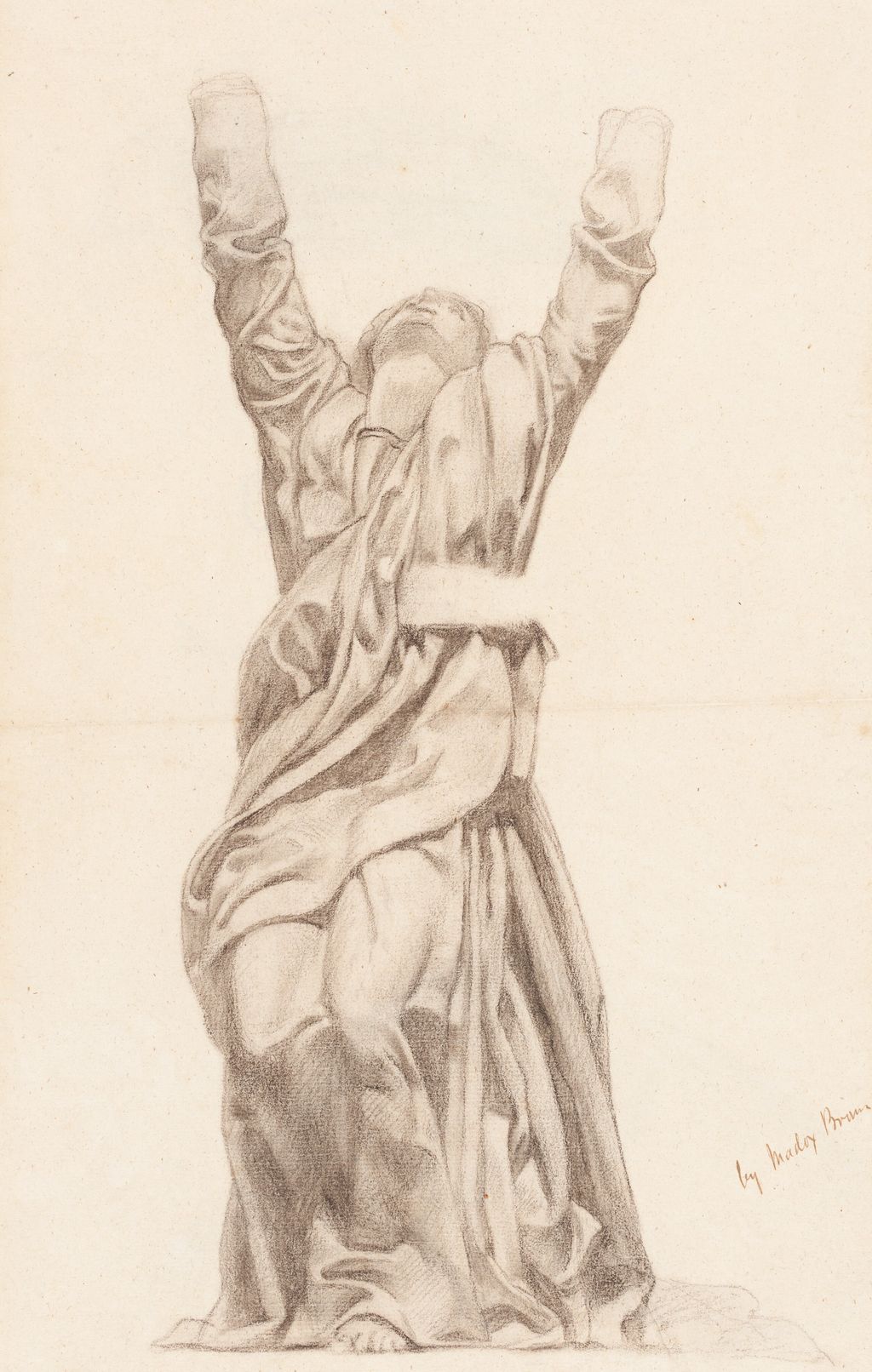
Ford Madox Brown, The Virgin Swooning, 1844. Black chalk on laid paper, 47.5 × 30 cm. National Gallery of Art, 1987.73.1.a.
Image source
.
CC0 / Public domain
.
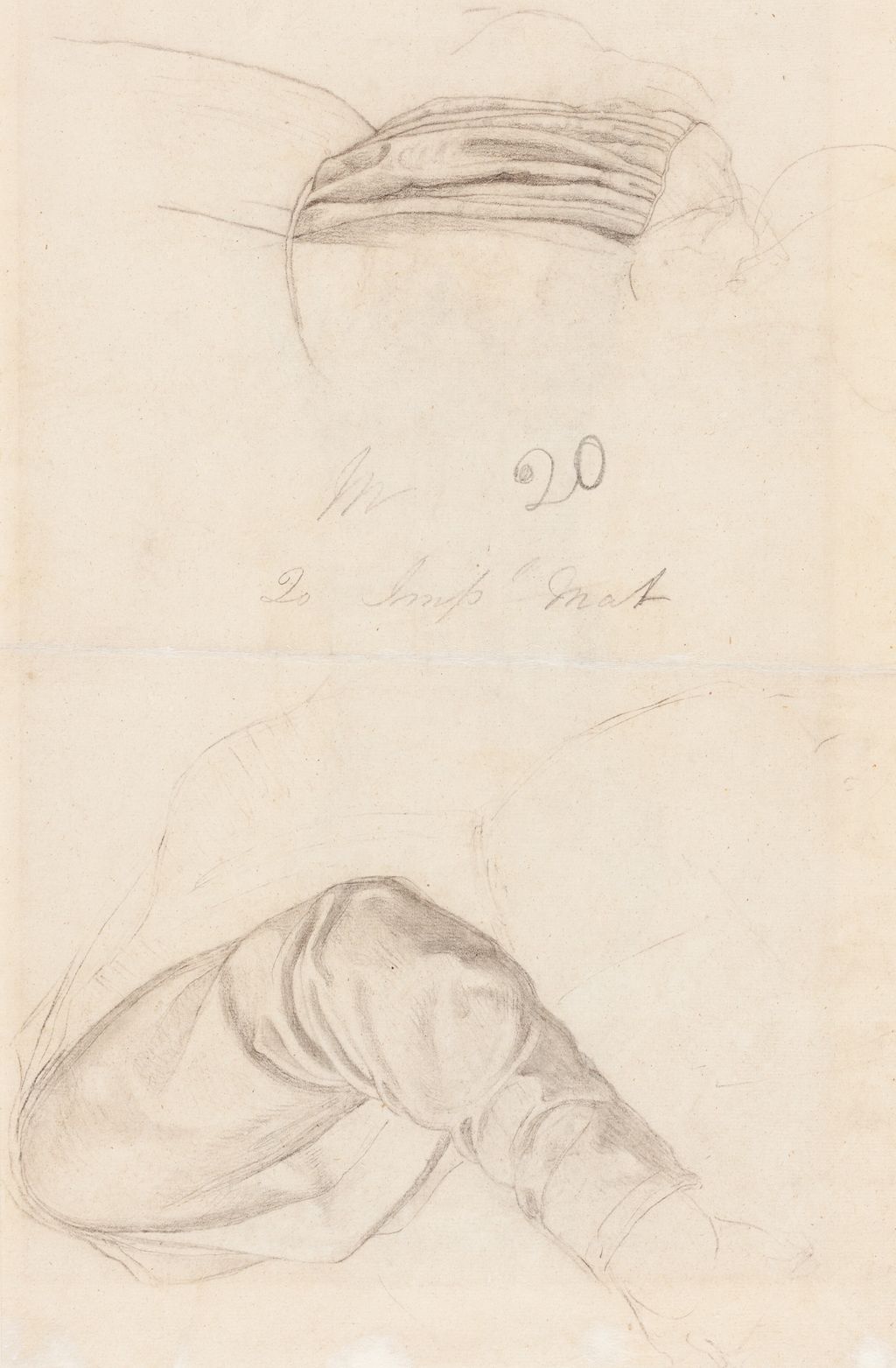
Ford Madox Brown, Two Drapery Studies, c.1844. Black chalk on laid paper; reverse of The Virgin Swooning. National Gallery of Art, 1987.73.1.b.
Image source
.
CC0 / Public domain
.
A portrait has another purpose
The oval Self-Portrait associated with Brown’s drawings belongs to a different category. The National Portrait Gallery’s catalogue identifies the Walker Art Gallery work as black chalk, dated September 1850 and inscribed as retouched in October 1853. It is a separate object from the later painted self-portrait . [4]
Here the face receives sustained modelling, while the coat dissolves into oblique strokes. The eyes look towards us although the shoulders turn away. Around the head, the oval boundary gives a formal completeness that a detached study of a hand does not seek. The contrast between resolved features and brisk clothing makes the encounter direct without demanding an equally finished surface everywhere.
A drawing need not explain another picture to justify our attention. In this portrait, line and tone already establish a relationship between sitter and viewer. Its later retouching also reminds us that a work on paper can have its own history of revision.
Drawing a drama: the King Lear sequence
Brown’s King Lear designs were made in Paris in 1844. Hueffer’s biography describes a sequence of sixteen outline designs, and records that Cordelia Parting from her Sisters later supplied the subject for Brown’s etching in The Germ . The drawings therefore belonged to a sustained encounter with the play, rather than being isolated preparations for one celebrated canvas. [5]
A sequence creates problems beyond the arrangement of a single scene. Characters must remain recognisable as their circumstances change. An exchange between two people must carry a different force from a confrontation before a group. A drawing can explore these relationships economically, using the direction of a body, the distance between figures or the interruption of an outline.
The later objects should nevertheless remain distinct. Cleveland’s Cordelia Parting from her Sisters is dated 1854 and made in pen and oil on paper on panel. It is a small coloured sketch, 19.5 × 26.5 cm, rather than one of the 1844 pen drawings or the later oil Cordelia’s Portion . [6] [7]
In the Cleveland composition, a red-cloaked figure at the left looks back across an interior towards a pale figure at the right. The central arch opens onto brighter space, dividing the gathering while also offering an exit. The long red fabric across the foreground and the opposing pale dress make the separation readable as a relationship between substantial shapes. Colour has become part of the drama’s organisation.
For the bedside reunion in Lear and Cordelia , another problem takes over: how to make waiting and recognition visible. Following these related subjects through drawing, print and painting reveals changes of emphasis as well as changes of medium. Their shared characters do not make them interchangeable images.
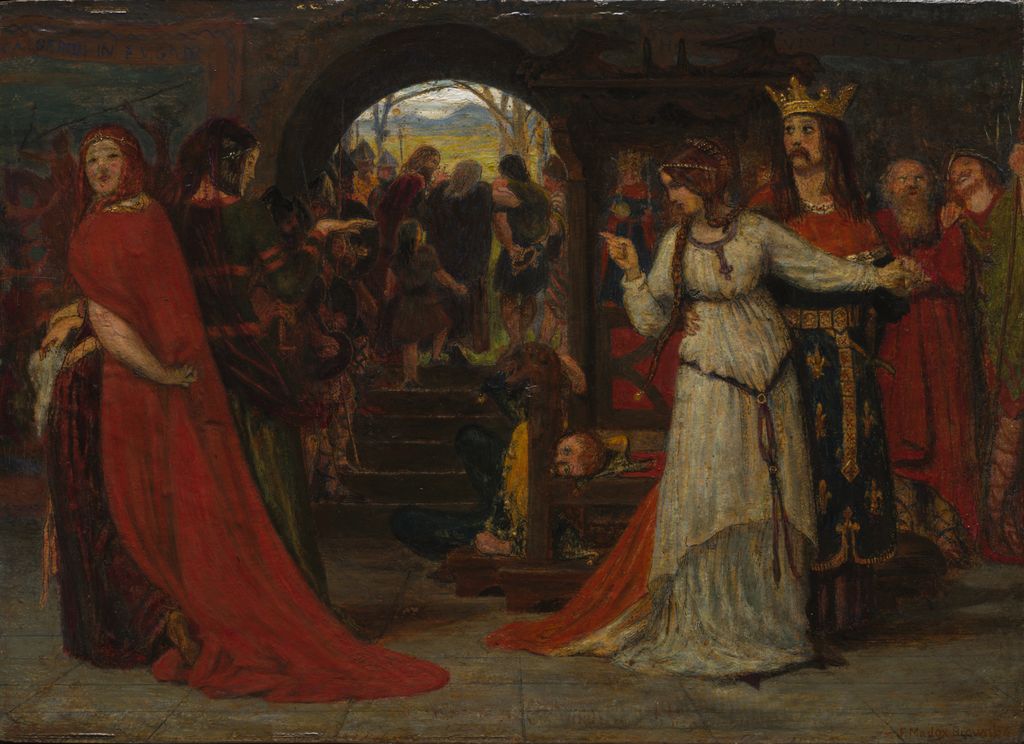
Ford Madox Brown, Cordelia Parting from her Sisters, 1854. Pen and oil on paper on panel. Cleveland Museum of Art, 2013.261.
Image source
.
CC0 / Public domain
.
Chaucer: parts and whole
MacCulloch’s Birmingham catalogue distinguishes an early compositional study for Chaucer , tracings of Milton and a Gothic arch, hand studies, and a drapery study for the Black Prince. These are separate kinds of preparation within the larger project. [8]
The early composition places small figures within an emphatic arched boundary. The figures are faint enough that the enclosing architecture can seem more immediately legible than the people. The two hand studies reverse that hierarchy of attention: each hand has room to become a substantial object, with fingers, knuckles and the turn of a wrist considered individually. In the Black Prince drapery study, folds radiate from the shoulder and tighten around the bent arm. A small portion of the eventual court occupies almost the whole sheet.
Brown’s diary supplies a useful counterpart to the surviving paper. On 4 September 1847, he recalled making an oil sketch in Rome, then a chalk drawing and an outline of the whole composition. That day he also recorded sketching Chaucer in white chalk and seeking costumes. His account moves between paper, paint, the canvas itself and the practical business of finding clothes. [9]
The diary prevents the preparation from becoming an abstract diagram of successive stages. In December 1847, while working on Wycliffe , Brown drew a tracing of a sketch in order to make it in oil. A week later he was chalking figures onto canvas, then found himself unable to continue because he had run out of chalk. Drawing included planning, copying, enlargement and work directly on the intended painting surface. [9]
The completed Chaucer at the Court of Edward III gathers these different scales of effort into a continuous scene. Its drawings let us move the other way, from the crowded whole back to a single bend of cloth or an isolated gesture.
Watch: Ford Madox Brown
Choose a film exploring the people, stories and visual details in two of Brown’s best-known paintings.
Pre-Raphaelites: Ford Madox Brown – Work
Curator Tim Barringer explores the figures and stories within Work.
Watch on YouTubeCartoons, tracings and transfer
A cartoon in this context is a developed design for another work. Full-size cartoons were useful for transferring an arrangement, but Brown’s language was flexible: in the 1850 essay he also described a small outline design as a cartoon. For a small painting he recommended a full-size outline on paper that could be traced onto canvas; for a large one, a smaller drawing could be squared for enlargement. [1]
Squaring provides corresponding grids on the design and its destination, allowing an outline to be carried across section by section. Tracing carries an existing contour more directly. Neither tells us, by itself, how the composition was first invented. A carefully transferred figure may already have undergone many changes before its outline reaches the new surface. [1]
MacCulloch describes cut-out cartoons for figures in Work , with pencil on one side and red chalk on the other for transfer. She catalogues the Last of England cartoon separately from the December 1852 chalk study of Emma. [8]
The latter comparison separates an individual likeness from a whole arrangement. Emma’s head study gives the face a quiet, frontal presence inside the bonnet. In the cartoon, that head belongs to an oval group, with another adult, joined hands, clothing and surrounding passengers. A convincing likeness is one component of a design that has further demands of its own.
Work provides a particularly candid example. Brown’s diary records sittings from F. D. Maurice and an outline cartoon. When he drew Maurice into the picture, however, exact fidelity to the sitter made the figure look too short and the head too large beside the navvy. He considered altering the proportions. Accuracy in an isolated study did not automatically produce a convincing relationship within the painting. [5]
Tate’s official collection data also records a compact Studies for “Work” , dated 1855, in graphite and ink on paper. The existence of such a sheet alongside cartoons and portrait studies is a reminder that “the preparatory drawing” rarely means a single definitive object. [10]
What a drawing could not replace
In September 1865, writing to his patron George Rae about the large Joseph picture, Brown explained a frustrating limit. His elaborate small drawing had helped him avoid mistakes, but was “of no use to copy from”. Flesh still required painting from nature, while draperies and accessories had to be arranged again. He had even needed to manufacture Levi’s necklace before painting it. [5]
This is a useful qualification to the idea that a detailed drawing simply contains a painting in miniature. The earlier work could settle the incident and test its parts without preserving every optical condition required by the larger canvas. Changing scale created fresh demands. An accessory’s place in the composition could be settled before its exact appearance had been investigated anew in the studio.
Brown’s letter also gives drawing a second value. To compensate Rae for the delayed painting, he offered a drawing equal to the interest on the money already advanced. A work on paper could assist a painting and still be something a patron might receive and value independently. The same medium belonged to the studio’s thinking and to the painter’s dealings with collectors. [5]
Monumental drawing and decorative design
At the opposite extreme from a small hand study stands the NGV’s Cartoon for The Baptism of Edwin . The museum dates the paper work 1879–1891 and gives its medium as pastel, coloured chalks and grey gouache. At 146.5 × 318.5 cm, it is a substantial coloured design associated with the Manchester Town Hall mural. [11]
Here colour distinguishes groups across a broad horizontal field. The pale body at the font, the tall patterned vestments, the warm barrier and the blue-clad figure at the right hold different parts of the composition together. Drawing operates at the scale of a public interior, where large relationships must remain intelligible before the viewer investigates smaller incidents.
Hueffer describes the mural’s preparation as including a cartoon the size of the panel, a smaller coloured sketch and studies of heads. He then records the outline being traced onto the wall over four days. This account explains the cartoon’s practical place in the project without turning the paper object into the wall painting itself. [5]
Stained glass introduces a further distinction between an artist’s invention and a workshop’s working material. MacCulloch catalogues Christ Blessing Little Children as a working copy after Brown, squared for transfer, and three Tamworth window watercolours as copies by Thomas Matthews Rooke in 1909. Their presence in a Brown collection does not make them drawings by his hand. [8]
Such distinctions enrich the story of design. An image can pass through a designer’s study, a working copy, a completed window and a later record. Brown’s prints offer a parallel opportunity to distinguish the person inventing an image from the people and processes carrying it into another medium.
 King of Northumbria and Deira Ford Madox Brown.jpg)
Ford Madox Brown, The Baptism of Edwin, 1879–1891. Pastel, coloured chalks and grey gouache on paper. National Gallery of Victoria, 216-2.
Finished pictures on paper
Paper and colour do not automatically identify a preparatory object. Tate’s records distinguish the watercolour The Last of England , dated 1864–1866, from the earlier studies, and identify The Coat of Many Colours of 1867 as watercolour and gouache on paper. These are separate versions whose medium and dates must stay attached to the particular objects. [10]
MacCulloch’s catalogue records the portrait Miss Iza Duffus Hardy (1872) in pastel and coloured chalks on brown paper: the same broad family of materials serves a different purpose. [8]
A sheet’s function becomes clearer through its subject, scale, degree of development, inscriptions and documented relationship to other works. Looking only for the familiar finished oil can make drawings seem like incomplete answers. Looking at the particular task of each sheet lets us see the questions Brown was asking.
Artworks directory
Explore paintings, drawings, cartoons, illustrations and decorative designs documented in museum collections and specialist research. Distinct versions are listed separately; repeated print impressions are grouped. The coverage includes studies and works without a dedicated article and remains open to further research.
| Name | Date | Medium |
|---|---|---|
| Work (Manchester) | 1852–1865 | Oil on canvas |
| The Last of England (Birmingham) | 1852–1855 | Oil on panel |
| Jesus Washing Peter’s Feet | 1852–1856 | Oil on canvas |
| Pretty Baa-Lambs | 1851–1859 | Oil on panel |
| Take Your Son, Sir | ?1851–1892 | Oil on canvas |
| Lear and Cordelia | 1849–1854 | Oil on canvas |
| Cordelia’s Portion | 1867–1875 | Oil on canvas |
| Walton-on-the-Naze | 1859–1860 | Oil on canvas |
| Chaucer at the Court of Edward III (Tate) | 1856–1868 | Oil on canvas |
| Carrying Corn | 1854–1855 | Oil on mahogany |
| The Hayfield (The Hay Harvest) | 1855–1856 | Oil on mahogany |
| Stages of Cruelty | 1856–1890 | Oil on canvas |
| The Irish Girl | 1860 | Oil on canvas laid on board |
| Romeo and Juliet (Delaware) | 1869–1870 | Oil on canvas |
| The Seeds and Fruit of English Poetry | 1845–1853 | Oil on canvas |
| Self-Portrait | 1877 | Oil on canvas |
| The Bromley Children | Probably 1844 | Oil on canvas |
| The Bromley Family | 1844 | Oil on canvas |
| Byron’s Dream (Manchester) | 1874; worked on into 1875 | Oil on canvas |
| Cartoon for The Baptism of Edwin | 1879–1891 | Pastel, coloured chalks and grey gouache |
| The Coat of Many Colours | 1864–1866 | Oil on canvas |
| The Convalescent (Birmingham) | Dated October 1872 | Pastel |
| Crabtree Watching the Transit of Venus (reduced painting) | 1881–1888 | Tempera on panel |
| Cromwell on His Farm (Lady Lever) | Completed 1874 | Oil on canvas |
| Cromwell Protector of the Vaudois | 1877 | Oil on canvas |
| Dalton Collecting Marsh-Fire Gas (Town Hall mural) | 1886–1887 | Mural on canvas |
| The Establishment of the Flemish Weavers (reduced painting) | 1881; completed 1888 | Tempera on panel |
| The Finding of Don Juan by Haidée (NGV) | 1869–1870; later retouched | Watercolour and gouache over pencil |
| Henry and Millicent Fawcett | 1872 | Oil on canvas |
| Jacob and Joseph’s Coat (Ponce) | c.1868–1871 | Oil on canvas |
| James Leathart | 1863–1864; altered 1869 | Oil on canvas |
| King René’s Honeymoon (Tate watercolour) | 1864 | Graphite, watercolour, gouache and gum arabic on card |
| King René’s Honeymoon Cabinet (collaborative work) | 1861; exhibited 1862 | Oak, inlaid woods, painted panels and metal mounts; Brown designed Architecture |
| Manfred on the Jungfrau | 1841; retouched 1861 | Oil on canvas |
| Millie Smith | 1846 | Oil on paper laid on panel |
| William Michael Rossetti by Lamplight | 1856–1857 | Oil on panel |
| The Traveller (Manchester oil) | 1868–1884 | Oil on panel |
| Waiting: An English Fireside of 1854–55 | 1851–1855 | Oil on panel |
| An English Autumn Afternoon | 1852–1853; finished c.1854 | Oil on canvas |
| Alfred the Great: Sketch of Alfred drawing in the Sand | 1843–1845 | pencil |
| Historical Notes and Sketches of Alfred the Great | 1843–1850 | brown ink writing over pencil |
| Angels watching the Crown of Thorns: Study of clasped Hands | 1846 | black chalk |
| Architecture: Study of Gothic Arches and 14th Century Vaulting | c. 1847 | brown pen and ink over pencil on grey paper |
| The Ascension: Study of Angels and Hands | 1844 | brown pen and ink over pencil |
| The Ascension: Study of a Group of Angels | 1844 | brown pen and ink over pencil |
| The Ascension: Study of a Group of six flying Angels | 1844 | brown pen and ink over pencil |
| The Ascension: Two nude Angels holding onto each other | 1844 | brown brush and ink over pencil |
| The Ascension: Study for a kneeling Apostle | 1844 | black chalk touched with white on brown-toned paper |
| Head of a Child | c. 1844 | black chalk touched with white on brown toned paper |
| The Ascension: Drapery Study of a praying Apostle | 1844 | black chalk |
| The Spirit of Justice: Seated Figure in ecclesiastical Robes, gripping a Staff with left Hand raised in a Blessing | 1844 | black chalk |
| The Ascension: Study for an Apostle | 1844 | black chalk |
| The Spirit of Justice: Body of seated Figure in ecclesiastical Robes holding a Staff and a Book | 1844 | black chalk |
| The Ascension: Study of an Apostle | 1844 | black chalk on toned paper |
| Full-length Sketch of a standing, naked Child | 1844 | black chalk on toned paper |
| The Ascension: Study for Christ | 1844 | brown pen and ink over pencil |
| Caricature: Composite Drawing: A Stunner | 1861–1863 | pencil |
| A Victorian Woman in her Underwear | 1861–1863 | pencil |
| Caricature: Composite Drawing: Bewigged Head | 1861–1863 | pencil |
| Bowed Head of a bearded Man | 1861–1863 | pencil |
| Chaucer at the Court of Edward III: Early compositional Study | 1845 | pencil with brown pen and ink |
| Chaucer at the Court of Edward III: Study for Milton and two Designs for Tombstones | c.1845–c.1846 | pencil with brown frame outline |
| Chaucer at the Court of Edward III: Tracing of the Figure of Milton | c.1845–c.1849 | brown pen and ink with pencil on tracing paper |
| Chaucer at the Court of Edward III: Tracing of a Gothic Arch | c.1845–c.1849 | brown pen and ink with pencil on tracing paper |
| Chaucer at the Court of Edward III: Early compositional Study | 1845 | pencil with brown pen and ink |
| Chaucer at the Court of Edward III: Nude Studies of two Boys | 1845 | pencil, laid down |
| Chaucer at the Court of Edward III: Nude Studies of four Figures | 1845 | pencil |
| Chaucer at the Court of Edward III: Eight early Studies of Figures and Hands | 1845 | pencil |
| Chaucer at the Court of Edward III: Nude Studies for the Figures of Byron, Shakespeare and Burns | 1845 | black chalk |
| Chaucer at the Court of Edward III: Drapery Study for Burns | 1847 | black chalk |
| Chaucer at the Court of Edward III: Study of a right Leg and left Foot for Milton | 1847 | black chalk |
| Chaucer at the Court of Edward III: Study of a left Leg for Shakespeare | 1847 | black chalk |
| Chaucer at the Court of Edward III: Study of Drapery for Milton | 1847 | black chalk |
| Chaucer at the Court of Edward III: Drapery Study for Shakespeare | 1847 | black chalk |
| Chaucer at the Court of Edward III: Study of a Man in a medieval Hood | 1847 | black chalk |
| Chaucer at the Court of Edward III: Study for the Cardinal | 1847 | black chalk |
| Chaucer at the Court of Edward III: Drapery Study in Profile for Courtier | 1847 | black chalk |
| Chaucer at the Court of Edward III: Drapery Study | 1847 | black chalk |
| Chaucer at the Court of Edward III: Female Nude Study of a Muse holding onto a Rail | 1847 | pencil |
| Chaucer at the Court of Edward III: Female Nude: Study of a Muse | 1847 | pencil |
| Chaucer at the Court of Edward III: Nude Study for seated Lady | 1847 | pencil |
| Chaucer at the Court of Edward III: Nude Study of a Woman with right Arm raised | 1847 | pencil |
| Chaucer at the Court of Edward III: Two Studies of Back of a seated Woman's Head | 1847 | pencil |
| Chaucer at the Court of Edward III: Two Studies of a seated Woman in lost Profile Pose and from the Back | 1847 | pencil |
| Chaucer at the Court of Edward III: Nude Study of a Woman | 1847 | pencil |
| Chaucer at the Court of Edward III: Sketch of a Woman supporting another Figure | 1847 | pencil |
| Chaucer at the Court of Edward III: Study of the Heads and Shoulders of two Women | 1847 | pencil |
| Chaucer at the Court of Edward III: Drapery Study for Edward III with Outline of a Child | 1847 | black chalk |
| Chaucer at the Court of Edward III: Foreshortened Study for Head of a Jester | 1847 | pencil |
| Chaucer at the Court of Edward III: Head of Alexander Pope | 1847 | black chalk |
| Chaucer at the Court of Edward III: Two Hand Studies | 1847 | black chalk |
| Chaucer at the Court of Edward III: Study of Head of Milton copied from Sculpture | 1848 | black chalk |
| Chaucer at the Court of Edward III: Nude Studies for the Squire and the Courtier talking to Gower | 1848 | pencil |
| Chaucer at the Court of Edward III: Drapery Study for the Black Prince | 1848 | black chalk with touches of white |
| Chaucer at the Court of Edward III: Three Studies of Hands | 1848 | Black chalk |
| Chaucer at the Court of Edward III: Four Studies of Hands | 1848 | black chalk touched with white |
| Chaucer at the Court of Edward III: Study of a clasped right Hand for one of the Poets | 1848 | black chalk |
| Chaucer at the Court of Edward III: Study of a left Hand for Burns | 1848 | black chalk heightened with touches of white |
| Chaucer at the Court of Edward III: Study of Drapery for Burns | 1848 | black chalk |
| Chaucer at the Court of Edward III: Drapery Study | 1848 | black chalk |
| Chaucer at the Court of Edward III: Drapery Study for the Black Prince | 1851 | black and white chalks on brown-toned paper |
| Chaucer at the Court of Edward III: Study for Squire's Legs | 1851 | black chalk heightened with white |
| Chaucer at the Court of Edward III: Two Head Studies of an old Woman | 1851 | black chalk |
| Costume Study: Five Sketches of Armour and Costume | 1844 | brown pen and ink over pencil |
| Costume Study: Archbishop's Dress | 1845 | brown pen and ink on tracing paper |
| Costume Studies: French and Italian thirteenth and fourteenth-century Costumes (seven Drawings) | 1845 | brown pen and ink on tracing paper |
| Costume Study: Seigneur de Rimini | 1845 | brown pen and ink on tracing paper |
| Dalziels' Bible Gallery: The Death of Eglon | 1863–1865 | engraved woodblock; designed by Brown, engraved by the Dalziel Brothers |
| Dalziels' Bible Gallery: The Death of Eglon | 1881 | wood engraving; designed by Brown, engraved by the Dalziel Brothers |
| Dalziels' Bible Gallery: Elijah and the Widow's Son | 1863–1865 | engraved woodblock; designed by Brown, engraved by the Dalziel Brothers |
| Dalziels' Bible Gallery: Elijah and the Widow's Son | 1881 | wood engraving; designed by Brown, engraved by the Dalziel Brothers |
| Dalziels' Bible Gallery: Joseph’s Coat (Compositional Sketch and four Studies for Jacob's Granddaughter) | 1863–1865 | pencil on paper |
| Dalziels' Bible Gallery: Joseph's Coat | 1863–1865 | engraved woodblock; designed by Brown, engraved by the Dalziel Brothers |
| Dalziels' Bible Gallery: Joseph’s Coat | 1881 | wood engraving; designed by Brown, engraved by the Dalziel Brothers |
| Decorative Sketches: Venus Reclining on a Shell in the Midst of the Sea | 1848–1849 | brown pen and ink over pencil |
| Decorative Design: Ornamental Pattern | 1850 | watercolour and bodycolour over pen and ink, and pencil on two sheets of paper |
| Down Stream: Main Illustration (Last Year's First of May) | 1871 | wood engraving; designed by Brown, print execution by an engraver |
| Down Stream: Tailpiece to the Poem (This Year's First of June) | 1871 | wood engraving; designed by Brown, print execution by an engraver |
| The Establishment of Flemish Weavers in Manchester A.D. 1363: Four Studies of Parts of a Horse | 1879–1882 | black, white and red chalk on rough brown paper |
| Female: Two Studies of young Woman in eighteenth-century Costume | 1849 | pencil |
| Infant's Repast: Study of Mother and Child | 1848 | black and white chalk |
| Infant's Repast: Study of Mother and Child with separate Arm and Leg Studies of the Child | 1848 | black chalk with grey wash |
| King Lear: Sketch of Lear questioning Cordelia | 1844 | brown pen and ink over pencil |
| Alfred the Great: Compositional Sketches | 1843–1845 | pencil |
| King Lear: Sketches of Lear imagining his unfaithful Daughters’ Trial and Lear in the Storm | 1844 | brown pen and ink over pencil |
| Alfred the Great: Compositional Studies and Sketches and Chaucer at the Court of Edward III: Study of Cherubs | 1843–1849 | pencil |
| King Lear: Kent accuses Oswald | 1844 | brown pen and ink with pencil underneath |
| King Lear: Lear recounts his Wrongs to Regan | Undated | Brown pen and ink over pencil |
| King Lear: Cordelia at Lear's Bedside (Lear's Awakening) | 1844 | brown pen and ink over pencil |
| Cordelia Parting from Her Sisters (The Germ) | 1850; reprinted 1901 | Etching; designed by Brown, print execution by an engraver |
| King René's Honeymoon: Study for Architecture | 1861 | brush and brown ink, with watercolour, over pencil on brown paper |
| The Last of England: Cartoon | 1852 | pencil, image edged with brown ink |
| The Last of England: Portrait of Emma Hill | December 1852 | chalks with scratching out on two sheets of paper |
| Lear and Cordelia and The Infant’s Repast: Four Studies of Hands | 1849 | black chalk |
| Lyra Germanica - the Christian Life: Abraham and Isaac | 1868 | wood engraving; designed by Brown, print execution by an engraver |
| Lyra Germanica - the Christian Life: Finished Design for The Entombment | 1867 | black pen and ink |
| Lyra Germanica - the Christian Life: The Entombment | 1868 | wood engraving; designed by Brown, print execution by an engraver |
| Male: Sketch of Man reclining on Steps with Hands bound together | 1844 | brown pen and ink over pencil |
| Male: Academic nude Study, half-length with Moustache and Arms folded | 1846–1849 | black chalk |
| Male: Academic Study of Nude holding a Staff | 1847 | pencil |
| Male: Academic Study of Nude posed as a Sculptor | 1847 | chalk with grey wash |
| Male: Academic Study, three-quarter length Nude, with a Moustache and clenched Fists | 1847 | black chalk |
| Oure Ladye of Saturday Night: Seven Sketches | 1846 | pencil |
| Oure Ladye of Saturday Night: Four Studies for Angel holding Child | 1847 | pencil |
| Oure Ladye of Saturday Night: Study of Angel holding Child | 1847 | black chalk |
| Oure Ladye of Saturday Night: Study of Arm and Hands for Angel holding Bowl of Water | 1847 | black chalk |
| Oure Ladye of Saturday Night: Drapery Study for Angel holding Bowl of Water | 1847 | black chalk |
| Oure Ladye of Saturday Night: Study of Head for Angel holding Bowl of Water | 1847 | black chalk with rubbing and grey wash |
| Oure Ladye of Saturday Night: Study of Child seated on Knees of the Virgin and two separate Studies of the Child's Legs | 1847 | pencil on brown-toned paper |
| Oure Ladye of Saturday Night: Frieze Design | c. 1847 | pencil and black pen and ink |
| Oure Ladye of Saturday Night: Three Studies of Arms and Legs of Child | 1847 | pencil |
| Oure Ladye of Saturday Night: Three Studies of Child's Legs on Virgin's Knees | 1847 | pencil |
| Oure Ladye of Saturday Night: Studies of Right Foot and Left Hand of Child | 1847 | pencil on light brown paper |
| Oure Ladye of Saturday Night: Drapery Study for Virgin | 1847 | black chalk |
| Oure Ladye of Saturday Night: Study for Head of Virgin | 1847 | black chalk with wash |
| Parisina’s Sleep: Study for Prince Azo and Parisina | 1842 | black chalk with pencil side drawing |
| Parisina's Sleep: Study for Head of Prince Azo | 1842 | black chalk with grey wash |
| Parisina's Sleep: Study for the Head of Parisina | 1842 | black and white chalk with grey wash |
| Poets of the Nineteenth Century: The Prisoner of Chillon: Compositional Sketch | 1856 | pencil |
| Profile of a Man's left Eye and Nose | c.1856 | pencil |
| Poets of the Nineteenth Century: The Prisoner of Chillon: Study of a Corpse | 1856 | pencil |
| Designs for Decoration | c.1856 | pencil |
| Poets of the Nineteenth Century: The Prisoner of Chillon | 1857 | wood engraving; designed by Brown, print execution by an engraver |
| Portrait: Head Study of Daniel Casey (three-quarter view) | 1848 | black chalk |
| Portrait: Head Study of Daniel Casey (full-face) | 1848 | black chalk |
| Portrait: Miss Iza Duffus Hardy | 1872 | pastel and coloured chalks on brown paper |
| Portrait: Emma Hill (later Mrs Madox Brown) | 1848 | black chalk |
| Portrait: Emma Hill (later Mrs Madox Brown) | 1852 | pencil |
| Portrait: Mrs Madox Brown (neé Emma Hill) | 9 May 1854 | pencil |
| The Repose in Egypt: Compositional Sketch | 1847 | pencil |
| Study of a Statue of the Discobolus | 1845 | Black chalk |
| William Shakespeare: Study | 1849–1850 | pencil |
| William Shakespeare: Invitation Card | 1850 | wood engraving; designed by Brown, print execution by an engraver |
| The Spirit of Justice: Study for Baron and his Advisor, with Sketches of Erudition and Wisdom | 1844–1845 | brown pen and ink over pencil |
| The Spirit of Justice: Drapery Study for Erudition | 1844–1845 | black chalk |
| Drapery Study and Sketch of Two Legs | Undated | Black chalk |
| The Spirit of Justice: Study for Wisdom | 1844–1845 | black chalk with grey wash |
| The Spirit of Justice: Study for Head of the Baron | 1844–1845 | black chalk |
| The Spirit of Justice: Study for the Head of central Bishop | 1844–1845 | black chalk |
| The Spirit of Justice: Study for the Head of a Bishop | 1844–1845 | black chalk with grey wash |
| The Spirit of Justice: Study for the uplifted left Arm of Justice | 1844–1845 | black chalk |
| The Spirit of Justice: Study for Head of Counsellor in a Coronet | 1844–1845 | black chalk with touches of blue chalk |
| The Spirit of Justice: Study for Head of Counsellor | 1844–1845 | black chalk |
| The Spirit of Justice: Drapery Study for the Central Bishop | 1844–1845 | Black chalk |
| Part of a Drapery Study | 1844–1845 | black chalk |
| The Spirit of Justice: Study for Head of Widow | 1844–1845 | black chalk |
| Stages of Cruelty: Study for the Child (Catherine Madox Brown) | 1857 | black chalk on pale grey paper |
| Stained Glass Design: Cartoon for Zachariah, The High Priest | 1872 | black chalk |
| Stained Glass Design: Cartoon for The Young Milton | 1874 | black chalk |
| Stained Glass Design: Cartoon for St Simon | 1874 | black chalk |
| Sterne's 'Sentimental Journey': Study for Yorick and La Fleur talking to Maria’s Mother | 1842 | brown pen and ink over pencil |
| The Body of Harold brought before William the Conqueror: Eight Sketches of Figure Groups | c.1844 | pencil |
| Sterne's 'Sentimental Journey' : Yorick (Laurence Sterne) and Maria Walking | 1842 | pen and ink, watercolour and bodycolour over pencil |
| Study of Tree Trunk with Roots | c.1847 | black chalk, heightened with white chalk on buff paper |
| Two Studies of Tree Trunks | c.1846 | black chalk |
| Unknown Subject: Compositional Sketch | 1843–1850 | pencil |
| Wycliffe reading his Translation of the Bible: Nude Study for Chaucer | 1847 | pencil |
| Wycliffe reading his Translation of the Bible: Study for Chaucer | 1847 | pencil |
| Wycliffe reading his Translation of the Bible: Nude Study of Gower | 1847 | pencil |
| Wycliffe reading his Translation of the Bible: Study for Gower | 1847 | pencil |
| Wycliffe reading his Translation of the Bible: Nude Study for John of Gaunt and Chaucer's right Hand | 1847 | pencil and black chalk |
| Wycliffe reading his Translation of the Bible: Study of John of Gaunt and Chaucer's Left Hand | 1847 | pencil and black chalk |
| Wycliffe reading his Translation of the Bible: Study for Wycliffe | 1847 | black chalk |
| Wycliffe reading his Translation of the Bible: Nude Study for Wycliffe | 1847 | pencil |
| Wycliffe reading his Translation of the Bible: Drapery Study for Wycliffe | 1847 | black chalk |
| Wycliffe reading his Translation of the Bible: Drapery Study for Chaucer | 1848 | black chalk |
| Wycliffe reading his Translation of the Bible: Study of Legs for John of Gaunt and two Studies of Feet for Wycliffe | 1848 | black chalk |
| Wycliffe Reading his Translation of the Bible: Studies of Hands for John of Gaunt and Gower | 1847 | black chalk |
| Wycliffe reading his Translation of the Bible: Study for Head of Wycliffe | 1847 | pencil |
| Wycliffe reading his Translation of the Bible: Study for Constance and Child | 1847 | pencil |
| Wycliffe reading his Translation of the Bible: Unfinished Study for Head of Constance | 1847–48 | pencil |
| Wycliffe reading his Translation of the Bible: Portrait of Elizabeth Bamford modelling for Constance | 1848 | pencil |
| Wycliffe reading his Translation of the Bible: Study for Head of Constance | 1848 | chalk over pencil |
| Wycliffe reading his Translation of the Bible: Study for Head of Chaucer | 1848 | pencil |
| Wycliffe reading his Translation of the Bible: Study of Monk representing the Catholic Faith | 1848 | black chalk with brown pen and ink, squared up |
| Wycliffe reading his Translation of the Bible: Study of young Woman representing the Protestant Faith | 1848 | black chalk |
| Cathy Madox Brown at the Age of Three (Tate N01356) | 1853 | Graphite on paper |
| King René‘s Honeymoon (Tate N02409) | date not known | Ink on paper |
| Sheepshearing (Tate N02410) | c.1887 | Ink and graphite on paper |
| Studies for ‘Work’ (Tate N02411) | 1855 | Graphite and ink on paper |
| Design for Badge for Gillum’s Homes (Tate N02412) | date not known | Ink and graphite on paper |
| Arkwright’s Mill (Tate N02413) | 1878 | Graphite on paper |
| Study for ‘John Kay’ (Tate N02414) | 1889 | Graphite on paper |
| Study for ‘Southend’ (Tate N02415) | date not known | Graphite on paper |
| ‘Where are you going, my pretty maid?’ (Tate N02416) | date not known | Graphite on paper |
| Section of the Bridgewater Canal (Tate N02417) | 1890 | Ink on paper |
| A Barge on the Bridgewater Canal (Tate N02418) | 1890 | Graphite on paper |
| Study of the Tow-Path on the Bridgewater Canal (Tate N02419) | 1890 | Graphite on paper |
| Our Lady of Good Children (Tate N02684) | 1847–61 | Pastel, watercolour and gold paint on paper |
| Arkwright’s Mill (Tate N02791) | 1881 | Graphite on paper |
| The Bridgewater Canal (Tate N02792) | 1890 | Ink on paper |
| The Bridgewater Canal (Tate N02793) | date not known | Chalk and graphite on paper |
| The Last of England (Tate N03064) | 1864–6 | Watercolour on paper |
| Mauvais Sujet (Tate N03228) | 1863 | Watercolour on paper |
| Study of a Man Painting (Tate N03472) | 1839 | Graphite on paper |
| The Brent at Hendon (Tate N03528) | 1854–5 | Oil paint on board on mahogany |
| Study for the Dean in the ‘Execution of Mary Queen of Scots’ (Tate N04280) | c.1840 | Oil paint on paper |
| Sketch for ‘Jesus Washing Peter’s Feet’ (Tate N04281) | 1852 | Graphite on paper |
| Sketch for ‘Cromwell on his Farm’ (Tate N04282) | c.1853 | Graphite on paper |
| The Coat of Many Colours (Tate N04584) | 1867 | Watercolour and gouache on paper |
| Stages of Cruelty (Tate N04625) | c.1856 | Watercolour on paper |
| Head of a Girl (Tate N04803) | date not known | Oil paint on paper |
| Portrait of Dykes Barry as a Child (Tate N04866) | 1853 | Oil paint on mahogany |
| Jesus Washing Peter’s Feet (Tate N05301) | 1857–8 | Watercolour on paper |
| Platt Lane (Tate N05383) | 1884 | Oil paint on canvas |
| Study of F.G. Stephens for ‘Jesus Washing Peter’s Feet’. Verso: A Head Crowned with Laurels (Tate T00571) | 1852 | Graphite on paper. Verso: graphite on paper |
| Sketch for ‘Jesus Washing Peter’s Feet’ (Tate T01035) | c.1851 | Ink and graphite on paper |
| Chaucer at the Court of Edward III (Sydney) | 1845–1851 | Oil on canvas |
| Wycliffe Reading His Translation of the Bible to John of Gaunt (Bradford) | 1848 | Oil on canvas |
| Work (Birmingham replica) | 1859–1863 | Oil on canvas |
| The Spirit of Justice (Book of Art reproduction) | Published 1846 | Wood engraving after Brown’s cartoon; engraver unknown |
| The Execution of Mary Queen of Scots | 1840–1842 | Oil on canvas |
| The Prisoner of Chillon (Manchester oil) | 1843 | Oil on canvas |
| The Parting of Cordelia from Her Sisters (oil) | 1853 | Oil on canvas |
| Cordelia’s Portion (Lady Lever) | 1866–1872 | Watercolour, gouache and pastel |
| The Ascension | 1844–1845 | Oil on canvas |
| Manfred in the Chamois Hunter’s Hut (oil sketch) | 1840 | Oil on canvas |
| Dr Primrose and His Daughters (The Vicar of Wakefield) | 1840–1841 | Oil on canvas |
| The Body of Harold Brought before William the Conqueror | 1844–1861 | Oil on canvas |
| The Seeds and Fruits of English Poetry (Bedford cartoon) | 1845 | Black chalk on paper |
| Wycliffe Reading His Translation of the Bible (oil sketch) | 1847–1848 | Oil on board |
| Cromwell Discussing the Protection of the Vaudois (Nottingham) | 1877–1878 | Oil on canvas |
| Two Drawings of Men in Hoods | c.1845 | Pencil on paper |
| The Seeds and Fruits of English Poetry: Study of the Right Side | c.1845 | Brown pen and ink with pencil |
| Chaucer: A Man in a Hood with a Liripipe and Two Drapery Studies | 1848 | Oil on canvas |
| The Prisoner of Chillon Entreating His Jailors (Yale watercolour) | 1858 | Watercolour heightened with bodycolour |
| Elijah and the Widow’s Son (Birmingham oil) | 1864 | Oil on panel |
| He That Soweth (Lyra Germanica) | Published 1868 | Wood engraving by the Dalziel Brothers after Brown |
| The Entombment (NGV) | 1871–1878 | Watercolour, gouache, gold paint and gum arabic over pencil |
| The Sower (Morris firm tile) | c.1864–1873 | Tile; design by Brown, workshop execution |
| Childe Harold’s Pilgrimage (Byron illustration) | Published 1870 | Steel engraving by Herbert Bourne after Brown |
| The Two Foscari (Byron illustration) | Published 1870 | Steel engraving by Herbert Bourne after Brown |
| The Corsair (Byron illustration) | Published 1870 | Steel engraving by Herbert Bourne after Brown |
| Sardanapalus (Byron illustration) | Published 1870 | Steel engraving by Herbert Bourne after Brown |
| Don Juan (Byron illustration) | Published 1870 | Steel engraving by Herbert Bourne after Brown |
| Byron’s Dream (roundel title-page design) | Published 1870 | Steel engraving by Herbert Bourne after Brown |
| The Finding of Don Juan by Haidée (Birmingham oil) | 1870–1873 | Oil on canvas |
| The Dream of Sardanapalus (Delaware) | 1871–1872 | Watercolour on paper |
| The Traveller (Once a Week) | Published 1869 | Wood engraving by Joseph Swain after Brown |
| The Infant’s Repast | 1848 | Oil on board |
| Oliver Madox Brown Aged Four (Dwale Bluth frontispiece) | Published 1876 | Etching |
| Oliver Madox Brown as a Young Man (Dwale Bluth frontispiece) | Published 1876 | Etching |
| A Beggar and Other Fantasies: Title-page Illustration | Published 1889 | Photo-engraving after Brown |
| Dramas in Miniature: Title-page Illustration | Published 1891 | Photo-engraving after Brown |
| The Brown Owl: Frontispiece | Published 1892 | Photo-engraving after Brown |
| The Brown Owl: Central Illustration | Published 1892 | Photo-engraving after Brown |
| The Feather: Frontispiece | Published 1892 | Photo-engraving after Brown |
| The Ascension: Study for Christ | 1844 | Pen and ink |
| King Lear: Lear Questions Cordelia (Whitworth) | 1844 | Pencil, pen and brown ink |
| King Lear: France Claims the Dispossessed Cordelia (Whitworth) | 1844 | Pencil, pen and brown ink |
| King Lear: Cordelia Parts from Her Sisters (Whitworth) | 1844 | Pencil, pen and brown ink |
| King Lear: Goneril and Regan Together (Whitworth) | 1844 | Pencil, pen and brown ink |
| King Lear: Goneril Tells Oswald How to Treat Lear (Whitworth) | 1844 | Pencil, pen and brown ink |
| King Lear: Oswald’s Insolence to Lear (Whitworth) | 1844 | Pencil, pen and brown ink |
| King Lear: Lear Rebukes Oswald (Whitworth) | 1844 | Pencil, pen and brown ink |
| King Lear: Kent Trips Oswald (Whitworth) | 1844 | Pencil, pen and brown ink |
| King Lear: Goneril’s Complaint to Lear (Whitworth) | 1844 | Pencil, pen and brown ink |
| King Lear: Lear Curses Goneril’s Infidelity (Whitworth) | 1844 | Pencil, pen and brown ink |
| King Lear: Kent Challenges Oswald (Whitworth) | 1844 | Pencil, pen and brown ink |
| King Lear: Kent in the Stocks (Whitworth) | 1844 | Pencil, pen and brown ink |
| King Lear: Lear Recounts His Wrongs to Regan (Whitworth) | 1844 | Pencil, pen and brown ink |
| King Lear: Lear Parts from Regan and Goneril (Whitworth) | 1844 | Pencil, pen and brown ink |
| King Lear: Lear and the Fool in the Storm (Whitworth) | 1844 | Pencil, pen and brown ink |
| King Lear: Lear Mad on the Beach at Dover (Whitworth) | 1844 | Pencil, pen and brown ink |
| King Lear: Alternative Study: Lear Curses Goneril (Whitworth) | 1844 | Pencil, pen and brown ink |
| King Lear: Lear Imagines His Daughters’ Trial (Whitworth) | 1844 | Pencil |
| King Lear: Alternative Study: Lear in the Storm (Whitworth) | 1844 | Pencil, pen and brown ink |
| The Last of England (Fitzwilliam) | 1860 | Oil on canvas |
| The Convalescent (Metropolitan Museum) | Dated 1872 | Pastel |
| Self-Portrait (Walker drawing) | 1850; retouched 1853 | Black chalk |
| Byron’s Dream (Whitworth) | 1889 | Watercolour over graphite |
| Cordelia Parting from Her Sisters (Cleveland sketch) | 1854 | Pen and oil on paper mounted on panel |
| David and Goliath: Cartoon for Stained Glass Window at Jesus College, Cambridge | 1872 | Charcoal and graphite on Japanese paper |
| The Virgin Swooning (recto) | 1844 | Black chalk on laid paper |
| Two Drapery Studies (verso) | c.1844 | Black chalk |
| Architecture: King René’s Honeymoon (stained glass) | 1862 | Stained glass; designed by Brown, made by Morris, Marshall, Faulkner & Co. |
| The Romans Building a Fort at Mancenion (Town Hall mural) | 1880 | Spirit fresco |
| The Baptism of Edwin (Town Hall mural) | 1879–1880 | Spirit fresco |
| The Expulsion of the Danes (Town Hall mural) | 1880–1881 | Spirit fresco |
| The Establishment of the Flemish Weavers (Town Hall mural) | 1881–1882 | Spirit fresco |
| Crabtree Watching the Transit of Venus (Town Hall mural) | 1882–1883 | Spirit fresco |
| The Proclamation Regarding Weights and Measures (Town Hall mural) | 1883–1884 | Spirit fresco |
| Wycliffe on Trial (Town Hall mural) | 1885–1886 | Spirit fresco |
| Chetham’s Life’s Dream (Town Hall mural) | 1885–1886 | Mural on canvas |
| Bradshaw’s Defence of Manchester (Town Hall mural) | 1892–1893 | Mural on canvas |
| John Kay, Inventor of the Fly Shuttle (Town Hall mural) | 1888–1890 | Mural on canvas |
| The Opening of the Bridgewater Canal (Town Hall mural) | 1891–1892 | Mural on canvas |
Frequently Asked Questions
His 1850 essay recommends several kinds of preparation, including drawings and an oil sketch. It is advice about constructing a historical picture, not proof that every work followed every stage. His letter to Rae also shows that even an elaborate drawing could leave much to be studied again while painting. [1] [5]
Here it means a preparatory design. Brown discussed both full-size outlines for tracing and smaller designs for enlargement. The term describes a role in making another work; it does not require a comic subject. [1]
Brown recommended studying the body before drawing it in costume. The separate stages establish the action and proportions, then investigate the clothing around them. His instructions particularly stress studying loose drapery from a living model. [1]
Discussion
Look again at the images and ideas explored in Ford Madox Brown Drawings. These editorial prompts invite your observations.
Reader Insights
Compare the whole figure in The Virgin Swooning with the isolated fabric studies on its reverse. Follow one dark fold through each image. How does shading give cloth a different role when it belongs to a complete body?
Choose a hand in a finished Brown painting and imagine it alone on a sheet. What would the isolated study preserve, and what would disappear when the neighbouring figures, objects and glances were removed?
Compare a compact composition with the broad Baptism of Edwin cartoon. Begin with the largest light and dark shapes, then look at faces. Consider which relationships can be understood at a distance and which need a closer view.
Join the Conversation
Share a detail, comparison or question about Ford Madox Brown Drawings below.
References
- Ford Madox Brown , “On the Mechanism of a Historical Picture. Part I. The Design”, The Germ , February 1850, pp. 70–73; digitised collected edition. View source .
- National Gallery of Art , The Virgin Swooning [recto] , 1844, accession 1987.73.1.a; object fields and associated verso. View source .
- National Gallery of Art , Two Drapery Studies [verso] , c.1844, accession 1987.73.1.b; object fields and associated recto. View source .
- National Portrait Gallery , Later Victorian Portraits Catalogue , Ford Madox Brown, “Self-portraits”, 1850 entry: Walker Art Gallery WAG 10505, inscriptions and medium. View source .
- Ford Madox Hueffer , Ford Madox Brown: A Record of His Life and Work (1896), pp. 37–38 (Lear designs), 74–75 (etching), 155 (Maurice), 207–208 (Brown’s September 1865 letter to George Rae), and 327 (Baptism preparations). View source .
- Cleveland Museum of Art , Cordelia Parting from her Sisters , 1854, accession 2013.261; object record, medium and unframed measurements. View source .
- Fitzwilliam Museum , Cordelia’s Portion , PD.9-1950, object 808; oil on canvas, dated 1867–1875. View source .
- Laura MacCulloch , Ford Madox Brown: Works on Paper and Archive Material at Birmingham Museums and Art Gallery , PhD thesis, University of Birmingham (2009), volume I, p. 137, pp. 209–211, 222–223, 252–254, 272 and 284–286; catalogue entries 15–15b, 42, 45, 89–90, 124, 144 and 148–150. Volume II, catalogue illustrations 15, 15a–15b, 42, 45, 89–91, 145–146 and 148, PDF pp. 42, 44, 61, 63, 99–101, 139 and 141. View source 1 . View source 2 .
- Ford Madox Brown; William Michael Rossetti, editor , Præraphaelite Diaries and Letters (1900), Brown’s diary, 4 September 1847, pp. 61–66; 9 and 16 December 1847, pp. 78–79. View source .
- Tate , official historical collection dataset, entries N02411, Studies for “Work” (1855); N03064, The Last of England (1864–1866); N04584, The Coat of Many Colours (1867). View source .
- National Gallery of Victoria , The Baptism of Edwin, King of Northumbria , 1879–1891, accession 216-2; medium, measurements and title. View source .
- Laura MacCulloch, Ford Madox Brown: Works on Paper and Archive Material at Birmingham Museums and Art Gallery, 2009, volumeI; catalogue entries. View source.
- Laura MacCulloch, Ford Madox Brown: Works on Paper and Archive Material at Birmingham Museums and Art Gallery, 2009, volumeII; illustration lists, pp1–24. View source.
- Tate, official historical collection dataset; Ford Madox Brown accession records. View source.
- Ford Madox Hueffer, Ford Madox Brown: A Record of His Life and Work, 1896; selected career, object and mural passages. View source.
- Fitzwilliam Museum, The Last of England, M.Add.3. View source.
- Metropolitan Museum of Art, The Convalescent, 10.46. View source.
- The Whitworth / Art UK, Byron’s Dream, 1889 watercolour. View source.
- Cleveland Museum of Art, David and Goliath: Cartoon for Stained Glass Window at Jesus College, Cambridge, 1872, 2013.247. View source.
- Victoria and Albert Museum, Architecture: King René’s Honeymoon, CIRC.516-1953. View source.
- Manchester City Council, The Ford Madox Brown Murals; cycle and individual scenes. View source.
- Splash image, Ford Madox Brown, Self-Portrait, September 1850, retouched October 1853. Black chalk. Walker Art Gallery, WAG 10505.


