


 by
Tom Gurney
Tom Gurney BSc (Hons) is an art history expert with over 20 years experience
Published on June 19, 2020 / Updated on October 30, 2026
Email:
tomgurney1@gmail.com
/ Phone:
+44 7429 011000
Ford Madox Brown: Introduction
Ford Madox Brown makes looking feel like an encounter with other people's lives. A labourer pauses above an open trench; an emigrant grips his wife's hand; a girl watches smaller children while the street carries on around her. His pictures give these actions the weight usually reserved for great historical events. They also ask us to look at the conditions surrounding them: the light, the tools, the clothes, the unequal distribution of comfort and responsibility.
Brown was a British painter born in Calais in 1821, trained on the Continent and closely associated with the Pre-Raphaelites, although he never became a member of their Brotherhood. His career extended from Romantic literary subjects and ambitious national histories to modern life, landscape, portraiture, decorative design and the twelve murals of Manchester Town Hall, completed in the year of his death, 1893. [1]
Work and The Last of England provide a compelling introduction, but they reveal only part of his range. The same painter could make summer heat the subject of a family scene, imagine the court listening to Chaucer, design a medieval king planning a house, or place scientific discovery beside pond dipping. Across these different activities, he repeatedly returned to a practical problem: how can a picture make a complex human situation intelligible?
At a Glance
- Life 1821–1893; born in Calais, died in London. [1]
- Training Academies in Bruges, Ghent and Antwerp, followed by work in Paris and a journey to Italy. [1] [2]
- Pre-Raphaelite relationship Close associate and brief teacher of Dante Gabriel Rossetti; never a formal member of the Brotherhood. [1]
- Particularly revealing works Work , The Last of England , Pretty Baa-Lambs , Jesus Washing Peter's Feet and the Manchester murals.
- Working interests Dramatic gesture, historical research, particular effects of light, the experience of ordinary people and the relation between painting and design. [1] [3]
- Further reading Biography , paintings , style and technique , drawings and Manchester murals .
Brown’s artistic connections
Teaching, friendship and collaborative design brought Brown into contact with several generations of artists.
- Gustaf Wappers: Brown studied in Wappers’s Antwerp studio during his continental training. That academic formation preceded his relationship with the Pre-Raphaelite circle. [4]
- Dante Gabriel Rossetti: Rossetti approached Brown for instruction in 1848. Their relationship developed into a sustained friendship, exchanging designs, advice and practical support. [4]
- William Morris: Brown was a founding partner in Morris, Marshall, Faulkner & Co. He supplied figure designs while the firm brought painters, designers and makers together. [4]
- Edward Burne-Jones: Brown and Burne-Jones contributed different figure designs to the firm’s decorative projects. Their participation in King René’s cabinet can be followed through separately attributed panels. [5]
- William Holman Hunt: Hunt belonged to the younger circle with which Brown debated pictures and shared models. Brown retained an independent position alongside the Brotherhood. [4]
Ford Madox Brown in context
Continental academic formation
c. 1835–1846Pre-Raphaelite dialogue
From 1848Arts and Crafts collaboration
From 1861Civic history painting
1878–1893Gustaf Wappers
1803–1874Dante Gabriel Rossetti
1828–1882William Morris
1834–1896Edward Burne-Jones
1833–1898William Holman Hunt
1827–1910Manfred on the Jungfrau
1841; retouched 1861Pretty Baa-Lambs
1851–1859The Last of England
1852–1855Work
1852–1865King René’s Honeymoon
Tate watercolour, 1864Manchester Murals
1878–1893Contents
- A Continental Education
- An Independent Pre-Raphaelite
- How Brown Built a Picture
- Work and the People Around It
- Emigration as Modern History
- Painting Heat, Twilight and Autumn
- Homes, Families and Unfinished Stories
- Literature and Religion in Human Gestures
- Portraiture and the Work of Attention
- Patrons, Repetition and the Business of Painting
A Continental Education
Brown's English subjects can obscure the international formation behind them. He studied successively at the academies of Bruges, Ghent and Antwerp. When MSK Gent presented his retrospective in 2012, it placed his paintings alongside Belgian contemporaries, restoring that training to the account of a painter usually introduced through a British movement. [2]
Paris then offered a different education. Hueffer describes Brown studying Rembrandt and the Spanish masters at the Louvre rather than joining a particular Paris atelier. The early Manfred on the Jungfrau belongs to this period: a figure in red confronts an alpine precipice while a hunter reaches towards him. Brown later explained that the conception was an early attempt at outdoor light, but admitted that glaciers had not formed part of his studies. He had also substantially repainted the colour by 1861. The surviving picture therefore brings together an early dramatic invention and later revision. [1]
That admission is useful. Brown's commitment to observation did not require every landscape in a literary picture to have been painted on the spot. Nor did a finished composition necessarily preserve its first appearance. He could construct an imaginary setting, investigate an actual view with exceptional patience, and return to an old picture years afterwards. The method depended on what he needed the particular work to communicate.
His Italian journey in 1845–46 widened the possibilities further. In a letter to George Rae of January 1865, recalling what had remained strongest in his memory, Brown singled out the wall paintings of Giotto , Masaccio and Fra Angelico , alongside other Italian art and Holbein at Basel. These were recollections offered to a traveller almost twenty years later, but they show the breadth of his lasting interests. [1]
The Seeds and Fruit of English Poetry makes the connection tangible. Its Gothic framework gathers Chaucer and other poets into a national artistic ancestry. Brown explained that the larger project began in Rome as a triptych, with Chaucer at the centre and other English poets at the sides. He abandoned the wings, while Chaucer at the Court of Edward III developed into the central public statement. The crowded court makes poetry a social event, surrounded by attention, distraction and conversation. [1]
Four stages of Ford Madox Brown’s career
These periods group related developments; painting, travel and local work overlap across their boundaries.
Training and historical imagination
Born in Calais, Brown trained in the Low Countries and worked in Paris before travelling in Italy. Literary subjects and ambitious historical compositions formed an early basis for his practice. [4]

Figures, observation and the Pre-Raphaelite circle
London friendships and sustained work from models accompanied paintings of modern experience, religious stories and landscape. Brown’s relationship with the Brotherhood developed through exchange while he retained his independence. [4]
A composition in several forms
The Morris partnership, illustrated books and northern patrons opened different routes for Brown’s designs. He revisited subjects in new media while continuing portraits and independent oil paintings. [4]

 Ford Madox Brown.jpg)
History for a public room
The Town Hall murals brought historical research and lively subsidiary incidents into a civic setting. Large cartoons, studies, wall paintings and canvases served different roles within this extended commission. [4]


An Independent Pre-Raphaelite
Brown's relationship with Dante Gabriel Rossetti began before the Brotherhood was founded in 1848. Rossetti sought instruction from him, and a brief pupilship became a lasting friendship. Brown belonged to the movement's daily world of visits, exchanged models, shared enthusiasms and arguments about painting. He was older and had a substantial artistic education behind him when Rossetti, William Holman Hunt , John Everett Millais and their companions formed the group. [1]
Later recollections disagree about whether Brown was invited to join. Hueffer printed both Brown's uncertain memory and Hunt's account of an invitation formulated but never delivered. Their disagreement need not be resolved to establish the essential point: Brown did not become a member. His contribution is clearer in the works and relationships than in an imagined place among the original seven. [1]
The King Lear drawings of 1844 already show his fascination with bodies caught in dramatic conflict. [6]
His literary and historical ambitions were established before he met the younger painters. The family portraits The Bromley Family and The Bromley Children offer another route into that early world: formal arrangement, direct expressions and relationships enacted through a cluster of figures.
Laura MacCulloch's research corrects the family chronology in earlier accounts. Brown married Elisabeth Bromley in 1841; she died during their return from Italy in 1846, leaving their daughter Lucy. Emma Hill subsequently became his model and partner. Their daughter Catherine, usually called Cathy, was born in 1850, before Brown and Emma married in 1853. These distinctions matter when identifying the people who appear in his pictures. [6] [1]
Family likenesses, however, do not turn every painted incident into autobiography. A familiar sitter could become an emigrant, a biblical figure or a woman in historical costume. Brown drew upon the people around him while arranging them into situations with meanings beyond their own lives.
How Brown Built a Picture
Brown's essay “On the Mechanism of a Historical Picture” , published in The Germ in 1850, provides an unusually clear account of design. He advised the beginner to research the period, its clothing, architecture, furniture and landscape before settling the composition. Otherwise, a persuasive invention might prove incompatible with the things it was meant to represent. Knowledge should enter at the beginning, while the design was still flexible. [3]
The next stage was mental and theatrical. The painter should imagine the whole scene, decide which actors deserved prominence and reject incidents that could not be understood through visible action. Brown recommended trying gestures before a mirror, or with an imaginative friend, before turning to professional models. Studies of the nude body and its clothed appearance followed, together with an oil sketch and a cartoon for transferring the arrangement. [3]
This sequence helps explain why Brown's pictures can be both minutely observed and unmistakably constructed. A convincing hand is also part of a larger pattern. In The Last of England , the joined hands hold the couple together; in Work , a shovel coordinates the activity above and below ground. The viewer reads relationships through these visible connections.
Brown placed that readability above professional admiration for technique. Artists might praise colour or drawing, he wrote, but “the clearness, truth, and sentiment” would affect the wider public. The phrase joins precision to feeling. His aim was not exhausted by getting a costume or a blade of grass right: those details had to contribute to an intelligible human event. [3]
The physical picture could change drastically in pursuit of that event. In his diary for June 1856, Brown recorded deciding to clothe Christ in Jesus Washing Peter's Feet . Rather than paint over a passage he valued, he cut the painted legs from the already lined canvas, inserted another piece of canvas and filled the join. This is evidence for one particular revision, as well as a striking example of the distance between a composed appearance and the labour beneath it. [1]
Work and the People Around It
In Work , Brown gave contemporary London the breadth of a history painting. He began the large Manchester canvas in 1852, painting the Hampstead background on the spot. Hueffer records its completion in August 1863; Brown exhibited it in his independent Piccadilly exhibition in 1865. Birmingham owns a smaller version made for James Leathart. The two paintings should be distinguished when comparing reproductions. [1] [7]
The excavators take possession of the street. Their tools interrupt its passage; their white shirts receive the strongest light. Brown explained that he had found the English navvy as worthy of painting as the foreign peasants and fishermen who conventionally attracted artists. His young labourer “occupies the place of hero,” but the heroism emerges from a coordinated operation: men below the trench shovel earth to an intermediate landing, from which it is thrown out. [1]
Around that labour, other activities become visible. A plant seller carries the equipment on which his livelihood depends. A young girl looks after smaller children. A beer seller brings refreshments; a prosperous woman negotiates the crowd. At the right, Thomas Carlyle and Frederic Denison Maurice stand for the work of thought and teaching. Brown called them “brain-workers.” The apparent idleness of their bodies is part of his argument that exertion takes more than one form. [1]
The painting also tests its own categories. Brown described the plant seller as a man never taught to work, although gathering, carrying and selling are strenuous occupations. He gave the eldest girl's care of the children a story of neglect and premature responsibility. His accompanying catalogue is rich in sympathy, but it also contains judgements about class, nationality and gender that belong to his historical outlook. The characters' imaginary histories should be read as his inventions, rather than as documented biographies of the models. [1]
There is comedy in the street, but it does not cancel suffering. Brown complained that friends laughed at the distant incident of a policeman pushing an orange seller and scattering her fruit. He remembered a working-class model responding instead that he knew such treatment to be true. The difference between those responses is part of the painting's challenge: an incident at the edge can look amusing until the spectator considers who bears its cost. [1]
Tim Barringer reads Work through the relation between labour and Christian service. The biblical texts on its frame and the comparison with Jesus Washing Peter's Feet help him explain how Brown could give manual work religious significance within a modern street scene. This interpretation adds another dimension to the picture's social argument: usefulness, dignity and service belong together, even when the characters disagree about what they require. [8]

Ford Madox Brown, Work, Manchester version, begun 1852 and completed 1863, exhibited 1865. Manchester Art Gallery.
Emigration as Modern History
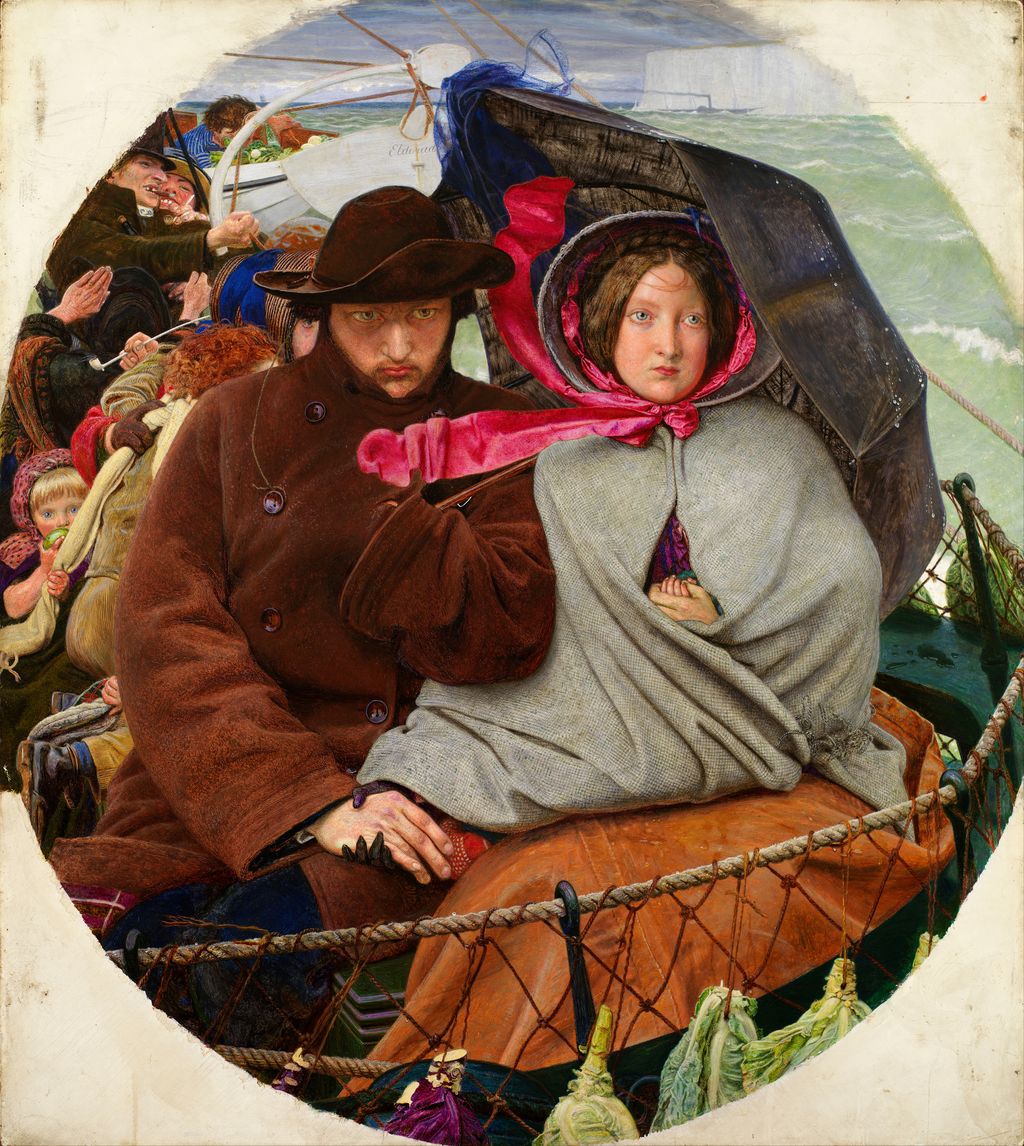
The Last of England gives the historical importance of ordinary experience a more concentrated form. Brown's own description called it historical “in the strictest sense,” identifying the mass emigration of the early 1850s as its subject. He began the Birmingham picture in 1852 and finished it in 1855. It represents a departure of its own time, made consequential through the experience of a small group. [1]
The oval encloses the husband and wife so closely that their bodies seem braced against its edge. His hat and the umbrella darken the upper part of the group; the pink ribbon pulls sideways across the cold colours. Their clasped hands occupy a small, firm centre. The baby's fingers, emerging through the woman's shawl, disclose another dependency within the apparently two-person image.
Brown and Emma modelled for the principal figures. The sculptor Thomas Woolner's departure for Australia in 1852 helped prompt the subject. The painting presents an invented family on a voyage; Brown himself did not make that journey. [7]
His explanation is both illuminating and partial. He believed the departure of an educated middle-class couple offered the fullest tragedy because they possessed especially strong cultural ties to their country. He also distinguished the husband's bitter reflection from the wife's attachment to the people travelling with her. Those are Brown's stated assumptions. Looking at the painting allows a less fixed response: the faces remain reserved, and the handclasp expresses solidarity without telling us everything either person thinks. [1]
Light carries much of the emotional pressure. Brown said he worked mostly outdoors on dull days, choosing cold days for the flesh to secure the appearance of an overcast scene at sea. Detail was necessary, in his account, because broad daylight would reveal it and bring the pathos closer to the beholder. The cabbages hanging around the ship belong to that same practical world: he explained them as provisions indicating a long voyage. [1]
This union of intimate gesture and large historical movement is central to Brown's achievement. The spectator encounters migration through a family whose physical closeness cannot remove uncertainty. The horizon may be open, but the couple have very little space in which to move.

Ford Madox Brown, The Last of England, 1852–1855. Oil on panel. Birmingham Museums Trust.
Painting Heat, Twilight and Autumn
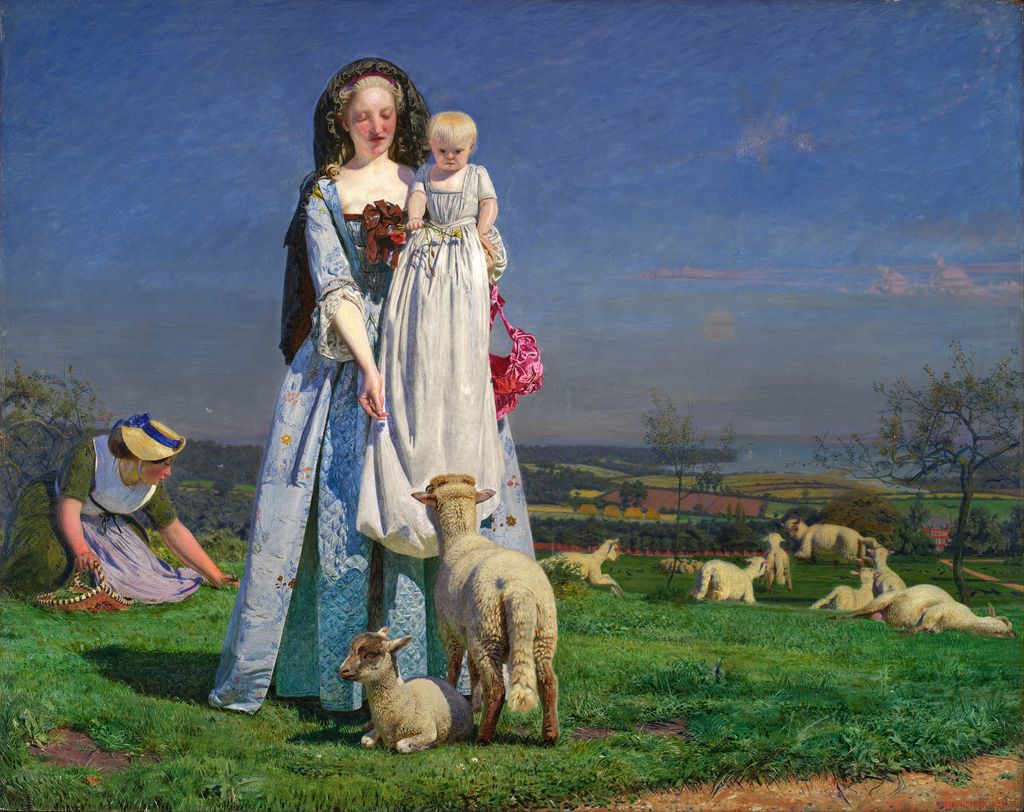
The sunlight of Pretty Baa-Lambs produces a different kind of pressure. White dress, exposed skin, patterned fabric and fleece each register its intensity. In his retrospective diary of 1854, Brown recalled taking a lay figure into the garden each morning, Emma and Cathy sitting for the main group, and sheep arriving from Clapham Common in a truck. The background was painted on the Common. What appears to be an easy outdoor gathering required an elaborate arrangement of models, props and repeated sessions. [9]
The figures' eighteenth-century clothes make it difficult to treat the scene as a casual family snapshot. Yet Brown resisted the demand for a hidden story. When using the alternative title Summer Heat , he explained that heat was the subject, while retaining his affection for the older name. The Birmingham painting's extended working date, 1851–1859, includes later revision. [7]
Carrying Corn and The Hayfield , also called The Hay Harvest , bring the same intensity to small landscapes. Tate records both as paintings on mahogany, dated respectively 1854–55 and 1855–56. Their modest size makes the expanse of sky and cultivated ground especially striking. [10]
Brown's explanation of The Hayfield connects colour with weather and work. Rain had delayed the second hay crop at Hendon and heightened the green of the grass and the brown of the hay. Under twilight, their contrast made the hay appear positively pink or red. The effect grew from a particular agricultural situation, rather than from colour detached from the scene. [1]
An English Autumn Afternoon extends the view from an upstairs room in Hampstead. Roofs occupy the near ground, foliage forms a broad middle distance, and the city rises on the horizon. Brown described the moment as three o'clock late in October, with the sun behind the spectator. The long view contains a nearby pair of young people, but the painting does not depend on discovering a decisive event between them. [1]
The contrast with Work is revealing. Both arrange a highly particular London environment, but the landscape lets the eye move through distance without a dominant human drama. In Walton-on-the-Naze , the small family group likewise shares attention with open sky, fields and water. Brown's landscapes repay looking as investigations in their own right, with distinct conditions of illumination and different proportions between people and place.

Ford Madox Brown, Pretty Baa-Lambs, 1851–1859. Oil on panel. Birmingham Museums Trust.
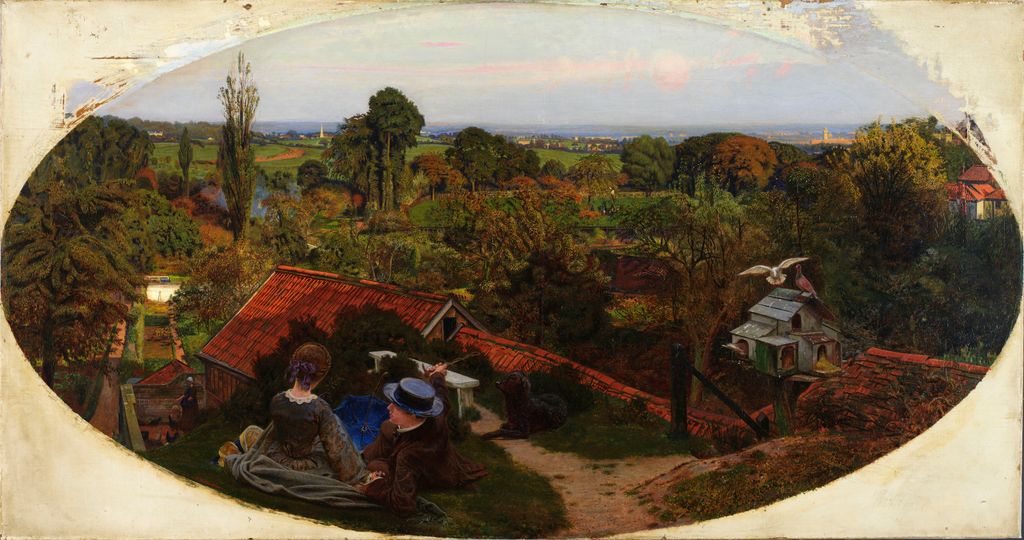
Ford Madox Brown, An English Autumn Afternoon. Oil on canvas. Birmingham Museums Trust, 1916P25; made and revised across several autumns in the 1850s.
Image source
.
Public domain
.
Homes, Families and Unfinished Stories
Brown's domestic pictures often bring us close while withholding a complete explanation. In Waiting: An English Fireside of 1854–55 , a woman sews beside the fire with a sleeping child across her lap. Her work continues through the child's rest. The tightly furnished space makes the quiet action substantial: cloth, furniture and the angle of the small body all direct attention back to her absorbed pose.
Take Your Son, Sir is more confrontational. A woman holds a baby towards the viewer, while a mirror places a man on the other side of the encounter. The title sounds like speech, but the expression allows several tones. Tate's historical collection data retain a tentative and extended date, ?1851–1892, consistent with the difficulty of reducing the unfinished canvas to a single moment of execution. [10]
The incompleteness changes our experience of the picture. Some passages have a forceful physical presence, while others remain unresolved. It is tempting to supply a dramatic secret that will finish the story for us. The evidence does not require one. The relationship between the offered child, the woman's gaze and the reflected man is already enough to make the encounter demanding.
Elsewhere, looking becomes quieter still. Millie Smith holds a child's steady presence against the pleasures of flowers and patterned cloth. The Convalescent brings Emma's face close against pillows and loose hair. Set beside the crowded public scenes, these pictures show how much Brown could make of a restricted space and a single figure's attention. [1]
Literature and Religion in Human Gestures
Brown repeatedly chose the instant when one person must respond to another. Lear and Cordelia approaches reconciliation through the daughter's extended hands and the father's vulnerable body. Cordelia's Portion returns to the play's earlier division of the kingdom, placing rejected affection inside a brilliant court. Romeo and Juliet catches the lovers at the dawn departure after their wedding night: the embrace holds Romeo near even as his body begins to leave. These are different dramatic situations, organised through distance, touch and competing movements. [1]
Jesus Washing Peter's Feet develops a reversal of rank through the same means. The master kneels, the disciple sits above him, and the service performed below becomes the moral centre. Brown's description emphasised Christ's humility and Peter's veneration. He also explained that the halo addressed the beholder rather than the other people within the scene. Historical surroundings and observed bodies could therefore coexist with a religious sign whose purpose was explicitly pictorial. [1]
In The Coat of Many Colours and the related Jacob and Joseph's Coat , an absent person is made painfully present through a garment. The brothers know that their story is false; their father does not. Brown's own explanation differentiated their reactions, making the biblical episode an arrangement of guilty, calculating and grieving attention. The effect depends on the unequal knowledge of the people gathered around the cloth. [1]
His historical subjects could also locate reflection inside ordinary activity. Cromwell on His Farm surrounds the rider with rural work, while Brown's explanation describes a biblical meditation prompted by burning stubble. Cromwell, Protector of the Vaudois gathers political authority, poetry and writing around a table. In each, the past becomes imaginable through an action rather than through a row of historical attributes. [1]
Stages of Cruelty brings disturbing relationships into a garden. A child threatens a dog while a young man seeks the attention of a woman who looks elsewhere. The comparison is deliberately uncomfortable: outward prettiness offers little protection against unkindness. Brown makes the spectator move between the small physical aggression below and the emotional distance above.
Watch: Ford Madox Brown
Choose a film exploring the people, stories and visual details in two of Brown’s best-known paintings.
Pre-Raphaelites: Ford Madox Brown – Work
Curator Tim Barringer explores the figures and stories within Work.
Watch on YouTubePortraiture and the Work of Attention
The portrait of Henry and Millicent Fawcett shows Brown's ability to make a relationship the subject of a portrait. Painted in 1872, it brings together Henry's speech and gesture, Millicent's listening, and the pen and paper she holds. The National Portrait Gallery identifies the scene with the couple's work together: Henry was blind, and Millicent acted as his secretary as well as pursuing her own writing and campaigning. Brown proposed the double portrait when commissioned to paint Henry. [11]
Their hands make a complicated central knot, neither a conventional handshake nor a simple display of affection. The paper hangs across it, connecting thought with the act of recording. Millicent's direct attention to Henry gives the scene its concentration. We see an intellectual exchange made visible through posture and objects.
A different concentration governs William Michael Rossetti by Lamplight . The National Trust records the sitting on the evening of 8 October 1856 and identifies the small portrait as a gift to the sitter's mother. Light and patterned wallpaper give the head a precise setting, while the small format leaves little room for a story beyond the encounter with the face. [12]
The Irish Girl gives another sitter a similarly concentrated presence. Yale identifies her as a young street vendor and dates the picture to 1860. The flowers at her chest belong to her livelihood; the red shawl and blue blooms also create a forceful arrangement of colour around the reserved face. Poverty here is encountered through an individual rather than through a distant figure in a crowd. [13]
Brown's Self-Portrait of 1877 offers another kind of occupational identity. Palette and brushes accompany painting clothes; a decorated screen fills the background. Harvard records the picture as a gift to Theodore Watts-Dunton, the lawyer who represented Brown in the dispute following the Morris firm's reorganisation. The portrait belongs to friendship and professional assistance, rather than to a securely documented paid commission. [14]
The ornament behind the painter makes a useful visual companion to his tools. The face turns towards us, while the palette confirms the activity from which he has paused. Painter and decorated interior occupy the same image, appropriate to an artist whose work extended beyond canvases into objects and buildings.
Patrons, Repetition and the Business of Painting
Brown's independence did not free him from the market. Hueffer's account repeatedly records sales, unsuccessful exhibitions, loans, payments and the difficulty of supporting a household through slow work. The 1854 auction of An English Autumn Afternoon brought only nine guineas. At other moments, committed collectors gave him sustained support. Thomas Plint's involvement with Work , James Leathart's purchases and George Rae's correspondence belong inside the history of the pictures. [1]
The portrait of James Leathart makes collecting itself visible: a chimney rises through the window while a framed painting occupies the room. The industrial and artistic worlds meet around the sitter. Brown's relationships with northern buyers complicate any account of him as simply isolated from Victorian society.
His 1865 exhibition was also an attempt to control the conditions in which he was understood. Work stood at the centre, surrounded by examples of the stages his art had passed through. Hueffer describes the preparations, the finishing and retouching of pictures, and the business correspondence involved. An individual exhibition required the artist to act as organiser, interpreter and financial risk-taker as well as painter. [1]
Repetition could be productive, as Brown's prints and illustrations demonstrate. MacCulloch shows how the Byron illustrations of 1870 generated later painted versions, including The Finding of Don Juan by Haidée and Byron's Dream . Brown supplied six designs and his son Oliver two; Herbert Bourne engraved them. The Traveller reached readers through Joseph Swain's wood engraving in Once a Week in 1869. Such distinctions recover the collaboration behind images often seen only as paintings. [6]
Painting Across the Decorative Arts
Brown was a founding partner of Morris, Marshall, Faulkner & Co., established in 1861. His collaboration with William Morris , Rossetti, Edward Burne-Jones and the firm's other partners gave drawing and figure design a life in furnishings and glass. This later partnership was a different undertaking from the original Pre-Raphaelite Brotherhood. [1]
The King René's Honeymoon Cabinet demonstrates the division of work. John Pollard Seddon designed the desk in 1861, his family's firm made it, and the Morris partnership supplied its painted panels. Brown proposed the theme and painted Architecture ; Burne-Jones painted Painting and Sculpture , and Rossetti supplied Music . Morris designed the decorative backgrounds. The cabinet was shown at the International Exhibition of 1862. [15]
In Brown's scene, the king and queen lean together over the business of building. Compasses, plans and their closely placed heads make design into an intimate activity. The subject joins artistic labour with a private relationship, offering a gentler counterpart to the many forms of work in the Hampstead street.
The designs were adapted for stained glass at Myles Birket Foster's house. The V&A distinguishes Brown as designer of the Architecture panel from the firm that made the stained and painted glass. That distinction matters throughout his decorative practice: a composition could move between paper, painted furniture and glass through the work of different people. [15]
Seen across these objects, Brown's detailed figure drawing was useful beyond the exhibition room. A gesture had to remain expressive inside a limited panel, among ornament or against transmitted light. His design and decorative work grew from the same concern with legible action that shaped the easel paintings.

King René’s Honeymoon Cabinet, designed by John Pollard Seddon in 1861, with painted decoration by the Morris partnership. Brown contributed Architecture. Victoria and Albert Museum.
Manchester: Public History at Full Scale
The Manchester Town Hall murals gave Brown's interest in history, labour and public understanding an architectural setting. The commission developed in 1878–79. Brown initially undertook six paintings; after Frederick Shields withdrew from the other half of the scheme, he took responsibility for the complete cycle. The twelve works were finished in 1893. [1] [16]
The cartoon for The Baptism of Edwin in the National Gallery of Victoria shows the scale of the preparatory work: its sheet is more than three metres wide. The museum records pastel, coloured chalks and grey gouache, and dates it 1879–1891. It is a monumental design on paper, distinct from the installed mural. [17]
The subjects range from the building of a Roman fort to religious change, textile manufacture, commerce, scientific observation and civic institutions. Manchester City Council explains the selection through Christianity, commerce and the textile industry, identifying the cycle with the ideals of Victorian civic leadership. Its account also records the material distinction: seven paintings used the Gambier-Parry spirit-fresco process directly on the walls; the last five were painted on canvas. Calling the whole cycle true fresco conceals that difference. [16]
Yet the scenes rarely behave like solemn illustrations of inevitable progress. In The Establishment of the Flemish Weavers , the ceremonial encounter shares space with animals, children and interrupted work. Looms, cloth and bodies create competing centres of interest. The queen may occupy a prominent place, but the viewer can continue looking elsewhere, finding activities that do not wait politely for the official story to finish.
Crabtree Watching the Transit of Venus turns a scientific event into a domestic interruption. The observer's physical response matters beside the apparatus and the family watching him. Dalton Collecting Marsh-Fire Gas gives experiment awkward equipment, muddy surroundings and interested children. Discovery becomes an activity performed by bodies in a shared world.
Colin Trodd's interpretation, presented by the University of Manchester, emphasises this interaction between ordinary people and larger social powers. He draws attention to the combination of seriousness, comedy and human energy, alongside Brown's difficult relations with civic officials and industrial interests. Read beside the council's account, it helps explain why a public commission can embody civic ideals while also unsettling the hierarchy through which they are represented. [18]
Brown himself considered the architectural setting fundamental. In “Of Mural Painting,” published in 1893, he argued that a wall picture should preserve the wall's solidity rather than seem to open a hole into distance. His advice was practical as well as aesthetic: he discussed spirit fresco, canvas attached to walls and the advantages of being able to detach or repair a painted canvas. The murals required an approach suited to their place and material conditions. [19]
Public money also created an obligation to public understanding. Brown insisted that the painter should choose the actual subject, within the commission's broad requirements, but should offer subjects the audience could comprehend and care about. His amusing example of spectators mistaking a wounded Danish chieftain for a man being carried away by police shows a generous tolerance of imperfect historical knowledge. They had understood misfortune and care, which he considered a meaningful response. [19]
That judgement reaches back to the advice he had given young painters in 1850. Exact costume and research mattered, but the communication of feeling mattered too. Manchester brought those concerns before a collective audience, on a scale that makes the murals an essential part of his achievement.

Ford Madox Brown, The Establishment of the Flemish Weavers, reduced tempera panel begun 1881 and completed 1888. Manchester Art Gallery, 1947.86; separate from the installed Town Hall mural.
Looking Across the Career
Four broad phases help orient a first encounter: Continental training and early Romantic invention; the historical and outdoor experiments surrounding the Pre-Raphaelite years; the expansion into portraiture, illustration and collaborative design; and the great Manchester undertaking. Their edges overlap. Manfred was recoloured long after its first conception; Work occupied more than a decade; old designs generated new objects and images. A chronology of Brown's art must leave room for these returns. [1]
His legacy is especially rich when those different kinds of work remain in view together. A grand history can depend on a distracted listener; a domestic scene can register the severity of sunlight; a portrait can make intellectual cooperation visible. The small activities keep large themes from becoming abstractions. Brown asks us to recognise effort, attention and vulnerability where an official account of history might pass them by.
Essential Ford Madox Brown works
Work
1852–1865 · The Manchester composition brings many kinds of labour into one crowded street.
The Last of England
1852–1855 · A close, tense view of an emigrant family, in the Birmingham panel.
Pretty Baa-Lambs
1851–1859 · Sunlight and colour organise a scene of people and animals.

Take Your Son, Sir
?1851–1892 · A woman and child address the viewer within an elaborately furnished interior.

Jesus Washing Peter’s Feet
1852–1856 · The Tate oil builds its religious encounter through contrasting bodily levels.

Lear and Cordelia
1849–1854 · Brown reconstructs the reunion through colour, costume and an intimate group.

Cordelia’s Portion
1867–1875 · The Fitzwilliam painting stages a different moment in Shakespeare’s tragedy.
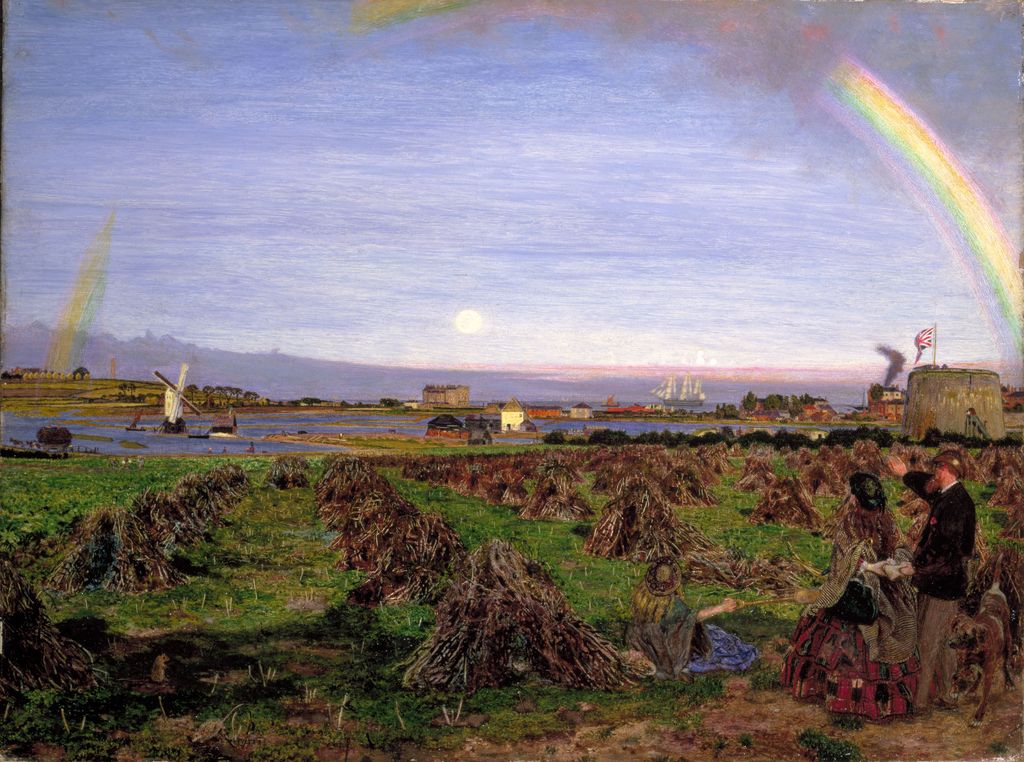
Walton-on-the-Naze
1859–1860 · A family outing opens onto a complex coastal landscape.
Books for further study
These scholarly publications offer routes into more detailed study.
Ford Madox Brown: A Catalogue Raisonné. Mary Bennett. Yale University Press / Paul Mellon Centre, 2010.
A detailed scholarly reference for versions, provenance and catalogue entries. Publisher information.
Ford Madox Brown: The Manchester Murals and the Matter of History. Colin Trodd. Manchester University Press, 2022.
A study of the Manchester mural cycle, historical interpretation and civic setting. Publisher information.
Artworks directory
Explore paintings, drawings, cartoons, illustrations and decorative designs documented in museum collections and specialist research. Distinct versions are listed separately; repeated print impressions are grouped. The coverage includes studies and works without a dedicated article and remains open to further research.
| Name | Date | Medium |
|---|---|---|
| Work (Manchester) | 1852–1865 | Oil on canvas |
| The Last of England (Birmingham) | 1852–1855 | Oil on panel |
| Jesus Washing Peter’s Feet | 1852–1856 | Oil on canvas |
| Pretty Baa-Lambs | 1851–1859 | Oil on panel |
| Take Your Son, Sir | ?1851–1892 | Oil on canvas |
| Lear and Cordelia | 1849–1854 | Oil on canvas |
| Cordelia’s Portion | 1867–1875 | Oil on canvas |
| Walton-on-the-Naze | 1859–1860 | Oil on canvas |
| Chaucer at the Court of Edward III (Tate) | 1856–1868 | Oil on canvas |
| Carrying Corn | 1854–1855 | Oil on mahogany |
| The Hayfield (The Hay Harvest) | 1855–1856 | Oil on mahogany |
| Stages of Cruelty | 1856–1890 | Oil on canvas |
| The Irish Girl | 1860 | Oil on canvas laid on board |
| Romeo and Juliet (Delaware) | 1869–1870 | Oil on canvas |
| The Seeds and Fruit of English Poetry | 1845–1853 | Oil on canvas |
| Self-Portrait | 1877 | Oil on canvas |
| The Bromley Children | Probably 1844 | Oil on canvas |
| The Bromley Family | 1844 | Oil on canvas |
| Byron’s Dream (Manchester) | 1874; worked on into 1875 | Oil on canvas |
| Cartoon for The Baptism of Edwin | 1879–1891 | Pastel, coloured chalks and grey gouache |
| The Coat of Many Colours | 1864–1866 | Oil on canvas |
| The Convalescent (Birmingham) | Dated October 1872 | Pastel |
| Crabtree Watching the Transit of Venus (reduced painting) | 1881–1888 | Tempera on panel |
| Cromwell on His Farm (Lady Lever) | Completed 1874 | Oil on canvas |
| Cromwell Protector of the Vaudois | 1877 | Oil on canvas |
| Dalton Collecting Marsh-Fire Gas (Town Hall mural) | 1886–1887 | Mural on canvas |
| The Establishment of the Flemish Weavers (reduced painting) | 1881; completed 1888 | Tempera on panel |
| The Finding of Don Juan by Haidée (NGV) | 1869–1870; later retouched | Watercolour and gouache over pencil |
| Henry and Millicent Fawcett | 1872 | Oil on canvas |
| Jacob and Joseph’s Coat (Ponce) | c.1868–1871 | Oil on canvas |
| James Leathart | 1863–1864; altered 1869 | Oil on canvas |
| King René’s Honeymoon (Tate watercolour) | 1864 | Graphite, watercolour, gouache and gum arabic on card |
| King René’s Honeymoon Cabinet (collaborative work) | 1861; exhibited 1862 | Oak, inlaid woods, painted panels and metal mounts; Brown designed Architecture |
| Manfred on the Jungfrau | 1841; retouched 1861 | Oil on canvas |
| Millie Smith | 1846 | Oil on paper laid on panel |
| William Michael Rossetti by Lamplight | 1856–1857 | Oil on panel |
| The Traveller (Manchester oil) | 1868–1884 | Oil on panel |
| Waiting: An English Fireside of 1854–55 | 1851–1855 | Oil on panel |
| An English Autumn Afternoon | 1852–1853; finished c.1854 | Oil on canvas |
| Alfred the Great: Sketch of Alfred drawing in the Sand | 1843–1845 | pencil |
| Historical Notes and Sketches of Alfred the Great | 1843–1850 | brown ink writing over pencil |
| Angels watching the Crown of Thorns: Study of clasped Hands | 1846 | black chalk |
| Architecture: Study of Gothic Arches and 14th Century Vaulting | c. 1847 | brown pen and ink over pencil on grey paper |
| The Ascension: Study of Angels and Hands | 1844 | brown pen and ink over pencil |
| The Ascension: Study of a Group of Angels | 1844 | brown pen and ink over pencil |
| The Ascension: Study of a Group of six flying Angels | 1844 | brown pen and ink over pencil |
| The Ascension: Two nude Angels holding onto each other | 1844 | brown brush and ink over pencil |
| The Ascension: Study for a kneeling Apostle | 1844 | black chalk touched with white on brown-toned paper |
| Head of a Child | c. 1844 | black chalk touched with white on brown toned paper |
| The Ascension: Drapery Study of a praying Apostle | 1844 | black chalk |
| The Spirit of Justice: Seated Figure in ecclesiastical Robes, gripping a Staff with left Hand raised in a Blessing | 1844 | black chalk |
| The Ascension: Study for an Apostle | 1844 | black chalk |
| The Spirit of Justice: Body of seated Figure in ecclesiastical Robes holding a Staff and a Book | 1844 | black chalk |
| The Ascension: Study of an Apostle | 1844 | black chalk on toned paper |
| Full-length Sketch of a standing, naked Child | 1844 | black chalk on toned paper |
| The Ascension: Study for Christ | 1844 | brown pen and ink over pencil |
| Caricature: Composite Drawing: A Stunner | 1861–1863 | pencil |
| A Victorian Woman in her Underwear | 1861–1863 | pencil |
| Caricature: Composite Drawing: Bewigged Head | 1861–1863 | pencil |
| Bowed Head of a bearded Man | 1861–1863 | pencil |
| Chaucer at the Court of Edward III: Early compositional Study | 1845 | pencil with brown pen and ink |
| Chaucer at the Court of Edward III: Study for Milton and two Designs for Tombstones | c.1845–c.1846 | pencil with brown frame outline |
| Chaucer at the Court of Edward III: Tracing of the Figure of Milton | c.1845–c.1849 | brown pen and ink with pencil on tracing paper |
| Chaucer at the Court of Edward III: Tracing of a Gothic Arch | c.1845–c.1849 | brown pen and ink with pencil on tracing paper |
| Chaucer at the Court of Edward III: Early compositional Study | 1845 | pencil with brown pen and ink |
| Chaucer at the Court of Edward III: Nude Studies of two Boys | 1845 | pencil, laid down |
| Chaucer at the Court of Edward III: Nude Studies of four Figures | 1845 | pencil |
| Chaucer at the Court of Edward III: Eight early Studies of Figures and Hands | 1845 | pencil |
| Chaucer at the Court of Edward III: Nude Studies for the Figures of Byron, Shakespeare and Burns | 1845 | black chalk |
| Chaucer at the Court of Edward III: Drapery Study for Burns | 1847 | black chalk |
| Chaucer at the Court of Edward III: Study of a right Leg and left Foot for Milton | 1847 | black chalk |
| Chaucer at the Court of Edward III: Study of a left Leg for Shakespeare | 1847 | black chalk |
| Chaucer at the Court of Edward III: Study of Drapery for Milton | 1847 | black chalk |
| Chaucer at the Court of Edward III: Drapery Study for Shakespeare | 1847 | black chalk |
| Chaucer at the Court of Edward III: Study of a Man in a medieval Hood | 1847 | black chalk |
| Chaucer at the Court of Edward III: Study for the Cardinal | 1847 | black chalk |
| Chaucer at the Court of Edward III: Drapery Study in Profile for Courtier | 1847 | black chalk |
| Chaucer at the Court of Edward III: Drapery Study | 1847 | black chalk |
| Chaucer at the Court of Edward III: Female Nude Study of a Muse holding onto a Rail | 1847 | pencil |
| Chaucer at the Court of Edward III: Female Nude: Study of a Muse | 1847 | pencil |
| Chaucer at the Court of Edward III: Nude Study for seated Lady | 1847 | pencil |
| Chaucer at the Court of Edward III: Nude Study of a Woman with right Arm raised | 1847 | pencil |
| Chaucer at the Court of Edward III: Two Studies of Back of a seated Woman's Head | 1847 | pencil |
| Chaucer at the Court of Edward III: Two Studies of a seated Woman in lost Profile Pose and from the Back | 1847 | pencil |
| Chaucer at the Court of Edward III: Nude Study of a Woman | 1847 | pencil |
| Chaucer at the Court of Edward III: Sketch of a Woman supporting another Figure | 1847 | pencil |
| Chaucer at the Court of Edward III: Study of the Heads and Shoulders of two Women | 1847 | pencil |
| Chaucer at the Court of Edward III: Drapery Study for Edward III with Outline of a Child | 1847 | black chalk |
| Chaucer at the Court of Edward III: Foreshortened Study for Head of a Jester | 1847 | pencil |
| Chaucer at the Court of Edward III: Head of Alexander Pope | 1847 | black chalk |
| Chaucer at the Court of Edward III: Two Hand Studies | 1847 | black chalk |
| Chaucer at the Court of Edward III: Study of Head of Milton copied from Sculpture | 1848 | black chalk |
| Chaucer at the Court of Edward III: Nude Studies for the Squire and the Courtier talking to Gower | 1848 | pencil |
| Chaucer at the Court of Edward III: Drapery Study for the Black Prince | 1848 | black chalk with touches of white |
| Chaucer at the Court of Edward III: Three Studies of Hands | 1848 | Black chalk |
| Chaucer at the Court of Edward III: Four Studies of Hands | 1848 | black chalk touched with white |
| Chaucer at the Court of Edward III: Study of a clasped right Hand for one of the Poets | 1848 | black chalk |
| Chaucer at the Court of Edward III: Study of a left Hand for Burns | 1848 | black chalk heightened with touches of white |
| Chaucer at the Court of Edward III: Study of Drapery for Burns | 1848 | black chalk |
| Chaucer at the Court of Edward III: Drapery Study | 1848 | black chalk |
| Chaucer at the Court of Edward III: Drapery Study for the Black Prince | 1851 | black and white chalks on brown-toned paper |
| Chaucer at the Court of Edward III: Study for Squire's Legs | 1851 | black chalk heightened with white |
| Chaucer at the Court of Edward III: Two Head Studies of an old Woman | 1851 | black chalk |
| Costume Study: Five Sketches of Armour and Costume | 1844 | brown pen and ink over pencil |
| Costume Study: Archbishop's Dress | 1845 | brown pen and ink on tracing paper |
| Costume Studies: French and Italian thirteenth and fourteenth-century Costumes (seven Drawings) | 1845 | brown pen and ink on tracing paper |
| Costume Study: Seigneur de Rimini | 1845 | brown pen and ink on tracing paper |
| Dalziels' Bible Gallery: The Death of Eglon | 1863–1865 | engraved woodblock; designed by Brown, engraved by the Dalziel Brothers |
| Dalziels' Bible Gallery: The Death of Eglon | 1881 | wood engraving; designed by Brown, engraved by the Dalziel Brothers |
| Dalziels' Bible Gallery: Elijah and the Widow's Son | 1863–1865 | engraved woodblock; designed by Brown, engraved by the Dalziel Brothers |
| Dalziels' Bible Gallery: Elijah and the Widow's Son | 1881 | wood engraving; designed by Brown, engraved by the Dalziel Brothers |
| Dalziels' Bible Gallery: Joseph’s Coat (Compositional Sketch and four Studies for Jacob's Granddaughter) | 1863–1865 | pencil on paper |
| Dalziels' Bible Gallery: Joseph's Coat | 1863–1865 | engraved woodblock; designed by Brown, engraved by the Dalziel Brothers |
| Dalziels' Bible Gallery: Joseph’s Coat | 1881 | wood engraving; designed by Brown, engraved by the Dalziel Brothers |
| Decorative Sketches: Venus Reclining on a Shell in the Midst of the Sea | 1848–1849 | brown pen and ink over pencil |
| Decorative Design: Ornamental Pattern | 1850 | watercolour and bodycolour over pen and ink, and pencil on two sheets of paper |
| Down Stream: Main Illustration (Last Year's First of May) | 1871 | wood engraving; designed by Brown, print execution by an engraver |
| Down Stream: Tailpiece to the Poem (This Year's First of June) | 1871 | wood engraving; designed by Brown, print execution by an engraver |
| The Establishment of Flemish Weavers in Manchester A.D. 1363: Four Studies of Parts of a Horse | 1879–1882 | black, white and red chalk on rough brown paper |
| Female: Two Studies of young Woman in eighteenth-century Costume | 1849 | pencil |
| Infant's Repast: Study of Mother and Child | 1848 | black and white chalk |
| Infant's Repast: Study of Mother and Child with separate Arm and Leg Studies of the Child | 1848 | black chalk with grey wash |
| King Lear: Sketch of Lear questioning Cordelia | 1844 | brown pen and ink over pencil |
| Alfred the Great: Compositional Sketches | 1843–1845 | pencil |
| King Lear: Sketches of Lear imagining his unfaithful Daughters’ Trial and Lear in the Storm | 1844 | brown pen and ink over pencil |
| Alfred the Great: Compositional Studies and Sketches and Chaucer at the Court of Edward III: Study of Cherubs | 1843–1849 | pencil |
| King Lear: Kent accuses Oswald | 1844 | brown pen and ink with pencil underneath |
| King Lear: Lear recounts his Wrongs to Regan | Undated | Brown pen and ink over pencil |
| King Lear: Cordelia at Lear's Bedside (Lear's Awakening) | 1844 | brown pen and ink over pencil |
| Cordelia Parting from Her Sisters (The Germ) | 1850; reprinted 1901 | Etching; designed by Brown, print execution by an engraver |
| King René's Honeymoon: Study for Architecture | 1861 | brush and brown ink, with watercolour, over pencil on brown paper |
| The Last of England: Cartoon | 1852 | pencil, image edged with brown ink |
| The Last of England: Portrait of Emma Hill | December 1852 | chalks with scratching out on two sheets of paper |
| Lear and Cordelia and The Infant’s Repast: Four Studies of Hands | 1849 | black chalk |
| Lyra Germanica - the Christian Life: Abraham and Isaac | 1868 | wood engraving; designed by Brown, print execution by an engraver |
| Lyra Germanica - the Christian Life: Finished Design for The Entombment | 1867 | black pen and ink |
| Lyra Germanica - the Christian Life: The Entombment | 1868 | wood engraving; designed by Brown, print execution by an engraver |
| Male: Sketch of Man reclining on Steps with Hands bound together | 1844 | brown pen and ink over pencil |
| Male: Academic nude Study, half-length with Moustache and Arms folded | 1846–1849 | black chalk |
| Male: Academic Study of Nude holding a Staff | 1847 | pencil |
| Male: Academic Study of Nude posed as a Sculptor | 1847 | chalk with grey wash |
| Male: Academic Study, three-quarter length Nude, with a Moustache and clenched Fists | 1847 | black chalk |
| Oure Ladye of Saturday Night: Seven Sketches | 1846 | pencil |
| Oure Ladye of Saturday Night: Four Studies for Angel holding Child | 1847 | pencil |
| Oure Ladye of Saturday Night: Study of Angel holding Child | 1847 | black chalk |
| Oure Ladye of Saturday Night: Study of Arm and Hands for Angel holding Bowl of Water | 1847 | black chalk |
| Oure Ladye of Saturday Night: Drapery Study for Angel holding Bowl of Water | 1847 | black chalk |
| Oure Ladye of Saturday Night: Study of Head for Angel holding Bowl of Water | 1847 | black chalk with rubbing and grey wash |
| Oure Ladye of Saturday Night: Study of Child seated on Knees of the Virgin and two separate Studies of the Child's Legs | 1847 | pencil on brown-toned paper |
| Oure Ladye of Saturday Night: Frieze Design | c. 1847 | pencil and black pen and ink |
| Oure Ladye of Saturday Night: Three Studies of Arms and Legs of Child | 1847 | pencil |
| Oure Ladye of Saturday Night: Three Studies of Child's Legs on Virgin's Knees | 1847 | pencil |
| Oure Ladye of Saturday Night: Studies of Right Foot and Left Hand of Child | 1847 | pencil on light brown paper |
| Oure Ladye of Saturday Night: Drapery Study for Virgin | 1847 | black chalk |
| Oure Ladye of Saturday Night: Study for Head of Virgin | 1847 | black chalk with wash |
| Parisina’s Sleep: Study for Prince Azo and Parisina | 1842 | black chalk with pencil side drawing |
| Parisina's Sleep: Study for Head of Prince Azo | 1842 | black chalk with grey wash |
| Parisina's Sleep: Study for the Head of Parisina | 1842 | black and white chalk with grey wash |
| Poets of the Nineteenth Century: The Prisoner of Chillon: Compositional Sketch | 1856 | pencil |
| Profile of a Man's left Eye and Nose | c.1856 | pencil |
| Poets of the Nineteenth Century: The Prisoner of Chillon: Study of a Corpse | 1856 | pencil |
| Designs for Decoration | c.1856 | pencil |
| Poets of the Nineteenth Century: The Prisoner of Chillon | 1857 | wood engraving; designed by Brown, print execution by an engraver |
| Portrait: Head Study of Daniel Casey (three-quarter view) | 1848 | black chalk |
| Portrait: Head Study of Daniel Casey (full-face) | 1848 | black chalk |
| Portrait: Miss Iza Duffus Hardy | 1872 | pastel and coloured chalks on brown paper |
| Portrait: Emma Hill (later Mrs Madox Brown) | 1848 | black chalk |
| Portrait: Emma Hill (later Mrs Madox Brown) | 1852 | pencil |
| Portrait: Mrs Madox Brown (neé Emma Hill) | 9 May 1854 | pencil |
| The Repose in Egypt: Compositional Sketch | 1847 | pencil |
| Study of a Statue of the Discobolus | 1845 | Black chalk |
| William Shakespeare: Study | 1849–1850 | pencil |
| William Shakespeare: Invitation Card | 1850 | wood engraving; designed by Brown, print execution by an engraver |
| The Spirit of Justice: Study for Baron and his Advisor, with Sketches of Erudition and Wisdom | 1844–1845 | brown pen and ink over pencil |
| The Spirit of Justice: Drapery Study for Erudition | 1844–1845 | black chalk |
| Drapery Study and Sketch of Two Legs | Undated | Black chalk |
| The Spirit of Justice: Study for Wisdom | 1844–1845 | black chalk with grey wash |
| The Spirit of Justice: Study for Head of the Baron | 1844–1845 | black chalk |
| The Spirit of Justice: Study for the Head of central Bishop | 1844–1845 | black chalk |
| The Spirit of Justice: Study for the Head of a Bishop | 1844–1845 | black chalk with grey wash |
| The Spirit of Justice: Study for the uplifted left Arm of Justice | 1844–1845 | black chalk |
| The Spirit of Justice: Study for Head of Counsellor in a Coronet | 1844–1845 | black chalk with touches of blue chalk |
| The Spirit of Justice: Study for Head of Counsellor | 1844–1845 | black chalk |
| The Spirit of Justice: Drapery Study for the Central Bishop | 1844–1845 | Black chalk |
| Part of a Drapery Study | 1844–1845 | black chalk |
| The Spirit of Justice: Study for Head of Widow | 1844–1845 | black chalk |
| Stages of Cruelty: Study for the Child (Catherine Madox Brown) | 1857 | black chalk on pale grey paper |
| Stained Glass Design: Cartoon for Zachariah, The High Priest | 1872 | black chalk |
| Stained Glass Design: Cartoon for The Young Milton | 1874 | black chalk |
| Stained Glass Design: Cartoon for St Simon | 1874 | black chalk |
| Sterne's 'Sentimental Journey': Study for Yorick and La Fleur talking to Maria’s Mother | 1842 | brown pen and ink over pencil |
| The Body of Harold brought before William the Conqueror: Eight Sketches of Figure Groups | c.1844 | pencil |
| Sterne's 'Sentimental Journey' : Yorick (Laurence Sterne) and Maria Walking | 1842 | pen and ink, watercolour and bodycolour over pencil |
| Study of Tree Trunk with Roots | c.1847 | black chalk, heightened with white chalk on buff paper |
| Two Studies of Tree Trunks | c.1846 | black chalk |
| Unknown Subject: Compositional Sketch | 1843–1850 | pencil |
| Wycliffe reading his Translation of the Bible: Nude Study for Chaucer | 1847 | pencil |
| Wycliffe reading his Translation of the Bible: Study for Chaucer | 1847 | pencil |
| Wycliffe reading his Translation of the Bible: Nude Study of Gower | 1847 | pencil |
| Wycliffe reading his Translation of the Bible: Study for Gower | 1847 | pencil |
| Wycliffe reading his Translation of the Bible: Nude Study for John of Gaunt and Chaucer's right Hand | 1847 | pencil and black chalk |
| Wycliffe reading his Translation of the Bible: Study of John of Gaunt and Chaucer's Left Hand | 1847 | pencil and black chalk |
| Wycliffe reading his Translation of the Bible: Study for Wycliffe | 1847 | black chalk |
| Wycliffe reading his Translation of the Bible: Nude Study for Wycliffe | 1847 | pencil |
| Wycliffe reading his Translation of the Bible: Drapery Study for Wycliffe | 1847 | black chalk |
| Wycliffe reading his Translation of the Bible: Drapery Study for Chaucer | 1848 | black chalk |
| Wycliffe reading his Translation of the Bible: Study of Legs for John of Gaunt and two Studies of Feet for Wycliffe | 1848 | black chalk |
| Wycliffe Reading his Translation of the Bible: Studies of Hands for John of Gaunt and Gower | 1847 | black chalk |
| Wycliffe reading his Translation of the Bible: Study for Head of Wycliffe | 1847 | pencil |
| Wycliffe reading his Translation of the Bible: Study for Constance and Child | 1847 | pencil |
| Wycliffe reading his Translation of the Bible: Unfinished Study for Head of Constance | 1847–48 | pencil |
| Wycliffe reading his Translation of the Bible: Portrait of Elizabeth Bamford modelling for Constance | 1848 | pencil |
| Wycliffe reading his Translation of the Bible: Study for Head of Constance | 1848 | chalk over pencil |
| Wycliffe reading his Translation of the Bible: Study for Head of Chaucer | 1848 | pencil |
| Wycliffe reading his Translation of the Bible: Study of Monk representing the Catholic Faith | 1848 | black chalk with brown pen and ink, squared up |
| Wycliffe reading his Translation of the Bible: Study of young Woman representing the Protestant Faith | 1848 | black chalk |
| Cathy Madox Brown at the Age of Three (Tate N01356) | 1853 | Graphite on paper |
| King René‘s Honeymoon (Tate N02409) | date not known | Ink on paper |
| Sheepshearing (Tate N02410) | c.1887 | Ink and graphite on paper |
| Studies for ‘Work’ (Tate N02411) | 1855 | Graphite and ink on paper |
| Design for Badge for Gillum’s Homes (Tate N02412) | date not known | Ink and graphite on paper |
| Arkwright’s Mill (Tate N02413) | 1878 | Graphite on paper |
| Study for ‘John Kay’ (Tate N02414) | 1889 | Graphite on paper |
| Study for ‘Southend’ (Tate N02415) | date not known | Graphite on paper |
| ‘Where are you going, my pretty maid?’ (Tate N02416) | date not known | Graphite on paper |
| Section of the Bridgewater Canal (Tate N02417) | 1890 | Ink on paper |
| A Barge on the Bridgewater Canal (Tate N02418) | 1890 | Graphite on paper |
| Study of the Tow-Path on the Bridgewater Canal (Tate N02419) | 1890 | Graphite on paper |
| Our Lady of Good Children (Tate N02684) | 1847–61 | Pastel, watercolour and gold paint on paper |
| Arkwright’s Mill (Tate N02791) | 1881 | Graphite on paper |
| The Bridgewater Canal (Tate N02792) | 1890 | Ink on paper |
| The Bridgewater Canal (Tate N02793) | date not known | Chalk and graphite on paper |
| The Last of England (Tate N03064) | 1864–6 | Watercolour on paper |
| Mauvais Sujet (Tate N03228) | 1863 | Watercolour on paper |
| Study of a Man Painting (Tate N03472) | 1839 | Graphite on paper |
| The Brent at Hendon (Tate N03528) | 1854–5 | Oil paint on board on mahogany |
| Study for the Dean in the ‘Execution of Mary Queen of Scots’ (Tate N04280) | c.1840 | Oil paint on paper |
| Sketch for ‘Jesus Washing Peter’s Feet’ (Tate N04281) | 1852 | Graphite on paper |
| Sketch for ‘Cromwell on his Farm’ (Tate N04282) | c.1853 | Graphite on paper |
| The Coat of Many Colours (Tate N04584) | 1867 | Watercolour and gouache on paper |
| Stages of Cruelty (Tate N04625) | c.1856 | Watercolour on paper |
| Head of a Girl (Tate N04803) | date not known | Oil paint on paper |
| Portrait of Dykes Barry as a Child (Tate N04866) | 1853 | Oil paint on mahogany |
| Jesus Washing Peter’s Feet (Tate N05301) | 1857–8 | Watercolour on paper |
| Platt Lane (Tate N05383) | 1884 | Oil paint on canvas |
| Study of F.G. Stephens for ‘Jesus Washing Peter’s Feet’. Verso: A Head Crowned with Laurels (Tate T00571) | 1852 | Graphite on paper. Verso: graphite on paper |
| Sketch for ‘Jesus Washing Peter’s Feet’ (Tate T01035) | c.1851 | Ink and graphite on paper |
| Chaucer at the Court of Edward III (Sydney) | 1845–1851 | Oil on canvas |
| Wycliffe Reading His Translation of the Bible to John of Gaunt (Bradford) | 1848 | Oil on canvas |
| Work (Birmingham replica) | 1859–1863 | Oil on canvas |
| The Spirit of Justice (Book of Art reproduction) | Published 1846 | Wood engraving after Brown’s cartoon; engraver unknown |
| The Execution of Mary Queen of Scots | 1840–1842 | Oil on canvas |
| The Prisoner of Chillon (Manchester oil) | 1843 | Oil on canvas |
| The Parting of Cordelia from Her Sisters (oil) | 1853 | Oil on canvas |
| Cordelia’s Portion (Lady Lever) | 1866–1872 | Watercolour, gouache and pastel |
| The Ascension | 1844–1845 | Oil on canvas |
| Manfred in the Chamois Hunter’s Hut (oil sketch) | 1840 | Oil on canvas |
| Dr Primrose and His Daughters (The Vicar of Wakefield) | 1840–1841 | Oil on canvas |
| The Body of Harold Brought before William the Conqueror | 1844–1861 | Oil on canvas |
| The Seeds and Fruits of English Poetry (Bedford cartoon) | 1845 | Black chalk on paper |
| Wycliffe Reading His Translation of the Bible (oil sketch) | 1847–1848 | Oil on board |
| Cromwell Discussing the Protection of the Vaudois (Nottingham) | 1877–1878 | Oil on canvas |
| Two Drawings of Men in Hoods | c.1845 | Pencil on paper |
| The Seeds and Fruits of English Poetry: Study of the Right Side | c.1845 | Brown pen and ink with pencil |
| Chaucer: A Man in a Hood with a Liripipe and Two Drapery Studies | 1848 | Oil on canvas |
| The Prisoner of Chillon Entreating His Jailors (Yale watercolour) | 1858 | Watercolour heightened with bodycolour |
| Elijah and the Widow’s Son (Birmingham oil) | 1864 | Oil on panel |
| He That Soweth (Lyra Germanica) | Published 1868 | Wood engraving by the Dalziel Brothers after Brown |
| The Entombment (NGV) | 1871–1878 | Watercolour, gouache, gold paint and gum arabic over pencil |
| The Sower (Morris firm tile) | c.1864–1873 | Tile; design by Brown, workshop execution |
| Childe Harold’s Pilgrimage (Byron illustration) | Published 1870 | Steel engraving by Herbert Bourne after Brown |
| The Two Foscari (Byron illustration) | Published 1870 | Steel engraving by Herbert Bourne after Brown |
| The Corsair (Byron illustration) | Published 1870 | Steel engraving by Herbert Bourne after Brown |
| Sardanapalus (Byron illustration) | Published 1870 | Steel engraving by Herbert Bourne after Brown |
| Don Juan (Byron illustration) | Published 1870 | Steel engraving by Herbert Bourne after Brown |
| Byron’s Dream (roundel title-page design) | Published 1870 | Steel engraving by Herbert Bourne after Brown |
| The Finding of Don Juan by Haidée (Birmingham oil) | 1870–1873 | Oil on canvas |
| The Dream of Sardanapalus (Delaware) | 1871–1872 | Watercolour on paper |
| The Traveller (Once a Week) | Published 1869 | Wood engraving by Joseph Swain after Brown |
| The Infant’s Repast | 1848 | Oil on board |
| Oliver Madox Brown Aged Four (Dwale Bluth frontispiece) | Published 1876 | Etching |
| Oliver Madox Brown as a Young Man (Dwale Bluth frontispiece) | Published 1876 | Etching |
| A Beggar and Other Fantasies: Title-page Illustration | Published 1889 | Photo-engraving after Brown |
| Dramas in Miniature: Title-page Illustration | Published 1891 | Photo-engraving after Brown |
| The Brown Owl: Frontispiece | Published 1892 | Photo-engraving after Brown |
| The Brown Owl: Central Illustration | Published 1892 | Photo-engraving after Brown |
| The Feather: Frontispiece | Published 1892 | Photo-engraving after Brown |
| The Ascension: Study for Christ | 1844 | Pen and ink |
| King Lear: Lear Questions Cordelia (Whitworth) | 1844 | Pencil, pen and brown ink |
| King Lear: France Claims the Dispossessed Cordelia (Whitworth) | 1844 | Pencil, pen and brown ink |
| King Lear: Cordelia Parts from Her Sisters (Whitworth) | 1844 | Pencil, pen and brown ink |
| King Lear: Goneril and Regan Together (Whitworth) | 1844 | Pencil, pen and brown ink |
| King Lear: Goneril Tells Oswald How to Treat Lear (Whitworth) | 1844 | Pencil, pen and brown ink |
| King Lear: Oswald’s Insolence to Lear (Whitworth) | 1844 | Pencil, pen and brown ink |
| King Lear: Lear Rebukes Oswald (Whitworth) | 1844 | Pencil, pen and brown ink |
| King Lear: Kent Trips Oswald (Whitworth) | 1844 | Pencil, pen and brown ink |
| King Lear: Goneril’s Complaint to Lear (Whitworth) | 1844 | Pencil, pen and brown ink |
| King Lear: Lear Curses Goneril’s Infidelity (Whitworth) | 1844 | Pencil, pen and brown ink |
| King Lear: Kent Challenges Oswald (Whitworth) | 1844 | Pencil, pen and brown ink |
| King Lear: Kent in the Stocks (Whitworth) | 1844 | Pencil, pen and brown ink |
| King Lear: Lear Recounts His Wrongs to Regan (Whitworth) | 1844 | Pencil, pen and brown ink |
| King Lear: Lear Parts from Regan and Goneril (Whitworth) | 1844 | Pencil, pen and brown ink |
| King Lear: Lear and the Fool in the Storm (Whitworth) | 1844 | Pencil, pen and brown ink |
| King Lear: Lear Mad on the Beach at Dover (Whitworth) | 1844 | Pencil, pen and brown ink |
| King Lear: Alternative Study: Lear Curses Goneril (Whitworth) | 1844 | Pencil, pen and brown ink |
| King Lear: Lear Imagines His Daughters’ Trial (Whitworth) | 1844 | Pencil |
| King Lear: Alternative Study: Lear in the Storm (Whitworth) | 1844 | Pencil, pen and brown ink |
| The Last of England (Fitzwilliam) | 1860 | Oil on canvas |
| The Convalescent (Metropolitan Museum) | Dated 1872 | Pastel |
| Self-Portrait (Walker drawing) | 1850; retouched 1853 | Black chalk |
| Byron’s Dream (Whitworth) | 1889 | Watercolour over graphite |
| Cordelia Parting from Her Sisters (Cleveland sketch) | 1854 | Pen and oil on paper mounted on panel |
| David and Goliath: Cartoon for Stained Glass Window at Jesus College, Cambridge | 1872 | Charcoal and graphite on Japanese paper |
| The Virgin Swooning (recto) | 1844 | Black chalk on laid paper |
| Two Drapery Studies (verso) | c.1844 | Black chalk |
| Architecture: King René’s Honeymoon (stained glass) | 1862 | Stained glass; designed by Brown, made by Morris, Marshall, Faulkner & Co. |
| The Romans Building a Fort at Mancenion (Town Hall mural) | 1880 | Spirit fresco |
| The Baptism of Edwin (Town Hall mural) | 1879–1880 | Spirit fresco |
| The Expulsion of the Danes (Town Hall mural) | 1880–1881 | Spirit fresco |
| The Establishment of the Flemish Weavers (Town Hall mural) | 1881–1882 | Spirit fresco |
| Crabtree Watching the Transit of Venus (Town Hall mural) | 1882–1883 | Spirit fresco |
| The Proclamation Regarding Weights and Measures (Town Hall mural) | 1883–1884 | Spirit fresco |
| Wycliffe on Trial (Town Hall mural) | 1885–1886 | Spirit fresco |
| Chetham’s Life’s Dream (Town Hall mural) | 1885–1886 | Mural on canvas |
| Bradshaw’s Defence of Manchester (Town Hall mural) | 1892–1893 | Mural on canvas |
| John Kay, Inventor of the Fly Shuttle (Town Hall mural) | 1888–1890 | Mural on canvas |
| The Opening of the Bridgewater Canal (Town Hall mural) | 1891–1892 | Mural on canvas |
Frequently Asked Questions
He was closely associated with the Pre-Raphaelite circle and briefly taught Dante Gabriel Rossetti, but he never joined the Brotherhood. His Continental education and substantial early work preceded its foundation in 1848. [1]
Work introduces his treatment of modern society; The Last of England concentrates a historical movement into a family group; Pretty Baa-Lambs shows the force of his outdoor light. Jesus Washing Peter's Feet and the Manchester murals extend that introduction into religion and public history. The paintings guide provides routes through the wider range.
Brown began the large Manchester painting in 1852. Hueffer records completion in August 1863, while its major public presentation came in Brown's solo exhibition of 1865. An extended date ending in 1865 can therefore include its exhibition history; completion and first exhibition are separate events. Birmingham's smaller Leathart version is another object. [1]
Yes, but his procedures varied. His diary describes figures, a lay figure and sheep arranged in the garden for Pretty Baa-Lambs . He chose dull, cold days for The Last of England , while The Hayfield investigated twilight colour. Direct observation worked alongside studies, constructed compositions and later alterations. [1] [9]
His decorative work involved collaboration. For King René's Honeymoon Cabinet , Seddon designed the furniture and his family's firm made it; Brown supplied the theme and Architecture panel. In the related glass, the V&A identifies Brown as designer and Morris, Marshall, Faulkner & Co. as maker. [15]
Seven were painted directly on the walls using spirit fresco, a Victorian process distinct from true fresco. The final five were painted on canvas. Brown described both wall painting and attached canvas in his 1893 essay, and the council preserves the distinction in its account of the cycle. [16] [19]
Discussion
Look again at the images and ideas explored in Ford Madox Brown. These editorial prompts invite your observations.
Reader Insights
Compare the central labourers in Work with the emigrant couple in The Last of England . Sunlight gives one group bodily force; cold daylight makes the other seem exposed. Consider how much each picture's account of human experience depends on the conditions under which its people are seen.
Follow the hands across Brown's pictures: the emigrants' clasp, Peter's response to Christ, the Fawcetts' shared paper, the king's compasses. Which gestures communicate immediately, and which become more complicated as you look? A small movement can organise an entire scene.
In the Manchester scenes, let your attention leave the king, queen, scientist or civic hero. Look at children, workers, animals and bystanders. Their activities can support the central event, distract from it or give it a different scale. Consider how the history changes when they receive equal attention.
Join the Conversation
Share a detail, comparison or question about Ford Madox Brown below.
References
- Ford Madox Hueffer , Ford Madox Brown: A Record of His Life and Work (London: Longmans, Green, 1896), selected passages on pp.9–24, 28–29, 37–46, 54–66, 80–102, 130, 160–163, 176–178, 189–195, 198–215, 224–232, 271–274, 289–292, 314–343, 361–363 and 384–398; includes Brown's 1865 picture descriptions, letters and diary extracts. View source .
- Museum voor Schone Kunsten Gent , “Ford Madox Brown: Pionier van de prerafaëlieten,” retrospective exhibition, 26 February–3 June 2012; Dutch museum account. View source .
- Ford Madox Brown , “On the Mechanism of a Historical Picture: Part I. The Design,” The Germ , February 1850, pp.70–73. View source .
- Ford Madox Hueffer, Ford Madox Brown: A Record of His Life and Work, 1896; selected career, object and mural passages. View source.
- John P. Seddon, The King René’s Honeymoon Cabinet, The Magazine of Art20, 1897, pp323–324. View source.
- Laura MacCulloch , Ford Madox Brown: Works on Paper and Archive Material at Birmingham Museums and Art Gallery , PhD thesis, University of Birmingham, 2009, vol.1, p.7, pp.20–25 and note 5, pp.179–183, and catalogue entries 82 and 90 (the latter pp.253–254); selected passages on Continental formation, corrected family chronology and illustration. View source .
- Birmingham Museum and Art Gallery Learning Department , The Pre-Raphaelites: Teachers' Notes , pp.12–13 and 15, object accounts for Pretty Baa-Lambs , The Last of England and Birmingham's Work . View source .
- Tim Barringer , “Ford Madox Brown, Work,” MAVCOR , 2014, DOI 10.22332/con.obj.2014.42; interpretation of labour, religious service and the inscribed frame. View source .
- Ford Madox Brown , retrospective diary resumed 16 August 1854, in William Michael Rossetti, ed., Præraphaelite Diaries and Letters (London: Hurst and Blackett, 1900), pp.108–110. View source .
- Tate , official historical collection dataset, entries for Carrying Corn N04735, The Hayfield T01920 and Take your Son, Sir N04429; dates and media. View source .
- National Portrait Gallery , “Millicent and Henry Fawcett by Ford Madox Brown,” NPG 1603, 1872; object data and portrait interpretation. View source .
- National Trust , William Michael Rossetti (1829–1919) by Lamplight , 1288936, Wightwick Manor; sitting, inscription, medium and gift history. View source .
- Yale Center for British Art , fourth-floor large-print gallery labels (2025), p.81, The Irish Girl , 1860, B1989.11; sitter and flowers. View source .
- Harvard Art Museums , Self-Portrait , 1877, object 1943.185; gallery text and recorded gift to Theodore Watts-Dunton. View source .
- Victoria and Albert Museum , King René's Honeymoon Cabinet , W.10:1 to 28-1927, and related Architecture stained-glass panel, CIRC.516-1953; current collection records, design and making responsibilities. View source 1 . View source 2 .
- Manchester City Council , “The Ford Madox Brown Murals,” Great Hall cycle, 1879–1893; subjects, civic interpretation and seven-wall/five-canvas distinction. View source .
- National Gallery of Victoria , The Baptism of Edwin, King of Northumbria , 216-2, 1879–1891; dimensions and media of the paper cartoon. View source .
- Joe Stafford / University of Manchester , “12 stunning murals which reveal a remarkable Victorian vision of Manchester,” account of Colin Trodd's research on the mural cycle; a report of the scholar's interpretation, rather than the complete monograph. View source .
- Ford Madox Brown , “Of Mural Painting,” in Arts and Crafts Essays , with a preface by William Morris (London: Rivington, Percival, 1893); complete essay. View source .
- Laura MacCulloch, Ford Madox Brown: Works on Paper and Archive Material at Birmingham Museums and Art Gallery, 2009, volumeI; catalogue entries. View source.
- Tate, official historical collection dataset; Ford Madox Brown accession records. View source.
- National Portrait Gallery, Henry Fawcett and Millicent Garrett Fawcett, NPG1603; portrait and frame record. View source.
- Laura MacCulloch, Ford Madox Brown: Works on Paper and Archive Material at Birmingham Museums and Art Gallery, 2009, volumeII; illustration lists, pp1–24. View source.
- Fitzwilliam Museum, The Last of England, M.Add.3. View source.
- Metropolitan Museum of Art, The Convalescent, 10.46. View source.
- Carol Blackett-Ord / National Portrait Gallery, Ford Madox Brown: all known portraits. View source.
- The Whitworth / Art UK, Byron’s Dream, 1889 watercolour. View source.
- Cleveland Museum of Art, Cordelia Parting from Her Sisters, 2013.261. View source.
- Cleveland Museum of Art, David and Goliath: Cartoon for Stained Glass Window at Jesus College, Cambridge, 1872, 2013.247. View source.
- National Gallery of Art, The Virgin Swooning, recto, 1987.73.1.a. View source.
- National Gallery of Art, Two Drapery Studies, verso, object70237. View source.
- Victoria and Albert Museum, Architecture: King René’s Honeymoon, CIRC.516-1953. View source.
- Splash image, Ford Madox Brown, Self-Portrait, 1877. Oil on canvas. Harvard Art Museums, 1943.185.
- Gustaf Wappers: life dates. Vlaamse Kunstcollectie.
- Dante Gabriel Rossetti: life dates. National Portrait Gallery.
- William Morris and Edward Burne-Jones: life dates. The Metropolitan Museum of Art, The Pre-Raphaelite Legacy.
- William Holman Hunt: life dates. National Portrait Gallery.
