



 by
Tom Gurney
Tom Gurney BSc (Hons) is an art history expert with over 20 years experience
Published on June 19, 2020 / Updated on October 30, 2026
Email:
tomgurney1@gmail.com
/ Phone:
+44 7429 011000
Pretty Baa-Lambs by Ford Madox Brown: Introduction
A woman holds a small child above a lamb's upturned head. Around them the grass is intensely green, white clothes cast blue shadows, and the sky fills the upper half of the picture. Pretty Baa-Lambs gives an ordinary act of feeding animals an unusual visual force. Its familiar subjects offer an approachable way into a demanding experiment: how can paint convey the colour and physical pressure of strong sunlight?
Birmingham's painting was begun in 1851 and worked on again during the following years, giving it the extended date 1851–1859. Brown also called it Summer Heat , a title that makes his interest in the weather explicit. [1]
The picture rewards attention to small changes within apparently simple colours. The child's dress is white, but its shaded folds are cool grey and blue. The sheep's fleece moves between cream, brown and blue-grey. Red and pink interrupt the larger areas of green, blue and white. These details make the scene feel both tender and strangely emphatic. Ford Madox Brown asks us to look at the people, animals and grass as things sharing the same light.
At a Glance
- Artist Ford Madox Brown
- Title Pretty Baa-Lambs , also known as Summer Heat
- Date 1851–1859: initial painting followed by later revision
- Medium Oil on panel
- Dimensions 60.9 × 76.2 cm
- Collection Birmingham Museums Trust; accession number 1956P9
- Principal models Emma Hill and Brown's daughter Catherine, called Kate or Cathy
The date, alternative title and models are discussed in Birmingham's teaching notes; the dimensions, support and accession details are recorded in Jacqueline Banerjee's account using Art UK collection information. [1] [2]
This work across Ford Madox Brown’s career
Manfred on the Jungfrau
1841; retouched 1861Pretty Baa-Lambs (current article)
1851–1859The Last of England
1852–1855Work
1852–1865King René’s Honeymoon
Tate watercolour, 1864Manchester Murals
1878–1893Contents
- Looking at the Woman, Child and Lambs
- A Garden Made into an Outdoor Studio
- How Sunlight Changes the Colours
- Emma, Cathy and the Eighteenth-Century Clothes
- From the First Painting to the Revised Landscape
- Exhibition, Rejection and a Patient Buyer
- Tenderness Without Easy Prettiness
- Annotated details
Looking at the Woman, Child and Lambs
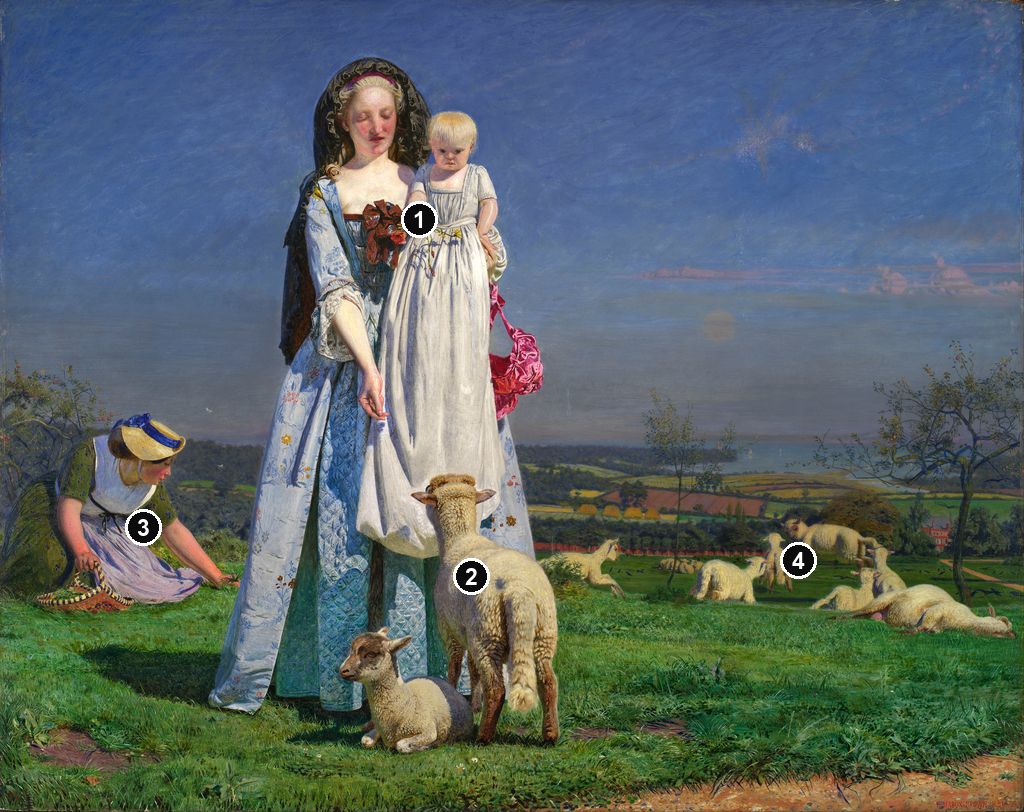
The standing woman and child form a tall, compact group, slightly left of centre. Their faces turn down towards the animals. The woman supports the child with one arm while extending her other hand towards the standing lamb. The long sleeve, bare forearm and lowered hand lead the eye through the same space as the lamb's raised neck. A second, smaller lamb rests at her feet, its head turned sideways. These gestures make a quiet exchange visible without requiring an elaborate story.
The child's long white dress is particularly important. It provides a bright, nearly continuous shape between the small head above and the lamb beneath. Its vertical folds give the child an elongated appearance, while the thin arms and intent face keep the figure recognisably infantile. The mother's blue patterned clothes frame this white shape on the left; a pink-red fold appears on the right. Together these colour boundaries help distinguish two bodies that overlap closely.
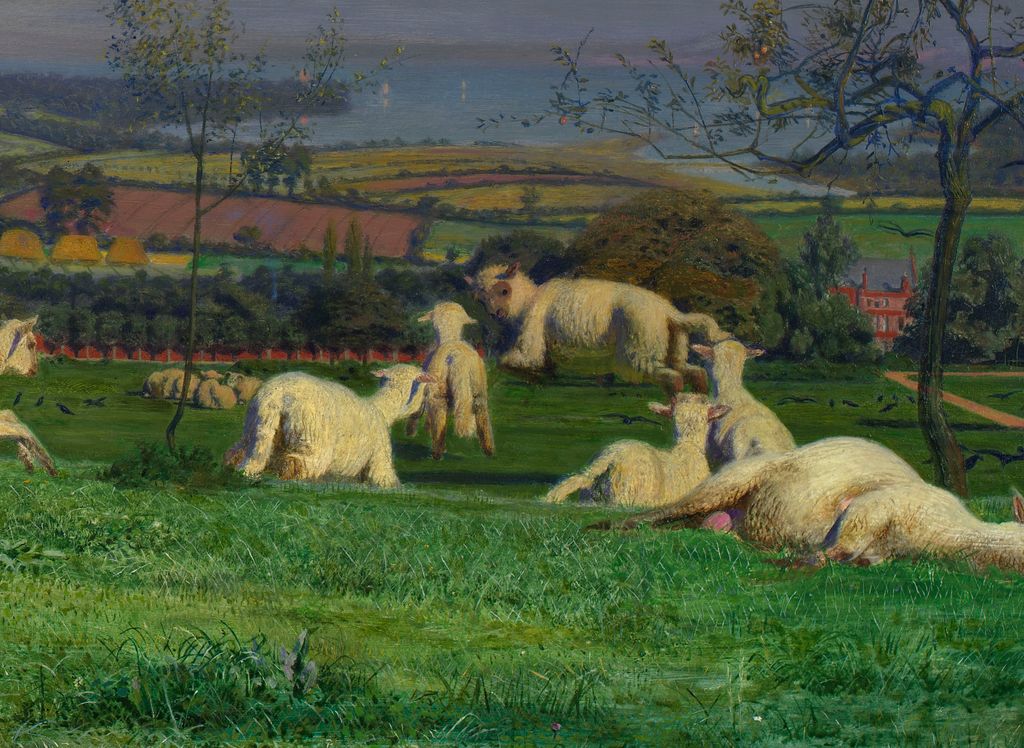
At the far left, another woman kneels in the grass beside a basket. Her bent body spreads horizontally, balancing the upright main group. Her hand reaches into the ground cover, connecting her activity with the food offered to the sheep. Across the right half of the field, other animals stand, lie down or turn in different directions. Their dispersed poses loosen the solemnity of the central group. The lamb stretched out near the right edge introduces an almost comic relaxation.
The foreground is dense with individual blades and patches of uneven growth. A narrow bare area cuts into the grass at the bottom, giving the green surface an edge and a change of texture. Farther back, fields and buildings shrink rapidly. The main figures stand against open sky, with few objects competing around their heads. This arrangement gives a domestic episode the scale and clarity of a formal figure composition.
Looking between the foreground and the distance produces a slight tension. The near grass is insistently tangible, while the landscape beyond the sheep opens into a much broader world. The figures seem close enough to touch, yet the sky gives them an unexpectedly expansive setting. The picture's sense of presence comes partly from this combination of intimate observation and a large visual stage.
A Garden Made into an Outdoor Studio
Brown left an unusually vivid account of the painting's beginnings. When he resumed his diary on 16 August 1854, he reconstructed the work of the preceding years from memory. He recalled beginning Baa Lambs after moving to Stockwell and spending five months of hard work on it. This was a retrospective account, written several years after the first painting sessions. [3]
His description explains how the outdoor scene was assembled:
“The Baa Lamb picture was painted almost entirely in sunlight, which twice gave me a fever while painting. I used to take the lay figure out every morning, and bring it in at night or if it rained.... My painting-room being on a level with the garden, Emma sat for the lady, and Kate for the child.” [3]
A lay figure was an artist's mannequin, useful for holding clothes in position between sittings. Its daily journey between room and garden made the house a practical base for a sustained outdoor experiment. Brown could preserve the arrangement of the costume while returning to living models for the people. The diary therefore describes a mixture of patient construction and direct observation. The scene's apparent ease depended on keeping an arrangement available over many sessions. [3]
The animals required their own arrangements. Brown wrote that sheep and lambs were brought each morning from Clapham Common in a truck. One ate all the garden flowers; collectively, he complained, they behaved very badly. He also stated that he painted the background on the Common. His account separates the place where he worked on the main group from the place used for the landscape. [3]
These details help explain why the picture should not be understood as a record of one uninterrupted moment. Brown studied actual bodies, clothes, grass and animals under outdoor conditions, then brought those observations together. A child could not remain perfectly still through months of work, and the sheep evidently had little respect for the composition. The lay figure, repeated sittings and separate background work were ways of making sustained observation possible.
Brown's complaint about fever conveys the discomfort he associated with the task. It does not establish a medical diagnosis, but it does tell us that he remembered strong sunlight as something endured as well as examined. The human effort behind the quiet scene was considerable. His wider style and technique often brought carefully arranged figures into close contact with particular conditions of light and weather. [3]
Annotated Details from Pretty Baa-Lambs
The numbered points identify visible features discussed in this article. Return from each detail to the whole composition. Ford Madox Brown, Pretty Baa-Lambs, 1851–1859. Oil on panel. Birmingham Museums Trust, 1956P9. Image source. Public domain. Numbers added to the overview; details are cropped.
Details from PRETTY BAA-LAMBS
Compare the cropped details with the complete images above. Notice how their colours, shapes and positions contribute to the larger compositions.
The standing woman and child
The pale dress and the child’s clothing gather light into one tall shape. Faces, sleeves and patterned fabric sit against the open blue sky.
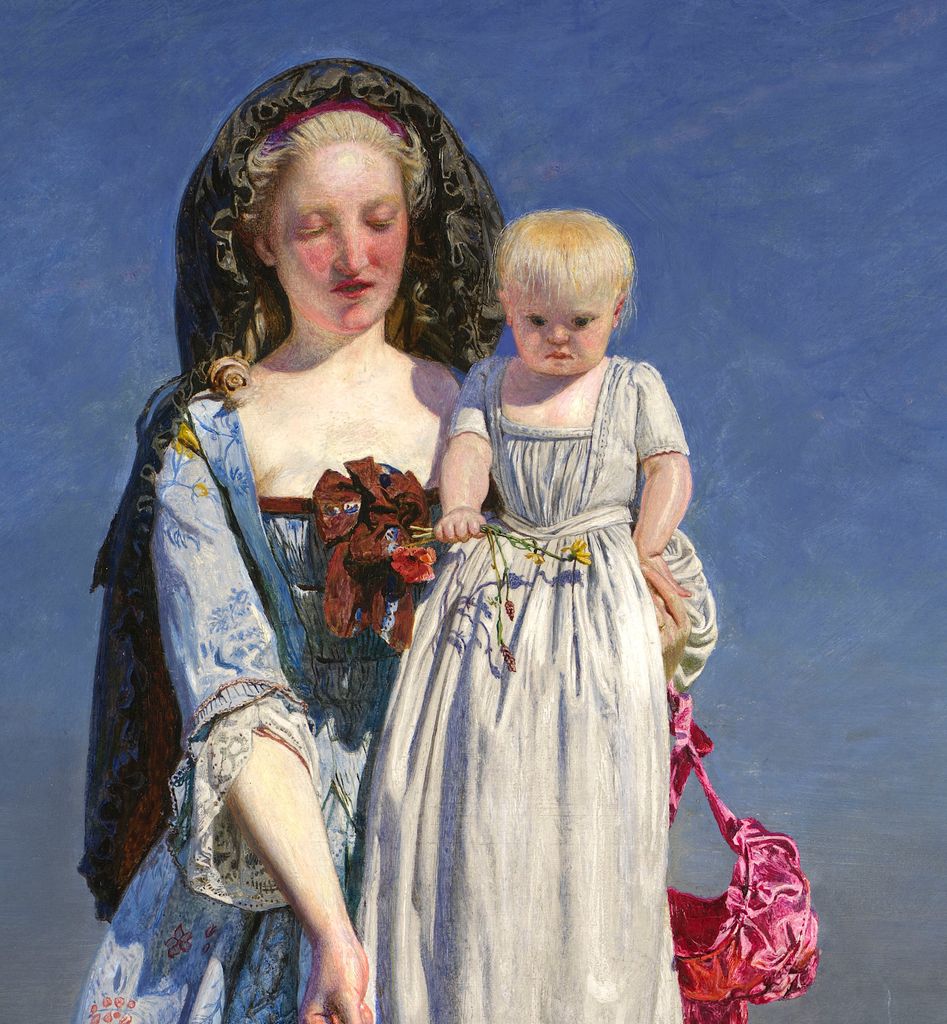
Sheep close to the dress
The upright sheep brings its head towards the offered hand. Its pale wool repeats the dress’s brightness, but the shorter legs and small lambs change the rhythm near the ground.
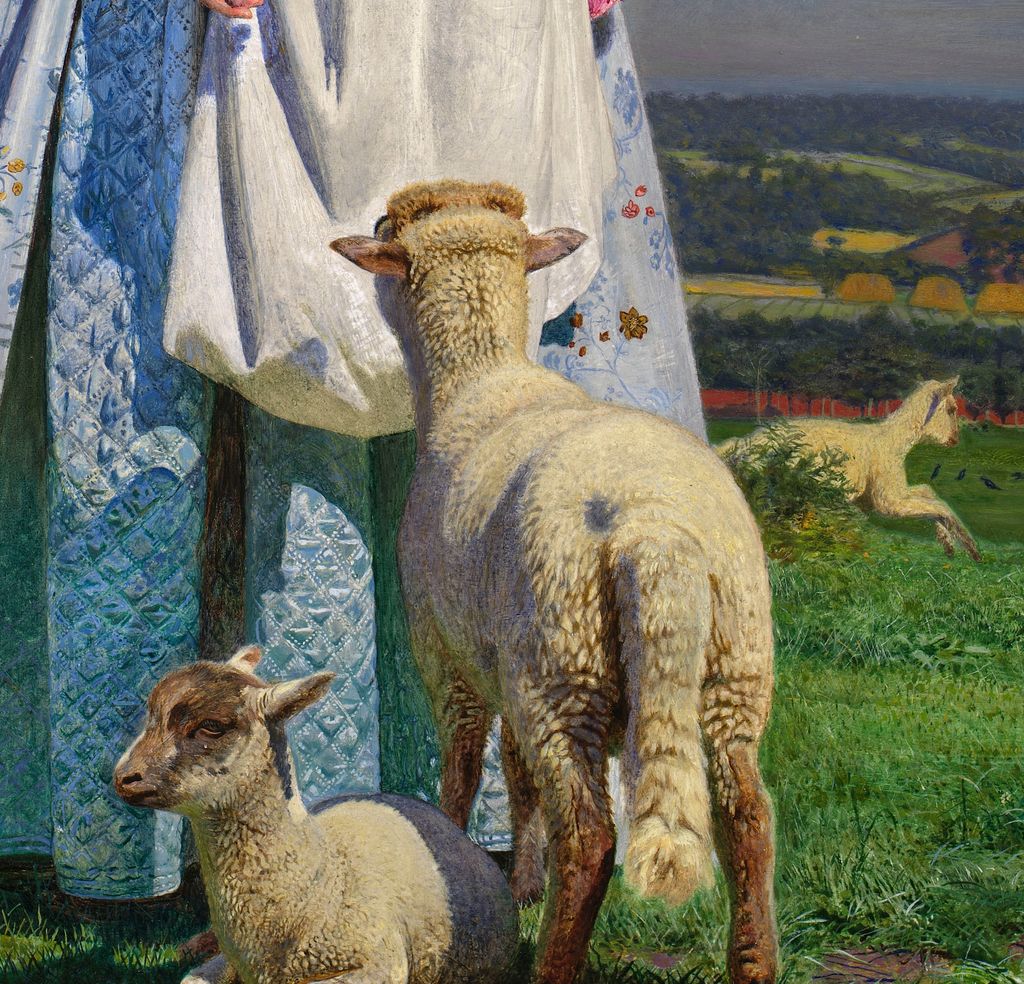
A second figure in the grass
The figure at the left bends towards the grass. Her low posture supplies a quiet counterweight to the tall standing pair.
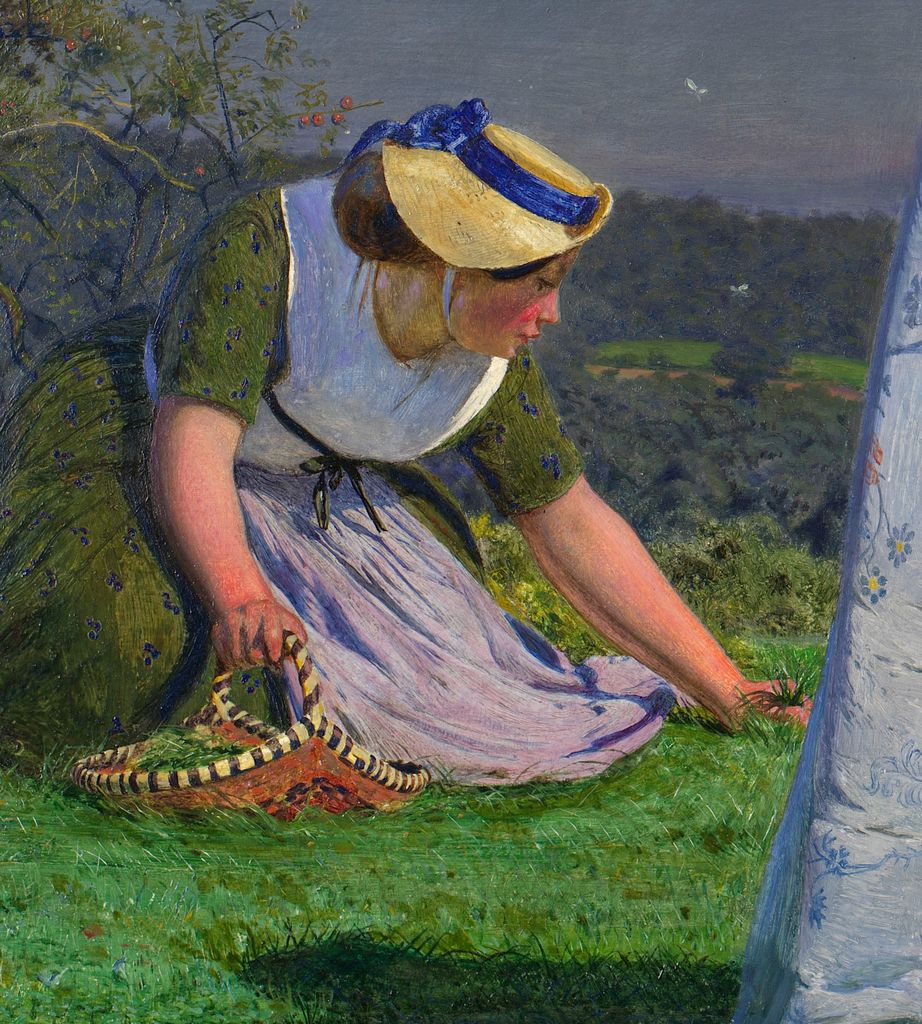
Animals and open grass
The flock extends across the sunlit ground behind the main encounter. Smaller animals and the distant horizontal boundary give depth to the broad green field.
How Sunlight Changes the Colours
Start with the mother's face. The forehead and cheeks have a strong pinkness, while the dark covering behind her head sets off the lit skin. Her eyes are lowered, and the contrast between exposed face and surrounding fabric gives the head a concentrated, almost uncomfortable brightness. The pale arm below is similarly emphatic against the patterned sleeve and dress. Sunlight registers on skin through changes of colour as well as through simple light and dark.
Now follow the child's dress downwards. Its brightest areas sit beside distinctly cooler folds. A conventional description of the dress as white misses much of what the painting shows. White fabric becomes a surface on which small differences in lighting can be made unusually clear. The child's fair hair also catches the light, while the shaded face remains more subdued than the mother's.
The lambs offer another kind of pale surface. Their fleece is broken into curls and small irregularities, so that illumination appears as a textured field. The animal facing away from us has a bright back and darker legs, with cooler tones around its flanks. The low, resting lamb has a darker face and ears that prevent it from becoming a shapeless white patch. Brown makes the viewer recognise both the animal's body and the local changes of colour across its coat.
Blue is distributed through several parts of the scene: sky, costume, fabric shadows and the cooler passages among the pale animals. Green is equally varied, from the brilliant foreground to the softer distant fields. The painting's colours connect its objects while preserving their differences. A fold of silk, a child's dress and a fleece receive the same outdoor light, yet each gives it a different texture.
Brown also recorded a material used during the work: “Roberson's undrying copal (flake white).” This is his own description of a painting supply, rather than a modern analysis of the finished panel. It establishes a specific material choice in his recollection; it does not by itself explain every visible effect or identify the paint in individual passages. [3]
The picture's meticulous surfaces are essential to its character. Small marks keep grass, wool and patterned cloth distinct even under a common illumination. Its account of sunlight depends on these differences remaining legible. The result can feel sharply focused and almost overabundant: the eye finds more activity in a patch of grass than the simple subject initially promises.
Emma, Cathy and the Eighteenth-Century Clothes
Brown identified the main models himself: Emma for the woman and Kate for the child. Kate was Catherine, usually called Cathy, the daughter born to Brown and Emma in 1850. Emma Hill became his second wife in 1853, after the painting had been begun. Laura MacCulloch's research distinguishes this chronology from an earlier family account that placed their marriage before Cathy's birth. [3] [4]
The distinction matters because the figures are frequently described simply as Brown's wife and daughter. That is a convenient later description of the family, but it compresses the history of the sittings. The painting brings us close to people in the artist's household without functioning as a straightforward record of how they normally dressed or spent an afternoon.
The eighteenth-century costume introduces a deliberate distance from everyday life. The mother's long patterned dress, elaborate head covering and coloured folds create a more formal presence than the action of feeding a lamb requires. The kneeling woman's broad hat and contrasting clothes help establish a shared costume world. Brown was observing real models while giving them roles within an arranged scene.
Birmingham's notes identify the dress as eighteenth-century and state that the artist intended no particular narrative subject. [1]
MacCulloch places Pretty Baa-Lambs within two recurring interests: family groups and eighteenth-century subjects or costume. Her comparison includes The Infant's Repast as another example of period dress. This makes the clothing part of a sustained artistic interest, rather than an isolated puzzle that demands a hidden literary source. [4]
The costumes also do visible compositional work. Their long folds hold the main group together, and their patterns introduce detail at a different scale from the grass. The blue fabric makes a broad coloured bridge between the white child and the green field. Historical dress and outdoor observation coexist throughout the painting: the arrangement is invented, while the light falling across it is closely studied.
Watch: Ford Madox Brown
Choose a film exploring the people, stories and visual details in two of Brown’s best-known paintings.
Pre-Raphaelites: Ford Madox Brown – Work
Curator Tim Barringer explores the figures and stories within Work.
Watch on YouTubeFrom the First Painting to the Revised Landscape
The range 1851–1859 records a painting with a working history. Brown's recollection of completing an initial campaign in five months does not mean that every part of the Birmingham panel was settled at that point. He described returning to Stockwell to alter a head while preparing his pictures for the Royal Academy in 1852. In 1853, he recorded perhaps another five weeks' work on Baa Lambs before sending it to Glasgow, where it remained unsold. [3]
Later work continued that process. In his 1896 biography, Brown's grandson Ford Madox Hueffer includes Pretty Baa-Lambs among pictures touched up during 1859. The museum's extended date is therefore consistent with a sequence of making and revision, rather than a claim that Brown spent eight continuous years on the same outdoor sitting. [5]
A smaller replica belongs to the Ashmolean Museum in Oxford. Banerjee points out that it gives a clearer idea of the earlier composition, before the Birmingham painting acquired its more expansive distant landscape. The two objects should be distinguished when comparing reproductions: they preserve different settings for the closely related figure group. [2]
That difference alters the balance of the scene. In Birmingham's painting, the eye travels beyond the sheep into a sequence of fields, buildings and pale distant water. The foreground episode sits within an extensive landscape. Brown's original statement that he painted the background on Clapham Common describes his early procedure; it should not make us treat the final distance as an exact, unaltered view from his Stockwell garden. [3]
Exhibition, Rejection and a Patient Buyer
Pretty Baa-Lambs appeared at the Royal Academy in 1852 alongside Jesus Washing Peter's Feet . Hueffer's biography describes Brown's frustration with the hanging and the criticism of the two pictures. Brown's own diary also complains about their positions, including the disruptive effect of light on their surfaces. The experience belongs to the history of how the works were seen, as well as to Brown's difficult relationship with exhibitions. [5] [3]
Hueffer reports that some responses to Pretty Baa-Lambs imposed a religious significance on it and even found it offensive. His account was written decades later, from within the artist's family, and its sweeping claims about the absence of admirers need to be recognised as his retrospective judgement. It nevertheless records a revealing mismatch: a picture Brown associated with light and heat invited viewers to hunt for a message. [5]
The alternative title Summer Heat helps make that physical subject clearer. Birmingham's notes quote Brown's explanation that heat was “seriously the subject,” while he still preferred the older, quaint name. [1]
The two titles direct attention differently: one towards the animals and the language of childhood, the other towards the condition affecting everything we see.
The painting found a buyer in James Leathart of Newcastle in 1859. Hueffer dates the purchase to July, placing it within a growing relationship between Brown and this northern patron. Leathart subsequently commissioned the smaller version of Work . These purchases show how an initially difficult picture could enter a collecting relationship that supported other ambitious work. [5]
Birmingham acquired Pretty Baa-Lambs from P. & D. Colnaghi in 1956. [2]
Tenderness Without Easy Prettiness
A mother, a child and lambs can suggest innocence and care. The central grouping may also remind a viewer of a Madonna and Child. Such associations arise from the familiar arrangement of bodies, but they do not establish an intended religious programme. Brown's emphasis on summer heat offers a firmer guide to the painting's stated subject. [1]
Elizabeth Helsinger offers a useful interpretation of its unusual emotional effect. She sees Brown's strong colour and harsh light as resisting conventional sweetness: the faces and exposed skin do not conform to an ideal of effortless prettiness. This reading allows tenderness and visual discomfort to coexist. It is a scholarly interpretation of the painting's effect, rather than proof that Brown encoded a particular domestic conflict in the scene. [6]
The woman's lowered gaze and protective hold remain gentle, while the emphatic colouring prevents the picture from dissolving into a soft pastoral fantasy. Even the sheep have distinct bodily weight and awkwardness. Looking closely makes the title's apparent simplicity less limiting: the animals can be pretty and engaging while the painting of them remains exacting.
Two other Brown landscapes help extend this attention to colour. In Carrying Corn , the contrast between green crops and yellow harvested corn gives cultivated land a strong visual structure. In Walton-on-the-Naze , figures occupy a wide landscape beneath an expansive, weather-filled sky. Set beside them, Pretty Baa-Lambs shows how closely Brown could join a figure group to the larger experience of looking outdoors. Each scene offers a different relationship between nearby bodies, worked land and the changing appearance of the sky.
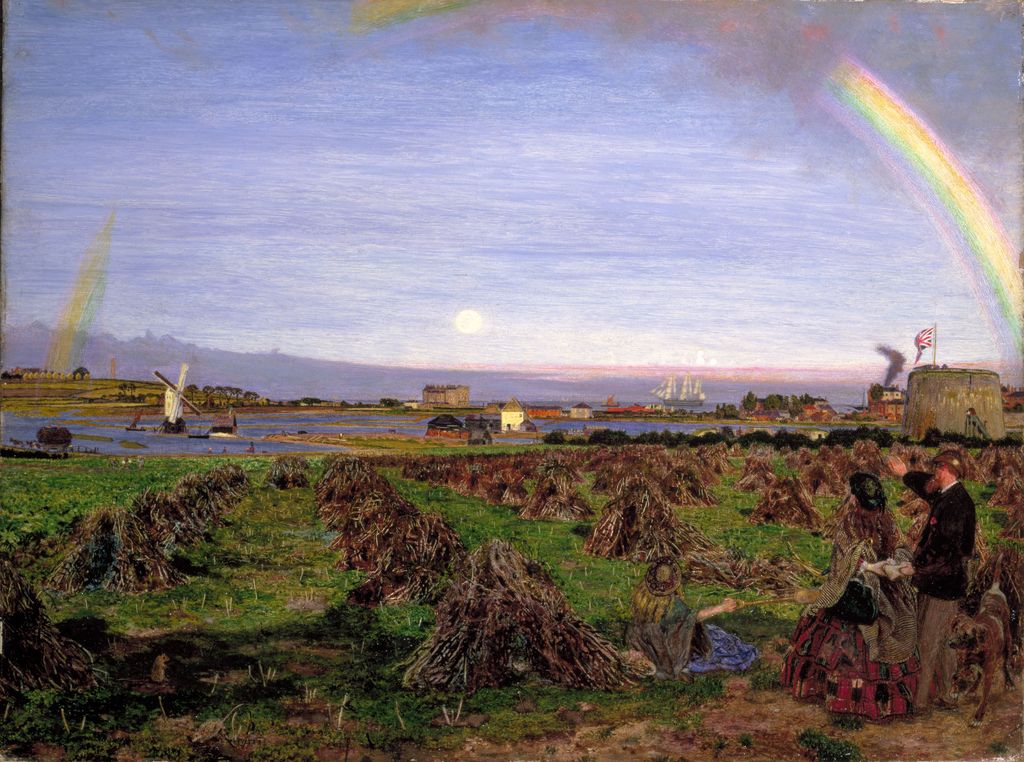
Ford Madox Brown, Walton-on-the-Naze, 1859–1860. Birmingham Museums Trust. A landscape where a family group sits beneath a broad weather-filled sky.
Image source
.
CC0 / Public domain
.
Artworks directory
Explore paintings, drawings, cartoons, illustrations and decorative designs documented in museum collections and specialist research. Distinct versions are listed separately; repeated print impressions are grouped. The coverage includes studies and works without a dedicated article and remains open to further research.
| Name | Date | Medium |
|---|---|---|
| Work (Manchester) | 1852–1865 | Oil on canvas |
| The Last of England (Birmingham) | 1852–1855 | Oil on panel |
| Jesus Washing Peter’s Feet | 1852–1856 | Oil on canvas |
| Pretty Baa-Lambs | 1851–1859 | Oil on panel |
| Take Your Son, Sir | ?1851–1892 | Oil on canvas |
| Lear and Cordelia | 1849–1854 | Oil on canvas |
| Cordelia’s Portion | 1867–1875 | Oil on canvas |
| Walton-on-the-Naze | 1859–1860 | Oil on canvas |
| Chaucer at the Court of Edward III (Tate) | 1856–1868 | Oil on canvas |
| Carrying Corn | 1854–1855 | Oil on mahogany |
| The Hayfield (The Hay Harvest) | 1855–1856 | Oil on mahogany |
| Stages of Cruelty | 1856–1890 | Oil on canvas |
| The Irish Girl | 1860 | Oil on canvas laid on board |
| Romeo and Juliet (Delaware) | 1869–1870 | Oil on canvas |
| The Seeds and Fruit of English Poetry | 1845–1853 | Oil on canvas |
| Self-Portrait | 1877 | Oil on canvas |
| The Bromley Children | Probably 1844 | Oil on canvas |
| The Bromley Family | 1844 | Oil on canvas |
| Byron’s Dream (Manchester) | 1874; worked on into 1875 | Oil on canvas |
| Cartoon for The Baptism of Edwin | 1879–1891 | Pastel, coloured chalks and grey gouache |
| The Coat of Many Colours | 1864–1866 | Oil on canvas |
| The Convalescent (Birmingham) | Dated October 1872 | Pastel |
| Crabtree Watching the Transit of Venus (reduced painting) | 1881–1888 | Tempera on panel |
| Cromwell on His Farm (Lady Lever) | Completed 1874 | Oil on canvas |
| Cromwell Protector of the Vaudois | 1877 | Oil on canvas |
| Dalton Collecting Marsh-Fire Gas (Town Hall mural) | 1886–1887 | Mural on canvas |
| The Establishment of the Flemish Weavers (reduced painting) | 1881; completed 1888 | Tempera on panel |
| The Finding of Don Juan by Haidée (NGV) | 1869–1870; later retouched | Watercolour and gouache over pencil |
| Henry and Millicent Fawcett | 1872 | Oil on canvas |
| Jacob and Joseph’s Coat (Ponce) | c.1868–1871 | Oil on canvas |
| James Leathart | 1863–1864; altered 1869 | Oil on canvas |
| King René’s Honeymoon (Tate watercolour) | 1864 | Graphite, watercolour, gouache and gum arabic on card |
| King René’s Honeymoon Cabinet (collaborative work) | 1861; exhibited 1862 | Oak, inlaid woods, painted panels and metal mounts; Brown designed Architecture |
| Manfred on the Jungfrau | 1841; retouched 1861 | Oil on canvas |
| Millie Smith | 1846 | Oil on paper laid on panel |
| William Michael Rossetti by Lamplight | 1856–1857 | Oil on panel |
| The Traveller (Manchester oil) | 1868–1884 | Oil on panel |
| Waiting: An English Fireside of 1854–55 | 1851–1855 | Oil on panel |
| An English Autumn Afternoon | 1852–1853; finished c.1854 | Oil on canvas |
| Alfred the Great: Sketch of Alfred drawing in the Sand | 1843–1845 | pencil |
| Historical Notes and Sketches of Alfred the Great | 1843–1850 | brown ink writing over pencil |
| Angels watching the Crown of Thorns: Study of clasped Hands | 1846 | black chalk |
| Architecture: Study of Gothic Arches and 14th Century Vaulting | c. 1847 | brown pen and ink over pencil on grey paper |
| The Ascension: Study of Angels and Hands | 1844 | brown pen and ink over pencil |
| The Ascension: Study of a Group of Angels | 1844 | brown pen and ink over pencil |
| The Ascension: Study of a Group of six flying Angels | 1844 | brown pen and ink over pencil |
| The Ascension: Two nude Angels holding onto each other | 1844 | brown brush and ink over pencil |
| The Ascension: Study for a kneeling Apostle | 1844 | black chalk touched with white on brown-toned paper |
| Head of a Child | c. 1844 | black chalk touched with white on brown toned paper |
| The Ascension: Drapery Study of a praying Apostle | 1844 | black chalk |
| The Spirit of Justice: Seated Figure in ecclesiastical Robes, gripping a Staff with left Hand raised in a Blessing | 1844 | black chalk |
| The Ascension: Study for an Apostle | 1844 | black chalk |
| The Spirit of Justice: Body of seated Figure in ecclesiastical Robes holding a Staff and a Book | 1844 | black chalk |
| The Ascension: Study of an Apostle | 1844 | black chalk on toned paper |
| Full-length Sketch of a standing, naked Child | 1844 | black chalk on toned paper |
| The Ascension: Study for Christ | 1844 | brown pen and ink over pencil |
| Caricature: Composite Drawing: A Stunner | 1861–1863 | pencil |
| A Victorian Woman in her Underwear | 1861–1863 | pencil |
| Caricature: Composite Drawing: Bewigged Head | 1861–1863 | pencil |
| Bowed Head of a bearded Man | 1861–1863 | pencil |
| Chaucer at the Court of Edward III: Early compositional Study | 1845 | pencil with brown pen and ink |
| Chaucer at the Court of Edward III: Study for Milton and two Designs for Tombstones | c.1845–c.1846 | pencil with brown frame outline |
| Chaucer at the Court of Edward III: Tracing of the Figure of Milton | c.1845–c.1849 | brown pen and ink with pencil on tracing paper |
| Chaucer at the Court of Edward III: Tracing of a Gothic Arch | c.1845–c.1849 | brown pen and ink with pencil on tracing paper |
| Chaucer at the Court of Edward III: Early compositional Study | 1845 | pencil with brown pen and ink |
| Chaucer at the Court of Edward III: Nude Studies of two Boys | 1845 | pencil, laid down |
| Chaucer at the Court of Edward III: Nude Studies of four Figures | 1845 | pencil |
| Chaucer at the Court of Edward III: Eight early Studies of Figures and Hands | 1845 | pencil |
| Chaucer at the Court of Edward III: Nude Studies for the Figures of Byron, Shakespeare and Burns | 1845 | black chalk |
| Chaucer at the Court of Edward III: Drapery Study for Burns | 1847 | black chalk |
| Chaucer at the Court of Edward III: Study of a right Leg and left Foot for Milton | 1847 | black chalk |
| Chaucer at the Court of Edward III: Study of a left Leg for Shakespeare | 1847 | black chalk |
| Chaucer at the Court of Edward III: Study of Drapery for Milton | 1847 | black chalk |
| Chaucer at the Court of Edward III: Drapery Study for Shakespeare | 1847 | black chalk |
| Chaucer at the Court of Edward III: Study of a Man in a medieval Hood | 1847 | black chalk |
| Chaucer at the Court of Edward III: Study for the Cardinal | 1847 | black chalk |
| Chaucer at the Court of Edward III: Drapery Study in Profile for Courtier | 1847 | black chalk |
| Chaucer at the Court of Edward III: Drapery Study | 1847 | black chalk |
| Chaucer at the Court of Edward III: Female Nude Study of a Muse holding onto a Rail | 1847 | pencil |
| Chaucer at the Court of Edward III: Female Nude: Study of a Muse | 1847 | pencil |
| Chaucer at the Court of Edward III: Nude Study for seated Lady | 1847 | pencil |
| Chaucer at the Court of Edward III: Nude Study of a Woman with right Arm raised | 1847 | pencil |
| Chaucer at the Court of Edward III: Two Studies of Back of a seated Woman's Head | 1847 | pencil |
| Chaucer at the Court of Edward III: Two Studies of a seated Woman in lost Profile Pose and from the Back | 1847 | pencil |
| Chaucer at the Court of Edward III: Nude Study of a Woman | 1847 | pencil |
| Chaucer at the Court of Edward III: Sketch of a Woman supporting another Figure | 1847 | pencil |
| Chaucer at the Court of Edward III: Study of the Heads and Shoulders of two Women | 1847 | pencil |
| Chaucer at the Court of Edward III: Drapery Study for Edward III with Outline of a Child | 1847 | black chalk |
| Chaucer at the Court of Edward III: Foreshortened Study for Head of a Jester | 1847 | pencil |
| Chaucer at the Court of Edward III: Head of Alexander Pope | 1847 | black chalk |
| Chaucer at the Court of Edward III: Two Hand Studies | 1847 | black chalk |
| Chaucer at the Court of Edward III: Study of Head of Milton copied from Sculpture | 1848 | black chalk |
| Chaucer at the Court of Edward III: Nude Studies for the Squire and the Courtier talking to Gower | 1848 | pencil |
| Chaucer at the Court of Edward III: Drapery Study for the Black Prince | 1848 | black chalk with touches of white |
| Chaucer at the Court of Edward III: Three Studies of Hands | 1848 | Black chalk |
| Chaucer at the Court of Edward III: Four Studies of Hands | 1848 | black chalk touched with white |
| Chaucer at the Court of Edward III: Study of a clasped right Hand for one of the Poets | 1848 | black chalk |
| Chaucer at the Court of Edward III: Study of a left Hand for Burns | 1848 | black chalk heightened with touches of white |
| Chaucer at the Court of Edward III: Study of Drapery for Burns | 1848 | black chalk |
| Chaucer at the Court of Edward III: Drapery Study | 1848 | black chalk |
| Chaucer at the Court of Edward III: Drapery Study for the Black Prince | 1851 | black and white chalks on brown-toned paper |
| Chaucer at the Court of Edward III: Study for Squire's Legs | 1851 | black chalk heightened with white |
| Chaucer at the Court of Edward III: Two Head Studies of an old Woman | 1851 | black chalk |
| Costume Study: Five Sketches of Armour and Costume | 1844 | brown pen and ink over pencil |
| Costume Study: Archbishop's Dress | 1845 | brown pen and ink on tracing paper |
| Costume Studies: French and Italian thirteenth and fourteenth-century Costumes (seven Drawings) | 1845 | brown pen and ink on tracing paper |
| Costume Study: Seigneur de Rimini | 1845 | brown pen and ink on tracing paper |
| Dalziels' Bible Gallery: The Death of Eglon | 1863–1865 | engraved woodblock; designed by Brown, engraved by the Dalziel Brothers |
| Dalziels' Bible Gallery: The Death of Eglon | 1881 | wood engraving; designed by Brown, engraved by the Dalziel Brothers |
| Dalziels' Bible Gallery: Elijah and the Widow's Son | 1863–1865 | engraved woodblock; designed by Brown, engraved by the Dalziel Brothers |
| Dalziels' Bible Gallery: Elijah and the Widow's Son | 1881 | wood engraving; designed by Brown, engraved by the Dalziel Brothers |
| Dalziels' Bible Gallery: Joseph’s Coat (Compositional Sketch and four Studies for Jacob's Granddaughter) | 1863–1865 | pencil on paper |
| Dalziels' Bible Gallery: Joseph's Coat | 1863–1865 | engraved woodblock; designed by Brown, engraved by the Dalziel Brothers |
| Dalziels' Bible Gallery: Joseph’s Coat | 1881 | wood engraving; designed by Brown, engraved by the Dalziel Brothers |
| Decorative Sketches: Venus Reclining on a Shell in the Midst of the Sea | 1848–1849 | brown pen and ink over pencil |
| Decorative Design: Ornamental Pattern | 1850 | watercolour and bodycolour over pen and ink, and pencil on two sheets of paper |
| Down Stream: Main Illustration (Last Year's First of May) | 1871 | wood engraving; designed by Brown, print execution by an engraver |
| Down Stream: Tailpiece to the Poem (This Year's First of June) | 1871 | wood engraving; designed by Brown, print execution by an engraver |
| The Establishment of Flemish Weavers in Manchester A.D. 1363: Four Studies of Parts of a Horse | 1879–1882 | black, white and red chalk on rough brown paper |
| Female: Two Studies of young Woman in eighteenth-century Costume | 1849 | pencil |
| Infant's Repast: Study of Mother and Child | 1848 | black and white chalk |
| Infant's Repast: Study of Mother and Child with separate Arm and Leg Studies of the Child | 1848 | black chalk with grey wash |
| King Lear: Sketch of Lear questioning Cordelia | 1844 | brown pen and ink over pencil |
| Alfred the Great: Compositional Sketches | 1843–1845 | pencil |
| King Lear: Sketches of Lear imagining his unfaithful Daughters’ Trial and Lear in the Storm | 1844 | brown pen and ink over pencil |
| Alfred the Great: Compositional Studies and Sketches and Chaucer at the Court of Edward III: Study of Cherubs | 1843–1849 | pencil |
| King Lear: Kent accuses Oswald | 1844 | brown pen and ink with pencil underneath |
| King Lear: Lear recounts his Wrongs to Regan | Undated | Brown pen and ink over pencil |
| King Lear: Cordelia at Lear's Bedside (Lear's Awakening) | 1844 | brown pen and ink over pencil |
| Cordelia Parting from Her Sisters (The Germ) | 1850; reprinted 1901 | Etching; designed by Brown, print execution by an engraver |
| King René's Honeymoon: Study for Architecture | 1861 | brush and brown ink, with watercolour, over pencil on brown paper |
| The Last of England: Cartoon | 1852 | pencil, image edged with brown ink |
| The Last of England: Portrait of Emma Hill | December 1852 | chalks with scratching out on two sheets of paper |
| Lear and Cordelia and The Infant’s Repast: Four Studies of Hands | 1849 | black chalk |
| Lyra Germanica - the Christian Life: Abraham and Isaac | 1868 | wood engraving; designed by Brown, print execution by an engraver |
| Lyra Germanica - the Christian Life: Finished Design for The Entombment | 1867 | black pen and ink |
| Lyra Germanica - the Christian Life: The Entombment | 1868 | wood engraving; designed by Brown, print execution by an engraver |
| Male: Sketch of Man reclining on Steps with Hands bound together | 1844 | brown pen and ink over pencil |
| Male: Academic nude Study, half-length with Moustache and Arms folded | 1846–1849 | black chalk |
| Male: Academic Study of Nude holding a Staff | 1847 | pencil |
| Male: Academic Study of Nude posed as a Sculptor | 1847 | chalk with grey wash |
| Male: Academic Study, three-quarter length Nude, with a Moustache and clenched Fists | 1847 | black chalk |
| Oure Ladye of Saturday Night: Seven Sketches | 1846 | pencil |
| Oure Ladye of Saturday Night: Four Studies for Angel holding Child | 1847 | pencil |
| Oure Ladye of Saturday Night: Study of Angel holding Child | 1847 | black chalk |
| Oure Ladye of Saturday Night: Study of Arm and Hands for Angel holding Bowl of Water | 1847 | black chalk |
| Oure Ladye of Saturday Night: Drapery Study for Angel holding Bowl of Water | 1847 | black chalk |
| Oure Ladye of Saturday Night: Study of Head for Angel holding Bowl of Water | 1847 | black chalk with rubbing and grey wash |
| Oure Ladye of Saturday Night: Study of Child seated on Knees of the Virgin and two separate Studies of the Child's Legs | 1847 | pencil on brown-toned paper |
| Oure Ladye of Saturday Night: Frieze Design | c. 1847 | pencil and black pen and ink |
| Oure Ladye of Saturday Night: Three Studies of Arms and Legs of Child | 1847 | pencil |
| Oure Ladye of Saturday Night: Three Studies of Child's Legs on Virgin's Knees | 1847 | pencil |
| Oure Ladye of Saturday Night: Studies of Right Foot and Left Hand of Child | 1847 | pencil on light brown paper |
| Oure Ladye of Saturday Night: Drapery Study for Virgin | 1847 | black chalk |
| Oure Ladye of Saturday Night: Study for Head of Virgin | 1847 | black chalk with wash |
| Parisina’s Sleep: Study for Prince Azo and Parisina | 1842 | black chalk with pencil side drawing |
| Parisina's Sleep: Study for Head of Prince Azo | 1842 | black chalk with grey wash |
| Parisina's Sleep: Study for the Head of Parisina | 1842 | black and white chalk with grey wash |
| Poets of the Nineteenth Century: The Prisoner of Chillon: Compositional Sketch | 1856 | pencil |
| Profile of a Man's left Eye and Nose | c.1856 | pencil |
| Poets of the Nineteenth Century: The Prisoner of Chillon: Study of a Corpse | 1856 | pencil |
| Designs for Decoration | c.1856 | pencil |
| Poets of the Nineteenth Century: The Prisoner of Chillon | 1857 | wood engraving; designed by Brown, print execution by an engraver |
| Portrait: Head Study of Daniel Casey (three-quarter view) | 1848 | black chalk |
| Portrait: Head Study of Daniel Casey (full-face) | 1848 | black chalk |
| Portrait: Miss Iza Duffus Hardy | 1872 | pastel and coloured chalks on brown paper |
| Portrait: Emma Hill (later Mrs Madox Brown) | 1848 | black chalk |
| Portrait: Emma Hill (later Mrs Madox Brown) | 1852 | pencil |
| Portrait: Mrs Madox Brown (neé Emma Hill) | 9 May 1854 | pencil |
| The Repose in Egypt: Compositional Sketch | 1847 | pencil |
| Study of a Statue of the Discobolus | 1845 | Black chalk |
| William Shakespeare: Study | 1849–1850 | pencil |
| William Shakespeare: Invitation Card | 1850 | wood engraving; designed by Brown, print execution by an engraver |
| The Spirit of Justice: Study for Baron and his Advisor, with Sketches of Erudition and Wisdom | 1844–1845 | brown pen and ink over pencil |
| The Spirit of Justice: Drapery Study for Erudition | 1844–1845 | black chalk |
| Drapery Study and Sketch of Two Legs | Undated | Black chalk |
| The Spirit of Justice: Study for Wisdom | 1844–1845 | black chalk with grey wash |
| The Spirit of Justice: Study for Head of the Baron | 1844–1845 | black chalk |
| The Spirit of Justice: Study for the Head of central Bishop | 1844–1845 | black chalk |
| The Spirit of Justice: Study for the Head of a Bishop | 1844–1845 | black chalk with grey wash |
| The Spirit of Justice: Study for the uplifted left Arm of Justice | 1844–1845 | black chalk |
| The Spirit of Justice: Study for Head of Counsellor in a Coronet | 1844–1845 | black chalk with touches of blue chalk |
| The Spirit of Justice: Study for Head of Counsellor | 1844–1845 | black chalk |
| The Spirit of Justice: Drapery Study for the Central Bishop | 1844–1845 | Black chalk |
| Part of a Drapery Study | 1844–1845 | black chalk |
| The Spirit of Justice: Study for Head of Widow | 1844–1845 | black chalk |
| Stages of Cruelty: Study for the Child (Catherine Madox Brown) | 1857 | black chalk on pale grey paper |
| Stained Glass Design: Cartoon for Zachariah, The High Priest | 1872 | black chalk |
| Stained Glass Design: Cartoon for The Young Milton | 1874 | black chalk |
| Stained Glass Design: Cartoon for St Simon | 1874 | black chalk |
| Sterne's 'Sentimental Journey': Study for Yorick and La Fleur talking to Maria’s Mother | 1842 | brown pen and ink over pencil |
| The Body of Harold brought before William the Conqueror: Eight Sketches of Figure Groups | c.1844 | pencil |
| Sterne's 'Sentimental Journey' : Yorick (Laurence Sterne) and Maria Walking | 1842 | pen and ink, watercolour and bodycolour over pencil |
| Study of Tree Trunk with Roots | c.1847 | black chalk, heightened with white chalk on buff paper |
| Two Studies of Tree Trunks | c.1846 | black chalk |
| Unknown Subject: Compositional Sketch | 1843–1850 | pencil |
| Wycliffe reading his Translation of the Bible: Nude Study for Chaucer | 1847 | pencil |
| Wycliffe reading his Translation of the Bible: Study for Chaucer | 1847 | pencil |
| Wycliffe reading his Translation of the Bible: Nude Study of Gower | 1847 | pencil |
| Wycliffe reading his Translation of the Bible: Study for Gower | 1847 | pencil |
| Wycliffe reading his Translation of the Bible: Nude Study for John of Gaunt and Chaucer's right Hand | 1847 | pencil and black chalk |
| Wycliffe reading his Translation of the Bible: Study of John of Gaunt and Chaucer's Left Hand | 1847 | pencil and black chalk |
| Wycliffe reading his Translation of the Bible: Study for Wycliffe | 1847 | black chalk |
| Wycliffe reading his Translation of the Bible: Nude Study for Wycliffe | 1847 | pencil |
| Wycliffe reading his Translation of the Bible: Drapery Study for Wycliffe | 1847 | black chalk |
| Wycliffe reading his Translation of the Bible: Drapery Study for Chaucer | 1848 | black chalk |
| Wycliffe reading his Translation of the Bible: Study of Legs for John of Gaunt and two Studies of Feet for Wycliffe | 1848 | black chalk |
| Wycliffe Reading his Translation of the Bible: Studies of Hands for John of Gaunt and Gower | 1847 | black chalk |
| Wycliffe reading his Translation of the Bible: Study for Head of Wycliffe | 1847 | pencil |
| Wycliffe reading his Translation of the Bible: Study for Constance and Child | 1847 | pencil |
| Wycliffe reading his Translation of the Bible: Unfinished Study for Head of Constance | 1847–48 | pencil |
| Wycliffe reading his Translation of the Bible: Portrait of Elizabeth Bamford modelling for Constance | 1848 | pencil |
| Wycliffe reading his Translation of the Bible: Study for Head of Constance | 1848 | chalk over pencil |
| Wycliffe reading his Translation of the Bible: Study for Head of Chaucer | 1848 | pencil |
| Wycliffe reading his Translation of the Bible: Study of Monk representing the Catholic Faith | 1848 | black chalk with brown pen and ink, squared up |
| Wycliffe reading his Translation of the Bible: Study of young Woman representing the Protestant Faith | 1848 | black chalk |
| Cathy Madox Brown at the Age of Three (Tate N01356) | 1853 | Graphite on paper |
| King René‘s Honeymoon (Tate N02409) | date not known | Ink on paper |
| Sheepshearing (Tate N02410) | c.1887 | Ink and graphite on paper |
| Studies for ‘Work’ (Tate N02411) | 1855 | Graphite and ink on paper |
| Design for Badge for Gillum’s Homes (Tate N02412) | date not known | Ink and graphite on paper |
| Arkwright’s Mill (Tate N02413) | 1878 | Graphite on paper |
| Study for ‘John Kay’ (Tate N02414) | 1889 | Graphite on paper |
| Study for ‘Southend’ (Tate N02415) | date not known | Graphite on paper |
| ‘Where are you going, my pretty maid?’ (Tate N02416) | date not known | Graphite on paper |
| Section of the Bridgewater Canal (Tate N02417) | 1890 | Ink on paper |
| A Barge on the Bridgewater Canal (Tate N02418) | 1890 | Graphite on paper |
| Study of the Tow-Path on the Bridgewater Canal (Tate N02419) | 1890 | Graphite on paper |
| Our Lady of Good Children (Tate N02684) | 1847–61 | Pastel, watercolour and gold paint on paper |
| Arkwright’s Mill (Tate N02791) | 1881 | Graphite on paper |
| The Bridgewater Canal (Tate N02792) | 1890 | Ink on paper |
| The Bridgewater Canal (Tate N02793) | date not known | Chalk and graphite on paper |
| The Last of England (Tate N03064) | 1864–6 | Watercolour on paper |
| Mauvais Sujet (Tate N03228) | 1863 | Watercolour on paper |
| Study of a Man Painting (Tate N03472) | 1839 | Graphite on paper |
| The Brent at Hendon (Tate N03528) | 1854–5 | Oil paint on board on mahogany |
| Study for the Dean in the ‘Execution of Mary Queen of Scots’ (Tate N04280) | c.1840 | Oil paint on paper |
| Sketch for ‘Jesus Washing Peter’s Feet’ (Tate N04281) | 1852 | Graphite on paper |
| Sketch for ‘Cromwell on his Farm’ (Tate N04282) | c.1853 | Graphite on paper |
| The Coat of Many Colours (Tate N04584) | 1867 | Watercolour and gouache on paper |
| Stages of Cruelty (Tate N04625) | c.1856 | Watercolour on paper |
| Head of a Girl (Tate N04803) | date not known | Oil paint on paper |
| Portrait of Dykes Barry as a Child (Tate N04866) | 1853 | Oil paint on mahogany |
| Jesus Washing Peter’s Feet (Tate N05301) | 1857–8 | Watercolour on paper |
| Platt Lane (Tate N05383) | 1884 | Oil paint on canvas |
| Study of F.G. Stephens for ‘Jesus Washing Peter’s Feet’. Verso: A Head Crowned with Laurels (Tate T00571) | 1852 | Graphite on paper. Verso: graphite on paper |
| Sketch for ‘Jesus Washing Peter’s Feet’ (Tate T01035) | c.1851 | Ink and graphite on paper |
| Chaucer at the Court of Edward III (Sydney) | 1845–1851 | Oil on canvas |
| Wycliffe Reading His Translation of the Bible to John of Gaunt (Bradford) | 1848 | Oil on canvas |
| Work (Birmingham replica) | 1859–1863 | Oil on canvas |
| The Spirit of Justice (Book of Art reproduction) | Published 1846 | Wood engraving after Brown’s cartoon; engraver unknown |
| The Execution of Mary Queen of Scots | 1840–1842 | Oil on canvas |
| The Prisoner of Chillon (Manchester oil) | 1843 | Oil on canvas |
| The Parting of Cordelia from Her Sisters (oil) | 1853 | Oil on canvas |
| Cordelia’s Portion (Lady Lever) | 1866–1872 | Watercolour, gouache and pastel |
| The Ascension | 1844–1845 | Oil on canvas |
| Manfred in the Chamois Hunter’s Hut (oil sketch) | 1840 | Oil on canvas |
| Dr Primrose and His Daughters (The Vicar of Wakefield) | 1840–1841 | Oil on canvas |
| The Body of Harold Brought before William the Conqueror | 1844–1861 | Oil on canvas |
| The Seeds and Fruits of English Poetry (Bedford cartoon) | 1845 | Black chalk on paper |
| Wycliffe Reading His Translation of the Bible (oil sketch) | 1847–1848 | Oil on board |
| Cromwell Discussing the Protection of the Vaudois (Nottingham) | 1877–1878 | Oil on canvas |
| Two Drawings of Men in Hoods | c.1845 | Pencil on paper |
| The Seeds and Fruits of English Poetry: Study of the Right Side | c.1845 | Brown pen and ink with pencil |
| Chaucer: A Man in a Hood with a Liripipe and Two Drapery Studies | 1848 | Oil on canvas |
| The Prisoner of Chillon Entreating His Jailors (Yale watercolour) | 1858 | Watercolour heightened with bodycolour |
| Elijah and the Widow’s Son (Birmingham oil) | 1864 | Oil on panel |
| He That Soweth (Lyra Germanica) | Published 1868 | Wood engraving by the Dalziel Brothers after Brown |
| The Entombment (NGV) | 1871–1878 | Watercolour, gouache, gold paint and gum arabic over pencil |
| The Sower (Morris firm tile) | c.1864–1873 | Tile; design by Brown, workshop execution |
| Childe Harold’s Pilgrimage (Byron illustration) | Published 1870 | Steel engraving by Herbert Bourne after Brown |
| The Two Foscari (Byron illustration) | Published 1870 | Steel engraving by Herbert Bourne after Brown |
| The Corsair (Byron illustration) | Published 1870 | Steel engraving by Herbert Bourne after Brown |
| Sardanapalus (Byron illustration) | Published 1870 | Steel engraving by Herbert Bourne after Brown |
| Don Juan (Byron illustration) | Published 1870 | Steel engraving by Herbert Bourne after Brown |
| Byron’s Dream (roundel title-page design) | Published 1870 | Steel engraving by Herbert Bourne after Brown |
| The Finding of Don Juan by Haidée (Birmingham oil) | 1870–1873 | Oil on canvas |
| The Dream of Sardanapalus (Delaware) | 1871–1872 | Watercolour on paper |
| The Traveller (Once a Week) | Published 1869 | Wood engraving by Joseph Swain after Brown |
| The Infant’s Repast | 1848 | Oil on board |
| Oliver Madox Brown Aged Four (Dwale Bluth frontispiece) | Published 1876 | Etching |
| Oliver Madox Brown as a Young Man (Dwale Bluth frontispiece) | Published 1876 | Etching |
| A Beggar and Other Fantasies: Title-page Illustration | Published 1889 | Photo-engraving after Brown |
| Dramas in Miniature: Title-page Illustration | Published 1891 | Photo-engraving after Brown |
| The Brown Owl: Frontispiece | Published 1892 | Photo-engraving after Brown |
| The Brown Owl: Central Illustration | Published 1892 | Photo-engraving after Brown |
| The Feather: Frontispiece | Published 1892 | Photo-engraving after Brown |
| The Ascension: Study for Christ | 1844 | Pen and ink |
| King Lear: Lear Questions Cordelia (Whitworth) | 1844 | Pencil, pen and brown ink |
| King Lear: France Claims the Dispossessed Cordelia (Whitworth) | 1844 | Pencil, pen and brown ink |
| King Lear: Cordelia Parts from Her Sisters (Whitworth) | 1844 | Pencil, pen and brown ink |
| King Lear: Goneril and Regan Together (Whitworth) | 1844 | Pencil, pen and brown ink |
| King Lear: Goneril Tells Oswald How to Treat Lear (Whitworth) | 1844 | Pencil, pen and brown ink |
| King Lear: Oswald’s Insolence to Lear (Whitworth) | 1844 | Pencil, pen and brown ink |
| King Lear: Lear Rebukes Oswald (Whitworth) | 1844 | Pencil, pen and brown ink |
| King Lear: Kent Trips Oswald (Whitworth) | 1844 | Pencil, pen and brown ink |
| King Lear: Goneril’s Complaint to Lear (Whitworth) | 1844 | Pencil, pen and brown ink |
| King Lear: Lear Curses Goneril’s Infidelity (Whitworth) | 1844 | Pencil, pen and brown ink |
| King Lear: Kent Challenges Oswald (Whitworth) | 1844 | Pencil, pen and brown ink |
| King Lear: Kent in the Stocks (Whitworth) | 1844 | Pencil, pen and brown ink |
| King Lear: Lear Recounts His Wrongs to Regan (Whitworth) | 1844 | Pencil, pen and brown ink |
| King Lear: Lear Parts from Regan and Goneril (Whitworth) | 1844 | Pencil, pen and brown ink |
| King Lear: Lear and the Fool in the Storm (Whitworth) | 1844 | Pencil, pen and brown ink |
| King Lear: Lear Mad on the Beach at Dover (Whitworth) | 1844 | Pencil, pen and brown ink |
| King Lear: Alternative Study: Lear Curses Goneril (Whitworth) | 1844 | Pencil, pen and brown ink |
| King Lear: Lear Imagines His Daughters’ Trial (Whitworth) | 1844 | Pencil |
| King Lear: Alternative Study: Lear in the Storm (Whitworth) | 1844 | Pencil, pen and brown ink |
| The Last of England (Fitzwilliam) | 1860 | Oil on canvas |
| The Convalescent (Metropolitan Museum) | Dated 1872 | Pastel |
| Self-Portrait (Walker drawing) | 1850; retouched 1853 | Black chalk |
| Byron’s Dream (Whitworth) | 1889 | Watercolour over graphite |
| Cordelia Parting from Her Sisters (Cleveland sketch) | 1854 | Pen and oil on paper mounted on panel |
| David and Goliath: Cartoon for Stained Glass Window at Jesus College, Cambridge | 1872 | Charcoal and graphite on Japanese paper |
| The Virgin Swooning (recto) | 1844 | Black chalk on laid paper |
| Two Drapery Studies (verso) | c.1844 | Black chalk |
| Architecture: King René’s Honeymoon (stained glass) | 1862 | Stained glass; designed by Brown, made by Morris, Marshall, Faulkner & Co. |
| The Romans Building a Fort at Mancenion (Town Hall mural) | 1880 | Spirit fresco |
| The Baptism of Edwin (Town Hall mural) | 1879–1880 | Spirit fresco |
| The Expulsion of the Danes (Town Hall mural) | 1880–1881 | Spirit fresco |
| The Establishment of the Flemish Weavers (Town Hall mural) | 1881–1882 | Spirit fresco |
| Crabtree Watching the Transit of Venus (Town Hall mural) | 1882–1883 | Spirit fresco |
| The Proclamation Regarding Weights and Measures (Town Hall mural) | 1883–1884 | Spirit fresco |
| Wycliffe on Trial (Town Hall mural) | 1885–1886 | Spirit fresco |
| Chetham’s Life’s Dream (Town Hall mural) | 1885–1886 | Mural on canvas |
| Bradshaw’s Defence of Manchester (Town Hall mural) | 1892–1893 | Mural on canvas |
| John Kay, Inventor of the Fly Shuttle (Town Hall mural) | 1888–1890 | Mural on canvas |
| The Opening of the Bridgewater Canal (Town Hall mural) | 1891–1892 | Mural on canvas |
Frequently Asked Questions
Brown said that he painted it almost entirely in sunlight. He worked with the figures in his Stockwell garden, used a lay figure to hold the costume, brought in sheep from Clapham Common and painted the background on the Common. Later revisions mean that its final appearance combines several campaigns of work. [3] [5]
The principal painting discussed here belongs to Birmingham Museums Trust, accession 1956P9. A smaller replica is in the Ashmolean Museum, Oxford; its background differs from Birmingham's later landscape. [2]
Discussion
Look again at the images and ideas explored in Pretty Baa-Lambs by Ford Madox Brown. These editorial prompts invite your observations.
Reader Insights
Compare the child's white dress with the fleece of the standing lamb. Both are pale, but their shaded areas and textures differ. Following those differences is a way to see how the same illumination changes as it meets cloth, skin, wool and grass.
Consider how the long dress, patterned fabric and dark head covering affect the mother's presence. The clothing lends formality to a small domestic action. How would the balance between intimacy and ceremony change if the figures wore less elaborate clothes?
Look at the scene first through the title Pretty Baa-Lambs , then through Summer Heat . The first encourages attention to animals and affection; the second brings the skin, shadows and brilliant ground forward. Which title better describes your experience of the painting?
Join the Conversation
Share a detail, comparison or question about Pretty Baa-Lambs by Ford Madox Brown below.
References
- Birmingham Museum and Art Gallery Learning Department , The Pre-Raphaelites: Teachers' Notes , p.12, “The Pretty Baa-Lambs 1851–'9.” View source .
- Jacqueline Banerjee , “Pretty Baa-Lambs, by Ford Madox Brown (1821–1893),” The Victorian Web , 15 October 2021; collection data credited to Art UK, and discussion of the Ashmolean replica. View source .
- Ford Madox Brown , retrospective diary resumed 16 August 1854, in William Michael Rossetti, ed., Præraphaelite Diaries and Letters (London: Hurst and Blackett, 1900), pp.106–114, especially pp.108–110 and 112–113. View source .
- Laura MacCulloch , Ford Madox Brown: Works on Paper and Archive Material at Birmingham Museums and Art Gallery , PhD thesis, University of Birmingham, 2009, vol.1, p.183 and catalogue entries 125–126, pp.273–274. View source .
- Ford Madox Hueffer , Ford Madox Brown: A Record of His Life and Work (London: Longmans, Green, 1896), pp.84–85 and 160–163. View source .
- Elizabeth Helsinger , “Lyric Colour: Pre-Raphaelite Art and Morris's The Defence of Guenevere ,” The Journal of William Morris Studies 15.4 (Summer 2004), pp.23–24. View source .
- Ford Madox Hueffer, Ford Madox Brown: A Record of His Life and Work, 1896; selected career, object and mural passages. View source.
- Laura MacCulloch, Ford Madox Brown: Works on Paper and Archive Material at Birmingham Museums and Art Gallery, 2009, volumeI; catalogue entries. View source.
- Tim Barringer, Ford Madox Brown, Work, MAVCOR, 2014. View source.
- Tate, official historical collection dataset; Ford Madox Brown accession records. View source.
- National Portrait Gallery, Henry Fawcett and Millicent Garrett Fawcett, NPG1603; portrait and frame record. View source.
- Laura MacCulloch, Ford Madox Brown: Works on Paper and Archive Material at Birmingham Museums and Art Gallery, 2009, volumeII; illustration lists, pp1–24. View source.
- Fitzwilliam Museum, The Last of England, M.Add.3. View source.
- Metropolitan Museum of Art, The Convalescent, 10.46. View source.
- Carol Blackett-Ord / National Portrait Gallery, Ford Madox Brown: all known portraits. View source.
- The Whitworth / Art UK, Byron’s Dream, 1889 watercolour. View source.
- Cleveland Museum of Art, Cordelia Parting from Her Sisters, 2013.261. View source.
- Cleveland Museum of Art, David and Goliath: Cartoon for Stained Glass Window at Jesus College, Cambridge, 1872, 2013.247. View source.
- National Gallery of Art, The Virgin Swooning, recto, 1987.73.1.a. View source.
- National Gallery of Art, Two Drapery Studies, verso, object70237. View source.
- Victoria and Albert Museum, Architecture: King René’s Honeymoon, CIRC.516-1953. View source.
- Manchester City Council, The Ford Madox Brown Murals; cycle and individual scenes. View source.
- Splash image, Ford Madox Brown, Pretty Baa-Lambs, 1851–1859. Oil on panel. Birmingham Museums Trust, 1956P9.


