

 by Tom Gurney
Tom Gurney BSc (Hons) is an art history expert with over 20 years experience
Published on June 19, 2020 / Updated on August 29, 2026
Email: tomgurney1@gmail.com / Phone: +44 7429 011000
Why Study of Sea - Stormy Sky Matters
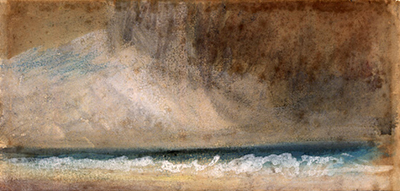
Study of Sea - Stormy Sky matters first because it asks for a different kind of confidence. Many Turner works can be introduced through a settled chain of facts: title, date, medium, dimensions, accession and collection. This title cannot responsibly be handled that way. A renewed search found the phrase in circulation, but not a stable museum entry for an exact object under this name. That means the work should be approached as a descriptive Turner sea-and-sky title whose material and ownership facts remain unresolved, rather than as a fully secured institutional object.
That uncertainty is not a reason to make the subject small. It is a reason to make the reading more exact. Turner’s career contains thousands of drawings, watercolours, sketchbook leaves, colour beginnings and studio remains, many of them arranged after his death through the Turner Bequest and later cataloguing. Tate’s research publication on Turner’s sketchbooks, drawings and watercolours exists because this part of the artist’s legacy is huge, complicated and dependent on careful description.[1] A title such as Study of Sea - Stormy Sky belongs in that world of studies, descriptive naming and changing cataloguing language.
The title itself is powerful. It gives no vessel, harbour, cliff, story, patron or named coast. It offers a conjunction: sea below, weather above, and a sky dark enough to define the scene. Turner often found large pictorial questions in that stripped-down arrangement. How much horizon is needed before water and air become legible? How can dark cloud press on a low marine band? How can light survive in storm without turning into theatrical decoration? These questions belong to the heart of Turner’s art, even when a particular sheet or image has not been fully identified.
The responsible way to discuss this title is therefore double. On one side, the exact object facts must remain qualified. On the other, the theme can be opened generously through secure Turner contexts: his watercolour practice, his habit of studying weather in rapid form, his marine ambitions, and the known works that show him reducing sea and sky to bands, forces and tonal events. The result is not a substitute for an object entry. It is an account of why a Turner sea-and-sky study can be historically meaningful even while its catalogue identity remains unsettled.
At a Glance
- Circulated titleStudy of Sea - Stormy Sky
- Object-title statusUnresolved descriptive title
- Exact museum recordNot located
- DateUnresolved
- MediumUnresolved; often approached as a watercolour-type study
- DimensionsUnresolved
- Collection and accessionUnresolved
- Display statusUnresolved
- Secure comparisonStudy of Sea and Sky, Isle of Wight, Tate N02001
- Interpretive boundaryTheme and Turner practice, not invented object facts
Contents
- Why Study of Sea - Stormy Sky Matters
- What Can Be Said Securely
- A Title Made from Elements
- Turner’s Marine Habit
- Watercolour, Paper and Light
- Storm Without Anecdote
- A Secure Comparison: Isle of Wight
- Late Marine Ambiguity
- How to Look at the Work
- Why the Uncertainty Matters
What Can Be Said Securely
The secure facts begin with Turner himself. Joseph Mallord William Turner was born in 1775 and died in 1851, and Tate identifies him as a central figure in British art whose collection presence is inseparable from the Turner Bequest.[2] The National Gallery describes a career grounded in Royal Academy training, topographical watercolour, oil painting and printmaking, with Turner becoming one of the dominant artists of landscape, light and weather in nineteenth-century Britain.[3] That baseline matters because the title under discussion is plausible only within Turner’s immense body of studies and marine subjects.
The next secure point is negative but important: no reliable object record has yet been found for Study of Sea - Stormy Sky as an exact title. The inherited local listing gives the date as unresolved, identifies the material as watercolour on paper and leaves the collection unresolved, but it does not supply a precise museum accession. Those notes should not be converted into certainty. A medium named without a holder record is a clue, not a fact on the same level as Tate, Art UK or a national collection catalogue.
The wording also calls for caution because Turner titles can be descriptive, posthumous, revised or shared across close variants. A title beginning with “Study of” often tells the viewer how an image has been classified rather than how Turner exhibited it. It may name the dominant visual problem rather than a finished public subject. In this case, “sea” and “stormy sky” sound like a descriptive pairing: the lower element and the upper weather condition. That language is useful for looking, but it cannot by itself establish date, provenance or original purpose.
Secure comparison helps. Tate’s Study of Sea and Sky, Isle of Wight is a known object: N02001, dated 1827 and identified as oil paint on canvas.[9] Tate Images gives the support as 321 x 502 x 10 mm and records the Turner Bequest connection.[10] Art UK gives the same work as oil on canvas, 32.1 by 50.2 centimetres, in Tate.[11] That object is not Study of Sea - Stormy Sky. It is a cautionary neighbour, because earlier local material had described the Isle of Wight work incorrectly as watercolour and bodycolour on blue paper. The secure records show why exact object authority matters.
The public argument should therefore rest on three levels of evidence. First, Turner’s authorship as the implied artist is grounded in the title’s circulation within Turner material and in the broader artist context. Second, the exact object facts remain unresolved. Third, the interpretation can use securely documented Turner practice to explain what such a sea-and-sky study is likely to mean within his art. That is a stricter position than pretending certainty, and it is more useful for readers who want to understand Turner rather than inherit confusion.
A Title Made from Elements
Study of Sea - Stormy Sky is a title made from elements rather than incident. It does not say “shipwreck,” “harbour,” “fishermen,” “coast,” “sunset” or “regatta.” It names water and weather. That matters because Turner often built marine drama from relations before narrative. A low marine field and a pressured sky can do much of the emotional work normally carried by figures or architecture. The title asks the viewer to begin with structure: a horizontal world below, a moving or darkening world above, and a boundary where the two meet.
The word “study” also alters expectation. It does not invite the same response as an exhibited narrative oil. It suggests concentration, trial, notation or investigation. In Turner’s practice, such categories were never merely secondary. His sketchbooks and studies could hold the thinking that later pictures amplified, but they could also stand as finished experiences of looking. Tate’s long research effort around the Bequest recognises that the artist’s works on paper and related studies are not peripheral debris. They are central evidence for how he saw, travelled, remembered and transformed visual experience.[1]
The title’s hyphen is equally revealing in a modest way. It binds two terms without forcing them into a full sentence. There is no stated action, only a relation. The sea is not described as calm or rough, while the sky is explicitly stormy. That imbalance draws attention upward. The viewer expects the weather to dominate, with the water receiving its pressure from above. Turner repeatedly found such imbalance productive: a small strip of land or water could hold the bottom of a composition while the sky became the field in which mood, light and motion unfolded.
Because the exact image is not securely catalogued, interpretation must avoid detailed claims that depend on unseen authority: no precise pigment, no named paper, no dimensions, no display history, no physical condition report. Yet the title can still be read as a capsule of Turner’s elemental method. It names the problem of scale without using grand language. Sea is wide; sky is wider; storm alters both. A study compresses that whole relation into a controlled surface, whatever the final medium proves to be.
This is why the article should not be embarrassed by uncertainty. The unresolved title allows an honest lesson in looking. Instead of pretending that every Turner image arrives with complete facts, it shows how art history often works: provisional names, fragmentary circulation, later catalogues, improved identifications and careful comparison. In Turner’s case, the problem is especially acute because his studio left behind a mass of material whose present order is partly a history of preservation and classification.
Turner’s Marine Habit
Turner’s sea imagery did not emerge from one episode or one late manner. It belonged to a lifelong habit. Exhibitions on Turner and the sea have stressed the span of his marine work, from early Royal Academy seascapes to the radical experiments of his later years.[12] The sea let him test almost every part of his art: drawing, weather, motion, light, danger, commerce, memory, national identity and abstraction before abstraction had a modern name.
The National Gallery’s account of Turner’s career is useful here because it places watercolour, oil and engraving together rather than treating them as sealed worlds.[3] Turner’s marine vision grew through all three. He observed coasts and rivers in sketchbooks, made watercolours that could become autonomous works or designs for engraving, and painted oils that entered the public theatre of the Royal Academy. A sea-and-sky study therefore need not be “minor” because it lacks a large narrative. It may be one of the small engines from which larger pictorial thinking developed.
Finberg’s historical account of Turner’s sketches and drawings is especially valuable for the marine habit. Discussing early sea-piece studies, he describes Turner’s interest in the horizontal sea line, heaving waves, light and dark masses in the sky, large ships and unstable smaller boats.[8] He also notes studies of storm-tossed waves in which Turner’s rapid handling made sea power vivid on a very small scale.[8] That account does not identify Study of Sea - Stormy Sky, but it supplies a historically grounded way of understanding why such a title fits Turner’s practice.
What Turner learned from the sea was partly that form could become unstable without becoming meaningless. Waves break shape, clouds move, boats tilt, light scatters, reflections shift. An ordinary view can become an event before the painter has introduced story. That is why the phrase “stormy sky” is not merely scenic. In Turner, storm often changes the grammar of vision. Objects lose their edges; distance becomes uncertain; brightness becomes intermittent; the viewer has to work harder to distinguish weather from water.
This does not mean that every sea study should be treated as a sublime manifesto. Turner could be practical, observational and experimental at once. A study might begin with a simple need: to understand a cloud mass, a horizon, a gale-darkened sea, or the way light appears under weather. But in Turner’s hands such practical work could open into larger experience. The sea became a place where quick notes and ambitious pictorial philosophy could meet.
Watercolour, Paper and Light
If the inherited material is right that this title refers to a watercolour on paper, the technical stakes are high. That claim still needs a secure object authority, but the watercolour context is strong enough to discuss cautiously. The V&A defines watercolour at the material level as pigment mixed with a binder, usually gum arabic, and water, then applied to a support such as paper.[5] The same source explains the British rise of watercolour as an art form and names Turner as a key figure in the transparent watercolour tradition.[5]
The V&A’s discussion of Turner’s Holy Island is especially relevant because it connects watercolour to light, weather and the sea. It explains that Turner and his contemporaries exploited the luminosity of white paper, often leaving it bare for white areas, and that dry paint could be scratched away or wet paint lifted to create reflected-light effects.[5] This is exactly the kind of technical context a stormy sea-and-sky study requires. Foam, cloud brightness and broken light in watercolour are often not added whites alone; they may be the support reappearing through painterly removal or reserve.
Joyce Townsend’s Wallace Collection account of Turner’s watercolour materials and techniques deepens that caution. Her discussion covers paper, wash, lifting, stopping-out, scraping and the complexity of identifying technique from surface evidence.[4] For Study of Sea - Stormy Sky, that means visual language should be modest. It is fair to discuss how Turner used watercolour effects in sea and sky studies generally. It is not fair to identify exact procedures for this unresolved work without a technical record.
Watercolour also changes how the viewer imagines time. Oil can be reworked, scraped, glazed and revised over longer intervals. Watercolour often preserves decisions that happen quickly, even when the finished effect is the result of great experience. A stormy sky in watercolour may depend on timing: the wetness of the wash, the absorbency of the paper, the moment a darker colour is dropped in, the instant when lifting can open light without tearing the surface. These are not decorative matters. They are the grammar of the medium.
The paper itself becomes part of the image. Turner’s watercolours can make the support act as sky, spray, glare or cloud-edge. In a sea study, white paper can be the most active light in the composition. If Study of Sea - Stormy Sky is indeed a paper work, then the title’s severity may be matched by material economy: water below, dark weather above, and exposed or recovered brightness binding them together. But the conditional matters. Until a holder record confirms the medium, this remains contextual reading, not object fact.
Storm Without Anecdote
Turner’s storm imagery is often surrounded by anecdote, especially stories that make him sound like a heroic witness of extreme weather. Those stories can be memorable, but they are not needed here. Study of Sea - Stormy Sky should be read without the borrowed drama of biography. The title gives enough: sea, storm and study. The real issue is how Turner made weather visible and how far a small work can carry the sensation of pressure.
A stormy sky in Turner is rarely just a dark lid over a landscape. It is a field of energy. It can tilt the whole image toward movement; it can make the horizon unstable; it can turn ordinary distance into threat. In a study, that pressure may be even clearer because other distractions have been reduced. The viewer is not following a ship’s story or identifying buildings. The viewer is watching relations of tone, edge and light change the whole emotional temperature.
The absence of a named event also protects the work from false specificity. A storm at sea need not be attached to a known wreck, a naval episode or a dateable journey to matter. Turner repeatedly used weather as a pictorial intelligence in itself. Sea and sky together can show force, instability, vastness and change without needing a narrative alibi. The descriptive title gives the viewer permission to stay with those fundamentals.
This is where Finberg’s account of early marine studies is again useful. His description of Turner handling sea lines, wave masses and sky contrasts presents the artist as someone who treated marine elements almost musically, recombining them through repeated study.[8] Whether one accepts all of Finberg’s language today or not, the central point remains convincing: Turner’s sea art was built from a deep repertoire of observed and invented forms. A stormy sky study would belong to that repertoire.
The storm also changes scale. In calm weather, horizon can reassure; sea and sky may appear as ordered bands. Under storm, the sky can descend, the water can rise visually, and the boundary between them can feel temporary. Turner’s genius lay partly in making that instability readable. He could give the viewer enough structure to perceive a scene, then disturb that structure so weather becomes the main experience.
A Secure Comparison: Isle of Wight
The safest nearby comparison is Study of Sea and Sky, Isle of Wight, because its object facts are secure and because it demonstrates how easily Turner sea-and-sky titles can be confused. Tate identifies the Isle of Wight work as N02001, dated 1827 and made in oil paint on canvas.[9] Tate Images records its support as 321 x 502 x 10 mm and links it to the Turner Bequest.[10] Art UK gives matching oil-on-canvas and Tate details.[11] Those facts define the comparison and keep it distinct.
The comparison matters because the Isle of Wight painting also reduces coastal experience to essentials. It has sea, sky, horizon and changing light, but little narrative furniture. It shows that Turner could make a small work feel large by enlarging the atmospheric problem rather than the physical size. Yet the medium is oil on canvas, not watercolour. That difference is crucial. It reminds us that two Turner works can look conceptually close while demanding different material readings.
For Study of Sea - Stormy Sky, the Isle of Wight painting functions like a guardrail. It shows what proper object authority looks like: title, date, medium, dimensions, holder and accession. It also shows why an inherited medium claim should not be trusted merely because it feels visually plausible. The earlier confusion around the Isle of Wight material proves that Turner’s study-like images can invite wrong assumptions. Speed, softness and atmospheric economy do not automatically mean watercolour.
At the same time, the Isle of Wight work helps explain the artistic value of a sea-and-sky study. Turner does not require an elaborate coastal landmark to make the subject complete. The image can be about relation itself: water as weight, sky as change, horizon as a fragile division. If Study of Sea - Stormy Sky shares that reduced vocabulary, its importance lies in the same area of Turner’s practice, where elemental forms become a complete visual proposition.
The two titles should therefore be held close but not merged. One is a documented 1827 Tate oil. The other is an unresolved descriptive title whose exact record is still missing. Comparison sharpens both. The known painting demonstrates Turner's capacity for compressed marine atmosphere; the unresolved title shows how much care is needed when a familiar-looking Turner label lacks an institutional anchor.
Late Marine Ambiguity
Turner’s later marine works make uncertainty even more interesting because they often sit near the border between image, study, studio remnant and posthumous title. Stormy Sea with Dolphins is a useful comparison for this broader problem, not because it identifies Study of Sea - Stormy Sky, but because it shows how marine images from Turner’s studio can carry ambiguous titles and uncertain finish. Public metadata derived from Art UK and Tate identifies Stormy Sea with Dolphins as an oil on canvas in Tate, 121.3 by 90.2 centimetres, with accession N04664.[13]
York Art History Collaborations describes Stormy Sea with Dolphins as found in Turner’s studio after his death, probably unfinished, and titled posthumously by curators of the Turner Bequest.[14] That context is valuable. It reminds readers that Turner’s marine afterlife includes works whose present names and statuses were shaped after the artist’s lifetime. Titles can become necessary handles for viewing and cataloguing, while still leaving interpretive questions open.
The dolphin painting also shows how hard Turner can make marine recognition. Even in a known oil, sea, animal forms, weather and paint can merge until the viewer has to search within the surface. That is relevant to a title like Study of Sea - Stormy Sky, where the named subject is already elemental and spare. Turner’s marine art often asks the viewer to accept a degree of visual instability as part of the experience, not as a failure of finish.
This late context should be used carefully. It would be wrong to date the unresolved stormy-sky title by simply associating it with late Turner. It would also be wrong to assume that all ambiguous sea studies are studio remnants. The point is broader: Turner’s sea imagery repeatedly challenges the boundaries between observation, invention, completion and later classification. A responsible reading can use those categories without forcing the title into one of them too quickly.
The comparison also keeps romance under control. A work may look radical because it is unfinished; it may look unfinished because it is radical; or it may be both. Without a secure object record, Study of Sea - Stormy Sky should not be made into a myth of late Turner. But it can be placed within the long Turner problem of marine visibility: how much image is needed before sea and sky become convincing, and how much dissolution can remain before the subject disappears.
How to Look at the Work
Begin with the title, because it is the only firm object-like clue currently available. It tells the viewer not to search first for story. Look instead for the division between water and sky, the weight of the weather, and the way the sea responds to that weight. If the sky is truly stormy, then the water below should not be read as a passive strip. In Turner, sea and sky usually affect one another.
Next, ask what kind of study this appears to be. Is it primarily tonal, concerned with dark and light? Is it compositional, testing the proportions of water and weather? Is it technical, exploring wash, paper, scraping or reserve if the medium is watercolour? Or is it pictorial, turning a small image into a complete mood? These questions are better than premature certainty because they make the viewer attend to the work’s operations.
Then consider what is absent. A descriptive sea-and-sky title has no named harbour, no famous vessel and no legible human drama. That absence can make the image more demanding. Turner is asking the viewer to care about atmospheric structure itself. The subject is not “nothing happening.” The subject is how weather happens visually: how darkness gathers, how light is suppressed or released, how water becomes heavier under cloud.
If the image shows reserved or scraped brightness, compare that possibility with the V&A and Wallace accounts of watercolour technique.[4][5] But keep the distinction between visible effect and confirmed method. A bright mark could be bare paper, bodycolour, lifted wash, later damage or reproduction behaviour unless a technical source specifies it. Turner rewards looking, but he also punishes overconfidence. The best response is close attention with a loose grip.
Finally, compare it with secure works without making them identical. The Isle of Wight oil shows Turner reducing sea and sky to a compact atmospheric structure.[9][10][11] Stormy Sea with Dolphins shows a later marine image whose recognition and finish remain challenging.[13][14] Finberg’s account of marine studies supplies a historical vocabulary for waves, sky masses and study freedom.[8] Together these comparisons frame the unresolved title without pretending to solve it.
Why the Uncertainty Matters
Uncertainty matters because Turner’s reputation is powerful enough to attract confident but weak description. A title can sound authoritative. A familiar reproduction can seem sufficient. A plausible medium can settle into repetition. But Turner’s work demands better habits. The difference between watercolour on paper and oil on canvas is not a small label problem; it changes the entire reading of light, surface, speed and revision.
The old Isle of Wight confusion proves the point. A local description had treated that related work as watercolour and bodycolour on blue paper, while current Tate, Tate Images and Art UK sources identify it as oil paint on canvas.[9][10][11] If that error can happen to a known Tate object, then an unresolved title such as Study of Sea - Stormy Sky deserves special care. It should be interpreted, but not over-certified.
Uncertainty also reveals something true about Turner’s afterlife. The Bequest did not hand later viewers a simple, finished sequence of masterpieces. It preserved a vast working world: sketchbooks, fragments, studies, unfinished canvases, watercolours, drawings and works whose meanings depend on later scholarship.[1] Turner’s modern greatness rests partly on that abundance. We see not only the public exhibitor, but also the restless maker of visual experiments.
For readers, this can be liberating. A painting or study does not need every fact resolved before it can be looked at seriously. What it needs is honesty about the level of evidence. With Study of Sea - Stormy Sky, the honest position is that the exact object remains unresolved, while the theme belongs unmistakably to Turner’s deepest concerns. Sea and weather were not side subjects for him. They were means of thinking about vision itself.
The title therefore becomes a lesson in art-historical discipline. Do not fill gaps with decorative certainty. Do not flatten all Turner studies into one atmospheric blur. Do not let the desire for a neat entry obscure the living complexity of the work. Instead, let the uncertainty sharpen the question: what does Turner achieve when he gives the viewer almost nothing but water, darkening air and the pressure between them?
Place Within Turner’s Art
Within Turner’s wider art, Study of Sea - Stormy Sky belongs with works that reduce landscape to the elements of perception. The National Gallery’s career summary stresses Turner’s movement from topographical beginnings into increasingly ambitious treatments of light, colour and atmosphere.[3] A sea-and-sky study is a perfect arena for that movement. It begins with observed nature, but its real subject is how observation becomes pictorial force.
The theme also bridges public and private Turner. A finished marine oil might proclaim itself through scale, exhibition title and dramatic incident. A study may work more quietly, but it can show the mechanism of the art more directly. The viewer sees Turner testing relations rather than presenting a polished conclusion. That testing is not lesser; it is where many of his most modern effects become visible.
It also bridges media. If the work is watercolour, it belongs to the tradition described by the V&A, where paper light and transparent wash became central to British art.[5] If later evidence identifies a different medium, the title would still belong to Turner’s broader investigation of sea and sky across supports. The safest public reading therefore does not depend on medium certainty alone. It depends on the relation Turner repeatedly pursued: unstable weather translated into disciplined visual form.
The marine context matters most. Turner’s sea subjects range from fishermen and Channel vessels to shipwreck, naval memory, whaling, steam and pure storm. The Peabody Essex Museum’s Turner & the Sea framing rightly treats the subject as lifelong rather than occasional.[12] A modest sea-and-sky study may not have the public fame of a major oil, but it speaks directly to the continuum that made those major works possible.
The same continuum runs through Turner’s portable habits. Tate Publishing’s watercolour overview stresses the importance of sketchbooks, pencil, portable colour and luminosity in Turner’s watercolour practice, from public works to more private experiment.[6] Warrell’s work on the sketchbooks likewise frames those notebooks as a career-long structure, not a youthful convenience.[7] That matters for Study of Sea - Stormy Sky because the title sounds like a working concentration rather than a public spectacle. It names what Turner needed to test: the balance of water and dark weather, the amount of light a disturbed sky can carry, and the speed with which a marine effect can be fixed before it changes. Even without a settled object entry, the title fits a discipline Turner practised repeatedly: returning to elemental views until they became a language.
In the end, Study of Sea - Stormy Sky should be valued for what it can honestly support. It is a title that opens onto Turner’s practice of looking at water and weather with unusual intensity. It is also a warning against lazy certainty. The best reading holds those things together: admiration for the visual problem, restraint about the object facts, and a clear sense that Turner’s smallest studies can lead into his largest questions.
Discussion
How can close looking remain useful when an image's exact object identity and material record are unresolved?
Reader Insights
Which observations belong to the image, and which require a holder record?
How do the sea band, horizon and storm-dark sky establish scale?
What can the secure Isle of Wight oil clarify without becoming an identification?
Join the Conversation
Share a close observation or a source-based question for other readers.
References
- Tate Research Publication, *J.M.W. Turner: Sketchbooks, Drawings and Watercolours*. https://www.tate.org.uk/art/research-publications/jmw-turner
- Tate, "Joseph Mallord William Turner 1775-1851." https://www.tate.org.uk/art/artists/joseph-mallord-william-turner-558
- National Gallery, London, "Joseph Mallord William Turner." https://www.nationalgallery.org.uk/artists/joseph-mallord-william-turner
- Joyce Townsend, "Turner's Watercolour Materials and Techniques," Wallace Collection. https://www.wallacecollection.org/explore/explore-in-depth/turner/turners-watercolors/turners-watercolour-materials-and-techniques/
- Victoria and Albert Museum, "What is watercolour?" https://www.vam.ac.uk/articles/what-is-watercolour
- Tate Shop, David Blayney Brown, *JMW Turner Watercolours*. https://shop.tate.org.uk/jmw-turner-watercolours/23603.html
- Tate Shop, Ian Warrell, *Turner's Sketchbooks*. https://shop.tate.org.uk/turners-sketchbooks/16438.html
- A. J. Finberg, *Turner's Sketches and Drawings*, Project Gutenberg. https://gutenberg.org/cache/epub/64312/pg64312-images.html
- Tate, "'Study of Sea and Sky, Isle of Wight', Joseph Mallord William Turner, 1827." https://www.tate.org.uk/art/artworks/turner-study-of-sea-and-sky-isle-of-wight-n02001
- Tate Images, "Study of Sea and Sky, Isle of Wight, Joseph Mallord William Turner, 1827." https://www.tate-images.com/n02001-Study-of-Sea-and-Sky-Isle-of-Wight.html
- Art UK, "Study of Sea and Sky, Isle of Wight." https://artuk.org/discover/artworks/study-of-sea-and-sky-isle-of-wight-202387
- Peabody Essex Museum, *Turner & the Sea*. https://www.pem.org/exhibitions/turner-the-sea
- Wikimedia Commons, "Joseph Mallord William Turner - Stormy Sea with Dolphins - N04664 - National Gallery.jpg." https://commons.wikimedia.org/wiki/File:Joseph_Mallord_William_Turner_(1775-1851)_-_Stormy_Sea_with_Dolphins_-_N04664_-_National_Gallery.jpg
- York Art History Collaborations, "Paintings from the Hull School," *Turner and the Whale*. https://yahcs.york.ac.uk/research/exhibitions/turner-and-the-whale/paintings/