

 by Tom Gurney
Tom Gurney BSc (Hons) is an art history expert with over 20 years experience
Published on June 19, 2020 / Updated on August 29, 2026
Email: tomgurney1@gmail.com / Phone: +44 7429 011000
Turner in His Own Words?
Joseph Mallord William Turner is regularly made to speak in a handful of perfect sentences. “Light is therefore colour.” “Atmosphere is my style.” “Indistinctness is my forte.” “The Sun is God.” Together they seem to describe the painter whom later generations wanted: devoted to light, defiantly atmospheric, contemptuous of precision and finally certain that the sun was divine. The sequence is memorable. As documentary history, however, it mixes four radically different things. One sentence survives in Turner's lecture material. Another was written down by John Ruskin after a conversation. A third appears to reverse the crucial word in an earlier witness letter. The fourth is famous as a deathbed utterance but lacks a secure contemporary record.
That mixture matters because a quotation does more than decorate an account of an artist. Quotation marks promise exactness. They suggest that these words, in this order, came from this speaker. When a saying is detached from date, recipient and medium, it can acquire an authority greater than the surviving evidence deserves. Turner is especially vulnerable to that process. He was not a systematic autobiographer, and his speech could be difficult for acquaintances to follow. Much of what he said reaches us through somebody else's diary, letter or recollection. Walter Thornbury's pioneering biography appeared in 1862, eleven years after Turner's death, and gathered irreplaceable testimony while also shaping it into dramatic scenes.[5][6]
There is nevertheless a substantial Turner in words. His letters discuss weather, journeys, dinners, sales, publication, insurance, friendship and injury. His Royal Academy lecture papers preserve a demanding engagement with perspective, light and the education of artists. Exhibition catalogues carry elaborate titles, literary citations and passages attributed to the mysterious Fallacies of Hope. Sketchbooks hold poetic experiments. Ruskin, C. R. Leslie, George Jones and other contemporaries recorded conversations. John Gage's collected correspondence remains the essential scholarly map through this dispersed material.[1][25]
The result is richer than a list of maxims. Turner's authenticated language is often practical, awkward, funny, defensive or technically absorbed. It reveals an artist negotiating obligations and making arguments rather than serenely announcing a modern creed. His catalogue verse can be elevated, violent and ethically pointed; his private letters may compress several concerns into one breathless movement. Even a doubtful saying can be historically valuable when treated as evidence of how Turner was remembered. The aim, then, is not to eliminate every uncertain phrase. It is to distinguish what Turner wrote, what a witness reported, what a biographer altered and what later culture invented.
How a Turner Quotation Is Tested
The most reliable starting point is an autograph document: a letter, note, lecture script or words that Turner supplied for an exhibition catalogue. An autograph can establish wording, but it still requires interpretation. A private sentence addressed to one collector is not automatically a universal statement of artistic belief. A much-revised lecture script may preserve several stages of thought rather than a single finished declaration. An exhibition title can be theatrical, allusive or deliberately ambiguous. Direct evidence is strong because its material chain is clear, not because it makes interpretation unnecessary.
Four Grades of Evidence
The first grade comprises Turner's own written words. The second consists of near-contemporary reports by named people who knew him: Ruskin's dated diary, for example, or Leslie's letter to the collector James Lenox. Such records are close to events, but they preserve the reporter's hearing, memory and punctuation. “Turner said” should therefore become “Ruskin recorded Turner as saying” whenever that distinction affects confidence.
The third grade is early biographical mediation. Thornbury interviewed surviving associates and printed documents no longer easily traced. His two volumes cannot be discarded; without them, much of Turner's social world would be thinner. Yet his “forte” where Leslie had written “fault” demonstrates that an early biography can transform meaning through one syllable. An anecdote in Thornbury should be read for its witness chain, date and corroboration, not promoted merely because it is old.[6][22]
The fourth grade contains unsupported attribution. A saying repeated on posters, commercial objects and quotation compilations may have no identifiable appearance in a Turner letter, lecture or witness record. Repetition shows popularity, not authenticity. Search results that all copy one another do not create independent confirmation. A responsible account either locates an early chain or labels the words unverified.
Several practical questions follow. Who first wrote the sentence down? How long after the supposed event? Did that person hear Turner directly? Does an earlier version differ? Is the wording private correspondence, public catalogue text or remembered speech? Has punctuation been modernised? Does a modern writer silently convert paraphrase into quotation? These tests explain why “Light is therefore colour” is secure as written lecture language, why “Atmosphere is my style” remains credible reported speech, why “indistinctness is my forte” fails in that form, and why “The Sun is God” belongs to cultural memory rather than the highest documentary grade.
Contents
- Turner in His Own Words?
- How a Turner Quotation Is Tested
- What Turner's Verbal Record Contains
- Letters to Benjamin Godfrey Windus
- Travel, Shipping and the Business of Art
- What Turner Actually Said About Hard Work
- The Professor Behind the Painter
- “Light Is Therefore Colour”
- The Variable Climate and the Discipline of Looking
- When an Exhibition Catalogue Becomes Part of the Work
What Turner's Verbal Record Contains
The surviving record is broad but uneven. Gage's Collected Correspondence of J.M.W. Turner brings letters together with an early diary and a memoir by Turner's friend George Jones. Its very organisation shows that no single archive contains the complete speaking artist. Documents are scattered among institutions, descendants, collectors, sale records and earlier publications. Some survive only because a recipient valued them; others are known through copies or printed extracts.[1]
Selection begins with the act of keeping. Business notes that seemed temporary may have disappeared, while a letter associated with a celebrated collector acquired value. Publication introduced another filter. Nineteenth-century editors chose passages they considered characteristic, sometimes regularised spelling, and embedded correspondence in a narrative of eccentric genius. A modern scholarly edition can compare documents and identify recipients, but even it works with what earlier custodians allowed to survive. Few letters about a subject do not prove that Turner rarely discussed it, and many letters about arrangements do not prove that arrangements monopolised his mind.
The physical document can answer questions that a bare sentence cannot. Address, postmark, paper, handwriting, corrections and neighbouring concerns help establish date and purpose. A quotation copied into a biography may lose all of those controls. Bibliographic description is the means by which words are returned to an action performed by a writer for a recipient. Turner's verbal record becomes most informative when its gaps remain visible instead of being filled with sayings that merely sound appropriate.
The British Library holds a particularly important body of lecture material. Add MS 46151 A-BB consists of twenty-eight volumes connected with Turner's Royal Academy teaching, mainly from 1810 to 1827. The catalogue describes scripts in different stages, with additions and alterations accumulated through repeated use. It distinguishes a general series, expanded in 1818, from more specialised mathematical material. This is not a neat book of aphorisms. It is the working archive of a professor trying to organise geometry, perspective, optics and pictorial practice for public delivery.[2]
Other correspondence and papers entered the British Library under different shelfmarks, while autograph letters remain elsewhere.[3] Seventeen letters to Benjamin Godfrey Windus, transcribed together by Turner in Tottenham, preserve one sustained relationship from the 1830s and 1840s.[4] Their survival partly depends on Windus and later custodians. The subjects that appear reflect what Turner needed to communicate to this particular collector, not everything he thought.
Exhibition catalogues create another corpus. Here Turner wrote for a public encounter at the Royal Academy. A title could name a precise event, announce a literary source, add verse or claim the artist's own presence in a storm. The language belongs beside the exhibited picture, although title and image do not always operate as literal report. Poetry survives again in notebooks, above all the Verse Book studied by Andrew Wilton.[20]
Finally, conversations survive in the records of other people. Ruskin wrote diary entries; Leslie sent letters; associates contributed recollections to Thornbury. These voices are indispensable and partial. Turner did not choose their wording or control their later publication. The corpus therefore asks for plural nouns: Turner's writings, his reported words, and the words attributed to him. Collapsing those categories produces a smoother personality but a less truthful one.
Letters to Benjamin Godfrey Windus
Benjamin Godfrey Windus was a successful coachbuilder and collector whose Tottenham home held an important group of Turner watercolours. The letters Turner sent him are not philosophical set pieces. They are valuable precisely because they preserve ordinary pressures around sociability, access and patronage. On 22 December 1834 Turner explained that he had prepared to visit, set out, and then abandoned the journey when “a damp sleet” aggravated a “sad cold and swelld throat.” The phrasing is physical, immediate and unpolished. Weather here is not the sublime subject of a painting; it is what prevents dinner.[4]
In a letter of 8 January 1840, Turner asked Windus to confirm a dining engagement and requested permission for a woman to see the collector's drawings. The note places him between owner and prospective viewer. Access to privately held art depended on invitation, trust and social negotiation. Turner's courteous request also complicates the stock image of an artist wholly indifferent to company. A year later he accepted Windus's birthday dinner with “very geat pleasure” and hoped George Jones would agree to attend. The misspelling is part of the document's texture, not evidence of a lack of intelligence. Turner's written fluency and his visual intelligence should not be judged by the same convention.[4]
The most revealing Windus document is the letter of 15 March 1842. A disagreement had arisen over drawings connected with the dealer Thomas Griffith. Turner began by acknowledging the “much concern and pain” caused by Windus's letter, then defended his right to continue working and to manage the drawings. He objected to a position in which he might be blamed alike “either if I do work or do not work.” The sentence is not a polished maxim, but it is authenticated testimony about artistic labour, ownership and emotional strain.[4]
The dispute warns against sentimentalising patronage. Windus admired Turner deeply, yet affection did not remove conflict over expectations and circulation. Turner framed the issue partly as his “professional” happiness. That word places personal fulfilment inside a commercial relationship rather than outside it. The painter was defending agency: a collector's support did not grant unlimited control over future production.
These letters also reveal how tone changes with purpose. An invitation produces formulaic warmth; illness prompts compressed explanation; conflict expands into injured argument. No single phrase captures the whole writer. Read together, the documents replace the mute, secretive genius with a man maintaining friendships, arranging encounters with art, getting sick in winter weather and insisting that his work remained his own concern.
Travel, Shipping and the Business of Art
Turner's travel letters make movement sound strenuous, expensive and productive. Writing to George Jones from Rome on 13 October 1828, he remarked that nearly two months had gone into reaching the “Terra Pictura” and that he was now at work. The mock-Latin or Italianate phrase turns Rome into the land of painting, but it follows an arduous itinerary. His account moves rapidly through southern France, oppressive heat, a plunge into the sea and a rugged coast. The letter does not resemble a polished travel essay. Its energy comes from accumulation, as if places and bodily sensations were crowding for room.[1][5]
Such correspondence gives context to Turner's extensive European drawing without supplying simple captions for particular works. A letter may establish that he experienced heat, delay or a coastal journey; it does not prove that every nearby watercolour records the exact incident described. Written and visual records overlap without becoming interchangeable. The important verbal fact is that Turner represented travel as labour followed by work, not as effortless inspiration.
Letters to Charles Lock Eastlake in 1829 reveal another dimension. Pictures and purchases had to get home from Rome. Turner wrote about invoices, agents and an insurance value of five hundred pounds, worrying about responsibility if a shipment were lost. The artist associated with dissolving light was attentive to consignments and financial risk. Matthew Hunter's study of Turner and insurance draws on this correspondence to place apparently mundane arrangements within a wider history of how artworks moved and acquired value.[24]
Business language also appears around engraving, sales and exhibitions throughout the correspondence. Turner negotiated with publishers, monitored plates, pursued payments and cultivated collectors. These activities were not distractions from art; they were conditions of a career that linked watercolour designs, oil paintings and reproductive prints. A famous remark detached from this infrastructure can make the artist seem to float above his economy. His letters put the invoices back.
They also show humour operating within pressure. Turner's compressed syntax and idiosyncratic spelling can make letters difficult, yet obscurity should not be romanticised as deliberate mystification. He often had several practical matters to settle at once. When he joked or complained, he did so to a particular correspondent who already knew people and circumstances omitted from the text. The most honest reading resists turning every lively phrase into a doctrine. These are acts of communication within relationships, and their incompleteness is part of their historical form.
What Turner Actually Said About Hard Work
One widely circulated sentence declares: “I have no secret but hard work.” It suits a familiar moral biography in which genius reassures ordinary readers that effort alone explains achievement. Yet no secure Turner letter, lecture, catalogue entry or named contemporary report has been established for that exact wording. Its appearance in later improving literature does not repair the missing chain. It should not be used as authenticated testimony.
There is better evidence. On 4 December 1848 Turner wrote to James Astbury Hammersley about the prospects of Hammersley's son entering art. He warned that the profession required “more care, assiduity, and perseverance” than anyone could guarantee in advance.[6] The advice is less marketable than the slogan because it is cautious. Turner did not promise that hard work would inevitably produce greatness. He emphasised sustained qualities that a parent could not simply assume on behalf of a young person.
The date sharpens the meaning. Turner was seventy-three and had spent decades navigating the Royal Academy, private patronage, publishing projects, travel and an enormous studio inventory. His warning came from professional duration. “Care” implies judgement and responsibility; “assiduity” implies continued attention; “perseverance” implies resistance to discouragement. Together they describe more than hours spent at an easel.
The Windus dispute of 1842 adds another authenticated view. Turner's complaint that he was blamed whether he worked or did not work shows labour entangled with ownership and expectation.[4] His correspondence from Rome similarly joins difficult travel to immediate application. These documents support a strong account of effort without relying on an untraceable maxim.
Replacing the slogan changes Turner's character for the better. He becomes neither a magician with a secret nor a motivational lecturer denying mystery. He is an experienced professional telling a family that talent cannot be separated from habits whose future cannot be guaranteed. The distinction exemplifies the value of quotation research: doubtful words may express a generic truth, while authenticated words reveal what Turner said to one person, at one moment, under real conditions.
The Professor Behind the Painter
Turner was elected Professor of Perspective at the Royal Academy on 10 December 1807. The appointment placed him inside an institution committed to public instruction and required him to translate specialised knowledge into lectures. The British Library's archive records principal activity between 1810 and 1827 and a resignation in February 1838. Its many volumes, repeated versions, additions and diagrams contradict the notion that Turner had no sustained verbal or theoretical engagement.[2]
The lectures were famously difficult. Perspective demanded geometry, while Turner's prose could become densely compressed. Difficulty, however, is not absence. Maurice Davies's study of Turner as professor reconstructs the relation between the papers, diagrams and Academy obligations; John Gage's scholarship situates colour and poetry within the artist's larger intellectual field.[7][8] Turner read, copied, revised and assembled authorities. His thought emerged through this labour rather than through a few spontaneous pronouncements.
The professorship also changes how familiar quotations should be heard. “Light is therefore colour” was not uttered while Turner stood before a sunset in mystical revelation. It belongs to formal teaching. Its neighbours concern definitions and relationships within pictorial representation. Likewise the passage about Britain's variable climate addresses the landscape painter's continual obligation to observe and remember changing effects. Both statements are arguments offered under institutional conditions.
Turner occupied a complicated position. He had risen from topographical and architectural drawing, mastered linear perspective, and built a reputation increasingly associated with effects that critics called indistinct. The lectures show no simple rejection of geometry in favour of atmosphere. Perspective and light were parallel problems of making appearances intelligible on a flat support. Even when his syntax strains, the conceptual ambition is clear: an artist must understand how vision, position, light, shade and convention interact.
Modern quotation culture extracts the most accessible clauses from this demanding archive. That can introduce new audiences to Turner, but it also reverses the scale of evidence. The isolated sentence begins to look like the source from which the paintings flowed, while twenty-eight volumes become background. A more accurate order starts with the working papers and treats the memorable phrase as one compressed point within them. Turner the professor is not a contradiction of Turner the painter. He is evidence that the paintings were made by someone who regarded visual art as teachable, debatable and intellectually structured.
Delivery complicates the archive further. A surviving script records what Turner prepared, amended or consulted; it cannot reproduce emphasis, hesitation, omission or explanation in the lecture room. Reports of his lecturing often stress difficulty, but retrospective amusement at his manner can obscure the seriousness of the appointment and the years devoted to it. Nor should every phrase in the papers automatically be treated as Turner's original discovery. Professorial writing drew upon books, established demonstrations and inherited terminology. Authentication establishes that he wrote or used a sentence. Intellectual history must still ask what he was adapting and how he made it serve an artist's education.
This distinction allows the lectures to show Turner participating in a community of knowledge while testing that knowledge against practice. Diagrams and geometrical propositions sit beside reflections on perception because perspective was not only mathematical construction; it governed how objects appeared from situated viewpoints. The famous colour sentence occupies the same culture of organised inquiry. Its force comes from compression after study, not exemption from study.
“Light Is Therefore Colour”
The secure full formulation is “Light is therefore colour, and shadow the privation of it.” It comes from lecture material associated with 1818.[7][10] The first clause has become Turner's most authoritative-looking maxim because it now appears on the polymer Bank of England £20 note bearing his portrait. The note turns a sentence from specialist Academy instruction into public language handled in millions of daily transactions.[9]
The shortened form is accurate as an excerpt, but shortening alters rhythm and argument. “Therefore” signals a conclusion, not an incantation. The second clause makes the statement relational: colour belongs to light, while shadow is described through its deprivation. Turner was participating in inherited debates about optics and pictorial art, not announcing that colour could exist without form, material or discipline. The conjunction holds light and shadow together.
The wording should also be kept separate from the later paintings often used to illustrate it. Works such as Light and Colour (Goethe's Theory) of 1843 make Turner's long interest in colour unmistakable, yet the lecture sentence predates that canvas by a quarter of a century. It cannot serve as a caption secretly explaining every yellow vortex, sunset or reflection. Its value is broader: it records Turner teaching that the painter's colour world depends on conditions of illumination.
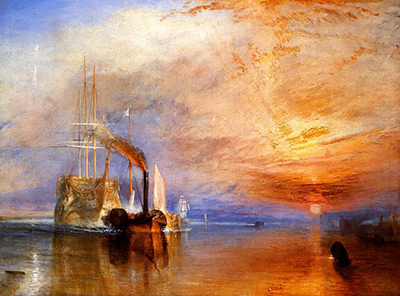
The modern banknote adds another interpretive layer. Turner's self-portrait, The Fighting Temeraire, a sketchbook image and the lecture words together construct a national artist of light, observation and innovation. That design is commemoration, not neutral archival presentation. It privileges the clause that best matches Turner's present reputation. The process resembles quotation anthologies, but with an important difference: the wording has a traceable documentary source.[9][10]
Authenticity does not freeze meaning. The sentence can be read within early nineteenth-century colour theory, Royal Academy pedagogy, Turner's practical experience and his twenty-first-century national afterlife. What it cannot honestly become is evidence that Turner spoke only in visionary paradoxes. In the lecture archive, he is reasoning from premise to consequence. The tiny word “therefore” reveals the professor at work.
The Variable Climate and the Discipline of Looking
Another lecture passage begins from Britain's “variable climate,” where recognisable seasons can seem to pass within a single day. Turner describes vapour disturbing the face of things and argues that every alteration rouses the landscape painter to admiration and investigation. The syntax is crowded and its surviving form does not read like edited prose. That difficulty is meaningful. The passage tries to hold continuous meteorological change and continuous artistic attention within one long movement.[7]
The central proposition is not simply that British weather is picturesque. Change prevents languor. Nature repeatedly places new effects before the artist and demands that they be stored in the mind across differences of time and place. Observation therefore includes memory. The painter does not merely copy one fixed arrangement; repeated encounters build a resource that can be developed later.
This helps explain why Turner's weather imagery should not be divided too sharply between outdoor truth and studio invention. The lecture imagines a cycle: notice, investigate, retain, transform. A cloud study, finished watercolour or exhibition oil may occupy a different point in that cycle. The words do not prove where any individual work was made, but they establish that Turner considered changing atmosphere a disciplined field of study rather than a vague emotional accessory.
The passage also resists the claim that indistinctness meant inattention. Vapour may “involve” or obscure the visible world, yet the artist's response is more looking, not less. Transience raises the demand on perception because the subject will not remain still. Turner joins wonder to inquiry. Admiration without investigation would be insufficient; investigation without responsiveness would also miss the experience.
When quoted only as a celebration of climate, the passage can sound patriotic or picturesque. Within a lecture, it becomes professional instruction. Britain's unstable weather offers an exacting education because every moment revises the last. That thought connects the professor's words to decades of sketchbooks and studies while avoiding the fantasy that one sentence generated them all. Turner's atmospheric art was enabled by a habit: return to the world, attend to alteration, and give memory enough material to work upon.
When an Exhibition Catalogue Becomes Part of the Work
Turner used Royal Academy catalogues as extensions of pictorial meaning. A conventional title could identify a place or story, but his titles often became unusually long. They specified weather, action, literary authority, historical timing or the conditions under which an event was supposedly seen. Alongside them, verse might direct attention toward loss, violence, failed empire or hope. The words were encountered publicly with the paintings, even though viewers might remember them through reviews or later catalogues.[11][13][15]
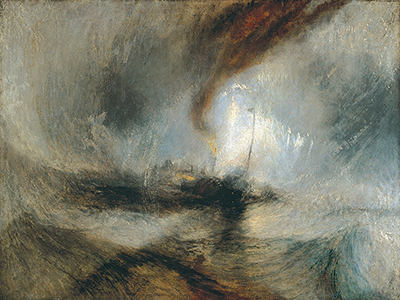
The 1842 Snow Storm - Steam-Boat off a Harbour's Mouth offers an extreme example. Its title continues through signals, shallow water and sounding by the lead before stating in the third person that “The Author was in this Storm on the Night the Ariel left Harwich.”[15] The wording asserts experiential authority. It invites viewers to connect the canvas's turbulence with Turner's bodily presence, while preserving a curious distance by calling him “The Author.”
That sentence is direct public text, but it does not include the later tale that Turner was tied to a mast. The distinction is crucial. A documented catalogue claim became the seed for a more theatrical biographical legend. Accepting the former does not require accepting every elaboration. Nor does “Ariel” automatically identify a vessel through independent maritime records. The title performs authenticity even as its precise circumstances remain difficult to verify.
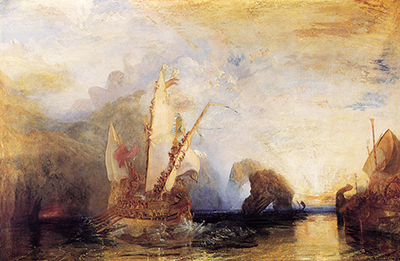
Catalogue language could operate differently elsewhere. A literary citation might place a mythological scene within an ancient poem. An adapted couplet could intensify the absence of a ship's flag. Original verse could expose the commercial logic within an atrocity. These are not interchangeable captions. Each has authorship, genre and function.
Turner's catalogues therefore complicate the boundary between painter and writer. He did not publish a comprehensive artistic treatise, but he repeatedly controlled the verbal threshold through which paintings entered public debate. To quote those words responsibly means preserving that threshold. A catalogue line belongs first to the exhibited conjunction of title, image, institutional setting and audience. Removed from it, even authentic wording can become a misleading slogan.
Contemporary reviewers extended that conjunction. They copied titles, mocked obscure verse, paraphrased subjects and tried to reconcile words with paint. A catalogue entry could therefore travel farther than the exhibition room, acquiring punctuation changes or abbreviated titles along the way. Later collection catalogues might adopt a familiar short title while preserving the longer exhibited form in historical notes. Anyone authenticating Turner's public wording must identify which catalogue and year are meant rather than assuming that a current museum title reproduces exactly what visitors read at the Royal Academy.
Authorship can also be distributed. Turner might cite an ancient or modern poet, alter a borrowed line, or append words under his own mysterious textual attribution. The visible result remains part of his presentation, but quotation marks alone cannot explain his role. Terms such as “cited,” “adapted,” “added” and “attributed” are essential. They turn a vague claim that Turner wrote poetry into a precise account of what he did with language for a specific work.
The Mystery of Fallacies of Hope
From 1812 onward Turner attached passages of verse to several exhibited paintings and attributed them to “MS. Fallacies of Hope.” The formula sounds bibliographically precise: an extract from a stable, titled poetic work. Yet no complete document bearing that title has been found. Jerrold Ziff argued that it probably never existed as one distinct poem, while Andrew Wilton's study of Turner's Verse Book demonstrated the abundance and complexity of his poetic activity without producing the missing whole.[19][20]
The safest conclusion is deliberately limited. Fallacies of Hope functioned as an attribution Turner used over many years. It may have named an evolving project, a loose reservoir of verse, an imagined larger poem, or a public fiction that gave isolated lines the authority of an unseen text. Those possibilities are not identical, and the evidence does not require one final choice. What should be rejected is the confident description of a complete poem composed in 1812 and later excerpted unchanged.
The first association in 1812, with Snow Storm: Hannibal and his Army Crossing the Alps, established a durable relation among history, natural force and disappointed ambition. Later extracts accompanied very different subjects: slavery at sea, the burial of Wilkie, Napoleon in exile, Caligula's ruined works, and meditations on light and darkness. “Hope” repeatedly appears under pressure from mortality, commerce, weather or empire. The attribution joins these concerns without proving continuous narrative.
Turner's verse can be metrically rough and syntactically unstable. That has sometimes encouraged critics either to dismiss it or to repair it silently. Both responses lose evidence. Awkwardness belongs to the surviving verbal practice, just as revisions belong to the lecture papers. The poems show Turner testing language beside visual art, not competing for recognition as a polished professional poet.
The formula “MS.” also creates an intriguing authority. Viewers were told that the visible lines came from something larger that they could not inspect. It resembles a classical citation while remaining private and elusive. That strategy may amplify the paintings' imaginative worlds: the picture is one fragment, the verse another, and an absent poem seems to extend beyond both.
Calling Fallacies of Hope a mystery is not an excuse for vagueness. Individual lines can often be tied securely to dated exhibition entries. Their immediate wording and pictorial context are documentable even when the supposed parent work is not. The right unit of analysis is therefore the particular catalogue extract, followed by a clear statement that its larger textual home remains unresolved.
The Adapted Voice of The Fighting Temeraire
Turner exhibited The Fighting Temeraire, which he described as being “tugged to her last Berth to be broken up, 1838,” at the Royal Academy in 1839. The catalogue added two lines: “The flag which braved the battle and the breeze, / No longer owns her.”[11][12] They sound entirely fitted to the image's pale old warship, dark steam tug and absent ensign. Their authorship, however, is collaborative across time.
Turner adapted Thomas Campbell's patriotic song Ye Mariners of England. Campbell had celebrated a flag that had braved battle and breeze; Turner redirected the language toward dispossession. The altered second line makes loss grammatical. The flag no longer belongs to the ship because the vessel has passed out of naval service and is travelling to be dismantled. Crediting Campbell does not diminish Turner's intervention. It reveals how economical that intervention was.[12]
The couplet also identifies what the painting withholds. Turner did not show the Union flag flying from the Temeraire. The National Gallery's catalogue explains the historical significance of that absence and the artist's willingness to alter other maritime facts for pictorial effect. Verbal and visual choices converge on a ship deprived of active national identity.[12]
These are neither conversational words nor Fallacies of Hope. They belong to literary adaptation in an exhibition setting. Calling them simply a Turner quote would conceal the source poem; calling them merely Campbell's would conceal Turner's rewriting and placement. Accurate attribution needs both names and the nature of the change.
The example also reveals the limits of extracting a poetic fragment. Detached from the full title, the lines can become a general lament for maritime decline. Beside the canvas, they focus attention on ownership, service and forced movement. The little tug supplies power while the great sailing ship possesses neither sail nor flag. Turner's words tell viewers what kind of absence to notice.
That precision helps explain the painting's extraordinary cultural memory. Image, descriptive title and adapted verse reinforce one another without saying exactly the same thing. The sunset suggests ending; the tug enacts technological succession; the couplet names lost affiliation. Turner did not need a wholly original poem to create this verbal structure. He selected, altered and repositioned familiar language until it belonged to the historical drama of his picture.
The Accusing Voice of Slave Ship
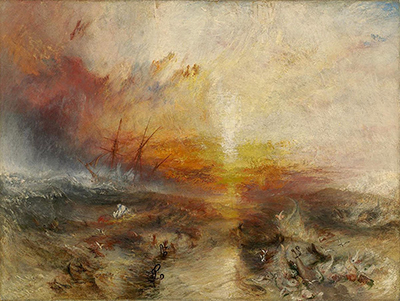
The 1840 Royal Academy catalogue presented the painting now known as Slave Ship with seven lines attributed to Fallacies of Hope. They begin with orders issued aboard a vessel threatened by a typhoon and move toward the command to cast enslaved people into the sea. The dead and dying are not to be spared because chains and human bodies are being calculated through a market. The extract ends with the question, “Where is thy market now?”[13][14]
The question makes commerce answerable to storm, death and moral judgement. “Market” is not an incidental word added by later interpretation; Turner put it at the climax of the exhibited text. It connects the human remains visible in the foreground with the economic logic of the ship. Hope is called fallacious because the violent calculation cannot control either nature or consequence.
The Museum of Fine Arts preserves the catalogue verse and the painting's expanded historical title: Slavers Throwing Overboard the Dead and Dying, Typhoon Coming On, now commonly called Slave Ship.[14] The text is often related to the 1781 massacre aboard the Zong, when enslaved people were thrown overboard and an insurance claim followed. The catalogue words do not name the Zong, and the painting should not be reduced to literal reportage of that one vessel. Yet Turner's combination of market language, chains, killing and an approaching storm makes the commercial structure of enslavement unavoidable.
The verse also changes who appears to speak. Its opening orders sound like commands on deck. The final apostrophe to hope moves beyond one sailor into a judging poetic voice. Turner makes language participate in violence before turning language against the market. That complexity disappears when only the last question is reproduced as an isolated moral aphorism.
As evidence of Turner's authorship, the dated catalogue extract is strong. As evidence for a complete Fallacies of Hope, it remains fragmentary. The distinction permits a clear claim: Turner deliberately accompanied this public painting with words that named chains, disposal of bodies and market calculation. It does not require inventing a finished abolitionist epic or treating every painted form as illustration of one line.
The pairing demonstrates why Turner's verbal record matters to interpretation. Without the extract, the foreground limbs and circling creatures remain horrifying, but the market question identifies an economic target. Without the painting, the verse could read as melodramatic maritime poetry. Together they force beauty, terror and profit into the same encounter. Few authenticated Turner texts carry greater ethical weight.
Verse for Peace, War, Caligula and Hero
Turner's catalogue writing did not settle into one formula. Four paintings show how he shifted among memorial verse, political allegory, historical ruin and classical citation. Each survives as public wording attached to a particular exhibition, and each needs its own attribution.
Peace - Burial at Sea, shown in 1842, commemorated Turner's friend Sir David Wilkie, who died at sea during the return from the eastern Mediterranean. The catalogue lines describe a midnight torch gleaming over a steamer before “Merit's corse” is yielded to the tide.[15][16] The compressed text identifies honour and irrevocable loss. It also directs attention to the torch, steamer and burial action without turning the picture into a literal diagram of the funeral.
Its companion, War. The Exile and the Rock Limpet, placed Napoleon on the shore of Saint Helena. The attached verse compares the limpet's tent-shaped shell with a soldier's lonely bivouac “amidst a sea of blood.”[15][16] Crimson colour becomes historical and psychological space. The language is attributed to Fallacies of Hope, but it is not speech assigned to Napoleon. Turner supplied a poetic frame through which the tiny shell, isolated figure and surrounding red could be connected.
For Caligula's Palace and Bridge, exhibited in 1831, the accompanying lines ask what remains of the emperor's mighty bridge and answer with “monuments of doubt and ruined hopes.”[18] The verse invokes the story of Caligula's temporary bridge across the Bay of Baiae while the painting opens a luminous coastal prospect. Words secure the imperial reference and the theme of collapse; they do not remove the gulf between ancient narrative and Turner's imagined view.
The Parting of Hero and Leander, exhibited in 1837, complicates authorship differently. Turner cited the ancient poet Musaeus and then added seven lines of his own.[17] The National Gallery's record identifies that combination. A reader who labels the whole verbal apparatus “Turner's poem” erases the classical source; one who attributes everything to Musaeus erases Turner's addition. The painting's language is a constructed conversation between antique authority and a modern artist.
Across these cases, Turner writes beside painting in several voices. He mourns a friend through elevated third-person language, frames Napoleon through an emblematic simile, addresses the remains of Roman ambition, and extends a classical source. The variety defeats the idea that his verse can be mined for transparent autobiography. These are crafted public texts. Their strongest meanings arise from the dated conjunction of words and images.
“Atmosphere Is My Style”
“Atmosphere is my style” has a substantially better claim than many sayings attributed to Turner, but it is not written in his hand. John Ruskin recorded the phrase in his diary entry for 29 April 1844. The date, the reporter's close involvement with Turner and the immediacy of a diary make it strong near-contemporary evidence.[21]
The wording emerged in response to criticism rather than as a prepared manifesto. In Ruskin's account, Turner justified his practice with “Yes, atmosphere is my style.” The initial assent matters. It sounds like an answer within an exchange, accepting or redirecting another person's characterisation. Removed from that setting, the phrase can seem to be Turner's timeless definition of his entire career.
Ruskin was not neutral. He had already committed himself publicly to Turner's art and would become its most influential interpreter. His diary preserves an encounter through his own attention and language. That does not make the report unreliable; it defines the kind of reliability available. The precise formulation belongs to Ruskin's record of what he heard.
The sentence is persuasive because Turner's paintings and watercolours do repeatedly organise meaning through air, vapour, weather and light. Yet stylistic fit is not proof. A fabricated remark can sound convincing when it matches an artist's reputation. Here the diary supplies the necessary chain, while the visual work explains why the words endured.
The phrase should therefore be introduced with a verb of transmission: Ruskin recorded, reported or noted. It should not be described as a letter, an inscription or a line from the lectures. Nor should “atmosphere” be treated as a synonym for formlessness. Turner's skies, waters, buildings, figures and vessels inhabit a medium that affects their visibility and relation. The reported answer claims that medium as style.
Used carefully, the quotation captures something important about Turner's self-defence in the 1840s. Critics could regard his atmospheric handling as failure to finish or describe. Ruskin's Turner responds by making the alleged defect intentional and personal. The evidence does not let us hear his tone, but it does preserve a concise claim made under pressure: what others found evasive, he identified as his chosen field.
“Indistinctness Is My Fault,” Not “My Forte”
No Turner saying demonstrates the danger of quotation culture more clearly. James Lenox, the New York collector, acquired Staffa, Fingal's Cave through the artist C. R. Leslie. Lenox found the painting disappointingly indistinct. In Thornbury's 1862 biography, Turner answers the complaint with apparent bravado: “You should tell him that indistinctness is my forte.”[6] The line seems to anticipate later admiration for atmospheric dissolution. It has been repeated as a proud declaration of modernity.
The earlier evidence says something different. In 1972 Adele M. Holcomb published Leslie's original letter to Lenox. Leslie wrote that Turner's response was “indistinctness is my fault.”[22] Since Leslie mediated the purchase and reported the exchange directly to the dissatisfied owner, his letter is both closer to the event and addressed to a person who knew the practical circumstances. It outranks Thornbury's version.
One changed word reverses the emotional posture. A “forte” is a strength or speciality; a “fault” is an acknowledged defect. The first Turner boasts that critics simply fail to understand his chosen manner. The second recognises the basis of Lenox's complaint, although the tone might still have ranged from rueful concession to dry irony. Leslie's text does not authorise a theatrical performance of humility any more than it authorises defiance.
The object adds useful boundaries. Yale Center for British Art identifies Staffa, Fingal's Cave as the work concerned.[23] Its steamer, smoke, island and dark weather offer obvious reasons a viewer might discuss visibility. But the letter does not transform the entire painting into an apology, nor does it establish a general rule for all Turner's later art. It records one response to one collector's reaction.
Why did “forte” prevail? The altered version is more quotable. It fits the retrospective story of an avant-garde artist knowingly advancing beyond conventional representation. It also makes Turner sound verbally polished. “Fault” is less heroic and more ambiguous; it leaves room for social tact in a difficult transaction. Later culture selected the version that resembled the paintings it had learned to value.
Thornbury's error should not be used simply to discredit his biography. It teaches a method. Early sources need comparison, especially when they reproduce speech. A biographer can preserve the outline of an incident while changing its verbal force. The survival of Leslie's letter makes correction possible in this case; many other anecdotes lack that check.
The authenticated phrase is therefore “indistinctness is my fault,” introduced as Leslie's report of Turner's words. “My forte” remains historically significant as a misquotation that helped create a modern Turner. Presenting both, in the correct order of authority, reveals more than choosing the attractive one. It shows the artist negotiating criticism and posterity rewriting the negotiation as prophecy.
“I Wish I Had Any Colour to Make Them Blacker”
Thornbury preserves another reported exchange around Peace - Burial at Sea. Clarkson Stanfield, a marine painter and Turner's friend, objected that the sails had been made too black to be true. Turner replied: “I only wish I had any colour to make them blacker.”[6] The anecdote has a named interlocutor, a specific exhibited work and a clear pictorial issue. Those features make it more useful than a floating saying, although its wording remains biographically mediated.
The reply places expressive purpose above ordinary local colour. Peace commemorated Wilkie's burial at sea; its dark sails participate in mourning. Turner did not answer Stanfield by defending their optical accuracy. In the reported words, existing black was inadequate to the emotional and memorial task. The wish for something blacker is deliberately impossible.
That impossibility should not be turned into technical evidence. The sentence does not identify a pigment, mixture, layer or method. It cannot establish what paint Turner used or whether the present surface matches its 1842 appearance. Stanfield's objection and Turner's answer concern perceived effect.
The exchange also gains meaning from professional difference. Stanfield was highly respected for marine subjects and brought practical knowledge of ships and sea. His criticism represented more than an uninformed viewer's complaint. Turner's response acknowledges the issue and refuses its standard of truth for this particular picture. The sails had to carry grief.
Unlike the “fault/forte” incident, no earlier contradictory document has been locked for this wording. It should still be introduced as Thornbury's report, not as autograph text. That attribution preserves both value and limit. The anecdote can illuminate how contemporaries remembered Turner's pictorial priorities while remaining evidence transmitted through a biography published after his death.
“The Sun Is God” and Other Seductive Myths
“The Sun is God” appears to complete Turner's life with irresistible neatness. The painter of sunrise, sunset and dazzling vapour supposedly uttered it at death. Yet neatness is exactly why scrutiny is needed. No locked autograph document, bedside diary or contemporary witness letter establishes the phrase as Turner's exact last words. Thornbury's extended account of his death does not supply it in the checked 1862 text.[6]
Modern scholarship treats the saying as myth. Matthew Hunter's 2024 article calls it Turner's “mythical dying words” and directs attention to John Gage's earlier examination of its derivation and meanings.[24] Museums and popular accounts often hedge with “reported,” “said to have been,” or “supposed.” Those verbs are not minor stylistic caution. They identify an unresolved chain.
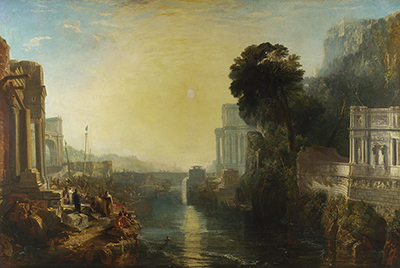
The phrase still belongs in Turner's history because it shaped interpretation, exhibition titles and public memory. Its plausibility draws strength from the art: suns organise Dido building Carthage, The Fighting Temeraire, Slave Ship and innumerable watercolours. The secure lecture clause about light and colour makes the alleged deathbed words feel intellectually consistent. But consistency is not authentication. Legends often succeed because they condense a life into what audiences think the subject ought to have said.
Nor can the saying prove Turner's theology. Even if an earlier witness were found, three words would require context before they could establish religious belief. Without that witness, claims about solar worship, conversion or final certainty are speculation built upon speculation. The responsible form is simple: the words are famous, culturally consequential and unverified.
Other attractive sayings fail more quietly. “I have no secret but hard work” lacks a secure early chain, while the Hammersley letter provides authentic, more nuanced counsel about care and perseverance.[6] “My business is to paint what I see, not what I know is there” circulates without an established Turner document. “The skies over Thanet are the loveliest in all Europe” is widely repeated, but popularity alone does not identify when, where or to whom Turner said it.
Misattribution can also cross speakers. The famous reaction to Turner's addition of a red buoy during a Royal Academy varnishing day belongs in accounts of John Constable, who reportedly compared the intervention to firing a gun. It is not Turner describing his own act. Once detached from narrative, a vivid sentence can migrate to the most famous person in the room.
Rejecting or qualifying these phrases does not impoverish Turner. It frees interpretation from ventriloquism. His documented letters, lectures and catalogue texts already provide abundant language. The myths then become evidence of reception: later generations wanted Turner to be tireless, purely visual, devoted to Thanet skies and certain of the sun's divinity. That desire tells us about his fame, not necessarily his voice.
Myths often gain credibility through circular citation. A recent biography repeats an undated anecdote from an older popular account; a quotation collection cites the recent biography; digital summaries then reproduce the words without either reference. At the end of that chain, dozens of appearances can descend from one unsupported assertion. Counting repetitions mistakes dependence for corroboration. Independent confirmation requires another early witness or document, not another modern restatement.
Variants can expose this process. A change from “fault” to “forte” is dramatic enough to trace, but smaller modernisations may also sharpen rhythm, remove hesitation or convert indirect report into first-person speech. Even a correct core phrase can acquire a false setting, such as moving “Atmosphere is my style” from Ruskin's diary into an imaginary letter. Provenance therefore concerns circumstances as well as words. A quotation with the right sentence and wrong documentary form is only partly accurate.
There is also an ethical reason for restraint. Famous names make anonymous wisdom commercially and rhetorically valuable. Assigning Turner a sentiment without evidence uses his authority while denying him historical specificity. Labelling uncertainty does not make writing timid. It tells readers which conclusions rest on documents and which remain possibilities, allowing the genuine surprises in the archive to carry their proper weight.
Reading Turner Responsibly
A responsible Turner quotation should arrive with its documentary type. “Turner wrote to Windus in 1842” identifies autograph correspondence, recipient and date. “Ruskin recorded in his diary on 29 April 1844” identifies near-contemporary reported speech. “Thornbury later recalled” signals biographical mediation. “Often attributed to Turner, but not traced to an early document” prevents an unsupported saying from borrowing false certainty.
Context should then remain attached. The lecture sentence about light belongs to Academy teaching, not a deathbed revelation. The variable-climate passage concerns the landscape painter's continuing discipline. The Temeraire lines adapt Campbell and belong to an 1839 exhibition. The market question accompanies Slave Ship in 1840. “Atmosphere is my style” answers criticism in Ruskin's record. “Fault” responds to Lenox's dissatisfaction with Staffa. The blacker-sails wish concerns mourning in Peace.
Exactness also means accepting imperfect language. Turner's spelling, compressed grammar and unfinished poetic lines should not be silently polished into eloquence. Editorially modern punctuation may help a reader, but it should not be mistaken for the original document. Conversely, difficulty should not be fetishised as proof of a mysterious mind. Turner usually wrote to accomplish something: arrange, request, explain, instruct, object or frame a painting.
His secure words reveal several Turners at once. The correspondent is socially engaged and commercially alert. The professor wrestles with geometry, light, shade and the education of perception. The exhibiting artist borrows, adapts and writes verse to direct public attention. The reported conversationalist can be defensive, humorous or uncompromising. None is adequately represented by four slogans.
The disputed quotations contribute a final lesson. “Forte” shows how one transcription can manufacture prophetic confidence. “The Sun is God” shows how a life can be compressed into a fitting ending without a secure witness. The hard-work maxim shows generic moral wisdom attaching itself to a famous name. Their correction does not close interpretation; it separates interpretation from invented evidence.
Turner's verbal legacy is therefore not a treasury of detachable inspiration. It is an archive of relationships and occasions. Read with provenance, his words deepen the paintings because they recover the circumstances in which he travelled, taught, exhibited, argued and mourned. Read without it, they make a complex historical person perform a script written by posterity. The distinction is the difference between quoting Turner and merely making Turner speak.
Discussion
Which kinds of evidence should carry the greatest weight when Turner's words are quoted?
Reader Insights
What changes when a sentence is returned to its letter, lecture or catalogue?
How should reported speech be distinguished from words in Turner's hand?
Why do doubtful sayings sometimes outlast better documented language?
Join the Conversation
Share a source-based observation or question for other readers.
References
- John Gage, ed., *Collected Correspondence of J.M.W. Turner: With an Early Diary and a Memoir by George Jones*, Clarendon Press, 1979, https://books.google.com/books/about/Collected_Correspondence_of_J_M_W_Turner.html?id=BZLqAAAAMAAJ
- British Library, “Royal Academy Lectures by Joseph Mallord William Turner,” Add MS 46151 A-BB, https://searcharchives.bl.uk/catalog/032-002019119
- British Library, Turner correspondence and papers, Add MS 50119, https://searcharchives.bl.uk/catalog/040-002083355
- Turner in Tottenham, “JMW Turner: letters to BG Windus,” https://www.turnerintottenham.uk/letters-to-windus.html
- Walter Thornbury, *The Life of J. M. W. Turner, R.A.*, vol. 1, 1862, https://archive.org/details/lifeofjmwturnerr01thor
- Walter Thornbury, *The Life of J. M. W. Turner, R.A.*, vol. 2, 1862, https://archive.org/details/lifeofjmwturnerr02thor
- John Gage, *Colour in Turner: Poetry and Truth*, Studio Vista, 1969, https://archive.org/details/colourinturnerpo0000gage
- Maurice Davies, *Turner as Professor: The Artist and Linear Perspective*, Tate Gallery, 1992, https://books.google.com/books/about/Turner_as_Professor.html?id=6ZxPAAAAMAAJ
- Bank of England, “Light is therefore colour,” remarks at the launch of the polymer £20 note, 10 October 2019, https://www.bankofengland.co.uk/-/media/boe/files/speech/2019/light-is-therefore-colour-governor-remarks-at-the-new-20-launch.pdf
- Turner’s House, “Turner’s House celebrates unveiling of the new £20,” 20 February 2020, https://turnershouse.org/blog-post/turners-house-celebrates-unveiling-of-the-new-20/
- Royal Academy Chronicle, 1839 exhibition, https://chronicle250.com/1839
- National Gallery, Judy Egerton, “The Fighting Temeraire,” collection catalogue, 2000, https://www.nationalgallery.org.uk/paintings/catalogues/egerton-2000/the-fighting-temeraire
- Royal Academy Chronicle, 1840 exhibition, https://chronicle250.com/1840
- Museum of Fine Arts, Boston, “Slave Ship (Slavers Throwing Overboard the Dead and Dying, Typhoon Coming On),” 1840, https://collections.mfa.org/objects/31102/slave-ship-slavers-throwing-overboard-the-dead-and-dying-t
- Royal Academy Chronicle, 1842 exhibition, https://chronicle250.com/1842
- Museum of Modern Art, *Turner: Imagination and Reality*, exhibition catalogue, 1966, https://www.moma.org/documents/moma_catalogue_2624_300062313.pdf
- National Gallery, “The Parting of Hero and Leander,” https://www.nationalgallery.org.uk/paintings/joseph-mallord-william-turner-the-parting-of-hero-and-leander
- William Lionel Wyllie, *J. M. W. Turner*, 1905, https://archive.org/details/jmwturner00wyll
- Jerrold Ziff, “John Langhorne and Turner’s ‘Fallacies of Hope’,” *Journal of the Warburg and Courtauld Institutes* 27, 1964, https://www.jstor.org/stable/750526
- Andrew Wilton, *Painting and Poetry: Turner’s Verse Book and His Work of 1804-1812*, Tate Gallery, 1990, https://books.google.com/books/about/Painting_and_Poetry.html?id=eQRGAQAAIAAJ
- John Ruskin, diary entry for 29 April 1844, in Joan Evans and John Howard Whitehouse, eds., *The Diaries of John Ruskin*, vol. 1, Clarendon Press, 1956, pp. 273-74, https://archive.org/details/diariesofjohnrus0001rusk
- Adele M. Holcomb, “‘Indistinctness Is My Fault’: A Letter about Turner from C. R. Leslie to James Lenox,” *The Burlington Magazine* 114, no. 833, August 1972, pp. 557-58, https://www.jstor.org/stable/877071
- Yale Center for British Art, “Staffa, Fingal’s Cave,” B1977.14.77, https://collections.britishart.yale.edu/catalog/tms:501
- Matthew C. Hunter, “The Sun Is God: Turner, Angerstein, and Insurance,” *Oxford Art Journal* 47, no. 1, 2024, pp. 39-65, https://academic.oup.com/oaj/article/47/1/39/7695169
- The Turner Society, “A Turner Bibliography,” https://www.turnersociety.com/bibliography/