

 by Tom Gurney
Tom Gurney BSc (Hons) is an art history expert with over 20 years experience
Published on June 19, 2020 / Updated on August 29, 2026
Email: tomgurney1@gmail.com / Phone: +44 7429 011000
Overview
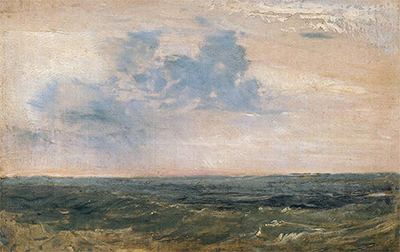
J. M. W. Turner's Study of Sea and Sky, Isle of Wight is the Tate painting recorded as N02001 and dated 1827.[1] Tate identifies the work as oil paint on canvas and links it with the Turner Bequest.[1] Tate Images records a support of 321 x 502 x 10 mm, while Art UK gives the equivalent scale as 32.1 x 50.2 cm and records the same accession number, N02001.[2][3]
The object should be described as an oil on canvas, not as a watercolour or bodycolour work on paper. That correction changes how the picture should be read. The roughness, low horizon, broad sky and worked surface belong to a compact oil study in which Turner tests weather, water and light through paint.
The image is simple at first glance. A dark strip of sea cuts across the lower half of the canvas. Above it, a pale sky opens in peach, cream and grey-blue tones. Blue cloud forms gather in the centre, while lighter scumbled passages hover toward the upper edge. The scene feels quick, but not careless.
The title gives an Isle of Wight association, but it does not by itself identify an exact viewpoint. The work should be discussed as an Isle of Wight sea-and-sky study, not as a precise topographical record unless a source supplies the spot. Its subject is the relation between water, horizon, cloud and changing light.
That modesty is part of the painting's force. Turner does not need a named cliff, harbour or vessel to make the place feel coastal. The work depends on essentials: a low band of water, a high field of air, and a surface where paint makes weather visible. Its small size invites close looking, but its space feels open.
At a Glance
- ArtistJoseph Mallord William Turner
- TitleStudy of Sea and Sky, Isle of Wight
- Date1827
- MediumOil paint on canvas
- Support32.1 x 50.2 cm
- CollectionTate
- AccessionN02001
- ProvenanceTurner Bequest, accepted 1856
- ScaleCompact oil study
- Viewpoint cautionNo exact spot inferred from title alone
Contents
- Overview
- Object Identity
- Correcting the Medium
- Isle of Wight Context
- Sea and Horizon
- Sky and Weather
- Scale and Study Status
- Oil Handling
- Distinguishing Nearby Works
- Looking at the Image
Object Identity
The preferred title is Study of Sea and Sky, Isle of Wight.[1] The artist is Joseph Mallord William Turner, whom Tate identifies as a British artist born in 1775 and dead in 1851.[5] The date is 1827.[1][3][4]
The medium is oil paint on canvas.[1][2][4] Art UK describes the medium as oil on canvas and gives the measurements as H 32.1 x W 50.2 cm.[3] Google Arts & Culture, using Tate partner data, gives the physical dimensions as 321 x 502 x 10 mm and identifies the medium as oil paint on canvas.[4]
The work belongs to Tate under accession number N02001.[1][3] Tate Images connects its ownership history to national acceptance of the Turner Bequest in 1856.[2] Tate's current public record states that it is not on display.[1] Display information may change, so the durable identity is Tate N02001, 1827, oil paint on canvas, 321 x 502 x 10 mm, Turner Bequest.
These facts matter because older summaries can confuse this object with Turner's many Isle of Wight watercolours, drawings and sketchbook studies. N02001 is a painting on canvas. It belongs with Turner's oil practice, even though its small scale and direct handling make it feel close to a field study.
The corrected identity also clarifies the viewer's task. The painting should not be read as a delicate paper surface whose colour depends mainly on wash and reserve. It should be read as a small canvas where oil paint has been moved across a textured support. That difference changes how one sees the cloud mass, the broken sea, and the rough light near the upper edge.
Correcting the Medium
The most important correction is the medium. This work is not a watercolour and bodycolour sheet. Current Tate, Tate Images, Art UK and Google Arts & Culture records all identify it as oil paint on canvas or oil on canvas.[1][2][3][4]
That distinction affects everything that follows. Oil paint can be dragged, scraped, loaded, thinned and reworked in ways that differ from watercolour. The visible surface of Study of Sea and Sky, Isle of Wight shows paint handled as a material layer, not only as transparent wash.
The detail image makes this clear. In the sky, pale passages appear rubbed and scumbled. Blue cloud forms sit within a worked field rather than floating on paper. In the sea, darker strokes and thicker touches create weight, movement and abrasion. These are oil-study effects.
The correction does not make the work less immediate. If anything, it sharpens its immediacy. Turner is using oil paint quickly and economically, making the canvas register a moment of looking without developing it into a large finished exhibition picture.
The result is a small oil that behaves with sketchlike freedom. It should be understood as a painted study: compact, experimental and responsive to changing conditions.
This makes the object especially useful for understanding Turner's range. He did not reserve oil paint only for grand, finished works. He could use it as a testing ground, close to observation and open to revision. In this study, oil becomes a medium for speed, not only for finish.
The medium correction also protects the work from a misleading kind of admiration. It may be tempting to praise the image as if its softness comes from watercolour technique. The institutional records point elsewhere. Its softness comes from oil handled with economy, and its small scale does not cancel its painted density.
Isle of Wight Context
The title associates the work with the Isle of Wight. Tate's object record and Art UK both retain that title and the 1827 date.[1][3] Tate's Turner research publication places many Isle of Wight subjects within the 1827 context of Turner's work around Cowes, East Cowes and the island's coastal views.[7]
That context is useful, but it should be handled with restraint. The painting does not show a named building, harbour, cliff or vessel in a way that securely fixes the exact spot. The image is primarily an atmospheric sea-and-sky study. The island association matters, but the work does not function like a detailed coastal map.
Turner had strong reasons to attend to the Isle of Wight. The island offered changing weather, marine light, busy waters and coastal edges. In 1827 he was also working within a wider group of Isle of Wight subjects, including views around Cowes and East Cowes recorded in Tate's Turner research material.[7]
This painting belongs to that environment through its essentials: water, sky, horizon and weather. It does not need a precise landmark to carry meaning. Turner reduces the coast to relations of tone and air, giving the viewer a concentrated study of conditions rather than a named view.
The restraint is part of the painting's value. It records a place through atmosphere. The Isle of Wight is present as coastal experience, not as tourist description.
The 1827 setting also matters because Turner was working around a dense network of island subjects. Tate's research material includes coastal views near Ryde, Cowes-related studies and East Cowes material within that year.[7] N02001 should be understood inside that larger attention to island water and weather, while still remaining a separate oil painting with its own object record.
This separation is important. A group context can help viewers understand why Turner was looking at the Isle of Wight, but it cannot supply details the painting itself does not show. The canvas gives no secure named building, no legible regatta episode, and no firm landmark. Its honesty lies in relation rather than naming.
Sea and Horizon
The sea occupies the lower portion of the canvas as a dark, active band. It is not a smooth decorative strip. Turner works it with green, grey, brown and blackish tones, creating the sense of surface movement and depth.
The horizon is low and relatively steady, but it is not hard. It separates water from sky while allowing the two zones to remain connected through colour. A thin warm line near the horizon gives the transition a sense of light passing through distance.
This low horizon gives the sky its scale. Because the sea is compressed below, the sky opens upward and becomes the main field of attention. The painting is small, but the arrangement makes it feel spacious.
The sea also keeps the image grounded. Without the dark lower band, the picture might become only a cloud study. With it, the sky is anchored to a coastal experience. Turner makes the viewer feel the weight of water beneath the changing air.
The handling of the sea is economical. A few dark strokes, lighter flecks and slanting touches suggest movement without describing individual waves in detail. The viewer reads the sea through pressure and rhythm rather than through exact contour.
The sea's darkness also changes the temperature of the whole painting. The sky has warmth, but the lower band keeps that warmth from becoming gentle decoration. It gives the image weight. The viewer feels that the pale air is set above something moving, dense and resistant.
Small light marks within the water are important because they prevent the sea from becoming a flat block. They read as broken flashes, foam or caught light, but Turner does not overdefine them. They are enough to animate the band without turning it into a fully described surf scene.
The low horizon creates a quiet tension. It makes the work feel expansive, but it also compresses the sea into a narrow zone of force. The painting's scale is small; the visual pressure is not.
Sky and Weather
The sky is the most varied part of the painting. Pale peach and cream tones form a broad atmospheric ground. Blue-grey cloud shapes gather in the centre and upper left, while lighter passages appear across the upper right.
Turner does not paint the sky as a fixed backdrop. It feels mobile, as if cloud and light are shifting while the image is being made. The blue forms are definite enough to carry structure, but soft enough to remain weather rather than objects.
The central cloud mass is especially important. It gives the painting weight above the horizon and prevents the upper field from dissolving into blankness. Its blue tone also creates contrast with the warmer ground.
The sky's surface is visibly worked. In the detail image, one can see directional handling, roughness and places where paint has been dragged or softened. These marks give the air a tactile quality. Turner makes atmosphere through touch.
The result is a study of weather as much as a study of sky. The painting does not describe a dramatic storm or a calm sunset. It describes change: a moving relation between cloud, light and the sea below.
The blue cloud forms are not simply decorative accents. They give the sky its internal architecture. Without them, the upper field might feel too even. With them, the sky becomes a layered atmosphere in which cooler and warmer passages meet.
The pale upper right also deserves close attention. It is one of the places where paint surface is most visible. Light seems to collect there, but it does so through rough, worked handling. Turner lets surface and atmosphere coincide.
The sky's openness does not mean it is empty. It is full of small shifts: warm to cool, smooth to rough, thin to more loaded, soft to more marked. The painting asks the viewer to read these shifts as weather.
Scale and Study Status
The painting's dimensions make its study status important. At 321 x 502 x 10 mm, the support is compact.[2][4] It is much smaller than Turner's large public oils, but it is not a tiny note. Its size allows quick handling while still giving enough breadth for a convincing sea-and-sky relation.
The word "study" in the title should not be treated as a weakness. A study can be exploratory, concentrated and highly revealing. Here, Turner strips the subject down to essential relations: horizontal water, open sky, cloud mass, light at the horizon and paint surface.
The work has no large narrative subject. There are no prominent figures, vessels or architecture. That absence places all attention on visual conditions. Turner is not telling a story; he is testing how little is needed to hold a marine view together.
The study status also helps explain the open handling. Turner does not finish every mark into descriptive detail. He lets passages remain broad because the purpose is atmospheric relation, not polished detail.
This does not make the work unfinished in a negative sense. It is complete enough to show what Turner was investigating. Its value lies in the clarity of that investigation.
The compact format also brings the viewer close to Turner's decision-making. In a large exhibition canvas, study elements may be absorbed into an elaborate composition. Here, the study remains visible as study. One can see Turner prioritizing relation over detail and atmospheric effect over narrative incident.
That priority gives the picture its modern appeal, but it should still be kept in historical terms. This is an 1827 oil study, not a later theory of pure abstraction. It remains tied to sea, sky, weather and the Isle of Wight title. Its freedom comes from how Turner treats those subjects, not from abandoning them.
Oil Handling
Townsend's account of Turner's materials and methods is useful for understanding why the surface matters.[6] Turner effects are made through physical paint decisions: how colour is layered, thinned, dragged, scraped, blended or left exposed.
In Study of Sea and Sky, Isle of Wight, the brushwork is part of the subject. The sea appears heavy because the lower paint is darker and more compressed. The sky appears open because the upper paint is lighter, broader and more varied in touch.
The detail image shows the difference between zones. The upper right contains pale worked paint with visible texture. The central cloud area has softer blue shapes. The lower sea carries darker, more forceful marks. These differences create the sense of air above water.
Oil paint allows Turner to make the image both direct and layered. The work may have been rapidly handled, but the surface is not flat. Paint catches light differently across the canvas, helping the image shift as the viewer studies it.
That material quality is why the medium correction matters so much. Calling the work a paper watercolour would mislead viewers about how the image is physically made. Its sea and sky depend on oil paint behaving on canvas.
The painting also shows how Turner could use contrast between thinness and density. The sky contains broad, pale handling, while the sea holds darker pressure. The difference is not only tonal; it is material. The lower part feels heavier because the paint is made to carry more weight.
This material contrast gives the composition stability. The viewer senses air above water because the two zones are painted differently. Turner does not need elaborate drawing to define the elements. Paint behavior performs that work.
In this sense, the picture is a study of medium as much as motif. It shows Turner asking how oil paint can stand for openness, depth, movement and changing light on a small canvas.
Distinguishing Nearby Works
Turner's Isle of Wight activity includes drawings, watercolours, sketchbook material and oil paintings. The shared geography can make those categories blur in casual discussion. For this object, they should stay distinct.
Tate's Turner research publication is valuable for the broader Isle of Wight context, especially the 1827 coastal and Cowes material.[7] But it is not a reason to change the medium of N02001. The object records identify this work as oil on canvas.[1][2][3][4]
The distinction is also visual. Many watercolours depend on paper tone, transparent wash and reserve. This painting depends on canvas support, worked oil surface and the physical weight of darker paint in the sea. The look of the object supports the institutional correction.
This does not isolate the painting from Turner's wider practice. It remains connected to his sketching habits and his interest in rapid observation. But it shows those habits translated into oil.
That translation is one of the painting's central interests. Turner brings sketchlike economy into a medium associated with more durable painted objects. The result is neither a finished marine exhibition picture nor a paper note. It is a compact oil study.
Distinguishing nearby works also prevents false certainty about place. Other Isle of Wight subjects may contain clearer coastal information, vessels or architectural references. This one does not need them. Its title establishes the island connection, while the image concentrates on elemental relation.
The painting therefore belongs in two conversations at once. It is part of Turner's Isle of Wight work, and it is part of his oil-study practice. Treating it only as local view misses the force of its surface. Treating it only as surface misses the coastal situation suggested by its title.
Looking at the Image
Begin with the horizon. It sits low and divides the painting into a dark sea zone and a much larger sky zone. The line is stable enough to orient the viewer, but soft enough to feel atmospheric.
Then look at the sea. Notice how little description Turner needs. The dark band contains touches of green, brown, grey and near black, plus small light flecks. Those marks create movement without turning into detailed waves.
Next, move into the sky. The central blue cloud mass draws the eye, but the surrounding pale ground is just as important. The warmer tones keep the sky from becoming cold, while the blue passages give it structure.
After that, study the upper right. The paint there is visibly worked and textured. It reminds the viewer that the sky is not only an illusion of air; it is also a surface built from oil paint.
Finally, step back mentally from the desire for a landmark. The painting is strongest when read as a relation of elements. Sea, sky, horizon, light and surface are the subject.
A second viewing can begin with the material support. Remember that the object is canvas, not paper. The worked oil surface helps explain why the darker lower band feels so weighty and why the pale sky catches light in uneven ways.
A third viewing can follow the direction of marks. Some passages run horizontally with the sea; others move through the cloud mass or catch in rough upper texture. These movements keep the picture from becoming static. The whole study feels made in response to a shifting scene.
The final step is to accept restraint. Turner gives less information than a topographical view would, but the reduction is deliberate. The painting shows how little is needed for coastal atmosphere to become convincing.
Why This Oil Matters
This 1827 Isle of Wight study matters because it shows Turner using a small oil canvas to address a large visual problem: how sea and sky meet in changing light. The work is modest in scale but ambitious in concentration.
It matters because it corrects assumptions about medium. The painting can look quick enough to be mistaken for a work on paper, but current institutional records identify it as oil on canvas.[1][2][3][4] That correction makes the surface more legible.
It matters because the Isle of Wight association is handled through atmosphere rather than landmark. Turner does not need a detailed coast to evoke coastal looking. A low horizon, dark water and shifting sky are enough.
It matters because it helps viewers understand study as a serious category. The painting is exploratory, but not slight. It reveals how Turner could compress observation into a few decisive relations.
Most of all, it matters because the work makes looking feel active. The viewer moves between water and sky, surface and space, paint and weather. Nothing is overexplained. Turner gives just enough for the sea and sky to become a lived visual event.
The painting also matters because it corrects the habit of separating Turner's rapid studies from serious painted thought. N02001 is small and open, but it is not slight. It shows how much Turner could do with a compressed format and a narrow subject.
It matters, finally, because the work is honest about uncertainty. It does not pretend to give the whole Isle of Wight. It offers a concentrated encounter with water and air. The painting's restraint is not a lack; it is the condition that makes its sea and sky so direct.
Frequently Asked Questions
Tate identifies Joseph Mallord William Turner as the artist of Study of Sea and Sky, Isle of Wight.[1]
Tate's current public record states that the work is not on display.[1]
No exact viewpoint should be inferred from the title alone. The work should be read as an Isle of Wight sea-and-sky study unless a more precise source is supplied.
Discussion
How does Turner use a compact oil canvas to make sea, sky, horizon and changing weather feel expansive?
Reader Insights
Which surface effects become clearer once the work is read as oil rather than watercolour?
How does the low sea band give the sky its apparent scale?
What can the Isle of Wight title establish without fixing an exact viewpoint?
Join the Conversation
Share a close observation or a source-based question for other readers.
References
- Tate, "'Study of Sea and Sky, Isle of Wight', Joseph Mallord William Turner, 1827." https://www.tate.org.uk/art/artworks/turner-study-of-sea-and-sky-isle-of-wight-n02001
- Tate Images, "Study of Sea and Sky, Isle of Wight, Joseph Mallord William Turner, 1827." https://www.tate-images.com/n02001-Study-of-Sea-and-Sky-Isle-of-Wight.html
- Art UK, "Study of Sea and Sky, Isle of Wight." https://artuk.org/discover/artworks/study-of-sea-and-sky-isle-of-wight-202387
- Google Arts & Culture, "Study of Sea and Sky, Isle of Wight - Joseph Mallord William Turner." https://artsandculture.google.com/asset/study-of-sea-and-sky-isle-of-wight-joseph-mallord-william-turner/FgECOx7pu6-0Hw
- Tate, "Joseph Mallord William Turner 1775-1851." https://www.tate.org.uk/art/artists/joseph-mallord-william-turner-558
- Joyce H. Townsend, *How Turner Painted: Materials & Techniques*, Thames & Hudson, 2019.
- Tate Research Publication, "Visit to the Isle of Wight and the 1827 Cowes Regatta and Other South of England Subjects." https://www.tate.org.uk/art/research-publications/jmw-turner/visit-to-the-isle-of-wight-and-the-1827-cowes-regatta-and-other-south-of-england-subjects-r1183233