

 by Tom Gurney
Tom Gurney BSc (Hons) is an art history expert with over 20 years experience
Published on June 19, 2020 / Updated on August 29, 2026
Email: tomgurney1@gmail.com / Phone: +44 7429 011000
Overview
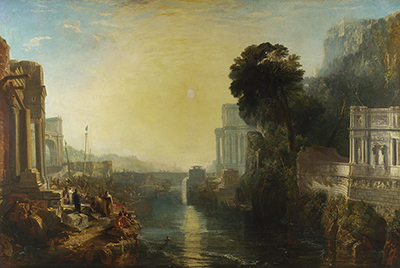
J. M. W. Turner's Dido building Carthage, or The Rise of the Carthaginian Empire is one of the grandest statements of his early maturity. Painted in 1815, it is an oil on canvas measuring 155.5 by 230 centimetres and now belongs to the National Gallery, London, where it is recorded as NG498.[1] The painting is often shortened to Dido Building Carthage, but the longer title matters. Turner did not simply imagine a harbour with classical architecture. He gave the picture an historical arc: Carthage at the moment of ascent, a new imperial city appearing through labour, ceremony, sunlight and myth.
The subject comes from the story of Dido, queen and founder of Carthage, as known through Virgil's Aeneid and its later English reception. The National Gallery connects the painting with Dryden's translation and identifies Dido as the blue-clad figure wearing a diadem near the front of the scene.[1] She is not presented as a remote emblem. Turner places her in a busy civic setting, walking near the tomb being built for her murdered husband, Sychaeus. A cloaked, helmeted man nearby is probably Aeneas, the Trojan exile whose arrival in Carthage will bind Dido's founding story to Rome's legendary prehistory.[1]
For modern viewers, the painting also matters because Turner made it a public argument about artistic inheritance. It is among his most deliberate engagements with Claude Lorrain, the seventeenth-century painter of luminous classical seaports. Turner admired Claude intensely, studied his framing of water, architecture and light, and wanted certain works of his own to be seen beside Claude's pictures after his death. Dido Building Carthage became central to that wish. In Turner's will, this work and Sun Rising through Vapour were named for display with Claude paintings in the National Gallery, a condition that gives the picture an unusual afterlife as both artwork and self-positioning.[1][2]
The result is a painting about beginning and inheritance at the same time. Within the fiction, Carthage is being raised from stone, scaffolding, ships and human organisation. Within Turner's career, the picture asks whether a modern British artist could enter the classical landscape tradition without merely repeating it. Its light is radiant, but its ambition is practical, historical and competitive. Turner builds a city, builds a myth, and builds a claim for his own place among the painters he revered.
At a Glance
- ArtistJoseph Mallord William Turner
- Full titleDido building Carthage, or The Rise of the Carthaginian Empire
- Date1815
- MediumOil on canvas
- Dimensions155.5 x 230 cm
- CollectionNational Gallery, London
- InventoryNG498
- AcquisitionTurner Bequest, 1856
- Literary sourceVirgil's Aeneid
- Artistic dialogueClaude Lorrain's classical seaports
Contents
- Overview
- Object Identity
- Dido, Aeneas and the Founding Story
- Carthage as Construction, Not Ruin
- Turner and Claude
- The Bequest and the National Gallery Pairing
- Figures, Architecture and Harbour Life
- Light, Colour and Material Handling
- Reception and Later Context
- How to Read Dido Building Carthage
Object Identity
The National Gallery records the painting's full title as Dido building Carthage, or The Rise of the Carthaginian Empire, with the date 1815, the medium as oil on canvas, and dimensions of 155.5 x 230 cm.[1] It is signed and dated, and it entered the National Gallery through the Turner Bequest in 1856.[1] Those facts make the painting more than a familiar reproduction of a golden classical harbour. It is a large, finished exhibition picture, made for public visibility and later drawn into the legal and institutional history of Turner's estate.
The date is important. By 1815 Turner was no novice seeking permission to enter the artistic establishment. He had entered the Royal Academy Schools in 1789 and had exhibited watercolours from 1790 and oils from 1796.[3] He was already known for technical command, travel subjects and ambitious historical landscape. Yet Dido Building Carthage announces a particular scale of ambition: Turner is using ancient subject matter, large format, architectural breadth and sunlight to contend with the highest inherited models of European landscape painting.
The National Gallery also notes the painting's original frame, an important detail because grand exhibition paintings were experienced as complete public objects, not just as flat painted surfaces.[1] The frame, size and polished composition work together. They signal a picture intended to command attention from across a room and then reward slow looking at close range. The viewer first sees the sunlit opening over water and the mass of classical architecture; only gradually does the narrative group in the foreground gather force.
The picture should therefore be approached on two levels. It is an episode from ancient literature and a constructed vision of urban power. It is also a professional statement by a painter who understood how a work would live in galleries, collections, catalogues and memory. The National Gallery inventory number NG498 gives the painting a present institutional identity, but Turner designed it with a future identity in mind: a work that could stand in open comparison with Claude.
The combination of public scale and carefully controlled identity also helps explain why the work has remained so useful for understanding Turner. It joins several interests that are sometimes separated in accounts of his career: learned subject matter, theatre-like staging, architectural imagination, marine space, colouristic force and self-conscious dialogue with earlier art. A viewer who knows only the later, more dissolved Turner may be surprised by the amount of readable detail here. A viewer who knows only the academic Turner may be surprised by how aggressively the light presses through the ordered setting. The painting sits at that productive middle point, where classical ambition and optical experiment are not rivals but partners.
Dido, Aeneas and the Founding Story
Turner's title names Dido before it names Carthage, and that order is not incidental. The city is huge in the painting, but its imaginative focus rests on the queen whose will and tragedy shape its story. According to the National Gallery, Dido appears in blue, wearing a diadem, as she visits the tomb being built for Sychaeus, her dead husband.[1] This detail is sombre. The scene is filled with morning-like brightness and civic activity, yet its central figure is marked by remembrance and loss.
The probable presence of Aeneas gives the painting another layer. The National Gallery identifies the cloaked and helmeted man as probably Aeneas.[1] Turner does not force that identification through theatrical gesture. The figure is absorbed into the courtly group, available to the informed viewer but not isolated as a single dramatic climax. This restraint suits the painting's larger structure. The picture is not a single instant of romantic crisis. It is a scene in which personal story, city building and imperial destiny occupy the same space.
In the Aeneid, Dido's meeting with Aeneas leads toward abandonment and suicide, while Aeneas moves onward toward the foundation story of Rome. Turner chooses an earlier, constructive moment rather than the catastrophe itself. Carthage is rising; the queen is alive; the harbour is filled with trade and movement. Yet viewers who know the story bring the coming tragedy with them. The painting's brightness is therefore complicated by hindsight. Its radiance does not erase the future; it makes the future more poignant.
The full title, with its phrase "The Rise of the Carthaginian Empire", widens the story from personal encounter to political ascent. Turner gives the viewer a city under formation: architecture, boats, figures, animals, masonry and ceremony all cooperate in the image. The founding of Carthage is not treated as a distant abstraction. It is made visible as an organised material event, with built form and human labour carrying the weight of history.
This is why the painting should not be reduced to a love story. Dido and Aeneas matter, but Turner embeds them in the broader theatre of foundation. The courtly figures do not stand before an empty backdrop. They inhabit a world that is becoming powerful. Turner makes the city almost a protagonist, using its scale and luminosity to suggest a civilisation at the beginning of its rise.
Carthage as Construction, Not Ruin
Many classical landscapes invite viewers to consider ruins: broken columns, surviving arches and fragments of past greatness. Dido Building Carthage reverses that habit. Its architecture is not chiefly a relic. It is aspirational, expansive and in progress. The eye moves among buildings, steps, vessels, distant towers and labouring figures, all bound by the light that opens through the centre of the composition.
That emphasis on construction is central to the painting's mood. Turner imagines empire not as a finished monument but as a process of making. The tomb of Sychaeus is being built; the city rises around it; the harbour gathers commerce. Even the ceremonial dignity of Dido's group is set against work. The painting's splendour depends on ordinary and extraordinary actions occurring together: civic authority, mourning, building, trade, movement and display.
The composition also resists a simple celebration of power. Because Dido's story is tragic, Carthage's rise carries instability from the start. Because Turner later painted and exhibited works concerned with decline, the theme of growth cannot be separated from the awareness that empires are mortal. The National Gallery notes Turner's repeated interest in Carthage and in the rise and fall of empire across many years.[1] In this painting, however, he keeps the emphasis on emergence. Decline is a shadow supplied by history and by comparison, not the main action.
The harbour setting intensifies this sense of collective becoming. Water gives the city openness and access; ships imply trade, travel and contact beyond the immediate scene. Architecture frames the view, but the centre breathes outward through light and distance. Turner uses space to imply that Carthage's story will not remain local. It will extend, compete, and eventually enter the larger struggle of Mediterranean powers.
What makes the picture powerful is that Turner does not need to explain this future through emblematic overload. He lets scale, placement and light carry the argument. Dido's smallness against the architecture is not a reduction of her importance. It shows the relation between human decision and historical consequence. The founder appears within the city she is making, while the city already seems larger than any one life.
This is also why the painting feels different from a mere antiquarian fantasy. Turner gives enough signs of ancient setting to establish the fiction, but he is more interested in momentum than reconstruction. The city has weight because it is being organised before us. The buildings do not simply frame a legend; they register collective desire, ambition and labour. In that sense, the painting's grand manner is grounded by activity. Its splendour depends on many small exertions distributed through the scene.
Turner and Claude
No serious reading of Dido Building Carthage can avoid Claude Lorrain. The National Gallery describes the painting as Turner's first picture intended to match Claude, especially Claude's seaport paintings.[1] The connection is visible at once: a luminous harbour, water receding toward the horizon, classical architecture at the sides, tall vertical accents, and a foreground filled with figures and activity. Turner is entering Claude's territory with unusual directness.
The relationship, however, is not simple imitation. Turner takes the grammar of the classical seaport and intensifies it. Claude's paintings often create a serene equilibrium between architecture, figures, water and light. Turner borrows that structure, but his surface is more crowded, more textured, and more emphatically historical. Stone, scaffolding, vessel, costume and glare compete for attention. The painting feels less like a perfected memory of antiquity than a city in the heat of formation.
This competitive homage reveals much about Turner's ambition. Claude represented an old master standard for poetic landscape, and Turner did not want merely to be measured against contemporary British painters. He wanted the comparison to occur at the highest level. By making a major Carthaginian picture in Claudean format, Turner accepted a difficult challenge: to show that modern landscape painting could absorb an inherited structure and give it new energy.
The National Gallery's account of Turner's will confirms that this was not a casual affinity.[1] Turner specified that Dido Building Carthage and Sun Rising through Vapour should hang with two paintings by Claude in the National Gallery. The bequest record further explains that this condition became part of the public history of the works after Turner's death.[2] In other words, Turner planned the comparison as part of the paintings' meaning.
The pairing also changes how we see the work. If the painting is isolated, its classical architecture and golden light may seem like admiration for an earlier ideal. When seen through Turner's Claude ambition, those same qualities become more pointed. The picture asks a question: can a British painter of Turner's generation inherit Claude's language without surrendering his own volatility, density and modern sense of change? Dido Building Carthage answers by making Claude's clarity more dynamic.
The Bequest and the National Gallery Pairing
Turner's bequest is essential to the painting's later identity. The National Gallery describes the Turner Bequest as the largest donation of works of art it had ever received, including finished pictures as well as a vast body of studies and unfinished works.[2] The bequest was not administratively simple. Turner's relatives contested his will, and the legal settlement after his death shaped how the works entered national ownership.[2]
Within that larger story, Dido Building Carthage occupies a privileged position. Turner singled it out with Sun Rising through Vapour for a specific afterlife beside Claude. The National Gallery's object record notes his wish that the works hang "in perpetuity" with Claude's A Seaport and Landscape with the Marriage of Isaac and Rebekah.[1] The Turner Bequest account gives a closely related account of the condition, naming the Claude pictures as Landscape with the Marriage of Isaac and Rebecca and Seaport with the Embarkation of the Queen of Sheba.[2]
The difference in title forms reflects gallery and historical naming practices, but the intention is clear: Turner wanted the comparison to endure. This was an unusually explicit act of self-placement. Artists often hope posterity will judge them generously; Turner gave posterity instructions about where to look. He understood that proximity in a national collection could become a form of argument.
The legal history sharpens the point. The National Gallery notes that the works were accepted by the Gallery within twelve months of Turner's death, moved according to his wishes, and formally entered the collection after the Court of Chancery decree of 1856.[1] The bequest account explains that the settlement gave the nation a larger body of art than the relatives had wished.[2] Dido Building Carthage thus stands at the crossing of private intention, family dispute, national collection policy and public memory.
This afterlife matters because it prevents the painting from being only an 1815 statement. It also became an 1850s statement, when Turner's legacy was being sorted, contested and institutionalised. The picture's subject is the rise of an ancient empire, but its own history involves the rise of Turner as a national painter. The Claude pairing helped convert personal ambition into museum fact.
Figures, Architecture and Harbour Life
The painting's foreground rewards close attention. Dido's blue dress and diadem distinguish her within the group, but she is not isolated against emptiness. She is surrounded by attendants, architectural elements, workers and signs of civic activity. The National Gallery notes that she is accompanied by a Black servant and a young purse-bearer, and it cautiously raises the possibility that her appearance may have been shaped by a recent operatic production.[1] Those details should be handled carefully. They enrich the scene, but the painting does not rest on any single theatrical reference.
The Black attendant is part of Turner's broader staging of Carthage as a cosmopolitan ancient power. The figure's presence points to courtly hierarchy, movement between cultures and the display conventions of European history painting. A modern viewer should neither ignore the figure nor turn him into a simple symbol. He is one component in a dense visual construction of royal presence and Mediterranean exchange.
The young purse-bearer likewise adds a worldly note. Carthage is not presented as pure myth detached from material concerns. Wealth, tribute, labour and ceremony belong together in the scene. Turner uses such details to keep the composition active at human scale even while the architecture creates grandeur. The city is magnificent because it is full of transactions, duties and specialised roles.
Architecture supplies the painting's monumental framework. Tall structures and classical forms rise on either side of the open harbour view. Steps, columns and terraces guide the eye inward, while the central light draws it outward. This double motion is one of the painting's great strengths. We move into the city and through it at the same time, entering the civic space while sensing the sea beyond.
Harbour life prevents the scene from becoming static. Boats, masts, water and workers keep the composition circulating. Turner understood that a seaport is both place and movement. It receives, sends, shelters and exposes. In a painting about the rise of Carthage, that matters. The city is not simply built on land; it is made through access to the sea.
Light, Colour and Material Handling
Turner's light in Dido Building Carthage is not merely decorative. It organises the painting's meaning. The bright central opening over the harbour gives the city an aura of destiny, while the surrounding architecture and figures provide weight and specificity. Light makes the imagined city feel newly visible, as though history itself were breaking open before the viewer.
The colour structure supports that effect. Dido's blue provides a vivid foreground note, helping the viewer locate her within the busy scene. Warmer tones in stone, sky and reflected light bind the architecture and harbour into a unified atmosphere. The painting balances local incident with overall glow, a balance that Turner would continue to test throughout his career.
Conservation-oriented writing on Turner has emphasised his experimental handling of paint, media and colour across both oil and watercolour, and Joyce Townsend's study of Turner's practice is especially useful for understanding how his technical decisions shaped pictorial effect.[4] In this particular work, the point is not that technique exists apart from subject. Paint handling serves the idea of emergence. Forms are legible enough to carry the narrative, yet the light continually presses against hard edges, making the city feel both built and visionary.
That tension between solid form and optical brilliance distinguishes Turner from a purely archaeological painter. He is not rebuilding Carthage as if preparing a measured report. He is making an image of foundation as experience: glare, motion, ceremony, building noise, and anticipated history. The eye receives the city as atmosphere before it parses it as information.
The scale of the canvas helps. At more than two metres wide, the painting gives light enough room to operate spatially. The viewer can travel across zones of detail and return to the central brilliance. That movement is part of the work's drama. Turner turns looking itself into a passage from narrative foreground to historical distance.
Reception and Later Context
Dido Building Carthage belongs to a long Turner engagement with ancient history, empire and Claudean landscape. The National Gallery notes that Turner painted a group of major Carthaginian empire subjects and that the rise and fall of empire concerned him over a long period.[1] That broader context is useful, but it should not flatten the individual work into a general lesson. This painting has its own tone: confident, ceremonial, luminous and uneasy beneath its splendour.
Butlin and Joll's catalogue of Turner's oil paintings remains an important reference for situating works such as this within the larger run of his exhibited and historical subjects.[5] Catalogue evidence matters because Turner's career was not a loose sequence of isolated masterpieces. He returned to themes, revised ambitions, and built relationships among works across decades. Dido Building Carthage is one of the key points where his classical ambition becomes public and monumental.
The painting's later association with The Decline of the Carthaginian Empire at Tate gives the rise theme a natural counterweight.[1] The two works should not be collapsed into one another, but their relationship helps explain why Carthage appealed to Turner. It allowed him to imagine history as sequence: foundation, splendour, vulnerability and loss. In Dido Building Carthage, the emphasis remains on the first movement of that sequence.
Turner's reputation also changed after his death, especially as large parts of his bequest entered public collections. The National Gallery artist record presents him as a central English Romantic painter, long associated with light, and notes the scale of the works left to the nation.[3] Dido Building Carthage is one of the paintings that helped make that public Turner visible: not only the Turner of storms and late colour, but the Turner who contended with classical grandeur.
The work's reception today is shaped by that layered history. It can be admired as a beautiful golden harbour, studied as an Aeneid subject, read as a national collection document, and compared with Claude. Its importance lies in the way these readings reinforce one another. The painting is strongest when seen as Turner intended: mythic, architectural, luminous and ambitious in the company of the old masters.
How to Read Dido Building Carthage
Begin with the title. The common shortened title identifies the scene, but the full title explains the scale of Turner's aim. This is not only Dido in Carthage. It is the rise of an empire, imagined through one founding queen, one harbour, and one overwhelming field of light.
Next, locate Dido. She is the blue-clad figure wearing a diadem, positioned near the front of the picture.[1] Her presence anchors the narrative. Around her, the courtly group, attendants and probable Aeneas create a human drama that is significant but deliberately contained. Turner lets the city speak as loudly as the characters.
Then follow the architecture. The flanking structures frame the harbour view and create a sense of civic order. They also establish the painting's conversation with Claude. If the composition feels familiar from classical seaport painting, that is part of Turner's design. He wants viewers to recognise the tradition and then feel how much activity, density and historical pressure he has packed into it.
After that, look at the light. The central radiance is the painting's emotional engine. It makes Carthage appear newly founded and already legendary. It also prevents the architecture from becoming heavy. Stone, water and sky meet in a vision of civic possibility, even as the story of Dido warns that possibility is never secure.
Finally, remember the bequest. Turner did not leave the painting's future entirely to chance. By linking Dido Building Carthage with Claude in the National Gallery, he made viewing itself part of the work's meaning. The painting asks to be judged not only within Turner's career but within a European lineage of landscape, history and light.
Frequently Asked Questions
The full title recorded by the National Gallery is Dido building Carthage, or The Rise of the Carthaginian Empire.[1] The longer title clarifies that Turner is presenting a founding moment and the beginning of imperial power, not simply a decorative classical harbour.
Turner painted it in 1815.[1] By then he was an established Royal Academy painter with many years of public exhibition behind him, and the work shows his ambition to compete with the European old master landscape tradition.
Probably. The National Gallery identifies the cloaked and helmeted man near Dido as probably Aeneas.[1] Turner keeps the identification understated, making the figure part of a broader scene of courtly presence and city building.
Discussion
How does Turner make a legendary city feel newly built while declaring his own place within landscape tradition?
Reader Insights
How do labour, architecture and harbour activity turn myth into construction?
How does the central radiance balance historical detail and visionary atmosphere?
Where does Turner's dialogue with Claude become competition rather than imitation?
Join the Conversation
Share a close observation or a question for other readers.
References
- National Gallery, London, "Joseph Mallord William Turner, 'Dido building Carthage', 1815." https://www.nationalgallery.org.uk/paintings/joseph-mallord-william-turner-dido-building-carthage
- National Gallery, London, "The Turner Bequest." https://www.nationalgallery.org.uk/about-us/history/the-turner-bequest
- National Gallery, London, "Joseph Mallord William Turner." https://www.nationalgallery.org.uk/artists/joseph-mallord-william-turner
- Joyce Townsend and Tony Smibert, *How Turner Painted*, Thames & Hudson. https://www.thamesandhudsonusa.com/books/how-turner-painted-softcover
- Martin Butlin and Evelyn Joll, *The Paintings of J. M. W. Turner*, revised edition, Yale University Press, 1984.