

 by Tom Gurney
Tom Gurney BSc (Hons) is an art history expert with over 20 years experience
Published on June 19, 2020 / Updated on August 29, 2026
Email: tomgurney1@gmail.com / Phone: +44 7429 011000
More Than a Nickname
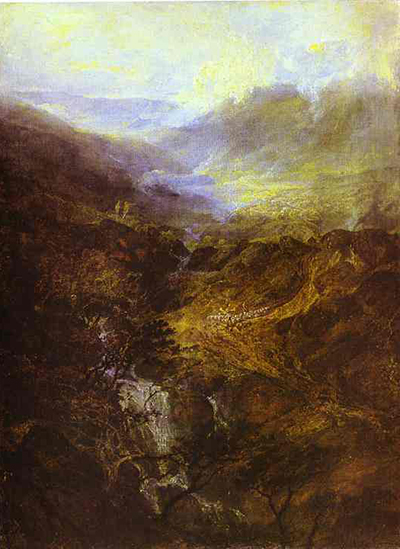
Turner is often called a painter of light, and the phrase is justified only if it leads to close looking rather than slogan. The National Gallery notes that he became known for brilliant colour as a main constituent in landscapes and seascapes.[1] But Turner's light is not one effect. It can reveal, blind, warm, dissolve, structure, dramatise or unsettle. Colour and atmosphere are not decorative veils over subject matter; they are often the means by which the subject becomes intelligible.
Turner's treatment of light developed across media. Oil paint, watercolour, paper, prepared grounds, scraping, opaque touches and layered washes all gave him different instruments. Joyce Townsend's technical work on Turner is essential because it keeps the discussion grounded in materials rather than mythology.[2] Turner was a visionary painter, but vision in his art is made with physical means.
At a Glance
- Central principleLight, colour and atmosphere construct meaning
- MediaOil, watercolour, paper and prepared grounds
- Watercolour toolsWash, reserve, scraping and opaque touches
- Oil toolsGlazing, scumble, impasto and abrasion
- Spatial methodColour relations can replace hard outline
- Atmospheric subjectsSea, Venice, Switzerland and modern transport
- Technical authorityMaterial evidence before mythology
- Finish boundaryOpen surfaces do not all share one status
- Historical boundaryModern-looking work remains nineteenth-century
- Working sequenceObservation, colour memory and studio transformation
Contents
- More Than a Nickname
- Early Clarity and Later Experiment
- Colour as Structure
- Atmosphere and Subject
- Watercolour and the Intelligence of Paper
- Oil Paint and Luminous Density
- The Risk of Modernist Teleology
- Seeing Through Light
- Light as Narrative Pressure
- Colour and the Bequest
Early Clarity and Later Experiment
The late works can make Turner seem as if he moved simply from clarity to dissolution. The truth is more interesting. His early topographical training gave him strong habits of structure, perspective and architectural attention. His later atmospheric works do not forget these habits; they often stretch them until the supporting structure is almost submerged in light.
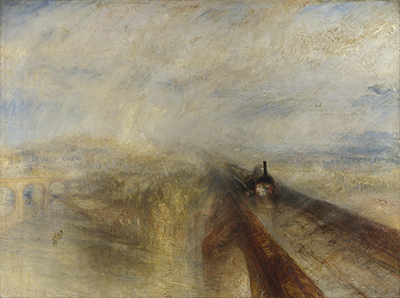
This is why paintings such as Rain, Steam, and Speed, Norham Castle, Sunrise and Sunrise with Sea Monsters should not be treated as mere dissolves. They depend on controlled relationships between motif and effect. Bridge, castle, horizon, boat or sun may be reduced, but they continue to organise the image.
Colour as Structure
Turner's colour often builds space. Warm and cool relations, pale reserves, dense accents and diffused washes can replace hard outline. In watercolour, the white or tone of the paper may become an active part of the image. In oil, scumbles, impasto and translucent layers can create weather, glare or reflected light. The technical evidence matters because the effect is not only optical; it is material.
The Wallace Collection's essay by Townsend on Turner's watercolour materials and techniques stresses both traditional and experimental procedures, including paper tone, opaque colour and methods such as scratching out.[3] Those techniques help explain how Turner could make light feel both immediate and constructed.
Atmosphere and Subject
Atmosphere in Turner is not a neutral environment. It changes meaning. In marine works, atmosphere can make danger visible before the viewer fully understands the vessel. In Venetian works, it can turn architecture into reflection and memory. In Swiss watercolours, it can make mountains appear as events of weather rather than fixed objects. In industrial subjects, smoke and rain are part of modern experience, not background decoration.
This is especially clear in Rain, Steam, and Speed. The National Gallery identifies the subject as a steam train crossing Maidenhead Railway Bridge in rain.[4] The train is a modern machine, but Turner makes it emerge through weather and light. Modernity is seen atmospherically, not diagrammatically.
Watercolour and the Intelligence of Paper
Watercolour was central to Turner's exploration of light because it allowed speed, transparency and delicate correction. A pale wash could suggest distance; a reserved highlight could hold sunlight; a scraped mark could recover brightness; an opaque accent could weight a form. Tate's research publication on sketchbooks, drawings and watercolours gives the broad framework for this works-on-paper practice.[5]
The medium also suited Turner's travel. It could record weather before it changed and preserve a colour idea for later use. The sketchbook and the finished watercolour are not the same thing, but both belong to a career in which light was repeatedly studied in motion.
Oil Paint and Luminous Density
Turner's oil paintings achieve light differently. They can use thickness, abrasion, glazing, broken brushwork and prepared tonal fields. Late oil works in the Turner Bequest often make viewers aware of paint as substance and atmosphere at once. The National Gallery's record for Margate (?), from the Sea notes the sculptural quality of the paint and the use of thickly applied white to suggest cliffs.[6] Such evidence reminds us that atmospheric painting may be materially assertive.
Turner's light is therefore not immaterial. It is made from pigment, binder, support and touch. The more radiant the image appears, the more important it becomes to ask how that radiance has been constructed.
The Risk of Modernist Teleology
Turner is often treated as a forerunner of later abstraction or Impressionism. There are real reasons for later artists and viewers to feel that connection, but the claim needs restraint. Turner did not set out to invent twentieth-century painting. His work belonged to Royal Academy exhibition culture, print culture, patronage, travel, Old Master rivalry and nineteenth-century science and criticism.
The better approach is to say that his handling of light, colour and atmosphere opened possibilities that later viewers found newly relevant. His paintings can look startlingly modern, but they remain rooted in his own historical world.
Seeing Through Light
Light in Turner is never only brightness. It is a way of thinking. It can make empire fragile, modern speed unstable, mountains evanescent, sea dangerous and Venice spectral. Colour is not applied after meaning; it is part of meaning. Atmosphere is not a veil; it is often the event itself.
To understand Turner through light, colour and atmosphere is therefore to avoid both extremes: the dry catalogue of subjects and the vague worship of radiance. His art asks for both material attention and imaginative response. He painted light as sensation, but also as structure, history, weather and work.
Light as Narrative Pressure
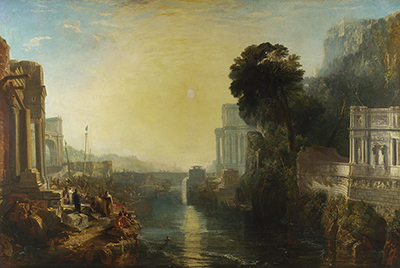
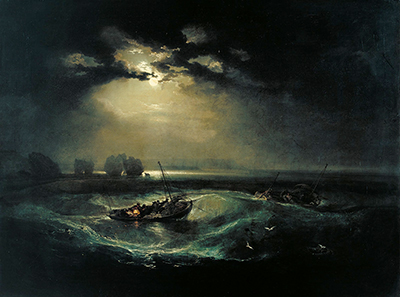
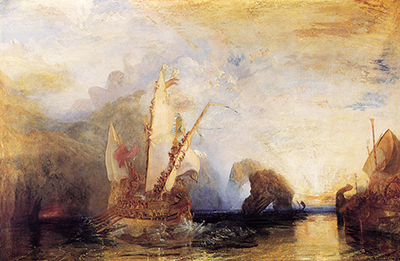
Turner's light often carries narrative pressure. In classical works, sunlight can suggest foundation, prophecy or decline. In maritime works, moonlight or dawn can clarify danger while making it more mysterious. In modern subjects, glare and rain can turn a technological event into a sensory crisis. Light does not simply reveal the subject; it tells the viewer how to experience time, risk and expectation.
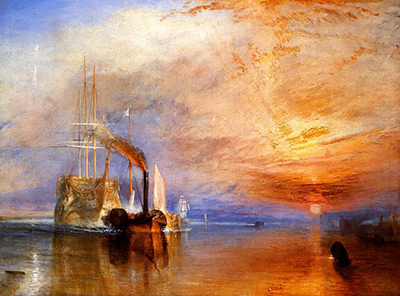
In Dido Building Carthage, radiant light supports the city's splendour while the story points toward loss. In The Fighting Temeraire, sunset turns a ship's final journey into elegy. In Rain, Steam, and Speed, light through rain makes modern movement feel unstable and almost unbelievable. These effects are emotional, but they are also structural. The picture's meaning depends on where light gathers, what it obscures and what it leaves unresolved.
Colour and the Bequest
The Turner Bequest is crucial for understanding colour because it preserved so many studies, beginnings and unfinished works. Finished exhibition pictures show public colour effects; studio material shows testing, variation and experiment. Tate's research into sketchbooks, drawings and watercolours makes it possible to see colour as a working process, not only as a final appearance.[5]
This is especially important for late Turner. The bequest includes works that later viewers have found radical because they seem to move toward pure colour and atmosphere. Yet their relation to Turner's process is complex. Some were unfinished; some were exploratory; some may have been private experiments. Their power is real, but their status must be handled carefully.
Colour in Turner is therefore both aesthetic and archival. It is what viewers see, and it is also evidence of how he worked.
Water, Reflection and Broken Light
Water gave Turner one of his richest instruments for light. Rivers, seas, lakes and canals allowed reflections, broken highlights, mist and shifting horizons. Water can double architecture, dissolve solidity or turn a scene into moving colour. This is why Venice, Lake Lucerne, the Thames and marine subjects became so important.
Reflection also creates ambiguity. A building reflected in water is both present and unstable. A sun path across a sea can guide the eye while overwhelming detail. A lake beneath the Rigi can make a mountain seem both massive and weightless. Turner used water to make light active.
This is not only a matter of beauty. Reflected light can carry danger, speed, memory or loss. It can make the viewer uncertain where solid form ends and atmosphere begins.
Atmosphere and Modern Technology
Turner's atmosphere was particularly suited to modern technology because steam, smoke and rain altered visibility. In Rain, Steam, and Speed, the train is not isolated as an engineering diagram. It appears through weather. The National Gallery's record identifies the railway bridge and the modern subject, but the painting's force lies in how that subject is perceived through atmospheric conditions.[4]
This approach allowed Turner to paint modernity without becoming merely descriptive. The locomotive is a machine, but the painting is about speed, sensation and the changing human experience of landscape. Atmosphere becomes the medium through which modern technology enters vision.
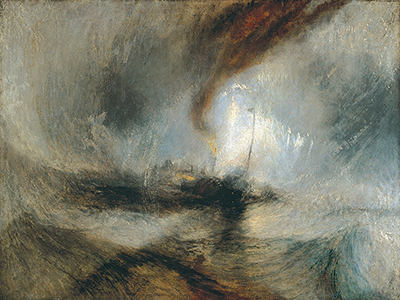
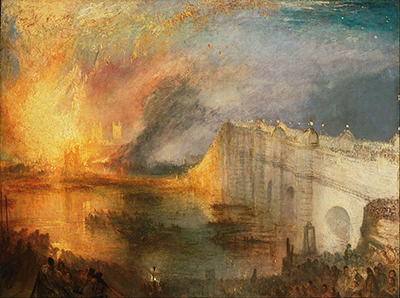
The same principle applies to steamboats and fires. Smoke, spray, rain and flame are not additions to modern life; they are part of how modern life is seen.
Materials Against Myth
Turner's reputation encourages mythic language: light as pure vision, colour as prophecy, atmosphere as emotion. Technical study restores resistance. Pigments have properties; supports absorb differently; oil and watercolour behave differently; scraping and opaque touches leave material traces. Townsend's work is valuable because it makes Turner's effects accountable to practice.[2][3]
This does not diminish the art. It sharpens admiration. A luminous watercolour becomes more impressive when one understands the control of paper, wash and reserve. A late oil becomes more interesting when its surface is seen as a field of physical decisions. Turner did not paint light by escaping material. He painted light by understanding material intensely.
Late Colour and Public Misunderstanding
Many of Turner's late works baffled or irritated contemporary critics. Their colour could seem excessive, their forms insufficiently finished, their subjects difficult to grasp. Later viewers often reversed the judgment and celebrated exactly those qualities. Both reactions show how challenging Turner's late colour was.
The danger is to treat late Turner as if he had simply leapt beyond his century. He remained tied to exhibition culture, literary titles, patrons and inherited genres. His late colour is most powerful when seen as a pressure placed on those contexts. He did not abandon history, sea, travel or architecture; he subjected them to light so intense that their usual boundaries changed.
Atmosphere as Knowledge
Turner's atmosphere is not vagueness. It is a form of knowledge about change. Weather changes what can be seen. Distance changes colour. Smoke changes modern cities. Water changes architecture. Sunrise and sunset change time. Turner made those changes central.
To paint atmosphere is to admit that the world is not available as fixed outline alone. Turner understood this across decades and media. His light and colour are therefore not late decorative signatures. They are ways of thinking about perception, history and the instability of visible experience.
Light and the Problem of Finish
Turner's light is closely tied to the problem of finish. A highly finished surface can make light appear controlled and settled. A more open surface can make light feel unstable, arriving or disappearing before the eye. In late Turner, this tension becomes especially important. Some works appear unfinished because their forms are so open; others use openness as the very means of representing atmosphere.
The bequest makes this question difficult and productive. Works left in the studio do not all have the same status. Some may be unresolved, some experimental, some private and some more complete than they first appear. When discussing light and atmosphere, it is therefore important not to equate openness automatically with intention. The material must be read carefully.
Even so, the unfinished or open surfaces are central to Turner's modern appeal. They show him testing how little outline a painting needs and how much light can do.
Colour Studies and Memory
Colour studies are not simply attractive fragments. They can preserve memory of an effect: a sky after rain, a burst of sun, a mountain seen through cloud, a reflection across water. Such studies show Turner separating chromatic experience from detailed description. The result is a form of memory carried by colour.
This practice helps explain why later finished works can feel both observed and visionary. Turner did not have to reproduce every detail of a place if he had grasped the relation of light, colour and atmosphere that made the place matter. Colour could become the durable part of memory.
The same process links travel to studio work. A note made quickly in Switzerland, Venice or on the coast could later support a more ambitious image. The remembered effect might become stronger than the original topographical detail.
Colour, Criticism and Reputation
Turner's colour provoked criticism because it challenged expectations of finish, naturalism and restraint. Some contemporaries saw brilliance; others saw excess. Ruskin's defence of Turner helped shift the terms of judgment, especially by arguing for truth to nature in ways that included atmospheric and chromatic complexity.
Later admiration has sometimes swung too far in the other direction, making Turner a heroic precursor of modern colour painting. A better view recognises both the historical controversy and the real innovation. Turner's colour was difficult because it changed the relationship between subject and perception. It made viewers ask whether accurate seeing might require looseness, brightness or instability.
This question remains alive. Turner still feels modern because his paintings show that visual truth is not always delivered by hard contour or local colour. Sometimes truth lies in the conditions that make the world difficult to see.
Atmosphere as Historical Medium
Atmosphere also carries history. Smoke over a city, mist over Venice, rain around a railway, sunset behind a departing ship: these are not neutral effects. They place events within time. They can make an old warship elegiac, a train uncanny, a city spectral or an empire fragile.
Turner's atmosphere therefore joins visual and historical instability. Things are changing because light changes, but also because history changes. A ship is being towed away; a train is arriving; a city is decaying; a storm is overtaking an army. Atmosphere makes change visible.
This is why light, colour and atmosphere deserve extended treatment in Turner. They are not a style label. They are among his main instruments of thought.
Why the Subject Can Bear a Full Treatment
Light, colour and atmosphere touch almost every part of Turner's career: topographical watercolour, marine painting, Venice, Switzerland, modern transport, late oils, the bequest and conservation research. The subject can easily become vague because it is so broad, but it can also organise a serious account of how Turner worked.
The key is to keep medium and meaning together. Light is not only an effect; it is made through materials. Colour is not only beauty; it structures space and memory. Atmosphere is not only mood; it carries history, weather and modern experience. Turner made these elements central across decades, which is why they deserve more than a short summary.
Seen this way, Turner is not simply a painter who added brilliance to landscape. He made brilliance a way of thinking about how the world appears, changes and disappears.
That is why the subject belongs at the centre of his career rather than at its decorative edge.
It explains his reach.
It also explains his lasting difficulty.
Discussion
How do physical materials make Turner's light operate as structure, history and changing perception?
Reader Insights
Which visible decisions in paper, wash or paint construct radiance?
When does atmosphere carry danger, memory, speed or historical change?
How should viewers distinguish deliberate openness from unfinished studio material?
Join the Conversation
Share a close observation or a source-based question for other readers.
References
- National Gallery, Joseph Mallord William Turner artist record, https://www.nationalgallery.org.uk/artists/joseph-mallord-william-turner
- Joyce H. Townsend, *How Turner Painted: Materials & Techniques*, Thames & Hudson, 2019
- Wallace Collection, Joyce Townsend, "Turner's Watercolour Materials and Techniques," https://www.wallacecollection.org/explore/explore-in-depth/turner/turners-watercolors/turners-watercolour-materials-and-techniques/
- National Gallery, *Rain, Steam, and Speed*, https://www.nationalgallery.org.uk/paintings/joseph-mallord-william-turner-rain-steam-and-speed-the-great-western-railway
- Tate Research Publication, *J.M.W. Turner: Sketchbooks, Drawings and Watercolours*, https://www.tate.org.uk/art/research-publications/jmw-turner
- National Gallery, *Margate (?), from the Sea*, https://www.nationalgallery.org.uk/paintings/joseph-mallord-william-turner-margate-from-the-sea