

 by Tom Gurney
Tom Gurney BSc (Hons) is an art history expert with over 20 years experience
Published on June 19, 2020 / Updated on August 29, 2026
Email: tomgurney1@gmail.com / Phone: +44 7429 011000
Overview
Fishermen at Sea is one of the decisive early works in J. M. W. Turner's career. Tate identifies the painting as Fishermen at Sea, by Joseph Mallord William Turner, exhibited in 1796 and held as accession T01585. [1] It is an oil painting on canvas, with a support measuring 914 x 1222 mm, and Tate Images records its acquisition as a purchase in 1972. [2] These facts give the work a firm public identity: an ambitious oil by a young artist entering a larger arena.
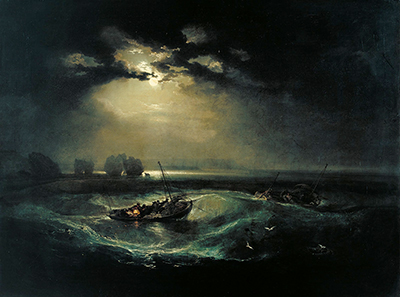
The painting shows fishing boats at night in unsettled water, lit by moonlight and by the smaller, warmer glow of a boat lantern. Its drama depends on scale and contrast. The fishermen are visible and active, but the sea, sky and rocks dominate the scene. Human work is placed within a natural world that is beautiful, unstable and threatening.
The work matters because it is not simply an attractive marine nocturne. Tate's research publication on the sublime describes it as Turner's first Royal Academy oil and places it within a tradition of moonlit scenes associated with Horace Vernet, Philip de Loutherbourg and Joseph Wright of Derby. [3] That framing is crucial. Turner was not merely displaying subject matter; he was entering a competitive tradition of night, sea, light and danger.
The painting also introduces a theme that would remain central to Turner: the sea as a place where human skill meets forces beyond control. Later Turner marine works would become larger, stranger and more turbulent, but Fishermen at Sea already contains the basic tension. The fishermen do their work, the boats ride the waves, the lantern burns, and the moonlight opens a cold distance around them.
Its date should be handled precisely. The controlling public anchor is Tate's exhibited 1796 date. [1] The safer formulation is not that this was Turner's first oil painting in every possible sense, but that it was the first oil he exhibited at the Royal Academy. That distinction matters because it keeps the object history clear while still acknowledging the painting's importance.
Seen in that way, Fishermen at Sea becomes a career statement. Turner was still young, but he was already using oil paint, exhibition scale, maritime danger and nocturnal light to claim serious artistic territory. The painting announces not only a subject, but a method: nature as visual force, work as vulnerability and light as a way of measuring danger.
The work also marks a shift in how Turner's early promise could be judged. A watercolour might demonstrate precision, taste and command of topographical detail. This oil had to do something more public: hold a large dark field together, make sea and sky active, place small figures within danger and compete with admired traditions of marine and nocturnal painting. That is why the painting still feels like an arrival rather than a student exercise.
At a Glance
- ArtistJoseph Mallord William Turner
- TitleFishermen at Sea
- Exhibited1796
- MediumOil paint on canvas
- Support914 x 1222 mm
- CollectionTate
- AccessionT01585
- Career importanceFirst oil Turner exhibited at the Royal Academy
- SettingMoonlit sea associated with the Needles, Isle of Wight
- Central contrastCold moonlight and the fishermen's warm lantern
Contents
- Overview
- Object Identity
- Royal Academy Context
- Moonlight, Lantern and Nocturne Tradition
- The Sea and the Sublime
- Composition and Movement
- Technique and Material Effect
- The Needles and the Isle of Wight
- Reception and Importance
- How to Read Fishermen at Sea
Object Identity
The basic object record is unusually important for this painting because familiar descriptions can easily become too broad. Tate's title is Fishermen at Sea. The artist is Joseph Mallord William Turner. The exhibited date is 1796. The work is held by Tate under accession T01585. [1] Tate Images adds the medium, oil paint on canvas, and the support dimensions of 914 x 1222 mm. [2]
Those measurements help explain the work's ambition. This is not a small private note in oil. It is a substantial canvas, wide enough for the sea and sky to take command of the viewer's attention. The horizontal format allows Turner to spread the boats, rocks, moon and waves across a broad field, turning a night fishing scene into a test of pictorial control.
The acquisition record matters too. Tate Images records the work as purchased in 1972. [2] That modern museum acquisition means the painting's public fame is partly a later institutional story. Its original importance belongs to Turner's Royal Academy career; its present visibility belongs to Tate's stewardship and display.
The work is sometimes discussed through the Needles, the chalk formations off the Isle of Wight. Tate-linked interpretive records connect the scene with those jagged rocks and a moonlit marine setting. [3] That identification should be used with care. The important point for close looking is that the rocks are not background decoration. They sharpen the danger and give the moonlit sea a threatening edge.
The title is direct and almost plain. It names people at work rather than a grand event. Yet the picture is anything but plain in its visual ambition. The fishermen are small figures within a vast nocturnal environment. The title may begin with labour, but the painting expands that labour into a drama of light, water and risk.
Butlin and Joll's catalogue of Turner's oil paintings remains the necessary scholarly control behind this object identity, especially for title, exhibited status, dating and provenance. [6] A public account does not need to reproduce catalogue apparatus, but it should follow the catalogue discipline: identify the exact painting, avoid casual date drift and distinguish an exhibited oil from broader claims about everything Turner may have painted privately.
Royal Academy Context
The Royal Academy mattered to Turner from the beginning of his public career. Exhibiting there meant placing a work before critics, patrons, other artists and the broader London art public. For a young artist, an ambitious oil at the Academy could operate as a declaration of seriousness.
Tate's sublime publication states that Fishermen at Sea was the first oil painting Turner exhibited at the Royal Academy. [3] This is the central career claim for the work. Turner had already been active as a watercolourist, but an oil canvas carried different demands. Oil painting, especially at this scale, belonged to a more prestigious public field.
The painting should therefore be read as both marine subject and professional move. Turner chose a theme that could show technical control: darkness, moonlight, reflected light, wave movement, boats, rocks and human figures. These elements allowed him to demonstrate ambition without relying on a complex historical narrative.
The Royal Academy context also helps explain the painting's relation to tradition. A young painter could not simply imitate well-known nocturne and marine painters. He had to show that he understood the tradition while adding force of his own. The composition's strong contrasts and restless water make the picture competitive rather than merely respectful.
This is why the phrase "first exhibited oil" should not be treated as a small biographical detail. It tells us what kind of public test Turner set for himself. He entered the Academy oil-painting field through a night sea subject, a choice that joined drama, skill and risk.
The work also helps correct a later view of Turner as if he only became a sea painter through the storms of maturity. His maritime imagination was already public in 1796. Later shipwrecks, naval subjects and violent weather paintings have deeper roots. Fishermen at Sea is one of the earliest clear signs that the sea would be a serious arena for his art.
The Academy setting also helps explain the painting's controlled ambition. Turner did not choose a huge battle, a mythological narrative or a crowded harbour scene for this first oil display. He chose a severe nocturnal marine subject in which light, scale and water movement had to carry much of the meaning. The restraint is part of the confidence. The picture asks to be judged by how it handles atmosphere and danger, not by how many incidents it can include.
That makes the work a hinge between Turner's early training and his later public identity. The young artist's discipline is visible in the careful structure of the scene, while the future Turner is visible in the appetite for difficult effects. The painting looks backward to eighteenth-century nocturnal models and forward to a career in which sea, light and weather would become increasingly unstable.
Moonlight, Lantern and Nocturne Tradition
The painting's drama begins with light. The moon creates a cold, high illumination across the water and sky, while the fishermen's lantern produces a smaller human glow. Tate's sublime account emphasizes the contrast between potent moonlight and the delicate vulnerability of the flickering lantern. [3] That contrast gives the work its emotional structure.
The lantern is not just a detail. It is the human measure inside the scene. Its warm light belongs to the boat, the fishermen and their work. Against the moon and sea it appears fragile, but it also keeps the men visible. Without it, the painting would risk becoming pure atmosphere. With it, the scene remains tied to labour and survival.
The moonlight has a different function. It does not comfort the fishermen. It exposes the scale of the world around them. It catches waves, opens the distance and gives form to the sky and rocks. The moon is beautiful, but its beauty is indifferent. Turner uses it to make the sea legible and threatening at once.
Tate's research places the work in a nocturnal tradition linked with Vernet, de Loutherbourg and Wright of Derby. [3] That tradition matters because moonlight was already a tested vehicle for drama. Night scenes allowed painters to explore contrasts between natural and artificial light, between visibility and darkness, between display and danger.
Turner's achievement is to make that tradition maritime and immediate. The scene is theatrical, but it does not feel staged in the simple sense. The waves move, the boats pitch, the rocks cut into the distance and the light divides the world into cold and warm zones. The viewer is not merely watching a night effect; the viewer is made to feel the instability of the water.
The painting is therefore a nocturne before the term becomes associated with later nineteenth-century art in other ways. It is a study in night as a pictorial condition. Darkness is not empty. It contains work, danger, reflection, depth and weather. Turner's later fascination with difficult light begins here with striking confidence.
The relation between moon and lantern also gives the painting a moral pressure without turning it into an allegory. The moon belongs to the indifferent order of nature. The lantern belongs to human effort. The two lights do not cancel each other. They define two scales of existence. The fishermen must work inside the larger light and weather they cannot command.
This is one reason the picture can feel calm and alarming at the same time. The moon stabilizes the composition, while the waves and rocks unsettle it. The lantern draws sympathy toward the boat, but its smallness makes that sympathy anxious. Turner is already learning how to make light carry emotional opposition.
The Sea and the Sublime
The sublime in Fishermen at Sea is not an abstract theory pasted onto the work. It is built into the relation between the boats and their environment. The fishermen are small; the sea is broad. The lantern is vulnerable; the moon is immense. The rocks are distant but dangerous. Nature is not merely scenery. It is the power under which the scene unfolds.
Tate's sublime account explicitly connects the painting with the fashion for sublime subjects, in which viewers confronted the overwhelming force of nature. [3] This is useful because it places the picture within late eighteenth-century taste. Turner was working in a culture that valued awe, danger, darkness and vastness as aesthetic experiences.
Yet the painting should not be reduced to a generic sublime image. It remains specific. Fishermen work at night. Boats move in rough water. A lantern burns. The likely Isle of Wight setting gives the scene a coastal identity. The sublime force of the painting comes through these particulars, not through vagueness.
The sea also has a social dimension. These are not aristocratic travellers enjoying a view. They are working men in a risky environment. Turner's title directs attention to them, even though the composition shows how small they are. This doubleness is part of the painting's power. It honours labour while exposing its fragility.
Royal Museums Greenwich records Christine Riding and Richard Johns's Turner & the Sea as a 2013 maritime study that foregrounds Turner's engagement with earlier sea painting, naval warfare, technological change, travel and print culture. [4] Fishermen at Sea belongs at the beginning of that long engagement. It establishes Turner's credentials in a tradition he would later transform.
In this early canvas, the sea is already more than a background. It is the active field of the painting. It carries light, destabilizes the boats, reflects the moon and separates the fishermen from safety. Turner would later push marine subjects toward catastrophe, industry and near-abstraction, but this work already understands the sea as a force that tests human presence.
Composition and Movement
The composition of Fishermen at Sea depends on opposing movements. The broad canvas spreads the scene horizontally, while waves, clouds, masts and rocks create local tensions within that breadth. The viewer's eye moves between the lantern, the boats, the moonlit water and the darker mass of the rocks.
The boats are essential because they give the painting human scale. Their forms are not monumental, but they are structurally important. They interrupt the water, catch the lantern light and create a zone of activity within the larger night. The fishermen's presence prevents the sea from becoming merely decorative.
The moon organizes the upper field. It creates a source of illumination that is distant, steady and inhuman. The lantern organizes the lower field. It is close, unstable and practical. The painting's drama arises from the relationship between these two lights. One belongs to the sky; the other belongs to work.
The rocks, often identified with the Needles, sharpen the left side of the composition. [3] Their jagged silhouettes give the scene a harder edge. They also stop the eye from reading the seascape as open and safe. A boat at sea is one kind of risk; a boat near hidden or jagged rocks is another.
Turner also manages movement without sacrificing clarity. The sea is restless, but the composition remains readable. The viewer can locate boats, light and danger. This balance is important for an early public oil. Turner shows that he can handle energetic effects while maintaining pictorial structure.
The painting's atmosphere is therefore disciplined. It may seem dramatic, even theatrical, but its drama depends on careful arrangement. Light directs attention; scale creates vulnerability; rocks create danger; the horizontal canvas gives the sea room to dominate. Turner is already thinking like a painter of large natural forces.
The format is central to that effect. A narrower or taller canvas would change the relation between the figures and the sea. Here the breadth allows the eye to move laterally across water and darkness, so the boats become part of a larger field rather than isolated subjects. Turner uses width to make danger environmental.
The composition also avoids easy symmetry. The moon, boats and rocks are related but not neatly balanced. This gives the scene a more unsettled energy. The viewer keeps measuring distances: from lantern to moon, from boat to rocks, from human warmth to cold light. That process of measurement is part of the painting's experience.
Technique and Material Effect
The medium matters. Tate Images records Fishermen at Sea as oil paint on canvas. [2] Oil gave Turner the density and depth needed for nocturnal contrast. It allowed him to build dark passages, reflective water and luminous points of light with a different material weight from watercolour.
Joyce Townsend's How Turner Painted, described by Thames & Hudson as a technical study of Turner's materials, modified paint media, colour, composition process and technical imaging, provides the broader caution for discussing such effects. [5] Claims about light in Turner should be tied to material practice, not left as vague admiration.
In this painting, the material problem is how to make darkness active. Night scenes can become flat if darkness is treated as absence. Turner instead gives the dark sea and sky internal variation. Moonlight and lantern light break the surface, while the forms of boats and rocks emerge against the surrounding gloom.
The lantern effect is especially demanding. It must be bright enough to matter, but not so bright that it defeats the moonlight. Turner uses the small warm glow to create intimacy and danger at once. It suggests human presence without making the fishermen masters of the scene.
The moonlight requires another kind of control. It spreads across the water and sky, creating a cold system of reflection. In a weaker painting, the moon might simply become a spotlight. Here it creates a spatial structure. It makes distance visible and gives the sea a changing surface.
Because the work is an early oil, it should not be discussed as if it already contains every feature of Turner's mature technique. Its importance lies in promise and achievement together. Turner is working within recognizable traditions, but he is already using oil to test atmosphere, scale and luminous contrast in ways that point forward.
The surface also has to persuade the viewer that the boats occupy water, not a dark stage. The wave pattern, reflections and shifting tones give the sea physical presence. Turner is not yet dissolving form as far as he would in later decades, but he is already interested in how forms emerge from darkness and light rather than being merely outlined.
This material problem connects the painting to Turner's later art without collapsing the difference between early and late work. The young Turner still needs clear structure, recognizable boats and a readable setting. The mature Turner would often press further into atmospheric uncertainty. Fishermen at Sea is powerful because it stands at the beginning of that line of experiment.
The Needles and the Isle of Wight
The scene is commonly associated with the Needles, the chalk formations off the Isle of Wight. Tate's sublime account and related partner descriptions identify the jagged forms at the left with that dangerous coastal feature. [3] This setting gives the painting a more specific geography than a general moonlit sea.
The Needles matter because they convert atmosphere into risk. A moonlit sea might be beautiful; a moonlit sea near sharp rocks becomes dangerous. Turner does not need to narrate a disaster. The setting itself implies hazard. The boats' relation to the rocks is enough to make the scene tense.
The Isle of Wight also belongs to Turner's early coastal interests. The island and nearby waters offered strong combinations of cliffs, shipping, weather and light. For a young artist learning how to make marine subjects carry public ambition, such material was invaluable.
The rocks should not be overread as a topographical exercise. Turner was not making a coastal survey. He was using recognizable coastal forms to create a scene in which human labour is measured against natural force. The location supports the drama; it does not exhaust the meaning.
This distinction is important because Turner often works between place and effect. A specific shore, river, harbour or stretch of sea can be transformed by light, weather and composition. Fishermen at Sea is anchored by coastal identity, but its larger force lies in the relation between location and atmosphere.
The viewer should therefore hold both facts together. The picture is connected with a real maritime landscape, and it is also a carefully composed sublime nocturne. Its credibility depends on place; its power depends on transformation.
The coastal identity also keeps the painting from becoming a fantasy of danger. Turner did not need to invent a supernatural sea. The British coast already supplied hazards, working boats and memorable rock forms. By setting human labour near a recognizable danger, he made the sublime feel close to ordinary maritime life.
This nearness is part of the painting's seriousness. The fishermen are not heroic figures from myth. They are working at night in difficult conditions. The large pictorial drama grows from that ordinary risk. Turner turns a coastal scene into a major oil without losing the sense that people earn their living inside such danger.
Reception and Importance
The importance of Fishermen at Sea begins with its Royal Academy exposure. As the first oil Turner exhibited there, it gave public evidence that he could operate beyond watercolour and topographical work. [3] The subject allowed him to demonstrate seriousness without abandoning the landscape and marine interests that were already central to him.
The painting also helped establish Turner as a marine painter. Riding and Johns's maritime framework, as summarized by Royal Museums Greenwich, emphasizes how Turner responded to older marine art while finding new ways to represent the sea. [4] This work stands near the beginning of that competitive process.
Its success lies in compression. The canvas brings together work, danger, night, coastal geography, moonlight, artificial light, old-master precedent and youthful ambition. None of these elements alone would make the painting major. Together they make it a persuasive early statement.
The work is also important because it warns against treating Turner's career as a sudden late revolution. Many later features have early roots: risk at sea, dramatic light, human smallness, atmospheric instability and engagement with earlier painting. Turner became more radical, but he did not begin from emptiness.
At the same time, the painting should not be made too prophetic. It is still an eighteenth-century nocturnal marine painting in dialogue with Vernet, de Loutherbourg and Wright of Derby. [3] Its originality lies within that inheritance. Turner makes the tradition his own by intensifying scale, danger and luminous contrast.
The present status of the work depends on both early reception and later museum care. Tate's ownership and display make it available as a key early oil. The acquisition in 1972 forms part of the modern history by which the painting became central to public accounts of Turner's development. [2]
Its importance also comes from what it does not do. It does not require a named historical event, a famous ship or a literary text to carry its force. It asks the viewer to take a working boat, a moonlit sea and a dangerous coast seriously enough for a large oil painting. That ambition helps explain why Turner could later make marine painting bear subjects of war, empire, modern industry and catastrophe.
For an early object, then, Fishermen at Sea is unusually concentrated. It is not yet the full Turner of late Venice, steam, slavery or shipwreck, but it sets the terms for much of that later achievement. Light is unstable. Water is active. Human presence is fragile. Tradition is acknowledged, then tested.
How to Read Fishermen at Sea
Begin with the title. Turner asks the viewer to think first about fishermen, not simply moonlight or the sublime. The human subject matters. The men in the boats are working under dangerous conditions, and the painting's larger effects should be read through that fact.
Next, look at the two lights. The moon creates vastness; the lantern creates human nearness. The contrast between them is the painting's central visual argument. Tate's sublime reading rightly stresses that the moon's power and the lantern's vulnerability work against each other. [3]
Then notice scale. The boats are small within the canvas. The sea, sky and rocks have greater visual authority. This does not erase the fishermen. It makes their presence more precarious. Turner gives them enough visibility to matter, but not enough power to control the scene.
The rocks should be read as danger rather than mere scenery. Their jagged silhouettes change the emotional temperature of the picture. They make the moonlit sea less serene and more hazardous. The scene is beautiful because it is perilous.
Finally, keep the early date in mind. This is a young Turner's public oil achievement, not a late storm picture. Its discipline is part of its importance. Turner is still working close to recognizable eighteenth-century models, but he is already pushing the marine nocturne toward a more intense relation between light, labour and natural force.
Frequently Asked Questions
Tate identifies Fishermen at Sea as exhibited in 1796. [1] That is the controlling public date for this article.
The careful claim is that this was Turner's first Royal Academy showing in oil. [3] That wording avoids overstating what can be safely proven about every private or experimental oil he may have made.
Tate Images records the work as oil paint on canvas, with a support measuring 914 x 1222 mm. [2]
The painting is in Tate's collection as accession T01585, and Tate's object record identifies Tate Britain display information. [1]
The lantern gives the fishermen a fragile human presence within the larger night sea. Its warm glow contrasts with the stronger, colder moonlight, intensifying the painting's sense of vulnerability. [3]
The jagged rocks at the left are commonly identified with the Needles off the Isle of Wight in Tate-linked interpretive accounts. [3] They help turn the moonlit sea into a scene of danger rather than simple beauty.
Discussion
How does Turner make ordinary maritime labour carry the scale and danger of the sublime?
Reader Insights
How do the moon and lantern define different scales of power?
How does the title keep the fishermen central despite their small scale?
What do the waves and jagged rocks add to the nocturnal scene?
Join the Conversation
Share a close observation or a question for other readers.
References
- Tate, "Fishermen at Sea." https://www.tate.org.uk/art/artworks/turner-fishermen-at-sea-t01585
- Tate Images, "Fishermen at Sea." https://www.tate-images.com/T01585-Fishermen-at-Sea.html
- Tate, "Joseph Mallord William Turner, Fishermen at Sea," *The Art of the Sublime*. https://www.tate.org.uk/art/research-publications/the-sublime/joseph-mallord-william-turner-fishermen-at-sea-r1105568
- Royal Museums Greenwich, "Turner & the sea / Christine Riding and Richard Johns." https://www.rmg.co.uk/collections/library/rmgl-152360
- Thames & Hudson, Joyce H. Townsend with Tony Smibert, *How Turner Painted*. https://www.thamesandhudsonusa.com/books/how-turner-painted-softcover
- Martin Butlin and Evelyn Joll, *The Paintings of J. M. W. Turner*, revised edition. New Haven and London: Yale University Press, 1984.