

 by Tom Gurney
Tom Gurney BSc (Hons) is an art history expert with over 20 years experience
Published on June 19, 2020 / Updated on August 29, 2026
Email: tomgurney1@gmail.com / Phone: +44 7429 011000
Overview
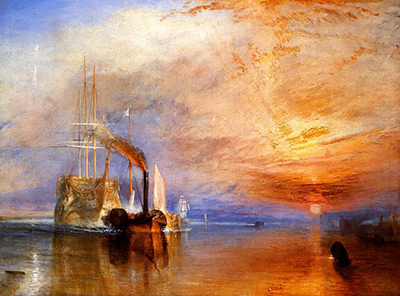
J. M. W. Turner's National Gallery title begins The Fighting Temeraire and continues with the ship being tugged to its last berth for breaking up in 1838.[1] It is one of the central paintings of his late career. The National Gallery dates the picture to 1839, records the medium as oil on canvas, gives the dimensions as 90.7 x 121.6 cm, and identifies the work by inventory number NG524.[1] It entered the National Gallery through the Turner Bequest in 1856 and was recorded in Room 40 when checked.[1] Those facts establish the object: a finished exhibition painting, not a literal ship portrait or a neutral marine document.
The event behind the painting took place in 1838. HMS Temeraire, a 98-gun three-decker famous for its role at the Battle of Trafalgar, had become redundant after decades of service and was being towed from Sheerness in Kent to Rotherhithe in south-east London, where the vessel would be broken up.[1] Turner turned that final voyage into an image of transition. A pale sailing warship moves across a luminous river while a dark steam tug pulls it forward, smoke marking the new power that has overtaken the old.
The painting is often read as a lament for the age of sail, and that reading is understandable. Turner gives the old ship a ghostly dignity, surrounds it with fading light, and removes its naval flag. Yet the National Gallery's interpretation is more subtle than a simple anti-industrial message. Turner took steam power seriously, travelled by modern transport, and painted contemporary technology elsewhere.[1][4] The painting is elegiac, but it is not blind to the force and reality of the modern world.
The National Gallery also warns against treating the image as direct eyewitness reporting. Turner probably did not witness the towing, and may not even have been in England at the time.[1] He imaginatively reconstructed the voyage from contemporary reports and from his knowledge of the ship's history. The result is a work in which factual departure, naval memory, artistic licence and symbolic design are inseparable.
This is why The Fighting Temeraire remains so powerful. It is a picture about a particular ship and a particular journey, but it is also about national memory, obsolescence, modern power, sunset, water, and the emotional charge of seeing an old order carried away by a new one. Turner does not ask the viewer merely to identify a vessel. He asks the viewer to feel the historical pressure of change.
At a Glance
- ArtistJoseph Mallord William Turner
- Full titleThe Fighting Temeraire tugged to her last berth to be broken up, 1838
- Date1839
- MediumOil on canvas
- Dimensions90.7 x 121.6 cm
- CollectionNational Gallery, London
- InventoryNG524
- AcquisitionTurner Bequest, 1856
- ExhibitedRoyal Academy, 1839
- Historical shipHMS Temeraire, 98-gun three-decker
Contents
- Overview
- Object Identity
- The Historical Temeraire
- The Final Journey
- Close Looking
- Artistic Liberties
- Steam, Sail and Modernity
- Trafalgar and Naval Memory
- Poetry and Exhibition
- Colour, Light and Atmosphere
Object Identity
The National Gallery's complete title names the old ship's movement to its final berth and attaches the date 1838 to that journey.[1] The date in the title refers to the event represented: the final movement of the old warship toward the breaker. The painting itself is dated 1839.[1] That distinction matters because it prevents a common confusion. Turner painted the remembered or reconstructed voyage after the event, then exhibited it at the Royal Academy in 1839.
The physical object is an oil painting on canvas measuring 90.7 x 121.6 cm.[1] It is large enough to command sustained looking, but it is not vast in the way Turner's Greenwich Battle of Trafalgar is vast. Its impact comes from concentration rather than sheer scale: a wide river, a white old ship, a black tug, a sinking sun, a sliver of moon, distant masts and a dark buoy in the right foreground.
The acquisition history also shapes interpretation. The National Gallery records the painting as part of the Turner Bequest of 1856.[1] Turner retained it despite offers to buy it, and the Gallery indicates that the work was especially valued by him.[1] That does not make the painting sentimental in a simple sense, but it does suggest that Turner understood its unusual importance within his own career.
Butlin and Joll's catalogue remains the broader oil-painting backbone for Turner's work, while the National Gallery object record supplies the primary facts for this painting.[6] The distinction is useful. The painting is famous enough to attract myths, patriotic anecdotes and simplified readings. Secure interpretation begins with title, date, medium, dimensions, bequest, exhibition record and current institutional account.
The word "Temeraire" itself carries naval memory. The ship's nickname, "Fighting" Temeraire, points back to its action during the Napoleonic Wars, especially the Battle of Trafalgar in 1805.[1] Turner did not invent that memory, but he shaped it visually. By making the vessel pale, almost spectral, and by showing it under tow, he made a famous ship appear both honoured and already passing from the world.
The painting's object identity also prevents an overly loose reading of the subject. It is not simply "a sailing ship and a tug." It is a named naval vessel with a known service history, a known disposal journey and a later institutional life in the national collection. Turner's poetic handling depends on that factual core. If the Temeraire were anonymous, the image would still be beautiful, but it would lose much of its historical pressure.
The title is therefore unusually active. It contains a verb of movement and an announced end. Many painting titles identify a person, place or event, but this one carries the ship forward toward dismantling. The viewer enters the scene already knowing that the voyage has no triumphant destination. The wording makes the painting a passage rather than a static view.
The National Gallery's dating also clarifies Turner's working distance from the event. A 1839 picture of a 1838 journey allows memory, reports and studio invention to intervene. That distance is exactly what gives the painting its measured pathos. Turner is close enough to the event for it to feel current, but far enough from it to redesign the scene as a symbolic image.
The Historical Temeraire
The National Gallery identifies the Temeraire as a 98-gun, three-decker warship built from the wood of more than 5,000 oaks.[1] It had played a distinguished role in the Battle of Trafalgar, helping defend Nelson's flagship, HMS Victory.[1] That history is essential. The ship in Turner's painting is not any old sailing vessel. It is a material survivor of a celebrated naval battle, a floating remnant of wartime victory and national self-image.
By 1838, however, the ship's active life was over. The National Gallery states that peace after 1815 left many great warships redundant, and that from 1820 the Temeraire was moored off Sheerness, mainly serving as a supply ship.[1] The painting therefore compresses a long process of demotion. A vessel once associated with battle glory had become old, stripped, sold and finally moved toward dismantling.
The Admiralty ordered the ship's sale in June 1838. The National Gallery notes that the Temeraire was over 40 years old and valued only for its timber, after being stripped of reusable parts such as masts and yards.[1] The buyer was John Beatson, a Rotherhithe shipbreaker and timber merchant, who paid 5,530 pounds.[1] These details matter because they ground the painting's poetry in practical economics. The old warship became material for salvage.
Because the mastless, 2,110-ton vessel could not sail under its own power, Beatson hired steam tugs to tow it along the Thames.[1] The National Gallery states that the journey took about two days and that the ship reached Beatson's wharf on 6 September.[1] Turner turns this practical towing operation into something much larger. The ship's last movement becomes a ritual passage.
Royal Museums Greenwich helps explain why Trafalgar memory mattered so strongly in Turner's career. Its record for Turner's large Battle of Trafalgar, 21 October 1805 describes that work as his only royal-command painting and as a major, controversial public work.[3] Turner had already wrestled with naval commemoration on a grand scale before returning, decades later, to the remembered afterlife of a Trafalgar veteran.
The Temeraire's history also places the painting inside the broader maritime world explored by Christine Riding and Richard Johns in Turner & the Sea. The Royal Museums Greenwich record for that book foregrounds Turner's engagement with maritime art, naval warfare, technological change, travel and print culture, including works such as The Battle of Trafalgar and The Fighting Temeraire.[2] The painting is therefore not an isolated patriotic image. It belongs to Turner's lifelong conversation with the sea and with Britain as a maritime power.
The practical story is almost harsh in its plainness. A ship built from thousands of oaks, armed for war and remembered for Trafalgar, became a decaying asset. Its useful fittings were removed, its timber value was calculated, and a commercial buyer acquired it for breaking.[1] Turner does not deny this material reality. Instead, he makes its emotional consequences visible.
That shift from service to salvage is one of the painting's deepest subjects. The old ship has not been defeated by an enemy fleet. It has been outlived by peace, age, expense and technology. Its end comes through administration and commerce rather than battle. Turner recognises that such an ending can be just as moving as a dramatic wartime loss because it reveals how public glory becomes obsolete matter.
The age of the ship is also important. More than 40 years old by the time of sale, the Temeraire belonged to a previous generation of naval construction and warfare.[1] Its journey to Rotherhithe was not only the disposal of a single hull. It was a visible sign that the world which had produced it was being rearranged by new machines, new economies and new forms of maritime labour.
The Final Journey
The represented journey runs from Sheerness toward Rotherhithe. That geography matters because it identifies the movement as a Thames passage from naval anchorage to commercial breaking yard.[1] The ship is not returning to battle or to ceremonial honour. It is travelling toward disposal. Turner understood the poignancy of that end, but he did not show the process as blunt demolition. He showed the approach, the in-between moment, the old ship still visible before it disappears.
The National Gallery says Turner probably did not witness the towing and may not have been in England at the time.[1] This point is essential. The painting should not be described as a direct transcription of something Turner saw from the riverbank. It is an imaginative reconstruction made from contemporary reports, from knowledge of the ship, and from Turner's command of marine atmosphere.
That lack of direct witnessing does not weaken the painting. It clarifies its method. Turner was not trying to file a visual report. He was constructing a memorial image. The final voyage had already acquired public meaning because the vessel was famous, and because its movement toward the breaker dramatized the passing of a generation of naval power. Turner shaped that meaning through composition, light and deliberate departures from fact.
The real towing involved two steam tugs, though Turner made one tug dominant and allowed another only at a distance.[1] This choice simplifies the action and sharpens the symbolism. A single dark machine becomes the visible agent of historical change. The Temeraire is large, pale and passive; the tug is small, active and forceful. The size contrast does not mean the tug is morally small. It means the modern power has a different kind of strength.
The journey also took about two days, and the ship finally reached the Rotherhithe yard on 6 September.[1] Turner's painting does not identify a precise hour in that practical itinerary. Instead, the artist selects a sunset mood that gives the image emotional finality. The last berth becomes not only a place but a condition: the end of service, identity and usefulness.
The title's wording is unusually narrative. It does not simply name a vessel. It tells the viewer that the ship is being tugged to the place where it will be broken up. That sentence-like title gives the painting its pathos before the viewer even begins looking closely. It prepares us to see motion as loss.
The journey also transforms scale. Historically, the Temeraire was enormous, but in Turner's painting it is handled with startling delicacy. The tug is smaller, yet it determines the direction of travel. The effect is not merely visual irony. It expresses a new distribution of power: bulk and memory no longer guarantee command, while compact mechanical force can move what once seemed commanding.
Rotherhithe matters as destination because it was not a ceremonial end point. It was a working riverside place of dismantling and salvage. Turner does not show the yard directly, but the title brings it into the viewer's mind. The painting holds the ship just before that final reduction. The viewer sees the old warship while it is still a recognisable vessel, not yet timber and material.
Sheerness matters for a different reason. The ship had been moored there after active service, and Turner may have seen it when passing the area even if he did not witness the final tow.[1] That possibility reinforces a careful distinction: prior familiarity with the vessel is not the same as direct observation of the 1838 journey. The painting can arise from knowledge without being a literal eyewitness scene.
The final voyage therefore occupies a middle condition between record and rite. It happened, and its logistical facts can be described. Yet Turner paints it as a threshold. The ship is moving from identity into disassembly, from naval fame into timber, from one historical order into another.
Close Looking
The most striking contrast is between the pale ship and the dark tug. The Temeraire appears high, delicate and almost weightless, even though the historical vessel was immense. Turner has given it a spectral presence, replacing its actual black and yellow paintwork with white and gold.[1] The old warship seems less like a working hull than a memory taking visible form.
The tug is compact, dark and smoky. Its funnel, paddle power and commercial flag give it a practical identity. It does not resemble the graceful, upright sailing vessels that surround the Temeraire. It works. It pulls. It produces smoke. The tug belongs to a world of utility, fuel and mechanical motion, while the old ship belongs to naval tradition, wind power and ceremonial memory.
The river surface mediates between them. The Thames is calm enough to hold reflections, but not so still that the picture feels frozen. Light trembles across the water. The old ship glows; the tug stains the air; the sunset lays warm colour into the right half of the composition. Turner uses water as a field where history becomes visible through reflection and motion.
The sunset occupies a crucial role. The National Gallery emphasizes the sunset's importance to the elegiac tone and notes that it supports the idea of the Temeraire approaching its final berth.[1] The sun is not just a natural effect. It is the painting's emotional clock. Day is ending as the ship's life ends. The river journey becomes a visual sunset for the age represented by the warship.
At the upper left, a pale moon appears in contrast to the sun.[1] Turner had long been interested in paired or simultaneous celestial effects, but here the sun and moon help organize the painting's transition. The sun sets on the old ship; another light enters the sky. The image is not simply deathly. It also implies sequence: one age declines as another emerges.
In the lower right, the buoy is a quiet but important form. The National Gallery notes how it counterbalances the sun and helps establish scale.[1] It also anchors the foreground. Without it, the eye might drift too easily into sunset and haze. With it, Turner keeps the viewer aware of river space, navigation and material reality.
The left side of the painting is therefore not simply "old." It is carefully layered. The Temeraire, the crescent moon and the cooler light create an atmosphere of distance and memory. The right side is not simply "new." It contains the sunset, the tug, the buoy and warmer colour. Turner does not organize the scene as a diagram, but he does give the viewer visual oppositions that carry historical feeling.
The old ship's pale colouring also affects how we read its materiality. A warship made from thousands of oaks should feel heavy, but Turner makes it seem almost weightless. Its masts rise like remembered forms rather than functioning equipment. This is not a denial of naval substance. It is a way of showing that the ship's meaning now belongs less to action than to memory.
The tug's smoke is equally active. It stains the air and passes backward through the space of the old ship's restored rigging. This visual contact matters. Modern steam is not merely next to old sail; it enters it, crosses it and partly obscures it. Turner makes the transition between eras atmospheric rather than mechanical alone.
The distant masts deepen the time scale. They suggest that the river is full of other vessels and other maritime histories, not just the old warship and tug. The Temeraire is exceptional, but it moves within a larger world of navigation, labour and trade. The painting's emptiness is therefore selective. Turner clears enough space to make the old ship memorable, while leaving signs of the wider river economy.
Artistic Liberties
The National Gallery is explicit that Turner took liberties with the facts, partly to preserve the ship's dignity and to draw symbolic meaning from the scene.[1] This is the right way to understand the painting's historical inaccuracies. They are not careless mistakes. They are purposeful transformations. Turner reshaped the event so the image could carry more than documentary information.
The real Temeraire had been stripped of reusable parts before sale, including masts and yards.[1] Turner restored lower masts and some rigging, with furled sails giving the ship a more complete and noble silhouette.[1] The choice alters the physical state of the vessel. It also helps viewers recognise the ship as a warship of the age of sail, not simply as a dismantled hulk.
Turner also changed the ship's colour. The National Gallery states that he replaced its original black and yellow paintwork with white and gold.[1] This is one of the painting's most important poetic decisions. White and gold remove the ship from ordinary material description. They make it seem ghostly, ceremonial and already partly beyond the present.
The tug is altered as well. The National Gallery notes that Turner placed the black funnel in front of the mast rather than behind it, so that smoke could blow back through the Temeraire's masts.[1] This adjustment intensifies the visual encounter between steam and sail. The tug's smoke does not remain separate. It invades the space of the old ship.
The sunset is another instance of licence. The National Gallery explains that the Temeraire probably reached Rotherhithe in the afternoon and that Turner's sunset is set in the wrong direction for the journey.[1] The point is not that Turner misunderstood geography. The point is that he chose sunset as a symbolic condition. The sky becomes a way of thinking about ending.
Even the number of tugs is adjusted. Historically, two tugs were hired, but Turner gives the main role to one, with another only faintly visible.[1] A literal double-tug operation would diffuse the image's force. One dominant tug allows the painting to read as a dramatic relation between old naval sail and modern steam.
These liberties should be treated as central to the painting's meaning. Turner was not erasing history. He was making its implications visible. The altered masts, colour, tug design and sunset all push the viewer away from mere record and toward symbolic understanding.
The corrected engraving episode, noted by the National Gallery, is revealing because Turner objected when the tug's design was altered to match mechanical fact more closely.[1] His anger shows that the displacement of the funnel was not a casual slip. The altered tug was part of the composition's emotional logic. Correcting it as engineering would damage the painting as art.
The masts offer a similar lesson. A stripped hulk would have been historically accurate, but it would not have carried the same public memory. Turner restores enough of the ship's sailing identity for the viewer to feel what is being lost. The restored rigging is not evidence of the ship's actual state in 1838. It is evidence of what Turner needed the vessel to signify.
The colour change from black and yellow to white and gold also shifts the ship from service reality into memorial vision.[1] The vessel becomes less a thing seen in daylight and more an apparition formed by recollection, patriotism and sunset. Turner's licence is therefore not a departure from seriousness. It is the means by which the painting becomes serious.
The sunset's impossible direction is perhaps the clearest example. A geographical correction would weaken the image's central feeling. Turner needed the sun to fall behind the old ship's symbolic end. The factual course of the Thames mattered, but the emotional direction of the painting mattered more.
Steam, Sail and Modernity
The painting's central drama is often summarized as sail giving way to steam. That summary is useful, but it can become too neat. Turner does not simply condemn the tug or celebrate the old warship. The National Gallery notes that some critics saw the painting as critical of the tug and what it represented, but also stresses that Turner's attitude to industrial modernity was more ambiguous.[1]
That ambiguity is important for Turner as a whole. He regularly engaged with modern life and travelled on new forms of transport, including steamships and railways.[1] The National Gallery makes a similar point about Rain, Steam, and Speed - The Great Western Railway, noting that Turner's interest in industry and technology makes it unlikely that the railway painting is a rejection of modernity.[4] The Fighting Temeraire should be read with that wider pattern in mind.
The tug is dark, smoky and low, but it is also necessary. Without it, the old ship cannot move. The Temeraire has dignity, but it no longer has operational power. The tug may seem visually unattractive beside the luminous warship, yet it is the active agent. Turner therefore creates emotional tension rather than a simple moral division.
Steam power also changes the meaning of maritime space. The age of sail depended on wind, rigging, skilled crews and naval hierarchy. Steam promised a different relation between vessel, time and movement. It was not bound to wind in the same way, and it belonged to a world of commercial energy, engineering and industrial infrastructure. Turner compresses that change into the relation between tug and ship.
The painting is not a technical diagram of steam. Turner does not explain machinery. He shows its effect. The tug pulls; smoke blows; the old ship moves without sails. The viewer understands modern power through visual action and atmosphere rather than through engineering detail.
The result is a painting that mourns without refusing the future. The Temeraire is beautiful because it is passing. The tug is forceful because it belongs to the present. The sunset gives pathos to the old ship, but the smoke announces a world that Turner knew was already here.
The ambiguity can be seen in the tug's visual treatment. It is dark and almost blunt beside the luminous ship, but it is not weak, ridiculous or marginal. Turner gives it the power of movement. It sits low in the water, yet it organizes the whole action. The old ship receives the painting's most tender light, but the tug has the painting's working energy.
This balance fits Turner's broader practice. He did not reserve art only for ruins, mountains, myth and storms. He also treated railway bridges, steam engines, burning government buildings and other modern events as subjects capable of pictorial grandeur. The Temeraire painting participates in that expansion. It makes machinery part of history painting's emotional territory.
It is also important that the tug is commercial. The old warship has left naval identity behind; the tug's flag belongs to another order of use.[1] Turner therefore presents modernity not only as machine power but as a change in ownership, labour and value. The vessel that once embodied public military force is now moved through a commercial process.
The painting's ambiguity is what keeps it alive. A simple anti-steam message would be easier, but less true to Turner's art. A simple celebration of progress would be equally thin. Turner gives the viewer a more difficult image: the future works, the past glows, and neither can be dismissed.
Trafalgar and Naval Memory
The Temeraire's meaning depends on Trafalgar. The National Gallery records that the ship defended Nelson's Victory during the 1805 battle.[1] That link makes the vessel a carrier of national memory. It had once belonged to a moment of naval triumph; in Turner's painting it belongs to a quieter scene of disposal.
Turner had already treated Trafalgar directly. Royal Museums Greenwich describes his large Battle of Trafalgar, 21 October 1805 as a royal-command work commissioned late in 1822 and intended as part of a patriotic post-war setting at St James's Palace.[3] That earlier project asked Turner to represent battle and national commemoration in a grand public mode. The Fighting Temeraire approaches naval memory differently. It does not show combat. It shows aftermath.
Aftermath can be more emotionally complex than victory. In battle imagery, a ship's significance is tied to action, danger and glory. In Turner's 1839 painting, significance is tied to survival, age and removal. The ship is famous because of what it once did; it is moving because it can no longer do it. That gap between past action and present passivity gives the painting its melancholy force.
The missing naval flag sharpens the issue. The National Gallery notes that Turner indicates the ship no longer flies the Union flag because it has ceased to be naval property.[1] The absence is quiet but charged. The ship that once belonged to national service now belongs to a breaker. Its identity has changed before the viewer's eyes.
The tug's commercial flag adds another layer.[1] This is not just old military power beside new machinery. It is naval honour beside commercial use. The ship passes from public service into private dismantling, from battle memory into timber value. Turner makes that change visible without needing an explanatory scene of sale.
The painting is therefore a memorial, but not a conventional monument. It has no statue, inscription or parade. Its memorial form is atmospheric: the pale ship, the dark tug, the setting sun, the empty flag position, the water and the haze. Turner turns naval memory into a river passage.
That atmospheric memorial differs from Turner's earlier Trafalgar work. The Greenwich painting gathers many battle episodes into a large commemorative composition, a choice that helped make it controversial.[3] The Fighting Temeraire avoids battle confusion by focusing on one symbolic action. Instead of showing conflict at sea, it shows the quiet movement of a survivor toward dissolution.
The quietness is part of the emotional force. There are no cannon blasts, no wreckage of combat, no heroic figures standing forward. The old ship's glory is carried by what is absent: battle, crew, flag, movement by sail, and naval purpose. Turner asks the viewer to recognise the weight of history in a scene where very little appears to happen.
The painting also reframes national pride. Trafalgar memory could support triumphal celebration, but here it is tied to loss and disposal. The same ship that helped defend Victory is being hauled by a tug to be broken apart.[1] Turner's patriotism, if we use that word, is elegiac rather than boastful. It honours service by acknowledging endings.
Poetry and Exhibition
When Turner exhibited the painting at the Royal Academy in 1839, he attached lines adapted from Thomas Campbell's poem Ye Mariners of England.[1] The National Gallery records the key phrase "No longer owns her" in relation to the absent flag.[1] Turner used poetry to frame the painting's emotional and patriotic meaning. The words did not replace the image, but they guided viewers toward loss and dispossession.
The Royal Academy context matters because the painting first met viewers as a public exhibition work. It was not a private study of a ship. It was a highly finished painting presented to an audience familiar with naval memory, patriotic verse and current debates about modern change. Turner knew that the old ship would be read symbolically.
The poem's adapted line draws attention to possession. The flag that once belonged to the ship, and to which the ship once belonged, is gone. That absence is not a minor detail. It changes the vessel's status. The Temeraire is still visible, but it is no longer what it was.
The National Gallery notes that reviewers in 1839 singled out the work for praise, often recognizing its poetic and patriotic resonance.[1] That early reception confirms that viewers saw more than a maritime incident. They saw a painting about national feeling, time and the old ship's dignity.
Turner's handling of poetry should not be confused with illustration. He did not simply paint Campbell's poem. He borrowed and adapted a phrase because it intensified the painting's central problem: what remains when a symbol of naval service is separated from the flag and world that once defined it.
The exhibition frame also helps explain the painting's careful balance of detail and atmosphere. Turner needed enough factual identity for viewers to recognize the Temeraire, but he also needed enough visual poetry for the image to rise beyond news. The painting succeeds because those two demands support each other.
The adapted Campbell line also points to Turner's own literary habits. He often associated paintings with poetry, sometimes using verse to extend their meaning. In this case, the line about the flag focuses attention on a precise pictorial absence. Viewers who noticed the missing naval ensign could connect that absence to the poem's past-tense language and to the ship's changed status.
The line is short, but its effect is large. It tells the viewer that a relation has ended: flag and ship no longer belong together. The painting then makes that ended relation visible through the tug's commercial flag, the old ship's pale hull and the sunset around them. Turner uses poetry not as ornament, but as a key to the image's central loss.
The Royal Academy audience would also have seen the painting amid other works, not in isolation. That setting matters because Turner had to make the image command attention while retaining ambiguity. The luminous sky and stark ship-tug contrast would have carried immediate visual force. The historical and poetic references would then deepen the initial impression.
Colour, Light and Atmosphere
Colour is central to the painting's emotional intelligence. The old ship is pale, the tug is dark, the sky is warm, and the water carries reflected tones across the foreground. Turner sets cool and warm passages against each other so that the viewer feels transition before analysing it. The painting is structured by oppositions: white and black, sail and steam, moon and sun, memory and modern force.
The National Gallery describes the Temeraire as having a ghostly presence after Turner changed its colours to white and gold.[1] That ghostliness is not merely decorative. It makes the ship appear as a vision of its former self. The vessel is still physically present, but Turner paints it as if it already belongs to recollection.
The dark tug gains force from its colour. It is not just a smaller object. It is a visual counterweight. Its smoke and hull create a compact mass against the old ship's pale verticals. The viewer senses that modern power does not need grandeur to be effective. It needs energy, fuel and purpose.
The sunset has several functions at once. It gives the picture warmth and splendour. It reinforces the idea of ending. It also creates a theatre of light in which the ship's white and gold can glow. The sun's placement may be geographically impossible, but it is pictorially decisive. Turner lets symbolic light override literal direction.
The moon changes the mood. If the sunset were alone, the painting might become a simple image of finality. The crescent at left suggests a different cycle of light. It does not cancel loss, but it prevents the painting from being merely terminal. One source of light declines; another appears.
Atmosphere unites the whole scene. Smoke, haze, water and sky prevent the objects from being isolated. The tug's smoke passes through the old ship's masts; sunset colour spreads into the river; distant vessels dissolve into light. Turner makes history feel like air, not just like objects.
The painting's colour also refuses dry nostalgia. White and gold might suggest purity or memory, but they are set beside smoke, dark water and a strongly physical tug. The old ship is not allowed to float away into pure dream. It remains attached by towline and movement to the present. The colours make it radiant, but the composition keeps it bound.
The sun's disc and the buoy create a subtle formal balance. One is luminous and distant; the other is dark and near. They help stabilize a scene that might otherwise dissolve into haze. Turner uses these anchors to keep the painting from becoming only atmosphere. The viewer remains aware of orientation, depth and the practical river environment.
The moon, by contrast, is delicate. It is easy to miss if the viewer concentrates only on the sunset. Its slightness is part of its role. The painting's new light is not triumphant; it is tentative. The image suggests change without making that change comfortable.
Turner's surface also encourages slow looking. The eye moves from tug smoke to masts, from ship to moon, from buoy to sun, from reflection to distant sail. No single element exhausts the painting's meaning. The historical story is concentrated in a few forms, but the emotional experience is distributed across the whole atmosphere.
Turner and the Sea
Turner's career cannot be separated from maritime subjects. He painted warships, fishing boats, storms, shipwrecks, ports, coasts and river passages across decades. The Fighting Temeraire draws on that long experience, but it does something unusually concentrated with it. It uses a maritime scene to think about national change.
The Royal Museums Greenwich record for Turner & the Sea emphasizes Turner's creative response to maritime affairs in an age marked by naval warfare, rapid technological change and increased travel.[2] That description fits the Temeraire painting closely. The picture gathers all three conditions: a warship remembered from battle, a steam tug as modern technology, and a river journey toward dismantling.
Turner's marine art often depends on the relation between vessel and environment. Ships are not isolated objects in his best sea paintings. They are tested by weather, light, water and human history. In The Fighting Temeraire, the test is not storm but time. The ship is overcome by age, policy, economy and technological change.
The sea tradition also gives the painting dignity. A ship under sail had long been a subject of beauty, power and skill. Turner understood that tradition and used it to make the old vessel noble. At the same time, he sets that tradition beside the unidealized tug. The painting becomes a meeting between maritime painting's inherited grace and the modern river's working machinery.
The river setting is especially important. This is not open ocean. The Thames is a working waterway tied to London, commerce, navy, industry and empire. By placing the famous warship on that river journey, Turner brings national memory into the space of ordinary transport and labour.
The painting therefore belongs both to marine painting and to the history of modern Britain. Its maritime beauty is inseparable from its industrial setting. Turner shows the sea's old symbols being moved by the river's new power.
Turner's marine knowledge also explains why the painting can be so economical. He did not need to describe every rope, plank and fitting to make the ship convincing. He could reduce detail because he understood the forms he was transforming. The Temeraire's dignity comes from selective memory, not from exhaustive description.
This selectiveness distinguishes the painting from a naval illustration. A technical view of the ship might have preserved more exact information about its construction or stripped condition. Turner gives less technical description and more historical feeling. He chooses the details that allow the ship to stand for a whole maritime order.
The tug receives the same selective treatment. It is not a complete engineering study, and the National Gallery notes the altered funnel arrangement.[1] But it is convincing as a force. Its smoke, dark hull and tow function tell us what it does. Turner is interested in the tug's historical role more than in its exact design.
Seen in this way, the painting is a compressed maritime essay. It addresses naval war, shipbuilding, decommissioning, river labour, steam power and national memory through a single scene. That compression is one reason the work has remained so widely discussed.
Reception and Afterlife
The National Gallery states that the painting was praised when first exhibited in 1839 and that reviewers noted its poetic and patriotic resonance.[1] That early response is important because it shows how quickly the work was understood as more than a ship image. Viewers recognized that Turner had made a public symbol from a contemporary event.
The Gallery also records that Turner kept the painting until his death in 1851 despite offers to buy it.[1] It later entered the nation through the Turner Bequest.[1] This afterlife helps explain the painting's special status. It was not absorbed into a private collection and removed from public view for generations. It became part of the national Turner inheritance.
Turner's attachment to the painting has become part of its story. The National Gallery states that it seems to have held a special place in his affections and records the tradition that he referred to it as his "Darling."[1] That detail should be used carefully, but it is relevant because it aligns with the painting's later reputation as one of Turner's defining works.
The painting's popularity can sometimes flatten it. It is easy to turn it into a comfortable image of nostalgia: beautiful ship, ugly tug, sad sunset. The object record resists that simplification. It emphasizes factual liberties, unlikely witnessing, modern transport, critical debate and Turner's ambiguous relation to industrial life.[1] The painting's fame should not make it less complex.
Ruskin's later writing is part of the wider reception field. The National Gallery's essay on Ruskin describes him as one of the Victorian era's most influential art critics, and notes that Modern Painters unfolded across five volumes between 1843 and 1860.[5] He mattered enormously to Turner's public reputation. Yet the Temeraire painting should not be reduced to Ruskinian praise alone. Its first power lies in Turner's own 1839 composition and exhibition framing.
The long bibliography attached to the National Gallery record also reflects the painting's afterlife. Writers returned to it across the nineteenth and twentieth centuries, from early critics to later Turner scholars.[1] That continuity is a sign of interpretive richness. The painting can sustain patriotic, technical, maritime, industrial and poetic readings because it was built from all of those elements.
The painting's later fame has also made it vulnerable to shorthand. It is often treated as the Turner painting that everyone knows, which can encourage a quick reading. The National Gallery record helps slow that reading down by insisting on the inconvenient details: probable non-witnessing, altered rigging, changed colour, the wrong sunset direction and the revised tug.[1] Those details make the painting more interesting than its reputation alone.
Its afterlife in public collection also changes the way viewers meet it. A work kept by Turner, then transferred through the bequest, carries a different historical aura from a work immediately sold into private hands. The painting's public identity is not separate from its subject. A national image of a national ship became part of a national collection.
The painting's appeal across time may come from the fact that its theme is not limited to naval history. Many viewers can understand the emotional pattern: an honoured thing outlives its use; a new force arrives; beauty and usefulness no longer align; memory survives while material forms pass away. Turner gives that pattern the specificity of a ship, a river and a sunset.
### Comparison with Rain, Steam and Speed
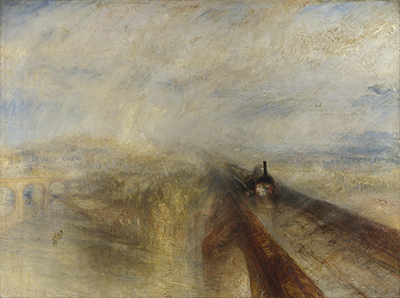
The Fighting Temeraire and Rain, Steam, and Speed - The Great Western Railway are often discussed together because both address modern transport. The comparison is useful, but each painting works differently. The Temeraire painting sets a steam tug beside an old sailing warship. The railway painting places the viewer before a train crossing Brunel's Maidenhead Railway Bridge in rain.[4]
The National Gallery records that Rain, Steam, and Speed was painted in 1844 and shows a locomotive on the Great Western Railway.[4] It also states that Turner was interested in industry and technology and that the painting is unlikely to be a simple rejection of modernity.[4] That point helps keep the Temeraire interpretation balanced. Turner's dark tug should not automatically be read as a villain.
In the railway painting, modern power rushes toward the viewer. In the Temeraire painting, modern power pulls the past away. One image is about arrival; the other is about departure. One makes speed its central force; the other makes transition and memory central. Together they show Turner returning to new technologies as subjects worthy of serious painting.
The treatment of nature differs too. In Rain, Steam, and Speed, rain and atmospheric blur heighten the train's velocity. In The Fighting Temeraire, sunset and haze slow the viewer down. The tug is active, but the overall mood is meditative. The comparison shows how Turner could use weather and light to shape very different meanings around modern transport.
Both works also resist simple opposition between nature and machine. The railway bridge, train, tug, river, sky and weather all share the painted world. Turner does not isolate machinery as an alien object. He absorbs it into atmosphere, making modern life visible through rain, smoke, light and water.
This is why the Temeraire painting should be read as ambiguous modernity rather than anti-modern certainty. The old ship receives more visual beauty, but the tug carries the action. Turner mourns the passing of one order while recognising that another order already moves the world.
The comparison also shows Turner's different tempos. The train painting creates a rush toward the viewer; the ship painting slows movement into ceremony. Both involve modern power, but their emotional speeds differ. Turner could make steam feel violent, exhilarating, melancholy or inevitable depending on the pictorial problem before him.
The paintings also differ in how they handle older forms. In Rain, Steam, and Speed, the railway bridge and train dominate the scene, while older travel forms are secondary or implied. In the Temeraire painting, the older form remains visually central even though it has lost practical command. Turner therefore gives the old ship a last radiance that the railway picture does not need.
Together, the two works confirm that Turner's modernity was not a single attitude. He did not simply cheer machines or denounce them. He studied what they did to perception, time, labour and inherited forms of beauty. In one case, a locomotive cuts through rain; in the other, a tug pulls a warship through sunset.
How to Read the Painting
Begin with the old ship's physical condition. The historical Temeraire had been stripped before sale, but Turner restored masts and rigging so the viewer would see a dignified sailing warship rather than a mere hulk.[1] This tells us immediately that the painting is symbolic reconstruction.
Then look at the tug. Its dark form, smoke and commercial flag make it the active force in the scene. It is small compared with the old warship, but it controls the movement. Turner uses that imbalance to show how historical power can change shape. The large ship represents past prestige; the smaller machine represents present function.
Next, attend to the missing Union flag. The National Gallery notes that Turner indicates the Temeraire no longer flies it because the ship has ceased to be naval property.[1] The absence matters as much as any visible detail. It tells the viewer that the vessel's status has changed irrevocably.
After that, read the sky. The sunset is not geographically literal, and the timing probably does not match the real arrival at Rotherhithe.[1] Turner is using sunset to give the scene its elegiac tone. The moon at left complicates that ending by introducing another kind of light.
Finally, hold fact and poetry together. The ship was real; the towing occurred; the breaker was real; the sale price, stripping and journey belong to the historical account.[1] But the painting's meaning comes from Turner's transformation of that account. The image is truthful not because it records every detail accurately, but because it makes the event's emotional and historical significance visible.
### Common Misreadings
The first misreading is to claim that Turner simply painted what he saw. The National Gallery states that he probably did not witness the towing.[1] The painting is better understood as an imaginative reconstruction based on reports and memory. That makes the work more deliberate, not less credible.
The second misreading is to call every departure from fact an error. Turner restored masts, changed colours, altered the tug, simplified the towing arrangement and moved the sunset.[1] These choices are not accidents to be corrected away. They are the means by which he converted a towing operation into a meditation on service, obsolescence and historical change.
The third misreading is to treat the tug as only ugly or villainous. The tug is dark and smoky, and it intrudes on the old ship's dignity. But it also performs the work. Turner knew steam power as part of modern life and made modern transport a serious subject in more than one major painting.[1][4] The tug should be read as unsettling, practical and historically necessary.
The fourth misreading is to turn the painting into pure nostalgia. Turner does mourn something, but nostalgia alone cannot account for the painting's complexity. The old ship is beautiful because it is no longer powerful. The tug is visually harsh because it is effective. The sunset is moving because it is symbolic, not because it offers a simple retreat into the past.
The fifth misreading is to detach the painting from naval history. Without Trafalgar, the Temeraire would not carry the same charge. The vessel's past as a defender of Victory gives the final tow its national resonance.[1] Turner paints an ending made meaningful by an earlier moment of battle memory.
The final misreading is to forget that this is an artwork with a public exhibition history. It was shown at the Royal Academy in 1839 with adapted poetic lines.[1] It entered later public memory through the Turner Bequest.[1] Its fame is not accidental; it grew from the painting's ability to join current event, national feeling and visual invention.
Another misreading is to treat the old ship as purely passive. It is being towed, but it still dominates the emotional field. Turner gives it height, light and delicacy. Its lack of practical power becomes the condition of its visual authority. The ship commands memory even after losing command of movement.
It is also misleading to treat the sunset as just pretty background. The National Gallery identifies sunset as fundamental to the painting's elegiac tone.[1] Its wrong direction and likely mismatch with the real timing make it even more important. Turner places emotional truth above geographic literalism.
Finally, one should avoid flattening the painting into biography. Turner's attachment to the work matters, but the image cannot be explained only by personal affection. It also draws on public naval history, Royal Academy exhibition culture, maritime technology, poetic allusion and the state of Britain after the Napoleonic Wars. Its richness comes from that combination.
Why The Fighting Temeraire Matters
The painting matters because it gives visual form to historical transition. Turner does not explain the end of sail and the rise of steam in abstract terms. He shows a revered warship being pulled by a workmanlike tug. The image condenses technology, memory and emotion into a single river scene.
It also matters because it demonstrates Turner's late ability to fuse fact and poetry. The details of the Temeraire's sale, stripping, towing and breaking are specific. Yet the painting is not trapped by fact. Turner uses colour, light, altered rigging and symbolic sky to make the event resonate beyond ordinary record.
The work is central to Turner's marine art. It belongs to a career-long engagement with ships, weather, naval war, travel and maritime labour. The Royal Museums Greenwich framing of Turner and the sea helps explain that breadth.[2] The Fighting Temeraire is one of the clearest moments when that maritime experience becomes a meditation on national time.
The painting is equally central to Turner's modern subjects. Alongside works such as Rain, Steam, and Speed, it shows Turner treating new technology as pictorially serious.[4] He did not retreat from the modern world. He transformed it into atmosphere, light and symbolic relation.
Its continuing importance also comes from its emotional balance. The image is beautiful, but not merely pretty. It is patriotic, but not merely celebratory. It is elegiac, but not anti-modern in a simple way. It honours the old ship while allowing the tug to pull it onward.
Finally, the painting matters because it remains a model of how art can represent change without reducing it to a slogan. Turner understood that historical change is felt through objects: a flag no longer flown, a mast restored in memory, a tug's smoke crossing old rigging, a sunset placed where it should not be but where the painting needs it to be.
Frequently Asked Questions
It shows the final journey of HMS Temeraire, a Trafalgar veteran, as it is towed from Sheerness toward Rotherhithe to be broken up.[1] Turner turns that journey into a symbolic image of naval memory, ageing, steam power and historical change.
The National Gallery says direct witnessing is unlikely and even raises doubt about whether Turner was in England then.[1] He imaginatively reconstructed the scene from contemporary reports and from knowledge of the ship's history.
The title's 1838 date refers to the ship's final journey. The National Gallery dates the painting itself to 1839.[1]
The National Gallery, London holds the work under inventory number NG524. The Gallery records it in the main collection and identifies Room 40 as its display location when checked.[1]
Turner restored masts and rigging, changed the ship's colours, adjusted the tug and altered the sunset to heighten the painting's symbolic meaning.[1] These choices should be read as artistic liberties, not simple mistakes.
The Temeraire had helped defend Nelson's Victory at the Battle of Trafalgar in 1805.[1] That history gives the old ship's final journey its emotional and national weight.
Discussion
How does Turner make one ship's final journey carry the pressure of technological and historical change?
Reader Insights
How do the pale warship and dark tug direct your attention?
What does the missing naval flag add to the painting's elegiac force?
Does the steam tug appear destructive, necessary, or deliberately ambiguous?
Join the Conversation
Share a close observation or a question for other readers.
References
- National Gallery, London, "Joseph Mallord William Turner, The Fighting Temeraire." https://www.nationalgallery.org.uk/paintings/joseph-mallord-william-turner-the-fighting-temeraire
- Royal Museums Greenwich, "Turner & the sea / Christine Riding and Richard Johns." https://www.rmg.co.uk/collections/library/rmgl-152360
- Royal Museums Greenwich, "The Battle of Trafalgar, 21 October 1805." https://www.rmg.co.uk/collections/objects/rmgc-object-12057
- National Gallery, London, "Joseph Mallord William Turner, Rain, Steam, and Speed - The Great Western Railway." https://www.nationalgallery.org.uk/paintings/joseph-mallord-william-turner-rain-steam-and-speed-the-great-western-railway
- National Gallery, London, "John Ruskin and the National Gallery." https://www.nationalgallery.org.uk/paintings/john-ruskin-and-the-national-gallery
- Martin Butlin and Evelyn Joll, *The Paintings of J. M. W. Turner*, revised edition, Yale University Press, 1984.