

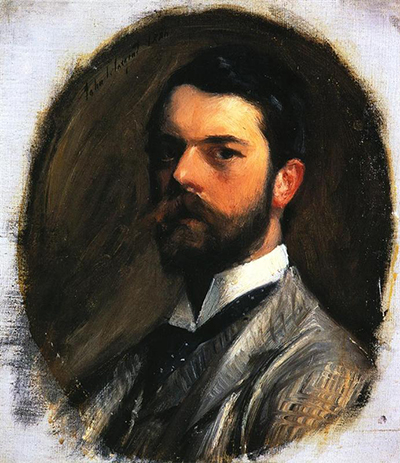
 by Tom Gurney
Tom Gurney BSc (Hons) is an art history expert with over 20 years experience
Published on June 19, 2020 / Updated on July 19, 2026
Email: tomgurney1@gmail.com / Phone: +44 7429 011000
John Singer Sargent Self-Portrait, 1886: Introduction
John Singer Sargent's 1886 self-portrait belongs to one of the most delicate moments in his career. It was made after the hostile reception of Portrait of Madame X in Paris and as Sargent was turning toward London, where he would rebuild his reputation and become one of the defining portrait painters of the age. The work is not a private diary in paint. It is a public image by an artist who understood exactly how much a face, a pose, and a painted surface could be asked to carry.
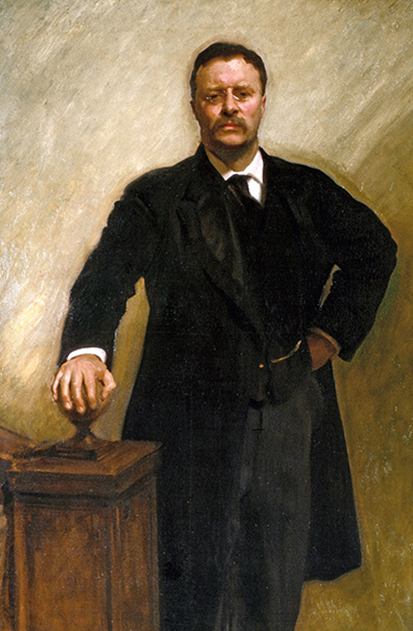
That makes the 1886 self-portrait more than a likeness. Sargent spent his career constructing other people's visibility: society women, artists, actors, children, presidents, military officers, patrons, and friends. In a self-portrait, the sitter and the maker become the same problem. The painter who could make others appear poised, exposed, theatrical, guarded, or authoritative had to decide how the painter himself should be seen.
The Aberdeen Archives, Gallery and Museums record is the principal object authority for the 1886 Self-Portrait [1]. A Smithsonian Catalog of American Portraits record provides a further public catalog path for the same work [2]. Those records anchor the object; Sargent's wider biography explains why the date matters. In 1886 he was a young master recalibrating his career after a very visible wound.
Contents
- Introduction
- Why 1886 Matters
- A Portraitist Looking At Himself
- Self-Image After Madame X
- Aberdeen, Catalog Records, And Object Caution
- The Self-Portrait Sequence
- How To Look At The Portrait
- Related Works And Where To Go Next
Why 1886 Matters
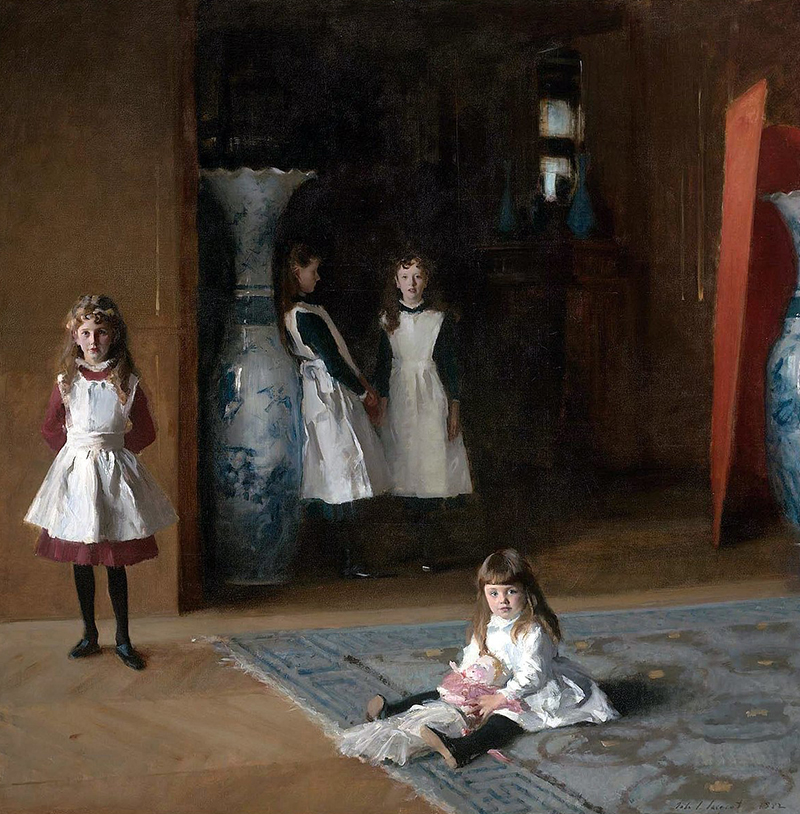
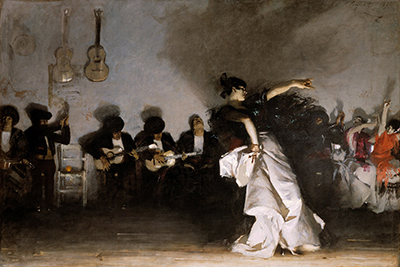
The date is the first key to the portrait. Sargent had already achieved serious success in Paris before 1886. He had trained with Carolus-Duran, absorbed direct painterly methods, studied old masters such as Velazquez, and made ambitious works including The Daughters of Edward Darley Boit and El Jaleo. He was not an uncertain beginner. He was an artist whose gifts had already become public.
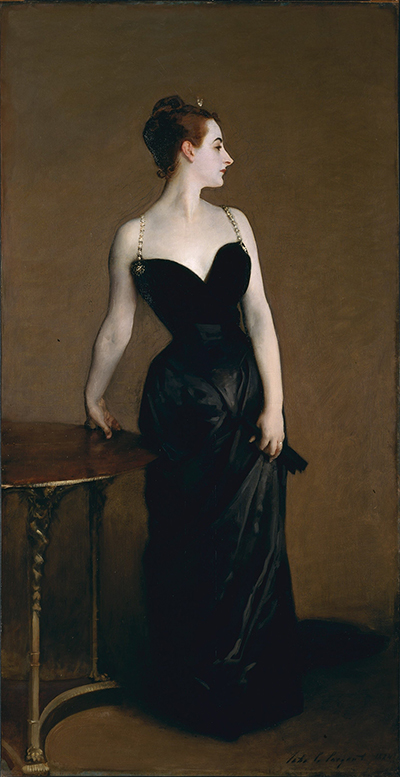
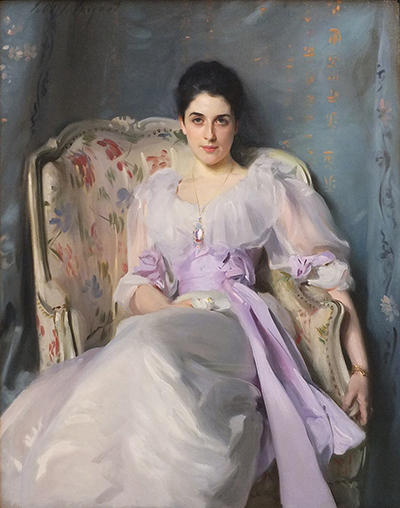
Then Portrait of Madame X changed the weather around him. Exhibited at the Paris Salon in 1884, the picture became a social and professional crisis. The Metropolitan Museum of Art's account of the painting's history makes clear that the work's first reception damaged both sitter and painter and helped redirect Sargent's career away from Paris [3]. The problem was not only the famous strap. The painting made Virginie Gautreau's public image too severe, too charged, and too exposed for its first audience.
By 1886, Sargent was seeking a new footing. The Sargent biography places this moment inside a broader London turn: after Paris, he rebuilt his career among British and Anglo-American patrons, becoming the portraitist many fashionable sitters wanted [4], [5]. The National Galleries of Scotland material on Lady Agnew of Lochnaw records that, after settling in London in 1886, he initially found clients difficult to secure because his continental bravura style attracted suspicion [6].
That context gives the self-portrait its pressure. The date places the image between damaged Paris confidence and future London authority. He was already brilliant, already controversial, and not yet securely remade in the public imagination. A self-portrait from that moment becomes a statement about professional presence. [7], [8]
A Portraitist Looking At Himself
Sargent's portrait art depends on the construction of appearance. In the portraits article, his sitters are described through pose, gaze, costume, hands, setting, and the pressure of being seen [9]. That same vocabulary matters here, even when the sitter is the artist himself.
Self-portraiture can tempt viewers toward biography by shortcut. Because the artist paints himself, it is easy to treat the image as confession. That is risky with Sargent. His art rarely gives simple access to inner life. It is more exact to think of the 1886 self-portrait as a controlled encounter between likeness and role. Sargent is not only showing what he looked like. He is deciding what kind of painter appears before the viewer.
This distinction is important because Sargent was unusually alert to public image. Madame X had shown that portraiture could exceed the intentions of painter and sitter. A picture could become an event, and an event could change a career. In a self-portrait, Sargent had no patron to satisfy, but he still faced an audience.
The technical question is also a portrait question. Sargent's style is often called effortless, but the style-and-technique article frames it more precisely as controlled freshness: major decisions about light, dark, head angle, surface, and finish made early enough for the image to feel alive [10]. A self-portrait asks that method to work under special conditions. The artist must be both observer and object. He must use the same economy, sharpness, and restraint that he used for others, while knowing that viewers will read the result as a statement about him.
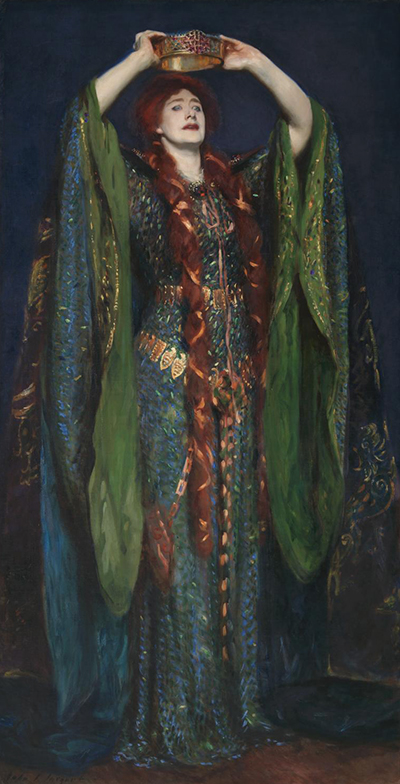
The painting therefore belongs with Sargent's artist portraits. His images of Claude Monet, Auguste Rodin, Ellen Terry, and other creative figures ask how a maker's identity can be turned into visual form. In 1886, the creative figure is Sargent himself.
Self-Image After Madame X
The 1886 self-portrait should not be reduced to the scandal around Madame X, but it cannot be separated from it either. Sargent's early Paris reputation had been built through daring. The same daring made Madame X unforgettable and socially dangerous. When he painted himself two years later, he was working in the aftermath of a lesson every portraitist fears: that the image may become more powerful than its maker can control.
That aftermath helps explain the self-portrait's interest. Sargent did not need to advertise novelty in an obvious way. He needed to appear as an artist capable of command. The image can be read as a form of professional steadiness: a painter presenting himself not as a wounded figure, but as someone still able to hold the terms of looking.
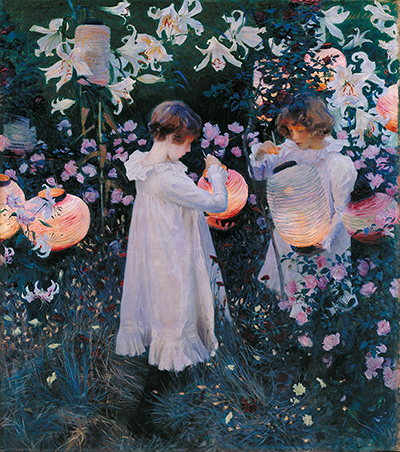
This is not a claim about Sargent's private emotion. The sources do not invite melodrama. The stronger claim is about career position. Other works from the same period show the variety of his response. Claude Monet Painting by the Edge of a Wood, dated 1885 in Tate-linked and Smithsonian records, places him close to outdoor painting and artistic friendship [7], [11]. Carnation, Lily, Lily, Rose, painted across 1885 and 1886, shows him working at Broadway in England on evening light, children, flowers, and patient revision [8], [12]. These works show someone widening his field while the portrait career found new ground.
Against that background, the self-portrait becomes part of a larger reset. Sargent was testing how portraiture, outdoor experiment, painterly surface, and public reputation could be reorganized after Paris.
Aberdeen, Catalog Records, And Object Caution
The Aberdeen record gives the 1886 self-portrait a museum anchor [1]. The Smithsonian Catalog of American Portraits record gives the work a second catalog presence [2]. Together they make the painting viable as an individual article rather than a stray biographical illustration.
At the same time, the article should stay careful. The cited records support strong object identity and a promising image status, but not every detail a full museum label might include. Where medium, measurements, accession data, or display history are not present in the cited records, they should not be invented.
That caution does not weaken the interpretation. The work's significance rests on date, subject, collection authority, and relation to Sargent's portrait practice. A self-portrait from 1886, documented by Aberdeen and Smithsonian records, is enough to open a serious reading because the career moment is so charged. [1], [2]
Aberdeen's out-of-copyright/CC0 presentation makes the work a stronger visual lead than many other Sargent objects whose image rights remain uncertain. For readers, the important point is that the Aberdeen record is not merely a citation. It is the institutional frame through which the work can be seen and checked. [1]
The Self-Portrait Sequence
The 1886 self-portrait is one point in a three-part sequence preserved in the Sargent article plan: 1886, 1892, and 1906. Each date belongs to a different career stage. The 1886 image is the transitional point, made after the Paris crisis and during the London turn. The 1892 self-portrait, represented in Smithsonian inventory material connected with the National Academy, belongs to a more established phase [13]. The 1906 self-portrait, represented through Smithsonian/National Portrait Gallery material connected with the Uffizi, belongs to mature recognition and to a longer self-portrait tradition [14].
The three works are not interchangeable. What matters here is the beginning of the sequence. In 1886, Sargent was still close to the event that had shaken his Paris prospects. By 1892, his London reputation had taken firmer shape. By 1906, the question of self-image had another public frame, because the artist had become a recognized figure whose own likeness belonged within a larger museum tradition.
Seen this way, the 1886 self-portrait asks what Sargent wanted to preserve about himself at the moment before later success made the answer easier. He had already painted sitters whose public roles were under pressure. He now had to make his own role visible: the modern painter, the portrait specialist, the expatriate American, the Paris-trained artist, the London aspirant, the maker whose technique could still command attention.
The sequence also helps prevent a narrow reading of self-portraiture as vanity. Sargent's self-portraits are better understood as professional images made at intervals. They show an artist returning to the problem of how a painter enters view. The 1886 work is the early test of that problem.
How To Look At The Portrait
Begin with the fact that Sargent is both maker and subject. In an ordinary commissioned portrait, the sitter brings social need and the painter brings pictorial control. Here those roles collapse into one person. That makes every decision about pose, gaze, finish, and presentation more deliberate.
Then look for restraint. Sargent's strongest portraits often do not explain everything equally. A face, hand, edge, collar, jacket, or dark passage may carry more authority than a surrounding area. In a self-portrait, that hierarchy becomes a statement about the artist's own visibility. [7], [8]
The gaze is central. Sargent understood that looking can create a social relation before any narrative begins. A sitter who meets the viewer directly, turns away, or withholds expression changes the portrait's terms. In the 1886 self-portrait, read the gaze not as a confession but as an arrangement: the painter deciding how to be encountered.
Clothing and surface matter too. Sargent's portraits often use costume, black, white, fabric, and dark ground to create identity. Even when the self-portrait is more compact than a grand society likeness, it belongs to the same system. The artist's appearance is not neutral. It is staged through paint.
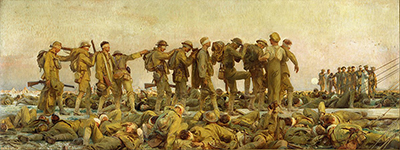
Finally, keep the date in mind. The portrait looks backward to the Paris training and the Madame X crisis, but also forward to London portrait success, later public commissions, watercolors, and Gassed. It stands at the hinge, not the endpoint.
Related Works And Where To Go Next
For the full career, start with Biography and the main John Singer Sargent overview. They place the 1886 self-portrait inside Sargent's movement from Florence and Paris to London, Boston, travel, public commissions, and late war art.
For the portrait question, continue to Portraits. That essay explains how Sargent made public identity through pose, gaze, costume, and surface. For method, Style and Technique is the natural companion.
For the immediate career pressure, use Portrait of Madame X. For the London recovery that followed, compare Lady Agnew of Lochnaw. For mid-1880s experiment beyond formal studio portraiture, use Claude Monet Painting by the Edge of a Wood and Carnation, Lily, Lily, Rose.
For the self-image sequence, move next to Self-Portrait, 1892 and Self-Portrait, 1906.
Frequently Asked Questions
The Aberdeen and Smithsonian catalog paths identify the work as Sargent's 1886 self-portrait [1], [2].
The principal object authority used here is Aberdeen Archives, Gallery and Museums. The Smithsonian Catalog of American Portraits provides a second public catalog record for the work [1], [2].
The date places the painting after the 1884 Salon reception of Portrait of Madame X and during Sargent's turn toward London. That makes the self-portrait an early image of professional self-presentation at a moment of career transition.
It is safer to read it as self-presentation. Sargent was a portraitist deeply skilled at constructing public identity through pose, gaze, surface, and restraint. The sources support that professional frame more strongly than private psychological speculation.
The 1886 image is the early transitional point. The 1892 self-portrait belongs to a more established phase, while the 1906 self-portrait belongs to mature recognition and the Uffizi self-portrait tradition [13], [14].
The cited Aberdeen and Smithsonian records confirm the work's basic identity, but the consulted notes do not capture every museum-label detail. Unsupported facts such as dimensions or full provenance should be checked directly against the museum record rather than guessed. [1], [2]
It shows Sargent applying his portrait intelligence to his own image at a charged moment. The painter who had made other people visible under social pressure also had to decide how he himself would appear.
Discussion
Sargent's 1886 self-portrait asks what happens when a portraitist becomes his own sitter. The answer is not simple self-revelation, but a controlled image of the painter at the edge of professional reinvention.
Reader Insights
What is the first detail that shapes your reading of John Singer Sargent Self-Portrait, 1886: pose, setting, light, costume, brushwork or historical context?
Which small visual decision begins to matter more after a longer look, and how does it change the mood of the page?
Which comparison helps most: another Sargent portrait, a travel subject, a public commission, or a work by one of his contemporaries?
Join the Conversation
Share a thoughtful comment below about what you notice, question or compare when looking at this page.
References
- Aberdeen Archives, Gallery and Museums, *Self-Portrait* https://emuseum.aberdeencity.gov.uk/objects/3366/self-portrait
- Smithsonian Catalog of American Portraits record for the 1886 self-portrait https://www.si.edu/es/object/self-portrait%3Anpg_01.1.192
- Metropolitan Museum of Art, *Portrait of Madame X* and related history https://www.metmuseum.org/art/collection/search/12127
- Museum of Fine Arts, Boston, John Singer Sargent biography https://www.mfa.org/news/sargent-bio
- John Singer Sargent Biography: Biography
- National Galleries of Scotland, *Gertrude Vernon, Lady Agnew of Lochnaw* https://www.nationalgalleries.org/art-and-artists/5396
- Tate, *Claude Monet Painting by the Edge of a Wood* https://www.tate.org.uk/art/artworks/sargent-claude-monet-painting-by-the-edge-of-a-wood-n04103
- Tate, *Carnation, Lily, Lily, Rose* https://www.tate.org.uk/art/artworks/sargent-carnation-lily-lily-rose-n01615
- John Singer Sargent Portraits: Portraits
- John Singer Sargent Style and Technique: Style and Technique
- Smithsonian record for *Claude Monet Painting by the Edge of a Wood* https://www.si.edu/object/claude-monet-painting-edge-wood-painting%3Asiris_ari_220152
- Rebecca Hellen and Elaine Kilmurray, "Carnation, Lily, Lily, Rose and the process of painting" https://britishartstudies.ac.uk/issues/02/sargent-conservation
- Smithsonian inventory record for John Singer Sargent self-portrait, 1892 https://www.si.edu/object/john-singer-sargent-self-portrait-painting%3Asiris_ari_44346
- Smithsonian/National Portrait Gallery record for Sargent's 1906 self-portrait https://npg.si.edu/object/npg_Inv._1890_n._3351_GU