

 by Tom Gurney
Tom Gurney BSc (Hons) is an art history expert with over 20 years experience
Published on June 19, 2020 / Updated on July 19, 2026
Email: tomgurney1@gmail.com / Phone: +44 7429 011000
Street in Venice by John Singer Sargent: Introduction
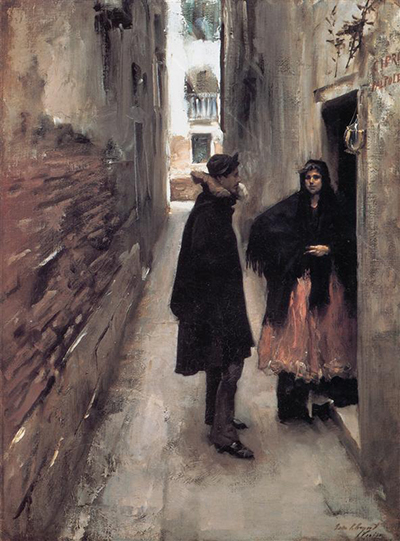
John Singer Sargent's Street in Venice is an 1882 oil on wood that turns a narrow Venetian passage into a charged scene of movement, shadow, and looking. The painting is small, but it does not feel minor. A woman walks toward the viewer with a black shawl drawn around her body, two men stand to the side, and distant figures sit at the far end of the alley. Venice appears here not as a famous view but as a compressed social space.
The work matters because it shows Sargent outside the formal portrait studio while keeping the portraitist's interest in bodies, glances, dress, and public appearance. The woman is not identified as a sitter. The men are not given names. The street is not offered as a grand landmark. Yet Sargent arranges all three elements - figure, observers, and urban enclosure - so that the viewer feels a moment of passage turning into a moment of exposure.
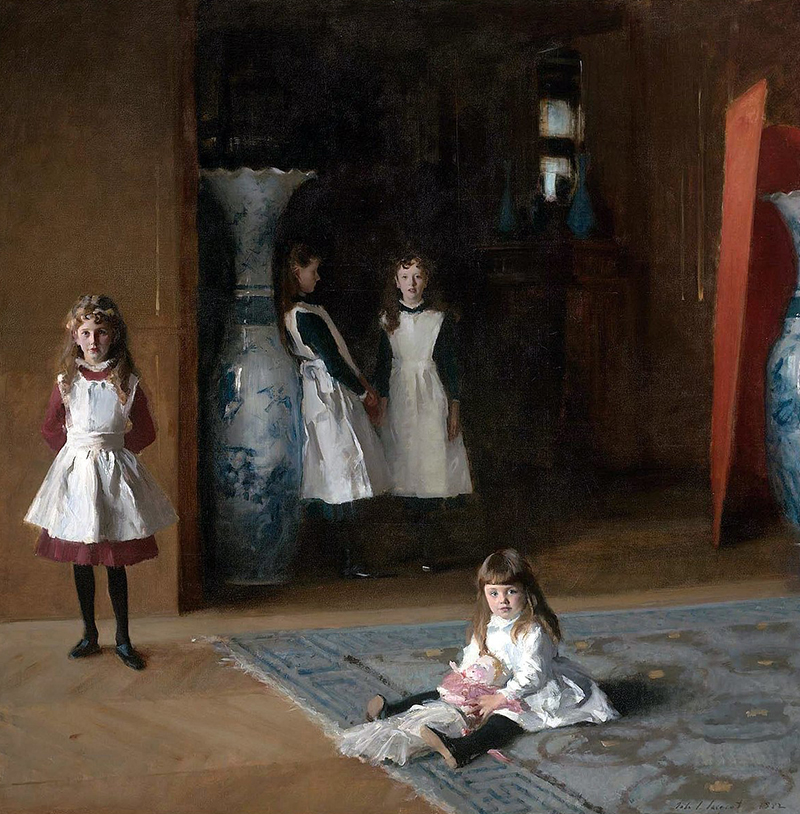
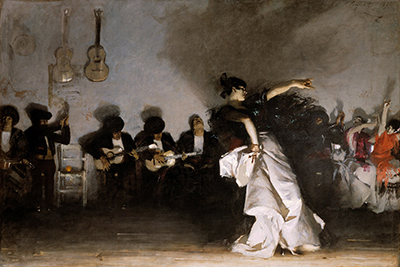
That balance makes Street in Venice one of Sargent's most revealing early travel works. It belongs to the same broad 1882 world as El Jaleo and The Daughters of Edward Darley Boit, when Sargent was proving that he could make ambitious images from performance, interiors, portraits, and travel subjects. Here the scale is intimate, but the pictorial question is sharp: how much social tension can a painter place inside one ordinary street?
At a Glance
- ArtistJohn Singer Sargent, American, 1856-1925 [1]
- TitleStreet in Venice [1]
- Date1882 [1]
- Mediumoil on wood [1]
- Dimensions45.1 x 53.9 cm, or 17 3/4 x 21 1/4 in [1]
- CollectionNational Gallery of Art, Washington [1], [2]
- Credit lineGift of the Avalon Foundation [1]
- Accession number1962.4.1 [1]
- Signaturelower right, "John S. Sargent." [1]
- Subjecta narrow Venetian alley with a woman approaching the viewer, two men standing nearby, and distant figures beyond [1]
Contents
- Introduction
- An 1882 Venice Work In Sargent's Early Career
- The Street As A Narrow Stage
- Figure Arrangement And Social Looking
- Venice Away From The Grand View
- Oil On Wood And The Look Of Speed
- Provenance, Exhibition History, And American Networks
- How To Look At Street In Venice
- Related Works And Where To Go Next
An 1882 Venice Work In Sargent's Early Career
The date 1882 places Street in Venice in one of the most important moments of Sargent's early career. He had trained in Paris with Carolus-Duran, absorbed lessons from old-master painting, and begun building a reputation at the Salon. The National Gallery of Art's artist record notes that he entered Carolus-Duran's atelier in 1874, studied at the Ecole des Beaux-Arts, began exhibiting at the Salon in 1877, copied Velazquez in Spain in 1879, visited Belgium and Holland in 1880, and met Whistler in Venice in 1881 [2].
That sequence matters for Street in Venice. The painting does not come from a late artist looking back on travel as leisure. It comes from a young painter making travel into a serious part of his public identity. Sargent was already moving among portraiture, figure painting, old-master study, and subjects gathered beyond the studio. Venice, Spain, and other travel settings gave him ways to test light, space, costume, and human movement without the rules of a commissioned likeness.
The year 1882 also brought El Jaleo, the great Spanish performance painting that helped announce Sargent in Paris, and The Daughters of Edward Darley Boit, the strange child-group interior now in Boston. Those works are far larger and more famous, but Street in Venice belongs to the same habit of mind. Sargent was exploring how bodies occupy charged spaces: a dancer before musicians, children in a deep room, a woman passing men in an alley.
That comparison helps prevent the Venice picture from seeming merely picturesque. It is a small panel, but it has the same young Sargent interest in staging. The street becomes a shallow theatre. The woman is not formally posed, but she is placed at the center of attention. The men are not described in detail, but their presence alters the mood. The buildings do not function as scenic backdrop only; they press the figures into a narrow visual channel.
Sargent's early career also explains the picture's mixture of freshness and control. He had been trained to see large tonal relations and to preserve the vitality of first decisions. In Street in Venice, the pale walls, dark clothing, cream skirt, green shutters, and diffused alley light create a structure before any story is named. The viewer feels the scene quickly because the main relations are clear.
The Street As A Narrow Stage
The National Gallery of Art's visual description gives the essential elements: a slim woman in a black shawl moves down an alley toward the viewer; two men in dark clothes stand to the right; a man and woman sit farther away; pale buildings rise on both sides and close the view [1]. Sargent uses these elements to make the street feel both ordinary and theatrical.
The woman's approach is the first fact of the picture. She is close enough to command the center, but not close enough to become a conventional portrait. Her black shawl wraps around her shoulders and body, and a pale skirt moves below it. Small accents of red or pink near the head and neck sharpen the otherwise restrained palette. Her features are loosely handled, and her gaze appears lowered. Sargent gives enough information for presence, not enough for biography.
The two men change everything. They stand behind her and to the side, near the building line. One leans against the wall and turns toward the woman; the other faces his companion. Their dark hats and coats make them visually dense, almost shadow-figures against the paler street. They do not touch the woman, and the painting does not give a clear incident. Yet their position means the woman is not simply walking through architecture. She is moving through a field of observation.
The distant seated pair extends the scene beyond the immediate encounter. They sit at a small table across the alley, much farther back, small enough to be part of the street's social texture rather than a second subject. Their presence prevents the scene from closing into a simple triangle of woman and men. The alley contains layers of life: approach, watching, conversation, distance.
Architecture holds those layers together. The buildings rise out of the frame, so the viewer cannot easily escape upward. The passage narrows toward the back, where further walls and structures close the view. Pale plaster, rough brushwork, and green shutters create a Venetian environment without relying on famous monuments. The city is felt through surfaces, thresholds, and compression.
Light is equally controlled. The alley is not sunstruck in a brilliant open-air manner. It sits in diffused shadow, with a higher structure catching a touch of brightness beyond. That muted light suits the social mood. Nothing is theatrical in the obvious sense, yet everything feels watched. Sargent uses shadow not for mystery alone but for pressure. The street is visible enough to read and dim enough to remain unsettled.
Figure Arrangement And Social Looking
The temptation with Street in Venice is to invent a story: a flirtation, a threat, an encounter, a moment of embarrassment, a coded urban drama. The painting invites narrative, but the sources do not identify the figures or explain an incident. A careful reading has to stay with what can be seen. The woman advances, the men stand aside, one seems to look toward her, and the viewer is placed in her path.
That is already enough. Sargent turns looking into the subject. The woman may be looking downward rather than meeting either the men or the viewer. The man leaning by the wall appears oriented toward her. The second man faces him. The viewer, placed at the end of the street, receives the woman's movement head-on. These relations make the painting a study of public visibility.
Gender matters here, but it should be handled with restraint. The picture shows a woman moving through a narrow public passage past men who occupy the side of the street. That arrangement carries a recognizable social tension: the body's movement through shared space, the discomfort of being seen, the imbalance between walking and watching. Sargent does not turn the woman into an allegory, and the painting does not require a fixed moral lesson. Its force lies in the precision of the arrangement.
The woman is both central and withheld. She dominates the foreground but remains unnamed. Her clothing is vivid enough to shape the design, but her inner life is not made accessible. That reserve is important. Sargent's formal portraits often build identity through face, costume, setting, and sitter status. Here he withholds identity and lets posture, clothing, and direction carry meaning.
The men are also withheld. Their dark clothes and partially obscured faces prevent them from becoming individual portraits. They function as presences in the street: male, stationary, observant, absorbed in their own exchange yet connected to the woman's passage. They are not villains in any documented story. They are agents of social atmosphere.
The viewer's position completes the structure. We stand where the woman is going. That means we are not outside the drama. We become the next point of looking. Sargent makes the act of viewing slightly uncomfortable because the painting's subject is partly the experience of being visible. The woman walks toward us, but she does not belong to us. The picture's intelligence lies in that tension.
Venice Away From The Grand View
Sargent's Venice is often most compelling when it avoids the obvious postcard. Street in Venice contains no sweeping Grand Canal, no celebrated facade, no gondola arranged for tourist pleasure. Instead, it gives a side passage, pale plaster, shutters, narrow depth, and anonymous figures. The city is recognized through lived compression rather than through landmark display.
This choice connects with the broader Sargent travel practice described in the watercolors and paintings essays. Venice gave him water, reflected light, narrow streets, thresholds, dark interiors, small figures, and buildings that could break into planes of cream, green, gray, and shadow. In a watercolor, those subjects often become quick decisions of line, wash, and reserved paper. In Street in Venice, the oil surface gives the same interest a heavier social density.
The Met's Venice is useful here because it shows Sargent working with the city in watercolor and graphite at roughly the same early moment, 1880-82 [3]. That sheet belongs to a world of works on paper, where drawing and color register travel quickly. The NGA panel, by contrast, is an oil painting on wood. It may look swift, but its material gives the alley a compact hardness. The street feels built as much as glimpsed.
The National Gallery of Art's Sargent and Spain publication page is about Spain rather than Venice, but it helps frame Sargent's travel subjects more broadly. It describes Sargent working across oil paintings, watercolors, and drawings, with landscapes, seascapes, architecture, scenes of everyday life, and people he encountered [4]. Street in Venice fits that larger habit: travel as a way to study place, people, light, and built space together.
Modern viewers should also notice what this Venice excludes. It does not promise transparent documentation of Venetian life. It is an American expatriate painter's selected view, shaped by travel, exhibition culture, and the appetite of international audiences for Venice as an artistic subject. The painting is more serious than a souvenir, but it is still a constructed image of a city seen by an outsider.
That outsider status does not weaken the work. It clarifies the question. Sargent was not recording Venice exhaustively. He was finding in Venice a compact problem of human movement and urban enclosure. The street gave him a setting where architecture and social looking could become inseparable.
Oil On Wood And The Look Of Speed
One of the most important facts about Street in Venice is also one of the easiest to miss: it is oil on wood, not watercolor. Because Sargent's Venetian subjects often invite discussion of works on paper, the medium needs to stay clear. This painting uses oil in a small format, giving it a firmness and density different from the transparency of watercolor.
The support is modest, only 45.1 x 53.9 cm. That scale suits the subject. A large canvas might have inflated the street into drama. The panel keeps the encounter close, almost handheld. The viewer is near the woman, near the men, near the plaster surfaces. The smallness creates intimacy, but not comfort.
The brushwork remains visibly loose. The National Gallery of Art notes rough layers on the buildings and visible strokes throughout [1]. Those strokes are not decorative bravura alone. They help create stucco, shadow, clothing, and movement without over-defining every edge. The pale walls feel rubbed and built up. The figures are quick but placed. The street seems to have been seized before its social tension disappears.
Sargent's technique here depends on hierarchy. The central figure receives enough definition to hold the viewer's attention. The men are darker and more compressed. The distant figures are smaller and looser. The architecture alternates between solid planes and broken brushwork. Finish is distributed according to function. The painting tells the eye where to stop and where to move on.
Color is restrained but exact. The black shawl, dark men's clothing, cream skirt, pale peach and ivory buildings, green shutters, and small red accents create a limited world. There is no need for spectacular color because the painting's drama is spatial and social. A small note of red near the woman's head becomes memorable precisely because the rest of the scene is subdued.
The signature in the lower right reinforces the picture's object status. Sargent signs the work, but the painting resists polished completion in the conventional sense. It asks to be read as a resolved image that preserves the alertness of a study. That combination - resolved enough to exhibit, open enough to breathe - is central to Sargent's early modernity.
Provenance, Exhibition History, And American Networks
The National Gallery of Art's provenance gives Street in Venice a rich American afterlife. Elizabeth Chanler purchased the painting in Boston on 30 January 1888 at the St. Botolph Club exhibition. She gave it to the architect Stanford White for professional services. It then descended through White's family before the National Gallery of Art purchased it in 1962; the work entered as a Gift of the Avalon Foundation [1].
The NGA record also preserves a second early tradition. Richard Ormond and Elaine Kilmurray cite a late October 1887 episode in which Stanford White hosted a dinner with Sargent as guest of honor. Sargent reportedly offered James Carroll Beckwith a choice between two Venetian studies as a wedding gift; Beckwith chose Venetian Bead Stringers, and Sargent gave A Street in Venice to Stanford White [1]. The NGA notes the distinction between this chronology and the provenance published in its systematic catalogue, so the story should be treated as part of the documented record's nuance rather than simplified into a single anecdote.
Either way, the picture's early American network is striking. Elizabeth Chanler, Stanford White, James Carroll Beckwith, Boston's St. Botolph Club, and later the National Gallery of Art all belong to the social and artistic world through which Sargent's work circulated. A small Venetian street scene became an object of exchange among artists, patrons, architects, and collectors. [1], [2]
The exhibition history is even broader. The painting appeared in Paris in 1882-1883 at the first exhibition of the Societe Internationale des Peintres et Sculpteurs, under the title Une Rue a Venise. In 1888 it was shown at the National Academy of Design as Venetian Street, at the St. Botolph Club in Boston, and at the Inter-State Industrial Exposition in Chicago as Sketch of Venetian Life [1].
Those shifting titles are revealing. Une Rue a Venise, Venetian Street, Sketch of Venetian Life, Venice, Venetian Scene: the work was repeatedly framed as street, city, sketch, and scene. The title history shows how viewers and institutions tried to name its category. Is it a genre scene, a travel sketch, a painting of Venetian life, an urban view? The answer is that it holds all of those possibilities without settling into one.
The later exhibition trail kept the painting visible across Sargent's reputation. It appeared in Sargent loan and memorial exhibitions, in National Academy and Copley Society contexts, in the 1998-1999 Sargent retrospective when shown in Washington, in Sargent's Women in 2003, in Whistler and His Circle in Venice, in Sargent's Venice in 2007, and in John Singer Sargent and Chicago's Gilded Age in 2018 [1]. That history confirms that the panel has mattered both as a Venetian work and as an image of figures, gender, and urban modernity.
How To Look At Street In Venice
Begin with the woman, but do not stop with her. She is the central moving figure, and Sargent makes her the first place the eye lands: black shawl, pale skirt, small warm accents, body angled toward the viewer. Yet she is not isolated. The painting becomes interesting when her movement is read against the men, the walls, and the direction of the alley.
Then look at the men's stillness. Their dark clothing makes them compact forms, and their placement beside the wall gives them a different rhythm from the woman. She advances; they remain. That contrast is the basic energy of the picture. Sargent does not need a dramatic gesture because the composition already contains motion and resistance.
Next, follow the alley backward. The distant seated pair and the closing buildings keep the painting from becoming a shallow portrait-like encounter. They extend the world of the picture, but only narrowly. The passage does not open into a broad square or view. It closes into another set of walls, so the viewer feels Venice as a system of compressed spaces rather than as a panorama.
The buildings deserve patient attention. Their pale surfaces are not blank. Rough, loose paint gives them the texture of stucco or plaster, while green shutters provide repeated accents. Sargent lets the buildings rise beyond the top of the panel, which makes the street feel taller and tighter than the format alone would suggest. The architecture is doing psychological work.
After that, look for light. The scene is not organized around full sunlight. It is held in a muted, shadowed atmosphere, with a small higher brightness beyond the alley. That difference between enclosed shade and distant light is crucial. It keeps the picture from becoming flat, and it gives the woman's passage a direction without turning the scene into a simple journey toward illumination.
Finally, notice what Sargent refuses to clarify. He does not explain the relationship among the figures. He does not give the woman a readable expression or the men a clear role. He does not identify the site as a famous Venetian landmark. The painting's strength lies in those refusals. It gives the viewer enough to feel a social situation and withholds enough to keep the encounter alive.
Related Works And Where To Go Next
For Sargent's wider travel practice, begin with Watercolors. That essay explains why Venice, Spain, North Africa, architecture, paper, light, and movement are central to his art beyond formal portraiture. For works on paper and the drawing underneath travel observation, use Drawings.
For oil painting context, use Paintings and Style and Technique. Street in Venice is small, but it belongs to Sargent's larger oil practice: controlled freshness, dark-light structure, mobile brushwork, and figure arrangement. It should not be isolated as only a travel curiosity.
For early 1882 ambition, compare El Jaleo and The Daughters of Edward Darley Boit. Those works are larger and more famous, but they share Sargent's interest in bodies staged inside charged spaces. For biography, use Biography, especially the sections on Paris, Venice, travel, and the desire to move beyond portrait commissions.
For a cautious comparison with another street subject, use A Street in Algiers. Venice and Algiers are not interchangeable, and the evidence for the Algiers work is much thinner, but both subjects help readers see how Sargent used streets as pictorial settings for movement, architecture, and outsider looking.
Frequently Asked Questions
Sargent painted Street in Venice in 1882. The date places it in his early Paris-period career, the same year as major works such as El Jaleo and The Daughters of Edward Darley Boit.
The painting is in the National Gallery of Art, Washington. Its accession number is 1962.4.1, and the NGA lists it as a Gift of the Avalon Foundation. [1], [2]
It is oil on wood. That point is important because Sargent made many Venetian works in watercolor and graphite, but Street in Venice is a small oil painting on a wood support.
The NGA gives the overall dimensions as 45.1 x 53.9 cm, or 17 3/4 x 21 1/4 in. The framed dimensions are larger, but the painted object itself is modest in scale. [1], [2]
It shows a narrow Venetian alley. A woman wrapped in a black shawl walks toward the viewer, two men in dark clothing stand near the wall behind her, and a man and woman sit farther back at a small table. Pale buildings and green shutters enclose the street.
Not in the formal sense. The woman and men are not identified as named sitters. Yet the painting uses a portraitist's sensitivity to posture, clothing, gaze, and social presence. It is best understood as a travel or genre scene with strong figure painting.
Venice gave Sargent narrow streets, canals, reflected light, thresholds, figures, plaster surfaces, and urban spaces that differed from the formal portrait studio. He used the city to study movement, light, architecture, and social looking.
The tension comes from arrangement rather than explicit incident. The woman moves toward the viewer, the men stand aside and appear to watch or converse, and the narrow alley gives the scene little escape. Sargent leaves the story unresolved, which makes the act of looking more important.
It shares the travel eye of the watercolors: quick attention to place, light, architecture, and figures. But its medium is different. Oil on wood gives Street in Venice a denser, more enclosed feeling than many watercolor views.
Discussion
Street in Venice asks whether an ordinary passage through a city can become a drama of visibility. Sargent's answer is yes: not by explaining the story, but by making the viewer feel the pressure of walking, watching, and being watched.
Reader Insights
What is the first detail that shapes your reading of Street in Venice by John Singer Sargent: pose, setting, light, costume, brushwork or historical context?
Which small visual decision begins to matter more after a longer look, and how does it change the mood of the page?
Which comparison helps most: another Sargent portrait, a travel subject, a public commission, or a work by one of his contemporaries?
Join the Conversation
Share a thoughtful comment below about what you notice, question or compare when looking at this page.
References
- National Gallery of Art, *Street in Venice* https://www.nga.gov/artworks/46428-street-venice
- National Gallery of Art, "John Singer Sargent" https://www.nga.gov/artists/1858-john-singer-sargent
- Metropolitan Museum of Art, *Venice* https://www.metmuseum.org/art/collection/search/12459
- National Gallery of Art, *Sargent and Spain* https://www.nga.gov/research/publications/sargent-and-spain