

 by Tom Gurney
Tom Gurney BSc (Hons) is an art history expert with over 20 years experience
Published on June 19, 2020 / Updated on July 19, 2026
Email: tomgurney1@gmail.com / Phone: +44 7429 011000
Theodore Roosevelt Portrait by John Singer Sargent: Introduction
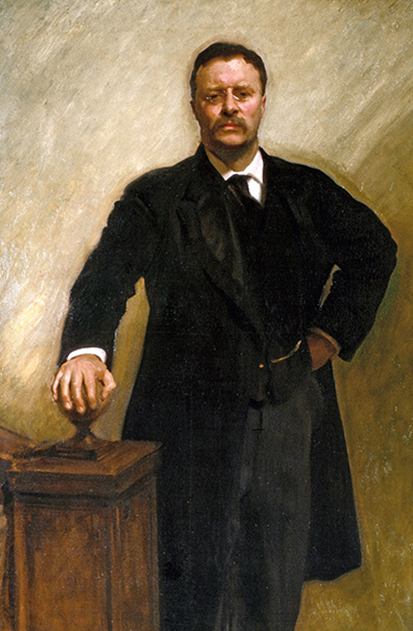
John Singer Sargent's portrait of Theodore Roosevelt is one of his clearest images of public authority because it makes presidential power physical. Roosevelt stands in a dark suit at the White House, one hand set on the rounded post of a stairway banister, the other at his hip, his face alert behind pince-nez and mustache. The painting does not rely on flags, desks, documents, or ceremonial costume. It turns a body at a stairway into an image of command.
Painted in 1903, the portrait grew from a White House commission arranged during the Roosevelt administration and linked to architect Charles McKim, who was overseeing major renovations to the building. Sargent was already famous on both sides of the Atlantic for portraits that could make social rank, theatrical force, artistic personality, or public office feel embodied. Roosevelt gave him a different kind of sitter: a president whose reputation depended on energy, impatience, reform, military memory, and the projection of national will.
The result is not a quiet official likeness. It is a controlled confrontation. Roosevelt seems to have paused on the stairs rather than settled into a chair. The right hand claims the banister post; the left arm presses the body outward; the gaze meets the viewer with compact force. Sargent's gift was to make pose and paint carry the pressure of a role. In this portrait, the role is the presidency itself.
At a Glance
- ArtistJohn Singer Sargent [1]
- TitleTheodore Roosevelt [1]
- Date1903 [1]
- MediumOil on canvas [1]
- SitterTheodore Roosevelt, president of the United States [1]
- OwnerThe White House [1]
- CreditWhite House Collection / White House Historical Association [1], [2]
- TypePortrait [1]
- DimensionsSmithsonian Catalog of American Portraits gives the sight size as 147.6 x 101.6 cm, or 58 1/8 x 40 in.; frame size is listed as 174 x 125.7 x 10.8 cm [3]
- Setting and attributesstairway, balustrade, dark suit, watch chain, pince-nez, mustache, and the rounded banister post under Roosevelt's right hand [3]
- Key contextCharles McKim invited Sargent to paint Roosevelt during the White House renovation period, and the portrait entered White House display in 1903 [1], [2]
Contents
- Introduction
- A Presidential Commission in 1902-03
- The Sitting and the Stairway Pose
- Close Looking
- Presidential Image and Public Authority
- The Sphere, Expansion and National Memory
- Sargent's Portrait Method
- White House Collection and Display
- Related Works And Where To Go Next
A Presidential Commission in 1902-03
The portrait's history begins with the White House itself. The White House Historical Association states that Charles McKim, the architect overseeing major renovations to the building, invited Sargent to paint Roosevelt. Its longer essay on Sargent in the White House gives the commission a more precise setting: the arrangement was made in 1902, probably through McKim, while Sargent was living in London and expecting to return to the United States for work connected with the Boston Public Library [1], [2].
Roosevelt understood the symbolic fit. WHHA records that when Sargent agreed in May 1902, Roosevelt thanked him and wrote that it was fitting for an American president to be painted by him [2]. The remark matters because Sargent's identity was itself transatlantic. He was American by family and citizenship, born in Florence, trained in Paris, professionally established in London, and repeatedly tied to American patrons and institutions. A Sargent portrait could bring international artistic prestige into the White House without losing its American claim.
Roosevelt's presidency also gave the commission unusual weight. He had become president on September 14, 1901, after the assassination of William McKinley, and served until March 4, 1909 [1]. A portrait painted in 1903 did not look back on a finished administration. It pictured a president in active power, early in a tenure that was already reshaping the national office. The painting therefore belongs to living political image-making, not merely memorial commemoration.
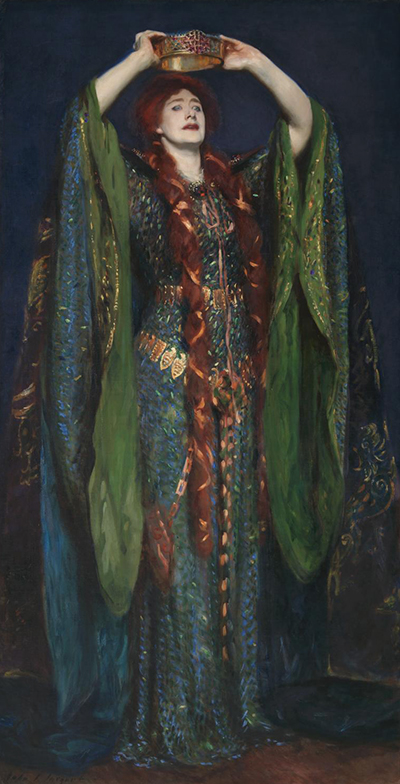
This is one reason the work should be read as both likeness and institution. The sitter is Theodore Roosevelt, with his recognizable face, mustache, glasses, compact stance, and charged temperament. But he is also the president in the White House, painted for the building that embodied executive authority. Sargent had painted social power before, and he had painted theatrical power in Ellen Terry as Lady Macbeth. Here, power has a constitutional address.
The Sitting and the Stairway Pose
Sargent arrived in the United States in January 1903 and came to live at the White House the following month, according to WHHA's account [2]. The sittings were not easy. The same essay notes that Sargent was particular about where Roosevelt should pose, while Roosevelt was impatient with direction. The best-known story from the sittings places the two men on the stairs, with Roosevelt accusing the artist of not knowing what he wanted and Sargent replying that Roosevelt did not know how to pose. Roosevelt then turned, gripped the newel post, and challenged him. Sargent told him to hold that position [2].
That anecdote is irresistible, but it should be used with care. It comes to us as a later account cited by WHHA, not as a stenographic record of every word exchanged. Its value is that it explains why the finished pose feels so unlike a studio formula. Whether every detail unfolded exactly as retold, the story fits the painting's visible drama: a sitter caught in resistance, energy, and command rather than polite compliance. [1], [2]
WHHA records that Sargent completed the portrait on February 19 after several sittings. The shorter WHHA portrait entry adds that Sargent later complained about Roosevelt agreeing only to short sittings, but that Roosevelt was pleased with the result. In a letter to his son Kermit that same day, Roosevelt wrote that he had just had his last sitting and liked Sargent's picture enormously [1], [2].
The short sittings matter because they sharpen the encounter. Sargent's portrait method often depended on intense concentration: deciding the pose, finding the angle, securing the head and hands, and letting surrounding passages carry life without equal finish. Roosevelt, by contrast, was not a sitter likely to dissolve into patient stillness. The painting's force comes partly from that friction. It looks as if Sargent found not a neutral pose, but a moment when Roosevelt's impatience became useful.
The stairway is therefore more than setting. It is the mechanism that transforms an argument over posing into an image of office. Roosevelt stands at a threshold inside the White House, not behind a desk. The stairs imply movement, ascent, interruption, and command over space. The president appears as someone stopped in motion, ready to resume action.
Close Looking
The first thing to notice is Roosevelt's right hand. It rests on the rounded post at the base of the stair rail, fingers spread and pressure visible. Sargent understood hands as instruments of character and structure. In many portraits, a hand reveals what the face controls. Here the hand does even more. It steadies the body, claims the architectural object, and directs the viewer toward the painting's central symbol.
The rounded post matters because it is not just a support. The National Portrait Gallery's Taina Caragol reads the sphere-like form as a possible metaphor of power within a long Western visual tradition. She also connects the sphere to U.S. visual culture around 1903, including images of the eagle over a globe or sphere containing the continental United States and newly acquired territories [4]. The painting can be read powerfully without claiming certainty about Sargent's intention. The object under Roosevelt's hand is visibly there; its symbolic resonance belongs to the world in which the portrait was made.
Roosevelt's left hand, set at his hip, completes the stance. It widens the body and gives the dark suit a firm angular shape. The gesture is not theatrical in the raised-arm sense, but it is assertive. The two hands create a circuit: one claiming the banister post, the other bracing the body. Sargent makes authority legible through pressure, not ornament.
The head is compact and concentrated. Roosevelt faces outward with direct attention. The pince-nez and chain are small but telling details. The glasses sharpen the face without softening it. The chain breaks the dark suit with a line of controlled brightness. The mustache and strong facial structure make the sitter immediately recognizable, but Sargent avoids caricature. He does not exaggerate Roosevelt into a cartoon of force. He condenses him.
The suit is equally restrained. There is no military uniform, although the Smithsonian record includes Roosevelt's earlier identity as colonel among the subject topics attached to the portrait [3]. There is no Rough Rider spectacle here, no cavalry memory turned into costume. The dark civilian clothing places Roosevelt in presidential office rather than battlefield legend. Sargent gives him force without uniform.
The background keeps the image architectural but not descriptive. Stairs, rail, and wall create enough White House interior to place the figure, yet the painting does not become an interior view. The setting serves the pose. The stair rail cuts through the space; the vertical body meets the rounded post; the head and hands hold the eye. Sargent simplifies the room so that Roosevelt's stance becomes the event.
The portrait's scale contributes to this effect. The Smithsonian record gives the sight dimensions as roughly 58 by 40 inches, large enough for Roosevelt to stand before the viewer with near bodily presence, but not a full-length state pageant [3]. The three-quarter-length format suits the painting's temperament. It concentrates attention on head, torso, hands, and banister rather than on ceremonial environment.
Presidential Image and Public Authority
A presidential portrait must do something different from a society portrait. It cannot be only flattering, and it cannot be only intimate. The sitter carries office, policy, party, national memory, and the expectations of viewers who may never know the person except through image. Sargent's Roosevelt succeeds because it makes the person and the role difficult to separate.
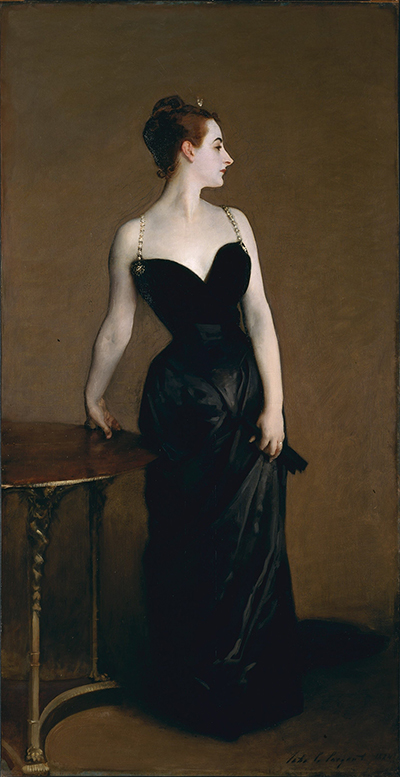
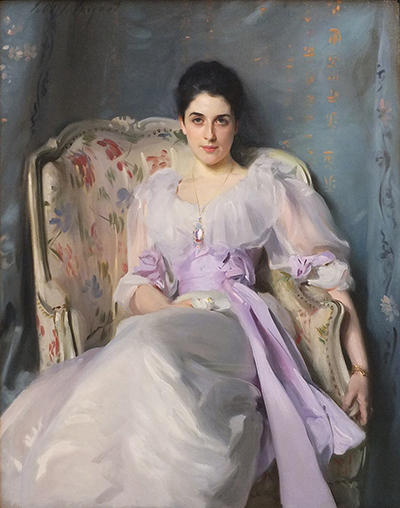
Sargent had long understood identity as performance. Madame X makes fashionable visibility severe and dangerous. Lady Agnew of Lochnaw turns seated ease into aristocratic confidence. Ellen Terry as Lady Macbeth makes theatrical role monumental. Roosevelt's portrait belongs to the same larger intelligence, but with a changed political weight. The sitter is not performing rank, beauty, or Shakespearean ambition. He is performing executive command.
That performance is restrained by the absence of obvious presidential props. There is no chair of state, no document, no bookcase full of law, no classical column doing the symbolic work for him. The White House stairway is enough. Sargent relies on body language: hand, hip, stance, face, pressure. This gives the portrait a modern directness. Roosevelt is not surrounded by symbols of authority so much as made into one.
The painting also balances energy and control. Roosevelt's public image was famously active, but an official likeness cannot simply show motion. Sargent's solution is compression. The figure seems charged but held. The hand grips, the body angles, the gaze meets the viewer, and the pose appears momentarily fixed. The effect is not calm repose. It is force paused.
This matters because modern political portraiture often depends on the management of vitality. Too much animation can look unserious; too much stillness can look lifeless. Sargent finds the point between them. Roosevelt appears disciplined enough for office and restless enough to feel alive.
The Sphere, Expansion and National Memory
The National Portrait Gallery interpretation gives the portrait one of its richest modern readings. Caragol's audio commentary begins with the hand and the sphere at the end of the banister, then places the sphere within older visual traditions of power reaching back to antiquity. She also notes that by the time Sargent painted Roosevelt, the sphere had a strong place in U.S. visual culture, including magazine imagery of the bald eagle spread over a sphere containing the continental United States and territories [4].
This interpretation matters because Roosevelt's presidency belonged to an era of American expansion. Caragol compares Sargent's Roosevelt with Francisco Oller's portrait of President William McKinley, in which McKinley holds a map of Puerto Rico. The comparison points to the War of 1898 against Spain and to the acquisition of territories that helped reposition the United States as a world power [4].
The reading is careful rather than absolute. Caragol does not claim that Sargent definitely intended the banister sphere as an imperial emblem. She says the image can be viewed within its context of production and understood as a metaphor for expansion [4]. That caution is important. The painting should not be reduced to one symbol. But neither should the symbol be ignored. The hand on the rounded post is too central to the composition to be treated as accidental background furniture.
For modern viewers, this context complicates admiration. The portrait's authority is visually compelling, but the historical power it evokes included territorial expansion and the assertion of U.S. influence beyond the mainland. Sargent's image does not narrate those events directly. It does not show Puerto Rico, war, policy, or empire as subject matter. Yet through the NPG reading, the portrait can be seen as part of a broader visual culture in which presidential power, national destiny, and territorial reach were being pictured. [4], [3]
That double vision is one of the painting's strengths. It is possible to admire Sargent's concentration of pose and still ask what kind of authority is being concentrated. The portrait does not only show a strong man. It shows strength made official, housed in the White House, and remembered through a collection that turns political image into national art.
Sargent's Portrait Method
Roosevelt's portrait depends on the same Sargent habits visible across the portrait career: a decisive pose, a charged hand, controlled finish, and a setting that functions as stage. What changes is the social meaning of those tools. The hand in Madame X steadies an exposed society figure. Lady Agnew's relaxed arm helps make ease commanding. Ellen Terry's raised arms turn Shakespearean role into image. Roosevelt's hand claims a sphere-like architectural form and turns the stairway into a theater of office.
Sargent's brushwork is quieter here than in some of the bravura society portraits, but it remains active. The dark suit is not painted as an empty mass. It carries shape, weight, and directional pressure. The face and hands receive the sharper attention they need. The stairs and wall recede enough to hold the setting without distracting from the body. This hierarchy of finish is central to Sargent's art. He does not describe everything equally because the portrait's authority depends on knowing what must command.
The portrait also shows Sargent as a director. He was not simply recording Roosevelt in whatever posture happened to be convenient. WHHA's account of the sittings stresses the struggle to find the right place and pose [2]. Sargent recognized that the president's image needed a bodily arrangement capable of holding his temperament. The stairway pose solved that problem by giving Roosevelt a structure to grip and a vertical field to inhabit.
Compared with Sargent's portraits of artists and performers, Roosevelt is less intimate and less experimental. Compared with formal society portraits, he is less decorative. The painting's force lies in restraint. Sargent removes most accessories and lets the sitter's physical claim on space do the work. That restraint is why the portrait remains fresh. It does not explain Roosevelt by listing achievements. It makes viewers feel the pressure of his presence.
White House Collection and Display
The portrait's institutional life is central to its meaning. WHHA identifies it as part of the White House Collection and credits the White House Collection / White House Historical Association [1]. The longer WHHA essay states that after being privately exhibited in a nearby gallery, the painting was hung in the White House Entrance Hall at the beginning of April 1903 as Roosevelt's official portrait [2].
That early display matters because the portrait returned quickly to the building that had produced it. The White House was not only the setting suggested by the stairs; it was the painting's civic home. Visitors encountered the image in relation to the presidency, the building, and the tradition of presidential likenesses. A Sargent portrait in that space did not function like a private commission in a family house. It helped shape the visual memory of an administration.
WHHA's essay on Sargent in the White House also notes that Sargent has two major paintings in the White House Collection: the Roosevelt portrait and The Mosquito Net [2]. The pairing is revealing because the works are so different. One is a forceful presidential portrait; the other is a later alpine subject with a more private, ambiguous mood. Together they show that the White House Collection contains Sargent not only as a painter of officials but as a painter whose range could enter a national residence.
The contemporary response quoted by WHHA recognized the portrait's emphasis on energy, alertness, aggressiveness, and unyielding disposition, while noting what the critic felt was absent: Roosevelt's kindliness and geniality [2]. That response is useful because it confirms how strongly viewers read force in the image from the beginning. The painting did not offer every aspect of Roosevelt. It chose command.
That choice is why the portrait endures. Official portraits often try to reconcile dignity with likeness. Sargent's Roosevelt goes further. It gives the presidency a nervous, modern charge. The sitter appears ready to move, argue, decide, and dominate the stair. The painting's authority is not calm marble. It is living pressure held just long enough for paint to fix it.
Related Works And Where To Go Next
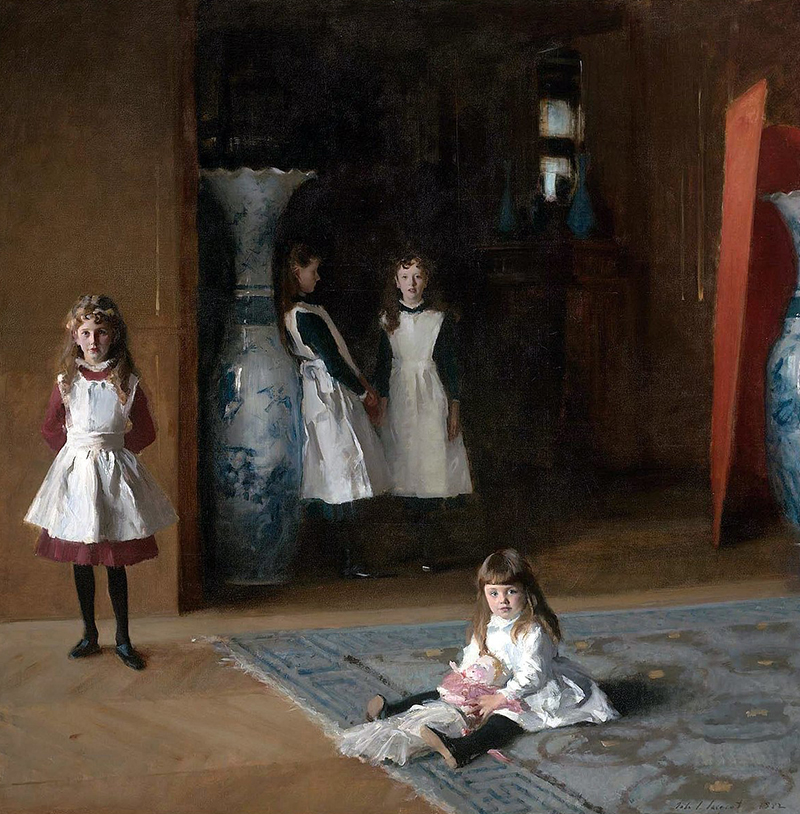
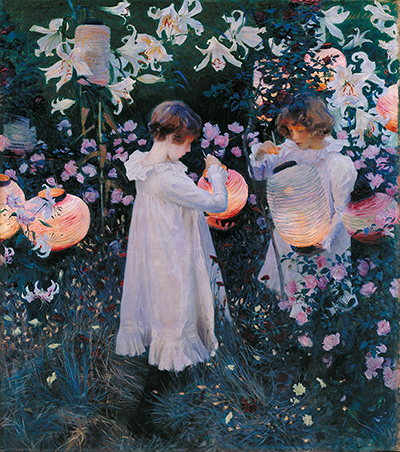
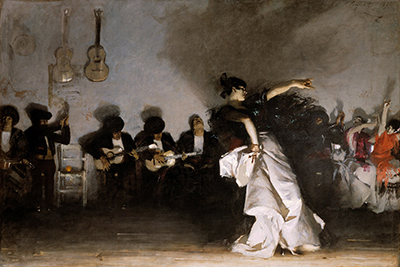
For Sargent's larger portrait practice, Roosevelt belongs beside the portraits essay. It shows how the same artist who painted society women, actors, children, artists, writers, and patrons adapted portraiture to political office.
The strongest comparisons are Lady Agnew of Lochnaw, Ellen Terry as Lady Macbeth, and Portrait of Madame X. Lady Agnew shows relaxed social authority; Ellen Terry shows theatrical authority; Madame X shows the dangers of social self-display. Roosevelt shows official authority made bodily and architectural.
The style and technique essay is useful for understanding hands, pose, staging, and the hierarchy of finish. Sargent's biography gives the transatlantic career behind the White House commission, including his London base, American ties, and Boston work. The public commissions essay helps place this portrait near Sargent's broader work for institutions and shared memory, even though it remains a portrait rather than a mural or memorial.
Roosevelt's portrait also invites comparison beyond Sargent, especially with other presidential images. The NPG comparison with Oller's McKinley portrait is particularly useful because it connects individual likeness to the wider visual culture of U.S. power after 1898 [4].
Frequently Asked Questions
Sargent painted the portrait in 1903. WHHA records that he came to the White House in February, completed the portrait on February 19 after several sittings, and that it was hung in the White House Entrance Hall at the beginning of April 1903 [2].
The White House Historical Association states that architect Charles McKim invited Sargent to paint Roosevelt. McKim was overseeing major White House renovations during Roosevelt's administration [1], [2].
WHHA recounts a story in which Sargent found the pose during a tense exchange with Roosevelt on the stairs. Roosevelt gripped the newel post, and Sargent told him to hold the position [2]. The story explains the portrait's sense of action and pressure.
The National Portrait Gallery's Taina Caragol reads the hand and sphere-like banister post in relation to older symbols of power and to U.S. visual culture around territorial expansion after 1898. She presents this as a contextual reading rather than a proven statement of Sargent's intention [4].
The portrait is owned by the White House and credited to the White House Collection / White House Historical Association [1]. The Smithsonian Catalog of American Portraits also lists the White House as owner [3].
Yes. WHHA records that Roosevelt wrote to his son Kermit on February 19, 1903, after his final sitting, saying that he liked Sargent's picture enormously [1], [2].
It belongs to Sargent's broad portrait practice, but its stakes are political. Like his society and theatre portraits, it uses pose, hands, costume, and setting to construct identity. In Roosevelt's case, that identity is presidential command.
Discussion
Sargent's Roosevelt asks how much authority a portrait can place in a hand, a stare, and a stairway. The painting still feels forceful because it does not merely identify a president. It stages the moment when a person and an office seem to grip the same space.
Reader Insights
What is the first detail that shapes your reading of Theodore Roosevelt Portrait by John Singer Sargent: pose, setting, light, costume, brushwork or historical context?
Which small visual decision begins to matter more after a longer look, and how does it change the mood of the page?
Which comparison helps most: another Sargent portrait, a travel subject, a public commission, or a work by one of his contemporaries?
Join the Conversation
Share a thoughtful comment below about what you notice, question or compare when looking at this page.
References
- White House Historical Association, *Theodore Roosevelt* https://www.whitehousehistory.org/photos/theodore-roosevelt
- Edward G. Lengel, White House Historical Association, *The Art of John Singer Sargent in the White House* https://www.whitehousehistory.org/the-art-of-john-singer-sargent-in-the-white-house
- Smithsonian National Portrait Gallery, Catalog of American Portraits, *Theodore Roosevelt* https://npg.si.edu/object/npg_903.1328.1_WH
- National Portrait Gallery, *Theodore Roosevelt*, audio commentary by Taina Caragol https://npg.si.edu/theodore-roosevelt