


 by Tom Gurney
Tom Gurney BSc (Hons) is an art history expert with over 20 years experience
Page Created on / Page Updated on
Email: tomgurney1@gmail.com / Phone: +44 7429 011000
Thomas Eakins: Introduction
Thomas Eakins made modern life in Philadelphia the basis of an art at once exacting and deeply human. He painted rowers measuring their strength on the Schuylkill River, surgeons teaching before crowded amphitheatres, musicians absorbed in performance, and friends whose faces resist easy interpretation. These were not incidental local subjects. They allowed him to ask how knowledge, training, work, and character could be made visible. The Philadelphia Museum of Art describes an artist who applied European academic methods to distinctly American experience, while the Metropolitan Museum of Art places his rowers, surgeons, musicians, artists, collectors, and teachers at the centre of his achievement.[1][2]
His reputation rests above all on painting, yet drawing, sculpture, watercolour, and photography were integral to his practice. The camera helped him study bodies, movement, light, and pose; it did not replace the sustained decisions through which he constructed a picture. Photographs associated with his studio also demand precise attribution, because major exhibitions distinguish work by Eakins from work made by members of his circle.[1][2] That distinction matters: his realism is best understood as a method of investigation, not as a claim that every surviving image around him came from his own hand.
Eakins could make physical action look measured and quiet, and stillness feel charged with thought. His art becomes clearest when approached through the particular worlds he knew: Philadelphia’s river, schools, hospitals, concert rooms, studios, and friendships. The seven works introduced here offer different entrances into that world, from the controlled momentum of a racing shell to the difficult public visibility of an operation and the private concentration of a portrait sitter.
At a Glance
- BornJuly 25, 1844, in Philadelphia, Pennsylvania [1]
- DiedJune 25, 1916, in Philadelphia, Pennsylvania [1]
- Known forPainting, drawing, watercolour, sculpture, photography, and teaching [1][2][3]
- TrainingPennsylvania Academy of the Fine Arts and Jefferson Medical College in Philadelphia; École des Beaux-Arts and private ateliers in Paris; further study in Spain [1][2][4]
- Central subjectsAthletes, surgeons, musicians, artists, teachers, family, friends, and other Philadelphia sitters [2][3]
- Defining approachClose observation of the body in action and of individual character, supported by anatomy, perspective, repeated sittings, and photographic study [2][3]
Thomas Eakins in context
Academic and Beaux-Arts training
c. 1820–1900Realism
c. 1840–1900American Realism
c. 1870–1930Jean-Léon Gérôme
1824–1904Eadweard Muybridge
1830–1904Winslow Homer
1836–1910Thomas Eakins
1844–1916Susan Macdowell Eakins
1851–1938Henry Ossawa Tanner
1859–1937The Gross Clinic
1875Swimming
1885The Agnew Clinic
1889The Concert Singer
1890–92The Thinker
1900Contents
- Introduction
- A Realism of Attention
- Philadelphia After Europe
- Rowing and Measured Motion
- Bodies, Medicine, and Teaching
- Portraits Without Ceremony
- The Camera as Tool
- Seven Ways In
- Recognition and Difficulty
A Realism of Attention
“Realism” can sound like a promise of visual transcription, but Eakins’s pictures are more deliberate than that. His figures occupy spaces whose geometry has been worked out, their gestures selected from continued observation, and their relationships arranged to guide attention. He wanted a body to carry weight, an oar to meet believable resistance, and a professional action to reveal acquired skill. Exact description served a larger purpose: it made thought and effort legible.
That purpose links subjects which can otherwise seem far apart. A rower keeps a shell level through coordinated movement. A surgeon stands before students with a bloodied hand while directing an operation. A singer produces a note through muscular exertion that an audience cannot normally see. A poet sits without theatrical accessories, his presence concentrated in posture and face. Eakins repeatedly chose people doing something they had learned to do, or inhabiting the inward consequences of a life’s work. The Smithsonian American Art Museum characterises his portraits as psychologically astute and his outdoor scenes as luminous, and notes his unusual focus on individual achievement, complexity, and vulnerability.[3]
Philadelphia gave this inquiry its social and physical setting. Eakins knew many of his models personally, and his large compositions often turn named people into participants rather than anonymous types. Familiarity did not guarantee flattery. His repeated sittings and scrutiny could produce portraits that patrons found uncomfortable, but they also gave his best work its refusal of formula. The person is neither an emblem nor a bundle of surface details. He or she appears as an intelligence occupying a body at a particular moment.
Philadelphia After Europe
Eakins’s roots in Philadelphia were unusually deep. His father, Benjamin Eakins, was a writing master and calligrapher, and the young artist developed skill in drawing alongside interests in mathematics, science, and languages. Before travelling abroad, he studied at the Pennsylvania Academy of the Fine Arts and attended anatomy teaching and medical demonstrations at Jefferson Medical College. The combination of graphic discipline and anatomical knowledge remained active throughout his career.[1][2]
From 1866, Eakins trained in Paris, chiefly with Jean-Léon Gérôme, while also studying sculpture and portraiture. A period in Madrid and Seville brought sustained contact with Spanish painting before he returned home in 1870.[2][4] The trip supplied professional tools rather than a permanent repertory of European subjects. In Philadelphia he redirected academic study towards the people and activities immediately around him.
This choice separates Eakins from a simple story of an American painter importing a foreign style. His training gave him command of the figure, perspective, modelling, and complex composition; his subject matter tested those resources against contemporary experience. River sport was relatively new as a serious theme for ambitious painting. Surgical instruction placed modern professional expertise where historical or religious narrative might once have stood. Portraits of scientists, physicians, writers, musicians, and teachers treated intellectual labour as worthy of close pictorial attention.[2][3]
The resulting art is local without being narrow. The Schuylkill is recognisably a working and recreational river, and the medical amphitheatres belong to named Philadelphia institutions. Yet the pictures address broader questions about modern identity: how a person earns authority, how a group coordinates action, how public achievement meets private consciousness, and what an artist owes to observed fact.
Rowing and Measured Motion
Eakins returned to Philadelphia as both an artist and an experienced rower. That practical knowledge helped him understand a racing shell as a system of forces rather than a picturesque accessory. In The Champion Single Sculls (Max Schmitt in a Single Scull), painted in 1871, his friend Max Schmitt occupies the foreground while Eakins appears in another shell farther back. The Metropolitan Museum of Art records the painting’s substantial horizontal format and its medium of oil on canvas.[6] Its calm surface holds a demanding balance of movement and reflection: the rower’s body, boat, oars, bridges, riverbanks, and mirrored forms are organised with uncommon clarity.
The picture is not simply a portrait set outdoors. Schmitt’s identity, the river’s topography, and the mechanics of sculling reinforce one another. The low shell lengthens the composition; the oars mark changing angles; the rower’s turn of the head interrupts the repeated horizontal bands. Eakins makes a competitive athlete available to slow looking without pretending that the race itself has stopped.
The Biglin Brothers Racing moves from the solitary sculler to coordinated effort. The National Gallery of Art identifies John and Barney Biglin as professional champions and connects the work to a five-mile Schuylkill race in May 1872 that drew thousands of spectators.[7] The brothers lean and reach within a shell cropped by the edges of the canvas. One gauges the rival boat while the other begins the next stroke. Distant boats and crowds establish the event, but the brothers’ timing gives the painting its structure.
These rowing pictures show why Eakins should not be reduced to a recorder of appearances. He selected phases of action that communicate skill, used rigorous perspective to stabilise open water, and converted the river’s bands into a framework for motion. The athletes are modern professionals and acquaintances, not mythological bodies. Their discipline supplies its own gravity.
Bodies, Medicine, and Teaching
The human body was both Eakins’s principal subject and the centre of his most serious conflicts. Anatomy offered knowledge of structure; life study tested that knowledge against individual variation; movement revealed the body through time. Those commitments produced extraordinary paintings, but his teaching practices and insistence on nude study also crossed boundaries contested by students and administrators.
The Gross Clinic of 1875 presents Dr Samuel D. Gross operating and teaching in Jefferson Medical College’s surgical amphitheatre. The Philadelphia Museum of Art explains that Eakins conceived the painting for the 1876 Centennial Exhibition, both to demonstrate his ability and to honour Philadelphia’s scientific achievement.[5] Gross stands at the centre, turning from the operation to address the assembled students. Five doctors work on a living patient, a woman recoils at the side, and Eakins includes himself among the witnesses. The painting makes authority visible through command of a difficult situation, while refusing to conceal the blood and distress that such authority confronts.
A decade later, Swimming joined group portraiture, outdoor recreation, and the pedagogical nude. The Amon Carter Museum of American Art calls the painting a visual manifesto for Eakins’s commitment to firsthand study of the living figure and identifies the swimmers as the artist and several male students.[8] Its careful pattern of standing, seated, diving, and swimming bodies looks almost timeless, but the people were identifiable and the setting belonged to a modern community around Eakins. That overlap between classical aspiration and personal exposure helps explain why the work became controversial.
In 1886, after disputes concerning nude models and classroom conduct, Eakins was asked to resign as director of the Pennsylvania Academy of the Fine Arts. Institutional accounts agree that the episode cannot be separated from his uncompromising promotion of nude study; they also preserve evidence that responses among students differed.[1][8] It is possible to recognise the importance of anatomical education to his art without treating every teaching decision as justified. The conflict changed his institutional position and forms essential context for interpreting both the paintings and his legacy as an instructor.
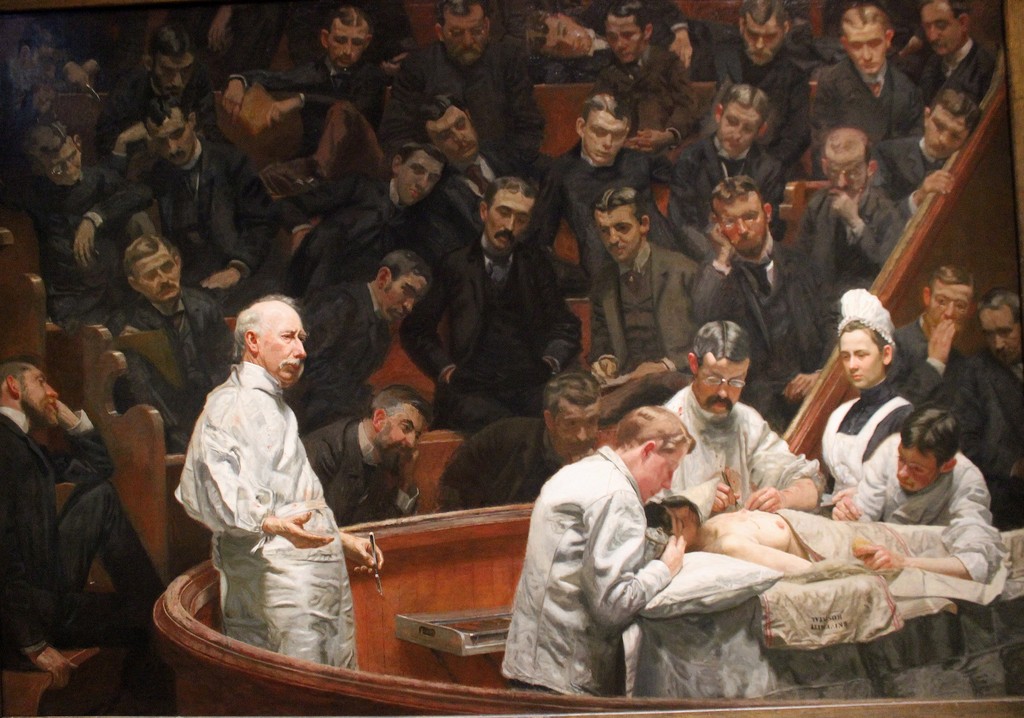
The Agnew Clinic of 1889 returned to the medical amphitheatre under different conditions. It was commissioned by the University of Pennsylvania medical class of 1889 to honour the retiring surgeon Dr D. Hayes Agnew. Penn Nursing’s account draws attention to Mary V. Clymer, the nurse standing at the right, and to the increasing reliance on surgical assistants.[9] Compared with the dark concentration around Gross, the later clinic is brighter and more expansive. It also stages professional hierarchy more visibly: surgeon, doctors, nurse, patient, and students occupy distinct roles within one public image.
Read together, the three paintings complicate any easy equation between seeing and knowing. Observation can support anatomical understanding, persuasive representation, and technical teaching. It can also expose bodies within unequal structures of authority. Eakins’s greatest works do not resolve that tension; their power partly depends on keeping it visible.
Portraits Without Ceremony
After leaving the Academy, Eakins devoted an increasing share of his work to portraiture. He did not abandon action so much as locate it inside attention: listening, remembering, singing, or simply sustaining a pose. Backgrounds often become quieter, while a hand, tilted head, or direction of gaze carries more of the picture’s meaning. The Smithsonian notes that he tended to select sitters he respected—scientists, physicians, writers, athletes, and musicians—and that his later portraits increasingly reduced environmental detail to focus on introspection.[3]
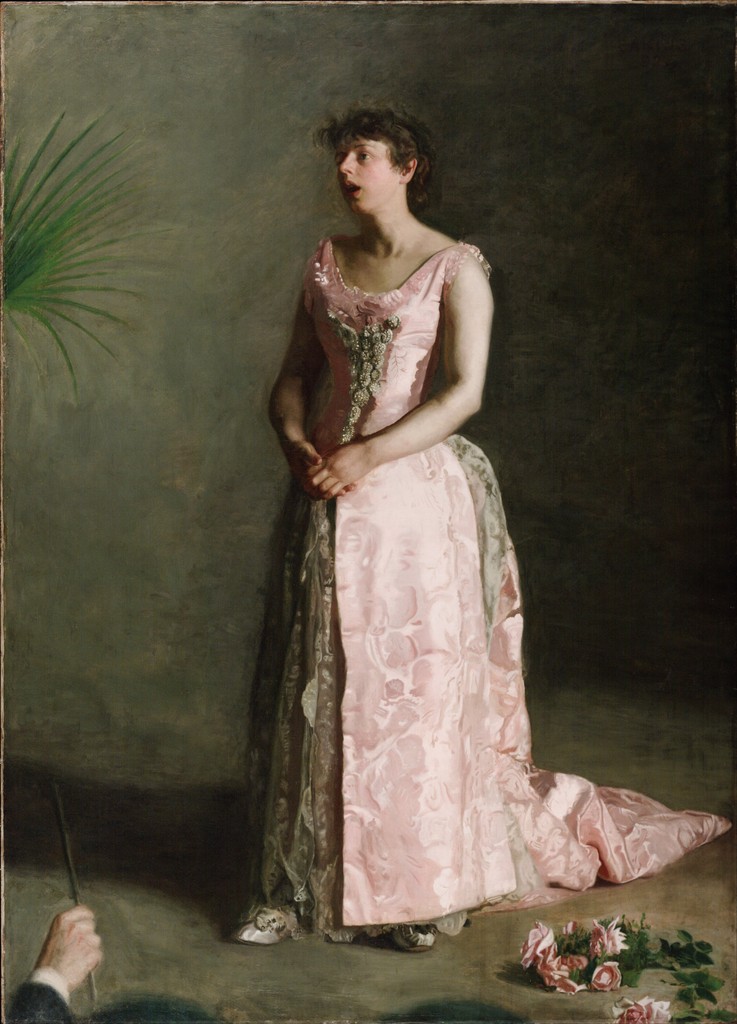
The Concert Singer demonstrates that a portrait could still show specialised work. Weda Cook posed over an extended period, repeatedly singing a phrase from Mendelssohn so Eakins could study the action of her mouth and throat. The Philadelphia Museum of Art records that he carved the opening bars of the music into the frame.[10] Cook is not presented as a social ornament. Her raised chest, open mouth, steady stance, and concentration make performance a bodily and mental achievement. The partial hand of a conductor confirms that her still figure belongs to an unfolding event.
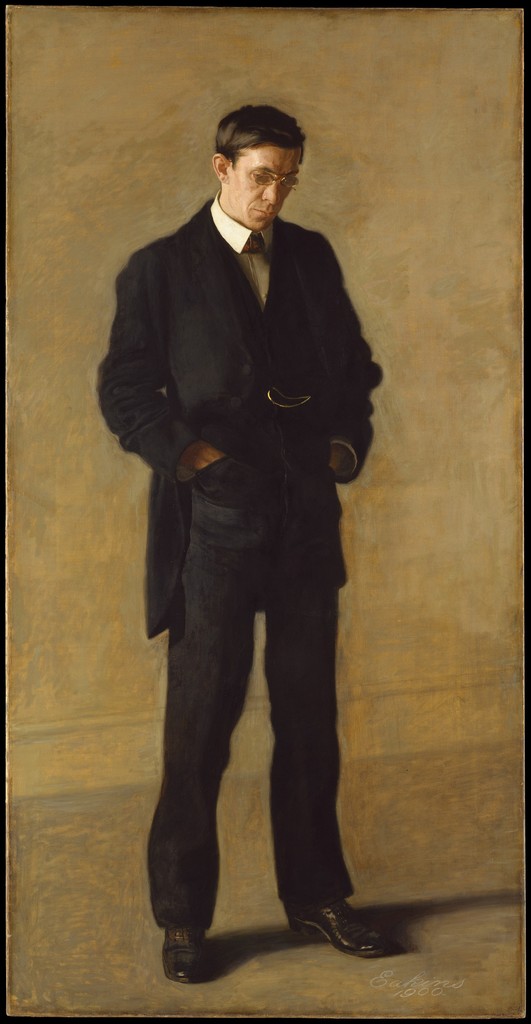
The Thinker: Portrait of Louis N. Kenton offers a different relation between artist and sitter. The Metropolitan Museum of Art identifies Kenton as Eakins’s brother-in-law and dates the portrait to 1900. Its familiar short title came from an inscription on the reverse apparently added by Susan Eakins.[11] The unusually tall, narrow canvas surrounds the standing figure with a subdued, nearly empty interior. Kenton’s lowered head, long coat, and hands in his front trouser pockets create an image of reflection without relying on professional attributes or narrative action. The painting attracted attention when it was exhibited from 1900, and its sober palette and refusal of flattery became central to its critical reception.[11]
The medical and rowing scenes are also portraits, just as these later likenesses retain traces of action. Gross teaches, the Biglins race, Cook sings, and Kenton’s standing stillness becomes an event in itself. Across those differences, Eakins asks viewers to look beyond role without pretending that role is irrelevant. Identity emerges where profession, physical presence, and private consciousness meet.
The Camera as Tool
Eakins was among the early American artists to make photography central to an ambitious studio practice. He used photographs to study movement and anatomy, to preserve configurations of models, and to work through problems that a brief pose could not hold. His interest in Eadweard Muybridge’s locomotion research belonged to this wider attempt to understand bodily action phase by phase, while his own photographs could support both painting and teaching.[1][3]
Yet the relation between photograph and painting was not mechanical. A photograph fixes one exposure from one viewpoint; a painting may combine observations, alter spacing, clarify a gesture, or build a more coherent field of attention. Eakins’s completed compositions bear the evidence of selection. Perspective drawings, anatomical study, oil sketches, sittings, and camera work formed a connected toolkit rather than a single shortcut.
Attribution must remain equally selective. The Philadelphia Museum of Art’s retrospective presented photographs by Eakins and his circle, and the Met likewise distinguished photographs made within that circle.[1][2] Studio communities share models, spaces, equipment, and visual habits, so proximity is not authorship. Where an institutional record identifies a maker, that object-level evidence should lead; where it does not, “Eakins and his circle” is more accurate than a confident personal attribution.
Seven Ways In
The strongest introduction to Eakins is comparative. Begin with the river paintings and notice how different kinds of coordination alter the composition. Max Schmitt’s single shell creates a long interval between one athlete and the surrounding city landscape. The Biglin brothers generate a tighter rhythm of matched effort, rivalry, and spectatorship. Both works turn exact knowledge of rowing into pictorial structure, yet one is meditative where the other is openly competitive.[6][7]
Then place the two clinics beside each other. The Gross Clinic presents a singular senior surgeon whose commanding gesture dominates a compressed, dark amphitheatre. The Agnew Clinic distributes action across a brighter field and gives a professional nurse a visible place within the surgical team.[5][9] Fourteen years separate them, allowing changes in Eakins’s composition and in the representation of medical work to be seen without assuming that the later picture simply corrects the earlier one.
Swimming makes a productive third term. Like the clinics, it concerns bodies, knowledge, and spectatorship; unlike them, it moves professional study outdoors and turns teachers and students into the nude subjects of their own artistic programme.[8] Its serenity should be looked at alongside the institutional controversy around that programme. Formal harmony and difficult social history occupy the same canvas.
Finally, compare Weda Cook and Louis Kenton. Cook is absorbed in a repeatable act that Eakins studied through many sittings. Kenton performs no named profession and meets no audience; thought is suggested through his lowered head, withheld hands, and the vertical expanse of his coat. One portrait opens the body through voice, while the other concentrates attention through quiet and surrounding space.[10][11] Together they counter the idea that Eakins had only one severe formula for likeness.
Across all seven works, look for intervals: between an oar and water, a surgeon and audience, a diver and the river, a conductor and singer, or a solitary figure and an almost empty room. Eakins organised those spaces as carefully as faces or hands. They make relationships visible and prevent his realism from becoming a collection of isolated facts.
Recognition and Difficulty
Eakins’s standing grew unevenly. Several ambitious works failed to win the reception he sought, teaching disputes damaged his career, and sitters were not always comfortable with portraits that withheld conventional flattery. Even so, he continued to exhibit, teach outside the Academy, and paint. By the early twentieth century he received important institutional honours, while portraits and modern scenes that had once seemed abrasive gained wider recognition.[1]
That recognition should not smooth away the difficult parts of his record. His directness could be illuminating, but it could also be intrusive; his commitment to the nude supported serious study, but his exercise of authority provoked justified scrutiny. The art benefits from historically specific attention rather than hero worship or summary condemnation. Institutional records, named sitters, and clearly attributed photographs provide firmer ground than myths about an isolated genius.
Eakins now matters because his paintings hold exact observation and unresolved experience together. Philadelphia becomes not a backdrop but a network of river sport, medicine, education, music, literature, and friendship. His people think through bodies and act within institutions. To follow them closely is to see modern American realism become a way of asking who is visible, who holds knowledge, and how a life’s discipline appears.
Follow Thomas Eakins's career through four stages
Philadelphia, anatomy, Paris and Spain
Eakins grew up in Philadelphia, studied at PAFA and attended anatomy instruction before training in Paris with Jean-Léon Gérôme and others. Several months in Spain sharpened his attention to direct, materially forceful painting.
Rowers, portraits and a modern clinic
Back in Philadelphia, Eakins made the Schuylkill and people he knew into ambitious subjects. The rowing pictures and The Gross Clinic applied academic discipline to recognisably contemporary American experience.
Teaching, photography and contested authority
At PAFA, Eakins placed anatomy and life study at the centre of training and incorporated photography into studio work. His methods drew loyalty and criticism before the 1886 dispute ended his directorship.
Independent teaching, concentrated portraits and later honours
Eakins continued to teach outside PAFA and increasingly focused on searching portraits of writers, physicians, musicians, artists and friends. Institutional recognition grew late in his life and more fully after his death.
Essential works
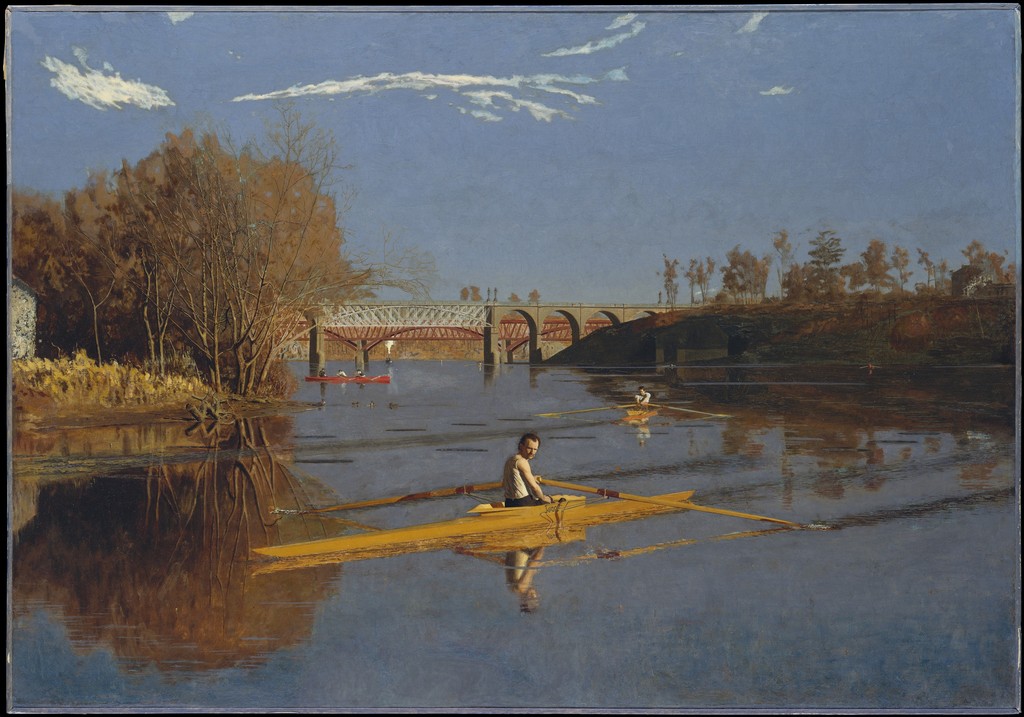
The Champion Single Sculls
1871 · Max Schmitt turns in his single shell while Eakins makes rowing mechanics, river topography and geometric construction work together.
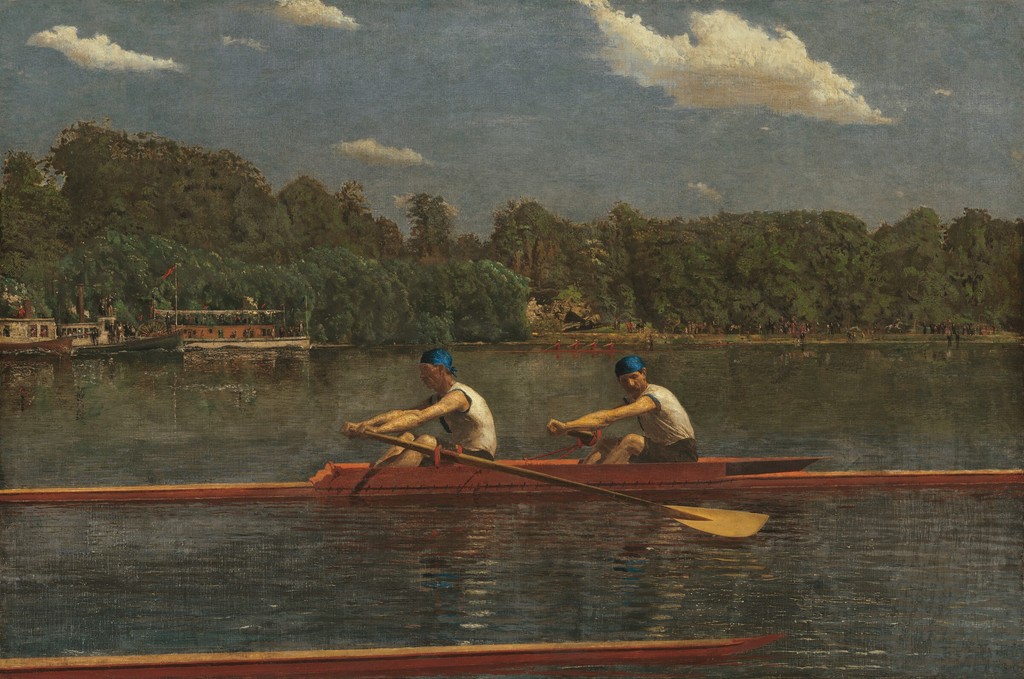
The Biglin Brothers Racing
1872 · Paired effort, rivalry and spectators turn a professional race into a compact study of coordinated modern movement.
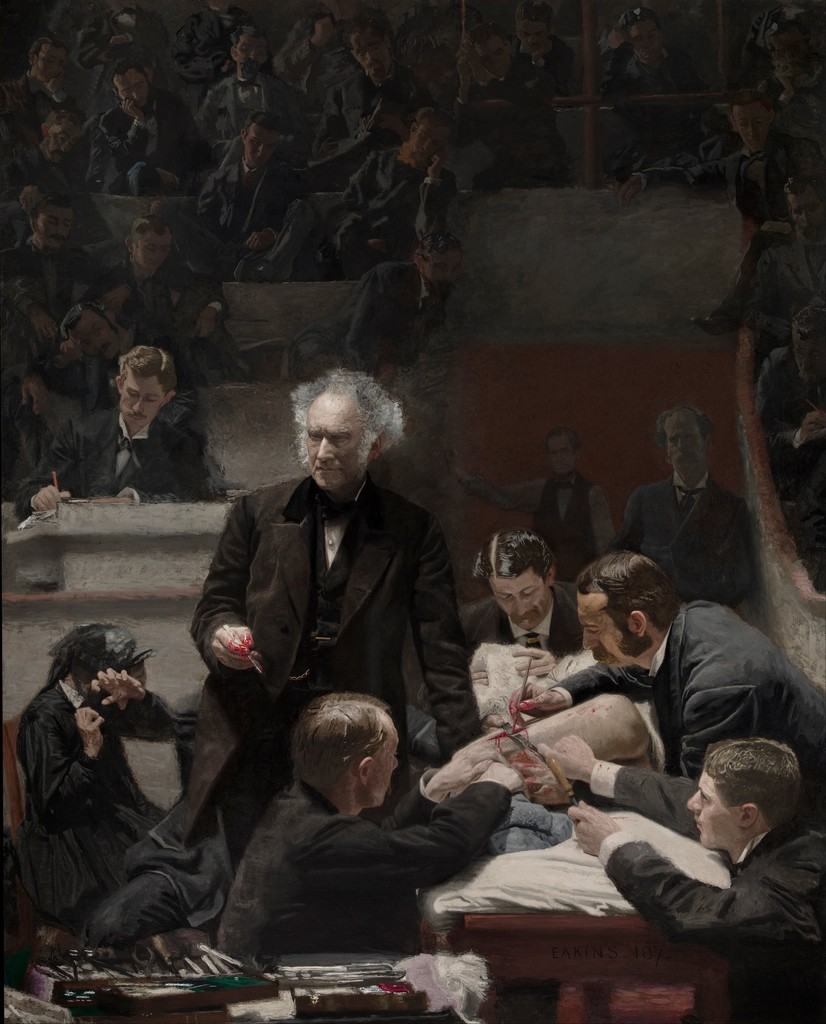
The Gross Clinic
1875 · Dr Samuel Gross interrupts an operation to teach, joining portraiture, surgery and public authority in one demanding contemporary scene.
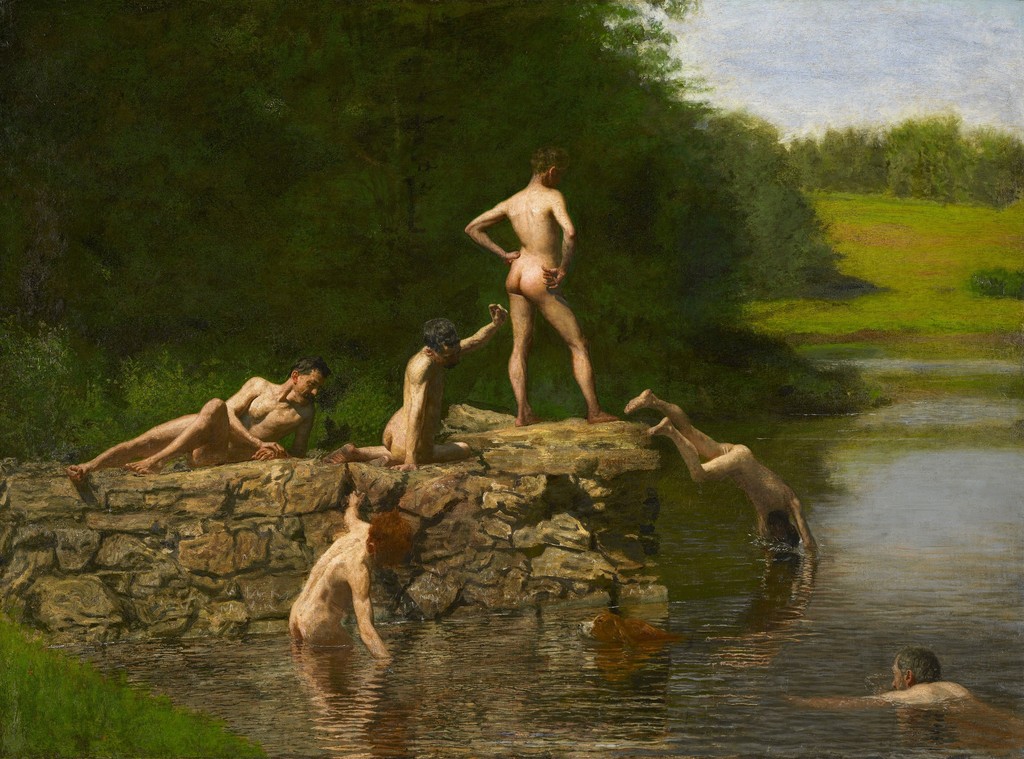
Swimming
1885 · A teacher-student group becomes a measured sequence of nude bodies at rest, in motion and entering the water.
The Agnew Clinic
1889 · A commissioned class portrait gives surgeon, assistants, nurse, patient and students differentiated places within a bright amphitheatre.
The Concert Singer
1890–92 · Weda Cook's sustained note makes a portrait about trained breath, bodily effort, listening and performance.
The Thinker
1900 · Louis N. Kenton's long dark figure and downward gaze turn a full-length portrait into a study of inward concentration.
Researched works directory
This searchable evidence census was assembled from public museum records and a reproducible Wikidata snapshot. It is not a catalogue raisonné, not a claim to complete oeuvre coverage, and not a substitute for the published catalogue literature, which was not used to claim absolute completeness.
| Name | Date | Medium |
|---|---|---|
| A Singer (Mrs. W.H. Bowden) | 1906 | Painting |
| A Singer: Portrait of Mrs. W.H. Bowden | 1906 | Painting |
| A Street Scene | Date unknown | Painting |
| A street scene in Sevilla | 1870 | Painting |
| A Street Scene in Seville | 1870 | Painting |
| African-American Man | 1884 | Photography |
| An Actress (Portrait of Suzanne Santje) | 1903 | Painting |
| Anna Lewis | 1890 | Painting |
| Annie C. Lochrey Husson (Mrs. Louis Husson) | 1905 | Painting |
| Antiquated Music (Portrait of Sarah Sagehorn Frishmuth) | 1900 | Painting |
| Arcadia | 1883 | Painting |
| Arcadia | Date unknown | Sculpture |
| Arcadia: Figure Study, Female Nude | 1883 | Painting |
| Arcadia Sketch | 1883 | Painting |
| Arcadian | Date unknown | Painting |
| Archbishop Diomede Falconio | 1905 | Painting |
| Archbishop James Frederick Wood | 1877 | Painting |
| Archbishop James Frederick Wood (1813-1883) | 1876 | Painting |
| Archbishop William Henry Elder | 1903 | Painting |
| Arthur B. Frost | 1886 | Painting |
| Artist and His Father Hunting Reed Birds: Marsh Landscape Sketch | 1873 | Painting |
| B.J. Blommers | 1904 | Painting |
| Baby at Play | 1876 | Painting |
| Baseball Players Practicing | 1875 | Artwork |
| Benjamin Eakins G38 | Date unknown | Painting |
| Bertrand Gardel (Sketch for The Chess Players) | 1875 | Painting |
| Between Rounds | 1898 | Painting |
| Billy Smith | 1898 | Painting |
| Billy Smith (Sketch for Between Rounds) | 1898 | Painting |
| Boy Reclining | 1883 | Painting |
| Carmelita Requena | 1869 | Painting |
| Charles Edmund Dana | 1902 | Painting |
| Charles Percival Buck | 1904 | Painting |
| Clara | 1890 | Painting |
| Courtship | 1878 | Painting |
| Cowboy Singing | 1892 | Painting |
| Cowboys in the Badlands | 1888 | Painting |
| Cowboys in the Badlands sketch 2 | 1888 | Painting |
| Delaware River Scene | 1881 | Painting |
| Delaware River Study | 1881 | Painting |
| Dr. Agnew (Dr. D. Hayes Agnew) (1818-1892) | 1889 | Painting |
| Dr. Agnew (Dr. D. Hayes Agnew) (1818–1892) | 1889 | Painting |
| Dr. Horatio C. Wood | 1886 | Painting |
| Dr. Thomas H. Fenton | 1916 | Painting |
| Drifting | 1875 | Painting |
| Eakins G184 | 1916 | Painting |
| Ecorché: Relief of a Horse (Josephine) | 1882 | Sculpture |
| Edward W. Redfield | 1905 | Painting |
| Fairman Rogers Four-in-Hand: Landscape Study of Fairmount Park | 1879 | Painting |
| Fairman Rogers Four-in-Hand: Study of a Horse's Leg | 1879 | Painting |
| Fairmount Park (Sketch for The Fairman Rogers Four-in-Hand) | Date unknown | Painting |
| Female Model | 1867 | Painting |
| Female Nude | 1884 | Painting |
| Female Nude from the Back | 1889 | Photography |
| Female Nude (Study) | 1881 | Painting |
| Fifty Years Ago (Young Girl Meditating): Study | 1877 | Painting |
| Figure Study: Masked Nude Woman | Date unknown | Painting |
| Figure Study: Nude Woman, Seated, with Arms Lowered (r) | Date unknown | Painting |
| Figure Study: Nude Woman, Seated, with Arms Raised | Date unknown | Painting |
| [Four Sketches: Seated Man, Sleeping Dog, Two Vases(?)] | Date unknown | Painting |
| Frances Eakins | 1870 | Painting |
| Francis J. Ziegler | 1890 | Painting |
| Frank Hamilton Cushing | 1895 | Painting |
| Frank Jay St. John | 1900 | Painting |
| General E. Burd Grubb (1841-1914) | 1898 | Painting |
| Girl with a Fan; Portrait of Miss Gutierrez | Date unknown | Painting |
| Harriet Husson Carville (Mrs. James G. Carville) | 1904 | Painting |
| Harrison S. Morris | 1896 | Painting |
| Hauling the Seine | 1882 | Painting |
| Head of a Man (Rutherford B. Hayes?) | 1877 | Painting |
| Hiawatha | 1874 | Painting |
| Hiawatha | Date unknown | Artwork |
| Home Ranch | 1892 | Painting |
| Home Scene | 1871 | Painting |
| Homespun | 1881 | Painting |
| In the Studio | 1884 | Painting |
| Interior of a Woodcarver's Shop (Sketch for William Rush Carving His Allegorical Figure of the Schuylkill River) | Date unknown | Painting |
| James MacAlister (Sketch) | 1895 | Painting |
| John Biglin in a Single Scull | 1873 | Painting |
| John Biglin in a Single Scull | 1874 | Painting |
| Joseph R. Woodwell | 1904 | Painting |
| Kathrin | 1872 | Painting |
| Knitting | 1881 | Sculpture |
| Knitting | 1882 | Sculpture |
| Knitting | Date unknown | Sculpture |
| Lafayette Park, Washington, D.C. | 1877 | Painting |
| Landscape | 1881 | Painting |
| Landscape | 1882 | Painting |
| Landscape Sketch | 1880 | Painting |
| Landscape (Sketch for Cowboys in the Bad Lands) | 1887 | Painting |
| Landscape Study: Cultivated Field and Tree | 1874 | Painting |
| Landscape Study: Shoreline with Trees | 1874 | Painting |
| Landscape with a Dog | 1874 | Painting |
| Letitia Wilson Jordan | 1888 | Painting |
| Louis Husson | 1899 | Painting |
| Major Manuel Waldteufel | 1907 | Painting |
| Masked nude standing | 1880 | Painting |
| Maud Cook (Mrs. Robert C. Reid) | 1895 | Painting |
| Mending the Net | 1881 | Painting |
| Mending the Net: Study of a Fisherman | Date unknown | Painting |
| Miss Alice Kurtz | 1903 | Painting |
| Miss Amelia Van Buren | 1891 | Painting |
| Miss Eleanor S. F. Pue | 1907 | Painting |
| Miss Gertrude Murray | 1895 | Painting |
| Monsignor James P. Turner | 1906 | Painting |
| Mother (Annie Williams Gandy) | 1903 | Painting |
| Mrs. Gilbert L. Parker | 1910 | Painting |
| Mrs. Mary Arthur | 1900 | Painting |
| Music | 1904 | Painting |
| Nude man with beard | Date unknown | Painting |
| Nude Woman Standing | 1908 | Painting |
| Old Lady Sewing | 1879 | Painting |
| Portrait of a Little Girl | 1897 | Painting |
| Portrait of a Woman Reading | Date unknown | Painting |
| Portrait of Adam S. Bare | 1903 | Painting |
| Portrait of Alfred Reynolds | Date unknown | Painting |
| Portrait of Arthur Burdett Frost | 1886 | Painting |
| Portrait of Ashbury Wright Lee | 1905 | Painting |
| Portrait of Benjamin Eakins | 1894 | Painting |
| Portrait of Benjamin Eakins (Sketch for The Writing Master) | 1882 | Painting |
| Portrait of Blanche Hurlburt | 1885 | Painting |
| Portrait of Douglass Morgan Hall | 1889 | Painting |
| Portrait of Dr. Edward J. Nolan | 1900 | Painting |
| Portrait of Dr. Samuel D. Gross (The Gross Clinic) | 1875 | Painting |
| Portrait of Edward Taylor Snow | 1904 | Painting |
| Portrait of Elizabeth L. Burton | 1905 | Painting |
| Portrait of Florence Einstein | 1905 | Painting |
| Portrait of Henry O. Tanner | 1902 | Painting |
| Portrait of J. Harry Lewis | 1876 | Painting |
| Portrait of John B. Gest | 1905 | Painting |
| Portrait of Joshua Ballinger Lippincott | 1892 | Painting |
| Portrait of Leslie W. Miller | 1901 | Painting |
| Portrait of Lucy Lewis | 1896 | Painting |
| Portrait of Margaret Eakins in a Skating Costume | 1871 | Painting |
| Portrait of Mary Adeline Williams | 1899 | Painting |
| Portrait of Mary Adeline Williams | 1900 | Painting |
| Portrait of Mrs. Fairman Rogers (Study for The Fairman Rogers Four-in-Hand) | 1879 | Painting |
| Portrait of Mrs. Frank Hamilton Cushing | 1895 | Painting |
| Portrait of Mrs. James Mapes Dodge (Josephine Kern) | 1896 | Painting |
| Portrait of Professor Benjamin H. Rand | 1874 | Painting |
| Portrait of Professor W. D. Marks | 1886 | Painting |
| Portrait of Rear Admiral George Wallace Melville | 1904 | Painting |
| Portrait of Walter S. Macdowell | 1904 | Painting |
| Porträt des Alfred Bryan Wall | 1904 | Painting |
| Porträt des David Wilson Jordan | Date unknown | Painting |
| Porträt des John McLure Hamilton (1853- 1936) | 1895 | Painting |
| Professionals at Rehearsal | 1883 | Painting |
| Professor William D Marks | 1886 | Painting |
| Professor William Woolsey Johnson | 1896 | Painting |
| Pushing for Rail | 1874 | Painting |
| Rail Shooting on the Delaware | 1876 | Painting |
| Rear Admiral Charles Dwight Sigsbee G388-2 | 1903 | Painting |
| Rear Admiral George W. Melville | 1905 | Painting |
| Reclining Male Nude | 1887 | Photography |
| Reclining Nude | Date unknown | Painting |
| Retrospection | 1880 | Painting |
| Riter Fitzgerald | 1895 | Painting |
| Robert M. Lindsay | 1900 | Painting |
| Ruth (Ruth W. Harding) | 1903 | Painting |
| Saddle (Sketch for Cowboys in the Bad Lands) | 1887 | Painting |
| Sailboats Racing on the Delaware | 1874 | Painting |
| Sailboats Racing: Study of the Delaware River | 1874 | Painting |
| Sailing | 1875 | Painting |
| Salutat | 1898 | Painting |
| Seated Figures | 1886 | Painting |
| Self-portrait | 1902 | Painting |
| Seventy Years Ago | 1877 | Painting |
| Shad Fishing at Gloucester on the Delaware: Delaware River and Gloucester Pier | 1881 | Painting |
| Shad Fishing at Gloucester on the Delaware River | 1881 | Painting |
| Shad Fishing at Gloucester on the Delaware River: Study of a Woman's Head | 1881 | Painting |
| Ships and Sailboats on the Delaware | 1874 | Painting |
| Ships and Sailboats on the Delaware: Study | 1874 | Painting |
| Shoreline of the Delaware River, with Fishing Nets | Date unknown | Painting |
| Signora Gomez d'Arza | 1901 | Painting |
| Singing a Pathetic Song | 1881 | Painting |
| Sketch for Cowboys in the Bad Lands | 1887 | Painting |
| Sketch for Music (The Violinist) | 1904 | Painting |
| Sketch for Portrait of Dr. Jacob Mendez da Costa | 1893 | Painting |
| Sketch for Portrait of Leslie W. Miller | 1901 | Painting |
| Sketch for Portrait of Letitia Wilson Jordan | 1888 | Painting |
| Sketch for Portrait of Monsignor James P. Turner | 1906 | Painting |
| Sketch for Portrait of Mother Patricia Waldron | 1903 | Painting |
| Sketch for Portrait of Professor George F. Barker | 1886 | Painting |
| Sketch for Seventy Years Ago | Date unknown | Painting |
| Sketch for The Concert Singer | 1892 | Painting |
| Sketch for The Fairman Rogers Four-in-Hand | 1879 | Painting |
| Sketch for The Gross Clinic | 1875 | Painting |
| Sketch for the Surrender of General Lee to General Grant at Appomatox | Date unknown | Painting |
| Sketch for William Rush and His Model | 1908 | Painting |
| Sketch of a Landscape | 1882 | Painting |
| Sketch of a Man and Study of Drapery | 1882 | Painting |
| Sketch of Harry | 1892 | Painting |
| Sketch of Max Schmitt in a Single Scull | 1874 | Painting |
| Sketches for “Home-Spun”, (recto and verso) | 1881 | Painting |
| Sketches (Four on one panel) | Date unknown | Painting |
| Spinning | 1881 | Painting |
| Spinning | 1882 | Sculpture |
| Spinning: Sketch | 1881 | Painting |
| Starting Out After Rail | 1863 | Painting |
| Starting Out After Rail | 1874 | Painting |
| Study for Arcadia: Youth Playing Pipes | 1883 | Painting |
| Study for "Cowboys in the Badlands | 1887 | Painting |
| Study for "Negro Boy Dancing": The Banjo Player | Date unknown | Painting |
| Study for "Negro Boy Dancing": The Boy | Date unknown | Painting |
| Study for Portrait of John McClure Hamilton | 1895 | Painting |
| Study for Salutat | 1898 | Painting |
| Study for 'The Meadows, Gloucester' | 1882 | Painting |
| Study for "William Rush Carving His Allegorical Figure of the Schuylkill River | 1876 | Painting |
| Study of a Groom | 1879 | Painting |
| Study of a Nude Man | 1869 | Painting |
| Study of a Nude Man (The Strong Man) | 1869 | Painting |
| Study of a Seated Nude Woman Wearing a Mask | 1863 | Drawing |
| Study of a Young Woman | 1868 | Painting |
| Study of Dr Samuel David Gross | 1875 | Painting |
| Study of Horse for The Fairman Rogers Four-in-Hand | 1879 | Painting |
| Swimming | 1885 | Painting |
| Taking the Count | 1898 | Painting |
| Taking the Count, study | 1898 | Painting |
| Taking Up Net | 1881 | Painting |
| Talcott Williams | 1889 | Painting |
| That's a New Game Down in Frisco": Study for the Central Standing Figure | 1878 | Painting |
| The Agnew Clinic | 1889 | Painting |
| The Art Student (James Wright) | 1890 | Painting |
| The Artist's Wife and His Setter Dog | 1884 | Painting |
| The Biglin Brothers Racing | 1872 | Painting |
| The Biglin Brothers Turning the Stake | 1873 | Painting |
| The Black Fan (Portrait of Mrs. Talcott Williams) | 1891 | Painting |
| The Bohemian (Portrait of Franklin Louis Schenck) | 1890 | Painting |
| The Brinton House | 1878 | Painting |
| The Cello Player | 1896 | Painting |
| The Champion Single Sculls (Max Schmitt in a Single Scull) | 1871 | Painting |
| The Chaperone | 1908 | Painting |
| The Chess Players | 1876 | Painting |
| The Concert Singer | 1890–1892 | Painting |
| The Courtship | 1878 | Painting |
| The Crucifixion | 1880 | Painting |
| The Dancing Lesson | 1878 | Painting |
| The Dean's Roll Call | 1899 | Painting |
| The Fairman Rogers Four-in-Hand | 1879 | Painting |
| The Fairman Rogers Four-In-Hand (A May Morning in... | 1899 | Painting |
| The Meadows, Gloucester | 1882 | Painting |
| The Model | 1908 | Painting |
| The Oarsmen (The Schreiber Brothers) | 1874 | Painting |
| The Oboe Player (Portrait of Dr. Benjamin Sharp) | 1903 | Painting |
| The Old-Fashioned Dress (Portrait of Helen Montanverde Parker) | 1908 | Painting |
| The Pair-Oared Shell | 1872 | Painting |
| The Pathetic Song | 1881 | Painting |
| The Pianist | 1896 | Painting |
| The Poleman in the Ma'sh | 1881 | Drawing |
| The Red Shawl | 1890 | Painting |
| The Spinner | 1876 | Painting |
| The Thinker: Portrait of Louis N. Kenton | 1900 | Painting |
| The Timer | 1879 | Painting |
| The Translator, Portrait of Monsignor Hugh T. Henry | 1902 | Painting |
| The Veteran (Portrait of George Reynolds) | Date unknown | Painting |
| The Writing Master | 1882 | Painting |
| The Young Man (Portrait of Kern Dodge) | 1898 | Painting |
| Thomas Eakins and John Laurie Wallace on a Beach | 1883 | Photography |
| Three Boys Wading in a Creek | 1883 | Photography |
| Trenton Battle Monument | 1893 | Sculpture |
| Two Pupils in Greek Dress | 1883 | Photography |
| Views of Harry | 1885 | Painting |
| Walt Whitman | 1887 | Painting |
| Whistling for Plover | 1874 | Painting |
| William H. Macdowell | 1884 | Photography |
| William H. Macdowell and Margaret Eakins in Saltville (or Clinch Mountain), Virginia | 1875 | Photography |
| William Hance Macdowell (1816-1906) | 1897 | Painting |
| William Rush and his Model | 1908 | Painting |
| William Rush and His Model | Date unknown | Painting |
| William Rush Carving His Allegorical Figure of the Schuylkill River | 1876 | Painting |
| William Rush Carving His Allegorical Figure of the Schuylkill River | 1908 | Painting |
| William Rush Carving His Allegorical Figure of the Schuylkill River, Study | 1876 | Painting |
| William Rush's Model | 1908 | Painting |
| Wrestlers | 1899 | Painting |
| Young Girl Meditating | 1877 | Painting |
Frequently Asked Questions
Eakins is best known for incisive portraits and ambitious scenes of modern American life, especially rowers on the Schuylkill River and surgeons teaching in Philadelphia medical amphitheatres. The Gross Clinic, The Champion Single Sculls, and The Agnew Clinic join anatomical precision to questions of professional identity, public authority, and individual character.[2][5]
Rowing belonged to Eakins’s own experience and to Philadelphia’s expanding culture of organised sport. It let him unite familiar people and places with demanding problems of perspective, balance, reflection, and bodies in motion. His rowing pictures are therefore both records of a modern activity and carefully structured investigations of coordinated physical skill.[1][7]
He used the camera as one part of a larger working method, alongside drawing, anatomical study, perspective, oil sketches, and repeated sittings. Photographs helped preserve poses and analyse movement, but paintings involved substantial recomposition and selection. Because photographs were also made within his studio circle, authorship should be assigned from object-level evidence rather than assumed from association.[1][2]
Eakins made close study of the nude central to his teaching and pressed that programme in ways that generated complaints about classroom conduct and boundaries. In 1886 he was required to leave his directorial post at PAFA. Accounts also record divided student responses, so the episode is best understood through evidence about both his pedagogical aims and his exercise of institutional authority.[1][8]
Start with The Champion Single Sculls for measured outdoor movement, then compare The Gross Clinic and The Agnew Clinic as public images of medical knowledge. Add Swimming for the connection between art teaching and the body, and finish with The Concert Singer and The Thinker to see how performance and stillness produce different kinds of portraiture.[5][6][8][9][10][11]
Discussion
Use this evidence-led guide as a starting point for close looking rather than a final verdict.
Share an observation about Thomas Eakins or a source that adds useful context.
Reader Insights
Which work most clearly complicates the familiar image of Eakins as a strictly literal realist?
Where do Philadelphia, Paris training, anatomy, photography or institutional life most productively alter your reading?
Which source or surviving object would you investigate next?
Join the Conversation
Add your reading below, keeping observations specific and evidence clear.
References
- Philadelphia Museum of Art, Thomas Eakins: American Realist, accessed 30 August 2026.
- The Metropolitan Museum of Art, Thomas Eakins: Exhibition Overview, accessed 30 August 2026.
- Smithsonian American Art Museum, Thomas Eakins, accessed 30 August 2026.
- Archives of American Art, Smithsonian Institution, A Finding Aid to the Thomas Eakins Letters, 1866–1934, accessed 30 August 2026.
- Philadelphia Museum of Art, Portrait of Dr. Samuel D. Gross (The Gross Clinic), accessed 30 August 2026.
- The Metropolitan Museum of Art, The Champion Single Sculls (Max Schmitt in a Single Scull), accessed 30 August 2026.
- National Gallery of Art, The Biglin Brothers Racing, accessed 30 August 2026.
- Amon Carter Museum of American Art, Swimming, accessed 30 August 2026.
- University of Pennsylvania School of Nursing, The Agnew Clinic, accessed 30 August 2026.
- Philadelphia Museum of Art, The Concert Singer, accessed 30 August 2026.
- The Metropolitan Museum of Art, The Thinker: Portrait of Louis N. Kenton, accessed 30 August 2026.
More EAKINS Artworks
The Agnew Clinic image: gallery photograph by Miguel Hermoso Cuesta, cropped and perspective-corrected, under CC BY-SA 4.0.