


 by Tom Gurney
Tom Gurney BSc (Hons) is an art history expert with over 20 years experience
Published on June 19, 2020 / Updated on November 6, 2026
Email: tomgurney1@gmail.com / Phone: +44 7429 011000
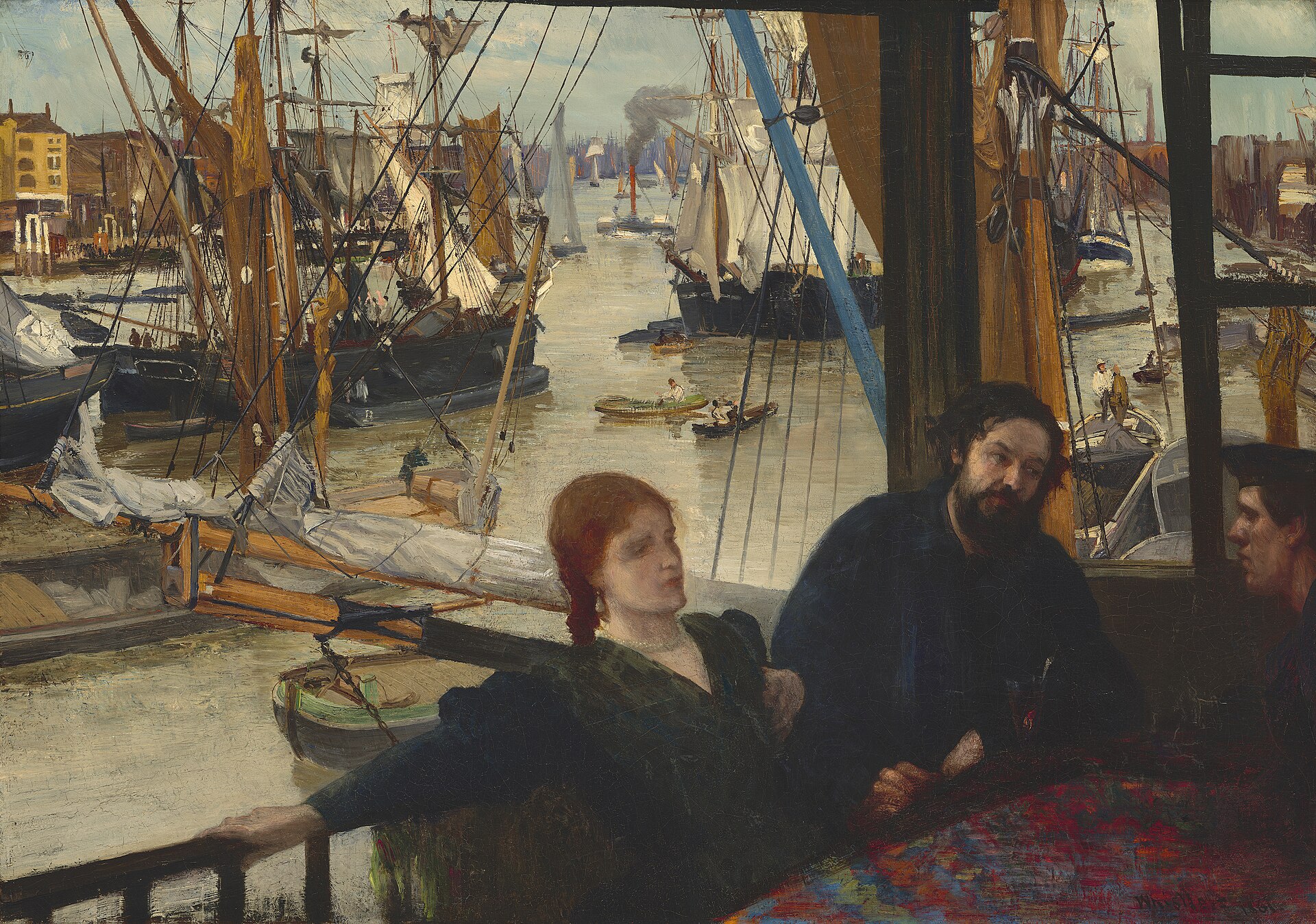
James McNeill Whistler's Wapping places three people at a riverside table while the commercial Thames spreads behind them. Joanna Hiffernan, with copper-red hair and dark green clothing, sits beside the bearded French artist Alphonse Legros. An unnamed sailor leans in from the right. Beyond the balcony, sails, masts, barges, boats, warehouses and a red-funnelled tug crowd the water.[1][2][16]
The title names the north-bank district across the river, not the foreground location. Whistler painted from the balcony of the Angel public house at Cherry Gardens in Bermondsey, on the south bank. The diagonal railing divides the drinking place from the water while allowing the social group and working port to occupy one continuous field.[1][15]
The canvas was begun around 1860, signed and dated 1861, and radically revised through 1864, with possible later touches. The inscription therefore records an intermediate state rather than final completion. Whistler repeatedly changed the foreground people even after much of the etched-looking river panorama had been established.[1][3][4]
Those revisions transformed the subject. In 1861, Whistler described Hiffernan performing a mocking, sexually knowing prostitute role with male clients. X-radiography shows the original central man leaning close and placing an arm around her. By the final state, that man had been replaced by Legros and the bodies separated, reducing the transaction's explicitness without erasing its dockside setting.[3][4][8]
The object is YMSM 035 in the University of Glasgow catalogue raisonné and accession 1982.76.8 at the National Gallery of Art, Washington. These identifiers distinguish it from the Rotherhithe etching, which was later published under the title Wapping, and from the vertical winter oil The Thames in Ice.[1][2][15]
At a Glance
- IdentityWapping
- CatalogueYMSM 035
- Date1860–64
- ViewpointThe Angel balcony, Cherry Gardens, Bermondsey
- SittersJoanna Hiffernan, Alphonse Legros and an unnamed sailor
- MediumOil on canvas
- Dimensions72 × 101.8 cm
- Accession1982.76.8
- Current holderNational Gallery of Art, Washington
- Image rightsNational Gallery of Art Open Access / CC0
Contents
- Object identity, dimensions and current location
- Why a Bermondsey view is called Wapping
- The three figures on the Angel balcony
- Joanna Hiffernan as collaborator and performer
- The original prostitution narrative
- From the old man to Alphonse Legros
- The unnamed sailor and uncertain identities
- River traffic behind the figures
- A background “like an etching”
- Rotherhithe the etching and Wapping the oil
Object identity, dimensions and current location
The National Gallery dates Wapping to 1860–64 and identifies the medium as oil on canvas. The painting measures 72 by 101.8 centimetres, or 28 3/8 by 40 1/16 inches. Its framed dimensions are 92.1 by 123.5 by 7.6 centimetres, figures that describe the present framed object rather than the painted image alone.[1][2]
At lower right, the inscription reads “Whistler.” above “1861.” The date cannot override the documented years of erasure and replacement. In February 1864, both Anna Whistler and William Bell Scott still described unfinished or tentative foreground work. Whistler himself said that the first plane had completely changed.[1][4][5]
The current holder is the National Gallery of Art, and the credit line is John Hay Whitney Collection. The museum received the work in 1982 through the Whitney charitable trust. Its online record checked on 25 August 2026 classified it as not on view, a time-sensitive status that does not alter ownership.[2][13]
The present surround is an American Grau-style frame from the 1920s. Its deep reeded design belongs to John Hay Whitney's ownership period, not securely to Whistler's 1864 Royal Academy display. No evidence identifies the original frame, and a later frame should not be called “Whistler's” merely because it follows a pattern associated with him.[1][14]
Why a Bermondsey view is called Wapping
The Angel stood at Cherry Gardens on the south side of the Thames, in Bermondsey. Older accounts often used Rotherhithe more broadly for this riverside area. From its balcony, Whistler looked north across the river toward Wapping's warehouses, wharves and shipping.[1][15]
The title privileges what lies across the water rather than the spot beneath the figures. This is not a geographical error. A view can take its name from its facing bank or dominant subject, especially when the far shore supplies the industrial identity of the panorama.[1][15]
Whistler used several names while the painting and its reputation changed. Correspondence refers to a great Thames picture or simply la Tamise. Exhibitions called it Wapping, On the Thames, Wapping, on the Thames and Wapping, London. Much later, Whistler or Beatrix used the Pool and The Pool Rotherhithe.[1][12]
These variants reveal uncertainty about whether site, river or district should lead. The preferred title remains Wapping because it was used at the first secure exhibition in 1864 and is retained by the current holder and catalogue raisonné. The other names document circulation; they do not create different paintings.[1][2][10]
The three figures on the Angel balcony
Joanna Hiffernan sits at the left of the foreground group, though near the visual centre of the canvas. Her red hair falls behind her, and a dark patterned shawl covers green clothing. She extends an arm along the balcony rail while her face turns toward the right, without making a fully unambiguous exchange of glances.[1][2][9]
Alphonse Legros occupies the seat beside her. His dark hair, beard and navy clothing make a compact mass against the river. He turns toward the clean-shaven sailor at the far right. Legros was an artist and Whistler's French colleague; posing in work clothes or a constructed social role does not make him a documented mariner.[1][7]
The right-hand man wears a sailor's cap and blue or navy clothing. His cropped profile enters from the edge and bends toward Legros. Walter Greaves later thought the description might fit a workman from his family's Chelsea boatyard, but he became uncertain when shown a photograph. The sitter must remain unnamed.[1][17]
The three people do not form an ordinary friendship portrait. Their positions derive from a drinking-place narrative that Whistler repeatedly altered. The current separation may look conversational, but technical evidence retains an earlier intimacy or transaction beneath it. Foreground sociability and river commerce are therefore linked through a history of revision.[3][4][16]
Joanna Hiffernan as collaborator and performer
Hiffernan was Whistler's partner and principal model during a decisive period, not an anonymous woman found in a dockside pub. She supplied sustained sittings, clothing, expression and physical presence while sharing his life and helping manage practical affairs. Her work in Wapping preceded the white paintings for which she is better known.[9][16]
In a 1861 letter to Fantin-Latour, Whistler complained that she was difficult to paint and described having painted her repeatedly. He emphasized the expression he had achieved: a wink, laugh or mocking response directed toward a sailor. The protected letter also used a crude sexual label for the effect.[1][4]
The language records Whistler's intended social type, but it does not exhaust Hiffernan's contribution. An expression is made by a sitter's face and body even when an artist claims to have “given” it to her. Current scholarship reads her performance as active: the represented woman mocks rather than submits quietly to male attention.[4][9]
Her final expression is less explicit than the letter's description. She may look past the sailor rather than directly meet him, and her body leans away from Legros. That ambiguity is historically meaningful because repainting changed the relations around her. It should not be replaced by certainty about reverie, seduction or private thoughts.[2][9]
The original prostitution narrative
Whistler's first conception represented a sex worker with male customers in a Thames drinking place. The artist's language, early drawing and visitor Benjamin Moran's 1863 response all support that reading. Moran described a sailor and his female companion drinking and smoking on a public-house balcony.[4][8][16]
The woman was not framed as a repentant victim awaiting rescue. Whistler stressed her mocking confidence. This distinguished the project from moralizing Victorian images in which prostitution leads visibly to remorse, abandonment or punishment. The social economy was contemporary and transactional without an attached cautionary ending.[4][8]
J. R. Spencer Stanhope's Thoughts of the Past, exhibited in 1859, has been proposed as context because it shows a red-haired prostitute beside a window overlooking the Thames. Whistler may have seen it, but no source proves direct borrowing. Similar subject elements do not establish dependence.[1][16]
The term “prostitute” belongs here because it is documented in the making history, not because every woman in a public house should be sexualized. Hiffernan performed a specifically constructed role. The distinction protects both historical precision and the sitter from a generic assumption based on location or clothing.[4][8][9]
From the old man to Alphonse Legros
Whistler's 1861 description placed an unnamed older man in a white shirt at the middle of the group. The accompanying sketch and text show him as part of the early relation between Hiffernan and the sailor. He cannot be identified with Legros, who did not settle in London until 1863.[1][4]
X-radiography makes the change more concrete. The original central figure leaned close to Hiffernan and put his right arm around her shoulder. This buried pose created an explicit physical connection. Its removal separated the bodies and made the final social exchange less immediately legible.[3]
Legros replaced the older man in 1863. Dante Gabriel Rossetti reported that Whistler painted him from life and might continue the figure as a kind of Spanish sailor. The final bearded face remains sufficiently specific to be recognized as Legros, while the proposed sailor transformation was not fully carried out.[1][7]
By early 1864, Whistler told Fantin-Latour that the foreground had changed completely and singled out the portraits of Legros and “Jo” among his best work. This pride coexisted with continued erasure. The signed 1861 surface had become a different group through later sittings.[1][4]
The unnamed sailor and uncertain identities
The sailor at far right survived as a type more securely than as a named person. His cap, collar, dark clothing and profile identify occupation within the picture's language. They do not yield a verifiable biography.[1][2]
Greaves's later recollection is tempting because Whistler knew the family's Chelsea boatyard after moving upriver in 1863. Yet Greaves was puzzled by the photograph, and Rossetti still found the figure scarcely begun late that year. The chronology permits a Chelsea model but does not prove one.[1][7]
Leaving him unnamed is not a deficiency. Anonymous labourers and sailors populated the river world that Whistler observed, while named artist friends and intimate partners also sat for constructed roles. The unequal survival of names reveals whose records were preserved, not whose body mattered least to the composition.[9][15]
The final exchange between sailor and Legros is likewise open. Their heads angle toward one another, but a still painting cannot supply dialogue. Hiffernan's displaced gaze and the buried embrace show that what seems like a casual conversation is the residue of several different staged relations.[2][3]
River traffic behind the figures
The Thames background is exceptionally dense. Sailboats, rowboats, barges, schooners and a tug move or rest among a profusion of masts. A red funnel supplies a small bright accent. The water is tan-brown beneath a pale blue, hazy sky.[1][2]
Warehouses extend along both banks, while a lower, tree-lined horizon opens at the centre. This central recession prevents the shipping from becoming a flat wall. Small hulls and rigging diminish with distance, and patches of water carry the eye between vessels.[2]
Anna Whistler's 1864 description named shipping, buildings, steamers, coal heavers and passengers going ashore. Her inventory captures the painting's claim to Thames life, although current viewers cannot securely label every tiny figure as one of those occupations. Her letter is evidence of contemporary recognition, not an index keyed to pixels.[5]
The river is not secondary decoration behind the “real” subject. It explains the public house's clientele, the sailor's presence and the economy within which Hiffernan's role was staged. Trade, transport, drinking and sexual exchange occupy connected spaces along the port.[8][16]
A background “like an etching”
Whistler told Fantin-Latour that the background resembled an etching. The comparison describes its network of masts, ropes, hulls and architectural edges. It also connects the painting with his intensive work around Wapping, Limehouse and Rotherhithe in etched line.[1][4][15]
Oil does not literally behave like copperplate. Lines in Wapping are brushed in paint, can change width and opacity, and coexist with broad colour masses. An etched plate holds incisions and prints in reverse, producing multiple impressions that may belong to different states.[3][15]
The comparison nevertheless clarifies why reviewers found the distant river so compelling. Rigging gives exactness without equal finish everywhere. Atmospheric colour unifies details that could otherwise become inventory. The result joins topographical density to painterly relation.[2][11]
Whistler's earlier employment at the United States Coast Survey supplied drafting experience, but it does not explain the painting as a professional map. Perspective, cropping and tonal grouping serve pictorial needs, while the river's exact traffic belongs to an observed day or accumulated studies rather than a survey record.[15][17]
Rotherhithe the etching and Wapping the oil
The etching catalogued as Rotherhithe, G70, also uses the Angel balcony. Two smoking men sit before a river view, with shipping and warehouses beyond. It was exhibited under Rotherhithe in 1862 but published in the Thames Set in 1871 as Wapping, creating lasting title confusion.[15]
The print and oil are not versions of one object. The etched plate is vertical, contains two different foreground men and exists in six states and many impressions. The oil is horizontal, includes Hiffernan, Legros and a sailor, and passed through years of painted revision.[1][15]
Shared balcony and river establish a working method. Whistler could reuse access, sight lines and social setting while changing medium and group. Comparing them reveals how foreground figures redirect the same broad viewpoint rather than proving that one simply copies the other.[15][16]
The Thames in Ice, YMSM 036, is another oil from the Angel vicinity. Its vertical format, frozen river and dominant ship belong to Christmas 1860 and a separate provenance. Nearby site does not make it an alternate state of Wapping.[1][17]
Four years of erasure and repainting
George du Maurier wrote in October 1860 that Whistler was working secretly and determinedly downriver on what was probably this “masterpiece.” A later recollection by Miriam Levy also places visitors before a nautical canvas in the area. Neither source supplies an accession number, so the identification remains probable.[1][6]
Whistler signed in 1861, yet continued. By 1863 he inserted Legros; by February 1864 Anna Whistler said the inn group still needed finishing touches. Bell Scott admired the painting's power and clarity at a distance but thought foreground figures rubbed in or tentative.[5][7]
Whistler's own explanation was blunt: he produced little because he erased so much. His revised foreground was not a minor polishing campaign. The change in people, proximity, costume and narrative required painting over substantial earlier work.[1][4]
The Royal Academy appearance in 1864 provides the best practical completion point. Glasgow allows that work may have continued into 1865, so absolute closure is unwarranted. Artists can exhibit, recover and touch canvases without creating a new catalogue identity.[1][10]
Not every portion changed at the same rate. The river background was already important in Whistler's early description, whereas the foreground group absorbed successive substitutions and altered poses. This uneven development helps explain why 1864 critics could experience the panorama as forceful and resolved while finding the people tentative or discordant. Their division of the canvas unknowingly tracked its different material campaigns.[1][4][11]
The long process also changes how perseverance should be understood. Whistler did not merely add finish to a stable design. He sacrificed painted work, brought in new sitters and weakened a narrative he had once described with confidence. Completion involved abandoning as well as perfecting. The surviving surface records a decision to keep the river's social setting while making its foreground transaction less explicit.[3][4][16]
Canvas, ground and thick paint
The support is tightly woven plain-weave canvas and has been lined. Lining attached another fabric to the original for structural support. It changed the physical backing but did not create the composition visible on the front.[3]
NGA technical notes describe thick paint laid with low, broad brushmarks, possibly over a tan ground. “Possibly” preserves uncertainty about the preparatory layer. The inherited claim that Whistler built this image from thin, repeated transparent shades is contradicted by object analysis.[3][18]
Thickness helps explain both visual weight and risk. Hiffernan's clothing, foreground table, figures and busy river contain superimposed campaigns. Broad marks can cover earlier forms but may dry and contract differently across layers.[3][4]
This method should not be generalized to all Whistler paintings. His later nocturnes often use much more fluid paint, while individual portraits and decorative works have different supports and revisions. Wapping documents one unusually extended material struggle.[3][17]
X-radiography and the buried composition
X-radiography detects contrasts produced by pigments and layer density beneath the visible surface. In Wapping, it reveals the central man's earlier position and arm around Hiffernan. The image corroborates letters saying that the foreground changed substantially.[3][4]
Technical imaging does not reconstruct every colour, facial expression or exact date. It shows material forms that Whistler covered. Correspondence supplies names and sequence; x-rays supply underlying placement. Each source answers different questions.[3][7]
The buried embrace changes how the final distance can be interpreted. Separation is not simply an original choice for three disconnected people. It is a revision away from direct contact, part of reducing the visible prostitution transaction and substituting Legros for a client type.[3][16]
Yet the earlier picture should not be imagined as a complete lost masterpiece. Whistler revised while working, and intermediate states could contain unresolved passages. X-radiography gives access to process, not permission to declare the covered version superior.[3][4]
Cracking, lining and conservation
Traction crackle appears across the surface. Such cracks can develop when paint layers dry, contract or interact unevenly, especially in a heavily revised work. The record does not isolate one recipe or campaign as the cause of every crack.[3]
Concern was already documented by 1892. In 1907, Harper Pennington described cracks as exceptionally wide. The Pennells later blamed Whistler's limited chemical knowledge, but their explanation is retrospective speculation rather than a modern analytical finding.[3][7]
In 1984 conservators repainted much of the traction crackle, abrasion in Hiffernan's hair and a small number of scattered losses. Here “repainted” means localized conservation inpainting, not replacement of the whole composition. The intervention aimed to make disruptions less visually intrusive.[3]
The NGA systematic catalogue describes the paint surface as in good condition despite the crackle. Condition and originality are not opposites: an object can retain extensive artist material, include documented treatment and present stably. Honest description names all three.[2][3]
Royal Academy exhibition in 1864
Whistler considered sending the revised canvas to the Paris Salon but ultimately exhibited it at the Royal Academy in 1864. It appeared as catalogue number 585 under Wapping. He told Fantin-Latour that the Thames picture had been accepted and expected it to be hung well.[1][4][10]
The first secure public showing therefore came after years of work. The 1861 signature was visible, but informed contemporaries knew that recent changes had transformed the foreground. Exhibition did not conceal process so much as present one provisional resolution.[5][7][10]
The painting combined categories that annual-exhibition criticism often kept apart: conversation piece, portrait, maritime landscape and contemporary genre subject. Reviewers repeatedly split the canvas into admired river and troublesome people, revealing difficulty with the relation Whistler had laboured to build.[11][16]
Acceptance did not mean unanimous approval. It gave the object public visibility under its lasting title and exposed the tension between technical admiration and demands for moral or narrative clarity.[10][11]
What the 1864 critics saw
The Spectator admired sensuous colour and remarkable technique but complained that the work lacked meaning because it offered no obvious moral story. That response is especially revealing: the original prostitution narrative had been muted enough that the critic could treat the group as insufficiently legible.[1][11]
The Times praised force and truth in the riverscape, even invoking Velázquez, while regretting that the masterly background was marred by grim, mean figures. Its division elevated ships and atmosphere over the people whose presence located the river within social life.[11]
The Daily Telegraph similarly disliked the figures but admired freshness of handling and truth of relative tone. The Athenaeum praised light, colour, chiaroscuro and the way painterly craft made observed material poetic.[11]
Together, the reviews confirm that the canvas's formal strengths were widely visible. They also show how classed or moral discomfort could be displaced into judgments about “unpleasant” figures. The foreground was not merely badly received because it was badly painted; it represented people and relations some critics did not want as the centre of art.[11][16]
From London to New York and Paris
In 1866, On the Thames appeared at the New York Artists' Fund Society exhibition, held in the National Academy of Design galleries. George Alfred Lathrop was listed as lender. That record is crucial for both title and provenance.[2][12][13]
The painting was securely included in the United States section of the 1867 Exposition Universelle in Paris, where catalogues varied between Wapping and On the Thames. A separate Salon appearance that year is possible but confused by titles also used for The Thames in Ice; it should not be stated as certain.[1][2][12]
Whistler complained angrily that his works had been put in a corridor. The location was at the entrance to the United States section, a nuance that does not invalidate his dissatisfaction but prevents caricaturing it as total exclusion.[1][12]
The canvas was shown in Baltimore in 1876 and later circulated through numerous exhibitions under variants including Wapping on Thames and Wapping Docks, London. These labels track changing audience needs, while current scholarship restores the concise 1864 title.[1][2][12]
Lathrop, Winans and an uncertain first sale
George Alfred Lathrop possessed or controlled the painting by 1866 because he lent it in New York. This evidence contradicts older claims that Thomas DeKay Winans securely bought it in 1864. A proposed Scottish sale in 1864 had also failed when James Leathart found Whistler's price too high.[1][7][13]
Winans acquired Wapping by 1867, but the exact route remains uncertain. He may have bought from Lathrop, or Lathrop may have acted as intermediary for Whistler. A scrapbook clipping connected the purchase with the Paris exhibition; a reported price of £350 is not independently conclusive.[1][2][13]
Winans had longstanding ties to the Whistler family through railway work in Russia and Baltimore industry. That connection explains access but does not settle the transaction. Biography is context, not a bill of sale.[2][13]
When Winans died in 1878, the painting passed to his daughter Celeste Winans Hutton. She retained it until at least 1923. Its extended Baltimore custody explains the 1876 charity exhibition and later appearance in the Baltimore Museum of Art's inaugural show.[2][12][13]
John Hay Whitney and the National Gallery
Flora MacDonald White sold the painting to John Hay Whitney on 29 September 1928. The current 1920s American frame belongs to this general change in presentation, though the maker and precise commissioning event have not been proved.[2][13][14]
Whitney lent Wapping widely, allowing the canvas to return to London and appear in major surveys of American, British and Whistler-related art. Exhibition mobility did not change private ownership.[2]
In 1982, Whitney deeded the painting to the John Hay Whitney Charitable Trust. The trust then gave it to the National Gallery of Art. The current credit line preserves Whitney's role without implying that he was the first American owner.[2][13]
The work's transatlantic history began much earlier: New York display in 1866, Paris in 1867 and Baltimore ownership followed a London making. National classifications cannot contain a canvas built through Irish, French, English and American participants and institutions.[1][2][9]
Why Wapping matters
Wapping makes the port a social system rather than a scenic backdrop. River shipping, public-house sociability, sex work, artists' friendships and transatlantic collecting occupy one object. The balcony is a threshold where those economies meet.[8][16]
The painting also preserves disagreement between narrative and form. Whistler began with a pointed sexual exchange, then revised it until critics complained that no meaning remained. Colour and handling became legible precisely as plot became harder to read.[3][4][11]
It does not need to be called Impressionist or Post-Impressionist. Those movements do not explain a project begun in 1860. Nor does mature Aestheticism or a generalized Japanese programme account for the old man, Hiffernan's performance, Legros's insertion or the x-rayed embrace.[3][16][18]
Its modernity lies in documented particulars: contemporary labour and sexuality, a mixed social group, an unidealized industrial river, visible broad paint and an unstable finish achieved through erasure. These features can be understood without inventing a direct line from Baudelaire or Courbet to every decision.[4][16][17]
Frequently Asked Questions
Yes, in the documented original conception. Whistler described a sexually knowing, mocking expression, and Benjamin Moran understood the group as a prostitute with sailors in a riverside drinking place. Later repainting reduced the explicit contact, so the final state is less narratively direct.[4][8][9]
It belongs to the National Gallery of Art in Washington, DC, as accession 1982.76.8, John Hay Whitney Collection. The NGA page checked on 25 August 2026 said it was not on view. Display can change, so visitors should consult the current record.[2]
Conclusion
Wapping holds a dense river and a repeatedly reconstructed social group in productive tension. The masts and warehouses make trade visible, while Hiffernan, Legros and the unnamed sailor occupy an inn balcony bound to that economy. The setting explains the people; the people keep the panorama from becoming neutral scenery.[1][8][16]
The final composition cannot be separated from what lies beneath it. An older client, an arm around Hiffernan and a more explicit prostitute role were painted out as Whistler inserted Legros and altered the group. Hiffernan's active performance survives even though the transaction became less legible.[3][4][9]
Material history records the cost of that process. Thick broad paint, lining, traction crackle and localized 1984 inpainting belong to the object now seen. The current good condition does not restore a pristine 1861 surface, because no such finished state ever remained fixed.[3]
From the Royal Academy's divided reception to Lathrop, Winans, Hutton, White, Whitney and the National Gallery, the painting crossed institutions and oceans while its titles shifted. Its lasting force comes from refusing an easy division between modern river, sexual economy, sitter collaboration and painterly form.[2][11][13]
Discussion
How do the revised foreground figures change the meaning of Whistler’s working-river panorama?
Look closely at Hiffernan’s pose, Legros’s separation, the unnamed sailor, the railing and the network of shipping behind them.
Reader Insights
What remains of the more explicit social exchange revealed by letters and x-radiography?
How do rigging, vessels and haze compete with the three foreground figures?
Why did 1864 critics admire the background while resisting the social group?
Join the Conversation
Share a close observation or an object-history question.
References
- Margaret F. MacDonald and Grischka Petri, “Wapping,” YMSM 035, The Paintings of James McNeill Whistler: A Catalogue Raisonné, University of Glasgow, https://www.whistlerpaintings.gla.ac.uk/catalogue/display/?mid=y035
- National Gallery of Art, “Wapping,” 1982.76.8, https://www.nga.gov/artworks/61254-wapping
- Robert Wilson Torchia, Deborah Chotner and Ellen G. Miles, American Paintings of the Nineteenth Century, Part II (Washington, DC: National Gallery of Art, 1998), 233–38.
- James McNeill Whistler to Henri Fantin-Latour, 1861 and 1864, The Correspondence of James McNeill Whistler, University of Glasgow.
- Anna Matilda Whistler to James H. Gamble, 10–11 February 1864, GUW 06522, The Correspondence of James McNeill Whistler, University of Glasgow.
- George du Maurier letter, October 1860, and Miriam Levy's later recollection, documented in YMSM 035.
- Dante Gabriel Rossetti and William Bell Scott correspondence concerning Wapping, 1863–64, documented in YMSM 035.
- Benjamin Moran, diary entry on Joanna Hiffernan and the Thames painting, April 1863.
- National Gallery of Art, The Woman in White: Joanna Hiffernan and James McNeill Whistler (2022), with Margaret F. MacDonald, “Joanna Hiffernan and James Whistler: The Model and the Artist,” Yale University Press, 2021.
- Royal Academy of Arts, The Exhibition of the Royal Academy, 1864, cat. 585.
- Spectator, Times, Daily Telegraph and Athenaeum reviews of the Royal Academy exhibition, May–June 1864.
- New York Artists' Fund Society, 1866, and Exposition Universelle, United States section, 1867, exhibition catalogues.
- National Gallery of Art and University of Glasgow provenance research, Winans-Hutton scrapbook and John Hay Whitney Foundation records.
- Sarah L. Parkerson Day, “Picture Frames,” The Paintings of James McNeill Whistler: A Catalogue Raisonné, University of Glasgow, with 2017 frame research.
- University of Glasgow, “Rotherhithe,” G70, The Etchings of James McNeill Whistler: A Catalogue Raisonné.
- Robin Spencer, “Whistler's Subject Matter: ‘Wapping’ 1860–1864,” Gazette des Beaux-Arts 100 (October 1982): 131–42.
- Andrew McLaren Young, Margaret F. MacDonald, Robin Spencer and Hamish Miles, The Paintings of James McNeill Whistler (New Haven and London: Yale University Press, 1980), no. 35.
- Existing live route, local image and frozen Waterhouse+ inherited-public-prose audit record for “Wapping.”


