


 by Tom Gurney
Tom Gurney BSc (Hons) is an art history expert with over 20 years experience
Published on June 19, 2020 / Updated on November 6, 2026
Email: tomgurney1@gmail.com / Phone: +44 7429 011000
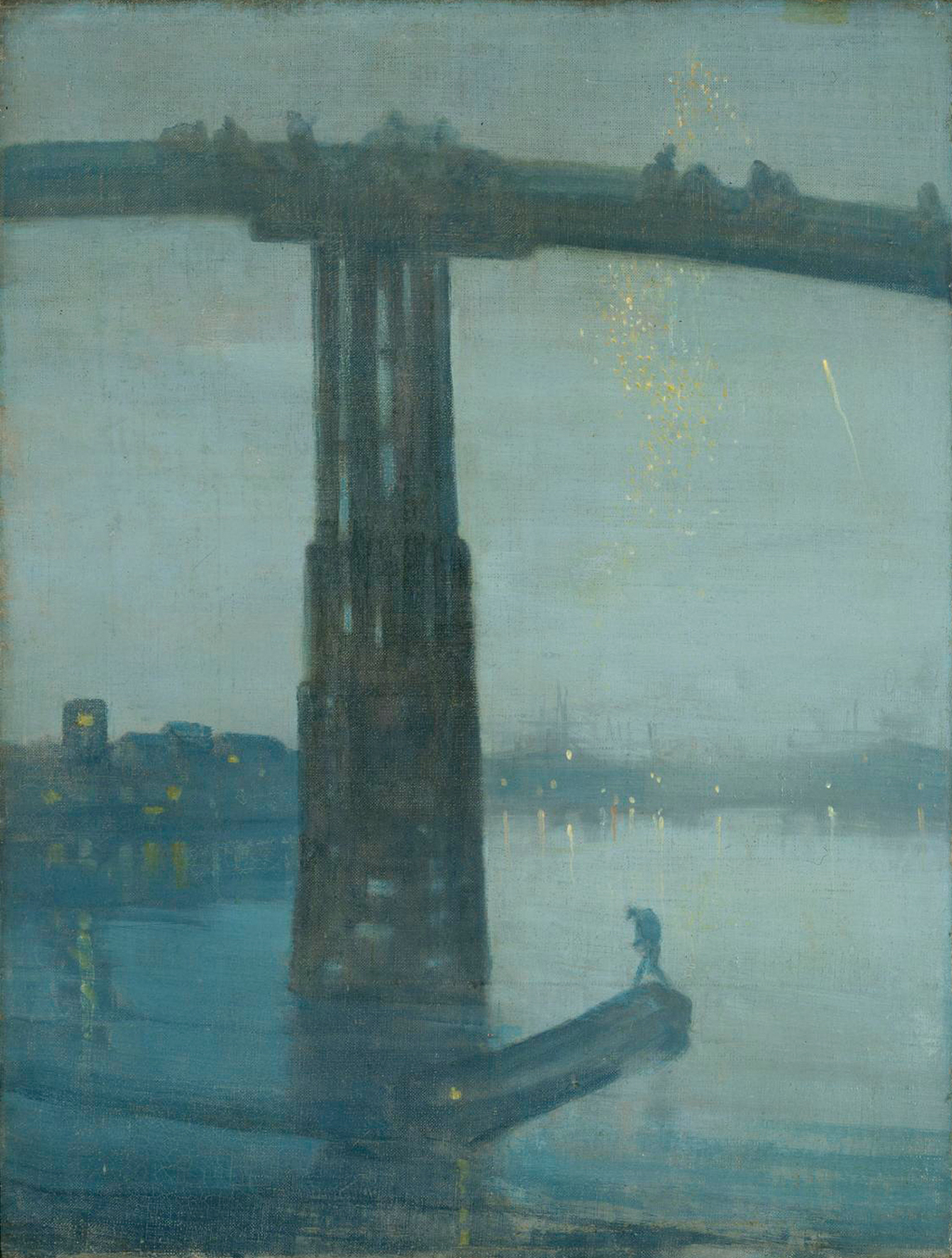
James McNeill Whistler's Nocturne: Blue and Gold—Old Battersea Bridge makes a London landmark both enormous and elusive. One timber pier rises almost the full height of the canvas. The bridge deck cuts across the upper margin. Through and beyond that dark structure, distant Chelsea is reduced to a church tower, scattered lamps and the pale lights of Albert Bridge. A low lighter moves diagonally across the water with one boatman standing at its stern. Gold fireworks break at the right, while blue, green, brown and exposed pinkish ground bind the scene into night.[1][4][5]
The painting is YMSM 140 and Tate accession N01959. Tate currently dates it about 1872–75, records the medium as oil paint on canvas, and measures the support at 68.3 by 51.2 centimetres. Its frame measures 92.2 by 76 by 8.3 centimetres. No signature or inscription is recorded on the canvas, although Whistler's butterfly appears midway down the right side of the painted frame. The Art Fund presented the work in 1905.[1][3][5][19]
When checked on 26 August 2026, Tate's live record reported the painting on display at Tate Britain in the exhibition James McNeill Whistler, scheduled for 21 May to 27 September 2026. That is dated visitor information rather than a permanent location guarantee: displays can change, and Tate's current object page should be consulted before travel.[1][2]
At a Glance
- CatalogueYMSM 140
- Datec.1872–75
- SupportOil on fine canvas with commercial priming and imprimatura
- Dimensions68.3 × 51.2 cm
- SignatureNone on canvas; butterfly at mid-right on frame
- ViewpointDownstream through Old Battersea Bridge
- Preferred titleNocturne: Blue and Gold—Old Battersea Bridge
- FrameFoord & Dickinson Flat Whistler frame with blue seigaiha
- CollectionTate, N01959
- DisplayTate Britain Whistler exhibition on 26 August 2026; verify current status
Contents
- One object, many titles
- A vertical river painting
- Looking downstream towards London
- The lighter and its boatman
- Fireworks, not stars
- A moonlight without a painted moon
- How far away should it be seen?
- Why the date is c.1872–75
- Repeating Old Battersea Bridge
- Hiroshige and the problem of influence
One object, many titles
The modern title is stable; its nineteenth-century names were not. A probable showing at Brighton in 1875 called the work a nocturne in blue and silver. At the Deschamps Gallery in 1876 it was Nocturne in Blue and Silver No. 5, the same formulation Whistler used when sending the canvas to William Graham in 1877. The Grosvenor Gallery then dropped the number, and the likely Durand-Ruel title of 1888 remained blue and silver. An 1889 engraving described a fragment of Old Battersea Bridge in those colours.[4][6][9]
Blue and gold entered the documented title history by the 1892 Goupil retrospective. Its catalogue and Whistler's loan list identify the Old Battersea subject under that combination, and the catalogue raisonné eventually standardised the present form. Even the 1905 memorial exhibition used blue-and-silver and blue-and-gold variants in different editions. The words changed while the physical painting, bridge design and provenance continued to identify the same canvas.[4][6][13][15]
The former `No. 5` should not be treated as a dependable position in a complete suite. Whistler attached numbers inconsistently. YMSM 118 was later described as a third nocturne, while YMSM 103 may once have been a first; no secure sequence connects all three. Likewise, a hostile review quoted at Goupil under `Blue and Gold No. 3` belongs more probably to YMSM 145, the Westminster nocturne. Similar colour labels are not licences to exchange evidence among different paintings.[4][6][7][15][18]
A vertical river painting
The canvas is unusually upright for a broad river prospect. Its proportions force Old Battersea Bridge to be encountered as a near obstruction rather than a horizontal span admired from shore. One pier begins below the lower edge and rises towards the deck, which crosses close to the top. Together they make a rough T, but not a geometrically perfect one: the pier varies in width, shifts away from the precise centre and carries irregular strokes that stop it becoming a diagram.[1][4]
That dominance changes the order in which the view is read. A distant bank normally supplies a landscape's horizon; here the bridge first divides the field. The viewer looks around, under and past it. Narrow openings beneath the deck release fragments of sky and shore, while the vertical pier separates the boat from much of the distant city. The painting makes seeing a matter of partial access, appropriate to a structure experienced from the river rather than surveyed as a complete elevation.[4][5]
Whistler did not present a literal architectural portrait. During the Ruskin trial he resisted that expectation while still identifying the bridge, the moonlit setting, a barge and fireworks. Topography and likeness therefore survive without exhaustive description. The bridge can be named because its form, site and surrounding landmarks cohere, yet its timber joints, traffic and exact engineering are subordinated to the relations of dark mass, blue space and scattered light.[10]
Looking downstream towards London
The viewpoint faces downstream. Chelsea lies beyond the old bridge, not behind the spectator. At lower left, the clock tower of Chelsea Old Church supplies a small but important bearing. More distant points of light belong to riverside activity and to Albert Bridge, the newer suspension bridge opened to the public in August 1873. These features establish a real reach of the Thames even though darkness removes most building detail.[3][4]
Albert Bridge is chronologically useful as well as geographically distant. Its lights appear as small accents rather than a complete technical rendering, but their presence makes a final state before the bridge opened unlikely. Whistler could have begun the support earlier, particularly because a related decorative screen was being completed in December 1872. The distant illumination, however, helps place later work after August 1873.[3][4][18]
The old bridge itself had been built in 1771–72 as a timber crossing between Chelsea and Battersea. By Whistler's period it was both useful infrastructure and a visibly old survivor within a rapidly modernising river. Authorities stopped road use in 1883, and removal followed seven years later. Joseph Bazalgette's present crossing was constructed during 1886–90. Whistler's nocturne thus preserves neither an immemorial monument nor today's bridge, but a structure nearing the end of its life.[4][6]
The lighter and its boatman
A lighter or small barge cuts across the lower field from right towards left. Its long, low body opposes the pier: the boat is diagonal and mobile where the bridge is vertical and fixed. It has passed through the bridge and continues downstream. Because it sits in front of the distant shore but behind the implied viewing position, it also joins the large near structure to the tiny lights beyond.[4][5]
One boatman stands at the stern. He is small, but his upright shape is decisive. The figure does not produce a genre story about labour, danger or homecoming; the evidence gives no name or episode. Instead, his scale makes the bridge tower higher and the river open wider. Technical study shows that he was added late and developed a distinctive crack pattern, so even this apparently incidental person belongs to a final phase of adjustment.[5]
Marks on the bridge deck should not be promoted into a crowd. When questioned about such forms, Whistler said in effect that they could be whatever the viewer preferred. That answer was evasive and strategic, but it also protects an important visual ambiguity. The dark touches may suggest people, fittings or breaks in the timber without resolving as individually described men. Calling them a queue of pedestrians would supply certainty the painting deliberately withholds.[4][10]
Fireworks, not stars
At the upper right, a cascade of warm marks is a firework. Farther right, a longer streak descends like a rocket's fading trail. These lights are not stars scattered uniformly through a night sky. Their clustered fall, varied colour and relation to the river festivities identify pyrotechnics, a subject Whistler also explored in other nocturnes. Recognising them changes the scene from timeless moonlight to a particular kind of public night spectacle.[4][5]
The fireworks did not enter the image in one final, effortless gesture. Technical examination finds early white marks in other positions and evidence that later bursts were scraped, shifted and repainted. The most prominent rocket was laid into paint that remained wet; Whistler then partially wiped it, making the tail diminish rather than end abruptly. The current sparks are the survivors of successive placements.[5]
Pigment analysis sharpens their differences. Lead white provides brilliant points; Mars orange contributes warm fire; red mixed with white forms pink; and an unidentified bright yellow appears among the accents. These colours are sparse relative to the extensive blue field. Their power therefore comes not only from brightness but from rarity and placement. Gold in the title is an interval of event, not a blanket hue.[5]
A moonlight without a painted moon
Whistler described the setting as moonlight in court, yet no circular moon needs to be visible. A nocturnal effect can be established through the cool illumination of sky and river, the silhouette of bridge timbers, and the contrast between ambient blue and concentrated lamps or fireworks. Insisting on locating a moon would mistake an account of light for a checklist of depicted objects.[10]
The predominant impression is blue, but the palette is not a simple opposition of blue and black. Greens modify the water and sky. The bridge and smoke use brown pigments rather than neutral black. A pinkish-brown ground remains visible and warms the intervals between cool strokes. Lamp black, brown ochre, madder and another red lake all participate in adjustments to the blue. The title names the prevailing relation, not every material found on the support.[5]
Whistler's bridge therefore does not become a pure silhouette. Brown passages retain temperature and transparency, allowing the pier to merge locally with river or smoke. Likewise, the background is not an opaque blue wall. Thin paint lets the prepared surface act through it. The resulting night is built from colour interaction: cool layers make the exposed ground look warmer, and small warm lights appear brighter because they interrupt broad restrained zones.[5]
How far away should it be seen?
Contemporary viewers repeatedly noticed that the painting changed with distance. A Brighton critic found the close surface disconcertingly like scene painting, then acknowledged that stepping back allowed the marks to cohere. Whistler made the same point under hostile courtroom examination. Distance did not conceal a defective picture; it was part of the designed viewing condition.[6][10][16]
From nearby, the canvas weave, rubbed patches, exposed ground and separate strokes are prominent. Farther back, those parts organise into river, pier, smoke, boat and sparks. Neither position is false. The work depends on movement between material and image. A viewer who remains far away may miss how much alteration the surface records; one who stays inches from it may refuse the optical relation that turns marks into night.[5][10]
The vertical format intensifies this requirement. At close range the pier can fill the visual field and the tiny boatman seems almost lost. With distance, the deck, pier, lighter and firework cascade become a balanced set of unequal directions. Whistler's advice was thus object-specific as well as polemical: the painting's scale and sparse accents require enough space for dispersed elements to join.[4][10]
Why the date is c.1872–75
The painting carries no secure painted date. Tate and the catalogue raisonné use about 1872–75 because multiple records define a range. The related YMSM 139 screen, with a comparable bridge structure, was being finished in December 1872. That connection makes an early beginning plausible but cannot prove that YMSM 140 then had its present fireworks, distant bridge lights or final boatman.[3][18]
Albert Bridge supplies the other end of one material clue. Its opening in August 1873 and the lights represented beyond Old Battersea Bridge suggest that at least some final accents belong after that date. A February 1876 report described the picture as lately completed. The likely Brighton appearance in 1875 and secure Deschamps exhibition in 1876 further locate its emergence as a public object.[3][6][16]
The careful conclusion is c.1872–75, perhaps with work distributed across that interval. It would be unsafe to fix the whole canvas to 1872, and still less to claim that every visible layer was made in one night. The technical evidence of reused imagery, rubbed paint, reordered fireworks and late figures independently contradicts such compression. Documentary and material chronologies agree that the present state accumulated.[3][5]
Repeating Old Battersea Bridge
Whistler returned to the old bridge in paintings, drawings, prints, a decorative screen and domestic schemes. Repetition did not mean mechanical transfer. Different works rotate the structure, shift the horizon, change format or emphasise another relation between pier and river. YMSM 139 and drawings M.0480–0485 are especially close in their use of a commanding upright pier and a crossbar near the top.[4][18]
These comparisons help explain design choices without dissolving the Tate canvas into a generic type. Its long format, single lighter, standing stern figure and right-hand fireworks define a particular arrangement. Other bridge nocturnes may be blue, silver or gold and may bear unstable numbers, but their catalogue identities remain separate. A responsible account begins with YMSM 140 and uses the related group to illuminate process, never to import another object's ownership, review or technical finding.[4][18]
The inherited claim that Whistler's oil paintings were simply based on his Thames etchings is therefore inadequate. His printmaking sharpened his knowledge of the river and of economical line, but no one-to-one derivation explains this canvas. The vertical bridge design belongs to a broader, cross-media investigation in which drawings, oils, prints and decorative objects solve different visual problems.[4][18]
Hiroshige and the problem of influence
The painting has long invited comparison with Utagawa Hiroshige. A night fête at Ryōgoku, with a bridge dominating the foreground and fireworks beyond, was specifically mentioned by Theodore Child in the nineteenth century. Cropping, asymmetry, sudden differences of scale and the placement of pyrotechnics across a dark field all make the comparison formally productive.[4][18]
No evidence establishes that Whistler traced or copied one print to make YMSM 140. Japanese woodblock prints supplied a repertoire of spatial possibilities rather than a mandatory template. The bridge close to the viewer, the low distant shore and the off-centre incident can be understood in relation to Hiroshige while remaining grounded in Whistler's repeated observation of the Thames.[4][18]
That distinction matters because `influence` can otherwise replace analysis. The relevant question is not whether a Japanese source excuses the painting's departure from European perspective, but how the design directs attention. The near pier blocks a continuous panorama; the lighter crosses its vertical; fireworks gather away from the centre; and distant London is recognisable through fragments. Such operations can be compared with Japanese prints without pretending that their cultural meanings or production methods are identical.[4][18]
At least three paintings beneath the nocturne
Technical imaging indicates that the Tate nocturne reuses a canvas carrying as many as three earlier images. One appears to have been a large face in the same orientation. Another, upside down relative to the bridge, was a half-length figure with abundant dark hair and has been tentatively proposed as a self-portrait. A further composition may have included a bridge, land and figures.[5]
The possible self-portrait must remain a hypothesis. Imaging reveals shapes and layer relations, not an identification document. Nor can the precise sequence of all underlying pictures be reconstructed. It is safer to say that Whistler repeatedly redirected the support, turning earlier attempts or abandoned subjects into the foundation of the nocturne.[5]
Reuse changes the meaning of apparent emptiness. Beneath a sky that seems almost unworked lie accumulated figures and structures; beneath the bridge are prior decisions now unavailable to ordinary sight. The final image may be thin, but the object as a whole is materially dense. Economy belongs to the visible state, not necessarily to the entire history of the canvas.[5]
Fine canvas, commercial priming and warm ground
The support is a fine canvas with visible slubs and knots. It arrived commercially prepared: glue size was covered by two lead-white oil priming layers. Whistler then applied a mid-toned pinkish-brown imprimatura. That extra field gave him a warmer, darker basis than the commercial white and allowed later blue to remain thin without making the picture pale.[5]
Analysis finds mainly lead white and lamp black in the imprimatura. Its pink appearance is relational: adjacent blue intensifies the sense of warmth. Along the distant shoreline, Whistler allowed this ground to serve as visible colour rather than covering every part with an opaque descriptive layer. The bank can therefore emerge from the prepared field with remarkably little added paint.[5]
Cusping—the slight distortions produced when woven fabric is stretched and prepared—survives only along the top. Its absence from the other sides supports an inference that at least ten to fifteen millimetres were lost there. This is not proof of a radical redesign after cutting, but it does mean the present edges do not preserve the support's entire prepared extent.[5]
Painting, wiping and painting again
Whistler began some firework positions with local white marks. Thin blue paint then spread through water and sky. At several stages he rubbed or scraped passages down far enough to expose thread peaks, the brown imprimatura or even the pale commercial priming. These returns were not uniform: some regions keep more buildup, while others preserve a visibly abraded route through earlier paint.[5]
Parts of the bridge span were added after sky and water. The great pier crossed water that had begun to dry, and adjustments at their junction produced fine cracking. In turn, sky paint later passed over bridge struts. The sequence therefore cannot be reduced to `background first, objects second`; Whistler moved backward and forward between structure and atmosphere.[5]
Lights and their reflections were placed in relation to each other rather than as unrelated embellishments. The boatman came later, and the fireworks continued to shift after much of the blue field existed. What now looks like a few economical signs is the result of testing positions, removing some and reinforcing others. The surface records composition as an active negotiation.[5]
The final visible image is extremely thin despite the greater aggregate thickness created by underlying pictures and revisions. This paradox is central to the work. Whistler sought a film that would read as air and water, yet reached it through reuse, abrasion and local repainting. Thinness should not be confused with lack of labour; it is the final condition he manufactured.[5]
The medium that kept blue fluid
The upper paint was diluted but not merely flooded with solvent. Evidence suggests that Whistler combined tube oil colour and turpentine with a natural-resin-based modifier. That mixture helped the paint remain glossy and mobile while limiting uncontrolled dripping. The result could travel across the fine canvas in long, restrained passages without behaving like transparent watercolour.[5]
Prussian blue mixed with lead white forms much of the cool field. Lamp black, brown ochre, madder and another red lake adjust its value and temperature. The bridge and smoke derive their darkness substantially from browns. Such findings dismantle the idea of a single blue wash: the apparent unity rests on small material changes that distinguish sky, water, timber, smoke and light without sharply modelling them.[5]
The large pier has absorbed medium, contributing to local differences in surface quality. A remnant of resinous varnish survives near the upper edge, but its place within the canvas's several painted lives is uncertain. It cannot safely be assigned to the final nocturne or to one underlying picture. Technical precision includes acknowledging when a layer can be detected but not securely dated.[5]
Damage produced during creation
Some fragile areas originated in Whistler's own process. Around the fireworks he scraped and reapplied paint, creating weak boundaries that later flaked. Retouching is now found in the rocket sky and in two severely abraded blocks below the bridge. These repairs should not be read as arbitrary repainting of the design; they respond to passages where the original method left the surface vulnerable.[5]
The main rocket particularly joins action and damage. It entered a wet upper layer, then was partly wiped to make its tail taper. That manipulation created the fleeting visual effect but also disturbed local paint. The material history reminds us that delicacy can be produced through forceful actions—scraping, wiping and restating—whose traces remain embedded beneath the atmospheric image.[5]
A frame that belongs to the composition
The current inner frame is a `Flat Whistler` type made by Foord & Dickinson about 1876–78. It uses oak over pine, oil gilding and painted blue ornament. A repeating seigaiha or wave pattern runs through the frieze and two fillets. The blue design links the architectural surround to the river colour inside rather than presenting a neutral gold border.[5]
Whistler placed his butterfly at mid-right on this frame. In court he explained that the blue ornament and monogram contributed to the balance and that painting and frame were conceived together. The signature's absence from the canvas is consequently meaningful: authorship and composition extend into the surround. Cropping a reproduction to the painted support alone gives the central image but omits part of the designed object.[5][10]
A glazed outer frame was added around the time of the 1905 accession to protect both canvas and decorated inner frame. That structure creates a layered object: painting, artist-directed frame and later protective housing. The additions do not have the same date or function, yet the outer glazing helped preserve the painted ornament that Whistler treated as integral.[5][19]
William Graham and an unfinished commission
In July 1877 Whistler sent the nocturne to the collector William Graham. His letter still called it Nocturne in Blue and Silver No. 5 and stressed how highly he valued it. The transfer compensated for Annabel Lee, a picture Whistler had not completed after Graham advanced 100 guineas. The nocturne therefore entered Graham's collection through the settlement of one artistic obligation with another object.[6][9]
Later legal papers described the substituted work at 150 guineas. These figures do not have to be forced into one identical amount. The 100 guineas belongs to the documented advance for the unfinished commission; 150 guineas appears as a legal valuation of the replacement transaction. Keeping source and purpose attached to each number is more accurate than reporting a single supposedly definitive price.[9][11]
Whistler's apologetic letter was also a work of persuasion. He emphasised his attachment to the nocturne while offering it to repair a strained relationship. It establishes title, ownership transfer and the commission context, but not an objective market appraisal. The exchange shows how aesthetic value and financial obligation could be negotiated together in his dealings with patrons.[9]
Grosvenor exhibition and divided viewing
The work's probable Brighton appearance in 1875 and the Deschamps exhibition in 1876 introduced its blue-and-silver identity. At the Grosvenor Gallery in 1877 it appeared without a number. Oscar Wilde's response turned the picture's fleeting effect into a joke about the length of time one ought to look. Other commentators moved between admiration for atmospheric coherence and suspicion that too little finish had been supplied.[6][16][17]
These disagreements were partly about the viewer's labour. A painting that resolves with distance asks spectators to test their own position, whereas a densely modelled bridge seems to offer information at any range. Whistler's canvas made critics decide whether a few strokes could carry sufficient visual fact. The old bridge, boat, church and pyrotechnics show that it was not empty; the controversy concerned how much description those facts required.[6][10][16]
Ruskin's attack and the trial boundary
John Ruskin's notorious accusation about throwing a pot of paint at the public was directed chiefly at Nocturne in Black and Gold: The Falling Rocket. It should not be reassigned wholesale to Old Battersea Bridge. The bridge picture nevertheless entered the 1878 trial as comparative evidence alongside YMSM 113 and the firework nocturne, giving lawyers and witnesses another example through which to debate finish, labour, subject and price.[6][10][17]
Whistler identified the bridge, moonlight, barge and fireworks while denying that fidelity to every beam was his aim. His recommendation to stand back was made under cross-examination, not in a detached teaching manual. It remains valuable because it connects his defence to the picture's actual optical behaviour, but its adversarial setting should remain visible.[10]
Edward Burne-Jones estimated that a work of this kind might be painted in one to one and a half days. That was hostile expert testimony, not a witnessed studio record. Whistler's own statement that the `mass` could be put in during a day referred elsewhere in the transcript to a different Leyland nocturne, not Graham's bridge canvas. Neither remark overrides the material evidence for repeated alteration.[5][10]
The technical record is particularly corrective here. Several earlier pictures, rubbed attempts, sky painted over struts, late boatman and repeatedly moved fireworks are incompatible with a simple one-session legend. Rapid individual passages may still have occurred; Whistler's fluid medium was designed to enable them. But speed of a stroke is not the same as total duration of the object.[5][10]
Sixty guineas and a hissed-at sale
Graham's collection was dispersed at Christie's on 3 April 1886. The bridge nocturne was lot 120, and R. H. C. Harrison acquired it for 60 guineas, or £63. Reports said the auction room hissed when it appeared. The episode indicates continuing resistance, but the low theatrical sound should not become a universal referendum on the painting.[6][12]
Whistler converted the insult into publicity. In correspondence and a letter prepared for the press, he treated the hissing as evidence against the crowd rather than the work. This was characteristic rhetorical reversal: hostile reception became material for his public persona. The letters tell us how he used the event, not how every bidder or viewer responded.[12]
The auction price also has to be read in sequence. Graham had received the work through a private settlement, and Harrison later retained it for almost two decades before the Art Fund paid a much larger sum. Values changed with ownership, reputation and institutional ambition. No one number captures the painting's aesthetic worth or proves a straight line of public acceptance.[6][19]
Paris, print and a wider audience
The likely Durand-Ruel exhibition of 1888 presented the canvas in Paris under a blue-and-silver title. In 1889 Harper's published an engraved interpretation that identified the fragment of Old Battersea Bridge. Translation into black-and-white print changed the balance of colour while making bridge, boat and fireworks available to readers far from the original.[4][6]
Such reproduction encouraged recognition of the image even as the name continued to shift. It also demonstrates why catalogue identity cannot rely on colour words alone: an engraving could preserve composition while losing blue and gold entirely. The vertical pier and crossbar, rather than pigment, became the most portable signs of the object.[4][6]
The Goupil retrospective of 1892
Harrison lent the painting to Whistler's Goupil retrospective under the blue-and-gold Old Battersea title. Whistler used the show to control the arrangement of his work and the history of its reception. The catalogue surrounded pictures with earlier criticism, making old attacks part of a deliberately theatrical retrospective argument.[13][15]
That polemic also produced an attribution problem. A review concerning `Blue and Gold No. 3` was assigned in a way that more probably belongs to the Westminster nocturne, YMSM 145. It cannot be treated as secure criticism of YMSM 140 merely because bridge nocturnes share colour terms. The error is a reminder that artist-curated evidence still needs object-by-object verification.[4][6][15]
Before the exhibition Whistler sought to have Harrison's canvas cleaned. Harrison declined to pay for treatment he understood the artist to have requested. The surviving letter documents disagreement over cost and responsibility; it does not prove that a cleaning occurred or specify a treatment method. It must remain separate from the much better documented 1942 conservation campaign.[5][14]
The Art Fund purchase and Tate transfer
By 1905 Harrison agreed to sell the nocturne to the National Art-Collections Fund for £2,000. The Fund presented it to the National Gallery in July, and it transferred to Tate in the same year. Tate's credit line records the Art Fund presentation, preserving the role of a public subscription organisation in moving the work from long private ownership into national custody.[1][6][19]
The acquisition was a dramatic change from the 60-guinea auction of 1886, but it should not be narrated as an uncomplicated final victory. The title remained inconsistent even in 1905 catalogues, and protective framing soon altered the physical presentation. Institutional recognition stabilised the accession and made conservation possible; it did not freeze either interpretation or display.[5][6][19]
Evacuation and the 1942 treatment
During the Second World War the painting was evacuated from London. In 1942 it was treated in Glasgow by, or under the direction of, Helmut Ruhemann. The campaign wax-resin lined the canvas, removed a yellowed tinted varnish and included retouching. It was probably the first lining and involved replacement of the stretcher.[5]
The lining strengthened a delicate, repeatedly worked support but necessarily changed its physical response. Fine cracking indicates that the original canvas had not been tensioned evenly, particularly towards the lower right. The present object thus combines Whistler's fine textile and cut edges with a twentieth-century backing and stretcher introduced during wartime custody.[5]
Very little early varnish survives. The present main varnish is synthetic resin and shows relatively little yellowing, so the tonality may now be reasonably close to the intended cool balance. That conclusion should remain qualified: removal of tinted coatings, retouching, lining and the uncertain upper-edge varnish fragment prevent access to a perfectly untouched state.[5]
A proteinaceous layer detected on the painting might be an egg-white coating applied by Whistler, but that attribution is hypothetical. The surface now also carries a light wax coating that protects without producing strong saturation. Different layers—possible early coating, surviving resin, synthetic varnish and wax—must not be collapsed into a single `original varnish`.[5]
What the present surface can tell us
Conservation history does not make visual interpretation impossible. It tells us which transformations stand between the painted act and today's view. The cool field is less obscured by yellow varnish than it was before 1942, while retouched abrasions help damaged passages remain legible. Differences in gloss arise from paint composition, medium absorption and later coatings as well as Whistler's brushwork.[5]
The current tonality is therefore historically mediated but materially informative. Prussian blue, warm ground and brown bridge pigments remain identifiable; concealed images and altered fireworks remain detectable; crack patterns still distinguish some late additions. Scientific examination expands the painting beyond what unaided sight can recover while also marking the limits of certainty.[5]
The two verified website images
The existing page carries a 400 by 529 pixel image and a 1,024 by 1,353 pixel detail file. Both independently match Tate's official photograph of N01959. Their object identity is secure, and the larger file preserves substantially more surface information for examining the pier, boatman and firework marks.[1][8]
Identity does not by itself grant publication permission. Tate's image record and reproduction terms require a later rights review, particularly for commercial use and preferred resolution. The correct production decision is to retain both files as verified carryover evidence while keeping licensing separate from scholarship. No claim about free reuse follows merely from an image matching the object.[1][8]
Seeing the painting at Tate in 2026
Tate's live data placed the painting at Tate Britain in the exhibition James McNeill Whistler when checked on 26 August 2026. The exhibition ran from 21 May to 27 September 2026 according to Tate's event record. This current display is significant because it offers a chance to see the painted inner frame and protective outer structure together, features often lost in cropped reproductions.[1][2]
Visitors should confirm availability near the intended date. A database field records a particular institutional moment, and conservation, lending or gallery changes can supersede it. The accession N01959 is the durable locator; `on display` is a dated status.[1]
What Whistler changed in river painting
This nocturne is sometimes described as an early step towards abstraction, but that phrase can conceal its exactness. Whistler retained the downstream orientation, Chelsea Old Church, Albert Bridge lights, old timber pier, working boat and public fireworks. He changed the hierarchy of those facts. A near structural mass dominates; named landmarks become tiny; colour and interval organise recognition before detail does.[4][5]
He also made incompleteness productive. Ambiguous bridge marks ask the viewer to suspend naming. Exposed imprimatura becomes shoreline. A partly wiped rocket reads as fading light. Rubbed paint converts an abandoned decision into atmosphere. None of these devices abolishes representation; each lets material and subject share the same mark.[4][5][10]
The picture's modernity lies as much in revision as in reduction. It contains prior portraits and landscape attempts, while its visible firework positions and bridge relationships were repeatedly changed. The calm image is an edited residue. That makes it a poor illustration of spontaneous genius and a powerful example of deliberate uncertainty.[5]
Why the painted frame matters
Many accounts end at the canvas edge, but Whistler's own object does not. The blue wave pattern carries river colour into the gilded surround, and the butterfly moves authorship from the picture surface to the right frieze. Frame and canvas collaborate: the inner gold intensifies cool paint, while the blue ornament prevents gold from becoming a conventional museum boundary.[5][10]
The outer glazed frame then records a different value system—preservation after national acquisition. It protects both the thinly painted canvas and the artist-designed border. Seeing all three layers clarifies the distinction between Whistler's integrated presentation and later institutional care. The protective frame is not part of his composition, but it preserves a frame that is.[5][19]
Why Old Battersea Bridge matters
The painting holds several histories in one compact object. It records a disappearing Georgian timber bridge alongside the lights of a new Victorian crossing. It belongs to Whistler's sustained observation of a working Thames and to an international visual culture in which Hiroshige offered new ways to crop and balance space. It participated in debates about finish, value and criticism, then moved from private debt settlement to auction controversy and national collection.[3][4][6][18][19]
Its physical history is equally dense. A reused canvas contains earlier faces and figures. Commercial priming, warm imprimatura and resin-modified blue support a sequence of painting, scraping and wiping. The decorated frame extends the image. Wartime lining, varnish removal, retouching and later coatings shape what Tate now displays. The work cannot be reduced to a misty blue mood because its stillness is full of decisions.[5]
Most importantly, the nocturne demonstrates that fidelity need not mean enumeration. A boatman, church tower, suspension-bridge lights and firework cascade are enough to secure place and event. Their sparseness makes the viewer participate in recognition. From close up one sees material discontinuity; from a distance, London gathers around the dark pier.[4][10]
Frequently Asked Questions
It shows a downstream Thames view through one great pier of the old wooden Battersea Bridge. Chelsea Old Church and the lights of Albert Bridge appear in the distance. A lighter with one standing boatman moves across the foreground water, while fireworks fall at the right.[4]
Whistler and exhibition organisers used several titles between 1875 and 1905. The same object appeared as blue and silver, sometimes with `No. 5`, before the blue-and-gold Old Battersea title became standard. The physical design and provenance, not the changing colour words alone, secure its identity.[4][6]
Discussion
How does one bridge pier turn a broad Thames view into a vertical balance of blue structure, small lights and moving water?
Trace the deck, irregular pier, diagonal lighter, boatman, distant church and Albert Bridge lights, then compare the apparently spare surface with the reused canvas, wiped paint and repeatedly repositioned fireworks.
Reader Insights
How do the T-shaped bridge and diagonal boat hold the vertical format together?
What does technical imaging add when several earlier paintings remain beneath the nocturne?
How does the blue seigaiha ornament extend the balance of the painted surface?
Join the Conversation
Share a close observation or an object-history question.
References
- Tate, “Nocturne: Blue and Gold—Old Battersea Bridge,” N01959, current artwork page and public API record, checked 26 August 2026. https://www.tate.org.uk/art/artworks/whistler-nocturne-blue-and-gold-old-battersea-bridge-n01959
- Tate, “James McNeill Whistler,” Tate Britain, 21 May–27 September 2026, current exhibition record, checked 26 August 2026. https://www.tate.org.uk/whats-on/tate-britain/james-mcneill-whistler
- Margaret F. MacDonald and Grischka Petri, “Nocturne: Blue and Gold—Old Battersea Bridge: Date,” YMSM 140, The Paintings of James McNeill Whistler: A Catalogue Raisonné, University of Glasgow, 2021. https://www.whistlerpaintings.gla.ac.uk/catalogue/display/?mid=y140
- MacDonald and Petri, “Nocturne: Blue and Gold—Old Battersea Bridge: Subject and Titles,” YMSM 140, University of Glasgow, 2021. https://www.whistlerpaintings.gla.ac.uk/catalogue/display/?mid=y140&xml=sub
- MacDonald and Petri, “Nocturne: Blue and Gold—Old Battersea Bridge: Technical Description,” YMSM 140, University of Glasgow, 2021. https://www.whistlerpaintings.gla.ac.uk/catalogue/display/?mid=y140&xml=tec
- MacDonald and Petri, “Nocturne: Blue and Gold—Old Battersea Bridge: History,” YMSM 140, University of Glasgow, 2021. https://www.whistlerpaintings.gla.ac.uk/catalogue/display/?mid=y140&xml=his
- MacDonald and Petri, “Nocturne: Blue and Gold—Old Battersea Bridge: Bibliography,” YMSM 140, University of Glasgow, 2021. https://www.whistlerpaintings.gla.ac.uk/catalogue/display/?mid=y140&xml=bib
- Tate and University of Glasgow, official YMSM 140 images and image-use records, checked 26 August 2026. https://www.tate.org.uk/art/artworks/whistler-nocturne-blue-and-gold-old-battersea-bridge-n01959 https://www.whistlerpaintings.gla.ac.uk/catalogue/display/?mid=y140
- James McNeill Whistler to William Graham, [23/30 July 1877], GUW 01784, The Correspondence of James McNeill Whistler, University of Glasgow. https://www.whistler.arts.gla.ac.uk/correspondence/recno/display/?cid=01784
- High Court of Justice, Whistler v. Ruskin trial transcript, 25 November 1878, GUW 11991, University of Glasgow correspondence edition. https://www.whistler.arts.gla.ac.uk/correspondence/recno/display/?cid=11991
- James McNeill Whistler, sworn answers to interrogatories in Whistler v. Ruskin, November 1878, GUW 13279, University of Glasgow correspondence edition. https://www.whistler.arts.gla.ac.uk/correspondence/recno/display/?cid=13279
- James McNeill Whistler correspondence concerning the Graham sale and its reception, 1886, GUW 08639 and 11342, University of Glasgow correspondence edition. https://www.whistler.arts.gla.ac.uk/correspondence/recno/display/?cid=08639 https://www.whistler.arts.gla.ac.uk/correspondence/recno/display/?cid=11342
- James McNeill Whistler, 1892 loan list, GUW 08214, University of Glasgow correspondence edition. https://www.whistler.arts.gla.ac.uk/correspondence/recno/display/?cid=08214
- R. H. C. Harrison to Boussod, Valadon & Co., 22 September 1892, GUW 02045, University of Glasgow correspondence edition. https://www.whistler.arts.gla.ac.uk/correspondence/recno/display/?cid=02045
- James McNeill Whistler and Goupil Gallery, Nocturnes, Marines & Chevalet Pieces: Small Collection Kindly Lent by Their Owners, London, 1892, Smithsonian Libraries, DOI 10.5479/sla.880959.39088020308615. https://library.si.edu/digital-library/book/nocturnesmarine00whis
- Brighton Gazette, 9 August 1875, and William Michael Rossetti's 1876 account, as transcribed and controlled in the YMSM 140 record. https://www.whistlerpaintings.gla.ac.uk/catalogue/display/?mid=y140&xml=his
- Oscar Wilde, “The Grosvenor Gallery,” 1877, and John Ruskin, Fors Clavigera, Letter 79, 1877, as controlled in the YMSM 140 history and bibliography. https://www.whistlerpaintings.gla.ac.uk/catalogue/display/?mid=y140&xml=his
- MacDonald and Petri, comparative records for YMSM 033, 103, 113, 118, 119, 139, 145 and 170 and M.0480–0485; Victoria and Albert Museum, Hiroshige E.2908-1913. https://www.whistlerpaintings.gla.ac.uk/catalogue/ https://collections.vam.ac.uk/item/O1302957/
- Art Fund and Tate acquisition records for N01959, reconciled with YMSM 140, checked 26 August 2026. https://www.artfund.org/supporting-museums/art-weve-helped-buy/nocturne-blue-and-gold-old-battersea-bridge https://www.tate.org.uk/art/artworks/whistler-nocturne-blue-and-gold-old-battersea-bridge-n01959


