


 by Tom Gurney
Tom Gurney BSc (Hons) is an art history expert with over 20 years experience
Published on June 19, 2020 / Updated on November 6, 2026
Email: tomgurney1@gmail.com / Phone: +44 7429 011000
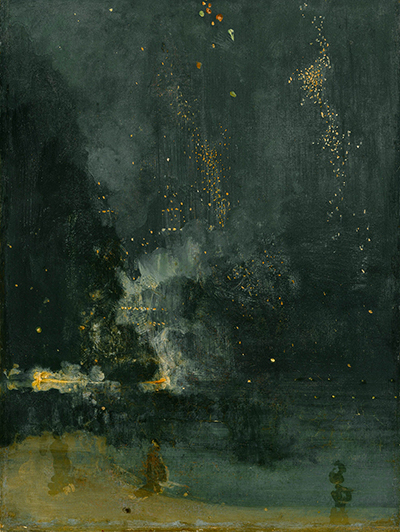
James McNeill Whistler's Nocturne in Black and Gold: The Falling Rocket is easy to approach as a courtroom exhibit. John Ruskin attacked Whistler's Grosvenor Gallery pictures in 1877; the artist sued; a jury found for him but awarded one farthing. That sequence made this small, upright panel one of the best-known disputed objects in nineteenth-century art. It can also prevent us from seeing what was disputed. Before it became evidence, the painting was an attempt to hold a moment that could not be held: sparks dropping through smoke above a pleasure garden, seen by a crowd whose bodies almost dissolve into the night.[1][4][10][11]
The Detroit Institute of Arts dates the work to 1875 and records it as oil on panel, 60.3 by 46.7 centimetres. The support is noticeably smaller than many reproductions suggest. Its vertical format directs attention upward, while its marks lead the eye in several directions at once. A grey plume climbs from the lower left. Gold and orange fragments fall through the centre and right. A projectile rises at the far side. Below them, pale ground, dark water and transparent spectators give the burst a place without turning the picture into a detailed report.[1][2][4][20]
That balance matters. Whistler did not remove the subject; he refused to make the subject behave like an inventory. Cremorne Gardens remains identifiable through its fireworks platform, dark foliage, pool and people. The painting nevertheless gives smoke and illumination more authority than architecture. It places the viewer between recognition and uncertainty, much as a firework display places an actual spectator between what has just vanished and what the eye still seems to retain.[4][13][14]
At a Glance
- CatalogueYMSM 170
- Date1875
- SupportOil on panel (wood)
- Dimensions60.3 × 46.7 cm; framed 93.7 × 77.8 × 8.6 cm
- SignatureNo object markings recorded
- SubjectFireworks at Cremorne Gardens, Chelsea
- Preferred titleNocturne in Black and Gold: The Falling Rocket
- FrameFrederick Henry Grau / Grau Whistler frame, 1892
- CollectionDetroit Institute of Arts, 46.309
- DisplayAmerican, Level 2, West Wing on 26 August 2026; verify current status
Contents
- The object in Detroit
- Seeing the fireworks before reading the verdict
- Annotated close reading
- A vertical picture, not the Fire Wheel
- Cremorne Gardens as a modern night subject
- Why Whistler called it a nocturne
- Dating the moment
- Paint on a reddish-brown panel
- Painted flecks, not thrown paint
- Did Whistler later change the foreground?
The object in Detroit
The painting is catalogue number YMSM 170 and Detroit Institute of Arts accession 46.309. Detroit uses the title Nocturne in Black and Gold, the Falling Rocket, with a comma; the catalogue raisonné uses a colon. Both identify the same object. The colon is useful editorially because it allows the colour harmony and the firework subject to remain related but not identical parts of the title.[1][3][4]
Detroit lists the medium as oil on panel. Its downloadable metadata also assigns the support term `panel (wood)`. The online YMSM header instead says canvas, yet the catalogue's own technical discussion repeatedly calls the support a panel and describes paint being worked across it. Current-holder examination therefore governs the medium line here. The disagreement is a catalogue inconsistency, not a reason to imagine two versions of the painting.[1][2][5]
The institute gives unframed dimensions of 23 3/4 by 18 3/8 inches, equivalent to 60.3 by 46.7 centimetres. Framed, it measures 93.7 by 77.8 by 8.6 centimetres. No marking is entered in the object's signature or inscription field. A monogram that Whistler discussed during the trial belonged to an earlier frame, not to the painted panel. Keeping object and surround separate corrects the tempting but inaccurate statement that the panel itself is signed.[1][5][18]
The work entered the museum in 1946 as the gift of Dexter M. Ferry, Jr. Detroit places it within American Art before 1950 and marks it Public Domain. When checked on 26 August 2026, the museum also reported it on view in its American galleries on Level 2 of the West Wing. Display can change, unlike accession and ownership, so that location is a dated observation rather than a permanent property of the work.[1][2]
Seeing the fireworks before reading the verdict
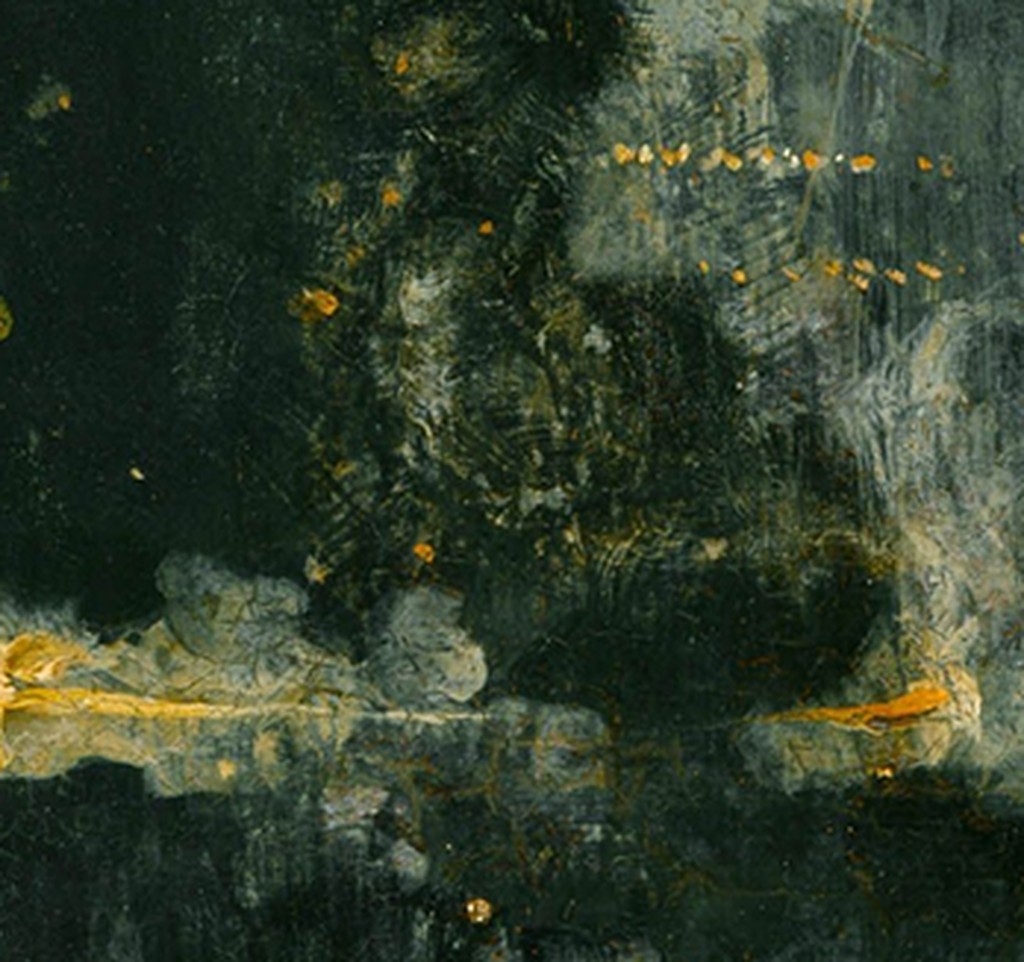
The most luminous activity occupies a loose vertical corridor. Cream, yellow, orange and reddish dabs gather near the upper centre, then descend in interrupted chains. Some are close and dense; others are isolated against the blue-green darkness. A few green notes resist the warmer shower. Near the right edge, a thin upward trajectory opposes the fall. Whistler therefore avoids one simple diagram of a rocket. The panel combines rise, burst, suspension and descent in a field where different phases seem to coexist.[4][13][20]
A broad smoke column rises from the lower-left half. Its pale grey is not a clean white spotlight. It spreads, thins and merges with the darker air, obscuring the structure from which the display is launched. The smoke is both consequence and veil: it makes the pyrotechnics visible by contrast while concealing their mechanism. Its relatively broad handling also sets a tonal mass against the minute points of the sparks.[5][13][20]
On the left, a near-black tree or block of foliage anchors the unstable display. Just beside it, a low bright band suggests the silver-gilt oyster-shell grotto or the fireworks platform at Cremorne. Four pointed turrets rose from that platform, but in the painting their distinctions are eroded by smoke and darkness. This is enough architecture to locate the event, not enough to turn it into a measured elevation.[4][13][14][20]
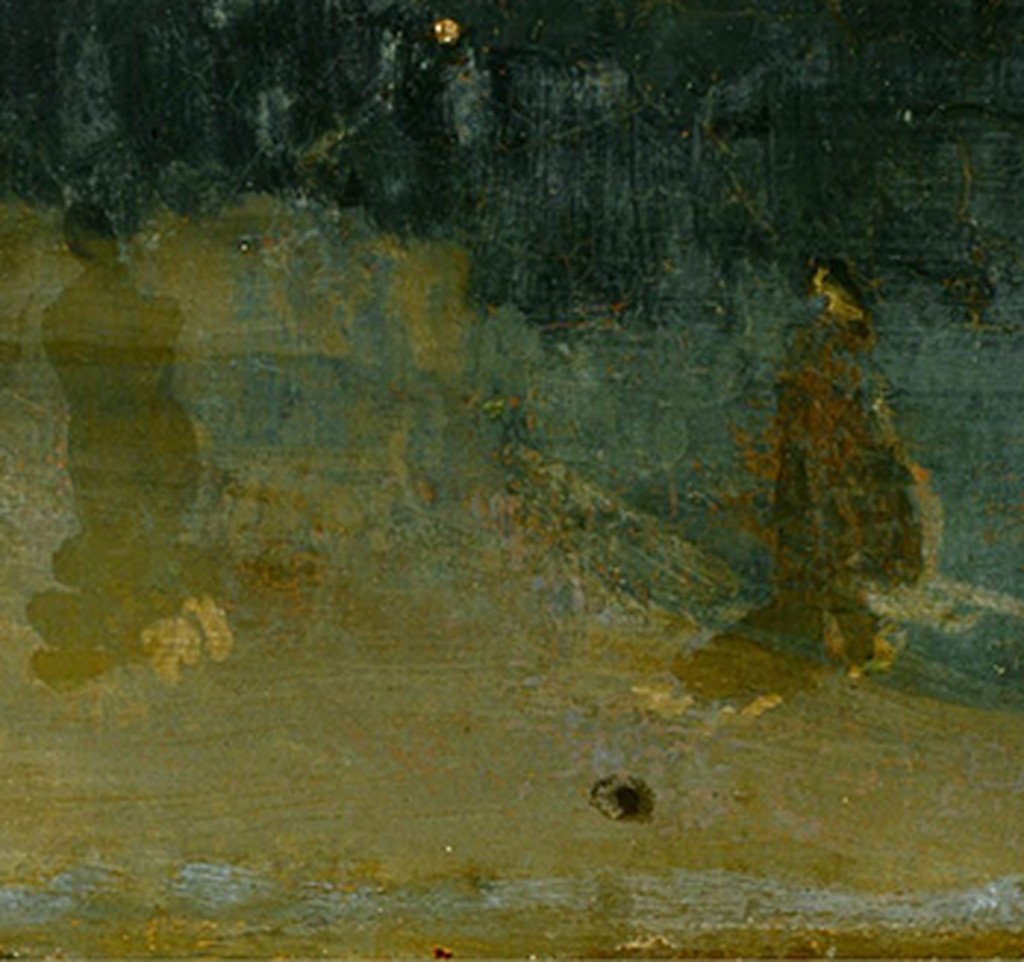
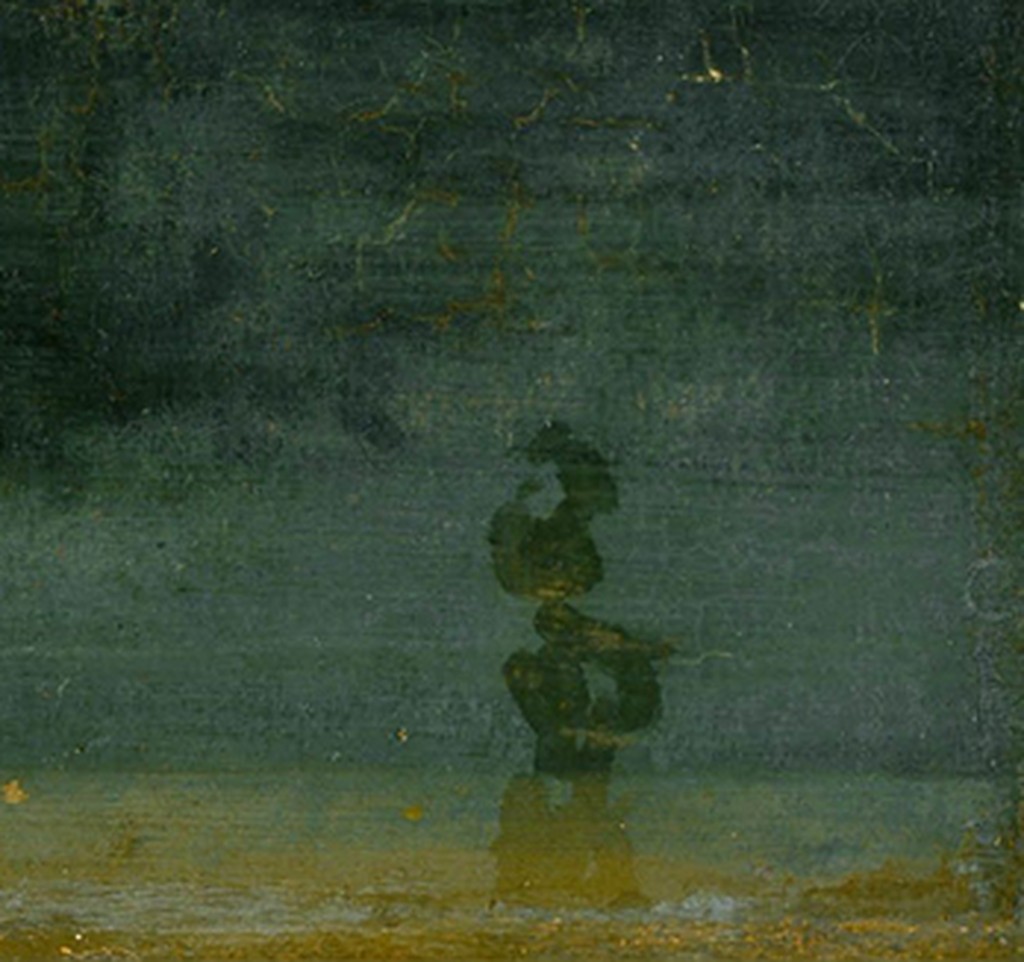
The lower zone is quieter but not empty. A dark pool occupies much of the foreground. Along its edge runs a pale ochre strip of ground or walkway. Several figures emerge as thin presences. One appears with a leg raised on a low wall, while darker companions gather at the lower right. Their bodies are not modelled as independent solid forms; passages of the underlying field serve as their colour and connect them to the space they inhabit.[5][20]
These spectators matter because they prevent the display from being only an arrangement of marks. They are witnesses within the painted event, but they do not supply a single, clearly readable reaction. No face explains how to feel. Their dispersion leaves room for the viewer outside the panel to repeat their act of looking upward. The picture stages public entertainment while withholding the social detail expected from a conventional crowd scene.[4][13][20]
Annotated Details from Nocturne in Black and Gold: The Falling Rocket
Six details keep the Detroit nocturne's painted fireworks, smoke, structure, ground and spectators visible before the Ruskin trial supplies its familiar legend.
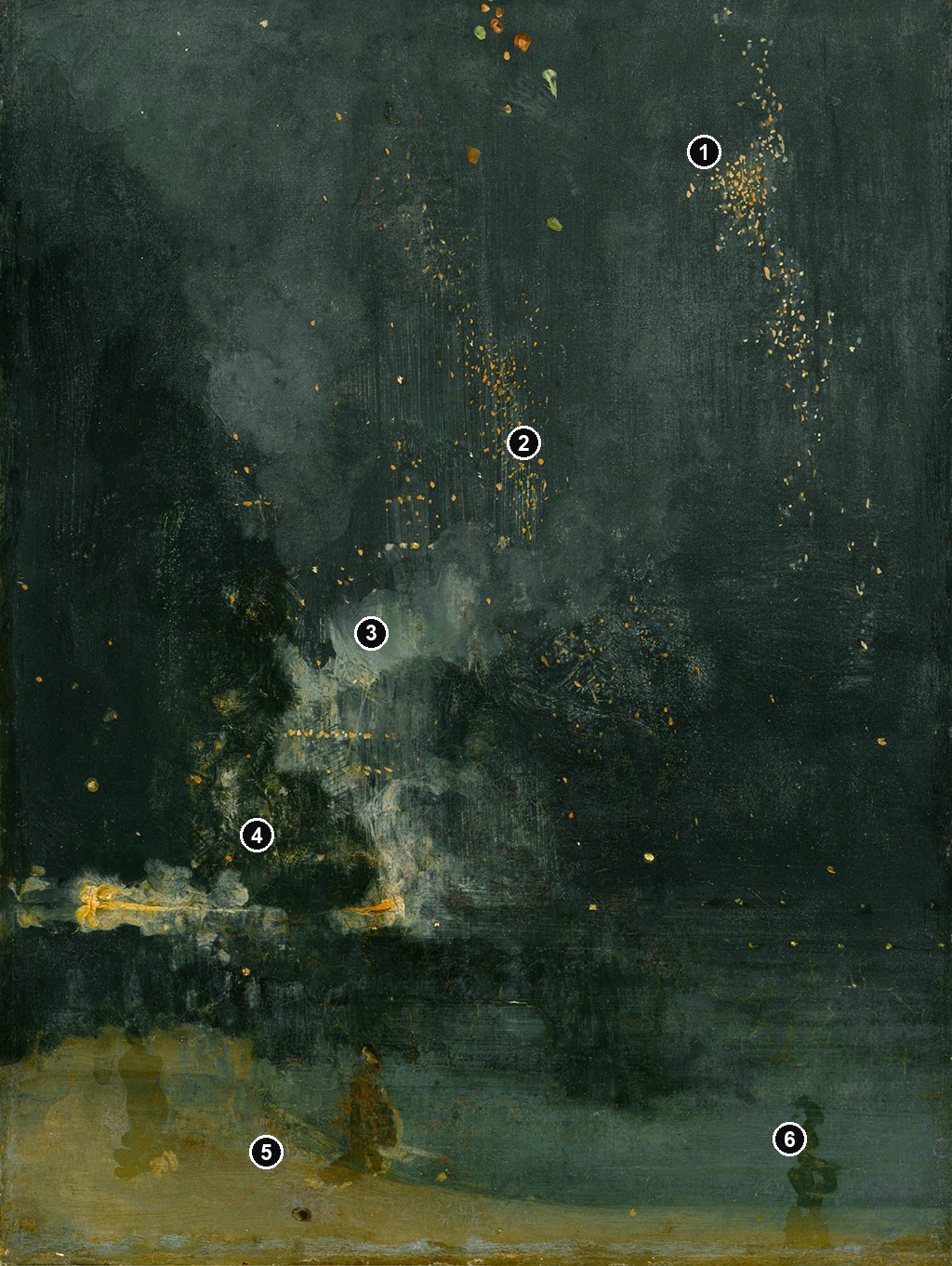
Details from NOCTURNE IN BLACK AND GOLD: THE FALLING ROCKET
The vertical panel combines different phases of a firework display with obscured architecture and dispersed viewers rather than illustrating one frozen explosion.
Upper bursts suspended in darkness
Small cream, yellow, orange and reddish marks hang near the upper edge. Their spacing makes the dark field active and allows separate sparks to register without a fully described sky or pyrotechnic mechanism. [4][13][20]

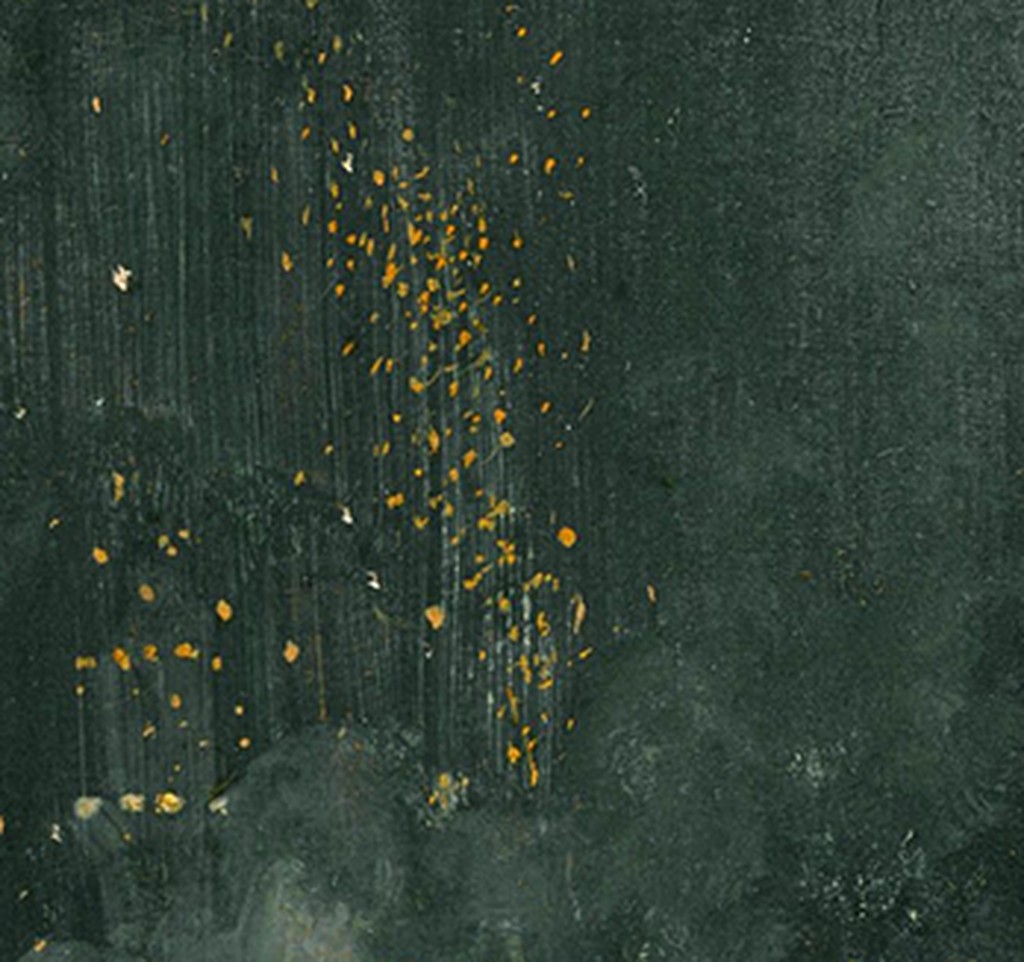
The descending golden shower
Interrupted chains of warm dabs descend through the centre while a few green notes resist them. Rise, burst, suspension and fall coexist instead of forming one simple diagram of a rocket. [4][13][20]
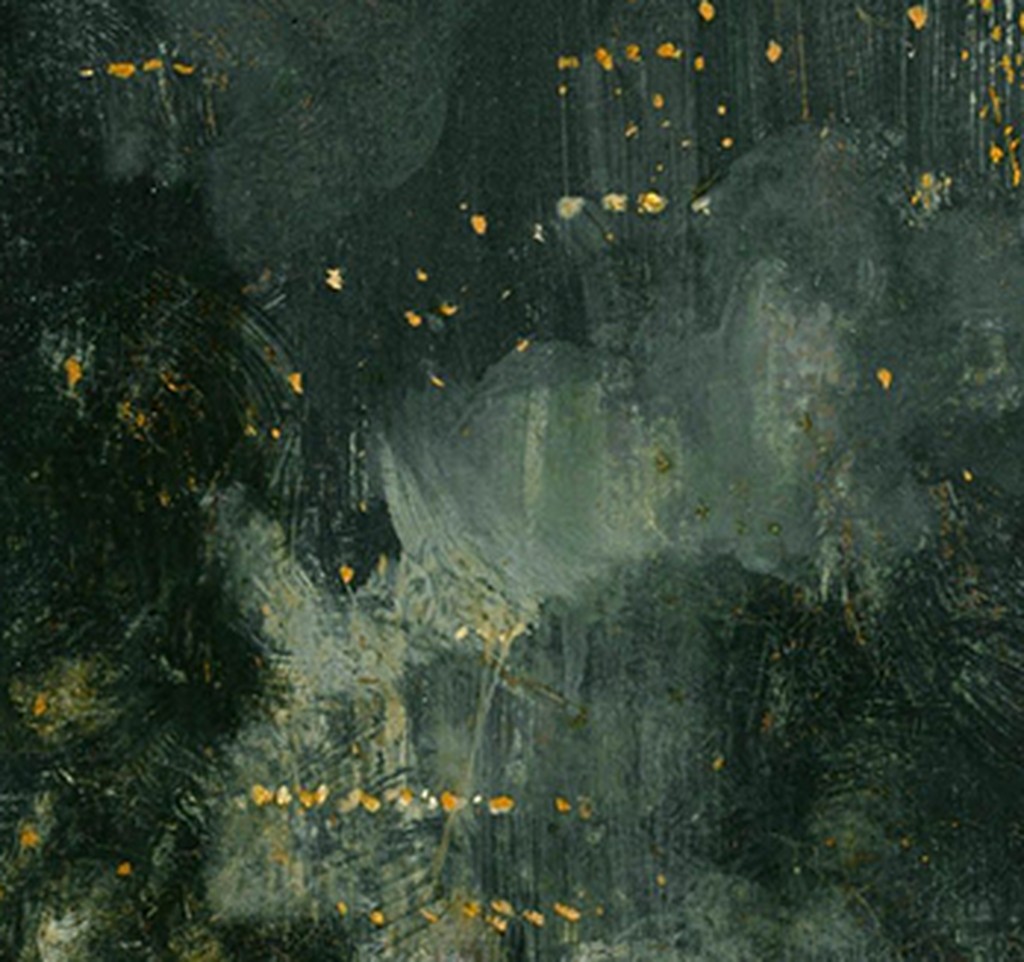
Smoke as consequence and veil
A broad grey smoke column rises from the lower-left half, giving the sparks contrast while concealing their source. Its diffuse handling sets a tonal mass against the minute points of light. [5][13][20]
Cremorne's partly erased structure
Beside the near-black foliage, a low bright band and pointed forms suggest Cremorne's grotto or fireworks platform. The architecture locates the entertainment but is eroded by smoke and darkness rather than measured in detail. [4][13][14]
A vertical picture, not the Fire Wheel
Whistler painted more than one nocturne associated with pyrotechnics at Cremorne. Similar names have repeatedly encouraged images, anecdotes and technical claims to migrate from one canvas to another. The Falling Rocket is the upright Detroit panel, YMSM 170. Nocturne: Black and Gold—The Fire Wheel, YMSM 169, is a horizontal Tate canvas dominated by a revolving Catherine wheel. The difference is not a minor title variant: it is a difference of object, format, firework type, surface history and ownership.[3][4][6]
Whistler himself distinguished them when writing to H. Graves & Co. in 1882. He asked about the upright falling rocket and the long picture with the large Catherine wheel. That business description is especially valuable because both works were then entangled in the same debt. It identifies the pictures by their opposing proportions and mechanisms, not merely by later museum titles.[6][15]
The distinction also protects the Detroit panel's legal history. The two-day exchange at the 1878 trial concerns The Falling Rocket. By contrast, later sales correspondence falsely attached Ruskin's attack to the Fire Wheel when Whistler was promoting that other picture. The error became durable because his nocturne titles were fluid and because the two works travelled together. A reliable account begins by holding their identities apart.[5][6][10][15]
Cremorne Gardens as a modern night subject
Cremorne Gardens stood on the north bank of the Thames in Chelsea, within reach of Whistler's home and studio. Visitors arrived by road and river for music, dancing, dining, acrobatics, promenading and pyrotechnic displays. It was neither a remote pastoral retreat nor a single-purpose theatre. Its attractions depended upon circulation between illuminated buildings, planted walks, performance spaces and crowds.[13][14]
Fireworks gave that environment a timed climax. A display enlisted the flash itself, the report of an explosion, the smell of burnt composition, drifting smoke, anticipation before ignition and conversation afterwards. The painter could offer only a silent, immobile surface. Rather than compensating by describing every part of the apparatus, Whistler relied on the spectator's familiarity with what painted sparks implied.[13]
Kate Flint has shown why that reliance is more than a vague appeal to imagination. Actual fireworks test visual memory. A bright trace may appear to persist after its source has moved or vanished, and earlier representations often converted the passage of fire into long continuous lines. In the Detroit panel, many sparks remain discontinuous. Their intervals ask the eye to build descent from separate points, so duration is inferred rather than diagrammed.[13]
This act of completion is cultural as well as optical. A person who recognises fireworks supplies noise, crowding, smell and motion from experience or from other representations. The canvas can therefore be materially sparse without being experientially empty. Its few high-colour accents activate a reserve of remembered spectacle. What looks almost abstract at first may become increasingly specific as the viewer spends time with it.[13][20]
Cremorne also complicates the idea of solitary aesthetic contemplation. The gardens drew a socially mixed audience and accumulated complaints about noise and disorder before their closure in 1877. Whistler did not paint a moral survey of that clientele, nor did he erase the fact of public entertainment. His transparent figures occupy a shared commercial venue while refusing the anecdotal clarity through which Victorian social types were often made legible.[4][13][14]
Why Whistler called it a nocturne
The word `nocturne` came from music, where it designated a night piece rather than a transcript of particular visible facts. Whistler used musical titles to redirect attention towards relations of colour, line and tone. During the Ruskin proceedings, he explained a nocturne as an arrangement of line, form and colour. He also resisted the suggestion that this panel should provide a good descriptive view of Cremorne.[4][10][12]
That resistance did not mean that titles were contentless. `Black and gold` prepares a viewer for the relation between a dark tonal field and brilliant accents. `The Falling Rocket` supplies an event, direction and temporal idea. The two parts work together: one names the formal relation, while the other tells us why scattered lights and veiling smoke might take this particular form.[3][4]
The title changed with exhibitions. At the Dudley Gallery in 1875 it appeared as Nocturne, in Black and Gold—The Falling Rocket. The Grosvenor Gallery shortened it in 1877. Later French and English catalogues rearranged or translated the wording, including forms that foregrounded the falling rocket or called it a black-and-gold nocturne. Treating any one version as Whistler's immutable original formula would flatten a history in which titles were adjusted for venue, language and renewed presentation.[4][6][8][19]
In 1892, after seeing the work in his Goupil retrospective, Whistler wrote that its colour title perhaps ought to have been blue rather than black and gold. The comment does not cancel the established title. It shows him continuing to judge the relationship between name and appearance seventeen years after the Dudley debut. Titles for Whistler were instruments of presentation, capable of revision even when already famous.[4][6]
Dating the moment
The secure date is 1875. Anna Matilda Whistler wrote in September that her son had recently finished a Cremorne subject, and Whistler referred around the same period to new nocturnes. Those letters help establish the activity of the moment, but neither safely identifies the Detroit panel by title. The first unambiguous anchor is its appearance in the Dudley Gallery's Ninth Winter Exhibition later that year.[3][7][8]
The Dudley catalogue assigned it number 170 and priced it at £262 10s, equivalent to 250 guineas. Its companion in that exhibition included Nocturne: Grey and Gold—Westminster Bridge. Contemporary viewers were therefore encountering the falling rocket within an already developing practice of named nocturnes, not as an isolated leap into darkness.[3][6][8]
Dating the work to the year of exhibition does not prove that it was made in one uninterrupted studio session or directly before the show. Whistler described carrying away an artistic impression from the site and working from memory. That testimony supports a distinction between observation and studio execution. It does not justify assigning every nocturne one fixed recipe or turning memory into a mystical absence of preparation.[4][5][10]
Paint on a reddish-brown panel
The material structure begins with a reddish-brown base. Over it, Whistler spread much of the image in thin paint. Technical description records square brushes, approximately seven to fourteen millimetres wide, in upper passages. Those tools could establish broad tonal movement efficiently, especially in the smoke and night field. Much finer brushes delivered the orange and green accents of the fireworks.[5]
The alternation of scale is central to the effect. Wide handling makes atmosphere continuous; small touches make the sparks discrete. The bright points are not accidental residues on top of an otherwise completed background. They are calibrated interruptions. Their different colour, density and direction establish near and far events without conventional modelling.[5][13]
The paint's thinness allows the base and underlying fields to remain active. In the foreground pool, Whistler worked around the figure with the raised leg. That person's colour is largely the background that was left or exposed. The body therefore emerges through omission and boundary, not through the accumulation of a fully opaque human form. Economy here is a positive method: a dark interval can act as water, air and figure depending upon the marks beside it.[5][20]
Diagonal shading around the showers complicates the seemingly simple dabs. It gives portions of the display a directional atmosphere, as though smoke and darkness were disturbed by the moving light. The surface shifts between fields made by larger sweeps and details placed with a fine point. Neither mode is sufficient alone. The small sparks require depth; the broad ground requires incidents that turn it into an event.[5]
Painted flecks, not thrown paint
The inherited page claimed that Whistler aimed or dripped paint at the panel, then connected this supposed procedure to Jackson Pollock. The evidence points in another direction. Individual firework colours were painted separately with small brushes. Their visual looseness is a designed effect, not proof of indiscriminate application.[5][13]
This distinction matters precisely because Ruskin's metaphor has encouraged later viewers to treat the work as if it were literally made by flinging pigment. His accusation described a perceived insult to labour, finish, price and public judgement. It was not a studio observation. Converting it into a technical report allows hostile rhetoric to overwrite the surface it attacked.[5][9][11]
Careful placement does not make the panel academically finished in the manner Ruskin preferred. Whistler's marks remain conspicuous as marks. The bright flecks do not disguise themselves as fully modelled sparks, and the translucent figures do not pretend to anatomical completeness. Material candour and control coexist. The work asks how little paint can organise a convincing experience without denying that the experience is painted.[5][13]
Nor does the correction require an opposite myth of effortless precision. The panel contains broad, rapid-looking passages, thin adjustments and fine accents. Whistler's own accounts of speed were produced in adversarial and promotional settings. Technical evidence shows choices and sequences; it cannot convert every gesture into a stopwatch measurement. The valuable point is not whether he worked slowly or quickly, but how different scales of handling cooperate.[5][10][11]
Did Whistler later change the foreground?
Historic reproductions introduce an unusual problem. Images made between 1892 and 1905 do not show the raised-leg figure that is visible today, and two other foreground figures are barely perceptible. The remaining tonality looks broadly like the present work, perhaps somewhat lighter. Simple overall darkening does not readily explain why these local forms disappeared from early photographs and then became visible again.[5]
The catalogue raisonné therefore proposes that Whistler may have revised the foreground before the Goupil retrospective of 1892, trying to suppress figures. The pool appears to have been painted around at least one body, and changing coatings or later cleaning could have altered the balance between the thin intervention and what lay beneath. Yet no document proves an exact campaign of removal. The proposal must remain a material hypothesis, not a dramatic story of censorship.[5][17]
Walter Sickert's April 1892 essay praised the nocturnes for enamel-like surface, form and colour without an ostentatious display of toil. His language is useful evidence of period response, especially close to the Goupil exhibition, but it is not microscopy. It records how the painting's finish could be understood by a sympathetic artist rather than what each layer chemically contains.[5][17]
Later treatment generated another disagreement. E. P. Richardson argued that cleaning in 1954 revealed little change from an 1892 photograph. YMSM challenges that conclusion because foreground details were more apparent after treatment than in the historic image. The dispute is instructive: photographs, coatings and thin paint each transform visibility. None provides a perfectly transparent window onto the panel in 1875.[5][17]
The frame as part of the work
Whistler treated frames as designed transitions between picture and room, not neutral protective equipment. The original surround for The Falling Rocket is lost. Research suggests a reeded cassetta type with painted ornament. At trial, the artist described a black tracing around it and said a black mark at the right was his monogram. That remembered mark belonged to the frame.[5][10][18]
The current frame dates from 1892 and is associated with Frederick Henry Grau, who supplied frames for Whistler's re-presented works. This later surround participates in the picture's Goupil-era history rather than recreating its precise 1875 appearance. Detroit's framed dimensions—nearly 94 centimetres high—also show how strongly the surround enlarges the experience of a panel only 60.3 centimetres high.[1][5][18]
Separating the two frames prevents several errors. The lost surround cannot be described from the present one. The frame monogram cannot be entered as a panel inscription. And the 1892 frame should not be treated as secondary decoration without historical value. Each belongs to a different phase of the object's public presentation.[5][18]
The Dudley Gallery debut in 1875
The Dudley Gallery specialised in cabinet pictures, and its winter exhibition provided the first secure public setting for the nocturne. Whistler's title announced both a colour relation and a firework. The substantial 250-guinea catalogue price positioned the panel as a serious market object despite its modest physical size and abbreviated handling.[6][8]
Responses were divided before Ruskin ever wrote about the painting. William Michael Rossetti recognised sparks, smoke and the garden but doubted whether fireworks made an adequate subject. Other reviewers considered the picture an eccentric provocation or found analogies for its dim illumination. These reactions demonstrate that viewers could identify the event while disagreeing about whether Whistler's means were sufficient.[6][13][19]
The early reception also complicates a simple story in which the painting appeared incomprehensible until modernism vindicated it. Some contemporaries saw the fireworks and the pictorial argument; others rejected the result. Recognition, approval and comprehension were separate questions. The very precision of the title could help locate what the paint only partially described.[6][13]
The Grosvenor Gallery and the 200-guinea price
In 1877 Whistler sent the panel to the Grosvenor Gallery's inaugural summer show. Sir Coutts Lindsay's new venue offered artists a prominent London platform outside the Royal Academy system and quickly became a focus for Aesthetic painting. Nocturne in Black and Gold appeared as catalogue number 4 and was offered for 200 guineas, or £210.[6][8][11]
The reduction from the Dudley price did not make the object cheap. A guinea equalled twenty-one shillings and carried associations with professional fees and luxury transactions. The sum invited comparison between price, visible labour and artistic reputation. That commercial fact gave Ruskin's later sentence a specific target among Whistler's exhibited works.[6][9][11]
The painting hung among several Whistlers. Ruskin's published paragraph attacked the group and the culture that exhibited it, not a title-by-title catalogue entry. Yet his reference to a coxcomb demanding 200 guineas singled out the one Whistler picture offered at that amount. The Falling Rocket was therefore the passage's clear financial and pictorial anchor, even though the criticism ranged more broadly.[8][9][11]
What Ruskin actually published
Ruskin's attack appeared in Letter 79 of Fors Clavigera, dated 2 July 1877. He had not merely said that he disliked the colour or failed to recognise Cremorne. He accused Whistler of impudence and described the asking price through the phrase “flinging a pot of paint in the public's face.”[9] The wording joined aesthetic judgement to an allegation of conduct: the artist was represented as imposing a sham upon buyers and the public.[9][11]
Because the words were printed, the legal action concerned libel. Detroit's short interpretation currently calls Ruskin's statement `slander`, but that is the wrong category for written publication. The correction does not diminish the museum's authority over the object. It illustrates why current-holder metadata, legal records and specialist scholarship have different jobs.[1][9][10][11]
Ruskin wrote as a critic who believed art involved moral responsibility, disciplined labour and truthful relation to nature. Whistler's nocturne made those commitments appear uncertain: its subject was popular entertainment, its forms were abbreviated, and its high price did not correspond visibly to hours of finish. The disagreement was therefore deeper than a bad review, although the court had to address the actionable wording rather than settle their entire theories of art.[9][11]
From criticism to a libel action
Whistler's Statement of Claim was delivered on 21 November 1877. It alleged that Ruskin had maliciously published words that injured his reputation, profession and business. The artist sought £1,000 in damages and costs. The defence denied actionable malice and argued, among other things, that the criticism was fair comment on work publicly exhibited.[10][11]
The delay before trial allowed both sides to assemble pictures, witnesses and documentary claims. The case eventually came before the Queen's Bench Division of the High Court on 25 and 26 November 1878. Baron Huddleston presided with a special jury. Ruskin did not attend; ill health kept him away, leaving his counsel and witnesses to defend the publication.[10][11]
Whistler was represented by Serjeant John Humffreys Parry with William Comer Petheram. The Attorney-General, Sir John Holker, appeared for Ruskin. Their questioning turned aesthetic disagreement into evidence about identity, ownership, prices, working time, professional standing and the authority to judge art.[10][11]
The original trial transcript has not survived. What can be reconstructed comes from legal drafts, newspaper reports, correspondence and later published versions. Linda Merrill compared those layers in A Pot of Paint, while the University of Glasgow editions preserve relevant legal papers and Whistler's writings. Apparent verbatim exchanges should therefore be treated as reconstructed testimony unless securely tied to a contemporary record.[10][11][12]
The painting in court
The Falling Rocket was produced in court on the afternoon of 25 November. Other Whistler pictures were used for comparison, including a blue-and-silver nocturne and Nocturne: Blue and Gold—Old Battersea Bridge. Their presence encouraged lawyers and witnesses to discuss whether Whistler's manner was consistent, whether the works were finished and whether sales supported his professional standing.[4][10][11]
Courtroom viewing was not museum viewing. A small, dark panel depends upon distance, illumination and time for the eyes to adjust. In court it became both an image and a contested exhibit, moved into a room organised for argument. Questions asked witnesses to translate a surface built from tonal relations into categorical statements about subject, effort, value and skill.[10][11]
Whistler said the panel represented fireworks at Cremorne but was not a literal view of the place. He had carried away an artistic impression and painted from memory. His explanation did not deny the garden. It denied that topographical resemblance was the proper test of the painting's completeness.[4][10]
He also defined the nocturne in terms of line, form and colour. That formula gave priority to pictorial arrangement, but it did not make the rocket irrelevant. Smoke, platform, crowd and falling light supplied the relations he arranged. The trial opposition between representation and arrangement was rhetorically useful; the panel itself demonstrates their interdependence.[4][10][13]
Two days and a lifetime
The most repeated exchange concerned time. Under cross-examination, Whistler indicated that such a nocturne might be executed over roughly two days—one for the work and another for finishing. Holker contrasted that period with the 200-guinea price. Whistler answered that the charge was for knowledge acquired over a lifetime.[10][11][13]
The exchange survives in versions polished by reporting, reconstruction and Whistler's own publication. Its underlying argument is nevertheless clear. Holker translated value into immediately visible labour. Whistler translated it into trained judgement: knowing which relation, dilution, interval or accent would produce the intended result. The fine individual flecks and broad thin fields of the panel give that defence a material dimension.[5][10][11]
Neither side's rhetoric should become an exact production log. Two days does not prove continuous work, exclude later alteration or establish that every passage was completed in the same campaign. The historic-image evidence even raises a possibility of later foreground revision. Conversely, lifetime knowledge does not remove the relevance of material labour; it changes the scale on which labour is valued.[5][10][11]
The price was also an asking price, not proof of a completed 1877 sale. In fact, the painting remained tied to loans and dealer efforts for years. The courtroom argument used 200 guineas as a measure of confidence and alleged excess. The later market history shows how far that confidence was from immediate commercial success.[6][15][16]
Artists as witnesses
Whistler called William Michael Rossetti, Albert Joseph Moore and William Gorman Wills. Their positions were not identical. Moore defended Whistler's colour and artistry; Wills discussed professional practice and criticism; Rossetti brought the complication of having already reviewed the work with reservations. Their evidence supported the right to serious artistic judgement without producing unanimous enthusiasm for the panel.[10][11]
Ruskin's side called Edward Burne-Jones, William Powell Frith and Tom Taylor. Burne-Jones could accept colour quality while questioning subject, finish and price. Frith represented a strongly different standard of elaborated contemporary painting. Taylor, an experienced critic and editor, addressed the permissible severity of criticism. The witnesses did not divide neatly into people who could see the painting and people who could not. They disagreed about the criteria by which seeing should become judgement.[10][11]
Whistler had feared a larger hostile `army`. Correspondence shows him urging Albert Moore to testify and naming artists whom he expected on the other side. The actual witness group was smaller. This gap between anticipation and courtroom event is another reason to resist treating partisan letters as completed procedural records.[10][11]
The defence testimony sometimes appears in later histories as proof that academic painters were blind to modern art. That caricature loses the case's difficulty. Burne-Jones himself occupied an alternative position to academic naturalism, yet remained sceptical of the firework subject and price. The trial gathered competing reformist, aesthetic, academic and critical positions rather than staging a simple old-versus-new contest.[10][11]
One farthing and no costs
The jury found for Whistler, which means that he succeeded on liability. It awarded damages of one farthing—one quarter of an old penny, or one 960th of a pound. The judge did not award him costs. The result therefore combined formal vindication with an almost complete refusal of financial compensation.[10][11][12]
The farthing was not the painting's appraised value. Nor did it mean that the jury mathematically valued Ruskin's criticism at that amount. Damages concerned proven injury in the libel action. Confusing damages with sale price turns a procedural outcome into a nonsensical art-market estimate.[10][11]
The verdict did not judicially declare that The Falling Rocket was great art, invent abstraction or revoke Ruskin's career as a critic. The jury answered a civil dispute framed by the pleadings, privilege and evidence before it. A legal win can coexist with hostile witness testimony, nominal damages and continuing public disagreement.[10][11]
Whistler's costs materially worsened his finances. Even so, the trial cannot bear sole responsibility for his bankruptcy in May 1879. He already faced extensive obligations, including liabilities surrounding the White House built for him in Tite Street, as well as dealer and personal debts. The action belongs within that crisis rather than serving as its single cinematic cause.[11]
Whistler publishes his own version
In December 1878, one month after the hearing, Whistler issued Whistler v. Ruskin: Art & Art Critics. The brown-covered pamphlet sold for one shilling and was dedicated to Albert Moore. It attacked critics' authority by opposing practical artistic knowledge to judgement made from outside the studio. Several editions followed rapidly.[12]
The pamphlet is invaluable because it shows how Whistler wanted to convert litigation into aesthetic argument. It is not an impartial transcript. Selection, rearrangement and polemic transformed the case into a public text under the artist's control. Later, The Gentle Art of Making Enemies continued that process, folding the dispute into a larger persona built from provocation, quotation and reply.[10][11][12]
This self-editing partly explains the case's durability. A nominal award that looked like defeat could be recast as evidence that art had confronted criticism. Ruskin's phrase became inseparable from the painting, while Whistler's response became a declaration of artistic value. The nocturne survived not simply as the silent object at issue but as a participant in a carefully managed print controversy.[9][12]
The afterlife should not be mistaken for a transparent account of the hearing. Newspaper reports, legal papers, memoirs and Whistler's publications each had different purposes. Merrill's reconstruction is persuasive because it compares them rather than granting any one source complete authority.[10][11][12]
A painting used as security
The panel's financial history began before the verdict. Between the Grosvenor exhibition and the hearing, Whistler pledged it to Jane Noseda, a printseller in the Strand who had advanced money on this and other works. The picture was therefore not freely available in the simple sense suggested by its gallery price. It was already functioning as collateral.[6][10]
Charles Augustus Howell later placed The Falling Rocket and The Fire Wheel with H. Graves & Co. as security for an £85 loan. The two nocturnes travelled together through this debt relationship, helping to explain later title confusion. Graves allowed exhibition movement in the hope that a sale would discharge the account.[6][15]
In April 1883 Whistler paid £50 towards retrieving the pair. A principal balance of £35 remained, alongside £9 18s 4d in interest. Those exact sums expose the practical underside of the artist's elevated courtroom language about lifetime knowledge. Pictures could embody aesthetic judgement and still be negotiable assets held against a modest loan.[6][15]
The outstanding account shadowed later attempts to sell and exhibit the work. Whistler proposed that Graves could deduct commission and debt if the `Ruskin` picture sold. By December 1890 he still referred to sums due on paintings, although the account was probably settled soon afterwards. The panel's notoriety did not translate automatically into liquidity.[6][15]
Exhibitions without a buyer
After the trial, the painting appeared or was proposed under changing titles in Paris, Edinburgh, New York, Brussels and London. Some mid-1880s identifications remain uncertain because documents refer only to a nocturne or firework picture. Secure records must be separated from plausible assignments rather than gathered into a falsely exact itinerary.[4][6][19]
At Wunderlich in New York in 1889, it was priced at 300 guineas and did not sell. It returned to Europe aboard the Servia. Sidney Starr later recalled that Dowdeswell had held it at a substantially lower figure without attracting a buyer. These episodes undermine the idea that scandal immediately created demand.[6][16][19]
The changing exhibition contexts did, however, keep the painting visible. French criticism and international display allowed viewers to approach it through Aestheticism, modern colour and atmospheric painting rather than only through English legal controversy. The title's translations show the work moving between markets while retaining its central relation of dark field and falling fire.[4][6][19]
Treatment language from 1892 must be handled cautiously. Whistler asked a restorer to clean a `large Nocturne of Cremorne` so that he could paint upon it, but the description may refer to the Fire Wheel rather than this upright panel. Its proximity to the Goupil show and the historic-photo problem make intervention possible, not proven. Object identity governs before narrative convenience.[5][6]
The Goupil retrospective and the Untermyer sale
Whistler's 1892 Goupil Gallery retrospective gave The Falling Rocket a prominent place in a show designed to revise his public standing. Works from different periods were reframed, retitled and surrounded by selected critical comments. The notorious nocturne could now appear as evidence within an artist-authored history rather than as a vulnerable defendant's exhibit.[4][6][12][19]
Samuel Untermyer bought the painting in October 1892 on Sidney Starr's advice. The price was £840, or 800 guineas—four times the 1877 Grosvenor asking price. It was dispatched to the United States on 6 October. The transaction arrived only after years of pledging, unsold consignments and shifting figures, making it the result of sustained reputation-building rather than a direct reward from the trial.[6][16]
Spelling varies in older sources between Untermeyer and Untermyer. The collector's name was Samuel Untermyer, the form used by Detroit. He retained the painting until his death in 1940. Under his ownership it appeared in exhibitions in Philadelphia, New York, Pittsburgh, Boston and Paris, becoming part of an American history of Whistler collecting.[1][6][16][19]
The work's arrival in America also sharpened its dual identity. Whistler was American-born but had built his mature career in London and Paris; Cremorne was a specifically metropolitan London subject. American collectors and museums could claim the painter nationally while exhibiting a work rooted in British entertainment, criticism and law.[1][6]
From the Untermyer sale to Detroit
The Untermyer family's Parke-Bernet sale offered the painting on 10 May 1940 as lot 29. Detroit's provenance then records Charles Sessler and Knoedler, followed by Scott and Fowles in 1946. Dexter M. Ferry, Jr. gave the work to the Detroit Institute of Arts that year.[1][6]
Institutional ownership changed the conditions of access. A painting once pledged to printsellers and dealers, repeatedly moved in search of a purchaser, entered a public museum collection. Detroit's conservation, cataloguing and display now provide the material authority through which its panel support, dimensions and rights status are described.[1][2]
The current provenance sequence is unusually useful because it corrects the shorthand that the painting went directly from Whistler to a museum. Between the artist and Detroit lay half a century of private ownership, exhibition, sale and dealing. Each stage affected which audiences could see the panel and how its legal fame was interpreted.[1][6][19]
What the painting changed—and what it did not
The Falling Rocket is often presented as a prophecy of twentieth-century abstraction. Its dark field, dispersed marks and refusal of detailed narrative certainly made it available to later modernist readings. Yet prophecy is a poor historical explanation. Whistler was working with a named site, a known form of entertainment, musical title conventions, thin oil paint and a Victorian market. Those conditions made the work modern in its own time.[4][5][13]
No evidence supports a direct technical line from Whistler throwing paint to Jackson Pollock, because the premise is wrong: the sparks were individually placed. Nor is it useful to award the painting generic influence over Manet and Degas without specifying a documented exchange. Its demonstrable importance lies closer at hand—in arguments about finish, sensory memory, artistic labour, critical authority, exhibition design and the market value of trained judgement.[5][10][11][13]
The panel also shows that abstraction and representation are not mutually exclusive destinations. Its figures can be both bodies and reserved ground. Its gold flecks can be both paint and sparks. Its smoke can be both a broad tonal passage and evidence of a particular technology. The viewer does not have to choose one side; recognition occurs through material relations.[5][13][20]
That double status was exactly what made the work difficult to price and judge. Ruskin saw abbreviated matter and alleged imposture. Whistler insisted that arrangement and accumulated knowledge supplied value. The surviving object prevents either account from becoming complete. It is neither a tossed-off fraud nor an immaterial harmony freed from work and commerce.[5][9][10][11]
Darkness as active structure
Reproductions often encourage a quick division between a nearly black background and a handful of bright marks. The panel is subtler. Its night field contains blue-green, brown and grey variations that separate foliage, air, water and smoke without giving any of them a hard border. Darkness is not the portion Whistler neglected after painting the fireworks. It is the connected structure that determines how every spark appears.[5][20]
This makes ambient light especially important. Under glare, the dark passages flatten and the gold flecks seem to float without depth. As the eye adapts, the platform and spectators begin to occupy different distances. The painting's demand for time is therefore physical as well as interpretive. A viewer must wait for low contrasts to become available, even though the represented event consists of flashes that vanished almost immediately.[13][20]
The relation also prevents the bright colours from becoming decorative confetti. Each accent has force because so little light surrounds it. A lime-green point near the upper field can pull forward; a warmer chain can drop behind smoke; the thin rising trace can compete with the heavier descent. Whistler generates scale and sequence through unequal intervals rather than through a single perspectival construction.[5][13]
To describe this structure is not to claim that present appearance perfectly reproduces 1875. Thin layers, historic treatment, photographic limits and possible revision all mediate what can now be seen. The disciplined response is neither to imagine an untouched original nor to dismiss the current panel as unreadable. Its surviving relations remain evidence, while uncertainty about particular figures and coatings stays visible in the account.[5][17]
How to look at The Falling Rocket
Begin at a moderate distance, where the grey smoke, dark foliage and falling lights assemble into the broad event. Notice that the sparks do not form one continuous arc. Their broken intervals make the eye construct paths. The brightest cluster is not the only motion: a thinner rising trace at the right complicates the dominant descent.[13][20]
Then move attention downward. Find the pale horizontal platform near the left, the dark water below it and the narrow ochre ground along the bottom. Allow the spectators time to emerge. Their incompleteness is not simply damage or photographic failure; at least some bodies were made from the surrounding field and were always intended to remain slight.[5][20]
Return to the smoke. It is not blank atmosphere. It covers the mechanism, separates warm sparks from the night and links upper spectacle to lower ground. Its broadness makes the fine firework touches seem more precise. The picture's drama depends upon this unequal distribution of detail.[5][13]
Finally, consider the frame. The present 1892 surround enlarges and orders the small panel, but it is not the frame described in court. Looking across that boundary makes the object's layered history visible: an 1875 painting, a lost 1870s presentation, an 1892 reframing and a 1946 museum accession occupy the same encounter.[1][5][18]
Why the controversy still matters
The Ruskin case remains important because it made hidden assumptions about art unusually explicit. How much description must a picture provide? Can price represent judgement rather than hours? What gives a critic authority? When does severe public comment become legally actionable? The trial did not settle those questions, but it recorded how urgently they were felt.[9][10][11]
Its danger lies in becoming a replacement for looking. The memorable insult and farthing verdict can turn the panel into an illustration of a story already known. The material evidence demands the opposite order. Individual flecks, thin paint, an active ground, altered foreground visibility and changing frames show an object more complicated than either litigant's compressed rhetoric.[5][11][18]
Whistler won the claim and failed to receive meaningful compensation. Ruskin's criticism remained in circulation. The painting passed through debt, unsuccessful sales, retrospective display and private American ownership before reaching Detroit. No single dramatic reversal completes its history. Its reputation accumulated through disputes that the object continued to outlast.[1][6][10][11]
A nocturne that exceeds its legend
The most productive way to understand Nocturne in Black and Gold: The Falling Rocket is to keep its layers in contact without collapsing them. It is a representation of a real London entertainment and a formal arrangement. It is thin oil paint on a small wooden panel and a celebrated argument about value. It is an image of an instant and an object repeatedly altered by framing, photography, treatment, movement and interpretation.[1][5][10][13]
Its sparks are separate but perceived as motion. Its figures are nearly lost but keep the event public. Its title names black and gold even though Whistler later wondered about blue. Its maker won a libel verdict worth almost nothing and eventually sold the panel for four times the price that provoked the dispute. These are not contradictions to be solved. They are the conditions through which the work acquired meaning.[4][6][10][16]
To linger before the painting is therefore to do something different from choosing between Ruskin and Whistler. The viewer can recognise controlled labour without demanding exhaustive description, and can see material paint without reducing it to raw matter. The firework has vanished, but the placed flecks continue to organise an experience of its disappearance. That is the panel's achievement before, during and after the trial.[5][13][20]
Frequently Asked Questions
Its costs worsened his position, but the case was not the sole cause. Construction liabilities associated with the White House and other existing debts formed part of the wider crisis that led to bankruptcy in 1879.[11]
Detroit Institute of Arts owns the work under accession 46.309. On 26 August 2026, its current record placed the panel on display in the Level 2 American galleries.[1]
Discussion
What does the painting communicate before its famous courtroom history takes over?
Follow the broad smoke, separate sparks, dark pool, platform and translucent spectators, then ask how deliberately placed marks turn a momentary public spectacle into sustained looking.
Reader Insights
How do gaps between painted sparks make the eye reconstruct motion?
How do the nearly dissolved spectators keep this from becoming an empty abstraction?
What changes when you compare the panel's controlled surface with Ruskin's hostile metaphor?
Join the Conversation
Share a close observation or an object-history question.
References
- Detroit Institute of Arts, Nocturne in Black and Gold, the Falling Rocket, 1875, accession 46.309, record 64931, checked 26 August 2026, https://dia.org/collection/nocturne-black-and-gold-falling-rocket/64931
- Detroit Institute of Arts, downloadable object and public-domain image metadata for record 64931 and master `46.309-S2.tif`, https://dia.org/download/metadata/64931
- Margaret F. MacDonald and Grischka Petri, “YMSM 170: Date,” The Paintings of James McNeill Whistler: A Catalogue Raisonné, University of Glasgow, https://www.whistlerpaintings.gla.ac.uk/catalogue/display/?mid=y170&xml=dat
- Margaret F. MacDonald and Grischka Petri, “YMSM 170: Subject and Titles,” The Paintings of James McNeill Whistler: A Catalogue Raisonné, University of Glasgow, https://www.whistlerpaintings.gla.ac.uk/catalogue/display/?mid=y170&xml=sub
- Margaret F. MacDonald and Grischka Petri, “YMSM 170: Technical Description,” The Paintings of James McNeill Whistler: A Catalogue Raisonné, University of Glasgow, https://www.whistlerpaintings.gla.ac.uk/catalogue/display/?mid=y170&xml=tec
- Margaret F. MacDonald and Grischka Petri, “YMSM 170: History and Provenance,” The Paintings of James McNeill Whistler: A Catalogue Raisonné, University of Glasgow, https://www.whistlerpaintings.gla.ac.uk/catalogue/display/?mid=y170&xml=his
- Anna Matilda Whistler to Kate Livermore Gamble and Emelie Gamble, 18 September 1875, GUW 06555, The Correspondence of James McNeill Whistler, University of Glasgow, https://www.whistler.arts.gla.ac.uk/correspondence/people/display/?cid=6555
- Dudley Gallery, Ninth Winter Exhibition of Cabinet Pictures in Oil (1875), cat. 170; Grosvenor Gallery, First Summer Exhibition (1877), cat. 4, catalogue evidence collated in YMSM 170.
- John Ruskin, “Letter 79,” Fors Clavigera, 2 July 1877, in E. T. Cook and Alexander Wedderburn, eds., The Works of John Ruskin, vol. 29 (1907), pp. 146–63.
- James McNeill Whistler legal and trial papers, including GUW 11991, GUW 11922 and GUW 13279, The Correspondence of James McNeill Whistler, University of Glasgow, https://www.whistler.arts.gla.ac.uk/correspondence/
- Linda Merrill, A Pot of Paint: Aesthetics on Trial in Whistler v. Ruskin (Washington, DC, and London: Smithsonian Institution Press, 1992).
- James McNeill Whistler, Whistler v. Ruskin: Art & Art Critics (London: Chatto & Windus, 1878), Smithsonian Libraries CC0 scan, https://library.si.edu/digital-library/book/whistlervruskin00whisa; scholarly edition, The Whistler Writings, University of Glasgow, https://whistlerwritings.gla.ac.uk/art-critics.html
- Kate Flint, “Fireworks,” 19: Interdisciplinary Studies in the Long Nineteenth Century 25 (2017), https://doi.org/10.16995/ntn.797
- Royal Borough of Kensington and Chelsea, “Cremorne Gardens,” and London Museum, institutional histories of the Chelsea pleasure gardens.
- James McNeill Whistler and H. Graves & Co., correspondence and accounts including GUW 10774, GUW 10775, GUW 01827 and GUW 05655, University of Glasgow.
- James McNeill Whistler and Sidney Starr, correspondence including GUW 05565, with the Untermyer sale and dispatch record collated in YMSM 170.
- Walter Sickert, “Whistler's Nocturnes,” Fortnightly Review (April 1892); E. P. Richardson, treatment claims of 1947 and 1954, discussed in the YMSM 170 technical record.
- Sarah Parkerson Day and YMSM frame research for YMSM 170, with Whistler's 1878 frame testimony and the 1892 Frederick Henry Grau frame.
- Georges Petit, Wunderlich, Les XX, Goupil and associated exhibition catalogues and period criticism, 1883–92, collated in the YMSM 170 history and bibliography records.
- Detroit Institute of Arts public-domain master derivative for 46.309 and two inherited local full-object JPEGs, visually checked 26 August 2026.


