


 by Tom Gurney
Tom Gurney BSc (Hons) is an art history expert with over 20 years experience
Published on June 19, 2020 / Updated on November 6, 2026
Email: tomgurney1@gmail.com / Phone: +44 7429 011000
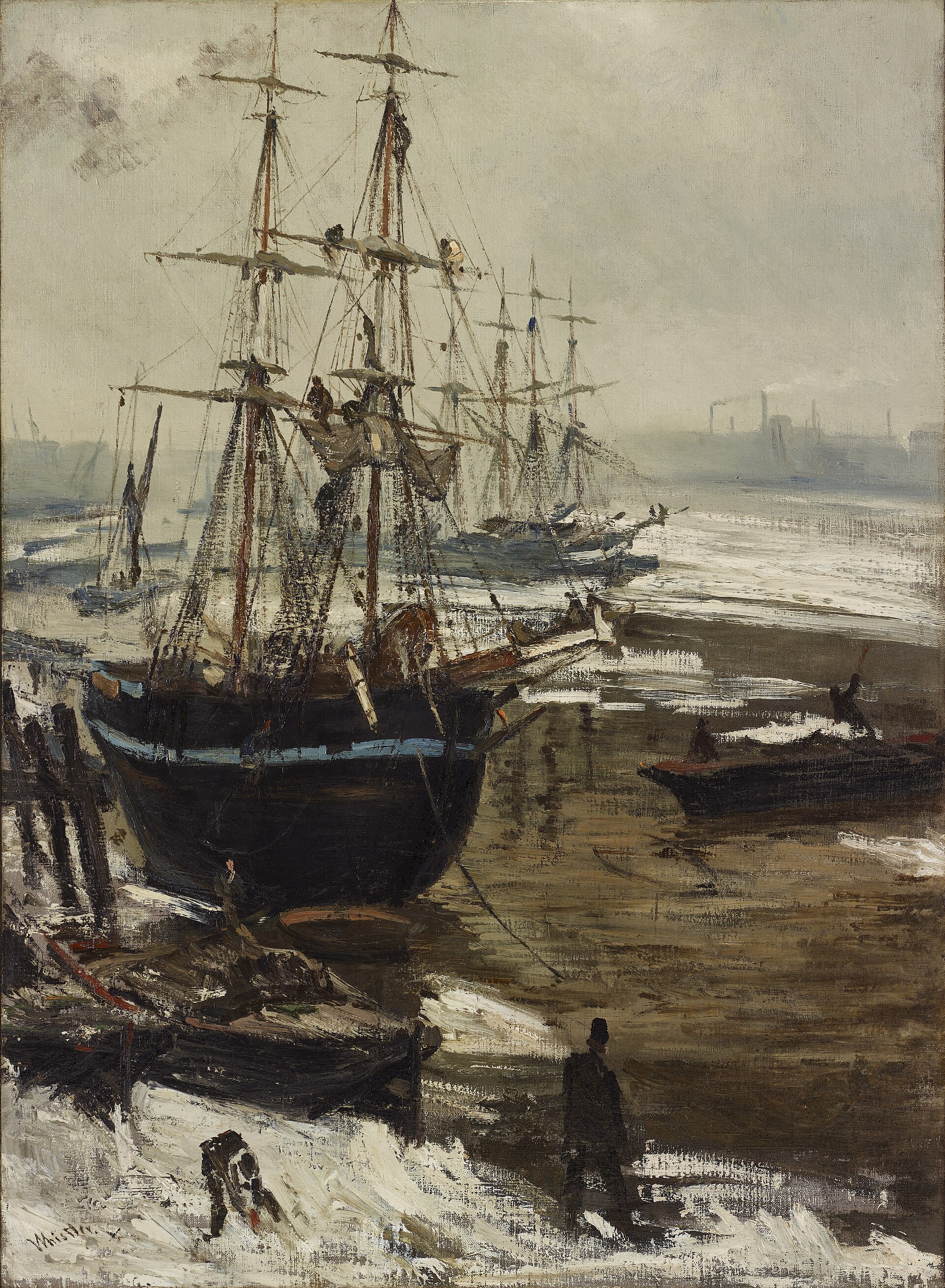
James McNeill Whistler's The Thames in Ice confronts a frozen working river rather than a peaceful winter retreat. A black-hulled sailing ship rises through the left foreground, its masts and rigging crossing a pale sky. Other vessels recede along dark water broken by ice, while small people and a dog move at the snowy lower edge.[1][2][3]
Whistler painted the scene from an inn at Cherry Gardens on the south bank of the Thames, commonly identified as the Angel. The view looks toward the Wapping side of the river. Warehouses, chimneys, moored ships and shore labour make this an image of London's commercial waterway under exceptional weather.[1][7][17]
Its first exhibition title was strikingly precise: The Twenty-fifth of December, 1860, on the Thames. The modern title shortens that dated record to The Thames in Ice, but Christmas 1860 remains essential to the work's identity. A contemporary report said the river had endured freezing conditions for fourteen weeks.[1][8][14]
The Pennells later reported Whistler's claim that he completed the painting in three days. Evidence that a Thames picture was unfinished in 1861, followed by the object's 1862 exhibition and probable later retouching, complicates that performance of speed. The canvas may preserve an urgent initial campaign without having reached its final state in three days.[1][2][4]
The object is YMSM 036 in the University of Glasgow catalogue raisonné and accession F1901.107a-b at the Smithsonian's National Museum of Asian Art. Those identifiers separate it from the horizontal oil Wapping, YMSM 035, the later Chelsea in Ice, YMSM 053, and Whistler's etched Thames subjects.[1][2][15]
At a Glance
- IdentityThe Thames in Ice
- CatalogueYMSM 036
- Date1860
- First titleThe Twenty-fifth of December, 1860, on the Thames
- ViewpointCherry Gardens, near The Angel, Rotherhithe
- MediumOil on canvas
- Dimensions74.6 × 55.3 cm
- AccessionF1901.107a-b
- Current holderFreer Gallery of Art, Smithsonian Institution
- Image rightsSmithsonian Open Access / public domain
Contents
- Object identity, size and current location
- What the painting shows
- Christmas 1860 and the long freeze
- Cherry Gardens, the Angel and Wapping opposite
- Ship, rigging and the portrait format
- Paint handling and winter colour
- The Thames Set and the Rotherhithe etching
- Distinguishing Wapping and Chelsea in Ice
- An unfinished submission in 1861
- The Royal Academy exhibition of 1862
Object identity, size and current location
The National Museum of Asian Art records The Thames in Ice as oil on canvas, dated 1860. It measures 74.6 by 55.3 centimetres, or 29 3/8 by 21 3/4 inches. The narrow portrait format allows the nearest ship's masts to occupy almost the full height while the river opens behind them.[1][2][3]
At the lower left, Whistler signed the canvas “Whistler.” No separate inscription is recorded. The signature belongs to this early written form rather than the butterfly device associated with later phases of his career. It should not be relocated or modernized in description.[1][15]
The painting belongs to the Freer Gallery of Art within the Smithsonian's National Museum of Asian Art, Washington, DC. Its current credit is Gift of Charles Lang Freer. The object record checked on 25 August 2026 said it was not on view; that display status can change without affecting ownership.[2][3]
The present frame is a Grau-style American design dating after 1902. Its deep reeded profile belongs to the painting's later collecting history, not securely to its Royal Academy appearance or Cherry Gardens making. No original or first frame has been identified.[1][16]
Smithsonian metadata assigns “United States” as a geography and places the work within American Art. These are collection classifications tied to the American-born artist and museum department. They do not move the site of production from London, which is secured by the dated history, viewpoint and family correspondence.[1][2][4]
What the painting shows
The nearest vessel is a dark sailing ship moored close to the viewer. Its bow occupies much of the lower left, and its hull creates the composition's greatest black mass. Tall spars, crossbars, ropes and partly furled equipment divide the sky into irregular linear compartments.[2][3]
Beyond it, a sequence of vessels becomes smaller toward the centre. Masts repeat at diminishing scale, while boats sit nearer the right bank or waterline. Whistler does not supply names, flags or cargoes that would identify each craft. They remain evidence of a working anchorage rather than a maritime inventory.[1][2][14]
At the bottom, snow and broken ice cut against brown-black water and shore. A standing person faces the river near the centre-right, with other small figures farther left and a dog in the foreground. Their identities and tasks are undocumented, so scale and activity can be described without inventing biographies.[2][3]
The far bank is reduced to a grey industrial strip. Chimneys and low structures emerge through haze, placing shipping within production and trade. Exact factory names cannot be recovered from the painted forms. Their importance lies in the contrast between distant horizontal industry and the near ship's vertical rigging.[2][14]
The river is not shown as one unbroken white floor. Dark open channels remain visible, and ice gathers in irregular sheets or ridges. This distinction matters on a tidal commercial river: freezing obstructs movement without turning the scene into a skating ground or a stable road.[1][2][14]
Christmas 1860 and the long freeze
The Royal Academy's 1862 catalogue preserved the original wording The Twenty-fifth of December, 1860, on the Thames. A date embedded in a title gives the image the force of an observed event. It does not, however, operate like a signed certificate that every painted passage was completed on Christmas Day.[1][8]
The Pennells wrote that Whistler worked for three days at Christmas from the Cherry Gardens inn. Their biography drew upon access to the artist and his circle, but it was published in 1908 and often shaped incidents into vivid anecdotes. The duration should therefore be attributed, not repeated as an independently timed studio record.[7]
An Illustrated London News report of January 1861, cited in later scholarship, said the Thames had been frozen for fourteen weeks. Whether every reach remained equally frozen throughout is not established by that summary. It nevertheless confirms a prolonged severe winter rather than a decorative dusting chosen for picturesque effect.[1][14]
Cold transformed the river's normal systems. Ice gathered around moored hulls, reduced navigable water and altered work along the banks. The painting records those consequences through halted or compressed shipping, heavy shore deposits and people dwarfed by vessels. It does not need a sentimental narrative to make the disruption visible.[2][3][14]
The dated title and exceptional weather also limit later aesthetic hindsight. Mist and reduced colour may anticipate effects Whistler developed in the nocturnes, but the subject here remains emphatically particular: ships in a freeze on a named river at a specified moment.[1][2][8]
Cherry Gardens, the Angel and Wapping opposite
Cherry Gardens lay on the south bank in Bermondsey. The riverside inn usually identified as the Angel gave Whistler an elevated, sheltered view over the Thames. Historical sources sometimes use Rotherhithe loosely for the area and for a related etching, but current geographical clarification places this site in Bermondsey.[1][7][17]
Wapping lies across the river on the north side. Saying that the picture looks toward Wapping is not the same as saying it was painted from Wapping. This bank-to-bank relation explains why Whistler could study the northern warehouses and shipping while working from a southern balcony or window.[1][17]
The viewpoint carried practical privilege. An inn room or balcony raised the artist above the foreshore and offered some protection during extreme cold. It also framed a view ordinarily occupied by labour, cargo and tidal movement. The canvas converts access to that commercial panorama into a vertical composition.[7][14][17]
Whistler did not simply “take lodgings by the river” and copy whatever passed. He selected one ship as an anchoring mass, aligned receding masts and compressed distant industry. The site supplied observable material; composition turned it into an argument about weight, distance and interrupted movement.[1][2][17]
Ship, rigging and the portrait format
Landscape subjects are often painted on horizontal supports, yet The Thames in Ice is taller than it is wide. The format privileges the near vessel's height. Mast and rigging continue upward while the far river is compressed into a relatively narrow band behind them.[1][2]
The ship is not centered. Its hull pushes toward the left edge, leaving a longer diagonal opening across water to the right. That asymmetry allows a viewer to encounter both obstruction and recession: the near mass blocks part of the view, while the exposed channel carries sight into distance.[2][3]
Rigging provides precise lines without describing every rope equally. Dark verticals and diagonals cross the lighter atmosphere, overlap one another and join the smaller masts beyond. Their repetition measures depth more effectively than a smooth perspective grid would.[2][14]
The hull's dark paint and the bright broken shore form a powerful value contrast. Small figures intervene between those scales, making the vessel feel monumental. Yet the picture does not turn the ship into an isolated portrait; its identity depends on mooring, ice, neighbouring craft and industrial horizon.[2][3]
Movement is suspended rather than absent. Water remains open in places, figures stand or walk, and boats occupy different orientations. The painting catches a river whose circulation has been constrained. “Waiting for the thaw” is plausible as a condition, but not a documented thought assigned to the people.[2][14]
Paint handling and winter colour
The National Museum of Asian Art emphasizes bold brushstrokes, a sombre palette and a thinly painted surface. Those qualities are compatible when distinguished by location. Much of the sky and distant bank can remain lean, while loaded or dragged strokes articulate ice, snow, shore and the nearest hull.[2]
Grey, beige, brown and black dominate. Pale paint does not produce spotless snow; it is crossed by earth, water and shadow. Dark ships are not uniform silhouettes either. Lighter touches break their structures, revealing decks, ropes and ice against the hulls.[2][3]
The handling looks immediate because strokes remain legible and fine finish is withheld. That effect should not be confused with an untouched three-day surface. The Smithsonian notes that Whistler probably retouched the picture later in the decade, while the 1861–62 history already suggests continued work.[1][2][4]
Calling the work Realist can describe attention to contemporary shipping, physical cold and industrial surroundings. It should not imply a neutral transcript. The elevated viewpoint, selective scale and emphatic brushwork organize what observation provided. Realist immediacy is made through pictorial decisions.[2][14][15]
Gustave Courbet belongs to Whistler's early Parisian context, and robust paint could invite comparison. No evidence identifies one Courbet canvas as the template for this composition. Fantin-Latour was a colleague and later exhibition adviser, not a documented co-author of the winter view.[6][14][15]
The Thames Set and the Rotherhithe etching
Whistler had been etching docks, warehouses, boats and river workers since settling in London in 1859. Many plates later grouped as the Thames Set were made around 1859–61, though publication as a sixteen-print series came in 1871. Plate date and set publication date must remain separate.[15][17]
The etching Rotherhithe, also later called Wapping within the set, looks across the river from the Angel balcony. Two men sit in the foreground while shipping and warehouses extend behind them. Its viewpoint helps locate the oils but its figures, medium and reversed printing process belong to a different object.[17]
Etched line and painted rigging can be compared without treating one as a mechanical tracing of the other. In the print, incised marks define architecture, rope and figure before ink and press create an impression. In the oil, dark strokes cross a light painted field and can vary in width, opacity and material weight.[15][17]
The relationship shows how Whistler investigated the same river through different systems. Prints could circulate in multiple impressions and states; the oil remained one revisable canvas. Both attend to trade and labour, but their histories of making, exhibition and ownership diverged.[15][17]
Distinguishing Wapping and Chelsea in Ice
Wapping, YMSM 035, also derives from the Angel and shows the river toward the north bank. It is a horizontal oil centered on figures at the inn's balcony, with shipping operating as their extensive background. Whistler worked on it over 1860–64, far longer than the initial campaign claimed for The Thames in Ice.[1][15][17]
The two paintings therefore share site without sharing composition. The Thames in Ice gives the near vessel and winter obstruction priority; Wapping places social figures close to the viewer and uses the broad river laterally. A reproduced detail or route title should never substitute one for the other.[1][17]
Chelsea in Ice, YMSM 053, is later, dated 1864/67, and belongs to a different stretch upriver. Its flatter open reach and later technical development have generated comparisons with Japanese prints and subsequent French ice scenes. Those arguments cannot simply be transferred to the Christmas 1860 canvas.[1][15]
These distinctions clarify development without turning it into a straight ladder. Lower-Thames ships, Chelsea reaches and nocturnal views each posed different problems of access, scale, light and surface. Whistler returned to water because it changed, not because every Thames picture repeats one formula.[14][15][17]
An unfinished submission in 1861
Anna Matilda Whistler wrote to her son in May 1862 about a Thames picture that had not been accepted the previous spring because it was unfinished. The Glasgow catalogue plausibly connects that reference to YMSM 036. Because her letter does not supply its catalogue number, the identification must remain qualified.[1][4]
If the connection is correct, Whistler submitted the painting unsuccessfully in 1861 before reaching a satisfactory state. That sequence directly challenges a simple claim of final completion in three days. It does not disprove an intense Christmas campaign; it distinguishes beginning rapidly from finishing permanently.[2][4][7]
By spring 1862 the work was ready for another submission. Anna congratulated Whistler on completing paintings in time, while Academy records confirm the acceptance of the Thames canvas. Private encouragement and institutional decision are different sources that converge on a changed status.[4][8]
This history also separates rejection from exclusion. An unfinished picture may fail to pass a jury because of its state, while the later version can be accepted without changing subject. The surviving evidence does not tell us every alteration made between the two submissions.[1][4]
The Royal Academy exhibition of 1862
The Royal Academy listed the painting as catalogue number 114 under its dated Christmas title. In the same exhibition The Coast of Brittany, also called Alone with the Tide, was accepted, while The White Girl was rejected. These were three independent jury outcomes, not one verdict on Whistler's career.[4][8]
Whistler complained to George A. Lucas that the ice picture had been placed as badly as possible. Hanging height and location affected what visitors could see, especially in a crowded annual exhibition. His complaint is partisan, but period criticism confirms that placement impeded inspection.[5][9]
The London Review found the broken ice and dingy sky broad and characteristic, while observing that any detail was difficult to trace from the work's position. Its response joined approval of general effect with uncertainty about close description.[9]
The Athenaeum recognized breadth and vigour but thought those qualities crossed into coarse dash. The Spectator, by contrast, praised truth of tone and powerful handling as evidence of study from nature. Broad strokes could therefore appear either forceful or insufficiently controlled.[9]
No review provides a permanent verdict. Together they document why the picture mattered: handling was visible enough to become the subject of disagreement. The frozen river was not judged only for its recognizable boats or weather, but for how paint translated them.[5][9]
Return to Paris in 1867
In February 1867, Fantin-Latour advised Whistler about works for Paris. He suggested showing At the Piano and the ships in ice as examples of where Whistler had begun, allowing recent work to be understood through earlier development. The protected letters are best paraphrased rather than quoted at length.[6]
Fantin also said the ice ships had been successful at Martinet's gallery. His statement suggests an interim Paris display, but no fully reconciled catalogue entry establishes its exact date and title. It is evidence of reception, not permission to invent an exhibition number.[1][6]
The Salon accepted the painting in 1867 as Sur la Tamise; l'Hiver, catalogue 1562. The French title means a winter view on the Thames and removes the precise Christmas date. Translation and exhibition context changed wording without changing the object.[1][10]
The canvas entered the Salon beside At the Piano, which the jury had rejected in 1859. Both works now served as early evidence within a more established career. Their 1867 acceptance did not annul earlier rejection or mixed London criticism; it added another institutional encounter.[6][10]
Later exhibitions and Whistler's display control
In 1898 Thames in Ice appeared at the International Society of Sculptors, Painters and Gravers in Knightsbridge. Whistler, the Society's first president, took an active role in arranging paintings. Surviving drawings and correspondence show that placement was part of his conception of exhibition experience.[1][11]
This later control contrasts with his complaint about the 1862 Academy hang. By 1898 he could influence spacing and visual relation rather than accept an assigned poor position. The change belongs to professional authority and display history; it did not alter the painting's ownership.[5][11]
The painting was shown at the Royal Scottish Academy in 1899 and the Glasgow International Exhibition in 1901. Memorial exhibitions followed in Boston in 1904 and Paris in 1905. These appearances helped turn an early winter study into a recognized component of Whistler's retrospective reputation.[1][12]
The current Freer bequest generally prevents lending, giving the object a more stable institutional setting than it had around 1898–1905. Historical exhibition movement and present restriction should not be confused, and current display status remains separately time-sensitive.[2][3][14]
Sale to Francis Seymour Haden
Whistler probably sold the picture around 1860 to his brother-in-law Francis Seymour Haden. The Pennells reported a price of £10 and connected it with the three-day campaign. Haden supposedly calculated the payment as three pounds for each day with one pound added.[1][7]
The anecdote came through Whistler decades later and carries the tensions of his relationship with Haden. Whistler also said he accepted because his sister Deborah was in the house and wanted him to please Haden. This is interested family testimony, not a neutral contract or secure account of motive.[7][13]
Ten pounds remains plausible as an initial price for a young artist's work, but it should not be converted into a timeless measure of quality. The amount gained rhetorical power only when Whistler contrasted it with the painting's much higher later valuation.[1][13]
Haden retained the canvas for more than three decades. Ownership did not mean that it vanished from public history: it appeared in Paris in 1867. A lender could possess a work while Whistler negotiated exhibition and title, so custody and artistic agency continued in parallel.[1][10][13]
Reid, Cowan and disputed prices
In 1897 Haden sold The Thames in Ice and At the Piano to the Glasgow dealer Alexander Reid after other negotiations failed. Reid quickly resold them to the Edinburgh collector John James Cowan. Dealer acquisition and collector sale were separate steps even when they occurred close together.[1][13]
Cowan's correspondence discussed proposed allocations of £1,200 and £800 for the two paintings, while also saying no separate price had been agreed when Reid bought them. Other accounts gave a £1,600 combined figure. These records do not support one clean, undisputed individual purchase price.[1][13]
Whistler told his lawyer that the ice painting for which he had received £10 had entered a much larger later transaction. His indignation joined pride in rising reputation with resentment toward Haden. It records the artist's market rhetoric rather than correcting Cowan's or Reid's books.[13]
In 1901 dealer David Croal Thomson offered Cowan £1,500 for the canvas and was refused; a press report mentioned a refused offer of £2,000. The figures come from different records and should remain distinct. A rejected offer is not a sale price in either case.[1][13]
Freer's purchase and the museum gift
The current National Museum of Asian Art provenance dates Charles Lang Freer's purchase from Cowan to November 1901. Glasgow lists the acquisition in 1902, while related correspondence continues into February of that year. The difference likely reflects negotiation, agreement, payment or receipt across a year boundary rather than two separate Freer purchases.[1][2][13]
Freer responded enthusiastically when the painting arrived. His purchase placed the early industrial Thames within a collection better known for close attention to Whistler's tonal development, frames and relationship to Asian art. That collecting context need not turn the 1860 canvas into a Japanese-derived nocturne.[13][14]
Freer signed the deed for his gift to the United States in 1906. He died in 1919, and the collection was received by the completed gallery in 1920. Purchase, deed, death and museum receipt are separate events that explain why a 1901 accession is credited today as a Gift of Charles Lang Freer.[2][3]
The American Grau-style frame dates after 1902 and therefore belongs near this change in custody. It may shape how modern viewers experience the painting, but it offers no evidence for the surround seen by Royal Academy visitors in 1862.[1][16]
Why the painting matters
The Thames in Ice joins weather to work. The freeze alters shipping, shore access and the relation between people and vessels. Whistler does not idealize labour through a heroic central worker; he makes human bodies small within a commercial system temporarily arrested by cold.[2][14]
The painting also joins observation to construction. A recognizable site and dated event support its documentary force, while portrait format, asymmetrical hull and repeating masts reveal deliberate organization. Modern life is not merely captured; it is selected, weighted and painted.[1][2][17]
Calling it Impressionist would reverse chronology and flatten difference. The canvas predates the first Impressionist group exhibition by fourteen years and uses a darker, more materially insistent language than that label implies. Whistler's later influence and affinities can be discussed without placing him inside a movement not yet formed.[14][15][18]
Nor is it already a mature nocturne. The misty far bank hints at interests Whistler later refined, but bold shipping, dated title and frozen foreground keep material incident prominent. Development is more convincing when early differences remain visible.[2][14]
Frequently Asked Questions
The painting dates to 1860 and was probably begun around Christmas. Its first exhibited title specified 25 December 1860. Whistler later claimed a three-day campaign, but evidence of an unfinished 1861 submission and probable later retouching means final completion cannot be confined securely to those days.[1][2][4]
The three-day claim survives through the Pennells' retrospective biography and should be attributed. A probable 1861 submission was unfinished; the work was accepted in 1862, and the Smithsonian says Whistler likely retouched it later in the decade. The story may describe initial execution rather than the final object.[2][4][7]
Reception was divided. The poor Academy position limited visibility. One critic admired its broad characteristic effect, another thought vigour became coarse dash, and a third praised tone and powerful handling. The disagreement centered on the same conspicuous brushwork that gives the image force today.[5][9]
Conclusion
The Thames in Ice fixes an exceptional winter to a specific working reach of London. A near ship rises against pale weather, receding masts mark distance, and people occupy an unstable boundary of shore, snow, ice and water. The scene's atmosphere never dissolves its material obstructions.[1][2][14]
Its history resists the legend of effortless speed. A three-day Christmas campaign, probable unfinished 1861 submission, 1862 acceptance and later retouching belong to one evolving object. Critics could agree that the handling was forceful while disagreeing sharply about whether that force was truthful or coarse.[2][4][9]
Ownership changed the painting's value and presentation. Whistler's alleged £10 sale to Haden preceded Reid's dealing, Cowan's disputed valuations, Freer's 1901–02 acquisition and the national gift. The current frame arrived late in that sequence and cannot stand for the lost early surround.[1][13][16]
The work matters not because it was secretly Impressionist or already a nocturne, but because it makes weather, trade and paint inseparable. Whistler found formal structure in a river whose ordinary circulation had broken down, and the resulting canvas carried that disruption from a poor Academy position into the concentrated Freer collection.[2][5][14]
Discussion
How does Whistler turn exceptional winter weather into a portrait of the working Thames?
Look closely at the locked rigging, broken ice, small figures and the contrast between descriptive detail and bold handling.
Reader Insights
How does the vertical rigging organise the unusually tall composition?
Where do colour and brushwork make the frozen river feel unstable?
How might the painting’s exhibition titles have changed what viewers expected to see?
Join the Conversation
Share a close observation or an object-history question.
References
- Margaret F. MacDonald and Grischka Petri, “The Thames in Ice,” YMSM 036, The Paintings of James McNeill Whistler: A Catalogue Raisonné, University of Glasgow, https://www.whistlerpaintings.gla.ac.uk/catalogue/display/?mid=y036
- National Museum of Asian Art, “The Thames in Ice,” F1901.107a-b, https://asia-archive.si.edu/object/F1901.107a-b/
- Smithsonian Institution, current collection and exhibition record for F1901.107a-b, https://www.si.edu/object/thames-ice%3Afsg_F1901.107a-b
- Anna Matilda Whistler to James McNeill Whistler, 12 May 1862, GUW 06519, The Correspondence of James McNeill Whistler, University of Glasgow.
- James McNeill Whistler to George A. Lucas, 26 June 1862, GUW 11977, The Correspondence of James McNeill Whistler, University of Glasgow.
- Henri Fantin-Latour to James McNeill Whistler, 12 and 21 February 1867, GUW 01083 and 01084, The Correspondence of James McNeill Whistler, University of Glasgow.
- Elizabeth Robins Pennell and Joseph Pennell, The Life of James McNeill Whistler (London: William Heinemann, 1908).
- Royal Academy of Arts, The Exhibition of the Royal Academy, 1862, cat. 114.
- “The Royal Academy Exhibition,” London Review, 10 May 1862; “Fine Arts: R.A.,” Athenaeum, 24 May 1862; and “Fine Arts: Royal Academy,” Spectator, 17 May 1862.
- Paris Salon, Explication des ouvrages de peinture et dessins, sculpture, architecture et gravure des artistes vivants, 1867, cat. 1562.
- International Society of Sculptors, Painters and Gravers, Exhibition of International Art (London, 1898), cat. 175, with Whistler's arrangement drawings and correspondence.
- Royal Scottish Academy 1899, Glasgow International Exhibition 1901, Copley Society Boston 1904 and Paris Whistler memorial 1905 catalogues.
- John James Cowan, Alexander Reid, David Croal Thomson, Charles Lang Freer and Whistler correspondence and dealer records in the Glasgow and Freer archives.
- David Park Curry, James McNeill Whistler at the Freer Gallery of Art (Washington, DC: Smithsonian Institution Press, 1984), 117 and 306.
- Andrew McLaren Young, Margaret F. MacDonald, Robin Spencer and Hamish Miles, The Paintings of James McNeill Whistler (New Haven and London: Yale University Press, 1980), no. 36.
- Sarah L. Parkerson Day, “Picture Frames,” The Paintings of James McNeill Whistler: A Catalogue Raisonné, University of Glasgow, with 2017 Freer frame report.
- University of Glasgow, “Rotherhithe,” G70, and Thames Set catalogue records in The Etchings of James McNeill Whistler.
- Existing live route, local image and frozen Waterhouse+ inherited-public-prose audit record for “The Thames in Ice.”


