 by
Tom Gurney
Tom Gurney BSc (Hons) is an art history expert with over 20 years experience
Published on October 6, 2016 / Updated on October 23, 2026
Email:
tomgurney1@gmail.com
/ Phone:
+44 7429 011000
The Water-Lily Pond
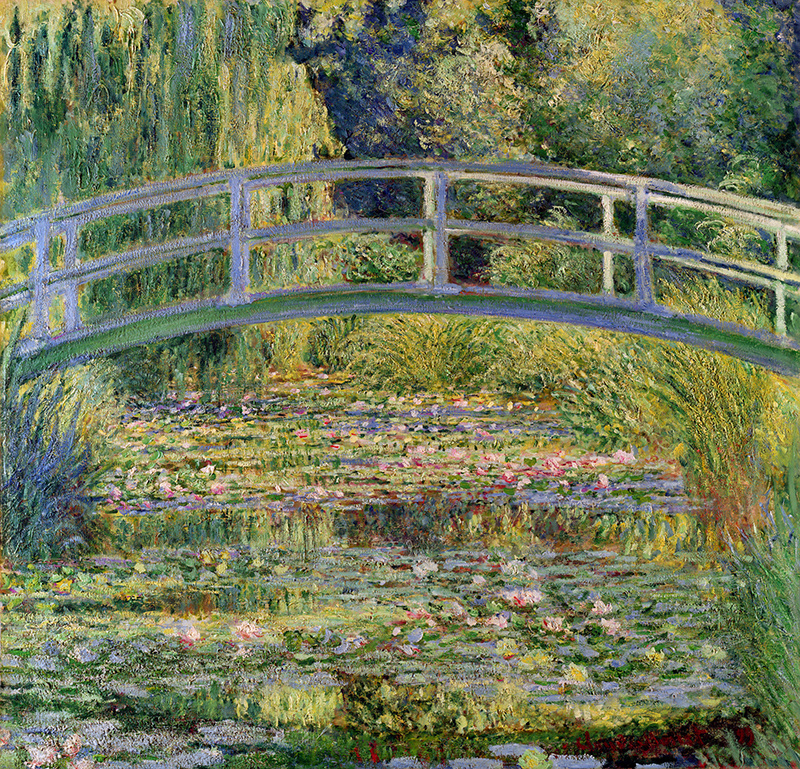
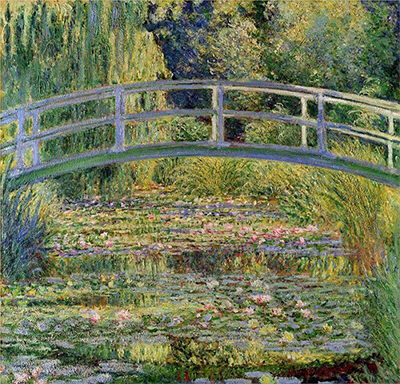
The Water-Lily Pond is Claude Monet's 1899 painting of the Japanese-style bridge in his garden at Giverny. It belongs to the National Gallery in London, inventory NG4240. [1] The pale bridge crosses a densely planted scene, while lilies, reflections and patches of darker water fill the foreground. Its nearly square format brings the garden close without offering a distant horizon or an open stretch of sky.
At a Glance
A garden made for looking
The water garden was not an untouched corner of countryside. In 1893 Monet acquired land beyond the railway line near his home and diverted water from the Ru, a branch of the Epte, to create the pond. The official history of the house and gardens describes the bridge, selected plants and sustained care that shaped this setting. [2]
This matters because Monet was working with a subject he had helped to arrange. The curving bridge, the pond's edge and the masses of plants were part of a place made to be experienced as well as painted.
The garden history also records a gardener devoted to its upkeep, including the removal of dead leaves. [2] The luxuriant appearance should not be mistaken for evidence of neglect. Cultivation could produce an effect of abundance without displaying its labour in the finished view.
The painting leaves that labour outside the frame. There are no gardeners, tools or maintenance paths competing with the water. What remains is the encounter between built structure, growing plants and changing light.
The bridge across the canvas
The bridge is the scene's clearest constructed form. Its shallow arch extends from one edge of the painting to the other, with neither end fully shown. The pale rails stand out against the darker foliage, but their colour also belongs to the surrounding greens and blues.
Its repeated upright supports divide the view into small openings. Through them, patches of plants and shadow remain visible, so the structure does not become an opaque barrier. It holds the scene together while allowing the eye to pass through.
The lower curve is especially important. It creates a long, continuous movement across a surface otherwise built from many short, interrupted marks. The rails above repeat that movement more lightly.
Because the bridge's approaches are cropped, the picture tells us little about how to reach or cross it. It is less a route leading somewhere than a shape suspended within the garden. This distinguishes the composition from a conventional landscape organised around a path into the distance.
Lilies above reflected trees
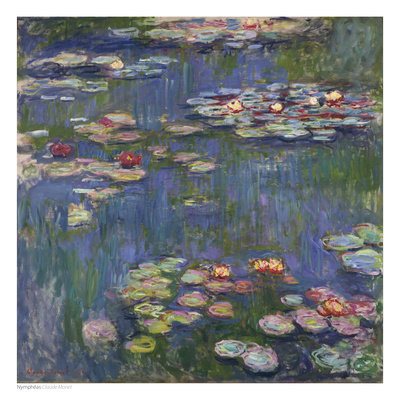
The pond contains two kinds of visible form. The lily pads occupy its surface, while the reflected trees seem to extend downwards beneath them. A single painted area must suggest both a flat expanse and an apparent depth.
The horizontal groups of leaves help establish the water's surface. They gather into bands, with pink, white and lavender flowers interrupting the greens. Between them are narrower openings where darker reflections become more apparent.
Vertical strokes beneath the willow connect the upper and lower parts of the painting. They do not describe separate plants growing upwards from the pond. They belong to the reflected world, made unstable by the marks that also describe the water itself.
Near the lower edge, a dark arc recalls the bridge above. The resulting echo is not a perfect mirror image: the lilies and other reflected forms interrupt its continuity. Water repeats the garden, but it also changes the garden's shapes.
These overlapping systems are central to Monet's treatment of water and reflection . The pond is not simply an empty interval between bank and bridge. It becomes the place where the composition is continually reassembled.
A close world of colour
Green dominates, yet the picture is not monochrome. The bridge has cool blue and violet passages; the foliage moves between yellow-green and deep shadow; pale flowers and pink touches bring small contrasts to the pond.
The most brightly lit marks do not all belong to one object. They appear on the rails, among leaves and across the water. Light therefore circulates through the composition rather than spotlighting a single centre.
The upper part is densely filled. Drooping willow branches occupy the left, and darker trees stand behind the bridge. There is no broad sky above them to explain the lighting in the usual way. Instead, brightness has to be read through the colours of things and their reflections.
Viewed from farther away, the brushstrokes combine into a convincing garden. Seen more closely, they become conspicuous dabs and lines. The painting's richness depends on both experiences: recognition of the place and awareness of the coloured surface that makes it visible.
Japanese inspiration without a literal copy
The National Gallery connects the bridge with Monet's interest in Japanese prints, including arched bridges in Hiroshige's work. [1] The relationship concerns a broad visual interest in gardens, curves, framing and water; it need not turn this painting into a copy of one print.
The bridge is recognisably built, but it is painted into the same atmosphere as the plants. Its cool colour makes it harmonise with the pond, while the surrounding growth prevents it from becoming a separate architectural display.
Monet's Japanese print collection helps explain the cultural setting of his garden design. The actual canvas, however, remains an observation and reconstruction of the place at Giverny. Its particular balance of foliage, reflected forms and flower colour is what distinguishes it from an illustration of a general influence.
Related paintings are not duplicates
Monet made several views of the pond and bridge. The catalogue raisonne identifies the London painting as W1516 and records its inclusion in the Durand-Ruel exhibition of 1900. [3] A shared subject does not mean that every version has the same proportions or balance.
The Metropolitan Museum of Art's Bridge over a Pond of Water Lilies, also dated 1899, has a distinctly vertical format. Its museum account notes how that shape gives greater prominence to the lilies and reflections. [4]
The National Gallery of Art in Washington owns another 1899 version, The Japanese Footbridge, in which the bridge is placed close to the top of a wider composition. [5] It is a separate canvas, not another title for the work in London.
Comparing the versions reveals choices rather than repetitions without purpose. The amount of water below the arch, the height of the bridge and the surrounding plants can all change how enclosed, spacious or balanced the scene appears.
From Giverny to the national collection
The London painting entered the Tate in 1927 and transferred to the National Gallery in 1961. [3] Its later exhibition history includes the 2024 National Treasures display at York Art Gallery, where it was the central loan for an exhibition connecting Monet's garden imagery with other artists and contemporary responses. [6]
That continuing interest rests on more than the familiarity of water lilies. The painting presents a carefully limited world in which almost every part participates in a larger pattern. A bridge becomes an arc; trees become vertical reflections; leaves become floating intervals of colour.
Within the wider Water Lilies paintings, this 1899 canvas retains a clear garden structure while already making the pond an absorbing subject in its own right.
Frequently Asked Questions
The version shown here belongs to the National Gallery in London, NG4240. [1]
No. Washington's 1899 painting is a separate, wider composition. [5]
Monet created and maintained the water garden on land acquired in 1893. [2]
It entered the Tate in 1927 and transferred to the National Gallery in 1961. [3]
Discussion
Look again at the images and ideas explored in The Water-Lily Pond. These editorial prompts invite your observations.
Reader Insights
Do you first notice the bridge's arch or the lilies below it?
Where is it easiest to distinguish the pond's surface from a reflection?
How does cropping both ends of the bridge change the sense of space?
Join the Conversation
Share a detail, comparison or question about The Water-Lily Pond below.
References
- National Gallery , London, The Water-Lily Pond, 1899, NG4240: object record and interpretation. View source .
- Maison et jardins de Claude Monet , Water lily pond: the garden's creation and care. View source .
- Daniel Wildenstein , Monet: Catalogue raisonne, 1996, volume III, W1516, p. 645, Wildenstein Plattner Institute digital edition. View source .
- The Metropolitan Museum of Art , Bridge over a Pond of Water Lilies, 1899, 29.100.113, a separate vertical composition. View source .
- National Gallery of Art , Washington, The Japanese Footbridge, 1899, 1992.9.1, a separate composition. View source .
- York Art Gallery , National Treasures: Monet in York, The Water-Lily Pond, 10 May-8 September 2024. View source .