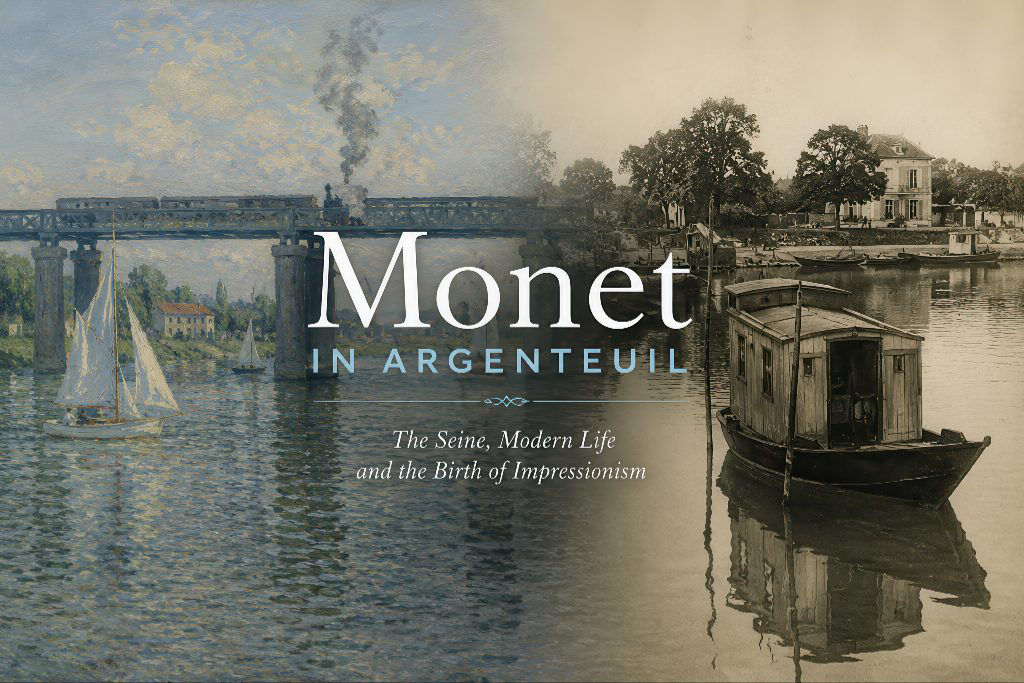
 by Tom Gurney
Tom Gurney BSc (Hons) is an art history expert with over 20 years experience
Published on October 6, 2016 / Updated on May 11, 2026
Email: tomgurney1@gmail.com / Phone: +44 7429 011000
Claude Monet in Argenteuil
Between 1871 and 1878, Claude Monet lived in the riverside town of Argenteuil, just northwest of Paris.
During this time Monet painted more than 150 works depicting the River Seine, sailing boats, bridges, suburban gardens and the changing society in and around Paris at that time. The emerging style of Impressionism would be finetuned here, in what became one of the most productive and innovative periods of his career.
Argenteuil had become a popular leisure destination for Parisians. Its broad stretch of the Seine accommodated boat races and other riverside activities, while railway connections made it accessible from the capital for boating, regattas and weekend excursions. Monet found in this modern suburban landscape a rich subject for painting: shimmering water, colourful sails, railway bridges and sunlight reflecting across the river. [8]
Monet Moves to Argenteuil
Monet settled in Argenteuil in December 1871, after his wartime stay in London and a subsequent stay in the Netherlands. Back in France, he passed through Paris before establishing his family home in Argenteuil. He rented a house with a garden near the station and the Seine, where he lived with his wife Camille and their son Jean, both of whom appear in his paintings. [4] [6]
Argenteuil provided Monet with open space, water and constantly changing light - which was perfect for his evolving Impressionist style. The Seine became the central motif in many of these paintings, though he also captured his home life in others.
From early morning mist to the bright reflections of midday sunlight, Monet studied the shifting atmosphere of the river in a way that would become fundamental to the Impressionist approach.
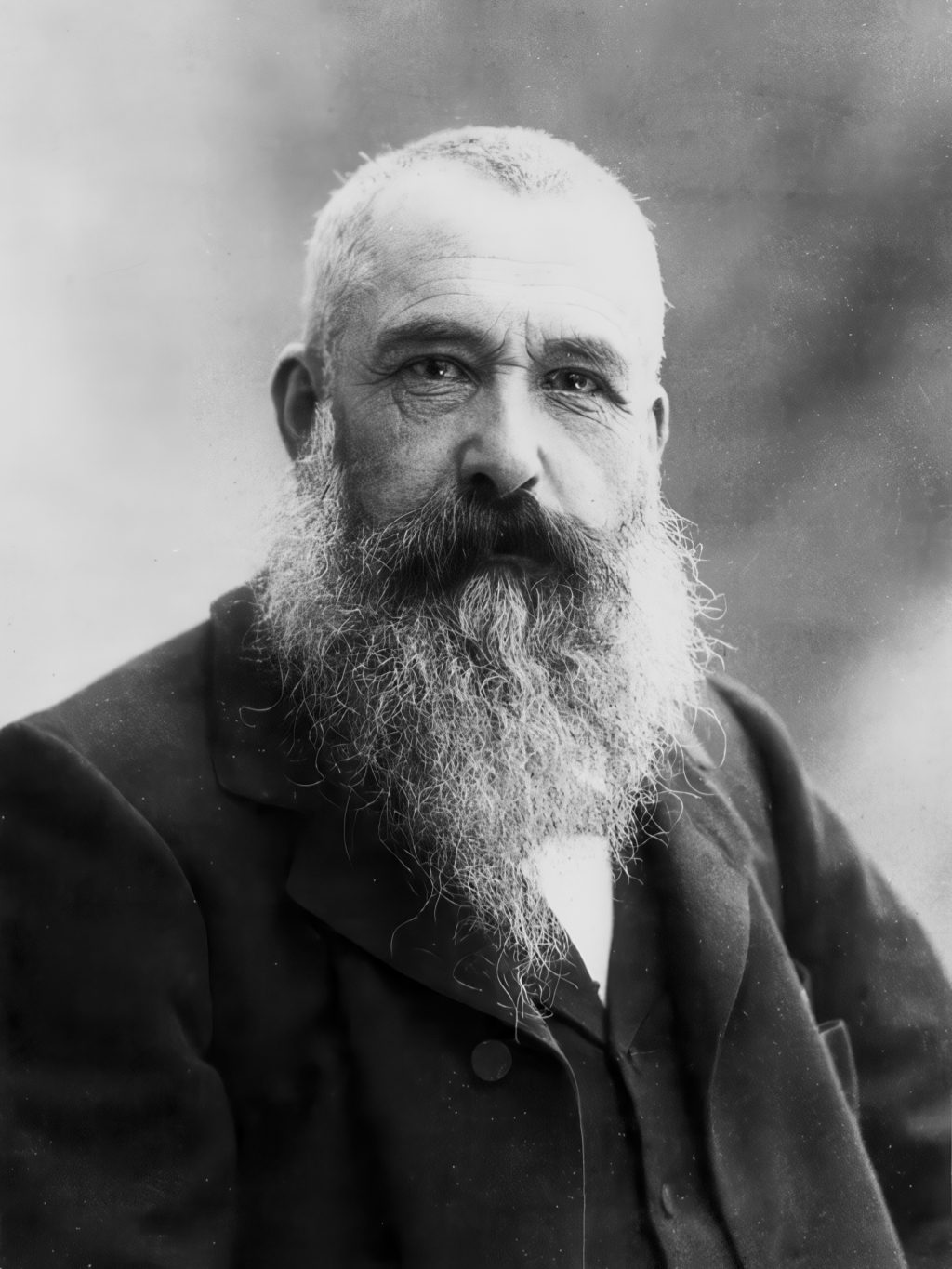
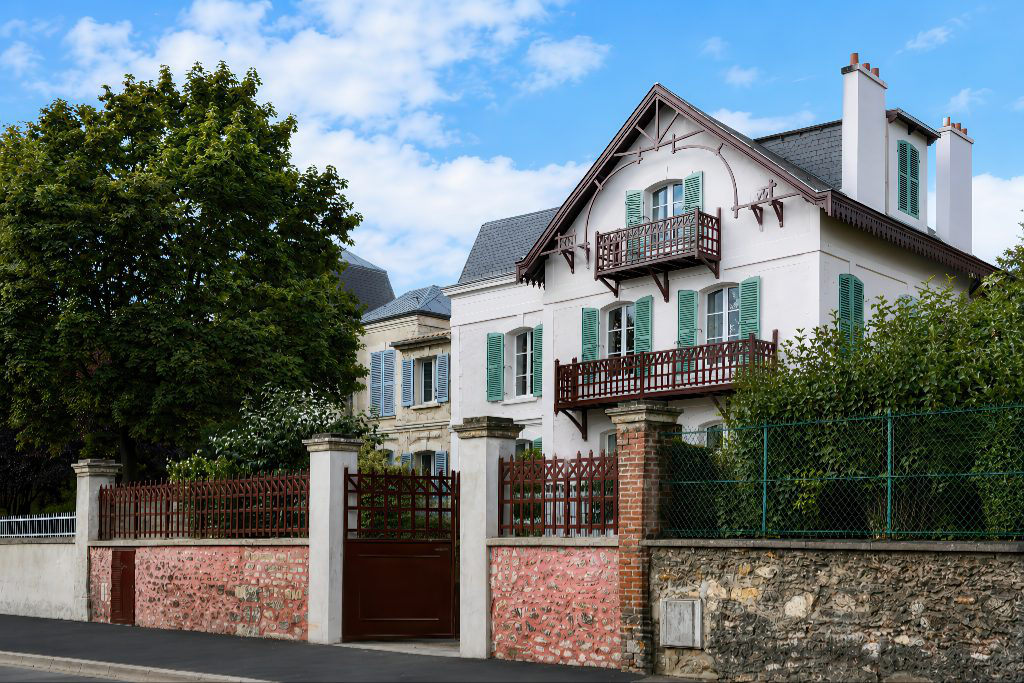
The restored house associated with Claude Monet in Argenteuil, where the artist lived during some of the most important years of early Impressionism in the 1870s. From here, Monet painted the Seine, railway bridges, regattas and suburban life that helped define the movement.
- Location: Argenteuil, Île-de-France, France
- Years Lived: 1871-1878
- Total Paintings: Approximately 150+
- Key Subjects: Seine River, bridges, regattas, gardens, railway bridge
- Most Famous Works: The Bridge at Argenteuil, Regatta at Argenteuil, Poppies
The Seine and Modern Leisure
During the 1870s Argenteuil frequently hosted regattas along the river and elegant yachts frequently appeared along the banks. Monet captured these leisure pursuits in paintings such as Regatta at Argenteuil. These were landscape paintings with modern features, including railways, bridges, and pleasure boats alongside quiet riverbanks and gardens.
The Bridges of Argenteuil
Argenteuil's road and railway bridges were damaged during the Franco-Prussian War. Rebuilding restored transport connections and provided Monet with subjects in which engineering met moving water. The road bridge near the town centre appears in several distinct canvases. Bridges also occur in Japanese prints, which Monet collected. This offers a comparison of motifs, rather than proof that a particular Japanese print caused him to choose the Argenteuil bridges. [7] [24] [24] [25]
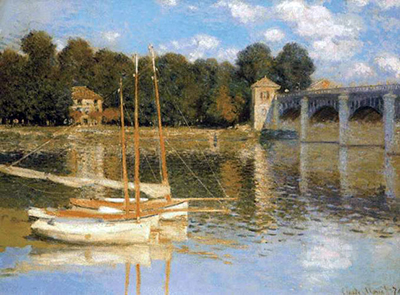
In works such as The Bridge at Argenteuil, the structure appears framed by sailing boats and reflections on the water. The crisp geometry of the bridge contrasts with the fluid brushstrokes used to depict the river and sky. This contrast between industrial modernity and natural light became a recurring theme in Monet's work during the 1870s. Water and architecture were both key focuses of his work, with bridges able to bring the two together seamlessly.
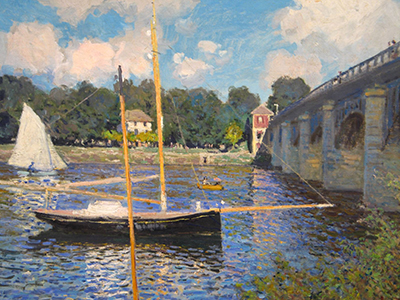
Claude Monet's The Bridge at Argenteuil (Washington version) is the National Gallery of Art's 1874 canvas (1983.1.24). Its boats, bridge, reflections and riverbank connect leisure activity with the modern structures along the Seine. The Washington and Orsay road-bridge paintings are separate versions.
[11]
The Floating Studio
Monet used a small boat adapted as a floating studio. It allowed him to work directly on the Seine and offered viewpoints at different distances from the banks. This mobile workspace formed part of a practice that also included painting from the shore. [20]
From the boat he could observe the reflections of vessels, clouds and sunlight while on the water. The changing position of a floating platform offered different relationships between the near water, the opposite bank and the sky. [20]
Discover more on Monet's Floating Studio in this detailed article which also includes several paintings of his unusual setup.
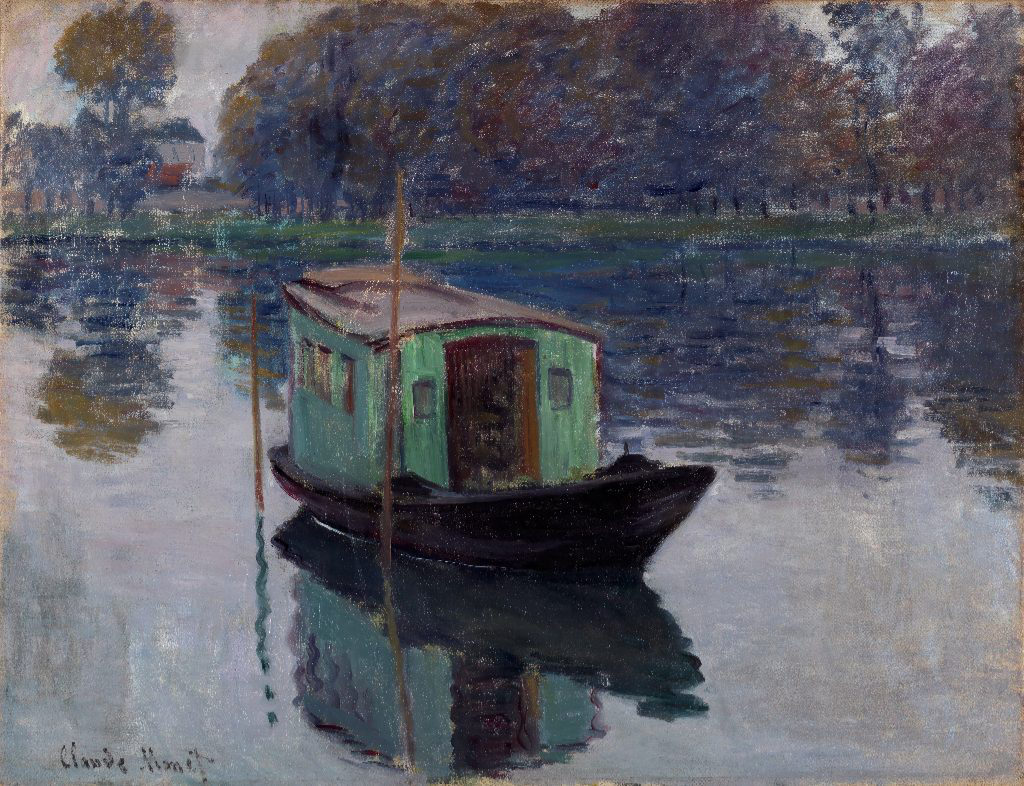
Claude Monet's floating studio boat at Argenteuil, painted in the 1870s during one of the most innovative periods of Impressionism. The small boat allowed Monet to work directly on the Seine, studying reflections, weather and shifting light from the surface of the river itself.
Important Paintings Monet Created at Argenteuil
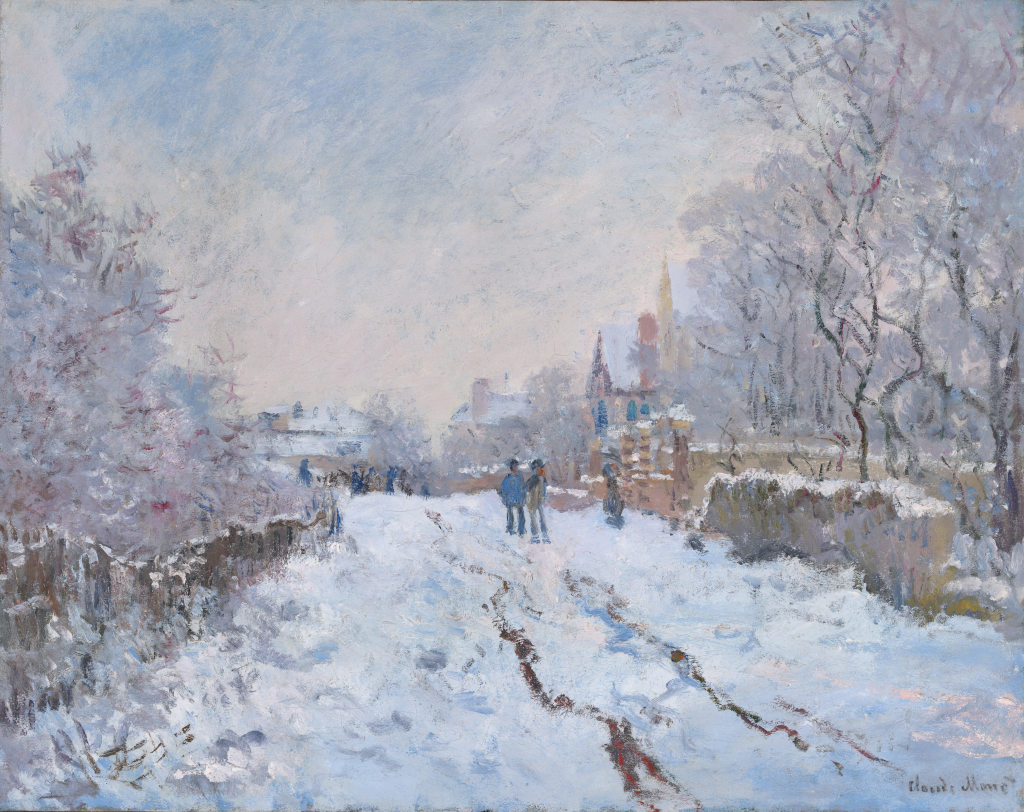
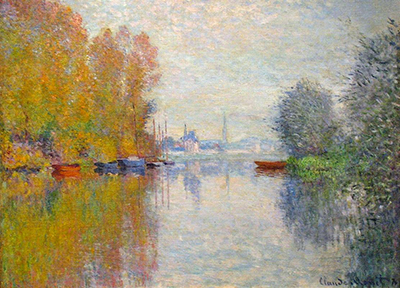
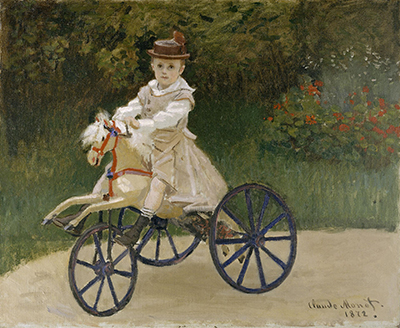
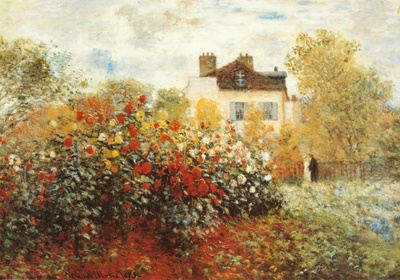
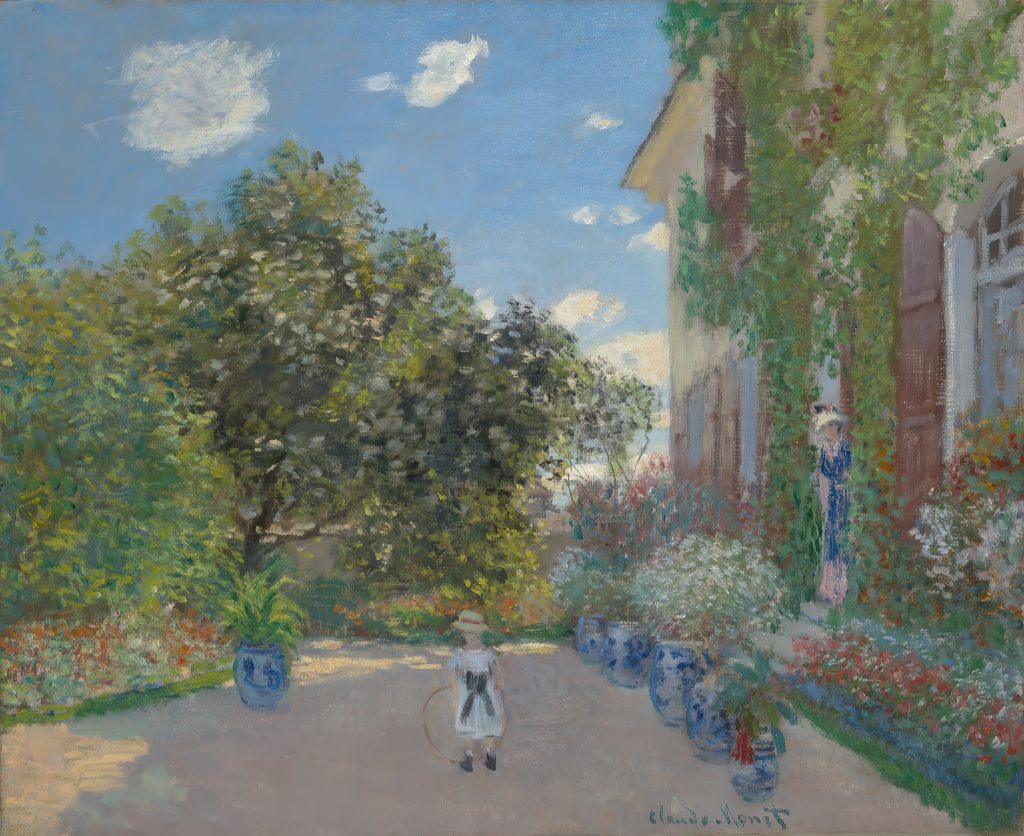
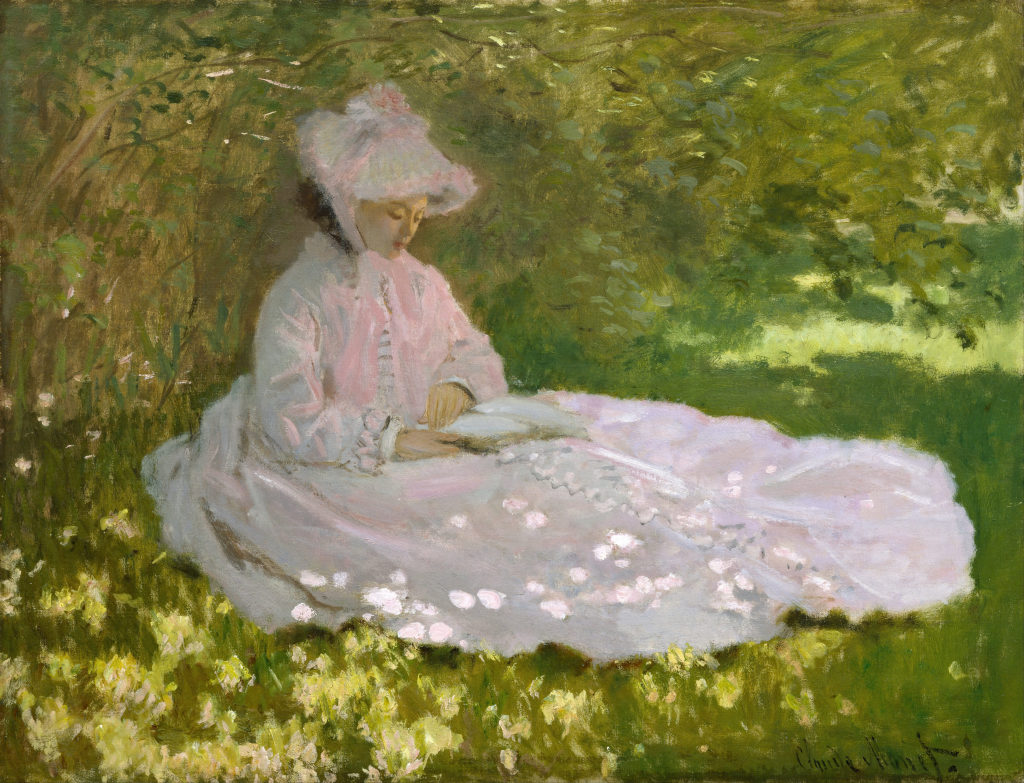
The Art Institute of Chicago connects Monet's Argenteuil years with a settled family home, river subjects and exchanges among fellow painters.
Art Institute of Chicago, account of Monet's Argenteuil years 4Historical Background to Monet's Time in Argenteuil
Argenteuil is a French commune which is located in the suburbs to the north west of Paris. It has so much to inspire the artist - bustling human life, languid canals, and some natural scenery too.
Monet's first Argenteuil home was on the rue Pierre Guienne, where his family lived from December 1871 until the summer of 1874. They then moved to another house on the boulevard Saint-Denis. Distinguishing the two residences prevents paintings of one garden from being assigned automatically to the other. [4]
His Argenteuil pictures bring boats and water into close relation through colour, reflection and changing light. A floating studio allowed him to work from the river as well as from its banks, widening the range of viewpoints available to him.
Bridges in Argenteuil were a subject that Monet kept returning to during his time in Argenteuil: the bridges themselves as well as the way that the sunlight played both on the edifice of the bridge itself and on the water beneath it. Carefully drawn boats also feature in this painting, as they did in so many of Monet's Argenteuil art works.
To summarise Monet's stay in Argenteuil, we can say that this was a period of intense activity, and of being inspired both by the unique landscapes of Argenteuil and by the company of like minded artists around him. In Argenteuil, Monet also came back to some of his favourite topics for paintings: bridges, boats, and light.
Monet's stay at Argenteuil coincided with the first Impressionist art exhibition and the moment when (in 1874) as a result of this exhibition the words 'Impressionism' and 'Impressionist' entered the vocabulary of art critics and the general public for the first time.
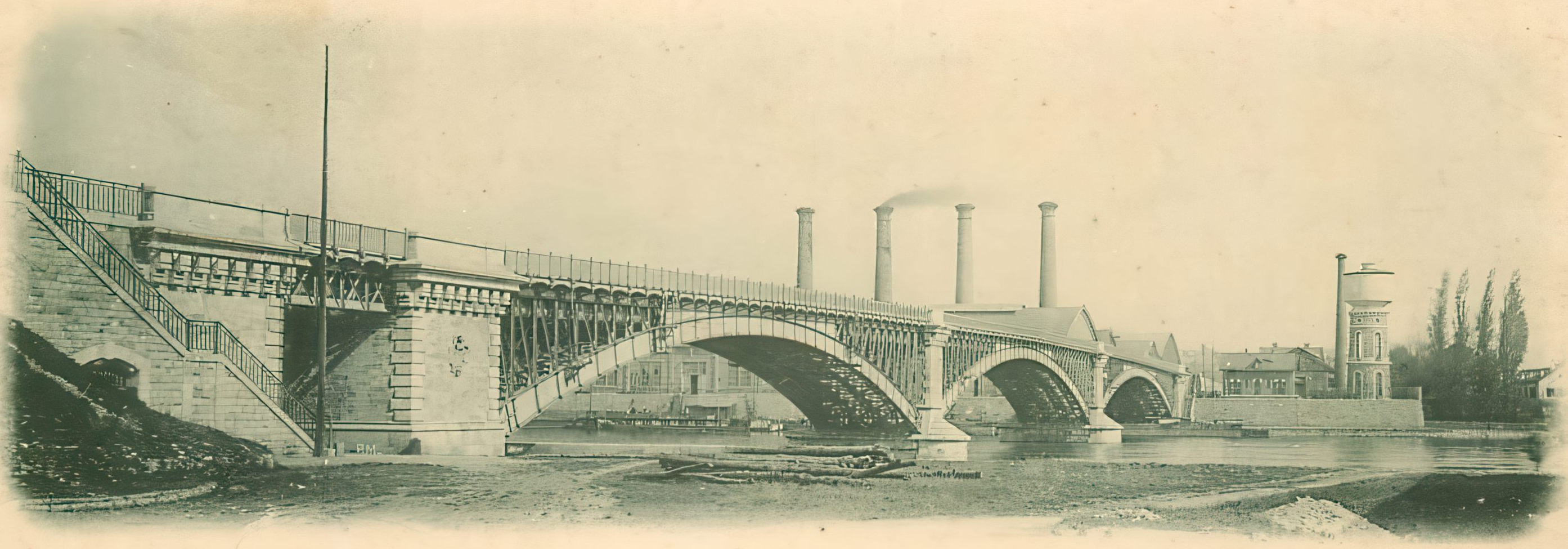
A historical view of a bridge crossing the Seine at Argenteuil. Later photographs document changing transport infrastructure and provide a useful comparison with the river crossings in Monet's 1870s paintings.
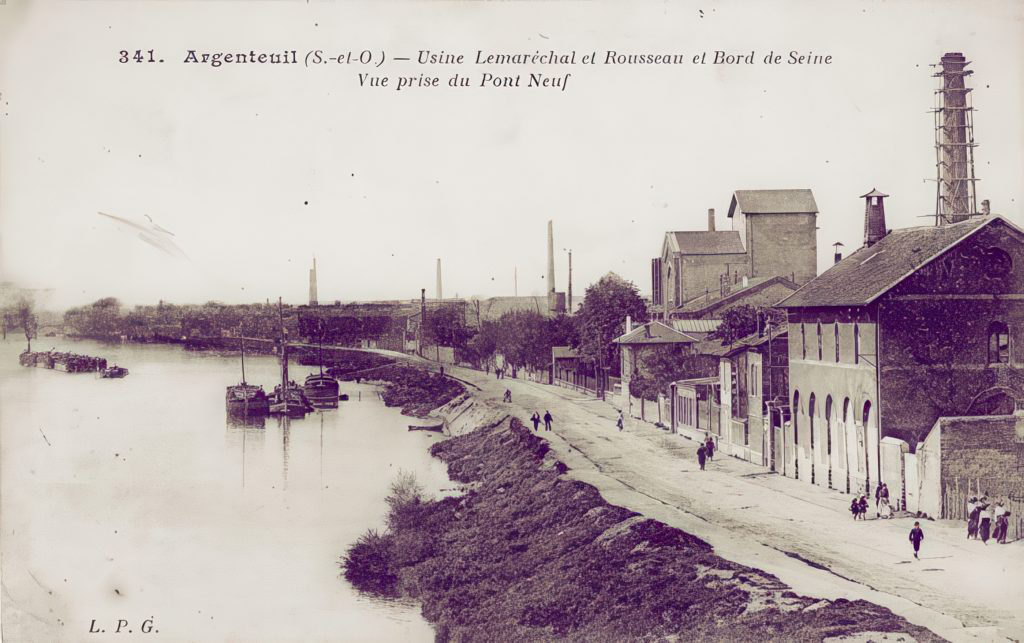
A vintage photograph of industrial Argenteuil along the banks of the Seine. Monet was fascinated by the contrast between leisure boating, suburban growth and expanding industry, often including factories, smoke and riverside activity within his Impressionist landscapes.
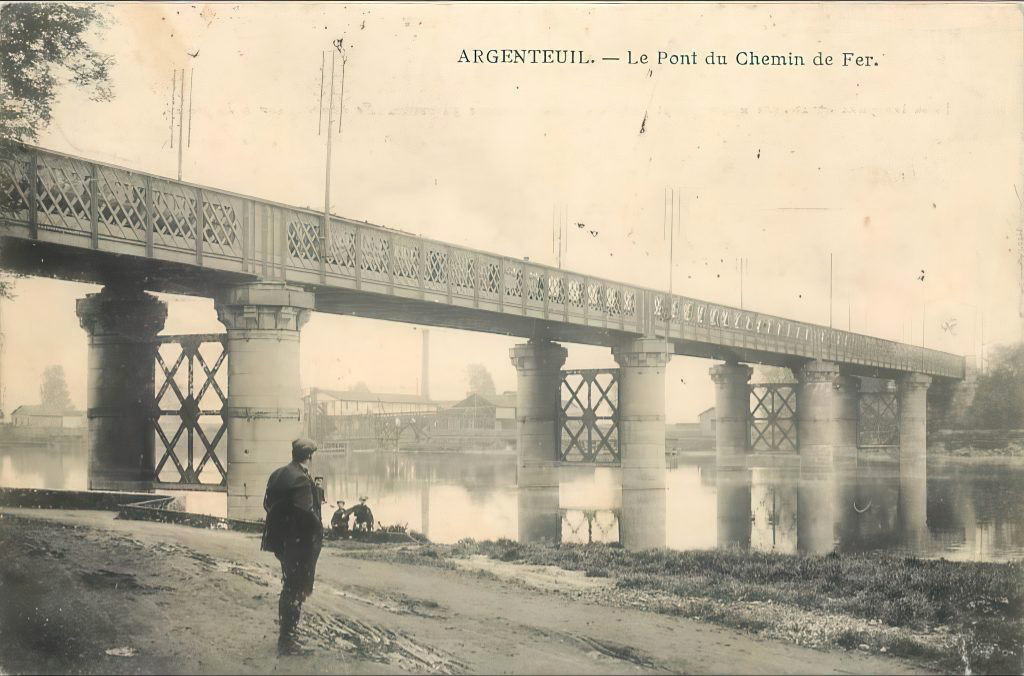
The railway crossing was one of Argenteuil's prominent modern landmarks. Monet painted its structure, reflections and passing trains in the 1870s. This historical photograph provides another view of Argenteuil's transport landscape.
Map of Argenteuil, Showing Proximity to Paris
Friends and Fellow Impressionists
Argenteuil also became a gathering place for several of Monet's friends and fellow artists. Pierre-Auguste Renoir visited frequently and painted alongside Monet along the riverbanks. Édouard Manet also travelled to Argenteuil and produced a number of paintings inspired by the boating culture of the Seine.
These visits strengthened relationships among artists associated with Impressionism. Their shared interest in outdoor work, modern subjects and visible brushwork helped develop the movement, although their paintings and individual methods remained distinct.
Gardens and Family Life
While the river provided Monet with many subjects, he also painted scenes closer to home. The garden of his Argenteuil house appears in several works, often featuring his wife Camille and their son Jean. These intimate domestic scenes contrast with the busy river views and show Monet experimenting with colour and light among flowers, trees and garden paths.
Paintings such as The Artist's Garden at Argenteuil reveal Monet's growing fascination with flowers and cultivated landscapes. This interest would later reach its full expression in the famous gardens he created at Giverny decades later.
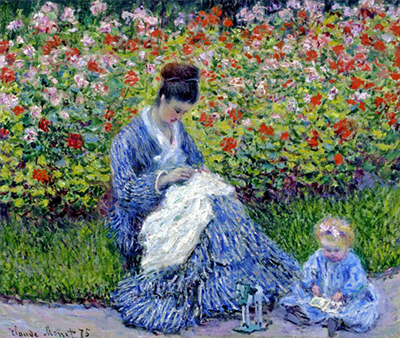
Camille Monet and a Child in the Artist's Garden in Argenteuil reveals the more intimate side of Monet's years in the town. While the Seine provided bridges, boats and reflections, his garden offered a domestic setting where family life, flowers and sunlight became part of the same Impressionist experiment.
Poppies and Fields Near Argenteuil
The countryside surrounding Argenteuil offered another rich subject for Monet's brush. In the nearby fields he painted one of his most beloved works, Poppies. The foreground figures are probably Camille and Jean, walking through a field of red flowers beneath a wide summer sky. [21]
The loose brushwork and vibrant colour of this painting demonstrate the developing language of Impressionism. Rather than carefully outlining individual flowers, Monet used quick touches of colour to suggest the overall effect of a field shimmering in sunlight.
 Claude Monet.jpg)
Monet's Poppy Field near Argenteuil is one of the most famous paintings from his years in the region. The scattered red flowers, open sky and figures, probably Camille and Jean Monet, show how he used quick touches of colour to capture the sensation of a summer field rather than describe every detail individually.
[21]
The Development of Impressionism
The years in Argenteuil were crucial for the development of Monet's mature style. Here he refined the short brushstrokes, bright palette and emphasis on fleeting light that would define Impressionist painting. Many of the works created in Argenteuil were later shown in the early Impressionist exhibitions of the 1870s.
Scenes of river reflections, regattas, railway bridges, and suburban gardens helped introduce viewers to a new way of seeing the modern world. Instead of historical subjects or carefully finished academic paintings, Monet presented moments of everyday life captured through colour and light.
Leaving Argenteuil
By 1878 Monet faced increasing financial difficulties. He left Argenteuil at the beginning of that year, spent a period in Paris and subsequently settled in Vetheuil. The transition was not a direct move from one riverside house to the next. The paintings of his Argenteuil years remain central works of early Impressionism. [6]
Today these paintings are held in major museums around the world, including the Musée d'Orsay in Paris, the National Gallery in London and the Metropolitan Museum of Art in New York. Together they capture a remarkable period when Monet transformed the riverside town of Argenteuil into one of the central landscapes of modern art.
Selected Argenteuil Paintings: Dates and Collections
This selection identifies individual canvases by their museum records. Similar titles can refer to different works, so collection names and inventory numbers matter alongside dates. It is not a complete catalogue of Monet's Argenteuil output. The examples connect the river, railway, garden and family subjects discussed above. [24]
| Painting | Date | Collection and identifier | Notes |
|---|---|---|---|
| Regattas at Argenteuil | about 1872 | Musee d'Orsay, RF 2778 | Sailing on the broad river basin. [8] |
| Springtime | 1872 | The Walters Art Museum, 37.11 | A woman reading beneath flowering lilacs. [16] |
| Jean Monet on His Horse Tricycle | 1872 | The Metropolitan Museum of Art, 2000.195 | Jean with his wheeled horse in the garden. [17] |
| The Artist's Garden in Argenteuil (A Corner of the Garden with Dahlias) | 1873 | National Gallery of Art, 1991.27.1 | Washington garden picture, distinct from the Chicago house. [10] |
| The Artist's House at Argenteuil | 1873 | Art Institute of Chicago, 1933.1153 | Camille at the doorway and Jean with his hoop. [4] |
| Autumn on the Seine, Argenteuil | 1873 | High Museum of Art, 2000.205 | Autumn river view; a separate canvas from the Courtauld version. [18] |
| Railroad Bridge, Argenteuil | 1873 | Philadelphia Museum of Art, object 101731 | The date follows the current museum record. [14] |
| Poppies | 1873 | Musee d'Orsay, RF 1676 | Figures and red flowers in a summer landscape. [21] |
| The Bridge at Argenteuil | 1874 | Musee d'Orsay, RF 1937 41 | The road bridge with moored boats. [7] |
| The Bridge at Argenteuil (Washington version) | 1874 | National Gallery of Art, 1983.1.24 | Boats and a diagonal road bridge structure this view. [11] |
| Monet's Studio-Boat | 1874 | Kroller-Muller Museum, KM 111.222 | Horizontal view of the floating studio. [20] |
| The Railway Bridge, Argenteuil (small study) | 1874 | Musee Marmottan Monet, 5037 | A 14 x 23 cm canvas, distinct from the Philadelphia picture. [15] |
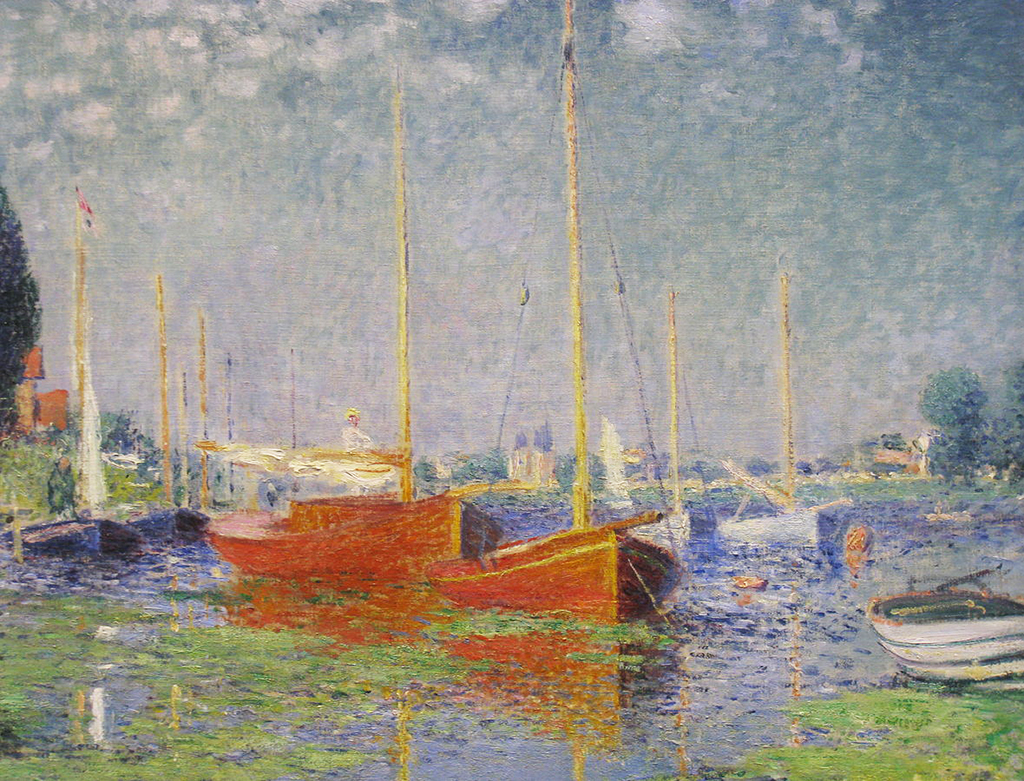
| Red Boats, Argenteuil | 1875 | Harvard Art Museums, 1951.54 | The Harvard canvas with two prominent red hulls. [9] |
| Camille Monet and a Child in the Artist's Garden in Argenteuil | 1875 | Museum of Fine Arts, Boston, 1976.833 | Camille sewing beside a child in the garden. [19] |
| Snow Scene at Argenteuil | 1875 | National Gallery, London, NG6607 | Snow-covered street; a specific winter canvas. [12] |
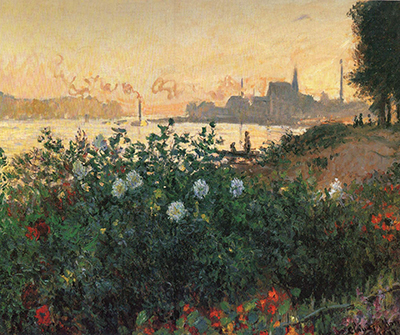
| Flowered Riverbank, Argenteuil | 1877 | Pola Museum of Art, 006-0467 | Flowered bank and the Seine, from the later Argenteuil years. [13] |
Frequently Asked Questions
References
- Daniel Wildenstein, Gilles Neret, Monet: Catalogue Raisonne, Cologne: Wildenstein Institute and Taschen, 1996.
- Daniel Wildenstein, Monet: The Triumph of Impressionism, Cologne: Taschen, 2015.
- Jackie Wullschlager, Monet - The Restless Vision, Milton Keynes: Allen Lane, 2023.
- Art Institute of Chicago, “The Artist's House at Argenteuil,” Monet Exhibition Catalogue, View source.
- Goodreads, “Claude Monet Quotes,” Goodreads, View source.
- Maison et jardins de Claude Monet, Giverny, Official timeline: late-1871 settlement and the Paris interval before Vetheuil in 1878. View source
- Musee d'Orsay, Le Pont d'Argenteuil, 1874, RF 1937 41; road-bridge version. View source
- Musee d'Orsay, Regates a Argenteuil, about 1872, RF 2778; boating and railway access. View source
- Harvard Art Museums, Red Boats, Argenteuil, 1875, 1951.54; museum-supplied record. View source
- National Gallery of Art, The Artist's Garden in Argenteuil (A Corner of the Garden with Dahlias), 1873, 1991.27.1. View source
- National Gallery of Art, The Bridge at Argenteuil, 1874, 1983.1.24; distinct Washington version. View source
- National Gallery, London, Snow Scene at Argenteuil, 1875, NG6607. View source
- Pola Museum of Art, Flowered Riverbank, Argenteuil, 1877, 006-0467. View source
- Philadelphia Museum of Art, Railroad Bridge, Argenteuil; current object record dates it to 1873. View source
- Musee Marmottan Monet, Le Pont du chemin de fer, Argenteuil, 1874, 5037; small 14 x 23 cm study. View source
- The Walters Art Museum, Springtime, 1872, 37.11. View source
- The Metropolitan Museum of Art, Jean Monet on His Horse Tricycle, 1872, 2000.195. View source
- High Museum of Art, Autumn on the Seine, Argenteuil, 1873, 2000.205. View source
- National Gallery of Victoria, French Impressionism, 2025 museum loan checklist, p.33; Boston 1976.833. View source
- Kroller-Muller Museum, Monet's Studio-Boat, 1874, KM 111.222. View source
- Musee d'Orsay, Coquelicots, 1873, RF 1676. View source
- Christie's, Monet and painting the air; later reported statement, not an Argenteuil-period letter. View source
- RISD Museum, Painting Air, 2012 exhibition introduction; later remark attributed to Monet in 1895. View source
- Paul Hayes Tucker / National Gallery of Art, The Impressionists at Argenteuil, 2000; individual canvas identifications and the town during Monet's residence. View source
- Maison et jardins de Claude Monet, Giverny, The house: the preserved Japanese print collection. View source