by
Tom Gurney
Tom Gurney BSc (Hons) is an art history expert with over 20 years experience
Published on May 6, 2026 / Updated on October 23, 2026
Email:
tomgurney1@gmail.com
/ Phone:
+44 7429 011000
Claude Monet Water Lilies: Selected Catalogue
Monet's Water Lilies comprise many separate paintings, not one famous canvas with interchangeable titles. This selected catalogue identifies examples through museum records and compares the early pond views, reflective water landscapes and large late compositions. It is a guide to particular works rather than a complete catalogue raisonne. The Orangerie installation is listed separately because its named compositions are assembled from several supports. [1] [8] [16] [17]
At a Glance
- Coverage Selected documented works, not a complete inventory
- Earliest example here Marmottan's Evening Effect, dated 1897 in its record [1]
- Bridge group Separate canvases from 1899 and 1900 [3] [7] [8]
- Repeated title The Met's Water Lilies of 1916-19 and 1919 are distinct works [13] [14]
- Multi-panel example MoMA's Water Lilies, 1914-26, is a triptych [16]
- Orangerie Eight named compositions, not eight individual canvases [17] [18]
What belongs in a Water Lilies catalogue?
The subject extends beyond flowers floating in isolation. It includes views in which a bridge spans the pond, pictures organised around reflected trees and large decorative compositions. The common setting is the water garden Monet developed at Giverny, but each canvas gives that setting a different structure. [7] [17]
A list can therefore be broad or narrow. Counting only paintings titled Nympheas produces a different category from counting every related bridge, willow or water-garden picture. A rounded estimate is not a substitute for explaining what has been included.
The selection below concentrates on works that can be connected with specific institutional records. It allows comparisons across time without claiming to reproduce the entire surviving body of paintings.
Dates follow the cited records, including their qualifications. Dimensions, where given, are height by width in centimetres and refer to the painted support rather than the frame. A loan is identified as a loan; a collection number does not, by itself, establish ownership. [2] [15]
Early water surfaces and the bridge paintings
The Marmottan dates Water Lilies, Evening Effect to 1897. Its account emphasises flowers, water and reflected sky, rather than a distant horizon. This is important: an early Water Lilies painting need not contain the bridge. [1]
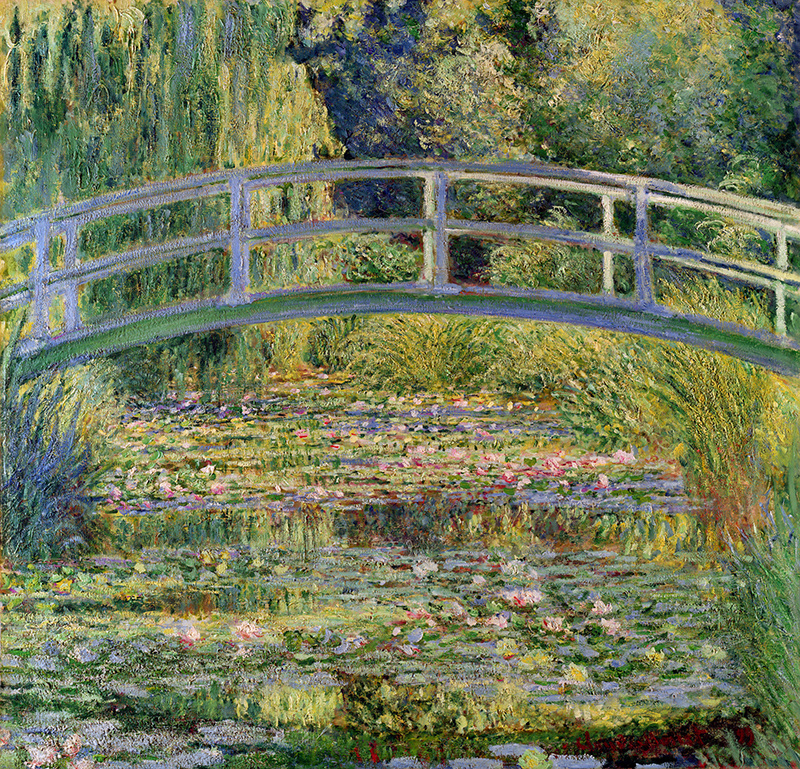
The 1899 bridge pictures develop another arrangement. Architecture supplies a strong arc across the vegetation, while lily pads and reflections occupy the water below. The Princeton, London, Washington and New York examples are related treatments of the same garden, not different names for a single object. [3] [5] [6] [7]
Their dimensions make useful differences visible before any detailed comparison of colour. The Met canvas is distinctly upright; Princeton's is close to square; the Washington work is wider than it is high. These formats change how strongly the bridge, its approaches and the foreground water occupy the field.
The table preserves those separate identities. The Los Angeles example is documented by LACMA's educational publication; the Tokyo example is explicitly recorded as a deposit from a private collection, rather than an acquisition by the museum. [19] [2]
| Work | Date in cited record | Institution / identifier | Support, cm |
|---|---|---|---|
| Nympheas | c. 1897-98 | LACMA, M.62.8.13 [19] | See institutional caption |
| Water Lilies, Evening Effect | 1897 | Marmottan, 5167 [1] | 73 x 100 |
| Water Lilies | c. 1897-99 | NMWA, Tokyo; deposit DEP.2025-0001 [2] | 73.3 x 101 |
| Water Lilies and Japanese Bridge | 1899 | Princeton, y1972-15 [3] | 90.5 x 89.7 |
| Water Lily Pond, Green Harmony | 1899 | Orsay, RF 2004 [4] | 89.5 x 92.5 |
| The Water-Lily Pond | 1899 | National Gallery, NG4240 [5] | 88.3 x 93.1 |
| The Japanese Footbridge | 1899 | NGA, 1992.9.1 [6] | 81.3 x 101.6 |
| Bridge over a Pond of Water Lilies | 1899 | The Met, 29.100.113 [7] | 92.7 x 73.7 |
| Water Lily Pond | 1900 | Art Institute of Chicago, 1933.441 [8] | 89.8 x 101 |
Chicago's 1900 pond: a specific exhibition history
The Art Institute's Water Lily Pond belongs to the bridge-and-pond group, but its history should not be inferred from the history of every related painting. Jill Shaw's scholarly catalogue explains that this canvas was not included in Monet's late-1900 Durand-Ruel exhibition. [8]
That distinction matters when reading a list organised by year. Two paintings can share a date and subject without having been exhibited or sold together. A campaign is not automatically an exhibition checklist.
The Chicago record also draws attention to the preparation and alteration of the painted image. Its appearance is the result of decisions made on the canvas, not simply a neutral transcription of a fixed garden view. [8]
An object-based catalogue brings these layers together: what the image depicts, what the physical examination reveals and what can be established about its circulation. None should be replaced by a general statement about how Monet supposedly treated every Water Lilies painting.
The reflective water landscapes, 1903 to about 1907
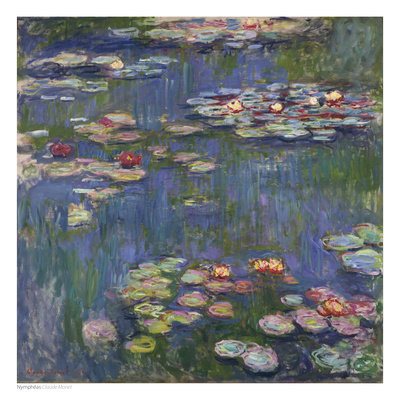
In the Marmottan's 1903 Water Lilies , the shore no longer anchors the image. The museum describes reflected clouds and vegetation mingling with floating plants, creating a sense of space that exceeds the canvas's modest size. [9]
Dayton's 1903 picture offers another horizonless arrangement. The museum identifies the tree branches at the upper left as an indication of the pond's surroundings, even though attention remains concentrated on the water. [10]
These pictures ask the viewer to distinguish objects lying on the surface from images reflected within it. A patch of colour may appear to belong to the pond's depth or to a tree standing outside the frame.
Chicago's 1906 canvas provides a further comparison, supported by a detailed scholarly and technical record. The National Gallery's Setting Sun , dated about 1907, introduces a different complication: studio photography suggests that some foreground vegetation may have been added later. [11] [12]
The subject's changing appearance therefore includes both changing light and changing paint. A catalogue date is valuable, but it need not identify one uninterrupted session or the last moment at which Monet touched the surface.
| Work | Date in cited record | Institution / identifier | Support, cm |
|---|---|---|---|
| Water Lilies | 1903 | Marmottan, 5163 [9] | 73 x 92 |
| Nympheas / Waterlilies | 1903 | Dayton Art Institute, 1953.11 [10] | 81.3 x 101.6 |
| Water Lilies | 1906 | Art Institute of Chicago, 1933.1157 [11] | 89.9 x 94.1 |
| Water-Lilies, Setting Sun | About 1907 | National Gallery, NG6608 [12] | 73 x 92.7 |
Late canvases: similar titles, different purposes
The Met holds two late paintings called Water Lilies that illustrate why titles alone are insufficient. One is dated 1916-19 and measures just over two metres in width. The other is dated 1919, is lower in height and has a different accession number. [13] [14]
The museum connects the 1919 work with three related pictures made for the dealers Gaston and Josse Bernheim. It should not be described as though every late water-garden painting had been set aside for the French State. [14]
The National Gallery's 1917 example is another independent object, recorded under loan number L772. Its nearly square format differs from the long Met canvases. The gallery's discussion places such work alongside the development of the monumental decorative project. [15]
These examples resist a simple progression in which small paintings stop and large ones begin. Different scales and destinations coexist. The later years are better understood through specific canvases and their histories than through one universal description of Monet's intentions.
| Work | Date in cited record | Institution / identifier | Support, cm |
|---|---|---|---|
| Water Lilies | 1916-19 | The Met, 1983.532 [13] | 130.2 x 200.7 |
| Water Lilies | 1919 | The Met, 1998.325.2 [14] | 101 x 200 |
| Water-Lilies | 1917 | On loan to National Gallery, L772 [15] | 148.5 x 164 |
| Water Lilies, triptych | 1914-26 | MoMA, 666.1959.a-c [16] | 200 x 1276 overall |
MoMA's triptych and the meaning of a panel
MoMA's Water Lilies is one composition made from three panels. Its overall width exceeds twelve metres. The museum's date, 1914-26, indicates a long period of production and reworking rather than a single year of completion. [16]
A reproduction can disguise that scale and structure. Viewed as a small rectangular image, the work may look like another easel painting; its dimensions reveal a different relationship with the viewer's body and field of vision.
The centre and flanking sections belong to a continuous painted environment, while the physical divisions remain part of the object's construction. A catalogue must therefore distinguish a composition from the number of supports on which it is painted.
MoMA's triptych is not one of the eight compositions installed in the Orangerie. The projects are related through Monet's late decorative ambitions, but they have separate object and collection histories. [16] [17]
The eight Orangerie compositions
The Orangerie arrangement surrounds the viewer in two oval rooms. Its eight named compositions are assembled from several canvases, so counting the names does not count the individual supports. [17]
The museum's guide identifies changes of light, reflected clouds and trees, and the presence of willows through the titles below. They describe related experiences of the pond rather than eight independent views of unrelated places. [18]
Their architectural setting is also part of the encounter. Curved walls and long expanses of paint encourage the viewer to turn and move, rather than absorb the entire installation from the position used to inspect a small framed picture.
The Water Lilies timeline follows the development of the gift and installation. For a catalogue, the essential distinction is between that installed ensemble and other large paintings that remained outside it. [17]
| Composition | French title in the museum guide |
|---|---|
| Setting Sun | Soleil couchant |
| The Clouds | Les Nuages |
| Green Reflections | Reflets verts |
| Morning | Matin |
| Reflections of Trees | Reflets d'arbres |
| The Morning with Willows | Le Matin aux saules |
| The Two Willows | Les Deux Saules |
| Clear Morning with Willows | Le Matin clair aux saules |
All eight belong to the Orangerie ensemble. [18]
Using dates, numbers and collection records
Museum accession numbers are especially useful when several paintings share a title. They identify the object within an institution's records; they are not dates of execution, prices or numbers assigned by Monet.
A scholarly catalogue raisonne uses another numbering system. Those references need to be checked against a specific publication and object, not guessed from the order of paintings on a webpage. This selection uses institutional identifiers to make its comparisons easier to follow.
Holding, ownership and display are also different matters. The Tokyo deposit and London loan show why a museum location should not automatically be described as permanent ownership. Exhibitions and loans can change what is available to see without changing the underlying identity of a canvas. [2] [15]
The broader Water Lilies overview introduces the subject's development. This catalogue provides a more focused route into it: select a particular painting, follow its linked museum reference and compare its dimensions, date and painted arrangement with another documented example.
Frequently Asked Questions
No. It is a selected catalogue of documented examples and the eight named Orangerie compositions.
No. The compositions combine several supports. A composition and a physical canvas are different units. [17]
Discussion
Look again at the images and ideas explored in Claude Monet Water Lilies: Selected Catalogue. These editorial prompts invite your observations.
Reader Insights
Compare the proportions of the Princeton and Met bridge paintings.
Compare a 1903 water surface with a late Met canvas.
Consider how a three-panel composition differs from one easel painting.
Join the Conversation
Share a detail, comparison or question about Claude Monet Water Lilies: Selected Catalogue below.
References
- Musee Marmottan Monet , Nympheas, Effet du soir, 1897, inventory 5167. View source .
- National Museum of Western Art , Water Lilies, c. 1897-99, deposit DEP.2025-0001. View source .
- Princeton University Art Museum , Water Lilies and Japanese Bridge, 1899, y1972-15. View source .
- Musee d'Orsay , Le Bassin aux nympheas, harmonie verte, 1899, RF 2004. View source .
- National Gallery, London , The Water-Lily Pond, 1899, NG4240. View source .
- National Gallery of Art , The Japanese Footbridge, 1899, 1992.9.1. View source .
- The Metropolitan Museum of Art , Bridge over a Pond of Water Lilies, 1899, 29.100.113. View source .
- Jill Shaw, Art Institute of Chicago , scholarly catalogue, entry 37, Water Lily Pond, 1900, 1933.441. View source .
- Musee Marmottan Monet , Nympheas, 1903, inventory 5163. View source .
- Dayton Art Institute , Nympheas, 1903, 1953.11. View source .
- Jill Shaw, Art Institute of Chicago , scholarly catalogue, entry 44, Water Lilies, 1906, 1933.1157. View source .
- National Gallery, London , Water-Lilies, Setting Sun, about 1907, NG6608. View source .
- The Metropolitan Museum of Art , Water Lilies, 1916-19, 1983.532. View source .
- The Metropolitan Museum of Art , Water Lilies, 1919, 1998.325.2. View source .
- National Gallery, London , Water-Lilies, 1917, L772. View source .
- Museum of Modern Art , Water Lilies, 1914-26, 666.1959.a-c. View source .
- Musee de l'Orangerie , History of the Water Lilies cycle. View source .
- Musee de l'Orangerie , official bilingual museum guide; eight composition titles. View source .
- LACMA , Renoir after Impressionism educational resource, Nympheas, c. 1897-98, M.62.8.13, page 8. View source .