by
Tom Gurney
Tom Gurney BSc (Hons) is an art history expert with over 20 years experience
Published on May 6, 2026 / Updated on October 23, 2026
Email:
tomgurney1@gmail.com
/ Phone:
+44 7429 011000
Timeline of Monet's Water Lilies
Monet's Water Lilies developed over decades, not in one continuous painting campaign. The creation of the garden, the dates of particular canvases, exhibitions and the preparation of a public decoration form related but different histories. Following them together explains how a pond at Giverny became the basis for both intimate pictures and an architectural environment. [1] [2] [7]
At a Glance
- Home at Giverny From 1883; property purchased in 1890 [1]
- Water-garden land Purchased in 1893 [2]
- Early pond paintings Examples dated to the late 1890s [3]
- Major gallery exhibition 48 water landscapes, Paris, 1909 [1] [4]
- Formal state donation 12 April 1922 [8]
- Orangerie Official inauguration 17 May 1927; public opening 20 May [1] [8]
Key dates at a glance
The main milestones belong to more than one kind of chronology. Property purchases establish the conditions for the garden; a canvas may carry a broad date range; an exhibition or signed deed can be tied to a particular day. These differences help keep the sequence clear.
| Date | Milestone |
|---|---|
| 1883 | Monet settles at Giverny. [1] |
| 1890 | He purchases the house and property. [1] |
| 1893 | Additional land becomes the basis of the water garden. [2] |
| Late 1890s | Early Water Lilies paintings appear. [3] |
| 1899-1900 | Pond and bridge paintings become a substantial group; garden subjects are exhibited in 1900. [2] [4] |
| 1903-1908 | A sustained group of water-surface paintings develops. [5] |
| 6 May 1909 | The Paris Water Lilies exhibition opens at Durand-Ruel. [5] |
| 1914 | Monet renews the large decorative project. [7] [9] |
| 1915-1916 | A large studio is built for monumental work. [6] |
| 12 November 1918 | Monet offers decorative panels to the state through Clemenceau. [7] |
| 12 April 1922 | The donation deed is signed. [8] |
| 1923 | Cataract surgery forms part of Monet's late working circumstances. [1] |
| 5 December 1926 | Monet dies at Giverny. [1] |
| May 1927 | The Orangerie installation is inaugurated and opens to visitors. [8] |
| Post-war decades | Interest in the late paintings grows; the present MoMA triptych is acquired in 1959. [9] [10] |
The stages are not sealed compartments. Smaller pictures and monumental decorations could coexist, and a painting might be revised after work had begun on another. A useful timeline therefore provides orientation without pretending to date every brushstroke.
1883-1893: making a place before painting the pond
Monet moved to Giverny in 1883 and purchased his house and property in 1890. The additional land associated with the water garden followed in 1893. [1] [2]
The sequence is important. His arrival in the village was not the beginning of an already completed lily pond, and the later Water Lilies should not be dated back automatically to his first year there.
A garden takes time to establish. Acquiring ground, shaping water and arranging plants create the conditions for a subject that will continue changing as it grows.
Monet's role was unusual because he helped organise the place he would paint. The subject was neither an untouched landscape nor simply an indoor arrangement. It combined cultivation with weather, reflections and seasonal growth.
This preparatory history gives the paintings a material setting. Before a canvas could transform the pond into colour and light, the pond had to exist as a functioning part of the property.
The late 1890s: early pictures and the bridge
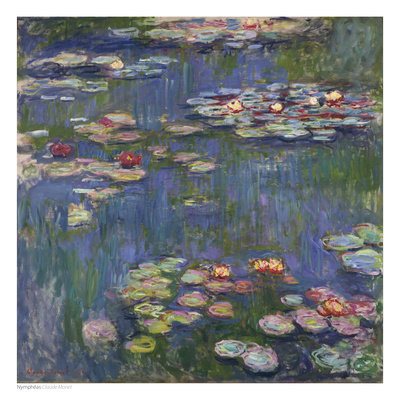
The National Museum of Western Art records an early Water Lilies with the date range about 1897-1899. [3] Such a range is more informative than assigning every early canvas to one supposedly decisive year.
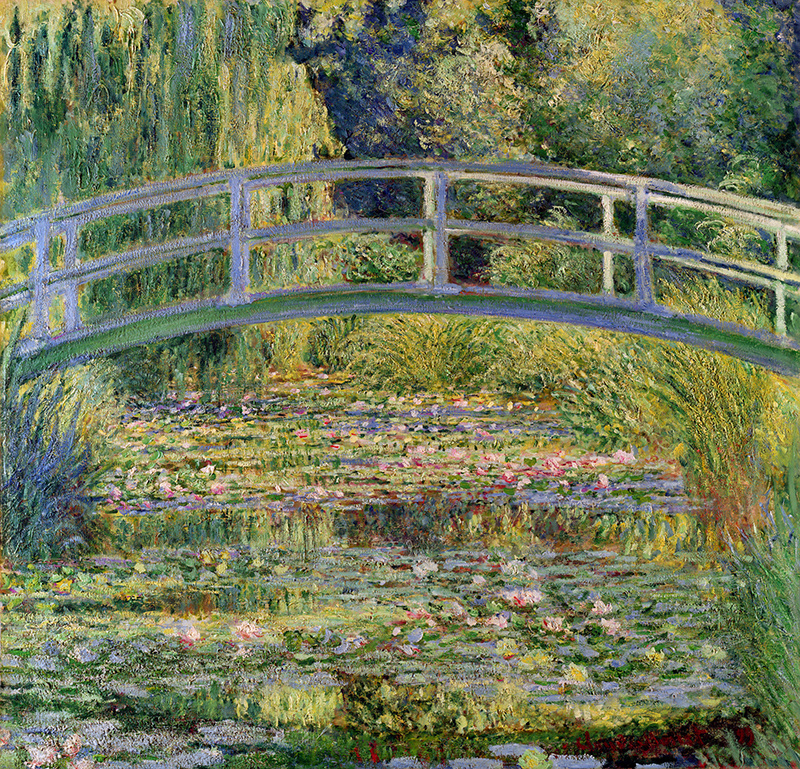
By 1899 Monet was also painting the wooden footbridge over the pond. The Met's Bridge over a Pond of Water Lilies is a specific canvas from that year, with a vertical format that gives substantial space to the water and its reflections. [2]
The bridge creates an easily recognised structure above the surface. Vegetation establishes the banks, while the lilies interrupt reflections below. This makes the garden identifiable without reducing the picture to a botanical record.
These works belong to the Water Lilies story even when the bridge is especially prominent. The subject includes relationships among pond, planting and reflected surroundings, not only close views of flowers.
An early bridge painting and an early surface study can therefore occupy the same broad period while asking different pictorial questions.
1900-1909: a garden subject becomes an exhibition group
The Musee des impressionnismes Giverny records garden and pond subjects in Monet's 1900 exhibition at Durand-Ruel. In 1909 a dedicated exhibition brought together 48 water landscapes. [4]
The Art Institute of Chicago's study of its 1906 Water Lilies connects the later exhibition with the sustained 1903-1908 group. Its technical discussion also shows the substantial effort behind surfaces that can seem fleeting. [5]
A water surface can carry several kinds of information at once. Lily pads locate the pond's plane, while reflected trees and sky introduce forms whose physical sources may lie outside the picture.
The viewer is asked to move between reading the surface and looking into an image of depth. That visual ambiguity could be developed across different canvases without making each a copy of the same effect.
The 1909 exhibition was thus a public gathering of related but varied pictures. Its date should not be confused with the making of every painting included in it.
1914-1916: a renewed ambition and a larger studio
In 1914 Monet returned to the ambition of creating a major decorative ensemble. MoMA describes the large canvases as works made and repeatedly revised from that year until his death. [9]
The physical requirements changed with the scale. The National Gallery dates the construction of a studio suited to the decorations to 1915-1916. [6] A broad building range is preferable to treating one construction year as the completion date of the whole artistic project.
Large works demanded room to stand, compare and adjust. Studio space also allowed paintings to remain available for revision rather than depending entirely on a brief encounter beside the pond.
This did not eliminate smaller canvases. The National Gallery's account places them alongside the monumental work, with different practical circumstances of making. [6]
Scale changed the viewer's relationship to the image as well. Instead of surveying a contained pond scene from outside, a person could face a stretch of painted water broad enough to extend beyond a single concentrated glance.
1918-1922: from an offer to a formal gift
On 12 November 1918, the day after the Armistice, Monet wrote to Georges Clemenceau offering decorative panels to the French state. The Orangerie places the gesture within the wish to create a monument to peace. [7]
The initial offer did not instantly settle the project's final dimensions, location or installation. Correspondence and negotiations formed part of its development.
The formal donation deed was signed on 12 April 1922. The museum's archive identifies the document and distinguishes it from the earlier promise. [8]
For a timeline, this is more than a legal detail. It separates an artist's declared intention from the administrative agreement through which a public work could be realised.
Nor did the signed deed mean that painting stopped. The project continued to occupy Monet, and its arrangements remained a source of concern. A work intended for public ownership could still remain physically in the artist's studio while he sought to resolve it.
1923-1926: continued work rather than a simple final date
Monet underwent cataract surgery in 1923 and died at Giverny on 5 December 1926. [1] Those dates belong to the conditions of his late life, but they should not be turned into a complete explanation of the paintings' colour or handling.
MoMA dates its triptych Water Lilies to 1914-1926. [9] The long range makes sense for work that was repeatedly reconsidered rather than completed and put aside in a single season.
A chronology can sometimes identify when work began more confidently than when its last adjustment occurred. Signatures, studio histories and later cataloguing do not always provide an exact sequence for every passage of paint.
That uncertainty need not diminish the works. It makes the distinction between sustained practice and an instantaneous impression especially useful.
The late painting technique involved looking back at a familiar subject while continuing to change the painted result. The long duration belongs to the achievement, not merely to a gap in the record.
1927: inauguration, public opening and an environment
The Water Lilies rooms at the Orangerie were officially inaugurated on 17 May 1927. The museum's archive account gives 20 May as the public opening. [1] [8] The two dates describe different events rather than competing dates for one occasion.
Monet had died a few months earlier, so he did not see visitors encounter the finished public installation. Yet the arrangement reflected a project he had considered in relation to its setting.
The Orangerie describes eight large compositions assembled from multiple panels and arranged around two elliptical rooms. [7] A composition and an individual canvas support are therefore not interchangeable units.
The surrounding arrangement gives a viewer no single prescribed point from which everything can be grasped. Moving, pausing and turning become part of looking.
This final setting connects painting to architecture. It is a particular realisation of the decorative project, not the destination of every Water Lilies canvas that remained at Giverny or later entered another collection.
Later decades: another history begins after Monet's death
The post-war movement of late Water Lilies into museums belongs to a further chapter. MoMA's present triptych was acquired in 1959; it should not be confused with the different canvas the museum had acquired in 1955. [9] [10]
Changing collections and displays encouraged new ways of viewing paintings that had remained in the studio. The removal of a horizon and the spread of colour across broad surfaces attracted attention in the context of twentieth-century art.
That later interest does not mean Monet was following movements that developed after his death. Reception can reveal new affinities without rewriting the original order of events.
The timeline consequently has several endings: the artist's death, the installation of a public ensemble and the later circulation and reassessment of other canvases.
Keeping those histories together, but distinct, helps explain the Water Lilies' range. The cycle developed from a cultivated garden, through repeated observation and revision, into pictures and spaces that continued to acquire new public meanings.
Frequently Asked Questions
No. Other large works remained in the studio and later entered separate collections. [9]
Discussion
Look again at the images and ideas explored in Timeline of Monet's Water Lilies. These editorial prompts invite your observations.
Reader Insights
Distinguish the date of a garden change from the date of a painting.
Compare the time needed to make a picture with the brief effect it may suggest.
Consider what changes when paintings are experienced around a room.
Join the Conversation
Share a detail, comparison or question about Timeline of Monet's Water Lilies below.
References
- Maison et jardins de Claude Monet , Timeline; Giverny residence, property purchase, surgery and late-life dates. View source .
- The Metropolitan Museum of Art , Bridge over a Pond of Water Lilies, 1899, accession 29.100.113; the 1893 land purchase and early bridge campaign. View source .
- National Museum of Western Art , Water Lilies, about 1897-1899, DEP.2025-0001; an early canvas with a qualified date range. View source .
- Musee des impressionnismes Giverny , Le jardin de Monet a Giverny: l'invention d'un paysage, educational dossier, 2009, chronology; garden development and exhibitions. View source .
- Art Institute of Chicago , Monet scholarly catalogue, Cat. 44, Water Lilies, 1906; the 1903-1908 group, technical evidence and 1909 exhibition. View source .
- National Gallery, London , Water-lilies, 1917, L772; the 1915-1916 studio and the coexistence of different formats. View source .
- Musee de l'Orangerie , History of the Water Lilies cycle; the decorative project, gift and eight-composition installation. View source .
- Musee de l'Orangerie , Correspondence related to the Water Lilies; donation deed and distinction between inauguration and public opening. View source .
- Museum of Modern Art , Water Lilies, 1914-1926, object 666.1959.a-c; prolonged revision and 1959 acquisition. View source .
- Museum Barberini , Water Lilies, 1914-1917; the later history of the series, including MoMA's separate 1955 purchase. View source .