 by
Tom Gurney
Tom Gurney BSc (Hons) is an art history expert with over 20 years experience
Published on October 6, 2016 / Updated on October 23, 2026
Email:
tomgurney1@gmail.com
/ Phone:
+44 7429 011000
In the Garden
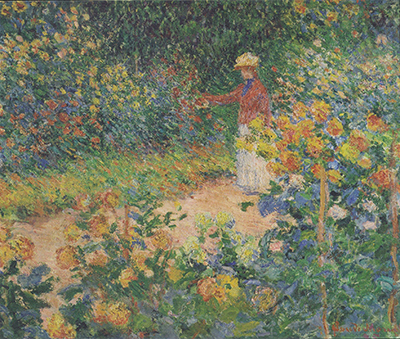
In the Garden is Claude Monet's 1895 painting of a woman among flowering beds at Giverny. The Kunsthaus Zurich catalogue records it as Le Jardin de Monet a Giverny, or Monet's Garden at Giverny. Its cultivated setting almost fills the canvas, surrounding the figure with colour and bringing the foreground plants unusually close to the viewer. [1]
At a Glance
A figure within the flowers
The woman stands just to the right of centre, beyond the nearest flowers. Her pale skirt creates a vertical interval within the green setting, while a reddish jacket connects her to the warm accents scattered through the beds. A light hat distinguishes the head without giving us a detailed view of the face.
One arm extends towards the plants. That gesture encourages the impression of someone attending to the garden, but the picture does not clearly establish a particular task. It is safer to describe the relation between hand and foliage than to invent a basket or a definite moment of flower-picking.
The figure is neither a large portrait placed before a garden backdrop nor a minute addition lost in the distance. She gives the scene a human measure while remaining partly absorbed into it. Plants overlap her lower outline, and the jacket's colour reappears elsewhere on the canvas. Her presence belongs to the garden's visual rhythm.
The path also helps locate her. A warm, comparatively open area enters from the left and turns towards the figure. Its bend gives the eye a route through the flowers, even though foliage repeatedly interrupts the edges. The garden feels accessible, but never completely laid out for inspection.
Who is the woman?
The catalogue raisonne identifies her as Suzanne Hoschede, who had married the American painter Theodore Butler in 1892. That identification is attributed to information supplied by her sister Germaine, later Madame Salerou. It is a specific piece of family testimony rather than a name inferred solely from costume or resemblance. [2]
This distinction matters in a picture whose face is only lightly described. Without the catalogue evidence, viewers could recognise a woman in a garden but would struggle to establish her identity from the painted features alone. The documentation adds personal meaning without changing the limited detail Monet chose to show.
Knowing the name need not turn the scene into an illustrated biography. The canvas does not explain a conversation, a family event or a private thought. Nor can a posture tell us exactly what Suzanne felt. The painting's intimacy lies partly in that restraint: a familiar person occupies a familiar place without being presented through a formal public pose.
Colour without a clear horizon
Flowering plants rise across the foreground, leaving little uninterrupted space between the viewer and the path. Bright yellow and orange touches mingle with pale blossoms and cooler blue-violet passages. Behind them, denser green growth closes the view. There is no substantial band of open sky to make the garden seem distant or detached.
The colour changes do more than decorate the scene. Warm notes advance in the foreground and find echoes in the woman's clothing. Cooler patches separate adjoining masses of foliage and keep the bright flowers from merging into one continuous glow. The eye moves through these relationships before it has identified every plant.
Monet varies the scale and direction of his marks. Upright stems can be suggested with longer strokes, while clusters of blossom depend on smaller touches. In other areas the marks gather into a more continuous surface. This variation gives the garden density without requiring an inventory of individual leaves.
The visible brushwork is not evidence of a particular pigment mixture or a single rapid sitting. It tells us how the image looks and how its forms have been articulated. Questions about chemical composition, drying intervals or the sequence of revisions would require technical examination of this exact canvas.
The cultivated landscape at Giverny
Monet's Giverny garden developed from a property that already contained an orchard and planted beds. The Musee des impressionnismes Giverny describes how he retained elements of the layout while replacing fruit trees with flowers in closely planted beds. The separate water garden began with his acquisition of a lower parcel in 1893. [3]
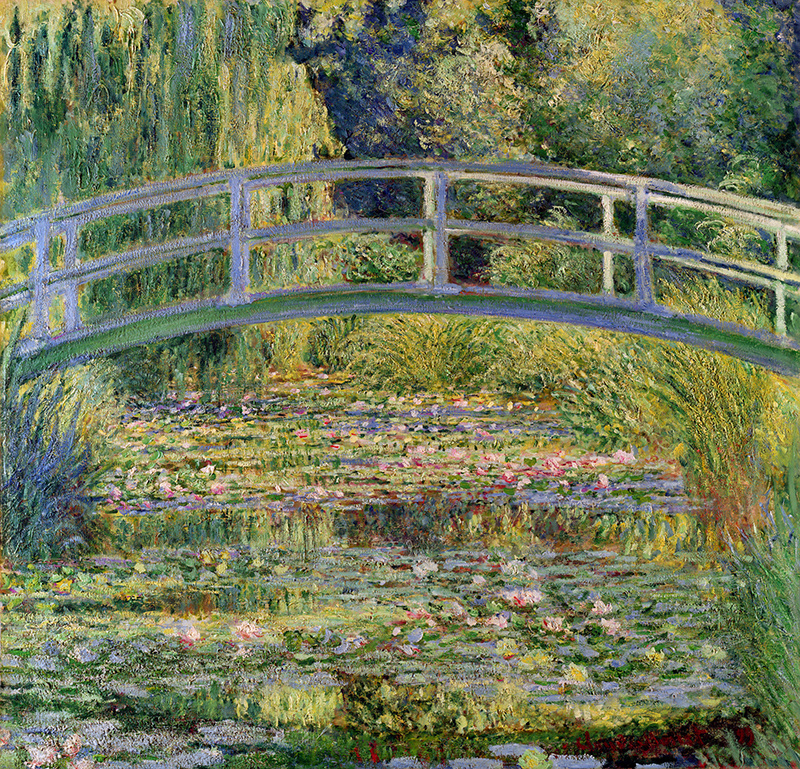
In the Garden concerns the flowering land rather than an expansive view of the lily pond. Its path, dense beds and standing figure offer a different kind of encounter from the later water-surface paintings. Both depend on a cultivated setting, but the subject should not be reduced to one unchanging garden formula.
The National Gallery's account of Monet's gardening also stresses the importance of specialist horticultural knowledge and the new plants available through modern growers. The apparently informal abundance rested on selection and care, not on a landscape left entirely to itself. [4]
Painting introduced another stage of selection. Monet could determine how much path to show, where to place the figure within the frame and which plants would obstruct the view. A real garden supplied the motif; it did not dictate every relation within the finished image.
Collection history and the Ullstein provenance
The work's later history needs careful qualification. The Kunsthaus's account of Jewish collectors records that it belonged to Franz Ullstein. His family suffered Nazi persecution and the forced sale of their publishing business. The museum states that the Zurich dealer Tony Aktuaryus sold this Monet to Emil Buhrle in 1941, but that it has not been established whether Ullstein received the proceeds. [5]
In 2024, the Buhrle Foundation announced that it would seek an agreement with the former owner's legal successors. The Kunsthaus's 2026 exhibition texts explain that this painting was withdrawn from display and remains among the works excluded while such a solution is sought. The online collection record also marks it as not on display when checked in October 2026. [1] [6]
These statements should not be replaced by an assumption that a settlement involving another painting resolves this one's history. The collection record, the provenance research and the display status answer different questions. An artwork can be catalogued within a long-term loan while not being available to see in the galleries.
The history also gives a reason to retain the names of earlier collectors, rather than passing directly from Monet to the best-known modern collection. The canvas's appearance remains important, but it is not the only part of its story.
An intimate garden, not a botanical inventory
The painting rewards attention to what it leaves indistinct. We can follow the pale skirt and the path without knowing the name of every flower. We can sense the garden's density without seeing its complete plan. The figure supplies a point of recognition, while the surrounding marks continually draw attention back into the plants.
This balance distinguishes In the Garden within Monet's paintings . Its subject is not simply the number of blooms or the beauty of a particular specimen. It is a relationship between a person, a cultivated place and the painted surface through which both become visible. The result feels close and absorbed, yet remains deliberately selective.
Frequently Asked Questions
In 1895. [1]
The catalogue raisonne identifies Suzanne Hoschede, citing her sister Germaine. [2]
81.5 x 92 cm. [1]
Discussion
Look again at the images and ideas explored in In the Garden. These editorial prompts invite your observations.
Reader Insights
How do the pale skirt and the path help you find your way through the dense flowers?
Does the figure seem separate from the garden or absorbed into it?
Which areas are most clearly described, and which depend on suggestions of colour?
Join the Conversation
Share a detail, comparison or question about In the Garden below.
References
- Kunsthaus Zurich , Le Jardin de Monet a Giverny, BU 0072, object and provenance record. Online display-status record. View source 1 . View source 2 .
- Daniel Wildenstein , Monet: Catalogue raisonne, 1996, volume III, W1420, p. 588, Wildenstein Plattner Institute digital edition. View source .
- Musee des impressionnismes Giverny , Le jardin de Monet a Giverny. View source .
- National Gallery , London, The Water-Lily Pond: Giverny garden context. View source .
- Kunsthaus Zurich , Jewish Collectors: Franz, Kurt and Lisbeth Ullstein. View source .
- Kunsthaus Zurich , En transition: La Collection Buhrle, exhibition texts, 2026. View source .