

 by Tom Gurney
Tom Gurney BSc (Hons) is an art history expert with over 20 years experience
Published on June 19, 2020 / Updated on August 2, 2026
Email: tomgurney1@gmail.com / Phone: +44 7429 011000
Contents
Introduction
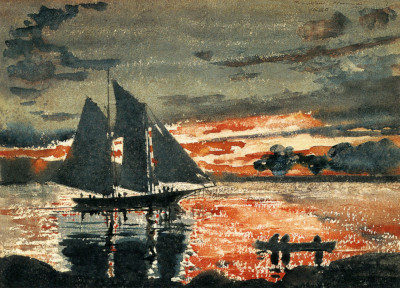
Winslow Homer's Sunset Fires is an 1880 watercolor on paper associated with the Westmoreland Museum of American Art in Greensburg, Pennsylvania. The available object metadata records the work as a small sheet, about 9 3/4 x 13 5/8 inches, with accession number 1964.36 and credit line Gift of the William A. Coulter Fund. The inscription note records Homer's signature and the date 1880 at the upper left. [1]
The article is bestgin with those facts because this work is easy to misplace. A local planning note had treated the article as possible Adirondack or campfire support, probably because of the title. The stronger source trail points elsewhere. Cape Ann Museum used Sunset Fires in connection with its Homer at the Beach programming and identifies the work as part of the Gloucester material from 1880. The fires in the title therefore be handled as evening color, sunset effect or possibly the fireworks context named in Cape Ann's lecture material, not as proof of a woodland campfire subject. [2]
Gloucester In 1880
Cape Ann Museum's Homer at the Beach material is especially useful for this article because it places Gloucester at the end of an eleven-year development in Homer's marine subjects. The museum describes Cape Ann as a repeated destination for Homer and identifies Gloucester as the place where he made his first watercolors and where his marine identity took form. Its 2019 program material also states that in Gloucester in 1880 he produced more than one hundred watercolors. [3]
Sunset Fires belongs inside that intense summer rather than inside the later Prouts Neck oil-seascape route. It is a watercolor about looking fast and decisively at light, water and boats near the close of day. The subject does not need a large narrative. Its interest is the way a small sheet can make sunset feel active: red and orange light spread across the sky and water, dark boat forms hold the foreground or middle distance, and the harbor scene turns on reflected color rather than anecdote. [4]
That is why the work is a useful rescue page even though the source packet is not deep enough for a long article. It shows Homer using watercolor as a primary instrument, not merely as preparation for oil painting. The paper surface carries the event. Washes, dark silhouettes and broken color can register the speed of changing light in a way that a more heavily built studio painting might slow down. [5]
Watercolor As A Working Method
The local Watercolours manuscript and source packets already establish the larger point: watercolor was central to Homer's career from the 1870s onward. The Art Institute of Chicago source packet records nearly 700 Homer watercolors between 1873 and 1905, and the local biography packet connects watercolor to his move away from freelance illustration and toward a more independent artistic practice. [6]
Sunset Fires makes that argument at a modest scale. It does not ask the reader to treat every small watercolor as a famous masterpiece. Instead, it helps explain why the medium mattered. A sunset is unstable by nature. Its colors change quickly, and its reflections can disappear in minutes. Homer did not need to turn that into a symbolic program. He could make the instability itself the subject. [7]
The title is also worth slowing down. Sunset Fires sounds dramatic, but the work does not need to be inflated into disaster or spectacle. Cape Ann's lecture listing connects Homer's Gloucester views of sunsets and fireworks in 1880, so the best public reading is restrained: the painting belongs to a cluster of evening and light effects, where fire may describe color, celebration, atmosphere or all three. Without a fuller object essay, the article does not need to claim a specific event. [1]
Why This Work Matters
Within the Winslow Homer cluster, Sunset Fires should function as a concise watercolor and Gloucester support page. It belongs near Watercolours, Biography, Paintings, Boys in a Dory, A Basket of Clams and The Blue Boat, rather than being pushed into the Adirondack hunting and campfire group. [2]
It also gives readers a useful bridge. Homer's better-known marine pictures often stress labor, danger, rescue or the later power of the sea. Sunset Fires is quieter, but it shows the same intelligence at an earlier and more portable scale. Boats and water are present, but the real drama is optical: how evening light turns harbor space into bands of color and shadow. [3]
The rebuilt page stays compact. It can identify the work, place it in Gloucester in 1880, connect it to Homer's mature watercolor practice and correct the campfire misread. It does not need to pad with generic biography, unsupported symbolism or a borrowed discussion of unrelated sunset paintings. Its value is exactness: a small watercolor, a documented collection trail, and a clear place in the Cape Ann route of Homer's marine career. [4]
Discussion
Winslow Homer rewards close looking because his strongest images rarely close down into one easy meaning. Use the prompts below to test how the work changes as you move between subject, place, medium and history.
Reader Insights
First Look
What detail in Sunset Fires changes how the whole work feels?
Homer's Method
Where do you see Homer's balance between clear observation and unresolved meaning?
Cluster Context
Which related Homer work helps you read this page more carefully?
Join the Conversation
Share a thoughtful observation below, especially if a detail, source connection or related Homer page changed the way you read the work.
References
- Cape Ann Museum, Winslow Homer Lecture Series: Homer's Wine-Dark Seas: https://www.capeannmuseum.org/event/winslow-homer-lecture-series-homers-wine-dark-seas/
- Cape Ann Museum, Winslow Homer Harbor Cruise: https://www.capeannmuseum.org/event/winslow-homer-harbor-cruise/
- Westmoreland Museum of American Art collection landing page and collection-search route: https://thewestmoreland.org/collection/
- Wikimedia Commons file metadata for Winslow Homer - Sunset Fires.jpg, used as a secondary object-metadata check because it cites Westmoreland Museum online: https://commons.wikimedia.org/wiki/File:Winslow_Homer_-_Sunset_Fires.jpg
- Local Winslow Homer active URL baseline audit dated 2026-07-20, which records Sunset Fires as an active artwork route with a 554-word baseline and current local image filename.
- Local Winslow Homer provisional URL decision matrix dated 2026-07-20, which records the page as a standard artwork route requiring source-test and a shorter target band if evidence is thin.
- Local Winslow Homer Watercolours manuscript, biography manuscript, paintings hub manuscript, source packets and internal-link ledger dated 2026-07-20, used for cluster placement and link caution.
 Winslow Homer.jpg)