

 by Tom Gurney
Tom Gurney BSc (Hons) is an art history expert with over 20 years experience
Published on June 19, 2020 / Updated on August 2, 2026
Email: tomgurney1@gmail.com / Phone: +44 7429 011000
Contents
- Introduction
- What the Painting Shows
- The Gulf Stream And The Caribbean
- The Black Protagonist
- Danger Without Resolution
- Reworked By 1906
- A Late Homer Marine Painting
- Why The Painting Still Feels Modern
- Related Works And Where To Go Next
- Annotated Details
Introduction
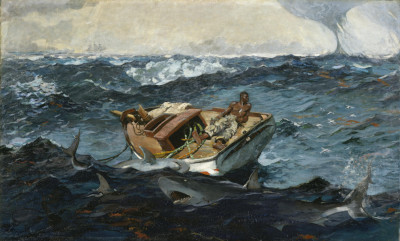
Winslow Homer's The Gulf Stream is one of the most powerful paintings in American art because it refuses the comfort of a simple rescue story. A Black man lies or braces himself on the deck of a damaged boat. The mast has snapped. The rudder appears useless. Sharks circle in the water. A waterspout rises in the distance. On the horizon, a ship passes so far away that it can barely function as hope. [1]
The painting was first made in 1899 and later reworked by Homer by 1906. It is an oil on canvas, now in the Metropolitan Museum of Art, where it belongs to the Catharine Lorillard Wolfe Collection through the Wolfe Fund. The Met gives the dimensions as 28 1/8 x 49 1/8 inches, or 71.4 x 124.8 centimeters. Those facts are useful, but they do not explain why the painting holds a viewer for so long. The real force of The Gulf Stream lies in how much Homer lets the scene contain at once: the body of one man, the weather of the Caribbean, the violence of the sea, the history of empire and slavery, and a modern sense that nature and history can press against a person at the same time. [2]
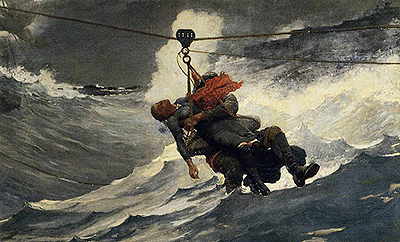
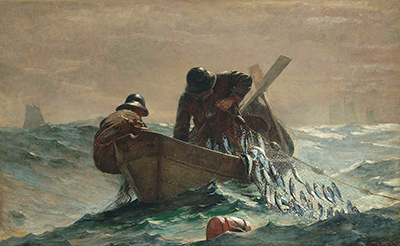
Homer had spent decades learning how to make images that were clear without being simple. He began as an illustrator, became known through Civil War subjects, painted scenes of childhood, leisure, labor and rural life, and then moved increasingly toward the sea. By the time he painted The Gulf Stream, he had already made works such as The Fog Warning, The Herring Net, The Life Line and later marine paintings from the Maine coast. Those works often show people trying to work, survive or judge risk in difficult conditions. The Gulf Stream belongs to that world, but it is more severe than most of them. Here, the viewer sees not a fisherman weighing a return to shore, or a rescue line carrying a body through surf, but a man isolated on an open sea whose dangers are already upon him. [3]
This is why the painting deserves to be treated as a full flagship page rather than a short image note. It is not only famous. It is a meeting point for several of Homer's deepest subjects. His early training as a commercial image-maker helped him make a scene instantly readable. His Civil War experience sharpened his interest in people caught inside historical pressure. His postwar paintings showed how silence, posture and social distance could carry large meanings. His watercolors and travel subjects brought him repeatedly into contact with southern light, weather and coastal life. His late seascapes taught him how to make the sea feel like an active force rather than a decorative setting. The Gulf Stream gathers all of that experience into one image. [4]
The painting is therefore both direct and difficult. A viewer can understand the basic situation in a few seconds, but the longer one looks, the less the scene behaves like a conventional disaster narrative. Homer does not simply ask whether the man will live or die. He asks what it means to look at a person whose danger is visible, whose history is partly legible, and whose future remains withheld. The painting's endurance comes from that pressure between visual clarity and moral uncertainty. [5]
What the Painting Shows
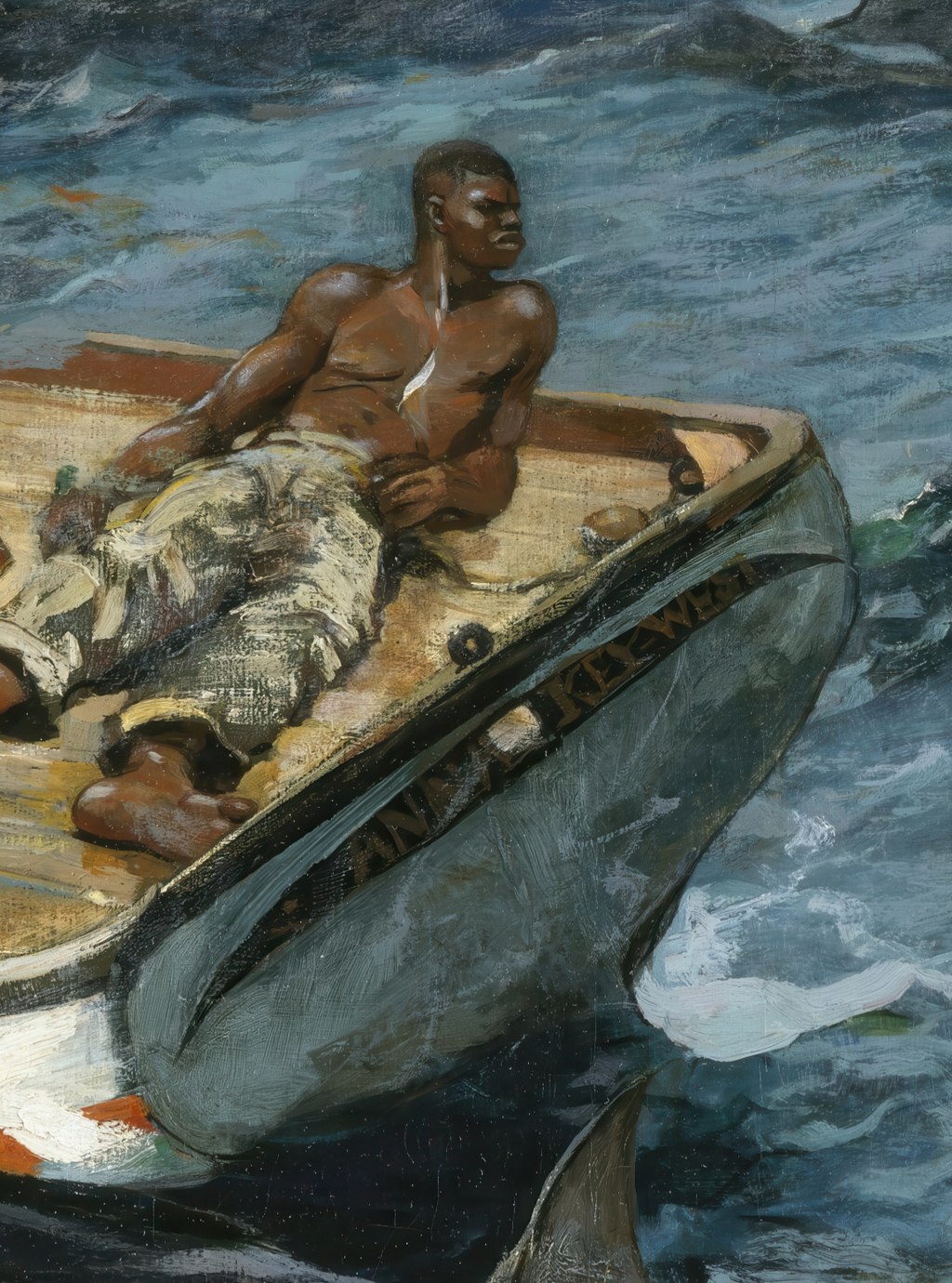
The central figure in The Gulf Stream is a Black man on a small, dismasted boat. His body is placed diagonally across the deck, with one arm near his head and one leg bent. Homer does not show him standing heroically at the center of the composition, nor does he present him as helpless decoration in a marine scene. He is the painting's human center, and the surrounding world is organized around the fact of his danger. [6]
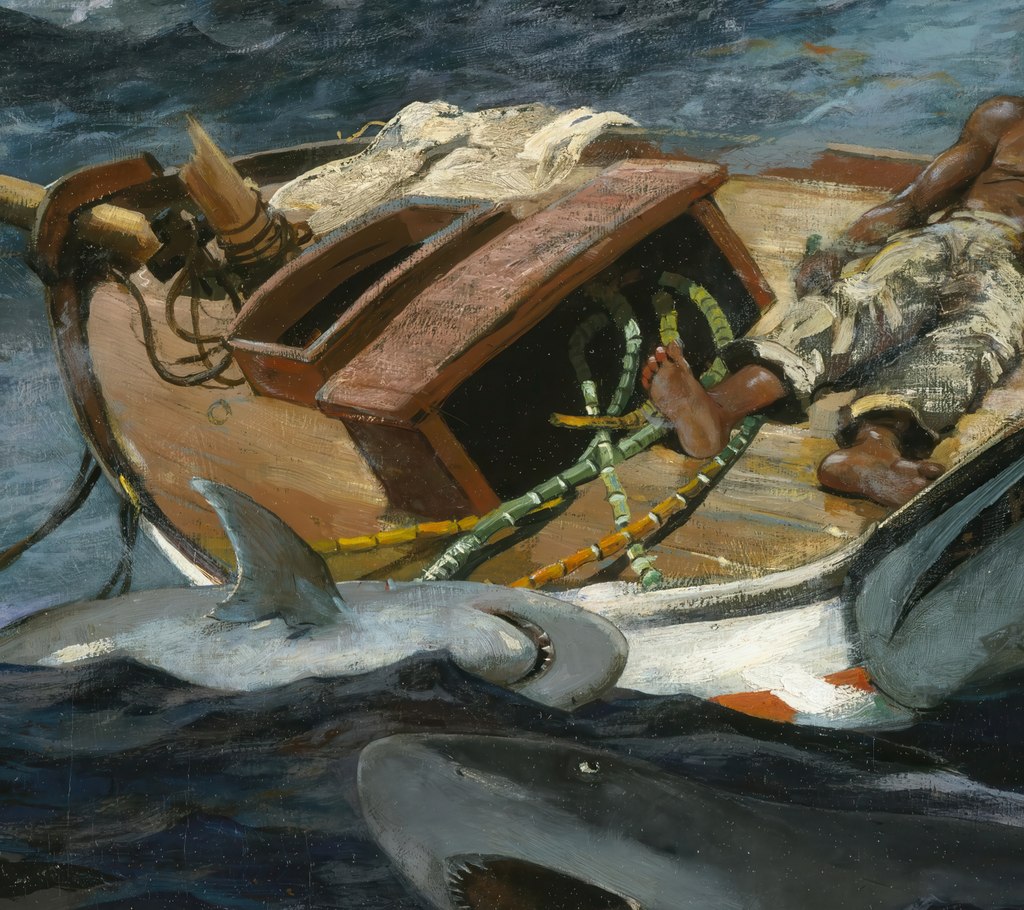
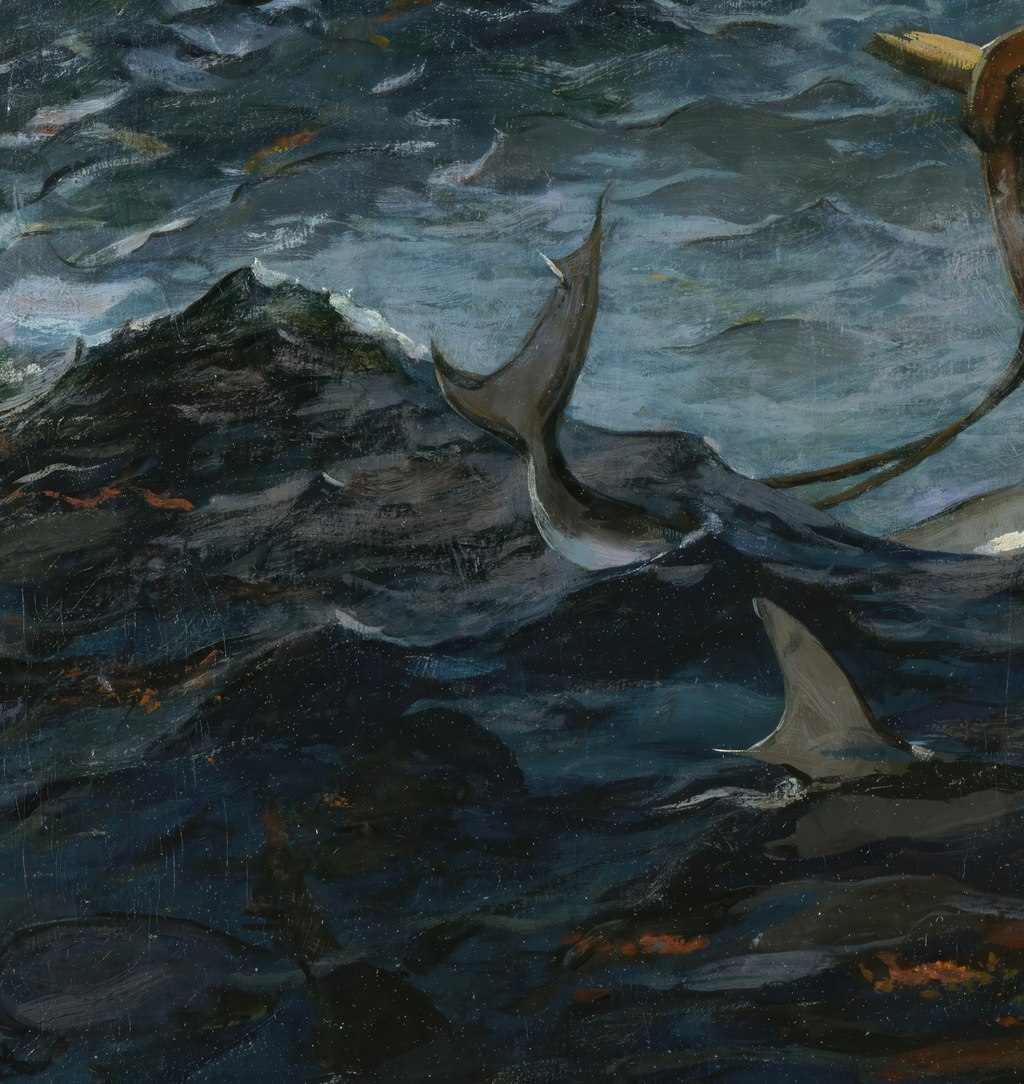
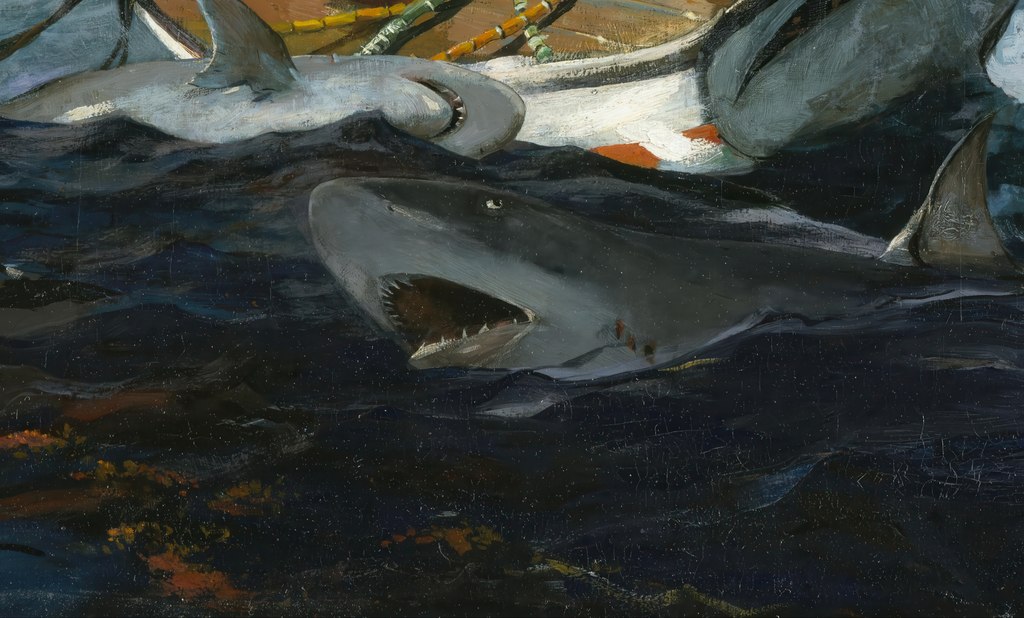
The boat has been badly damaged. Its mast is broken and lies across the deck. The rigging is tangled. The vessel has lost the means by which it would normally be controlled. The sea is not a clean blue expanse, but a force made of deep green, gray and blue passages, stirred by wind and current. Around the boat, sharks cut through the water. Some are close enough to make the danger immediate, while others extend the threat outward into the surrounding sea. [1]
In the distance, a waterspout rises from the horizon. It is not the painting's largest shape, but it changes the whole atmosphere. Without it, the sharks and broken boat might be read as enough. With it, Homer adds another scale of peril. The man is threatened not only by animals or shipwreck, but by weather and forces too large to negotiate. [2]
There is also a ship on the horizon. It is small, distant and ambiguous. It may suggest rescue, but Homer gives the viewer no certainty that it has seen the boat or will reach the man in time. This is one of the painting's central decisions. A more conventional disaster picture might have made salvation or death unmistakable. Homer leaves the future unresolved. The viewer remains with the present: a man, a broken boat, the Gulf Stream, the sharks, the weather and the historical weight of the region. [3]
The boat also carries stalks of sugarcane. This detail matters. It anchors the painting in the Caribbean economy and in the history of plantation labor, empire and slavery. Homer is not painting an abstract marooned sailor in an unspecified ocean. The work points toward a place and a history. Its force depends partly on the way the visible facts of sea disaster and the less visible histories of the Caribbean meet inside a single composition. [4]
Annotated Details from The Gulf Stream
The numbered details move from the sailor and damaged boat through the circling sharks to the distant ship and waterspout on the horizon.
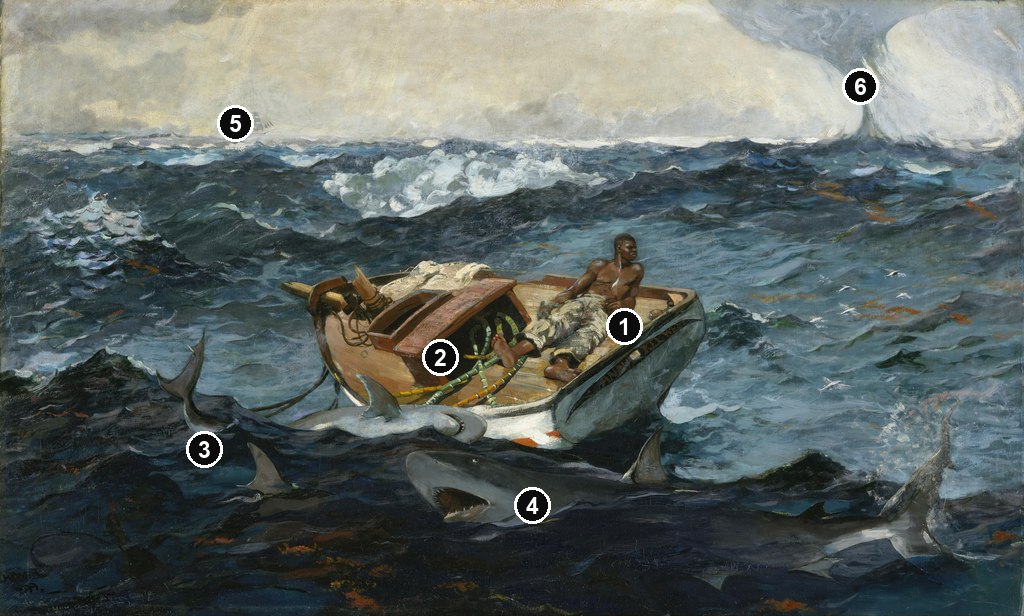
Details from THE GULF STREAM
Close looking reveals how the isolated sailor and damaged boat are enclosed by circling sharks, rough water and distant signs of danger or possible rescue.
Stranded sailor
The sailor reclines against the stern with his head raised above the gunwale. His bare torso and pale trousers stand out against the dark water and ochre interior of the boat.
Broken boat and scattered cargo
The damaged deck, snapped rigging and loose stalks form a dense cluster of diagonals. Red-brown planks and yellow-green cargo punctuate the boat's otherwise weathered surfaces.
Sharks beside the hull
Two dark fins and a curving tail break the water beside the port side of the boat. Their silhouettes echo the surrounding wave crests while remaining sharply legible.
Open-mouthed foreground shark
The nearest shark rises across the foreground with its mouth open. Its pale underside, dark back and triangular fins are framed by the trough of the wave.
Distant sailing ship
A small multi-masted ship appears on the far horizon beneath the grey-yellow sky. Its scale and subdued tones make it seem remote from the central emergency.
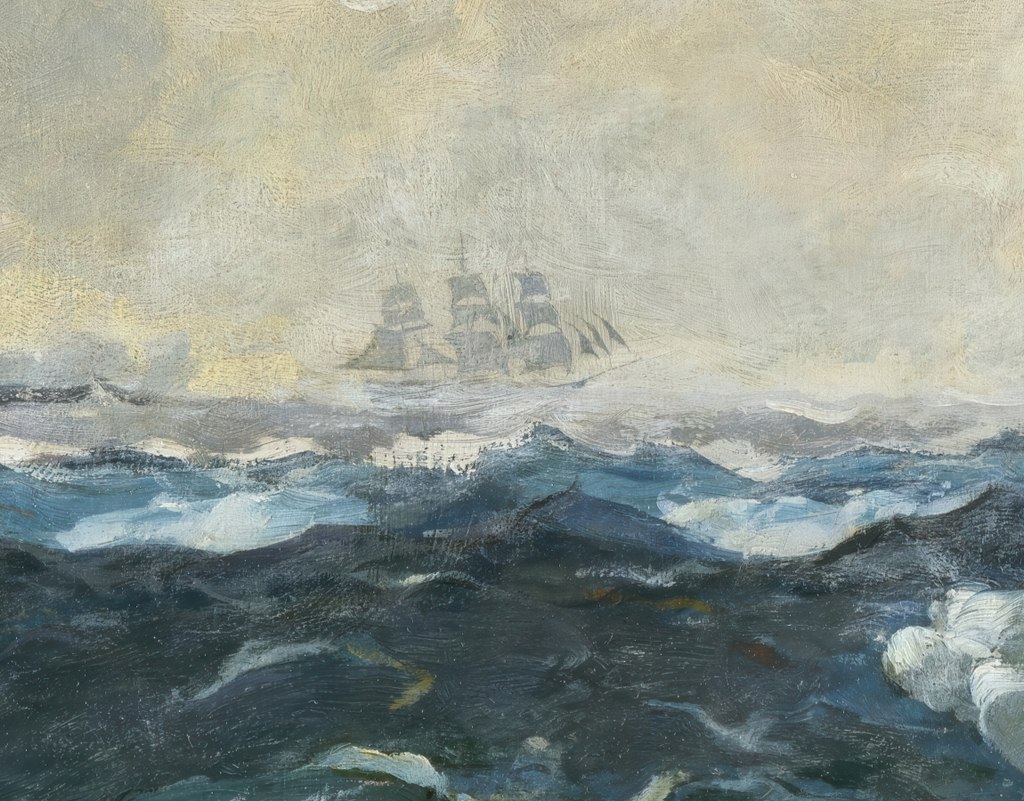
Waterspout on the horizon
At the upper right, a pale twisting waterspout descends from the dark cloud bank to the horizon. Its sweeping curve repeats the rotational movement of the sea below.
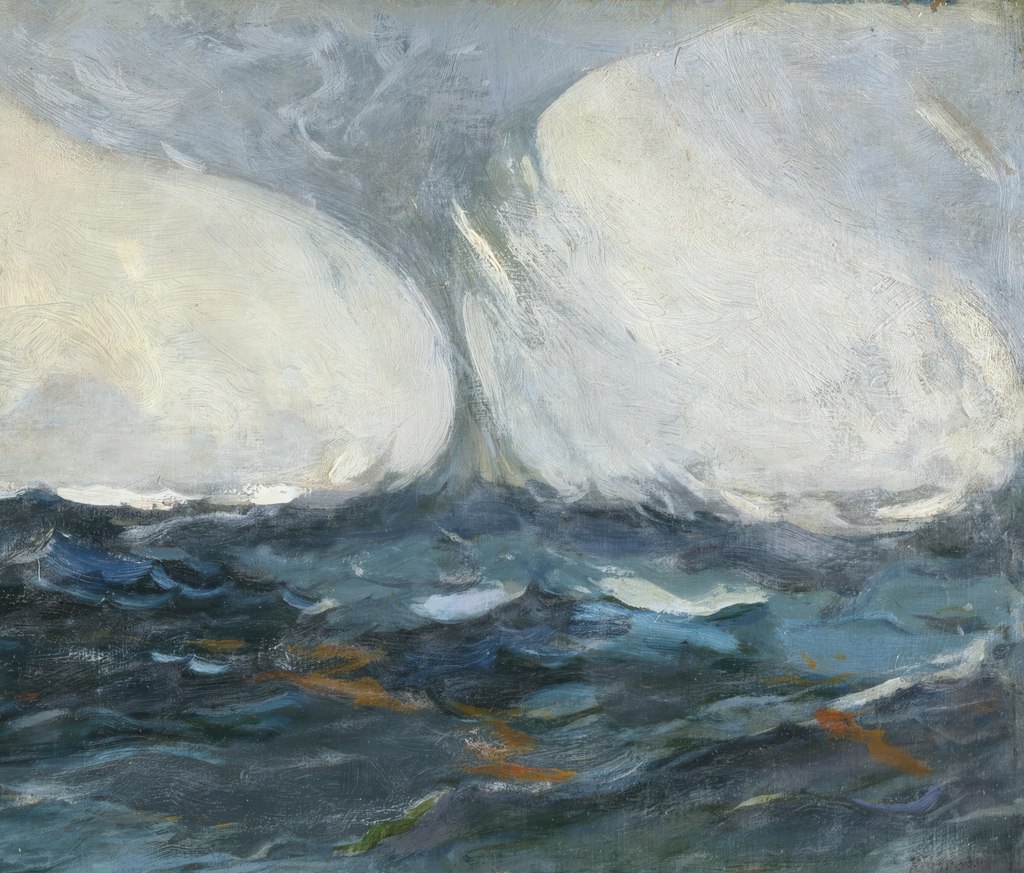
The Gulf Stream And The Caribbean
The title The Gulf Stream names one of the world's great ocean currents. It also tells the viewer not to read the painting as any sea anywhere. Homer had traveled in the Bahamas and other warm-weather places, and his late work repeatedly returned to southern waters, tropical light, storm, surf and the difficulty of survival in exposed marine environments. The Gulf Stream itself is not a passive backdrop. It is a moving force, a current that links the Caribbean, the Atlantic and the eastern coast of North America. [5]
This matters because the painting's geography is also historical. The Caribbean was shaped by colonial expansion, plantation economies and the forced labor of enslaved people. The sugarcane in the boat is therefore not just a still-life detail. It asks the viewer to consider the painting's Black protagonist within a region marked by transatlantic slavery and its aftermath. Homer does not turn that history into an illustrated lesson, but he places enough evidence in the painting to keep the sea from becoming neutral. [6]
That is part of what makes the work so unsettling. The water is beautiful in places. The color can be luminous. The open sea gives the painting a breadth that might, in another context, feel liberating. But here the current, the sharks, the broken boat and the distant ship produce a geography of danger. Homer makes the Caribbean visible as environment, economy and history. [1]
The painting also belongs to the final decades of Homer's career, when the sea became one of his great subjects. Earlier American marine paintings could celebrate trade, naval power, coastal life or picturesque weather. Homer was certainly capable of drama and spectacle, but his late marine works often resist easy narrative satisfaction. In The Gulf Stream, the sea is not merely a stage for human courage. It is a living system of forces in which the human figure is present but not in control. [2]
Homer's repeated travel also complicates the word "late" in this context. The late marine works are often associated with Prout's Neck and the Maine coast, but The Gulf Stream reminds us that his final decades were not confined to northern rock and surf. The Caribbean and the Bahamas offered different water, different light and different histories. Homer could carry the discipline of his Maine seascapes into a warmer, wider and more historically charged maritime world. [3]
That wider world changes the painting's tone. A Maine surf picture might make the viewer think first about weather, rock, wave and endurance. The Gulf Stream includes weather and endurance, but the sugarcane and the Black protagonist make it impossible to treat the sea as nature alone. The water is a physical environment, but it is also a route: of trade, empire, forced movement, labor and modern passage. The distant ship is part of that system. It crosses the same horizon that may or may not bring help. [4]
The Black Protagonist
The most important decision in The Gulf Stream is Homer's placement of the Black protagonist. The man is not a minor figure in a landscape. He is the person around whom the whole painting turns. The viewer's eye returns to him again and again, even while the sharks, waves, waterspout and distant ship compete for attention. [5]
Homer gives him neither theatrical panic nor sentimental rescue. His body is tense, but not exaggerated. He appears aware of danger, yet the painting does not reduce him to fear. This restraint is crucial. The man is caught in an extreme situation, but Homer does not make his inner life fully available to the viewer. The painting's emotional pressure comes partly from that withholding. We see enough to know the stakes, but not enough to claim possession of the figure's thoughts. [6]
The figure's race matters because the painting's setting matters. A Black man on a disabled boat in the Caribbean, surrounded by sugarcane and threatened by the sea, cannot be separated from the histories of labor, colonial power and racial violence that shaped the region. At the same time, the man does not need to be treated as a symbol only. He is also a body in danger, an individual held in a particular moment. Strong interpretation of the painting has to keep both facts alive. [1]
This is where The Gulf Stream becomes more complex than a survival scene. If the viewer sees only a shipwreck, the painting loses much of its depth. If the viewer sees only an allegory of history, the man becomes too abstract. Homer does something harder. He gives the viewer a figure who is visually specific and historically charged, but not explained away. The painting's meaning gathers around him without closing him down. [2]
The distant ship sharpens that problem. If it is a sign of rescue, the painting withholds confirmation. If it is indifferent passage, it becomes part of the painting's cruelty. The ship is visible, but it is not yet answerable. It suggests a world beyond the damaged boat, but that world remains too far away to be trusted. The viewer is left to ask whether visibility is the same as aid, and whether the modern systems that cross the sea are capable of seeing the person at the center of the painting. [3]
Homer's restraint is especially important here. He does not fill the canvas with explicit signs of the man's biography. He does not name him. He does not give the viewer a story of where he has come from or where he hoped to go. That absence can feel frustrating, but it is also part of the painting's seriousness. The man's anonymity does not make him less important. It makes the viewer confront how much can be asked of a body in a painting, and how much cannot be ethically claimed from it. [4]
This is one reason the work benefits from careful language. It is tempting to call the protagonist a victim of nature, but that is too narrow. It is also tempting to turn him into a pure emblem of Black Atlantic history, but that risks making the person disappear into interpretation. The painting is strongest when the viewer keeps returning to the figure himself: his position, his stillness, his nearness to danger and his distance from explanation. [5]
Danger Without Resolution
Many paintings of danger depend on the moment before or after a decisive action. A hero acts, a victim is saved, a ship goes down, a storm breaks, a rescue arrives. The Gulf Stream works differently. Homer constructs the painting around duration. The man is still there. The sharks are still there. The waterspout is still there. The ship is still far away. Nothing has resolved. [6]
This refusal gives the painting its modern feeling. Homer does not organize the image as a moral lesson with a clear conclusion. He gives the viewer a condition. The boat has already been damaged. The mast is already broken. The sea is already dangerous. The man is already exposed. The painting's drama is not the sudden event but the continuation of risk. [1]
The composition reinforces this. The boat tilts across the lower part of the canvas, holding the human figure close to the viewer while also trapping him within the broken geometry of mast, deck and sea. The sharks move in arcs around the boat. The waterspout rises vertically at a distance. The far ship is so small that it almost disappears. Each element has a different scale and tempo: the immediate body, the circling predators, the weather system, the remote vessel. Homer makes the viewer hold all of them together. [2]
The result is a painting that does not let the eye rest easily. If the viewer looks at the man, the sharks press in. If the viewer looks at the sharks, the waterspout grows in importance. If the viewer looks for rescue, the ship remains too distant. The composition keeps redistributing attention across danger, hope and history. [3]
Homer also controls the viewer's distance. The boat is close enough for the man's body and the broken mast to be read clearly, but not so close that the viewer feels able to intervene. The scene is intimate and remote at the same time. That is a crucial part of its discomfort. We are near enough to witness, but not near enough to help. [4]
This distance separates The Gulf Stream from sentimental rescue imagery. In a rescue scene, the viewer is often invited to identify with action: the line thrown, the body lifted, the shore reached. Homer denies that structure. He does not give the viewer a rescuer to admire or a rescue technology to trust. He gives the viewer a sightline. [5] The question becomes not "Who saves him?" but "What kind of looking is this?"
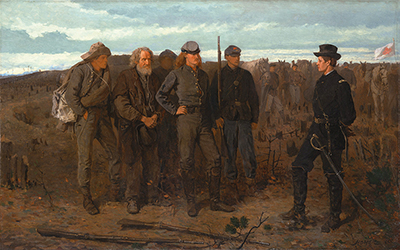
That question runs through much of Homer's strongest work. In Prisoners from the Front, the viewer studies a confrontation between captor and captured without being given a simple moral tableau. In A Visit from the Old Mistress, the viewer looks at a postwar encounter whose silence is more important than any obvious action. In The Gulf Stream, looking itself becomes a test. The painting asks whether the viewer can remain attentive when the scene refuses an easy conclusion. [6]
Reworked By 1906
The Met dates The Gulf Stream to 1899 and notes that Homer reworked it by 1906. That later reworking is important because it reminds us that the painting was not simply a single burst of dramatic invention. Homer returned to it. He reconsidered it. The final painting belongs to a process of adjustment. [1]
Reworking matters in Homer's late art because his marine paintings often seem direct, even inevitable. Their force can make them look as though they arrived fully formed. But The Gulf Stream was worked and reworked into its final state. That process fits the painting's density. The image is not just a theatrical arrangement of dangers; it is a carefully built scene in which every element carries pressure. [2]
The 1906 date also places the work near the end of Homer's life. He died in 1910 at Prout's Neck, Maine, where he had lived for many years apart from travel. By this late period, he had moved far from the early world of Harper's Weekly illustration, yet some habits of clarity remained. The painting is legible at once: man, boat, sharks, sea, storm. But that clarity opens into uncertainty rather than closing it down. Homer's long training in making readable images becomes, in The Gulf Stream, a way to make a deeply unreadable fate visible. [3]
The reworking also helps explain the painting's balance between drama and control. A lesser version of this subject could easily become sensational. Sharks, storm, broken boat and isolated figure are the ingredients of spectacle. Homer uses them, but he does not let spectacle take over. The painting has drama, but it also has discipline. The figure is not swallowed by incident. The sea is active, but the composition remains measured. The distant ship and waterspout are carefully placed so that they extend the danger rather than merely decorate it. [4]
That discipline is one mark of Homer's late art. His best late paintings often seem stark because they have been stripped of unnecessary explanation. In The Gulf Stream, the stripping down does not make the scene simple. It makes every remaining detail heavier. The broken mast, the sugarcane, the sharks, the waterspout and the ship all have work to do. [5]
A Late Homer Marine Painting
The Gulf Stream is best read alongside Homer's other late marine works, but it does not need to be collapsed into them. In The Fog Warning, a fisherman in a dory turns toward a distant schooner as fog gathers. In The Herring Net, men work on the water under pressure of weather and labor. In The Life Line, rescue technology carries bodies through surf. In Northeaster, the sea and rocks become the main subject, with human presence largely removed. [6]
Those works show the range of Homer's late marine imagination. Sometimes he focuses on labor. Sometimes on rescue. Sometimes on weather. Sometimes on the sea itself as a nearly independent force. The Gulf Stream gathers several of those concerns but adds the charged Caribbean setting and the Black protagonist. Its human figure is more isolated than the fishermen in the working scenes and less directly connected to rescue than the figures in The Life Line. [1]
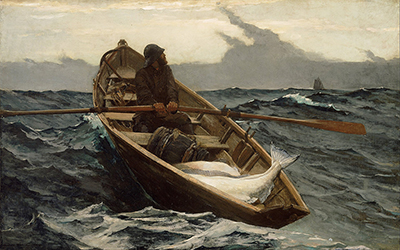
The comparison with The Fog Warning is especially useful. In both paintings, a small craft occupies an unstable sea, and a distant vessel complicates the idea of safety. But The Fog Warning still belongs to a world of work. The fisherman has caught halibut. He is trying to judge his return. The danger is grave, but the viewer understands the labor system around him. The Gulf Stream is more radically exposed. The central figure is no longer shown working, steering or deciding. He is caught after the boat has already lost its ordinary function. [2]
The Life Line offers another contrast. That painting centers on rescue technology: a breeches buoy carrying bodies through surf. It is dramatic, but the technology creates a structure of possible salvation. The Gulf Stream removes that structure. The distant ship may be rescue, but it is too uncertain to anchor the image. There is no line, no shore, no visible rescuer. The painting withholds the very apparatus that would make danger narratively manageable. [3]
Northeaster, by contrast, nearly removes the human figure altogether. The sea pounds against rocks, and nature dominates. The Gulf Stream keeps the human body central while still giving the sea enormous force. That balance is part of the painting's difficulty. It is not pure landscape, not pure figure painting, not pure history painting and not pure marine drama. It is all of these at once. [4]
The painting also speaks to Homer's broader career. His Civil War subjects, such as Prisoners from the Front, had already shown his interest in individuals caught inside national and historical conflict. His Reconstruction-era works, including A Visit from the Old Mistress and The Cotton Pickers, had addressed post-emancipation life with a restraint that leaves social tension unresolved. The Gulf Stream is not a Reconstruction painting in the same direct sense, but it carries forward Homer's ability to place a figure within historical pressure without turning the image into a sermon. [5]
This is why the work sits so naturally at the center of a Winslow Homer cluster. It links the biography, the paintings, the marine works, the Bahamas subjects and the articles dealing with race and postwar America. It also shows why Homer cannot be described only as a painter of seascapes. He painted the sea, but he used it to think about labor, danger, history, place and human uncertainty. [6]
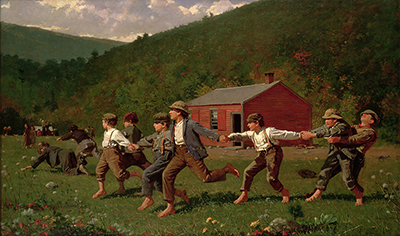
That cluster role matters for readers. A person who comes to Homer through Breezing Up may know him first as a painter of fresh air, childhood and confident movement. A person who comes through Snap the Whip may see rural play and postwar nostalgia. A person who comes through Prisoners from the Front may see Civil War memory. The Gulf Stream changes the frame. It shows how late Homer could retain the clarity of popular imagery while making a painting that is severe, unresolved and historically dense. [1]
Why The Painting Still Feels Modern
The Gulf Stream still feels modern because it does not tell the viewer what to feel. It creates a situation and holds it open. The man may survive, or he may not. The distant ship may matter, or it may not. The sharks are real dangers, but they are not the only dangers. The waterspout may never reach the boat, yet it changes the whole field of possibility. The sugarcane is just cargo, but it also carries history. [2]
Modern viewers are often drawn to this openness. The painting does not require a single interpretation. It can be read as a marine disaster, a Caribbean scene, an image of Black survival, a meditation on empire, a late Homer seascape, or a study in human isolation. The strongest readings are those that do not force these meanings to compete. Homer has made a painting that can hold them together. [3]
The painting also feels modern because it distrusts easy spectatorship. It does not flatter the viewer with a position of mastery. We cannot solve the scene by naming every object, and we cannot solve it by choosing one theme. The work remains bigger than any one label because each label leaves something behind. "Shipwreck" leaves out the sugarcane and history. "Allegory" risks leaving out the body. "Seascape" leaves out the protagonist. "Survival" leaves out the systems that shape the scene. Homer makes the viewer move among these possibilities without allowing one to cancel the others. [4]
The work also resists easy heroism. The man is not shown conquering the sea. He is not shown being rescued by modern technology. He is not shown vanishing beneath the waves. He remains present. That presence is the painting's ethical center. The viewer must stay with him inside a scene where the ordinary comforts of narrative have been stripped away. [5]
In this sense, The Gulf Stream is one of Homer's most demanding paintings. It is visually direct but interpretively difficult. It is dramatic but not theatrical in a simple way. It is historical without becoming an illustration of a single event. It is about nature, but not only nature. It is about survival, but not only survival. It is about one man in a broken boat, and it is also about the world that made such an image possible. [6]
Related Works And Where To Go Next
Readers who begin with The Gulf Stream should next look at Homer's late marine and rescue paintings. The Fog Warning shows a fisherman caught between labor, weather and the uncertain distance of safety. The Life Line turns to modern rescue technology and the drama of bodies carried through surf. The Herring Net focuses on fishing labor at sea. Northeaster pushes even further toward the force of water and rock. [1]
The painting also belongs beside Homer's Bahamas and Caribbean subjects, including After the Hurricane, Bahamas. Those works help explain that The Gulf Stream did not emerge from an abstract idea of tropical danger. Homer repeatedly studied southern light, sea, weather and travel. The Caribbean was a real visual and historical field for him. [2]
Finally, the painting is best connected to Homer's works about race, war and post-emancipation America. Prisoners from the Front examines the Civil War through a staged encounter between Union authority and Confederate defeat. A Visit from the Old Mistress examines the changed social relations of Reconstruction through posture and silence. The Cotton Pickers and related works carry the question of Black labor and historical uncertainty into the postwar South. The Gulf Stream is different in setting and subject, but it shares Homer's refusal to make history easy. [3]
That refusal is one reason the painting remains so strong. Homer gives the viewer a scene that can be understood quickly and thought about for a long time. A man is alone on a broken boat. Sharks circle. A storm rises. A ship passes in the distance. Sugarcane lies on deck. The sea moves beneath everything. Nothing is resolved, and that is exactly why the painting endures. [4]
Discussion
Winslow Homer rewards close looking because his strongest images rarely close down into one easy meaning. Use the prompts below to test how the work changes as you move between subject, place, medium and history.
Reader Insights
First Look
What detail in The Gulf Stream changes how the whole work feels?
Homer's Method
Where do you see Homer's balance between clear observation and unresolved meaning?
Cluster Context
Which related Homer work helps you read this page more carefully?
Join the Conversation
Share a thoughtful observation below, especially if a detail, source connection or related Homer page changed the way you read the work.
References
- The Metropolitan Museum of Art, object record
06.1234, The Gulf Stream, 1899, reworked by 1906. - The Metropolitan Museum of Art, Heilbrunn Timeline of Art History essay on Winslow Homer.
- National Gallery, London, Introduction to Winslow Homer, Winslow Homer: Force of Nature.
- Winslow Homer Phase 1A Green-Route Manuscript Briefs, 2026-07-20.
- Winslow Homer Phase 1A Green-Route Feature Support Pack, 2026-07-20.
- Winslow Homer internal-link and image ledgers, 2026-07-20.
 Winslow Homer.jpg)