

 by Tom Gurney
Tom Gurney BSc (Hons) is an art history expert with over 20 years experience
Published on June 19, 2020 / Updated on August 2, 2026
Email: tomgurney1@gmail.com / Phone: +44 7429 011000
Contents
- Introduction
- Homer, Harper's Weekly and the War
- What the Painting Shows
- Barlow, Spotsylvania and the Problem of Evidence
- A Modern American History Painting
- Class, Region and Defeat
- Reception and Early Meaning
- Why the Painting Matters in Homer's Career
- How to Look at Prisoners from the Front
- Related Works and Cluster Context
Introduction
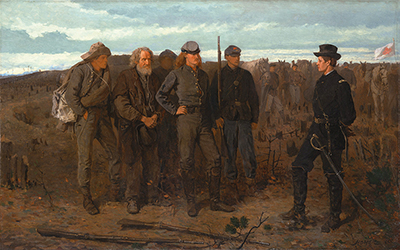
Prisoners from the Front is one of Winslow Homer's defining Civil War paintings and one of the clearest early statements of his ambition as a painter. Completed in 1866, the work looks back to the war that had just ended, but it does not behave like a conventional battle picture. There is no charging army, no explosion, no heroic death and no panoramic sweep of victory. Homer instead builds the painting around a charged meeting between a Union officer and three captured Confederate soldiers, using posture, clothing, landscape and silence to turn a military incident into a psychological and social confrontation. [1]
The painting is now in the collection of The Metropolitan Museum of Art, where it is catalogued as an oil on canvas from 1866. The Met records its dimensions as 24 x 38 inches, with the object number 22.207, and its credit line as the Gift of Mrs. Frank B. Porter, 1922. Those basic facts matter because the scale is modest for a history painting, yet the subject is national in reach. Homer compresses the meaning of the Civil War into a group of figures standing on damaged ground. [2]
The scene is commonly connected with Brigadier General Francis Channing Barlow and the capture of Confederate soldiers at Spotsylvania in 1864. Nicolai Cikovsky Jr.'s 1977 study for The Metropolitan Museum Journal gave that connection sustained scholarly attention, while also warning against treating the canvas as a simple documentary transcript of a single event. That balance is essential. Homer drew on his experience of the war and on recognisable military circumstances, but the finished painting is a studio work of selection, compression and judgment. It asks viewers to look at evidence, but it also asks them to read the human arrangement that evidence has been made to serve. [3]
For TheHistoryOfArt.org's Homer cluster, Prisoners from the Front should sit beside the artist's biography, his print career and his later Reconstruction paintings. Homer became famous partly through his images of Civil War life for Harper's Weekly, and this painting marks the moment when that journalistic training was transformed into something more monumental. It belongs with Prints because it grows out of Homer's work as an illustrator. It belongs with The Veteran in a New Field and The Bright Side because it considers the war and its aftermath without bombast. It also belongs near A Visit from the Old Mistress, Dressing for the Carnival and The Cotton Pickers, because Homer's strongest postwar subjects repeatedly return to the question of how history remains visible after the formal event has passed. [4]
Homer, Harper's Weekly and the War
Before Prisoners from the Front, Homer was already deeply associated with the Civil War in the public imagination. He had worked as an artist-correspondent and illustrator, supplying images to Harper's Weekly, one of the major illustrated newspapers of the period. That background trained him to observe camp life, uniforms, gesture, fatigue, waiting and small encounters that do not always fit grand narratives. It also trained him to think clearly about legibility. A newspaper image had to communicate quickly, but the best of Homer's Civil War work also carried emotional reserve. [1]
This matters because Prisoners from the Front is not an abandonment of illustration so much as an enlargement of what illustration had taught him. The painting keeps the readability of a scene observed at close range. The viewer can understand the basic situation almost immediately: prisoners have been brought forward; a Union officer stands before them; war has altered the landscape and the men in it. Yet the painting slows that understanding down. It invites the viewer to distinguish types of defeat, types of authority and types of endurance. [2]
The end of the Civil War created a difficult visual problem for American artists. The conflict had produced immense violence and political transformation, but much of that history resisted easy pictorial summary. A large battle scene could show action, but it might leave untouched the social ruptures that the war exposed. A sentimental homecoming could show feeling, but it might avoid the unresolved aftermath. Homer found another route. He presented a meeting in which the war's military outcome, sectional division and social hierarchy appear through four principal figures. [3]
The painting was made in New York in 1866, close enough to the war for its subject to feel immediate. Homer was not looking back from a long historical distance. Viewers of the National Academy of Design exhibition that year were still living inside the war's aftermath. Many had followed newspaper accounts, read casualty lists, seen soldiers return or disappear, and watched the political battle over Reconstruction begin. In that setting, a painting of captured Confederate soldiers was not an antiquarian subject. It was a contemporary history painting. [4]
The phrase "history painting" needs some care here. In older European academic tradition, history painting often meant a scene from classical mythology, the Bible, ancient history or grand national legend. Homer offers something plainer and more modern. His subject is not remote. His figures are not idealized heroes. His battlefield is a broken landscape. His drama occurs through stance and relation rather than theatrical action. Cikovsky's account is useful because it helps describe the painting as a modern American answer to the history-painting problem. Homer makes the national event visible through the social pressure between living men. [1]
Annotated Details from Prisoners from the Front
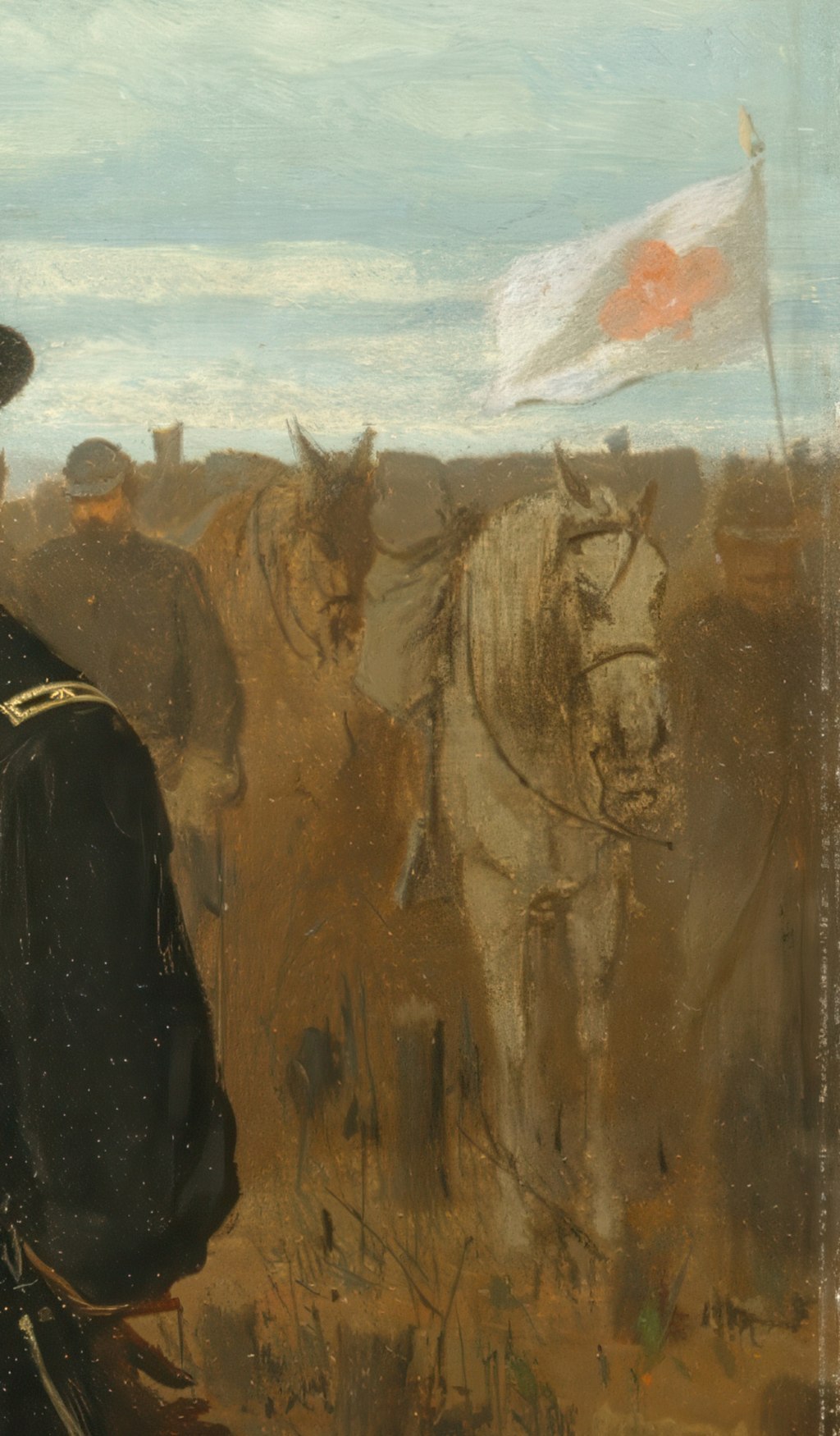
The numbered details follow the encounter from the three Confederate captives through the Union guard and officer to the mounted ranks behind them.
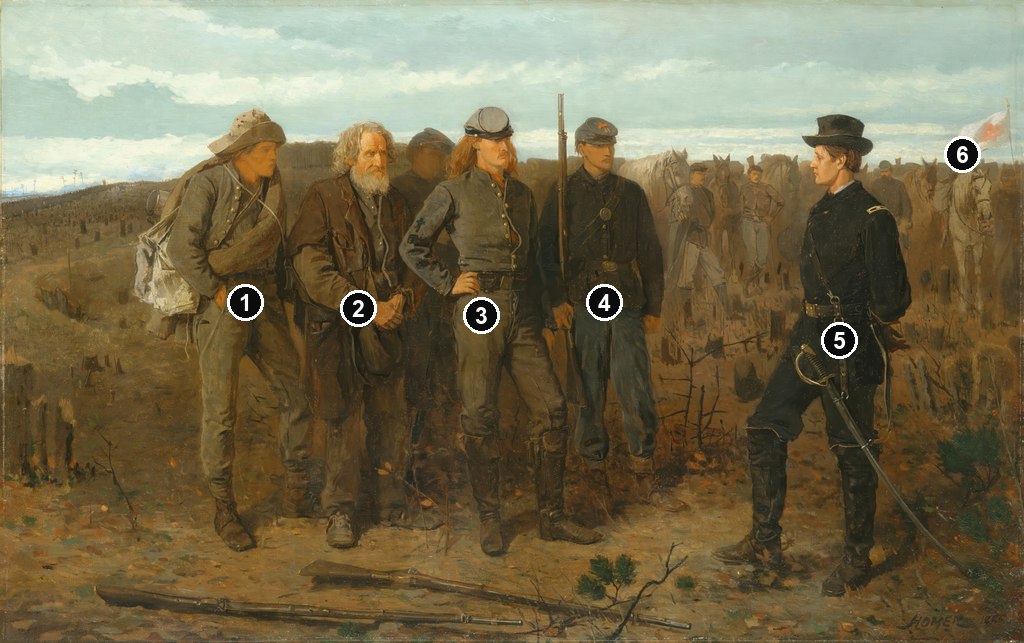
Details from PRISONERS FROM THE FRONT
Close looking reveals how posture, spacing, uniform, weapons and the compressed background ranks organise the tense exchange across the canvas.
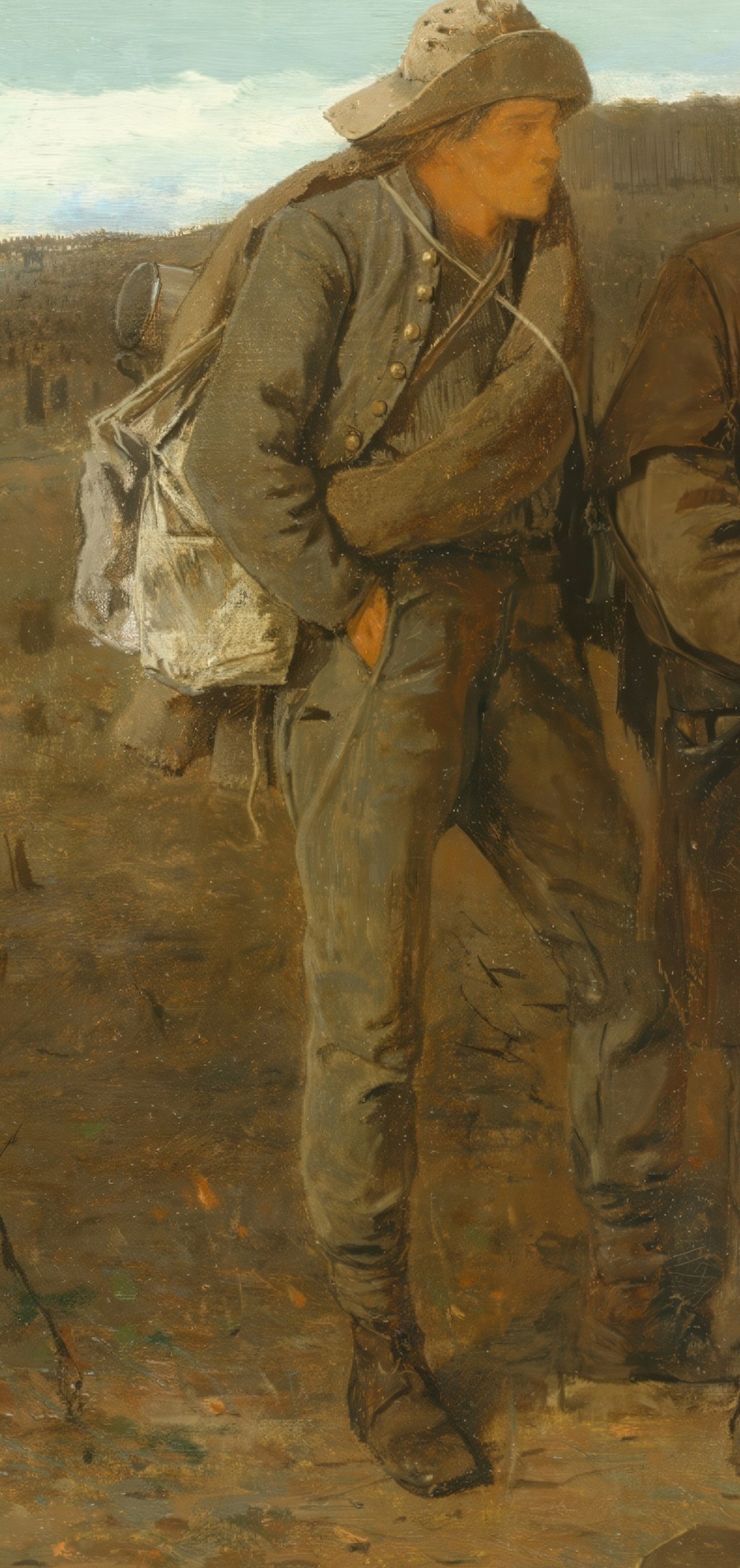
Young Confederate prisoner
The youngest prisoner leans forward beneath a broad, battered hat. His slung bag, loose clothing and bent posture form an irregular silhouette against the open battlefield.
Grey-haired captive
The older captive's pale hair and beard stand out from his dark brown coat. His lowered hands and forward step contrast with the sharper gestures beside him.
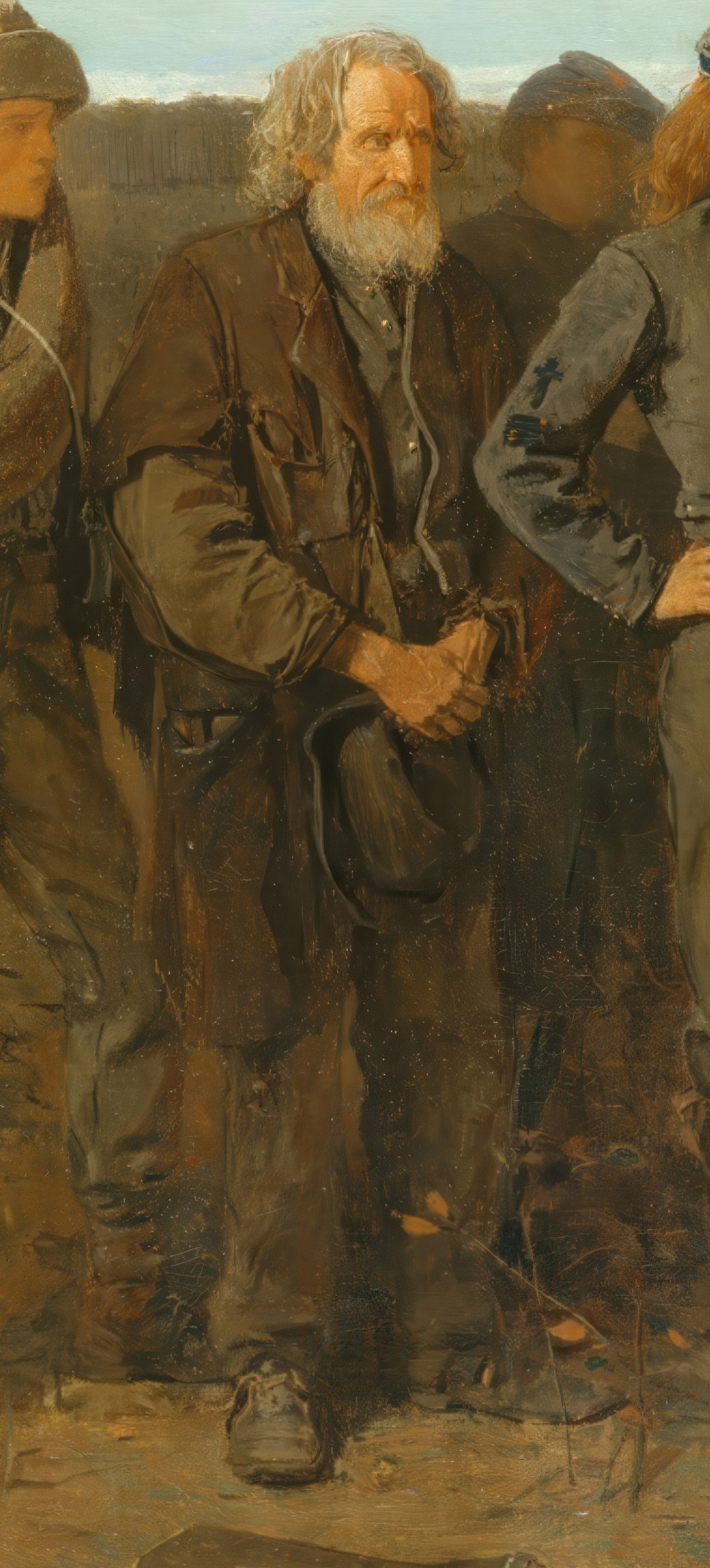
Defiant central prisoner
At the centre, the long-haired prisoner plants one hand at his hip and turns his face toward the Union officer. The angular elbow and upright stance give this exchange its visual tension.
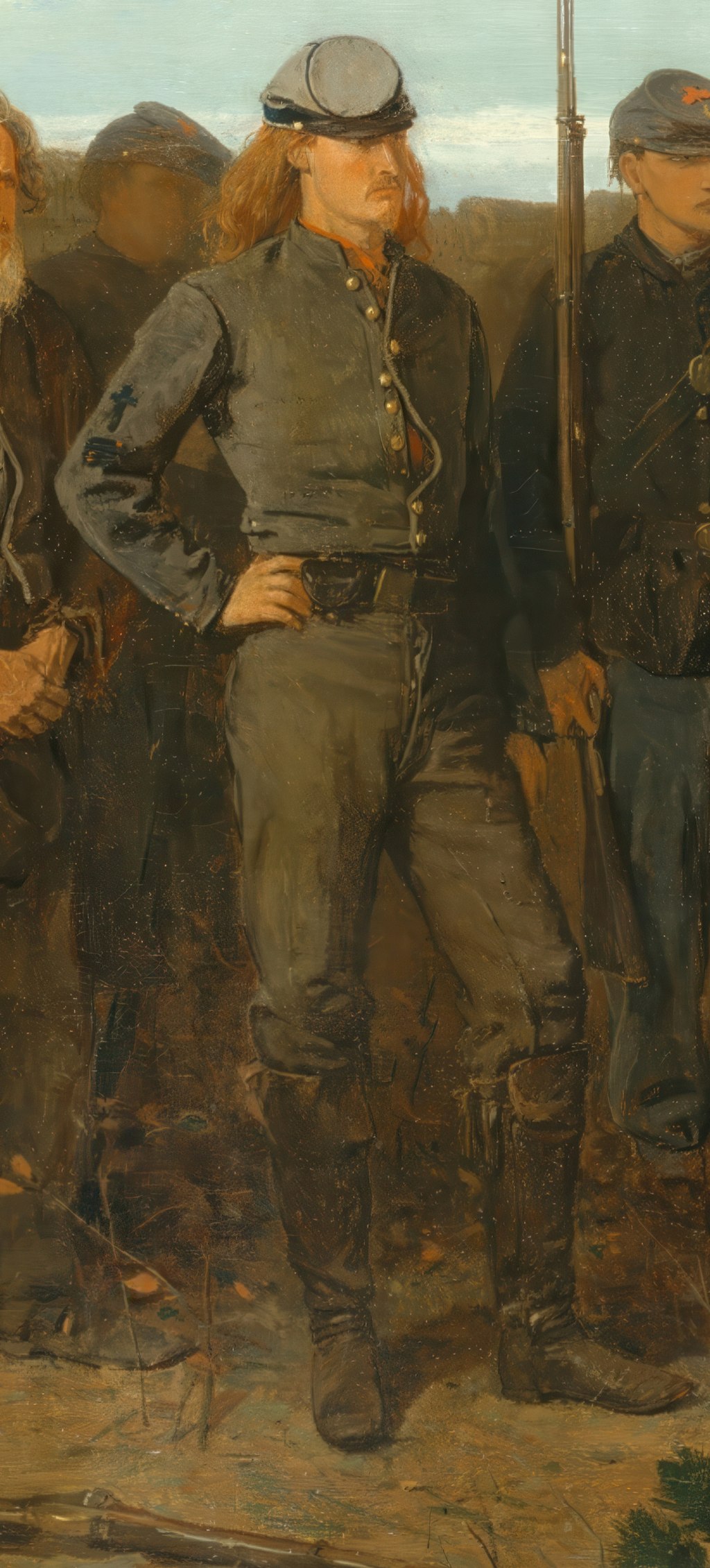
Union guard and upright rifle
The dark-uniformed guard and his vertical rifle divide the central group from the mounted ranks beyond. Small red and brass accents punctuate the subdued blue-black uniform.
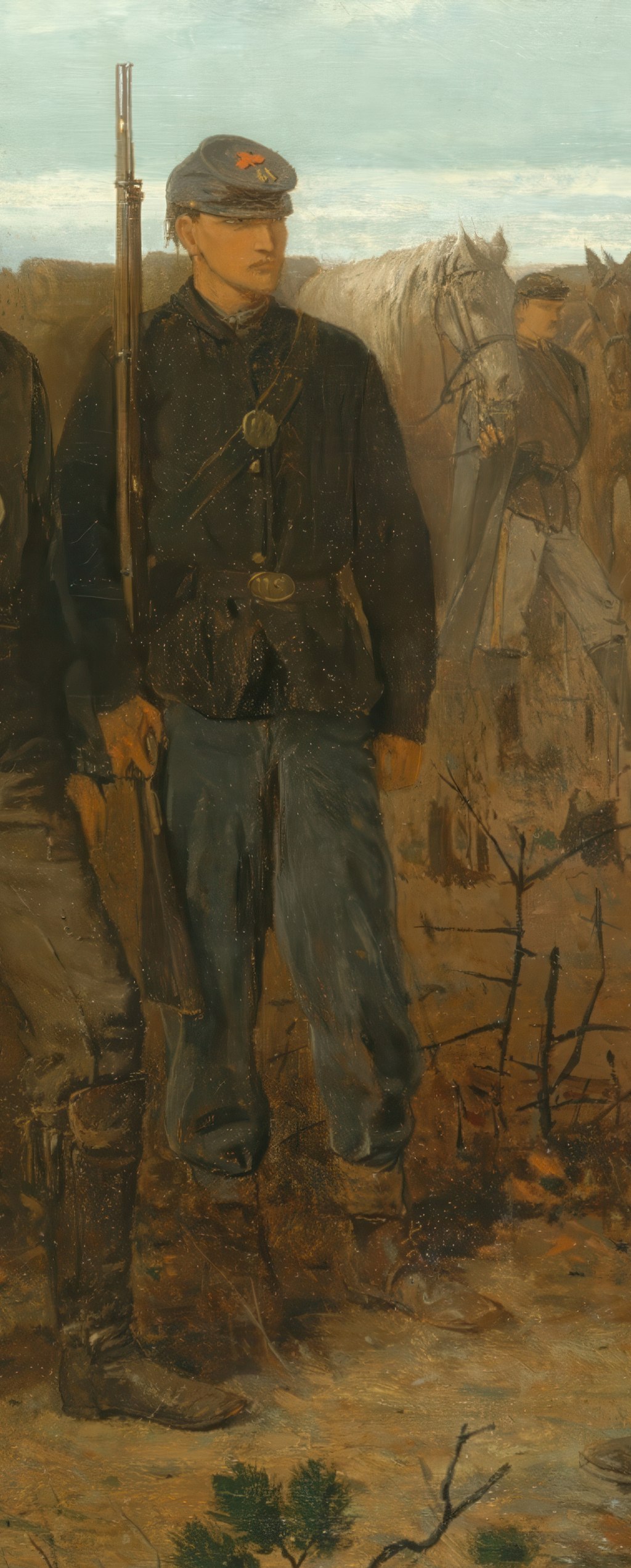
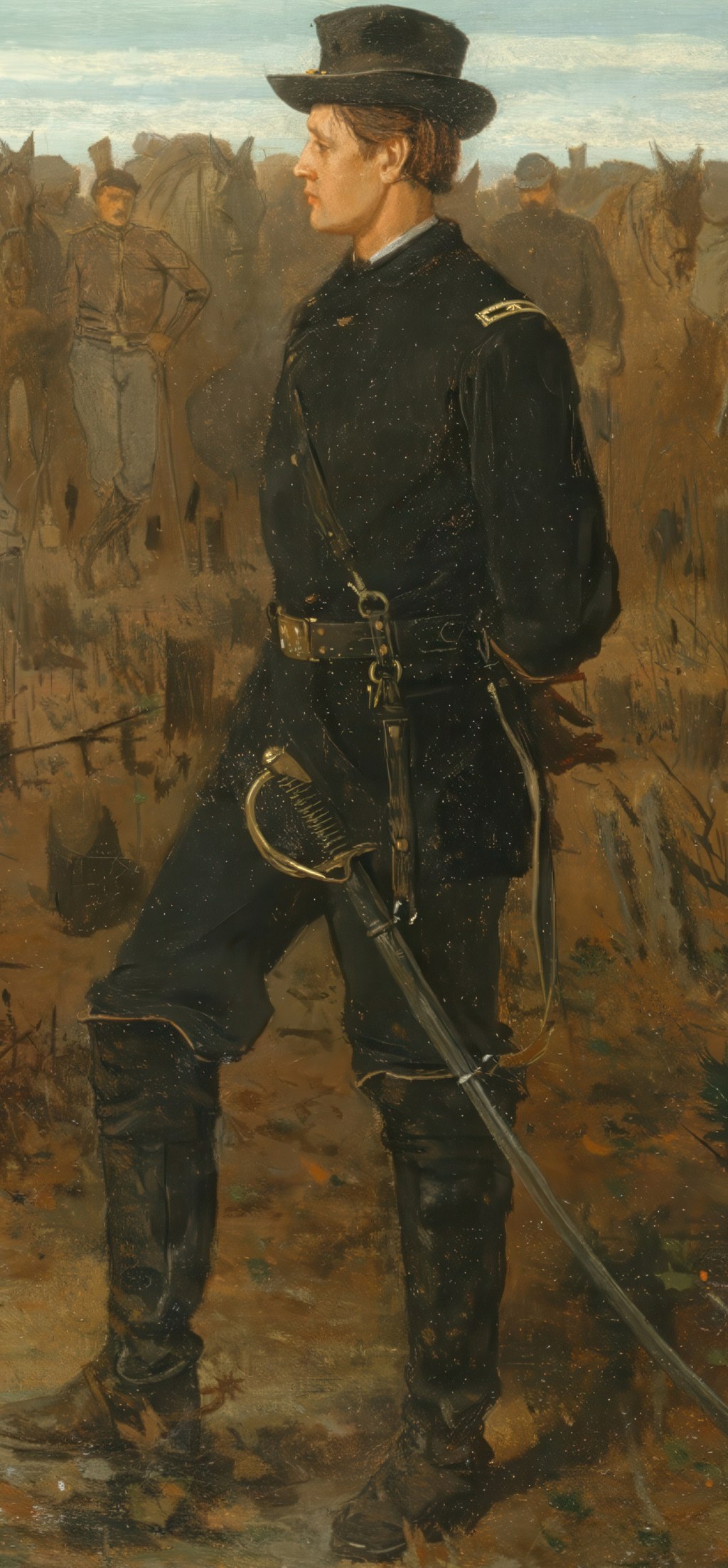
Union officer facing the prisoners
The Union officer stands apart in a crisp dark uniform, his hands held behind him and sword angled toward the foreground. The gap before him makes the confrontation legible.
Distant flag and mounted ranks
At the far right, a pale flag rises above overlapping horses and soldiers. Their muted forms dissolve into a compressed background band beneath the open sky.
What the Painting Shows
The composition is organized around a confrontation. At left stands the Union officer, usually identified as Francis Channing Barlow. He is upright, controlled and alert, his body turned toward the prisoners. Across from him stand three Confederate soldiers, each distinct in age, posture and social type. The encounter is not crowded. Homer gives the figures enough space for every tilt of the head and bend of the body to matter. [2]
The officer's authority is clear, but it is not flamboyant. He does not brandish a weapon or perform triumph. He stands as a military representative of Union power at the moment when Confederate resistance has been overcome. His posture is disciplined and contained. He is not relaxed, but neither is he theatrically aggressive. Homer makes him the fixed point in the picture, a figure of order against which the varied bodies of the prisoners can be read. [3]
The Confederate prisoners are not treated as a single undifferentiated mass. One appears older and more worn, another ragged and defiant, another perhaps more genteel or socially marked. This differentiation is one of the painting's central achievements. The war is present not just as a contest between armies but as a rupture that has brought different Southern types into the same condition of defeat. Clothing, bearing and facial expression matter because Homer uses them to suggest class, region and temperament. [4]
The prisoner group also complicates the viewer's response. The men are captured enemies, but they are not caricatures. Their clothing is worn and their position is diminished, yet Homer does not make them comic or monstrous. Nor does he sentimentalize them into noble victims. They stand inside defeat, and that is enough. Their presence gives the painting its gravity because the Union victory is made visible through the human cost and social exposure of the defeated side. [1]
The setting reinforces that reading. The landscape is not simply background scenery. It is damaged ground, a Southern terrain marked by war. The ruined or stripped quality of the environment suggests the physical devastation of the conflict. It also keeps the scene from becoming purely personal. The men stand in a landscape that has itself been changed by military action. Their confrontation belongs to a broader world of destruction, occupation and uncertainty. [2]
Homer's economy is striking. He does not need many figures, and he does not need an elaborate narrative sequence. The painting presents the moment after action. The capture has already occurred. The men have been brought forward. The officer judges, receives or confronts them. The viewer enters at a pause, which is why the picture feels so psychologically dense. We are not watching a battle; we are watching the social aftershock of battle. [3]
That pause lets the figures become legible in relation to one another. The Union officer's clean vertical stance contrasts with the uneven grouping of the Confederates. The officer seems to belong to a functioning military order. The prisoners appear as fragments of a collapsing order. The difference is visible in posture before it becomes verbal in interpretation. Homer makes social and political meaning out of bodily arrangement. [4]
This is why the painting cannot be reduced to a simple surrender scene. Its drama is not only that one side has captured the other. Its drama is that capture exposes a social world. The officer, the prisoners and the damaged ground together become a compact image of Civil War outcome. The Union has prevailed, but the painting does not ask the viewer to cheer. It asks the viewer to look at what victory has revealed. [1]
Barlow, Spotsylvania and the Problem of Evidence
The officer's identification with Francis Channing Barlow gives the painting an important historical anchor. Barlow was a Union officer whose Civil War career included service in the Army of the Potomac. The painting has long been associated with an 1864 episode near Spotsylvania, when Confederate soldiers were captured and brought before him. The Met object record and the local source packet both preserve this connection as central to the work's interpretation. [2]
Cikovsky's 1977 Met Journal study strengthens the Barlow identification through several kinds of evidence. The article attends to photographic likeness, written accounts, military detail and the insignia visible in the painting. It notes Homer's care with aspects of uniform and unit identification, including details associated with the 1st Division of the 2nd Corps and the 61st New York. These details matter because they show that Homer was not using generic military costume. He was building the scene from a specific war world. [3]
At the same time, the evidence does not need to be pushed too far. A strong identification does not make the painting a field report. Homer had been near relevant Virginia contexts, and his Civil War drawings and illustrated work gave him access to the look and texture of military life, but the 1866 canvas is a composed painting made after the fact. It is better to say that the work is inspired by Barlow, Spotsylvania and Homer's wartime observation than to say it simply records an exact instant. [4]
That distinction is important for readers. A documentary image claims its authority by proximity to an event. Prisoners from the Front claims a different kind of authority. It uses the event as a structure through which Homer can examine defeat, discipline, class and national trauma. The painting is historically grounded, but its force comes from transformation. Homer selects, arranges and clarifies. [1]
The Barlow connection also shapes the painting's moral temperature. Barlow was not an anonymous officer in Homer's design. By making the Union figure specific, or at least strongly identifiable, Homer gives the scene an anchor in Union command and contemporary military memory. Yet the officer is not glorified in a theatrical way. His importance comes through controlled presence. He stands as the point at which a larger political outcome becomes a face-to-face encounter. [2]
The captured soldiers are less individually named, but not less significant. Their anonymity works differently. They become social types without becoming empty symbols. Cikovsky's account emphasizes the interest that contemporary viewers and critics found in the psychological relation among the figures and in their differentiated social character. That is one reason the painting is more complex than a victory image. The Confederacy is not represented by a flag or emblem alone; it appears through men whose bodies and clothing disclose different histories inside the defeated cause. [3]
Spotsylvania was one of the brutal campaigns of 1864, and any link to that context brings the painting close to the late-war reality of exhaustion and attrition. Yet Homer does not show the battle itself. He shows the encounter that follows military action. This choice changes the meaning of the scene. The viewer is made to consider not only what happened on the battlefield, but what happens when enemies are made to stand before each other after violence has paused. [4]
The painting's precision and restraint are inseparable. Homer's details make the scene believable; his restraint keeps those details from becoming mere illustration. A reader can learn about Barlow, unit insignia and Spotsylvania, but the article does not need to bury the painting in military minutiae. [1] The details should return us to the central question: how does Homer turn a historically grounded incident into a larger image of national reckoning?
A Modern American History Painting
Prisoners from the Front is often most powerful when viewed as a painting about history without spectacle. Homer does not dramatize the Civil War through combat. He does not show a climactic charge or a battlefield death. Instead, he uses a small group of figures to show how the war rearranged power. The result is modern because it treats history as a social encounter rather than as a staged heroic episode. [2]
In this sense, the painting is a bridge between Homer's public illustration career and the major independent works that would define his mature reputation. The skills of the illustrator remain: clear grouping, readable gesture, strong silhouette, narrative compression. But the painting also exceeds journalistic immediacy. It is not designed merely to inform the viewer that prisoners were captured. It asks the viewer to study the meaning of that capture. [3]
The absence of melodrama is part of its intelligence. Many war images depend on movement, smoke, blood or dramatic pathos. Homer uses stillness. The men's positions are held in a tense equilibrium. The Union officer and the prisoners face each other, but the painting does not tell us exactly what words are spoken or what will happen next. That withholding gives the viewer responsibility. We must read the scene from posture, relation and context. [4]
The painting is also modern in its refusal to simplify moral feeling. A Union viewer in 1866 might see rightful victory, Confederate defeat and the authority of the restored nation. But Homer does not make the captured men into simple villains. He gives them a degree of human presence that complicates easy triumph. At the same time, he does not romanticize the Confederate cause. The men are defeated; the Southern landscape is ruined; the old order has been brought low. [1]
This balance can be difficult because later viewers come to the Civil War with different knowledge and different moral responsibilities. The Confederacy was built to defend slavery, and any image of Confederate soldiers must be read within that historical fact. Homer does not paint slavery directly here, but the war's cause and outcome stand behind the encounter. That is one reason this article connects to Homer's later Reconstruction and post-emancipation subjects. The question of what the war destroyed and what it failed to resolve continues into paintings such as A Visit from the Old Mistress, The Bright Side, Dressing for the Carnival and The Cotton Pickers. [2]
Homer's achievement is to create an image that can bear that continuing pressure. The painting does not close the war into a neat story. It shows a moment of Union control, but the terrain remains damaged and the social meaning remains unsettled. The prisoners are physically present but politically defeated. The officer stands for order, but the larger national future is not visible. The picture gives a result without pretending to give an ending. [3]
That quality helps explain why Prisoners from the Front became a major work so early in Homer's career. It showed that he could handle national subject matter without depending on borrowed academic formulas. He could bring the observational habits of American illustration into oil painting and make them serious. The painting's seriousness comes from attention, not from grandeur. [4]
The size of the canvas reinforces this point. At 24 x 38 inches, it is not a mural-like public epic. Its authority comes from compression. Homer places the viewer close enough to inspect the men, but far enough to register the landscape and the formal relation among the figures. The scale encourages reading rather than awe. It is history painting brought down to a human interval. [1]
Class, Region and Defeat
One of the painting's richest features is its attention to social difference. The prisoners are not interchangeable. Their clothes, bearing and degree of wear suggest that the defeated South contained different classes and types within a common military collapse. Homer allows viewers to sense that defeat does not erase difference; it exposes it. [2]
The Union officer's bearing is central to this structure. He appears disciplined, professional and secure in his role. The captured men are physically and socially less ordered. Their grouping is uneven. Their clothing carries the signs of strain. Their relationship to the officer is not only military but social. They stand before a representative of the power that has defeated them, but they also stand before a different model of order. [3]
Cikovsky's summary of contemporary reception is useful here because it indicates that early viewers recognized the painting's psychological and sociological force. Critics responded not just to the subject but to the arrangement of human types. That early reception suggests that the painting was understood as more than an anecdote from the front. It was read as a concentrated image of Civil War society. [4]
The old Confederate order is present through the prisoners, but Homer does not illustrate it with plantations, flags or enslaved people. Instead, he lets that order appear through the men's predicament. Their capture implies the failure of the world they fought to defend. Their bodies carry the consequence. The painting is therefore politically charged even in its restraint. [1]
The landscape deepens that charge. A devastated background prevents the encounter from feeling like a clean ceremonial surrender. The setting suggests that both men and place have been altered by war. There is no lush pastoral consolation, no tidy stage. The ground itself has become evidence. [2]
This is one reason the painting is best linked carefully to The Veteran in a New Field. That later work also considers the war through aftermath rather than combat, placing a single veteran within a field of labor and memory. Prisoners from the Front is more public and confrontational, but both works refuse to identify the Civil War only with battle action. They show what remains when battle stops. [3]
The connection to The Bright Side is also important. Homer's wartime and postwar images often examine people at the margins of official military drama: soldiers resting, waiting or surviving; Black teamsters and camp laborers; civilians and former slaves living through the aftermath. Prisoners from the Front is best read within that broader habit. Homer was repeatedly drawn to scenes where history presses on ordinary bodies. [4]
Reception and Early Meaning
When Prisoners from the Front appeared in 1866, it reached viewers who did not need the Civil War explained to them as distant history. The war had only recently ended. The assassination of Abraham Lincoln, the return of soldiers, the beginning of Reconstruction and the public debate over the defeated South were all current realities. A painting of captured Confederate soldiers therefore entered a charged national conversation. [1]
Cikovsky records that contemporary criticism at the National Academy of Design was broadly favorable and that commentators recognized the work's unusual breadth as a Civil War image. The painting offered a way to see the conflict without reducing it to battle spectacle. Viewers could admire Homer's craft while also reading the figures as embodiments of region, class and psychological state. [2]
The painting's later reputation has depended in part on this early achievement. It is not merely an important work because it was painted soon after the Civil War. It is important because Homer found a visual form equal to the moment's complexity. He made a picture that could be understood quickly but not exhausted quickly. [3]
The reception history is best handled without overclaiming. A page does not need long excerpts from period criticism to explain the painting's significance. Paraphrase is enough here. The key point is that contemporary viewers recognized the painting as an ambitious Civil War work and that later scholarship has continued to see it as a turning point in Homer's development. [4]
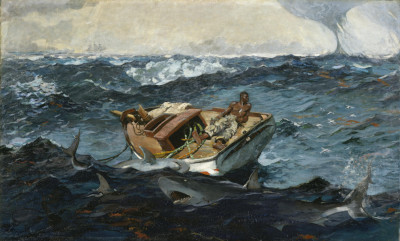
That tension makes the work valuable for teaching Homer's larger career. The same restraint that appears here will reappear in later paintings where the historical stakes are high but the visible action is quiet. In A Visit from the Old Mistress, the distance between figures carries the weight of emancipation and changed social obligation. In The Cotton Pickers, labor, race and postwar uncertainty sit inside a deceptively calm rural scene. In The Gulf Stream, a lone Black man in a broken boat becomes the center of a painting that joins survival, Caribbean history and imperial trade. Prisoners from the Front is an early proof that Homer knew how to let silence work. [1]
Why the Painting Matters in Homer's Career
Prisoners from the Front belongs near the beginning of Homer's major reputation as a painter. It arrives after his intense Civil War illustration work and before the coastal, rural, watercolor and late marine subjects that would expand his range. The painting shows him converting the observational discipline of graphic journalism into a major oil painting without losing the sharpness of observed fact. [2]
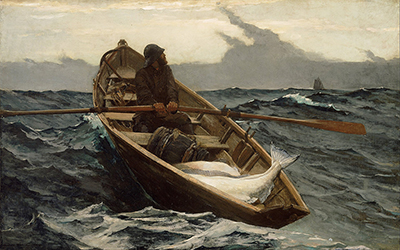
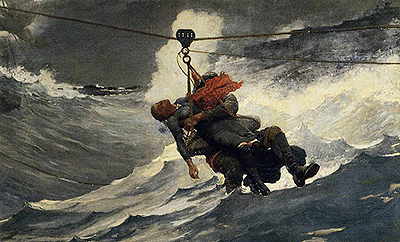
It also helps explain why Homer does not need to be reduced to a painter of the sea. The marine works are central, and later paintings such as The Fog Warning, The Life Line and The Gulf Stream are indispensable. But the Civil War and Reconstruction subjects show another Homer: an artist alert to national trauma, racial history, social hierarchy and the limits of resolution. The sea paintings become more powerful, not less, when placed beside this earlier historical intelligence. [3]
The painting is also a key route into Homer's biography. It connects the young Boston-born artist, the New York illustrator, the Civil War observer and the ambitious postwar painter. It shows why the Biography page does not need to treat the war merely as an early career episode. The war gave Homer subjects, habits of looking and public authority. Prisoners from the Front demonstrates how those materials could become art of lasting consequence. [4]
For the Paintings hub, the work is best treated as a flagship. It is not simply one military painting among many. It is a central example of how Homer could build a painting around a decisive relation between figures. The same compositional intelligence appears in different forms throughout his career: boys in a boat in Breezing Up, fisherfolk in marine works, a postwar interior in A Visit from the Old Mistress, or a lone figure in The Gulf Stream. [1]
The painting also helps organize the cluster's Civil War and aftermath links. A reader who begins here is best able to move naturally to Prints, where Homer's illustration career can be understood; to The Veteran in a New Field, where postwar labor and memory come forward; to The Bright Side, where wartime life and Black labor require careful reading; and to Reconstruction-related pages such as A Visit from the Old Mistress, Dressing for the Carnival and The Cotton Pickers. [2]
Those links does not need to make the article feel overstuffed. The core page still belongs to one painting. But Prisoners from the Front is strong enough to function as a hinge. It joins illustration, war memory, history painting and Homer's later concern with social pressure after conflict. [3]
How to Look at Prisoners from the Front
A useful way to begin is with the spacing between the figures. The painting is not only a row of people. It is an arrangement of power. The Union officer's position and bearing establish the governing order of the scene. The prisoners' grouping creates variation and imbalance. The space between them becomes the moral and historical center of the work. [4]
Next, look at the prisoners separately. Homer gives them different kinds of presence. Their clothing and posture suggest more than military capture. They indicate social distinction within defeat. One figure may seem more ragged, another more self-contained, another marked by class. The viewer should resist collapsing them into one type. Homer's point is partly that the defeated Confederacy contained different human faces and social ranks. [1]
Then look at the officer. His authority is not noisy. He stands with a composure that can feel almost severe. Because he is associated with Barlow, the figure carries specific Union military identity. But he is also a compositional force. He clarifies the scene by holding the left side of the confrontation with discipline and restraint. [2]
The landscape should come next. It is easy to focus only on the figures, but the damaged setting makes the scene historically larger. This is not a neutral meeting place. The ground and background suggest a war-torn environment, a place through which armies have moved and in which social order has been broken. [3]
Finally, consider the moment Homer chooses. The painting is after capture but before any visible resolution. That in-between timing is what gives the work its lasting pressure. The prisoners have been taken, but the nation has not yet healed. The officer has authority, but the future remains unstated. The battle may be over, but the historical problem remains open. [4]
Related Works and Cluster Context
Prisoners from the Front is best read first within Homer's Civil War group. The Prints page explains the illustrated newspaper culture that shaped his early public voice. The war drawings and engravings gave Homer practice in observation, compression and figure grouping. The 1866 painting shows those habits elevated into oil. [1]
The Veteran in a New Field is a close companion because it shifts attention from military confrontation to postwar labor and memory. The veteran's return to the field is not simply peaceful. It carries the recent war into agricultural work. In both paintings, Homer makes aftermath visible without relying on battle spectacle. [2]
The Bright Side belongs nearby because it requires the cluster to handle Black subjects, army life and the social world around the war with care. Homer's postwar and Reconstruction images cannot be understood only as genre scenes. They carry the historical pressure of slavery, emancipation, military service and national transformation. [3]
A Visit from the Old Mistress extends that pressure into the Reconstruction South. Its drama is quieter than Prisoners from the Front, but it is no less charged. Formerly enslaved women and a former mistress occupy the same room in a relation that has been altered by emancipation. The painting's silence and spacing echo Homer's earlier ability to make history visible through stillness. [4]
Dressing for the Carnival and The Cotton Pickers continue the post-emancipation route. They does not need to be treated as illustrations of a single argument, but together they show Homer's repeated attention to Black life after slavery. Connecting them to Prisoners from the Front gives readers a stronger sense of how the Civil War and Reconstruction move through the artist's work. [1]
The later marine paintings also gain from this context. When Homer paints danger at sea, he is often doing more than describing weather. His best works place figures inside forces larger than themselves. That habit is already present in Prisoners from the Front. The larger force here is history itself. [2]
Summary
Prisoners from the Front is a compact, rigorous and unusually modern Civil War painting. Homer transforms a source episode associated with Francis Channing Barlow and Spotsylvania into a scene of social and psychological confrontation. The Union officer, captured Confederate soldiers and ruined landscape create a picture of defeat, authority and national aftermath without turning the war into spectacle. [3]
The painting matters because it shows Homer becoming more than an illustrator of current events. It proves that the observational clarity of his Harper's Weekly years could support a serious American history painting. It also prepares the viewer for the restraint of his later career, where silence, posture and setting often carry the deepest meanings. [4]
For the Winslow Homer cluster, this article is bestcome a flagship Civil War and aftermath route. It connects biography, prints, paintings and Reconstruction-era subjects while preserving the painting's own complexity. The best reading begins with the visible confrontation, follows the evidence carefully, and stops short of pretending that the Civil War ended neatly when the prisoners were brought forward. [1]
Discussion
Winslow Homer rewards close looking because his strongest images rarely close down into one easy meaning. Use the prompts below to test how the work changes as you move between subject, place, medium and history.
Reader Insights
First Look
What detail in Prisoners from the Front changes how the whole work feels?
Homer's Method
Where do you see Homer's balance between clear observation and unresolved meaning?
Cluster Context
Which related Homer work helps you read this page more carefully?
Join the Conversation
Share a thoughtful observation below, especially if a detail, source connection or related Homer page changed the way you read the work.
References
- The Metropolitan Museum of Art, object record
22.207, Prisoners from the Front, 1866. https://www.metmuseum.org/art/collection/search/11133 - Nicolai Cikovsky Jr., Winslow Homer's Prisoners from the Front, The Metropolitan Museum Journal, vol. 12, 1977. Met publication route: https://www.metmuseum.org/met-publications/winslow-homers-prisoners-from-the-front-the-metropolitan-museum-journal-v-12-1977
- The Metropolitan Museum of Art, Heilbrunn Timeline of Art History essay on Winslow Homer, used as broader career context for Homer's Civil War and postwar development.
- Local Art Content Publisher packet set:
phase-1a-green-route-flagship-source-packets-2026-07-20.md,phase-1a-source-enrichment-before-manuscripts-2026-07-20.md,phase-1a-green-route-manuscript-briefs-2026-07-20.md,phase-1a-green-route-feature-support-pack-2026-07-20.md,internal-link-ledger-2026-07-20.md,quote-ledger-2026-07-20.md,approved-eight-image-rights-review-2026-07-20.mdandtom-image-policy-issue-bearing-pd-assets-2026-07-20.md.
 Winslow Homer.jpg)