


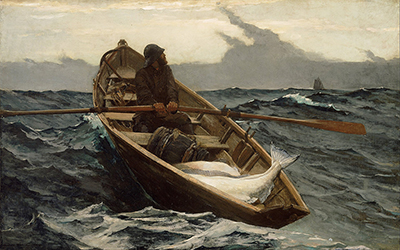
 by Tom Gurney
Tom Gurney BSc (Hons) is an art history expert with over 20 years experience
Published on June 19, 2020 / Updated on August 2, 2026
Email: tomgurney1@gmail.com / Phone: +44 7429 011000
Contents
Introduction
Winslow Homer is not an artist with a large, easy body of public sayings. That is exactly why a quotes page about him needs more discipline than a normal collection of memorable lines. The useful Homer quotations are not motivational slogans. They are traces from letters, dealer exchanges, painted instructions and reported speech, and each one needs a source, date, speaker and context before it belongs on the article. [1]
The safest route is to treat these as annotated quote candidates. Some can be used as short public fragments now because they are carried by museum or official pages with object details. Others stays in the source ledger until the original letter route, publication rights and wording are confirmed. The goal is not to make Homer sound like a modern aphorism machine. It is to let readers hear how terseness, privacy, practical humor and fierce independence shaped the world around the paintings. [2]
The strongest personal quote route is the Portland Museum of Art audio guide for the Winslow Homer Studio. PMA presents primary-source letters and identifies the Bowdoin College Museum of Art objects behind them. In a letter to his brother Charles S. Homer, Jr., dated February 21, 1895, Homer describes the life he has chosen at Prouts Neck. A short display fragment such as "The life that I have chosen" can introduce the late studio years, while the source note explains that the larger passage belongs to a family letter, not a polished public statement. [3]
That same 1895 letter also gives the article a second, closely related candidate: Homer's sense of "absolute freedom." This does not need to be used as a floating inspirational line. It belongs beside the biography's Prouts Neck section, where the studio, the sea, outdoor work and distance from city obligations help explain why freedom mattered to him. [4]
Another PMA letter, sent to Charles on January 14, 1897, shows the sharper comic edge of Homer's privacy. The phrase "I am a dead shot" is tempting, but it is best handled as character evidence rather than bravado. The context is a family letter about living alone, unwanted dogs, sunny rooms and imagined intruders. Used carefully, it helps readers see why later anecdotes about Homer's reserve need both humor and caution. [5]
The June 26, 1901 letter to the Maine architect John Calvin Stevens gives a different register. Homer thanks Stevens for his work on the cottage and calls him a "brother Artist." That fragment is valuable because it complicates the familiar image of Homer as purely solitary. He could be terse, but he also recognized craft, practical labor and professional sympathy. [6]
The painting itself can speak too. The National Gallery's Homer material records that on The Gulf Stream Homer painted a small viewing instruction: "At 12 feet from the picture you can see it." This is a quote candidate from the canvas, not from a letter. It belongs on the article because it joins voice, viewing distance and the physical object. It links internally to The Gulf Stream. [7]
The same National Gallery page records Homer's impatient response when his New York dealer asked for an explanation of The Gulf Stream. A safe public fragment is "requires any description," with the surrounding sentence paraphrased. This candidate is best paired with the painting rather than turned into a general anti-interpretation slogan. Homer disliked explaining the picture, but modern readers still need historical context for its Black protagonist, damaged boat, sharks, sugarcane and Caribbean setting. [8]
A final cautionary candidate comes from the National Gallery introduction, which reports "Mind your own business!" as Homer's favorite words according to a friend. This is useful because it is explicitly reported speech, not a documented letter line. It can appear only with that caveat. The article should tell readers that the line helps explain Homer's reputation for privacy, but it is not the same kind of evidence as a dated letter. [1]
Together these candidates make a small, honest quote page. They show Homer as private but not blank: funny, sharp, grateful, practical, difficult, observant and protective of his work. The article should resist unsourced quote sites and overlong excerpts. Its value is the provenance. Every fragment should lead readers back to the biography, the Prouts Neck studio story, the watercolors, the prints, and especially The Gulf Stream, where Homer's refusal to explain becomes part of the painting's afterlife. [2]
Discussion
Winslow Homer rewards close looking because his strongest images rarely close down into one easy meaning. Use the prompts below to test how the work changes as you move between subject, place, medium and history.
Reader Insights
First Look
What detail in Quotes changes how the whole work feels?
Homer's Method
Where do you see Homer's balance between clear observation and unresolved meaning?
Cluster Context
Which related Homer work helps you read this page more carefully?
Join the Conversation
Share a thoughtful observation below, especially if a detail, source connection or related Homer page changed the way you read the work.
References
- Local
quote-ledger-2026-07-20.md. - Local
internal-link-ledger-2026-07-20.md. - Local
manuscript-homepage-v1-2026-07-20.md. - Local
manuscript-biography-v1-2026-07-20.md. - Portland Museum of Art, Winslow Homer Audio Guide: https://www.portlandmuseum.org/magazine/homerguide/
- Archives of American Art, Smithsonian Institution,
Winslow Homer and Homer family papers from the Bowdoin College Museum of Art, 1846-1954: https://www.aaa.si.edu/collections/winslow-homer-and-homer-family-papers-bowdoin-college-museum-art-6715 - National Gallery, London, Introduction to Winslow Homer: https://www.nationalgallery.org.uk/exhibitions/past/winslow-homer-force-of-nature/introduction-to-winslow-homer
- National Gallery, London, A closer look at three paintings by Homer: https://www.nationalgallery.org.uk/exhibitions/past/winslow-homer-force-of-nature/a-closer-look-at-three-paintings-by-homer