

 by Tom Gurney
Tom Gurney BSc (Hons) is an art history expert with over 20 years experience
Published on June 19, 2020 / Updated on August 29, 2026
Email: tomgurney1@gmail.com / Phone: +44 7429 011000
Overview
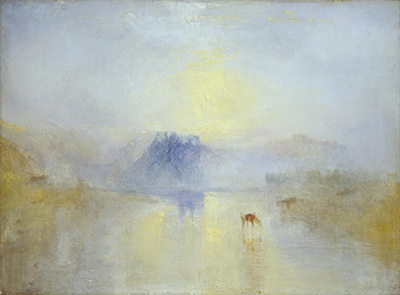
J. M. W. Turner's Norham Castle, Sunrise is one of the late works in which a familiar landscape subject seems to return as light, memory and barely held form. Tate records the painting as by Joseph Mallord William Turner, dated c.1845, with the accession number N01981.[1] Tate Images records oil paint on canvas, a support measuring 908 x 1219 mm, and entry into the national collection through the Turner Bequest, accepted in 1856.[2]
The subject is Norham Castle, a Northumberland stronghold above the River Tweed near the border between England and Scotland. Turner had known this subject for decades before the late oil. Tate's works-on-paper publication records Norham material connected with his sketching, colour studies and Liber Studiorum designs, including a published Norham Castle on the Tweed print in 1816.[3] The late painting should therefore be read as a return, not as a first encounter.
This matters because Norham Castle, Sunrise can be misread if it is treated only as a prophecy of modern abstraction. Its forms are open and luminous, but the work is not detached from subject. Castle, river, cattle, bank and sunrise remain part of the image, even when Turner reduces their edges almost to signs. The painting is abstract-like in handling, but it remains a landscape of memory and place.
The approximate date also matters. The painting is best identified as c.1845, not as an image pinned to a single certain day or year. It belongs to Turner's late studio practice, when he revisited earlier subjects with extraordinary freedom of colour and atmosphere. It is not simply a view of Norham at dawn. It is a late rethinking of a place that had become part of Turner's own artistic history.
The discussion should stay focused on the Tate oil N01981. Earlier Norham watercolours, sketches and prints help explain why the subject mattered, but they should not take over the interpretation. This is a painting about return, sunrise and the threshold between remembered topography and radiant colour.
At a Glance
- ArtistJoseph Mallord William Turner
- TitleNorham Castle, Sunrise
- Datec.1845
- MediumOil paint on canvas
- Support90.8 x 121.9 cm
- CollectionTate Britain
- AccessionN01981
- ProvenanceTurner Bequest, accepted 1856
- SubjectNorham Castle and the River Tweed
- ContextA late return to an earlier Turner subject
Contents
- Overview
- Object Identity
- Norham and the River Tweed
- Earlier Norham Works
- Sunrise and Light
- Late Handling
- Memory and Return
- Norham and the Liber Studiorum
- Not Pure Abstraction
- Why the Painting Matters
Object Identity
Tate's title is Norham Castle, Sunrise.[1] The accession number is N01981.[1] The date is given as c.1845, and that approximate date should be preserved because it reflects the work's late, catalogued status rather than a single documented exhibition moment.[1]
Tate Images identifies the work as a painting in oil paint on canvas and gives the support dimensions as 908 x 1219 mm.[2] Those dimensions are close to the wide format of other late Turner oils, but the effect is very different from the storm paintings or railway subjects. The canvas becomes a field of luminous recession rather than a stage for violent action.
The provenance through the Turner Bequest is central. Tate Images records that the painting was accepted by the nation as part of the bequest in 1856.[2] The work was therefore part of the material left by Turner and later organized into the public story of his late art. Its fame belongs partly to that posthumous context.
Butlin and Joll's catalogue remains an important backbone for placing the painting among Turner's late oils.[6] The object needs those anchors because the painting's apparent openness can encourage loose claims. A responsible reading starts with Tate's title, c.1845 date, accession, medium, support size and bequest provenance.
The title also prevents confusion with related Norham works. Turner made earlier studies, watercolours and a Liber Studiorum design connected with Norham.[3] The late oil is not identical with those works. It revisits a subject already shaped through drawing, print and memory.
This object identity is the ground for interpretation. The painting can look almost dissolved, but it is not nameless colour. It is a late oil painting in Tate's collection, titled Norham Castle, Sunrise, and connected to decades of Turner's work around the same place.
The scale also affects the reading. At 908 x 1219 mm, the canvas is large enough for the viewer to feel immersed in the field of light rather than merely observe a small study.[2] Yet the subject is not enlarged into a historical set piece. Turner uses the breadth of the support to spread dawn across the scene, so that size serves atmosphere rather than show.
The accession number, medium and bequest history keep the work within a definite record, but the painting itself works against hard certainty. That tension is productive. The more secure the external facts become, the more striking the internal looseness appears. Turner gives the viewer a named place and then tests how little description that name needs.
Norham and the River Tweed
Norham Castle stands above the River Tweed, close to the English-Scottish border. That border setting gives the subject historical weight, but Turner does not turn the late painting into a documentary castle view. Instead, the castle becomes a pale marker inside dawn light. Place remains, but its form is softened by sunrise.
Turner's earlier engagement with Norham helps explain the late painting's compression. Tate's research on related Norham works shows that the castle and river were not casual motifs. They belonged to a long sequence of sketches, studies and designs that Turner could return to from memory and from prior work.[3] By c.1845, the subject had accumulated personal and artistic resonance.
The River Tweed is important because it gives the painting both geography and reflection. The river helps organize the lower part of the image, even when its banks are not sharply defined. Water becomes a passage through which sunrise and landscape are joined.
Norham's castle form is equally restrained. It is visible enough to anchor the title, but not described with architectural precision. Turner does not ask the viewer to inspect masonry, towers or historical detail. The castle becomes a sign of memory within light.
This does not make the place unreal. Rather, it shows Turner reworking topography through long familiarity. The castle, river and dawn are recognizable only to the extent needed for the painting's purpose. The place is not erased; it is transformed into a late image of recollection.
Norham also gives the painting a northern British landscape identity distinct from Turner's Venice, Alps or Thames subjects. It belongs to the history of Turner's travels within Britain and to his habit of revisiting earlier places through later imagination.
The border location also matters because Norham had long carried associations of history, distance and vantage. A castle above a river can easily invite a picturesque treatment: solid masonry, winding water, atmospheric sky, and a clear viewpoint from which the visitor can possess the scene. Turner refuses that conventional clarity in the late oil. He lets dawn displace the stable view.
That refusal does not mean the landscape has lost its identity. The title still guides the eye, and the composition still depends on the relation between raised castle, lower ground and reflective water. What has changed is the emphasis. Norham is no longer presented mainly as architecture or antiquity. It is presented as an event of light passing over a remembered place.
The River Tweed helps sustain that event. Its reflective character lets Turner bind sky and earth without forcing a hard division between them. The water is not simply a geographic detail. It is a pictorial instrument through which sunrise can spread, shimmer and return upward into the rest of the scene.
Earlier Norham Works
The late oil should be read in relation to earlier Norham material, but not collapsed into it. Tate's works-on-paper publication includes Norham studies and records connections to the Liber Studiorum design Norham Castle on the Tweed.[3] The Liber etching and mezzotint version was published on 1 January 1816.[3]
That print context matters because Liber Studiorum was Turner's ambitious project for landscape categories and print circulation. Here the point is narrow: Norham was one of the subjects Turner had already processed through drawing and print before the late oil.
Tate's research also notes that Turner used the Norham composition repeatedly, including in relation to late oil reinterpretation.[4] This continuity helps explain why the c.1845 painting can be so reduced. Turner did not need to discover the subject from scratch. He could rely on a visual memory that had been formed over decades.
Ian Warrell's Turner's Sketchbooks is useful here because Tate describes the book as the first single-volume survey of Turner's sketchbooks across the full span of his career.[5] Warrell's broader framework helps place Norham within Turner's lifelong habit of collecting visual notes and returning to them later.
The earlier Norham works should remain secondary in this article. They explain the late oil's ancestry, but the late oil is not just a copy or enlargement. It is a reinterpretation in which the familiar subject has been remade through sunrise and late colour.
The relationship between earlier works and N01981 is therefore one of memory, not simple repetition. Turner returns to Norham as a place already stored in drawing, print and artistic identity. The painting's thinness of form is partly the result of that accumulated familiarity.
This is why the earlier works are most useful when they are handled as a frame, not as replacements for the late oil. They show that Turner had already tested the subject's structure: castle, river, rising ground, open sky. By the time of the c.1845 painting, he could compress that structure almost to a memory trace.
The difference between a preparatory study and a late reinterpretation is important. A study often gathers information for later use. A reinterpretation takes something already known and changes its expressive weight. Norham Castle, Sunrise belongs to the second category. It is informed by earlier work, but it is not subordinate to it.
The repeated subject also reveals Turner's confidence in recurrence. He did not treat originality as the need never to return. In his practice, return could produce new meaning. Norham becomes powerful because the place has been revisited through different media and at different stages of the artist's life.
Sunrise and Light
Sunrise is not only a time of day in this painting. It is the painting's organizing force. Light spreads through the canvas and makes the castle, river and land appear as if they are emerging from brightness rather than being lit from outside. Turner makes dawn both subject and method.
The central light reduces hard boundaries. Forms are not sharply separated. The castle, water and banks seem to gather within a shared atmosphere. This is one reason the painting can feel so radical, but the radicalism is anchored in sunrise. Turner is painting what light does to perception and memory.
The colour range is restrained but potent. Pale yellows, blues and soft tones create a world in which illumination seems more important than mass. The castle is present, yet light has more authority than architecture. The viewer sees Norham through dawn's transformation.
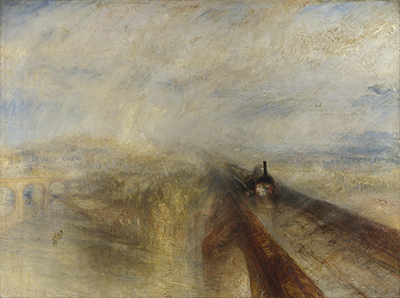
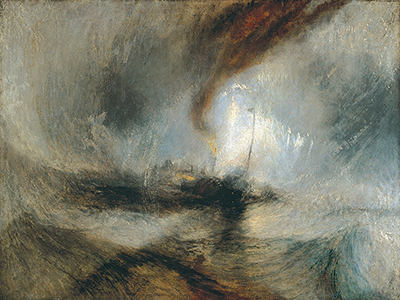
This handling gives the painting its quietness. Unlike Snow Storm - Steam-Boat off a Harbour's Mouth, there is no violent weather crisis. Unlike Rain, Steam, and Speed, there is no machine rushing forward. Norham Castle, Sunrise is a late painting of suspension, stillness and emergence.
The sunrise also carries emotional weight. Because Turner had returned to the subject over many years, dawn can be read as both beginning and return. The painting looks like morning, but it also belongs to the end of Turner's career. That tension between dawn and late style gives the work much of its poignancy.
The light does not erase the landscape. It remakes it. The viewer is asked to accept a form of recognition based on tone, placement and memory rather than on sharp description.
This is especially clear in the painting's balance between warmth and coolness. The sunrise brings yellow and pale warmth into the scene, while blue and cooler passages keep the image from becoming merely golden. Turner uses that balance to hold the eye in uncertainty. The viewer feels the coming of morning, but the world has not yet settled into ordinary detail.
The softness of the edges also changes the pace of looking. A sharply described castle would allow quick recognition. Here recognition arrives slowly. The eye moves through atmosphere, finds a few signs, loses them again, and returns to the central brightness. Sunrise becomes a process rather than a backdrop.
Turner had long been interested in the effects of light on visibility, but in this work the effect is pushed to unusual delicacy. The painting does not simply show sunlight falling on things. It shows light becoming the condition under which things can barely be known.
Late Handling
The painting's handling is open, but it should not be treated as pure abstraction. Turner reduces forms, softens edges and lets colour carry structure, but the title and visible elements remain attached to Norham, sunrise and landscape.
This distinction matters because late Turner is often described through later modern categories. The painting may have seemed startlingly free to later viewers, and it certainly anticipates questions about how little description a landscape needs. But Turner was not abandoning the world. He was distilling a known place through light.
Townsend's work on Turner's materials and techniques is useful because it reminds us that late effects depend on material decisions, not vague inspiration.[7] Colour, layering, handling and surface all shape the image. In Norham Castle, Sunrise, the apparent lightness of the scene depends on disciplined pictorial construction.
The castle's reduced form is a good example. Turner leaves enough structure for identification, but not enough for architectural inventory. The viewer must accept that recognition can happen through a small interruption in colour rather than through detailed outline.
The cattle and lower land forms work similarly. They are not fully descriptive, but they give the painting a lived scale. Without them, the image might float too far from landscape. With them, the sunrise remains connected to ground, water and rural presence.
Late handling therefore becomes a way of balancing dissolution and recognition. The painting approaches the edge of formlessness, but it does not cross it. Its power lies in that edge.
The surface should be read as active, not empty. Thinness, breadth and softness are all decisions with consequences. They make the eye less certain of boundaries and more attentive to transitions. In a conventional castle view, the viewer might move from tower to bank to river. In this painting, the viewer moves from one condition of light to another.
Townsend's technical emphasis is useful because it discourages a vague account of late style.[7] The effect of radiance is not only poetic. It depends on how paint is distributed, how tones relate, and how much descriptive pressure Turner withholds. The image feels airy because the material handling has been made to serve that airiness.
This makes the work different from a finished view that has simply lost detail over time or been left unresolved by accident. The visible economy has meaning. Turner presents a landscape in which the old apparatus of topographical description has been pared back until light, memory and minimal signs do the work.
Memory and Return
Norham Castle, Sunrise is a painting of memory as much as a painting of place. Turner had engaged with Norham across earlier decades, and the late oil seems to return to the subject after it had been absorbed into his visual imagination. It is not simply topographical record.
Memory changes how the painting works. Details that might have mattered in an early travel study are reduced. The castle becomes a luminous sign; the river becomes a band of reflected light; cattle and land become touches within the dawn. The painting remembers enough to remain Norham, but not enough to behave like a literal survey.
This helps explain why the work feels late. It is not only the date that makes it late, but the manner of return. Turner revisits an old subject after years of travel, exhibition, printmaking and experimentation. The image seems to ask what remains when a place is seen through a lifetime of painting.
The answer is not nostalgia in a simple sense. The painting is tender, but it is not merely sentimental. Norham is not restored in crisp detail as a beloved view. It is transformed by light until it becomes both present and distant.
The memory reading also prevents the work from becoming a purely formal exercise. Its openness is emotionally grounded. The castle has been seen before, drawn before, printed before, and now returns as a late condensation of those earlier acts.
This is why the earlier Norham material matters without overtaking the article. It shows that Turner's late simplicity was built from long experience.
There is also a biographical poignancy in that return. Turner was not a young artist discovering northern scenery for the first time. He was an old artist returning, through paint, to a subject he had carried for much of his career. The dawn image therefore has a double register. It looks forward through morning light, while its act of return looks backward across decades of practice.
That double register helps explain the painting's emotional restraint. Turner does not announce memory through dramatic gesture. There are no figures posed in grief, no narrative incident, and no emblem forced onto the scene. The feeling comes from reduction itself: a familiar place held just long enough before it dissolves into brightness.
The work can therefore be understood as one of Turner's most concentrated images of artistic recall. Norham is not merely remembered as a subject. It is remembered as something already shaped by drawing, engraving, colour and repeated looking. The late oil gathers those acts into a single luminous field.
Norham and the Liber Studiorum
The Liber Studiorum connection is important but should be kept precise. Tate's research records Norham Castle on the Tweed within the Liber context, including the 1816 publication of the etching and mezzotint engraving.[3] The late oil should not be described as merely the Liber image in colour, but the connection helps explain continuity.
The Liber Studiorum was Turner's self-conscious project of landscape classification and ambition. Norham's presence within that project means the subject carried more than local memory. It belonged to Turner's broader argument that landscape could sustain many kinds of meaning.
When Turner later returned to Norham in oil, the subject already had a printed afterlife. It had been transformed from sketch and drawing into reproductive form. The c.1845 painting therefore re-enters a subject that had moved across media: sketch, watercolour, print and oil.
This cross-media history is central to Turner's practice. He often developed subjects through repeated treatment rather than one final version. Norham is a strong example because the late oil feels both fresh and deeply familiar. It is new because the handling is late and luminous; it is old because the subject had long been in Turner's repertoire.
The Liber connection also helps guard against seeing the late oil as accidental incompletion. Even if questions of finish remain part of late Turner discussion, the subject itself is not vague. Norham had a durable place in Turner's landscape imagination.
The late painting's spare forms can therefore be read as a culmination of long repetition. Turner has already done the work of description elsewhere. Here he keeps only what sunrise and memory need.
The Liber connection also clarifies the difference between public ambition and private recollection in Turner's career. The printed Norham belonged to a project in which Turner organized landscape for circulation and comparison.[3] The late oil feels more inward, yet it still draws authority from that earlier public career. It is both personal return and continuation of a subject already made important.
That continuity should not flatten the works into one another. The 1816 print context and the c.1845 oil do different things. The print works through tonal structure, engraved translation and the logic of publication. The late oil works through colour, loosened form and the immediate presence of painted light. Their connection is historical and imaginative, not identical.
For that reason, the Liber material is best used to understand depth of memory. It explains why a few signs could carry so much. When Turner reduced Norham in the late oil, he reduced a subject whose structure and associations had already been repeatedly tested.
Not Pure Abstraction
The painting is sometimes tempting to describe as abstract because its forms are so reduced. That word must be used carefully. Turner did not make a non-representational painting. He made an image titled Norham Castle, Sunrise, and the castle, river, land and animals remain legible enough to matter.
The better question is not whether the painting is abstract, but how far Turner can reduce a landscape while preserving identity. In this work, a few signs are enough: the castle mass, the river passage, the ground line, cattle, sunrise. The viewer recognizes the subject through relationships rather than through detail.
This makes the painting radical without making it anachronistic. It belongs to the nineteenth century and to Turner's late studio, not to a later modernist movement. Its openness arises from Turner's long exploration of light, colour and atmosphere within representational painting.
The danger of calling it pure abstraction is that it erases Norham. The place matters. The painting's poignancy depends on the return to a known northern subject, not on an escape from subject altogether. Turner makes Norham less solid, but not irrelevant.
The same caution applies to finish. Some late Turner works raise questions about completion, but openness is not automatically carelessness. A late image can leave much unresolved while still having powerful pictorial intent.
Norham Castle, Sunrise is best understood as a threshold work: between place and light, memory and perception, landscape and near-dissolution. Its meaning lies in holding those terms together.
This threshold quality is also what makes the painting resistant to quick labels. Calling it only topographical misses the looseness of the surface. Calling it only abstract misses the persistence of the subject. Calling it unfinished without qualification misses the intensity of its pictorial decisions. The work sits between categories, and that position is central to its force.
The viewer's task is therefore not to choose between Norham and abstraction-like colour. The painting asks that both be held in view. It is Norham because the title, structure and history remain active. It is radical because Turner allows those anchors to operate with extraordinary economy.
That economy is not a weakness. It is the painting's language. Turner shows that a castle can be made from interruption, a river from reflection, and a sunrise from the spreading relation of tones across a wide canvas.
Why the Painting Matters
The painting matters because it shows Turner returning to a lifelong subject with late economy. He does not need to describe Norham fully. He lets sunrise and memory carry the place. The result is one of the clearest examples of how late Turner could make landscape feel both specific and almost immaterial.
It also matters because it changes the status of topography. Early topographical work often depended on careful description of place. In Norham Castle, Sunrise, place survives through minimal signs and luminous atmosphere. Turner shows that a landscape can be remembered rather than catalogued.
The work is important for Turner's late style because it shows openness without detachment from subject. It can support discussion of abstraction-like handling, but only if that discussion remains tied to Norham, sunrise, Tate N01981 and Turner's prior engagement with the place.
It also provides a counterpoint to the more dramatic Batch 5 storm and sea works. After the steam-boat's dangerous weather, Norham offers stillness. Yet it is no less radical. Its drama is quieter: the drama of form nearly disappearing into light.
The painting also matters within the Turner Bequest. Many of Turner's late works became central to later understandings of his originality only after his death. Norham Castle, Sunrise is part of that story: a work whose posthumous public life helped viewers reassess what late Turner had achieved.
Finally, the painting matters because it asks for slow recognition. The viewer has to let the castle emerge, let the river organize the lower space, and let sunrise become more than a background effect. Turner makes dawn a way of thinking about artistic memory.
Its importance also lies in the way it changes the viewer's confidence. Many landscapes tell the viewer where to stand and what to see. Norham Castle, Sunrise withholds that comfort. It asks the viewer to trust partial evidence: a pale mass, a horizontal drift, a few touches below, a field of light. That uncertainty is not decorative. It is the means by which the painting makes memory visible.
The painting also belongs to a broader late Turner group in which light becomes the main agent of form. Yet Norham's calm gives it a special place within that group. The image is not built around disaster, speed or imperial theatre. Its drama is quiet, and that quietness allows the viewer to notice how radical the reduction really is.
For modern viewers, the work can seem close to later art because it gives colour such independence. The more historically grounded reading is stronger: Turner was extending landscape painting from within, using a remembered subject to test how far atmosphere could carry meaning. That achievement is more precise than saying that he simply predicted later movements.
How to Read Norham Castle, Sunrise
Begin with the object identity: Norham Castle, Sunrise, c.1845, oil paint on canvas, Tate accession N01981.[1][2] That keeps the focus on the late oil, not on every Norham work Turner made.
Next, locate the subject. The painting refers to Norham Castle above the River Tweed, a place Turner had treated across earlier decades. The title gives the anchor, even when the forms are reduced.
Then look at how little description Turner needs. The castle is not a detailed architectural study. It is a faint presence within sunrise. Cattle and land forms give scale, while the river and light organize the scene.
After that, use earlier Norham works carefully. The Tate research publication and Liber Studiorum context explain the subject's history in Turner's practice, but the late oil should remain the central object.[3]
Finally, avoid treating openness as pure abstraction. The painting presses toward luminous dissolution, but it remains a remembered landscape. Its achievement is not the disappearance of subject, but the transformation of subject into light.
It also helps to compare the kind of attention the painting rewards. A viewer looking for narrative incident may find very little. A viewer looking for exact architectural description may feel denied. But a viewer following shifts of tone, scale and visibility will find a highly organized work. The painting is quiet, not slight.
Look especially at how the upper brightness and lower signs depend on one another. Without the castle and land, the light would lose its place. Without the light, the castle would become only a minor topographical remnant. Turner makes each term depend on the other.
The result is a late landscape that works almost like recollection itself. It does not deliver every detail at once. It offers fragments, atmosphere and conviction. The viewer completes recognition slowly, through trust in Turner's arrangement of light.
Frequently Asked Questions
It is a late oil painting by J. M. W. Turner, dated c.1845 by Tate and held under accession number N01981.[1]
It depicts Norham Castle above the River Tweed, but it does so through a highly reduced field of dawn light rather than through detailed architectural description.
Tate Images records the medium as oil paint on canvas and gives the support size as 908 x 1219 mm.[2]
No, not in the strict modern sense. Turner reduces forms strongly, but the work remains tied to Norham Castle, the River Tweed, sunrise and landscape.
Norham was a long-standing subject in Turner's practice. Tate's works-on-paper research connects Norham to earlier drawings, colour studies and Liber Studiorum material.[3]
By returning to the subject late in life, Turner could transform a familiar place into an image of memory, light and artistic recall.
No. Earlier Norham watercolours, sketches and prints provide context, but the Tate oil N01981 is a late reinterpretation, not the same object.
Tate dates the painting c.1845.[1] That approximate date should be preserved rather than converted into a hard year.
It shows Turner transforming a known landscape through late light and colour while keeping enough structure for recognition. It is a major example of late Turner at the edge between place and luminous memory.
Its importance also comes from its restraint. Turner makes a celebrated late painting from a few durable anchors: a named castle, a river, dawn, and the long memory of earlier work.
Discussion
How does Turner preserve a specific place while allowing sunrise, memory and colour to loosen its visible form?
Reader Insights
Which minimal signs keep castle, river and cattle legible?
How does sunrise organize the image more strongly than architecture?
What does the late oil retain from Turner's earlier Norham works?
Join the Conversation
Share a close observation or a source-based question for other readers.
References
- Tate, "Norham Castle, Sunrise, Joseph Mallord William Turner, c.1845." https://www.tate.org.uk/art/artworks/turner-norham-castle-sunrise-n01981
- Tate Images, "Norham Castle, Sunrise." https://www.tate-images.com/N01981-Norham-Castle-Sunrise.html
- Tate Research Publication, "Joseph Mallord William Turner, Norham Castle on the Tweed." https://www.tate.org.uk/art/research-publications/jmw-turner/joseph-mallord-william-turner-norham-castle-on-the-tweed-r1131761
- Tate Research Publication, "Joseph Mallord William Turner, Norham Castle at Sunrise c.1830." https://www.tate.org.uk/art/research-publications/jmw-turner/joseph-mallord-william-turner-norham-castle-at-sunrise-r1144324
- Ian Warrell, *Turner's Sketchbooks*, Tate Publishing, 2014/2018. Tate Shop record: https://shop.tate.org.uk/turners-sketchbooks-paperback/20184.html
- Martin Butlin and Evelyn Joll, *The Paintings of J. M. W. Turner*, revised edition, Yale University Press, 1984.
- Joyce H. Townsend, *How Turner Painted: Materials & Techniques*, Thames & Hudson, 2019.