by Tom Gurney
Tom Gurney BSc (Hons) is an art history expert with over 20 years experience
Published on June 19, 2020 / Updated on November 3, 2026
Email: tomgurney1@gmail.com / Phone: +44 7429 011000
Textiles: Introduction
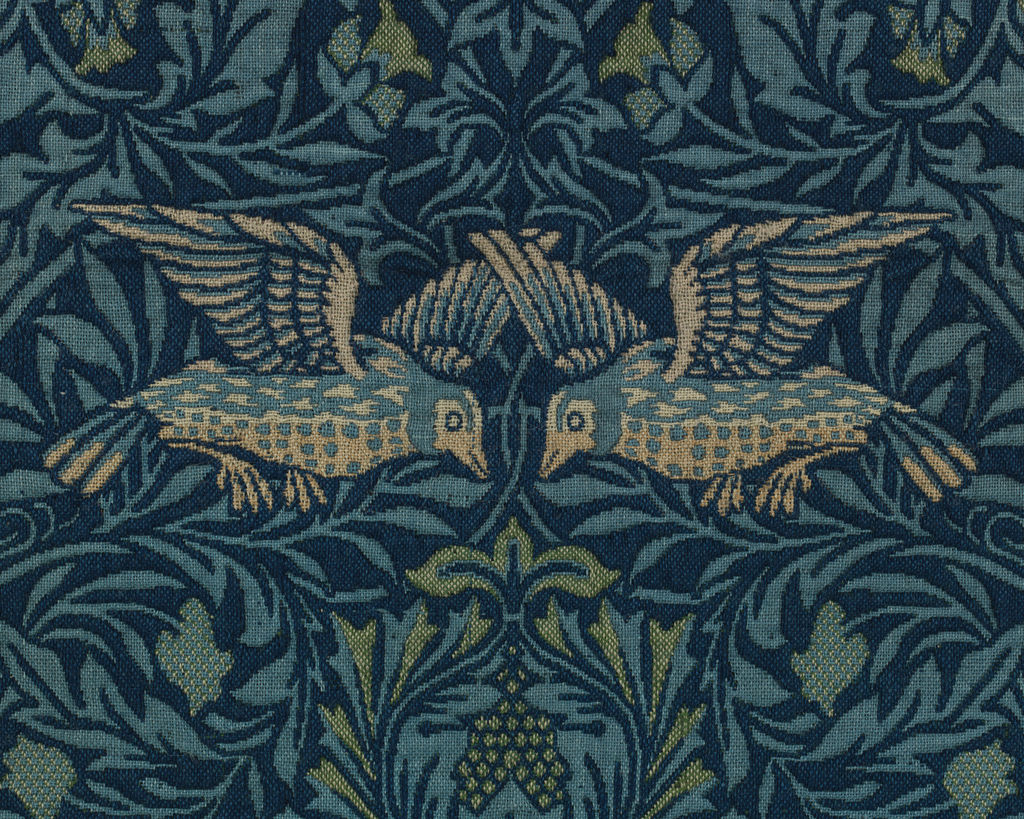
In the drawing room of Kelmscott House, William Morris used the heavy wool furnishing Bird to cover the walls. Registered in 1878, its repeated pattern belonged to the room as a whole, surrounding its occupants rather than asking to be studied like a framed picture. Morris called this kind of cloth “woven wool tapestry.” The Metropolitan Museum of Art makes a useful correction: Bird is technically doublecloth, not tapestry weave. That distinction opens up a much richer understanding of Morris textiles than the familiar image of flowers printed on fabric. [1]
A printed cotton, a woven wool curtain, an embroidered panel and a knotted carpet acquire their patterns in different ways. Peacock and Dragon, designed in 1878, was woven on hand-operated Jacquard looms; the mechanism controlling its pattern was compatible with hand weaving. Calling everything handmade tells us too little about how these objects were produced. Calling everything a Morris design can also conceal the work of designers, dyers, printers, weavers and embroiderers. [2]
Morris himself organised his 1893 essay “Textiles” around separate methods: tapestry, carpet weaving, mechanical weaving, printing and embroidery. His judgments about their relative merits were emphatic, but his underlying demand remains a valuable way of looking: understand what the material and process can do, and judge the design in relation to them. A flower translated into thread, printed dye or carpet pile becomes a different kind of flower. [3]
At a Glance
- Bird structureDoublecloth, although Morris called it woven wool tapestry [1]
- Jane’s embroideryA textile stitched by Jane won an award at the 1862 International Exhibition [4]
- First securely dated woven designTulip and Rose, registered 1876 [4]
- Merton AbbeyConnected textile manufacturing site established in 1881 [4] [5]
Contents
- How a textile gets its pattern
- Embroidery, women and professional design
- Printed cotton and the search for colour
- Dye belongs to the material
- Woven wool, silk and the Jacquard loom
- From workshop to furnished room
- Historical textiles and familiar plants
- Carpets, from machine production to hand knotting
- Tapestry and the people behind the image
- A length of cloth has more than one date
How a textile gets its pattern
In printing, colour is applied to cloth that already exists. In a patterned woven furnishing, the arrangement of threads produces the ornament as the cloth is made. Embroidery adds stitches to an existing ground. Tapestry builds its image through the weaving itself, with coloured weft threads covering the supporting warp. A knotted carpet creates a further kind of surface, whose pile changes both the appearance and the physical character of its pattern. Morris discusses these as related arts with distinct opportunities, rather than interchangeable ways of reproducing a drawing. [3]
This matters because a design can depend on its method of manufacture. In his textile essay, Morris associates printing with the possibility of fine hatching, dots and a comparatively varied palette. For repeating woven cloths he recommends clear organisation and carefully controlled contrasts. He treats the rich gradations available to tapestry separately from the more sharply bounded passages of colour that he considers suitable for knotted carpets. These are his artistic prescriptions, not rules defining everything that textiles can achieve. They nevertheless explain why the same designer might seek different effects in different materials. [3]
The ground is part of this relationship. An embroidered flower can draw attention to the cloth around it; a printed pattern may occupy that cloth extensively; a tapestry image can conceal the warp beneath its coloured surface. Looking only at the motif removes these differences. Looking at how the motif meets its ground begins to reveal the decisions that made it possible. Morris's insistence on material knowledge asks us to notice the whole fabric, including the apparently empty areas. [3]
His classification also helps explain the breadth of the business. The firm offered textiles for floors, windows, doorways, beds, walls and smaller furnishings. Some were sold finished, while embroidery designs could be supplied for customers to execute themselves. A complete hanging and a kit were different relationships between the company, the design and the eventual maker, even when they belonged to the same decorative world. [4]
Bird, a museum close-up showing the woven surface around a bird and the surrounding leaves. The Metropolitan Museum of Art. Image source. CC0 / Public domain.


Embroidery, women and professional design
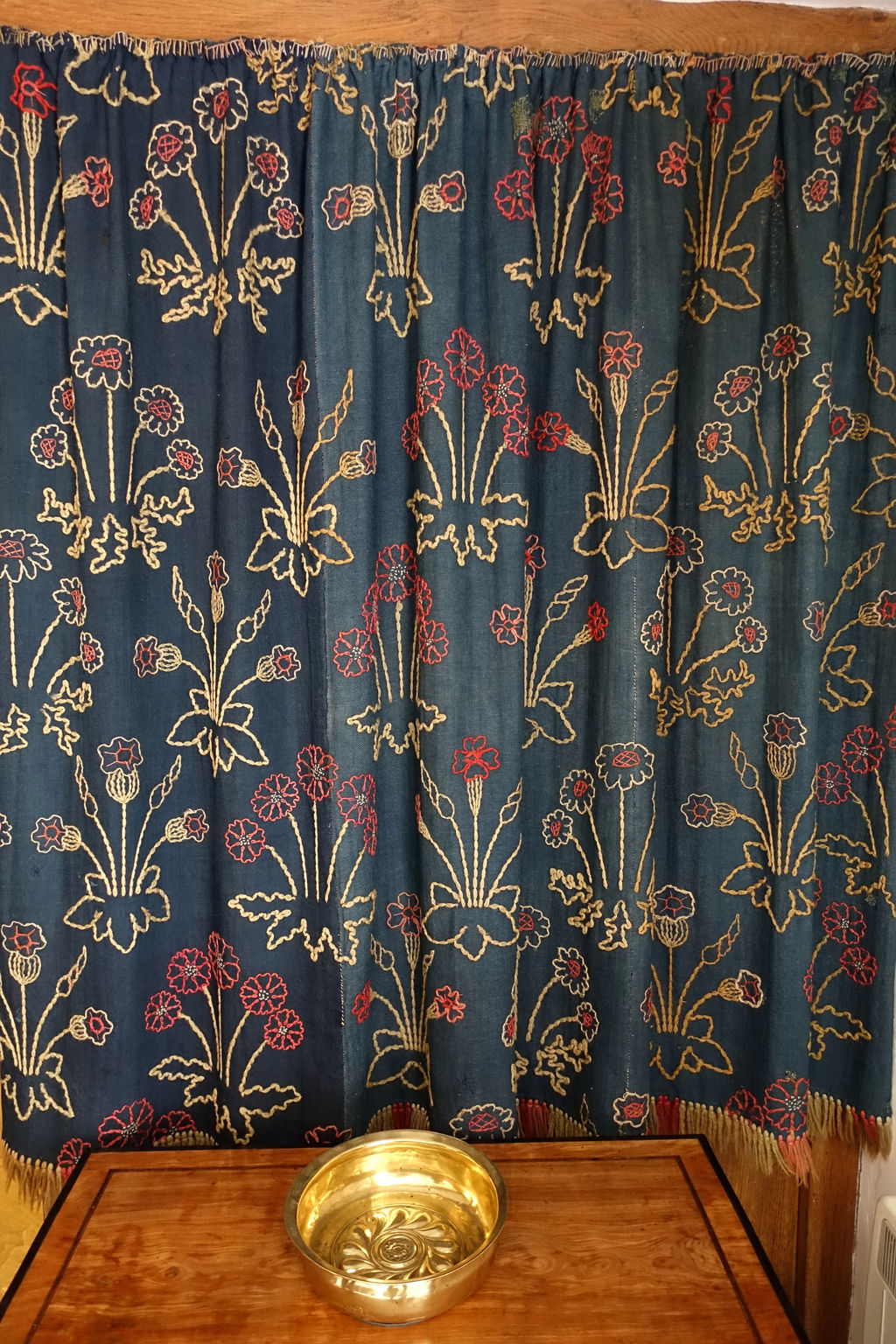
Embroidery came before the firm's printed and woven furnishing ranges. Morris's early experiments were followed by the hangings and curtains made for Red House by Jane Morris and their circle. A textile stitched by Jane won an award at the 1862 International Exhibition. The V&A's account places that skilled needlework near the beginning of the commercial enterprise, rather than treating it as a domestic accompaniment to William's career. [4]
As the embroidery business grew, it included commissioned hangings, ready-made work and designs for home stitching. In 1885 May Morris took charge of the department, aged twenty-three. Textile historian Lynn Hulse describes a role combining design, supervision and commissions for British and overseas clients. May's responsibility was professional and creative: a department needed patterns that could be made, materials suited to the intended effect and the organisation of the people executing them. [6]
Hulse's account of the Ashmolean's collection makes the range of May's practice tangible. Her designs extend from substantial furnishings to book covers, clothing details and small accessories. Some surviving work combines darning stitches with a stem-stitch outline, using silk on a cotton or silk ground and leaving the background exposed. Here the fabric beneath the stitching contributes to the finished effect. The ornament does not have to smother its support to look complete. [6]
In his 1881 lecture “Some Hints on Pattern-Designing,” William described embroidery as “gardening with silk and gold-thread.” The phrase is useful because it keeps both plant and material in view. A rose should be recognisable, but its beauty must also come from the needlework: how colour is placed, how a contour turns and how the chosen thread behaves. His argument was against using the apparent freedom of stitching merely to imitate another medium. [7]
May's work developed this relationship between observation and ornament in her own right. Hulse connects her botanical studies with historical needlework and textiles from Turkey and Iran. Her practice cannot be explained as copying her father's flowers. It combined close attention to plants with an understanding of what stitches and surfaces could express. Nor should the identity of designer and embroiderer be assumed: the Ashmolean essay identifies an Anemone panel designed by John Henry Dearle and stitched by May. Naming both preserves the creative decisions made at different stages. [6]
Daisy embroidered hanging photographed in an interior setting. The flower motifs and their stitched outlines remain distinct from printed pattern. Daderot. Image source. Public domain.
Printed cotton and the search for colour
The company's early printed fabrics depended on specialist manufacturers. Clarkson's in Lancashire printed its initial experiments, while Thomas Wardle's works at Leek became important to Morris's investigation of natural dyes from 1875. The move towards greater control of production did not begin with a fully equipped workshop and a perfected palette. It involved working with experienced manufacturers and revising what a design could become in cloth. [4]
Tulip and Willow makes that development unusually clear. The William Morris Gallery dates the design to 1873 but its linen specimen to after 1883. The Gallery explains that Clarkson's first printed the pattern with chemical dyes, while later production at Merton Abbey used indigo. One pattern therefore belongs to more than one technical moment. A date attached to a design should not be mistaken for the date of every surviving length, or proof that its colouring was always achieved by the same means. [8]
Strawberry Thief, introduced in 1883, shows how process could enable greater complexity. The Huntington's account describes an indigo ground followed by block-applied discharge, which removed colour to produce the pattern. Further stages introduced yellow and red, with washing, drying and preparation between operations. A mordant helped selected areas take the additional dye. The finished cloth's apparent unity depended on a sequence of treatments. [9]
Discharge removes colour already present. For this indigo process, it is misleading to imagine the entire design being printed as separate coloured pictures onto untouched white cloth. The blue ground and its controlled removal were fundamental to the result. The fuller sequence can be followed through Morris's printed fabrics, including the relationship between blocks, dyes and repeated impressions. [9]
Morris also understood the cost of technical elaboration. In his pattern-design lecture, he insists that every extra operation applied to inexpensive cotton should earn its place through the beauty it adds. The concern is not simply whether a complicated process is impressive. It is whether the labour has a visible purpose. This makes the printed textiles especially revealing: their small leaves and coloured details can be enjoyed as ornament while also prompting attention to the time and coordination behind them. [7]
Dye belongs to the material
In “Of Dyeing as an Art,” published in 1893, Morris describes colour as something produced through skilled handling of substances and fibres. Indigo requires preparation in a vat so that it can enter the textile; exposure to air restores its insoluble blue form. Repeated dipping deepens the shade. Madder and weld belong to a different part of his account, involving mordants that help establish colour on the fibre. His explanations connect the appearance of a textile to knowledge that a design drawing alone cannot supply. [10]
He also describes how the same dye behaves differently with different materials. Madder, for example, could produce reds on cotton and linen but, in his judgment, diminish the gloss of silk. Such remarks complicate the idea of a single “Morris palette” applied uniformly across every product. A colour had to work with the particular fibre and the desired surface, as well as with neighbouring colours in the pattern. [10]
Morris's hostility to commercial aniline dyes was outspoken. It belongs to his criticism of an industry he believed subordinated beauty to cheapness. That polemic should not become a claim that every textile bearing the firm's name was always coloured exclusively with natural dyes: the early history of Tulip and Willow supplies a direct counterexample. His preferred methods were the result of investigation and change. [8] [10]
Nor did he claim that natural colours were immune to light. His dyeing essay explicitly acknowledges fading, while arguing that the colours he favoured changed agreeably. He considers their appearance under artificial illumination too. His preference is an aesthetic judgment about colour in use and over time, rather than a promise of permanence. A textile's beauty, in this account, includes its response to the conditions of a room. [10]
Woven wool, silk and the Jacquard loom
The woven furnishing range encompassed wool, silk and mohair, with some designs incorporating gold thread. Tulip and Rose, registered in 1876, is Morris's earliest securely dated woven furnishing design. Historic cloth offered both models of pattern and problems of construction. Morris studied early textiles in the South Kensington Museum, now the V&A Italian silks and later experiments with elaborate velvet structures helped shape his ambitions. His 1884 Granada pursued the possibilities of historic brocaded Flemish velvets, bringing the construction of cloth into the investigation alongside its ornament. [4]
Bird gives one accessible point of entry. The Met identifies its structure as doublecloth, while recording its use on the drawing-room walls at Kelmscott House and its production in three colourways. The heavy wool made an enveloping wall covering. Its historical description as a tapestry records the decorative role Morris associated with it, but the technical name explains how it differs from an individually woven tapestry image. [1]
Peacock and Dragon offers another case. The William Morris Gallery identifies it as hand-loom Jacquard-woven wool and records production first at Queen Square and later at Merton Abbey. Its repeat measures 109 by 90 centimetres. Those dimensions describe the unit of pattern, not the length of a curtain or the dimensions of every surviving sample. Available cloth widths were different measurements again. [2]
The Jacquard mechanism controlled the selection of warp threads through punched cards. This helped a loom produce an intricate repeating pattern. It did not mean that the loom had to be powered mechanically: the Gallery's description of Peacock and Dragon combines hand operation with Jacquard control without contradiction. A useful account asks which operation was mechanised and how the cloth was woven, rather than treating “hand” and “machine” as sufficient descriptions of the whole process. [2] [5]
From workshop to furnished room
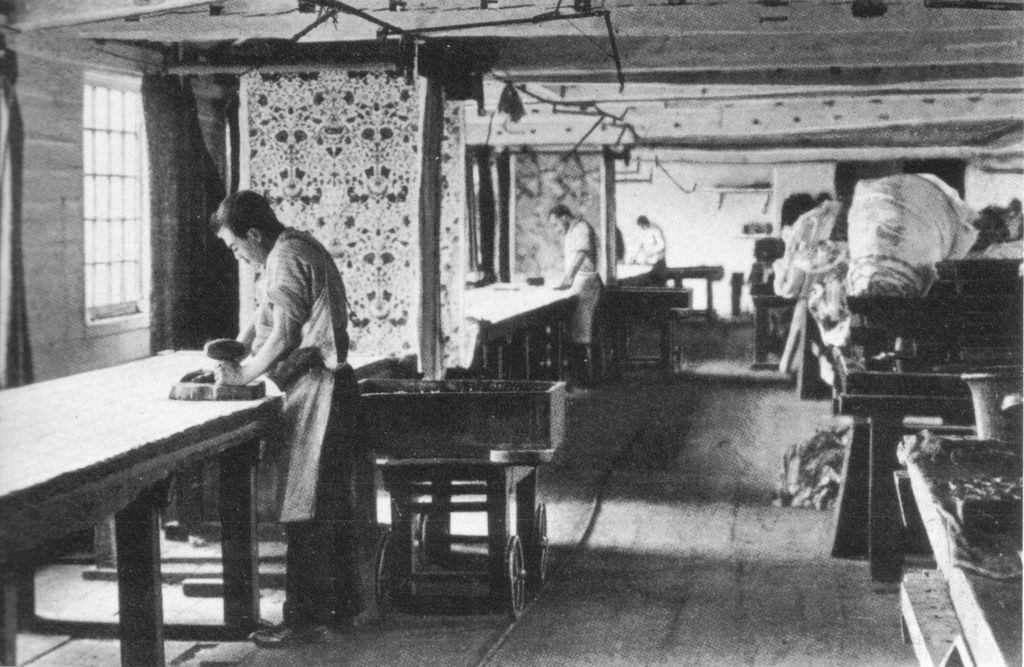
Merton Abbey brought dyeing, printing, woven furnishings, carpets and tapestry into a connected manufacturing site in 1881. Its location mattered to the textiles: the River Wandle supplied water for dyeing and washing, while the grounds allowed cloth to dry. Production required space for vats, long printing tables and looms, as well as somewhere to draw and organise designs. The fabric's journey from colour preparation to finished length was distributed across these different working areas. [4] [5]
The Merton Priory Trust identifies Louis Bazin as the weaver employed when Morris developed Jacquard weaving at Great Ormond Yard, before the move to Merton. That earlier workshop helps explain why a company's name and a manufacturing address do not tell the whole story. Processes had their own beginnings, trained workers and changing locations. The later works brought existing skills together as well as enabling new experiments. [5]
David Saxby's study of the workforce shows how distinct these skills were. Experienced Jacquard weavers came from Bethnal Green, including the brothers William and Frederick Chadwick. Samuel Goodacre was the dye-house foreman, while William Hillier and Henry and George Hill worked as block printers. The textile departments depended on people with different forms of technical knowledge, rather than a group of interchangeable assistants carrying out William's instructions. [11]
Training formed another part of the workshop's life. Saxby identifies local young women, including Eliza Merritt and Diana Penn, who learned carpet knotting, alongside a separate history of boys apprenticed to tapestry weaving. Their different training paths help explain how production could expand. They also make the workforce more visible: the hands behind these textiles belonged to people who acquired particular skills over time. [11]
Consolidation also had limits. Merton did not manufacture every furnishing sold by Morris & Co.: embroidery and wallpaper were produced elsewhere, with Jeffrey & Co. responsible for wallpaper printing. Outsourced carpets remained part of the range. The company should be understood as a network of workshops and specialist production, with Merton an important centre rather than the source of every object. [4] [5]
The room was the other end of that network. A curtain presents only part of its pattern at any moment, concealing and revealing it in folds; a flat wall covering exposes the repeat more continuously. Morris's advice permits a larger and more openly constructed pattern in cloth partly because those folds and its surface supply further incident. Scale therefore concerns the relationship between motif, material and use, rather than the size of the flower alone. [7]
In “Textiles” he argues that large patterns can be restful when their structure and contrasts are well managed. Strong organisation need not mean a strident effect, just as plentiful detail need not produce confusion. He discourages shading intended merely to make a motif look rounded, while valuing the actual light and shade supplied by the textile. The distinction is telling: the cloth can contribute effects that the drawing does not need to counterfeit. [3]
Textile printing at Merton Abbey, about 1890, in a photograph published in 1911. Long tables and hanging cloth place pattern within a working room. Not identified for original photograph. Image source. Public domain.
Historical textiles and familiar plants
English flowers and historic textiles offered Morris different kinds of knowledge. Plants supplied recognisable forms and associations; older cloth supplied ways of organising those forms, controlling repetition and making colour work in a material. Treating these sources as alternatives misses how his practice brought them together. In his textile essay he directs readers to Syrian, Sicilian, Persian and Italian work, revealing an interest far wider than a single national tradition. His sweeping judgments about these traditions remain his historical views. [3]
Wandle gives a specific example of this combination. The V&A traces its winding structure to a sixteenth-century Italian brocaded velvet acquired by the museum in 1883, object 442A-1883. Morris adapted the rhythmic vine and replaced the older textile's crowns with stylised chrysanthemum heads. The connection is structural as well as botanical: the historical cloth helped him organise a new repeating design. [12]
An English river name consequently does not establish an exclusively English source for a pattern. The title, the plant forms, the historical arrangement and the place of manufacture answer different questions. Wandle can evoke a local association while drawing on an Italian textile. Similarly, Morris's study of Persian carpets need not imply that the resulting work simply copies an individual rug. A specific prototype requires specific evidence. [4] [12]
In “Some Hints on Pattern-Designing,” Morris argues that a designer should begin with an overall idea before drawing its constituent flowers. He imagines the effect of a sunlit rose hedge, then the leaves, thorns and blossoms needed to express it. This reverses the idea that pattern is assembled by collecting attractive plants and forcing them into gaps. Observation supplies material, but the designer must give it order, direction and a convincing suggestion of growth. His familiar plants are made to inhabit a constructed surface. [7]
Carpets, from machine production to hand knotting
Carpets expose the limits of the claim that Morris rejected every machine-made product. The firm sold outsourced machine-woven carpets as well as hand-knotted rugs. Its products included flat-woven Kidderminster carpeting and cut-pile Wilton carpets. Heckmondwike Manufacturing Company and the Wilton Royal Carpet Factory appear among the manufacturers named in the V&A's examples. These were genuine parts of the commercial range, not exceptions that can be omitted from its history. [4]
The V&A identifies Wilton carpeting as the firm's most popular flooring product. The prestige of a hand-knotted commission should consequently be distinguished from the products that sold most successfully. At the more elaborate end of the range, the Bullerswood carpet of about 1889 formed part of a furnishing commission for wool trader John Sanderson's house in Chislehurst. The museum credits William Morris and John Henry Dearle in its caption. This particular carpet brings collaboration and a specific domestic setting into a history that also includes manufactured yardage sold for other rooms and budgets. [4]
Morris's personal preference was clear. In “Textiles” he gives hand-knotted carpets a higher status and calls machine-made versions economical substitutes. Yet he also considers the design demands of the latter. A restricted palette and a necessary repeat require adjustment: a smaller, simpler pattern might serve a mechanically woven carpet where a more expansive arrangement could work in a hand-knotted rug. His criticism of production methods did not prevent him from thinking carefully about products made through them. [3]
The hand-knotted “Hammersmith” rugs began in the outbuildings of his London home before production moved to Merton Abbey in 1881. The name survived the change of location. At Merton, designs could be translated onto squared point paper, with each square representing a knot, for the workers to follow. This intermediate stage connected a drawing to the scale and structure of the carpet; the finished surface depended on the weavers' repeated decisions and skilled execution. [4] [5]
For Morris, carpet colour needed to remain clear and the pattern appropriately flat. In the 1881 lecture he resists illusionistic shading that muddies the small passages of colour. He also devotes attention to borders, their relation to the central field and the difficult task of turning a corner. A border could quietly secure the design or provide a stronger counterpoint. These practical problems show how much more was involved than enlarging a floral motif to cover a floor. [7]
The floor brought its own use and wear, distinct from the changing folds of a curtain or the protected face of a wall hanging. Morris's emphasis on the individual beauty of each passage of carpet colour follows from that setting: the textile should reward attention as material underfoot, while its larger organisation holds a place in the room. [3] [7]
Tapestry and the people behind the image
Tapestry offered Morris a different scope from repeating furnishings. Coloured wefts create the image and cover the warp, allowing forms and passages of colour to be developed through the weaving. At Merton Abbey, high-warp looms held the warp upright. Morris valued the richness of colour this method could achieve and the possibility of building abundant foliage or a narrative image without relying on a regularly repeating unit. [3] [5]
His first completed tapestry, Acanthus and Vine of 1879, preceded a workshop practice involving trained weavers and collaborative designs. The V&A describes Dearle's management of tapestry production and the combination of Morris, Dearle and Burne-Jones in large commissions. The Holy Grail tapestries belong to that shared enterprise. “Morris tapestry” can therefore name the firm or its artistic world without identifying the person responsible for every figure, background or woven passage. [4]
Woodpecker, made in 1885, brings those jobs into focus. The William Morris Gallery identifies the whole design as William's, with the weaving carried out at Merton Abbey by W. H. Knight and William Sleath. May Morris and assistants embroidered its inscription. A work described as designed entirely by William was still made through several people's specialist labour. [13]
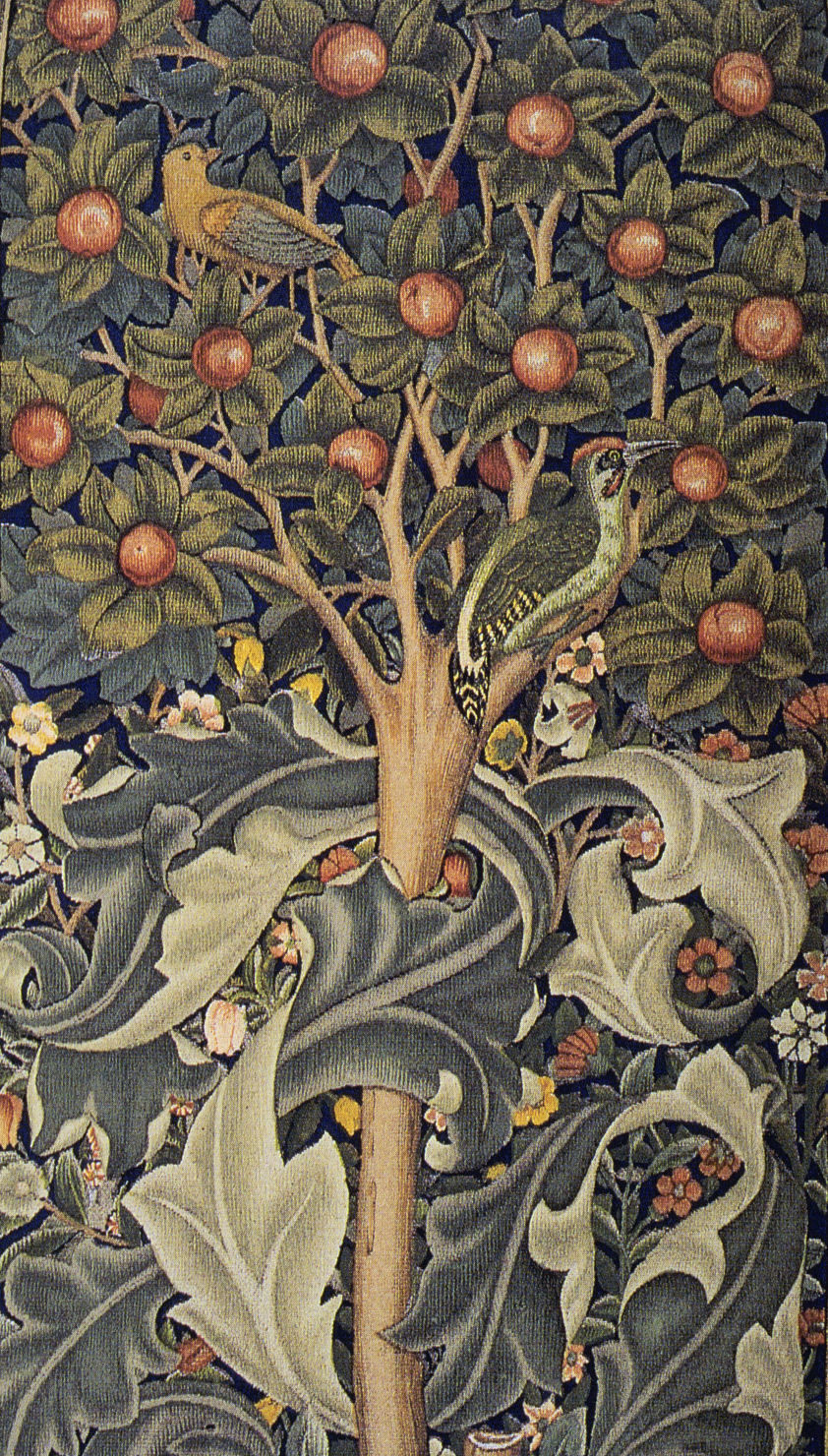
The Gallery describes a fruit tree, birds and acanthus, with honeysuckle borders and text referring to the classical story of Picus transformed into a woodpecker. Here patterned growth, a literary reference and an inscription occupy one hanging. The object also crosses technical boundaries: weaving establishes the main image, while embroidery supplies the lettering. Its unity was an achievement of coordination rather than evidence of a single hand. [13]
Knight and Sleath were named in the catalogue when the tapestry appeared at the first Arts and Crafts Exhibition Society exhibition in 1888. That public credit is especially useful to preserve. The makers were identifiable participants in the work's history, and their names help turn an abstract celebration of craftsmanship into an account of actual people. [13]
A length of cloth has more than one date
Textile collections preserve patterns across long manufacturing histories. Cleveland's Strawberry Thief, for example, is catalogued about 1936, although William designed the pattern in 1883. Its plain-weave cotton and discharge printing identify a later material example of the established design. The two dates describe different events; neither needs to displace the other. [4] [14]
The Gallery's Peacock and Dragon has an equally instructive later history. It came from a thirty-yard length acquired when Morris & Co. closed in 1940. The Gallery made that cloth into display curtains in the 1960s, then separated the widths around 1988. The 1878 design, the acquisition of cloth and the making of those curtains are separate episodes. Calling them all “curtains of 1878” would erase what the surviving object actually records. [2]
Authorship continued to develop too. The V&A places Morris's last identifiable woven textile designs in 1888 and describes Dearle's subsequent responsibility for that part of the firm's output. Lesley Baker's study of Dearle explains how company branding could obscure his contribution, while also arguing against dismissing his work as merely a decline from Morris. A familiar style or company label is insufficient evidence of William's personal authorship. [4] [15]
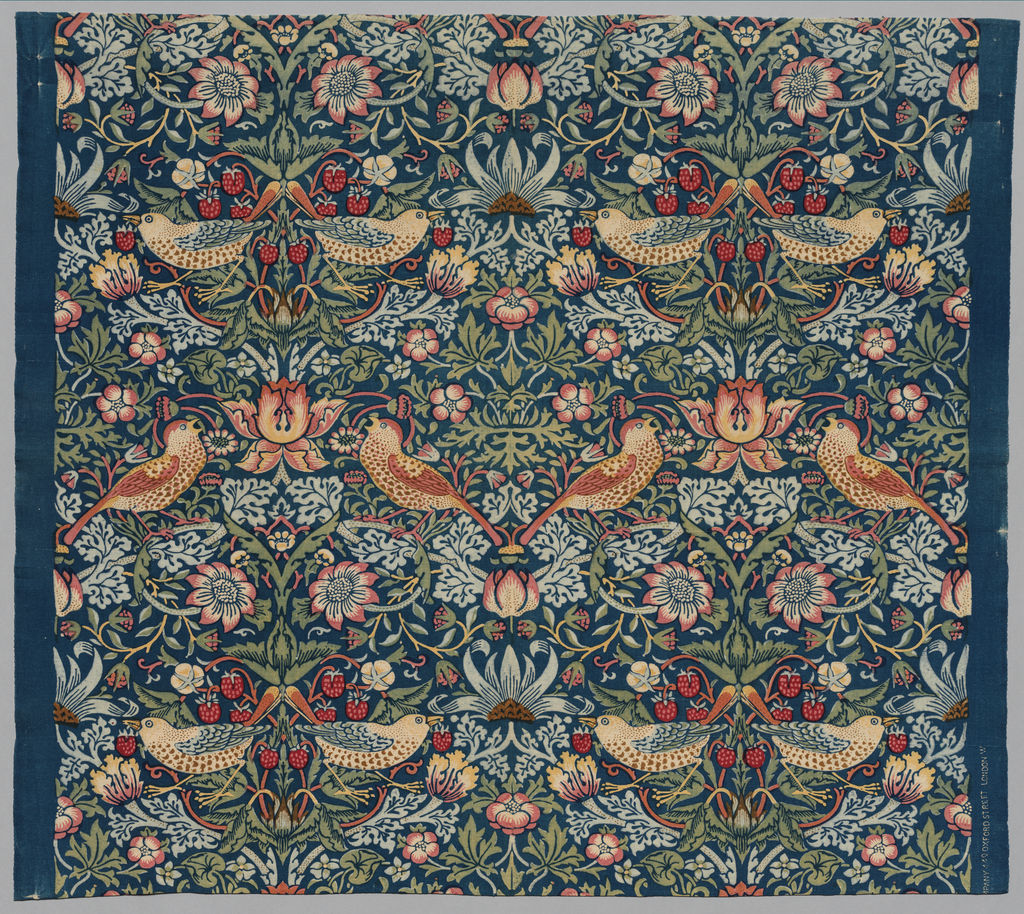
Strawberry Thief furnishing fabric, Cleveland Museum of Art 1937.696. This later manufactured textile preserves Morris’s design of 1883. Image source. CC0 / Public domain.
Works and designs directory
This directory brings together 365 design, edition and collection records, plus 208 individually listed samples from three historical sample books. Design families, surviving objects, later printings and book editions have separate entries. It covers the research assembled for these articles, rather than the full output of Morris and his associates. Dates and attributions follow the named catalogues; differences are retained where they matter. Search by title, designer, material, collection, accession or colourway.
| Name | Date | Medium |
|---|---|---|
| Blackberry | Design: early twentieth century; specimens catalogued 1903 | Wallpaper |
| Hyacinth | Design: c.1900–12 | Wallpaper |
| Horn Poppy | Design: c.1885 | Wallpaper |
| Chrysanthemum | Design: 1877; some later catalogues say 1876 | Wallpaper |
| Fruit or Pomegranate | Design dates reported: 1862 / 1865–66 | Wallpaper |
| Jasmine | Design: 1871–72; wallpaper issued 1872 | Wallpaper |
| Larkspur | Design/issue dates reported: 1872–75 | Wallpaper |
| Marigold | Design: 1873–75; registered 1875 | Wallpaper |
| Pimpernel | Design/registration: 1876 | Wallpaper |
| Willow | Design: 1874 | Wallpaper |
| Wreath | Design: c.1876 | Wallpaper |
| Trellis | Design: November 1862; registered 1864 | Wallpaper |
| Bird | Design: 1877–78; registered 1878 | Textile |
| Bird — Met 23.163.15 | Design: 1877–78; registered 1878; specimen: unknown | Textile |
| Bird — DIA F1986.48 | Specimen: 1878 | Textile |
| Bird — WMG F283b | Design: 1877–78; registered 1878; specimen: unknown | Textile |
| Bird — Orsay OAO 1249 1 | Design: 1877–78; registered 1878; specimen: unknown | Textile |
| Cabbage and Vine | Design: 1879 | Textile |
| Cabbage and Vine — SAL KM032 | Specimen: 1879 | Textile |
| Cabbage and Vine — V&A E.45-1940 | Drawing/cartoon: 1879 | Drawing |
| Cabbage and Vine — V&A E.3472-1932 | Drawing/cartoon: 1879 | Drawing |
| Evenlode | Registered: 2 September 1883 | Textile |
| Evenlode — WMG F325a | Registered: 2 September 1883; specimen: unknown | Textile |
| Evenlode — Cincinnati 1993.144 | Specimen: 1883–1900 | Textile |
| La Belle Iseult | Painting: conventionally dated 1858 | Painting |
| Study for La Belle Iseult — Christie’s lot 5807506 | Study date: unknown | Drawing |
| Membland Hall Tile Panel | Design: 1876; Orsay model c.1876–77 | Drawing |
| Membland Hall Tile Panel — V&A C.36-1972 | Design/panel: 1876 | Ceramics |
| Membland Hall Tile Panel — WMG C176 | Design/panel: 1876 | Ceramics |
| Design for Membland Hall tile panel — WMG A31 | Drawing: 1876 | Drawing |
| Membland Hall Tile Panel — Orsay OAO 1210 | Model: c.1876–77; specimen: unknown | Ceramics |
| Membland Hall Tile Panel — Cologne E04941 | Design: 1876; specimen: unknown | Ceramics |
| Peacock and Dragon | Design: 1878 | Textile |
| Peacock and Dragon — WMG F26cii | Design: 1878; specimen: unknown | Textile |
| Peacock and Dragon — Met 30.95.52 | Design: 1878; specimen: unknown | Textile |
| Snakeshead | Design: 1876 | Textile |
| Snakeshead — WMG F345 | Design: 1876; specimen: unknown | Textile |
| Snakeshead — Huntington 2000.5.525 | Specimen: c.1876 | Textile |
| Snakeshead — Birmingham 1941M398 | Specimen: 1876–77 | Textile |
| Snakeshead — WMG F366 | Design: 1876; specimen printed after 1917 | Textile |
| Strawberry Thief | Design: 1883 | Textile |
| Strawberry Thief — WMG F422b | Design: 1883; specimen: unknown | Textile |
| Strawberry Thief — Huntington 2000.5.523 | Specimen: c.1883 | Textile |
| Strawberry Thief — Cleveland 1937.696 | Specimen: c.1936 | Textile |
| Tulip and Willow | Design: 1873 | Textile |
| Tulip and Willow — WMG F3 | Design: 1873; specimen printed after 1883 | Textile |
| Tulip and Willow — V&A CIRC.91-1933 | Catalogue date: 1873; manufacture unknown | Textile |
| The Attainment or Vision of the Holy Grail | Design cycle: 1890–91 | Textile |
| The Attainment or Vision of the Holy Grail — Birmingham 1907M131 | Specimen: 1895–96 | Textile |
| The Attainment or Vision of the Holy Grail — Stanmore original Attainment | Woven by 1893 (original Attainment) | Textile |
| The Attainment or Vision of the Holy Grail — McCulloch repeat group | Specimen: 1898–99 | Textile |
| The Attainment or Vision of the Holy Grail — Beecham Attainment/Summons | Specimen: 1927–32 | Textile |
| Wandle | Design: 1884 | Textile |
| Wandle — WMG F50 | Design: 1884; specimen: unknown | Textile |
| The Kelmscott Chaucer | Edition: 1896; issued 26 June | Book |
| The Kelmscott Chaucer — WMG K20 | Specimen: 1896 | Book |
| The Kelmscott Chaucer — Morgan PML76849 | Edition: 1896; issued 26 June; specimen: unknown | Book |
| The Kelmscott Chaucer — Birmingham special-bound copy | Edition: 1896; issued 26 June; specimen: unknown | Book |
| The Kelmscott Chaucer — UMD2010acquisition | Edition: 1896; issued 26 June; specimen: unknown | Book |
| Woodpecker Tapestry | Design/tapestry: 1885 | Textile |
| Woodpecker Tapestry — WMG F139 | Specimen: 1885 | Textile |
| Larkspur — V&A E.468-1919 | Design/issue dates reported: 1872–75; specimen: unknown | Wallpaper |
| Marigold — V&A E.478-1919 | Design: 1873–75; registered 1875; specimen: unknown | Wallpaper |
| Willow — V&A E.488-1919 | Specimen: 1874 (Produced) | Wallpaper |
| Pimpernel — V&A E.497-1919 | Design/registration: 1876; specimen: unknown | Wallpaper |
| Wreath — V&A E.501-1919 | Specimen: 1876 (Produced) | Wallpaper |
| Chrysanthemum — V&A E.802-1915 | Specimen: 1877 (made) | Wallpaper |
| Fruit — V&A E.2210-1913 | Specimen: 1866 (produced) | Wallpaper |
| Blackberry — V&A E.2793-1980 | Specimen: 1903 (made) | Furniture |
| Blackberry — V&A E.2794-1980 | Specimen: 1903 (made) | Furniture |
| Blackberry — V&A E.2839-1980 | Specimen: 1903 (made) | Furniture |
| Blackberry — V&A E.1415-1979 | Specimen: c. 1955 (printed) | Wallpaper |
| Hyacinth — V&A E.1416-1979 | Specimen: c. 1955 (printed) | Wallpaper |
| Trellis — V&A E.452-1919 | Specimen: 1864 (manufactured) | Wallpaper |
| Willow Bough | Design: 1887 | Wallpaper |
| Willow Bough — V&A E.558-1919 | Specimen: 1887 (made) | Wallpaper |
| Blackberry — B179 | Specimen: c.1960s | Wallpaper |
| Hyacinth — B101 | Specimen: 1968 | Wallpaper |
| Horn Poppy — B155 | Specimen: 1885–1920 | Wallpaper |
| Horn Poppy — B112b | Design: c.1885; specimen: unknown | Wallpaper |
| Chrysanthemum — B172 | Specimen: c.1960 | Wallpaper |
| Fruit — B9a | Design dates reported: 1862 / 1865–66; specimen: unknown | Wallpaper |
| Larkspur — B11c | Design/issue dates reported: 1872–75; specimen: unknown | Wallpaper |
| Marigold — B40 | Specimen: before 1940 | Wallpaper |
| Pimpernel — B13 | Specimen: before 1940 | Wallpaper |
| Willow — B69 | Specimen: before 1940 | Wallpaper |
| Willow Bough — B22 | Specimen: after 1940; presented 1950 | Wallpaper |
| Poppy or Wreath — B15 | Specimen: c.1950 | Wallpaper |
| Wreath — 20032D1 | Specimen: c.1876 | Drawing |
| Design for Chrysanthemum — A33 | Drawing: 1877 | Drawing |
| Design for Trellis — BLA472 | Drawing: 1862 | Drawing |
| Trellis — B31 | Specimen: before 1940 | Wallpaper |
| Larkspur printing block — R253 | Design/issue dates reported: 1872–75; specimen: unknown | Printing block |
| Jasmine — 23.163.4j | Catalogue date: 1872; manufacture unknown | Wallpaper |
| Marigold — 23.163.4c | Catalogue date: 1875; manufacture unknown | Wallpaper |
| Willow Bough — 23.163.4k | Catalogue date: 1887; manufacture unknown | Wallpaper |
| Larkspur — 23.163.4i | Catalogue date: 1875; manufacture unknown | Wallpaper |
| Fruit or Pomegranate — 23.163.4g | Catalogue date: c.1866; manufacture unknown | Wallpaper |
| Chrysanthemum drawing — 2000.5.61 | Specimen: c.1877 | Drawing |
| The Pimpernel — HH3016 | Specimen: c.1876 | Wallpaper |
| Marigold — M.2003.6.2 | Design: 1873–75; registered 1875; specimen: unknown | Wallpaper |
| Marigold textile — 1937.699 | Specimen: twentieth century | Textile |
| An Angel with a Harp — Tate A00815 | Work date: unknown | Drawing |
| An Angel with a Pipe — Tate A00816 | Work date: unknown | Drawing |
| A Girl with a Flute — Tate A00817 | Work date: unknown | Drawing |
| Design for Tapestry — Tate A00818 | Work date: unknown | Drawing |
| The Archangel Raphael — Tate A00819 | Work date: unknown | Drawing |
| The Archangel Gabriel — Tate A00820 | Work date: unknown | Drawing |
| La Belle Iseult — Tate N04999 | Work: 1858 | Painting |
| The Archangel Gabriel — Tate N05219 | Work date: unknown | Drawing |
| Figure of Guinevere — Tate N05221 | Work: c.1858 | Drawing |
| Guinevere and Iseult: Cartoon for Stained Glass — Tate N05222 | Work: 1862 | Drawing |
| Angel of the Resurrection: Cartoon for Stained Glass — Tate N05223 | Work: 1862 | Drawing |
| Daisy tile | Specimen: c. 1870 | Ceramics |
| Alceste tile | Specimen: c. 1862 | Ceramics |
| The Labours of the Month | Specimen: 1862 | Ceramics |
| Trellis — Met 23.163.4h | Catalogue date: 1864; manufacture unknown | Wallpaper |
| Trellis — William Morris Gallery B132a | Design: November 1862; registered 1864; specimen: unknown | Wallpaper |
| Trellis — Standen NT1213907 | Design: November 1862; registered 1864; specimen: unknown | Wallpaper |
| Trellis — loose sample-book page B133 | Specimen: printed before 1917 | Wallpaper |
| Sussex armchair — G29 | Design: c.1860s; specimen: unknown | Furniture |
| Sussex chair — G51 | Specimen: c.1868 | Furniture |
| Round-seated Sussex chair — 1214043.2 | Specimen: c.1870 | Furniture |
| Oval centre table — 1213993 | Specimen: c.1870 | Furniture |
| The Backgammon Players — 26.54 | Specimen: 1861 | Painting |
| Table de travail — OAO450 | Specimen: c.1860–68 | Furniture |
| King David the Poet — 1998.231 | Specimen: 1863 | Stained glass |
| Eve and the Virgin cartoon — A8 | Drawing: 1864 drawing; window installed 1865 | Drawing |
| Design for Mermaid woven fabric — A32b | Drawing: c.1880; mermaid figures 1875 | Drawing |
| Wreath carpet point paper — BlA477 | Drawing: c.1870 | Drawing |
| A Note by William Morris on His Aims in Founding the Kelmscott Press — K260 | Edition: March 1898; exact date statements differ | Book |
| Oak cabinet for Kelmscott Press books — no accession supplied | Design: unknown; specimen: unknown | Furniture |
| Stained-glass quarry design, Diplacus punicus / Nihil Desperandum — WMG BLA444 | Drawing date: unknown | Drawing |
| House of Retreat, Crowborough: rose window design — WMG BlA405 | Drawing: c.1913 | Drawing |
| Circular embroidery design with flower and butterfly — WMG A993 | Drawing date: unknown | Drawing |
| Aquilegia quarry design — WMG BLA447 | Drawing date: unknown | Drawing |
| Carnation textile design — WMG A1070 | Drawing: c.1875 | Drawing |
| Wallpaper design with roses and acanthus — WMG BlA503 | Drawing: c. 1880-1900 | Drawing |
| Rottingdean Grail cartoon, fourth panel — WMG A208.4 | Drawing: 1886 | Drawing |
| Rottingdean Grail cartoon, second panel — WMG A208.2 | Drawing: 1886 | Drawing |
| Rottingdean Grail cartoon, third panel — WMG A208.3 | Drawing: 1886 | Drawing |
| Thisbe embroidery design — WMG A211 | Drawing: c. 1863-4 | Drawing |
| Prophet predella cartoon for Jesus College Chapel — WMG A256 | Drawing: 1877 | Drawing |
| Rottingdean Grail cartoon, first panel — WMG A208.1 | Drawing: 1886 | Drawing |
| Designs for embroidery frames — WMG A307 | Drawing: c.1910s | Drawing |
| Flower Garden embroidery design — WMG A218 | Drawing: c.1892 | Drawing |
| Design possibly for painted panelling — WMG A476 | Drawing: 2.1.1886 | Drawing |
| Annunciation cartoon for St Michael and All Angels, Brighton — WMG A4 | Drawing: 1862 | Drawing |
| Design for reversible embroidered table cover — WMG BlA456 | Drawing: c. 1880 | Drawing |
| Combe Court panelled ceiling design — WMG A294 | Drawing: 1890s | Drawing |
| Circular embroidery design with flowers and leaves — WMG A249 | Drawing: 1880-90s | Drawing |
| Carpet design for Miss Beardmore — WMG BLA458 | Drawing: 1875-1877 | Drawing |
| Acanthus embroidery design — WMG A459 | Drawing: 1870s | Drawing |
| Stained-glass quarry design for Jesus College, Cambridge — WMG BlA439 | Drawing: 1873 | Drawing |
| Stained-glass quarry design for Duke of Westminster — WMG BlA440 | Drawing: 1876 | Drawing |
| Stained-glass roundel design with seated young man — WMG BLA487a | Drawing: c. 1930s | Drawing |
| Design for tapestry sofa upholstery — WMG A34 | Drawing: 1880s/early 1900s | Drawing |
| King Arthur and Sir Lancelot stained-glass design — WMG A262 | Drawing: 1862 | Drawing |
| Peacock embroidery-frieze design — WMG A209 | Drawing: c.1875 | Drawing |
| Drawing-room cornice, 9 Chesterfield Gardens — WMG A301 | Drawing: 1880s | Drawing |
| The Flight into Egypt stained-glass design — WMG A260 | Drawing: 1872 | Drawing |
| Lily and Pomegranate wallpaper design — WMG A30 | Drawing: 1886 | Drawing |
| Sideboard inlay design — WMG A1071 | Drawing: c1890 | Drawing |
| Pelican design from the Brampton east window — WMG A136 | Drawing: c.1880 | Drawing |
| African Marigold textile design — WMG BLA464 | Drawing: 1876 | Drawing |
| Medway textile design — WMG A38 | Drawing: 1885 | Drawing |
| East-window canopy, St John the Apostle — WMG BLA413 | Drawing: 1865 | Drawing |
| Window canopy for Christ Church — WMG BLA416 | Drawing: 1865 | Drawing |
| Canopy tracery design — WMG BlA410 | Drawing: 1863 | Drawing |
| Architectural canopy for All Saints Church — WMG A429 | Drawing: 1862 | Drawing |
| The Orchard embroidery design — WMG D294vi | Drawing: 1888 | Drawing |
| Medway working design for block cutters — WMG BLA453 | Drawing: 1885 | Drawing |
| Swivel woven-textile design — WMG BLA465 | Drawing: 1877 | Drawing |
| Red House corridor stained-glass panel designs — WMG BLA436a & b | Drawing: c.1861 | Drawing |
| Two-light window scale drawing — WMG BLA342 | Drawing date: unknown | Drawing |
| Dundee Parish Church memorial-window design — WMG BLA371 | Drawing: c.1874 | Drawing |
| Good Shepherd and Caritas cartoon — WMG BLA364 | Drawing date: unknown | Drawing |
| St Paul’s Montreal window design — WMG BLA354 | Drawing date: unknown | Drawing |
| Honeycomb carpet design — WMG A39 | Drawing: 11.02.1876 | Drawing |
| Wreath three-ply Kidderminster carpet design — WMG BLA480 | Drawing: 1875-1880 | Drawing |
| St Cecilia, Halewood window design — WMG A519 | Drawing: 1881 | Drawing |
| Stained-glass quarry design for 17 Charles Street — WMG BlA438 | Drawing: 1874 | Drawing |
| Parable of the Vineyard cartoon, A268 — WMG A268 | Drawing: 1861 | Drawing |
| Sailing-ship embroidery design — WMG A250 | Drawing date: unknown | Drawing |
| Parable of the Vineyard cartoon, A267 — WMG A267 | Drawing: c.1861 | Drawing |
| Formal net pattern with leaves and flowers — WMG BLA483 | Drawing date: unknown | Drawing |
| Wallpaper design and tracing with pink flowers — WMG A1424:1 | Drawing: 1908-1910 | Drawing |
| Panel-and-tile scheme for 1 Palace Green — WMG A25 | Drawing: c. 1879-80 | Drawing |
| Frieze scheme for 1 Palace Green — WMG A26 | Drawing: 1868-81 | Drawing |
| The Story of the Glittering Plain (first Kelmscott edition) — A1 | Edition: 1891 | Book |
| Poems by the Way — A2 | Edition: 1891 | Book |
| The Love-Lyrics and Songs of Proteus — A3 | Edition: 1892 | Book |
| The Nature of Gothic — A4 | Edition: 1892 | Book |
| The Defence of Guenevere and Other Poems — A5 | Edition: 1892 | Book |
| A Dream of John Ball and A King's Lesson — A6 | Edition: 1892 | Book |
| The Golden Legend — A7 | Edition: 1892 | Book |
| The Recuyell of the Historyes of Troye — A8 | Edition: 1892 | Book |
| Biblia Innocentium — A9 | Edition: 1892 | Book |
| The History of Reynard the Fox — A10 | Edition: 1892 | Book |
| The Poems of William Shakespeare — A11 | Edition: 1893 | Book |
| News from Nowhere — A12 | Edition: 1893 | Book |
| The Order of Chivalry, and L'Ordene de Chevalrie — A13 | Issued: 12 April 1893; catalogue year 1892 | Book |
| The Life of Thomas Wolsey, Cardinal Archbishop of York — A14 | Issued: 3 May 1893; catalogue year 1892 | Book |
| The History of Godefrey of Boloyne and of the Conquest of Iherusalem — A15 | Issued: 24 May 1893; catalogue year 1892 | Book |
| Utopia. — A16 | Edition: 1893 | Book |
| Maud: A Monodrama — A17 | Edition: 1893 | Book |
| Gothic Architecture: A Lecture for the Arts and Crafts Exhibition Society — A18 | Edition: 1893 | Book |
| Sidonia the sorceress — A19 | Edition: 1893 | Book |
| Ballads and Narrative Poems by Dante Gabriel Rossetti — A20 | Edition: 1893 | Book |
| Sonnets and Lyrical Poems — A20a | Edition: 1894 | Book |
| Of King Florus and the fair Jehane — A21 | Edition: 1893 | Book |
| The Story of the Glittering Plain (illustrated edition) — A22 | Edition: 1894 | Book |
| Of the Friendship of Amis and Amile — A23 | Edition: 1894 | Book |
| The Poems of John Keats — A24 | Edition: 1894 | Book |
| Atalanta in Calydon: a Tragedy — A25 | Edition: 1894 | Book |
| The Tale of the Emperor Coustans and of Over Sea — A26 | Edition: 1894 | Book |
| The Wood Beyond the World — A27 | Edition: 1894 | Book |
| The Book of Wisdom and Lies — A28 | Edition: 1894 | Book |
| The Poetical Works of Percy Bysshe Shelley — A29 | Edition: 1895 | Book |
| Psalmi penitentiales — A30 | Edition: 1894 | Book |
| Epistola de contemptu mundi — A31 | Edition: 1894 | Book |
| The tale of Beowulf — A32 | Edition: 1895 | Book |
| Syr Perecyvelle of Gales — A33 | Edition: 1895 | Book |
| The Life and Death of Jason. A Poem — A34 | Edition: 1895 | Book |
| Child Christopher and Goldilind the Fair — A35 | Edition: 1895 | Book |
| Hand & Soul — A36 | Edition: 1895 | Book |
| Poems Chosen Out of the Works of Robert Herrick — A37 | Edition: 1895 | Book |
| Poems Chosen Out of the Works of Samuel Taylor Coleridge — A38 | Edition: 1896 | Book |
| The Well at the World's End — A39 | Edition: 1896 | Book |
| The Earthly Paradise — A41 | Edition: 1896 | Book |
| Laudes Beatae Mariae Virginis — A42 | Edition: 1896 | Book |
| The Floure and the Leafe / The Boke of Cupide — A43 | Issued: 2 November 1896 | Book |
| The Shepheardes Calendar — A44 | Edition: 1896 | Book |
| The Water of the Wondrous Isles — A45 | Edition: 1897 | Book |
| Froissart Chronicles: specimen pages — A46 | Edition: 1896, 1897 | Book |
| Sire Degrevaunt — A47 | Edition: 1896 | Book |
| Syr Ysambrace — A48 | Edition: 1897 | Book |
| Some German Woodcuts of the Fifteenth Century — A49 | Edition: 1898 | Book |
| The Story of Sigurd the Volsung and the Fall of the Niblungs — A50 | Issued: 25 February 1898 | Book |
| The Sundering Flood — A51 | Issued: 25 February 1898; catalogue year 1897 | Book |
| Love is Enough, or the Freeing of Pharamond — A52 | Issued: 24 March 1898; catalogue year 1897 | Book |
| A Note on Aims / A Short Description of the Press — A53 | Issued: 24 March 1898 | Book |
| Wandle — 23.163.10 | Specimen: printed 1917–23 | Textile |
| Snakeshead — 1937.695 | Specimen: early twentieth century | Textile |
| Evenlode curtain — F325b | Registered: 2 September 1883; specimen: unknown | Textile |
| Snakeshead — 1972.395 | Specimen: manufactured 1925–40 | Textile |
| Helen (Flamma Troiae) drawing — E.571-1940 | Caption date: c. 1860; manufacture date unknown | Drawing |
| Lotus wall hanging — T.192-1953 | Caption date: 1875–1880; manufacture date unknown | Textile |
| Wall hanging made by Ada Phoebe Godman — T.166-1978 | Caption date: 1877; manufacture date unknown | Textile |
| Acanthus wall hanging — T.153-1979 | Caption date: c. 1880; manufacture date unknown | Textile |
| Flowerpot embroidered picture — T.68-1939 | Caption date: 1878–1880; manufacture date unknown | Textile |
| Small Stem furnishing textile — T.37-1979 | Caption date: c. 1868; manufacture date unknown | Textile |
| Jasmine Trellis — T.70-1953 | Caption date: 1868–1870; manufacture date unknown | Textile |
| Marigold textile — CIRC.496-1965 | Caption date: 1875; manufacture date unknown | Textile |
| Honeysuckle textile — CIRC.491-1965 | Caption date: 1876; manufacture date unknown | Textile |
| Rose and Thistle — T.634-1919 | Caption date: 1881; manufacture date unknown | Textile |
| Strawberry Thief — T.586-1919 | Caption date: 1883; manufacture date unknown | Textile |
| Cray — CIRC.82-1953 | Caption date: 1884; manufacture date unknown | Textile |
| Tulip and Rose — CIRC.390A-1970 | Caption date: 1876; manufacture date unknown | Textile |
| Peacock and Dragon curtains — T.64&A-1933 | Caption date: 1878; manufacture date unknown | Textile |
| Granada — T.4-1919 | Caption date: 1884; manufacture date unknown | Textile |
| The Forest — T.111-1926 | Caption date: 1887; manufacture date unknown | Textile |
| The Orchard tapestry — 154-1898 | Caption date: 1890; manufacture date unknown | Textile |
| Tulip and Lily — T.101-1953 | Caption date: 1875; manufacture date unknown | Textile |
| Artichoke carpet — T.188-1984 | Caption date: 1875–1880; manufacture date unknown | Textile |
| Floral tile — C.58-1931 | Caption date: 1862; manufacture date unknown | Ceramics |
| Sleeping Beauty tile panel — CIRC.520-1953 | Caption date: 1862–1865; manufacture date unknown | Ceramics |
| Table designed by Philip Webb — W.45-1926 | Caption date: c. 1865; manufacture date unknown | Furniture |
| St George Cabinet — 341:1–8-1906 | Caption date: 1861–1862; manufacture date unknown | Furniture |
| Sideboard — CIRC.540:1–5-1963 | Caption date: c. 1862; manufacture date unknown | Furniture |
| Sunflower — E.513-1919 | Caption date: 1879; manufacture date unknown | Wallpaper |
| St James’s — E.528-1919 | Caption date: 1881; commission 1880; manufacture date unknown | Wallpaper |
| Balmoral — CIRC.16-1961 | Work date: unknown | Wallpaper |
| Pink and Rose — E.708-1915 | Caption date: c. 1890; manufacture date unknown | Wallpaper |
| Compton — CIRC.290-1959 | Caption date: 1896; manufacture date unknown | Wallpaper |
| Tulip frieze (wallpaper design) | Design: unknown | Wallpaper |
| Branch (wallpaper design) | Design: unknown | Wallpaper |
| Daisy (wallpaper design) | Design: 1862 | Wallpaper |
| Scroll (wallpaper design) | Design: c. 1872 | Wallpaper |
| Lily (wallpaper design) | Design: unknown | Wallpaper |
| Powdered (wallpaper design) | Design: c. 1874 | Wallpaper |
| Vine (wallpaper design) | Design: c. 1873 | Wallpaper |
| Acanthus (wallpaper design) | Design: unknown | Wallpaper |
| Honeysuckle (wallpaper design) | Design: 1883 | Wallpaper |
| Wild Tulip (wallpaper design) | Design: unknown | Wallpaper |
| Garden Tulip (wallpaper design) | Design: 1885 | Wallpaper |
| Iris (wallpaper design) | Design: c. 1887 | Wallpaper |
| Autumn Flowers (wallpaper design) | Design: unknown | Wallpaper |
| Norwich (wallpaper design) | Design: c. 1862-96 | Wallpaper |
| Double Bough (wallpaper design) | Design: c. 1884 | Wallpaper |
| Flora (wallpaper design) | Design: late nineteenth century | Wallpaper |
| Blackthorn (wallpaper design) | Design: unknown | Wallpaper |
| Compton (wallpaper design) | Design: 1896 | Wallpaper |
| Celandine (wallpaper design) | Design: late nineteenth century | Wallpaper |
| Golden Lily (wallpaper design) | Design: c. 1880-1917 | Wallpaper |
| Orchard (wallpaper design) | Design: unknown | Wallpaper |
| Seaweed (wallpaper design) | Design: early twentieth century | Wallpaper |
| Daffodil (wallpaper design) | Design: unknown | Wallpaper |
| Meadow Sweet (wallpaper design) | Design: c. 1904 | Wallpaper |
| Persian (wallpaper design) | Design: late 19th century | Wallpaper |
| Sweet Pea (wallpaper design) | Design: c. 1908 | Wallpaper |
| Harebell (wallpaper design) | Design: c. 1911 | Wallpaper |
| Leicester (wallpaper design) | Design: c. 1911-12 | Wallpaper |
| Sweet Briar (wallpaper design) | Design: c. 1912 | Wallpaper |
| Arbutus (wallpaper design) | Design: unknown | Wallpaper |
| Bird and Pomegranate (wallpaper design) | Design: unknown | Wallpaper |
| Brentwood (wallpaper design) | Design: unknown | Wallpaper |
| Indian (wallpaper design) | Design: c. 1868-70 | Wallpaper |
| Morris & Co. Ltd. Wallpaper Pattern Book (post 1917) — B46 | Specimen: after 1917 | Wallpaper |
| Christchurch (wallpaper design) | Design: c. 1882 | Wallpaper |
| Rambler (wallpaper design) | Design: late nineteenth/early twentieth century | Wallpaper |
| Rose (wallpaper design) | Design: 1877 | Wallpaper |
| Brocade (wallpaper design) | Design: late nineteenth century | Wallpaper |
| Triple Net (wallpaper design) | Design: late nineteenth century | Wallpaper |
| Lechlade (wallpaper design) | Design: late nineteenth century | Wallpaper |
| Woodland Weeds (wallpaper design) | Design: late 19th century/early twentieth century | Wallpaper |
| Granville (wallpaper design) | Design: late nineteenth century | Wallpaper |
| Bower (wallpaper design) | Design: c. 1870s | Wallpaper |
| Clover (wallpaper design) | Design: 1903 | Wallpaper |
| Morris & Co. Ltd Wallpaper Pattern Book (c.1913–17) — BlB90 | Specimen: c.1913–17 | Wallpaper |
| Bruges (wallpaper design) | Design: c.1887 (catalogue states 1887–87) | Wallpaper |
| Planet (wallpaper design) | Design: late nineteenth century | Wallpaper |
| Net ceiling (wallpaper design) | Design: 1895 | Wallpaper |
| Sunflower (wallpaper design) | Design: 1879 | Wallpaper |
| Bachelor’s Button (wallpaper design) | Design: 1892 | Wallpaper |
| Bird and Anemone (wallpaper design) | Design: 1881 | Wallpaper |
| Michaelmas Daisy (wallpaper design) | Design: 1912 | Wallpaper |
| Queen Anne (wallpaper design) | Design: c.1868–70 | Wallpaper |
| Borage ceiling (wallpaper design) | Design: 1888-89 | Wallpaper |
| Pink and Rose (wallpaper design) | Design dates reported: c.1890 / 1891 | Wallpaper |
| Poppy (Pink and Poppy) (wallpaper design) | Design: 1880 | Wallpaper |
| Mallow (wallpaper design) | Design: 1879 (Sanderson sample-book catalogue) | Wallpaper |
| Acorn (wallpaper design) | Design: 1879 | Wallpaper |
| Sanderson & Sons Wallpaper Pattern Book (1964) — B89 | Specimen: 1964 | Wallpaper |
| Design for Honeysuckle wallpaper — D7 | Specimen: 1881 (current collection title) | Drawing |
| Arcadia | Design: 1886 | Wallpaper |
| Study of yellow-horned poppy | Specimen: 1882 | Drawing |
| Lily carpet sample — CIRC.65B-1959 | Caption date: c. 1875; manufacture date unknown | Textile |
| Bullerswood carpet — T.31-1923 | Caption date: c. 1889; manufacture date unknown | Textile |
| Design for Oxford Union Ceiling (curved rib of roof) — William Morris Society highlight | Index date: unknown | Drawing |
| Design for Bird, woven wool — William Morris Society highlight | Index date: 1878 | Drawing |
| Design for Windrush printed cotton — William Morris Society highlight | Index date: c.1881 | Drawing |
| Strawberry Thief printed cotton — William Morris Society highlight | Index date: design 1883 | Textile |
| Hammersmith rug — William Morris Society highlight | Index date: 1879 | Textile |
| Design for St Radagunda stained-glass window — William Morris Society highlight | Index date: 1866 | Drawing |
| Design for Ecce Agnus Dei embroidered altar frontal — William Morris Society highlight | Index date: 1868 | Drawing |
| Design for Lamb and Flag embroidered altar frontal — William Morris Society highlight | Index date: 1868 | Drawing |
| Westward Ho! embroidery — William Morris Society highlight | Index date: 1885 | Textile |
| Minstrel with Cymbals embroidery — William Morris Society highlight | Index date: 1885 | Textile |
| Sussex chair — William Morris Society highlight | Index date: c.1865 | Furniture |
| Socialist League membership card — William Morris Society highlight | Index date: 1885 | |
| Stained-glass quarries for Sandroyd — William Morris Society highlight | Index date: 1861 | Stained glass |
| Sussex chair — 2003.14 | Specimen: c.1870 | Furniture |
| Violet and Columbine reclining chair — 2005.2 | Specimen: c.1880 | Furniture |
| Cinderella tile panel — 2000.5.1872 | Specimen: 1862–65 | Ceramics |
| David Healey memorial window, Heywood — 2000.5.530 | Specimen: 1898 | Stained glass |
| Invitation for tapestry viewing — 2000.5.1554 | Design: unknown; specimen: unknown | |
| Pink and Rose printing block — 2000.5.1874 | Design: unknown; specimen: unknown | Printing block |
| Flower Garden embroidered panel — 1983.160a | Commissioned: 30 May 1892 | Textile |
| Flower Garden companion panel — 1983.160b | Commissioned: 30 May 1892 | Textile |
| Fruit Garden pair — Boston accession reported as 1893.160c & d | Design: before 1890; commissioned 30 May 1892 | Textile |
| The Orchard embroidered panel — CIRC.206-1964 | Specimen: 1894 | Textile |
| Peacock embroidery frieze — F430 | Design: unknown; specimen: unknown | Textile |
| Hammersmith rug belonging to Dorothy Walker — 02344 | Design: unknown; specimen: unknown | Textile |
| Garden Tulip original design — 1941p412 | Drawing date: unknown; related textile design 1885 | Drawing |
| Tulip frieze — B46, sample 1 | Sample book: after 1917 | Wallpaper |
| Tulip frieze — B46, sample 2 | Sample book: after 1917 | Wallpaper |
| Willow — B46, sample 3 | Sample book: after 1917 | Wallpaper |
| Willow — B46, sample 4 | Sample book: after 1917 | Wallpaper |
| Willow — B46, sample 5 | Sample book: after 1917 | Wallpaper |
| Willow — B46, sample 6 | Sample book: after 1917 | Wallpaper |
| Willow — B46, sample 7 | Sample book: after 1917 | Wallpaper |
| Willow — B46, sample 8 | Sample book: after 1917 | Wallpaper |
| Willow — B46, sample 9 | Sample book: after 1917 | Wallpaper |
| Willow — B46, sample 10 | Sample book: after 1917 | Wallpaper |
| Willow Bough — B46, sample 11 | Sample book: after 1917 | Wallpaper |
| Willow Bough — B46, sample 12 | Sample book: after 1917 | Wallpaper |
| Willow Bough — B46, sample 13 | Sample book: after 1917 | Wallpaper |
| Willow Bough — B46, sample 14 | Sample book: after 1917 | Wallpaper |
| Branch — B46, sample 15 | Sample book: after 1917 | Wallpaper |
| Daisy — B46, sample 16 | Sample book: after 1917 | Wallpaper |
| Daisy — B46, sample 17 | Sample book: after 1917 | Wallpaper |
| Daisy — B46, sample 18 | Sample book: after 1917 | Wallpaper |
| Daisy — B46, sample 19 | Sample book: after 1917 | Wallpaper |
| Fruit (Four Fruits or Pomegranate) — B46, sample 20 | Sample book: after 1917 | Wallpaper |
| Fruit (Four Fruits or Pomegranate) — B46, sample 21 | Sample book: after 1917 | Wallpaper |
| Fruit (Four Fruits or Pomegranate) — B46, sample 22 | Sample book: after 1917 | Wallpaper |
| Fruit (Four Fruits or Pomegranate) — B46, sample 23 | Sample book: after 1917 | Wallpaper |
| Fruit (Four Fruits or Pomegranate) — B46, sample 24 | Sample book: after 1917 | Wallpaper |
| Trellis — B46, sample 25 | Sample book: after 1917 | Wallpaper |
| Scroll — B46, sample 26 | Sample book: after 1917 | Wallpaper |
| Scroll — B46, sample 27 | Sample book: after 1917 | Wallpaper |
| Jasmine — B46, sample 28 | Sample book: after 1917 | Wallpaper |
| Jasmine — B46, sample 29 | Sample book: after 1917 | Wallpaper |
| Lily — B46, sample 30 | Sample book: after 1917 | Wallpaper |
| Larkspur — B46, sample 31 | Sample book: after 1917 | Wallpaper |
| Larkspur — B46, sample 32 | Sample book: after 1917 | Wallpaper |
| Larkspur — B46, sample 33 | Sample book: after 1917 | Wallpaper |
| Powdered — B46, sample 34 | Sample book: after 1917 | Wallpaper |
| Vine — B46, sample 35 | Sample book: after 1917 | Wallpaper |
| Acanthus — B46, sample 36 | Sample book: after 1917 | Wallpaper |
| Acanthus — B46, sample 37 | Sample book: after 1917 | Wallpaper |
| Pimpernel — B46, sample 38 | Sample book: after 1917 | Wallpaper |
| Chrysanthemum — B46, sample 39 | Sample book: after 1917 | Wallpaper |
| Honeysuckle — B46, sample 40 | Sample book: after 1917 | Wallpaper |
| Honeysuckle — B46, sample 41 | Sample book: after 1917 | Wallpaper |
| Honeysuckle — B46, sample 42 | Sample book: after 1917 | Wallpaper |
| Wild Tulip — B46, sample 43 | Sample book: after 1917 | Wallpaper |
| Wild Tulip — B46, sample 44 | Sample book: after 1917 | Wallpaper |
| Wild Tulip — B46, sample 45 | Sample book: after 1917 | Wallpaper |
| Wild Tulip — B46, sample 46 | Sample book: after 1917 | Wallpaper |
| Garden Tulip — B46, sample 47 | Sample book: after 1917 | Wallpaper |
| Garden Tulip — B46, sample 48 | Sample book: after 1917 | Wallpaper |
| Garden Tulip — B46, sample 49 | Sample book: after 1917 | Wallpaper |
| Iris — B46, sample 50 | Sample book: after 1917 | Wallpaper |
| Iris — B46, sample 51 | Sample book: after 1917 | Wallpaper |
| Autumn Flowers — B46, sample 52 | Sample book: after 1917 | Wallpaper |
| Autumn Flowers — B46, sample 53 | Sample book: after 1917 | Wallpaper |
| Norwich — B46, sample 54 | Sample book: after 1917 | Wallpaper |
| Norwich — B46, sample 55 | Sample book: after 1917 | Wallpaper |
| Double Bough — B46, sample 56 | Sample book: after 1917 | Wallpaper |
| Double Bough — B46, sample 57 | Sample book: after 1917 | Wallpaper |
| Double Bough — B46, sample 58 | Sample book: after 1917 | Wallpaper |
| Flora — B46, sample 59 | Sample book: after 1917 | Wallpaper |
| Blackthorn — B46, sample 60 | Sample book: after 1917 | Wallpaper |
| Compton — B46, sample 61 | Sample book: after 1917 | Wallpaper |
| Compton — B46, sample 62 | Sample book: after 1917 | Wallpaper |
| Celandine — B46, sample 63 | Sample book: after 1917 | Wallpaper |
| Golden Lily — B46, sample 64 | Sample book: after 1917 | Wallpaper |
| Golden Lily — B46, sample 65 | Sample book: after 1917 | Wallpaper |
| Golden Lily — B46, sample 66 | Sample book: after 1917 | Wallpaper |
| Orchard — B46, sample 67 | Sample book: after 1917 | Wallpaper |
| Seaweed — B46, sample 68 | Sample book: after 1917 | Wallpaper |
| Daffodil — B46, sample 69 | Sample book: after 1917 | Wallpaper |
| Meadow Sweet — B46, sample 70 | Sample book: after 1917 | Wallpaper |
| Persian — B46, sample 71 | Sample book: after 1917 | Wallpaper |
| Sweet Pea — B46, sample 72 | Sample book: after 1917 | Wallpaper |
| Harebell — B46, sample 73 | Sample book: after 1917 | Wallpaper |
| Harebell — B46, sample 74 | Sample book: after 1917 | Wallpaper |
| Leicester — B46, sample 75 | Sample book: after 1917 | Wallpaper |
| Sweet Briar — B46, sample 76 | Sample book: after 1917 | Wallpaper |
| Arbutus — B46, sample 77 | Sample book: after 1917 | Wallpaper |
| Bird and Pomegranate — B46, sample 78 | Sample book: after 1917 | Wallpaper |
| Bird and Pomegranate — B46, sample 79 | Sample book: after 1917 | Wallpaper |
| Brentwood — B46, sample 80 | Sample book: after 1917 | Wallpaper |
| Indian — B46, sample 81 | Sample book: after 1917 | Wallpaper |
| Indian — B46, sample 82 | Sample book: after 1917 | Wallpaper |
| Indian — B46, sample 83 | Sample book: after 1917 | Wallpaper |
| Christchurch — BlB90, sample 1 | Sample book: c.1913–17 | Wallpaper |
| Powdered — BlB90, sample 2 | Sample book: c.1913–17 | Wallpaper |
| Powdered — BlB90, sample 3 | Sample book: c.1913–17 | Wallpaper |
| Powdered — BlB90, sample 4 | Sample book: c.1913–17 | Wallpaper |
| Celandine — BlB90, sample 5 | Sample book: c.1913–17 | Wallpaper |
| Rambler — BlB90, sample 6 | Sample book: c.1913–17 | Wallpaper |
| Blackberry — BlB90, sample 7 | Sample book: c.1913–17 | Wallpaper |
| Blackberry — BlB90, sample 8 | Sample book: c.1913–17 | Wallpaper |
| Blackberry — BlB90, sample 9 | Sample book: c.1913–17 | Wallpaper |
| Meadow Sweet — BlB90, sample 10 | Sample book: c.1913–17 | Wallpaper |
| Meadow Sweet — BlB90, sample 11 | Sample book: c.1913–17 | Wallpaper |
| Willow — BlB90, sample 12 | Sample book: c.1913–17 | Wallpaper |
| Willow — BlB90, sample 13 | Sample book: c.1913–17 | Wallpaper |
| Willow — BlB90, sample 14 | Sample book: c.1913–17 | Wallpaper |
| Willow — BlB90, sample 15 | Sample book: c.1913–17 | Wallpaper |
| Willow — BlB90, sample 16 | Sample book: c.1913–17 | Wallpaper |
| Willow — BlB90, sample 17 | Sample book: c.1913–17 | Wallpaper |
| Willow Bough — BlB90, sample 18 | Sample book: c.1913–17 | Wallpaper |
| Willow Bough — BlB90, sample 19 | Sample book: c.1913–17 | Wallpaper |
| Willow Bough — BlB90, sample 20 | Sample book: c.1913–17 | Wallpaper |
| Willow Bough — BlB90, sample 21 | Sample book: c.1913–17 | Wallpaper |
| Willow — BlB90, sample 22 | Sample book: c.1913–17 | Wallpaper |
| Daisy — BlB90, sample 23 | Sample book: c.1913–17 | Wallpaper |
| Daisy — BlB90, sample 24 | Sample book: c.1913–17 | Wallpaper |
| Daisy — BlB90, sample 25 | Sample book: c.1913–17 | Wallpaper |
| Willow — BlB90, sample 26 | Sample book: c.1913–17 | Wallpaper |
| Sweet Briar — BlB90, sample 27 | Sample book: c.1913–17 | Wallpaper |
| Daisy — BlB90, sample 28 | Sample book: c.1913–17 | Wallpaper |
| Sweet Pea — BlB90, sample 29 | Sample book: c.1913–17 | Wallpaper |
| Sweet Pea — BlB90, sample 30 | Sample book: c.1913–17 | Wallpaper |
| Iris — BlB90, sample 31 | Sample book: c.1913–17 | Wallpaper |
| Iris — BlB90, sample 32 | Sample book: c.1913–17 | Wallpaper |
| Iris — BlB90, sample 33 | Sample book: c.1913–17 | Wallpaper |
| Rose — BlB90, sample 34 | Sample book: c.1913–17 | Wallpaper |
| Larkspur — BlB90, sample 35 | Sample book: c.1913–17 | Wallpaper |
| Larkspur — BlB90, sample 36 | Sample book: c.1913–17 | Wallpaper |
| Garden Tulip — BlB90, sample 37 | Sample book: c.1913–17 | Wallpaper |
| Honeysuckle — BlB90, sample 38 | Sample book: c.1913–17 | Wallpaper |
| Hyacinth — BlB90, sample 39 | Sample book: c.1913–17 | Wallpaper |
| Brocade — BlB90, sample 40 | Sample book: c.1913–17 | Wallpaper |
| Leicester — BlB90, sample 41 | Sample book: c.1913–17 | Wallpaper |
| Honeysuckle — BlB90, sample 42 | Sample book: c.1913–17 | Wallpaper |
| Rose — BlB90, sample 43 | Sample book: c.1913–17 | Wallpaper |
| Harebell — BlB90, sample 44 | Sample book: c.1913–17 | Wallpaper |
| Harebell — BlB90, sample 45 | Sample book: c.1913–17 | Wallpaper |
| Scroll (or Scroll and Flower) — BlB90, sample 46 | Sample book: c.1913–17 | Wallpaper |
| Garden Tulip — BlB90, sample 47 | Sample book: c.1913–17 | Wallpaper |
| Garden Tulip — BlB90, sample 48 | Sample book: c.1913–17 | Wallpaper |
| Triple Net — BlB90, sample 49 | Sample book: c.1913–17 | Wallpaper |
| Lechlade — BlB90, sample 50 | Sample book: c.1913–17 | Wallpaper |
| Persian — BlB90, sample 51 | Sample book: c.1913–17 | Wallpaper |
| Persian — BlB90, sample 52 | Sample book: c.1913–17 | Wallpaper |
| Woodland Weeds — BlB90, sample 53 | Sample book: c.1913–17 | Wallpaper |
| Chrysanthemum — BlB90, sample 54 | Sample book: c.1913–17 | Wallpaper |
| Double Bough — BlB90, sample 55 | Sample book: c.1913–17 | Wallpaper |
| Scroll (or Scroll and Flower) — BlB90, sample 56 | Sample book: c.1913–17 | Wallpaper |
| Honeysuckle — BlB90, sample 57 | Sample book: c.1913–17 | Wallpaper |
| Garden Tulip — BlB90, sample 58 | Sample book: c.1913–17 | Wallpaper |
| Granville — BlB90, sample 59 | Sample book: c.1913–17 | Wallpaper |
| Granville — BlB90, sample 60 | Sample book: c.1913–17 | Wallpaper |
| Flora — BlB90, sample 61 | Sample book: c.1913–17 | Wallpaper |
| Flora — BlB90, sample 62 | Sample book: c.1913–17 | Wallpaper |
| Bower — BlB90, sample 63 | Sample book: c.1913–17 | Wallpaper |
| Bower — BlB90, sample 64 | Sample book: c.1913–17 | Wallpaper |
| Clover — BlB90, sample 65 | Sample book: c.1913–17 | Wallpaper |
| Compton — B89, sample 1 | Sample book: 1964 | Wallpaper |
| Norwich — B89, sample 2 | Sample book: 1964 | Wallpaper |
| Pimpernel — B89, sample 3 | Sample book: 1964 | Wallpaper |
| Golden Lily — B89, sample 4 | Sample book: 1964 | Wallpaper |
| Seaweed — B89, sample 5 | Sample book: 1964 | Wallpaper |
| Fruit (Four Fruits or Pomegranate) — B89, sample 6 | Sample book: 1964 | Wallpaper |
| Honeysuckle — B89, sample 7 | Sample book: 1964 | Wallpaper |
| Vine — B89, sample 8 | Sample book: 1964 | Wallpaper |
| Celandine — B89, sample 9 | Sample book: 1964 | Wallpaper |
| Chrysanthemum — B89, sample 10 | Sample book: 1964 | Wallpaper |
| Persian — B89, sample 11 | Sample book: 1964 | Wallpaper |
| Garden Tulip — B89, sample 12 | Sample book: 1964 | Wallpaper |
| Garden Tulip — B89, sample 13 | Sample book: 1964 | Wallpaper |
| Harebell — B89, sample 14 | Sample book: 1964 | Wallpaper |
| Sweet Briar — B89, sample 15 | Sample book: 1964 | Wallpaper |
| Bruges — B89, sample 16 | Sample book: 1964 | Wallpaper |
| Bruges — B89, sample 17 | Sample book: 1964 | Wallpaper |
| Planet — B89, sample 18 | Sample book: 1964 | Wallpaper |
| Planet — B89, sample 19 | Sample book: 1964 | Wallpaper |
| Indian — B89, sample 20 | Sample book: 1964 | Wallpaper |
| Indian — B89, sample 21 | Sample book: 1964 | Wallpaper |
| Net ceiling — B89, sample 22 | Sample book: 1964 | Wallpaper |
| Net ceiling — B89, sample 23 | Sample book: 1964 | Wallpaper |
| Sunflower — B89, sample 24 | Sample book: 1964 | Wallpaper |
| Sunflower — B89, sample 25 | Sample book: 1964 | Wallpaper |
| Sunflower — B89, sample 26 | Sample book: 1964 | Wallpaper |
| Willow Bough — B89, sample 27 | Sample book: 1964 | Wallpaper |
| Willow — B89, sample 28 | Sample book: 1964 | Wallpaper |
| Willow — B89, sample 29 | Sample book: 1964 | Wallpaper |
| Horn Poppy — B89, sample 30 | Sample book: 1964 | Wallpaper |
| Horn Poppy — B89, sample 31 | Sample book: 1964 | Wallpaper |
| Marigold — B89, sample 32 | Sample book: 1964 | Wallpaper |
| Marigold — B89, sample 33 | Sample book: 1964 | Wallpaper |
| Marigold — B89, sample 34 | Sample book: 1964 | Wallpaper |
| Bachelor’s Button — B89, sample 35 | Sample book: 1964 | Wallpaper |
| Bachelor’s Button — B89, sample 36 | Sample book: 1964 | Wallpaper |
| Bird and Anemone — B89, sample 37 | Sample book: 1964 | Wallpaper |
| Bird and Anemone — B89, sample 38 | Sample book: 1964 | Wallpaper |
| Bird and Anemone — B89, sample 39 | Sample book: 1964 | Wallpaper |
| Michaelmas Daisy — B89, sample 40 | Sample book: 1964 | Wallpaper |
| Michaelmas Daisy — B89, sample 41 | Sample book: 1964 | Wallpaper |
| Queen Anne — B89, sample 42 | Sample book: 1964 | Wallpaper |
| Queen Anne — B89, sample 43 | Sample book: 1964 | Wallpaper |
| Indian — B89, sample 44 | Sample book: 1964 | Wallpaper |
| Indian — B89, sample 45 | Sample book: 1964 | Wallpaper |
| Indian — B89, sample 46 | Sample book: 1964 | Wallpaper |
| Larkspur — B89, sample 47 | Sample book: 1964 | Wallpaper |
| Larkspur — B89, sample 48 | Sample book: 1964 | Wallpaper |
| Larkspur — B89, sample 49 | Sample book: 1964 | Wallpaper |
| Larkspur — B89, sample 50 | Sample book: 1964 | Wallpaper |
| Borage ceiling — B89, sample 51 | Sample book: 1964 | Wallpaper |
| Borage ceiling — B89, sample 52 | Sample book: 1964 | Wallpaper |
| Pink and Rose — B89, sample 53 | Sample book: 1964 | Wallpaper |
| Pink and Rose — B89, sample 54 | Sample book: 1964 | Wallpaper |
| Poppy (Pink and Poppy) — B89, sample 55 | Sample book: 1964 | Wallpaper |
| Poppy (Pink and Poppy) — B89, sample 56 | Sample book: 1964 | Wallpaper |
| Poppy (Pink and Poppy) — B89, sample 57 | Sample book: 1964 | Wallpaper |
| Mallow — B89, sample 58 | Sample book: 1964 | Wallpaper |
| Mallow — B89, sample 59 | Sample book: 1964 | Wallpaper |
| Acorn — B89, sample 60 | Sample book: 1964 | Wallpaper |
Frequently Asked Questions
The Met identifies Bird as doublecloth. Morris’s historical description “woven wool tapestry” should be distinguished from the technical structure of the fabric. [1]
Jane and their circle made embroidered furnishings for Red House. A textile stitched by Jane won an award at the 1862 International Exhibition, placing her needlework within the early enterprise’s public achievements. [4]
Tulip and Rose, registered in 1876, is the earliest securely dated woven furnishing design identified in the V&A’s account. [4]
Discussion
Look again at the images and ideas explored in Textiles. These editorial prompts invite your observations.
Use the details, comparisons and questions below to begin your own reading of Textiles.
Reader Insights
Compare a printed cotton, woven wool and embroidered hanging. How does each surface make its pattern?
What can a reverse view reveal that a flat front photograph cannot?
How does later manufacture change the way we should label a familiar design?
Join the Conversation
Share a detail, comparison or question about Textiles below.
References
- The Metropolitan Museum of Art, Bird, designed 1878, wool, object 23.163.15; collection record and curatorial commentary. Accessed 29 October 2026. View source.
- William Morris Gallery, Peacock and Dragon woven wool, designed 1878, hand-loom Jacquard-woven wool, F26cii; object record and later curtain history. Accessed 29 October 2026. View source.
- William Morris, “Textiles”, in Arts and Crafts Essays, Rivington, Percival & Co., 1893, pp. 22–38; Wikisource transcription. Accessed 29 October 2026. View source.
- Victoria and Albert Museum, “William Morris textiles”, updated 23 March 2026; complete essay, including embroidery, printed and woven fabrics, tapestry and carpets. Accessed 29 October 2026. View source.
- Merton Priory Trust, “William Morris”, history and accounts of weaving, carpet weaving, tapestry and printing at Merton Abbey. Accessed 29 October 2026. View source.
- Lynn Hulse, Ashmolean Museum, “The Many Talents of May Morris”, essay, design and embroidery captions. Accessed 29 October 2026. View source.
- William Morris, “Some Hints on Pattern-Designing”, lecture delivered 10 December 1881, first reported in The Architect, 17 and 24 December 1881; William Morris Internet Archive transcription of the reported text. Accessed 29 October 2026. View source.
- William Morris Gallery, Tulip and Willow printed linen, designed 1873, printed after 1883, indigo discharge and block-printed linen, F3. Accessed 29 October 2026. View source.
- The Huntington, Strawberry Thief, about 1883, block-printed cotton, 2000.5.523; collection record and label explaining the indigo-discharge sequence. Accessed 29 October 2026. View source.
- William Morris, “Of Dyeing as an Art”, in Arts and Crafts Essays, Rivington, Percival & Co., 1893, pp. 196–211; Wikisource transcription. Accessed 29 October 2026. View source.
- David Saxby, “William Morris and His Workers at Merton Abbey”, Useful & Beautiful, Winter 2020, pp. 20–26, especially pp. 21–23 on the textile workforce and training. Accessed 29 October 2026. View source.
- Victoria and Albert Museum, “William Morris and historical design”, updated 17 April 2024, “Pattern” section; Wandle and Italian brocaded velvet 442A-1883. Accessed 29 October 2026. View source.
- William Morris Gallery, Woodpecker Tapestry, 1885, F139; high-warp tapestry, named makers, inscription and 1888 exhibition record. Accessed 29 October 2026. View source.
- Cleveland Museum of Art, Strawberry Thief, about 1936, plain-weave cotton, discharge printed, 1937.696. Accessed 29 October 2026. View source.
- Lesley Baker, “John Henry Dearle's Contribution to Morris & Co.”, Journal of William Morris Studies 15.1, Winter 2002, pp. 38–42, especially p. 38 on textile attribution and company branding. Accessed 29 October 2026. View source.
- Splash image, Floral furnishing textile associated with the Morris tradition.


 William Morris.jpg)