by Tom Gurney
Tom Gurney BSc (Hons) is an art history expert with over 20 years experience
Published on June 19, 2020 / Updated on November 3, 2026
Email: tomgurney1@gmail.com / Phone: +44 7429 011000
Flowers and Nature in Morris Designs: Introduction
The large flowers in William Morris’s Pimpernel are tulips. They turn away from one another, spread their rippled petals and send curling leaves across a crowded ground. The much smaller flowers that give the pattern its name occupy the spaces between them. The gap between the title and the most conspicuous plant invites a closer look at how the ornament is constructed. The William Morris Gallery identifies both plants in its account of the wallpaper, designed in 1876. [1]
Flowers gave William Morris a vocabulary of forms: branching stems, leaves that could turn or overlap, rounded heads and narrow buds. His task was to organise those forms into something that could continue over a wall, fold into a curtain or take shape in woven thread. In his 1881 lecture Some Hints on Pattern-Designing, he explained that a designer should begin with an overall idea, then draw the flowers needed to realise it. Observation mattered because the resulting ornament should evoke a living world; construction mattered because it had to become a convincing and useful object. [2]
At a Glance
- Pimpernel’s large flowersTulips, alongside smaller flowers [1]
- Plant observationRose hedge is Morris’s example in the pattern lecture [2]
- Working drawingWreath sheet retains outlined and coloured stages [3]
- Material mattersA flower’s shape must suit paper, woven cloth or embroidery [2]
Contents
- Begin with the hedge, then draw the flowers
- How flowers hide and reveal a framework
- A working drawing exposes the decisions
- Paper flowers, woven flowers and flowers made with a needle
- English landscapes and a wider history of ornament
- Look at the plant, then check the name
Begin with the hedge, then draw the flowers
Morris’s example in the lecture was a rose hedge with sunlight coming through it. The designer first imagines that effect and only afterwards draws the flowers, leaves and thorns. A carefully studied flower cannot rescue a pattern whose parts have no convincing relationship. He explicitly rejected taking a natural spray and forcing it into a set of ornamental curves. Starting with the larger conception gives every individual leaf a job within the whole. [2]
He called for “rational growth”: one part should appear to grow necessarily from another. A stem must have the strength to support what springs from it, and even a line that ends should seem capable of continuing. This is a principle of visual organisation rather than a demand for a botanical diagram. A real hedge includes gaps, accidents, dead wood and branches obscured by other plants. A repeat designer selects and rearranges such information so that the eye can follow the growth while accepting its invented order. Morris’s insistence on firm outlines serves the same purpose. The viewer should be able to understand a form rather than lose it in indecisive marks. [2]
The purpose of this transformation was also domestic. Morris distinguished the ornament encountered throughout an ordinary day from pictures that continually stir strong emotions. A pattern could suggest woods, garden boughs or meadows and let memory complete the scene. He wanted that suggestion to accompany work and rest without demanding the concentrated attention of a dramatic image. The imagined hedge therefore offered more than a collection of attractive blossoms: it brought associations of a larger world into a usable room. [2]
His preference for familiar plants also belongs to this argument. He recommended roses, lilies, tulips, oak and vine because viewers knew and enjoyed them. Their familiarity could awaken associations without requiring an unusual plant to supply novelty. That list is about shared recognition, not a claim that every flower was native to England. Nor did familiarity mean copying the same conventional flower indefinitely. He warned that apparently convenient decorative plants could become lazy devices unless a designer took fresh trouble over them. [2]
The historian Sarah Mead Leonard connects this approach with the managed landscape around Kelmscott Manor. In her reading, Morris’s layered patterns evoke the mingling of plants in hedgerows and along the Upper Thames rather than record a single view. She also observes that garden and wild plants mingle in his designs: cultivated double roses can occupy compositions that suggest a hedge. This is a useful distinction between environmental association and exact identification. A recognisable rose does not establish a particular species, cultivar or spot where Morris must have drawn it. [4]
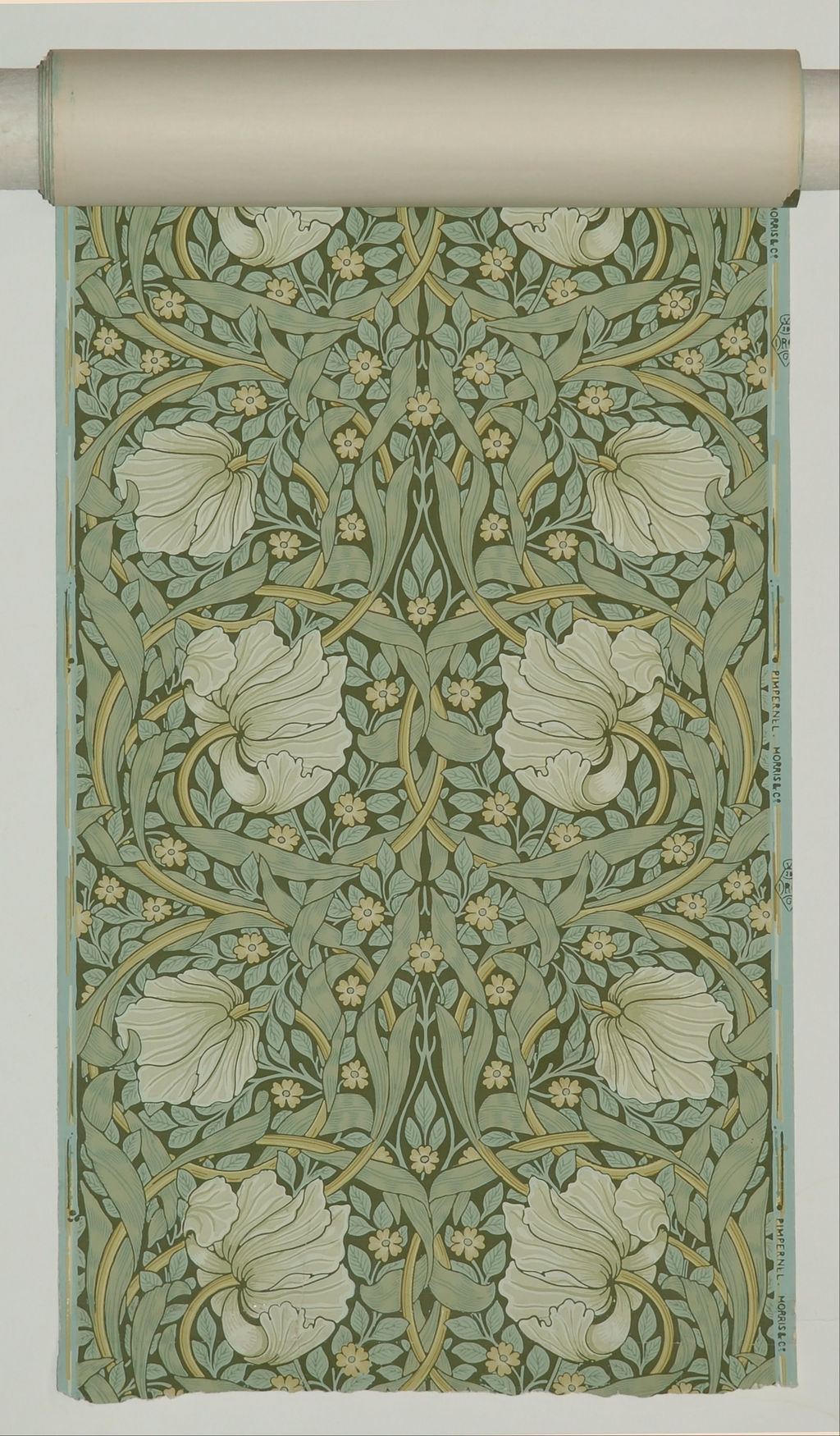
Pimpernel wallpaper in the Museo Nacional de Artes Decorativas, Madrid. The large tulip forms and smaller flowers occupy different scales within the repeat. William Morris. Image source. Public domain.
How flowers hide and reveal a framework
Behind the abundant vegetation lies a limited set of organising possibilities. In the 1881 lecture, Morris described two principal constructions for continuous patterns: a branch travelling diagonally and a net based on diamonds. These were leading lines, capable of innumerable variations. They could remain visible or disappear beneath the motifs arranged upon them. Once this is understood, the pleasure of a Morris pattern includes a double movement: following apparently lively growth and gradually discovering the order that sustains it. [2]
Trellis makes the relationship unusually clear. In the Metropolitan Museum’s printed specimen, pale horizontal and vertical bars sit behind thorny green rose stems. Red flowers punctuate the growth; blue birds turn, perch and spread their wings between the bars. The stems cross the lattice without dissolving it, so two different kinds of order remain legible: the built support and the plant growing across it. Dark outlines hold leaves, thorns and flowers together on the light ground. [5]
The William Morris Gallery dates the original design to 1862 and relates it to the rose trellises at Red House. It also credits Philip Webb with the birds. This is a particular garden connection and a particular collaboration, rather than evidence that every later floral pattern came directly from Morris’s own planting. Webb’s birds matter to the composition because their changing poses interrupt the steadier rhythm of the support and foliage. The effect of a garden depends on more than its flowers. [6]
In Pimpernel, the framework is less exposed. The reproduced roll from the Madrid collection shows large pale tulips carried on looping stems, with long leaves turning through the intervals. Smaller flowers and leaf sprays fill the dark spaces. The broadly paired arrangement is easy to sense, but the flower heads turn and bend enough to keep the eye moving around it. The small blooms are structurally important: without them, the large flowers would sit in much more isolated compartments. Their modest size helps explain why the namesake can be less conspicuous than the tulip. [1] [7]
Colour changes which layer first catches the eye. The William Morris Gallery describes small blue pimpernels in its specimen; the Madrid reproduction has small pale flowers against its green-brown ground. These are different colour presentations of the design. Neither gives permission to identify every stylised bloom by colour alone. For the French specimen in Paris, Les Arts Décoratifs records six-colour woodblock printing over a hand-brushed green ground, showing how the apparent continuity of a growing plant was assembled through separate operations. [1] [7] [8]
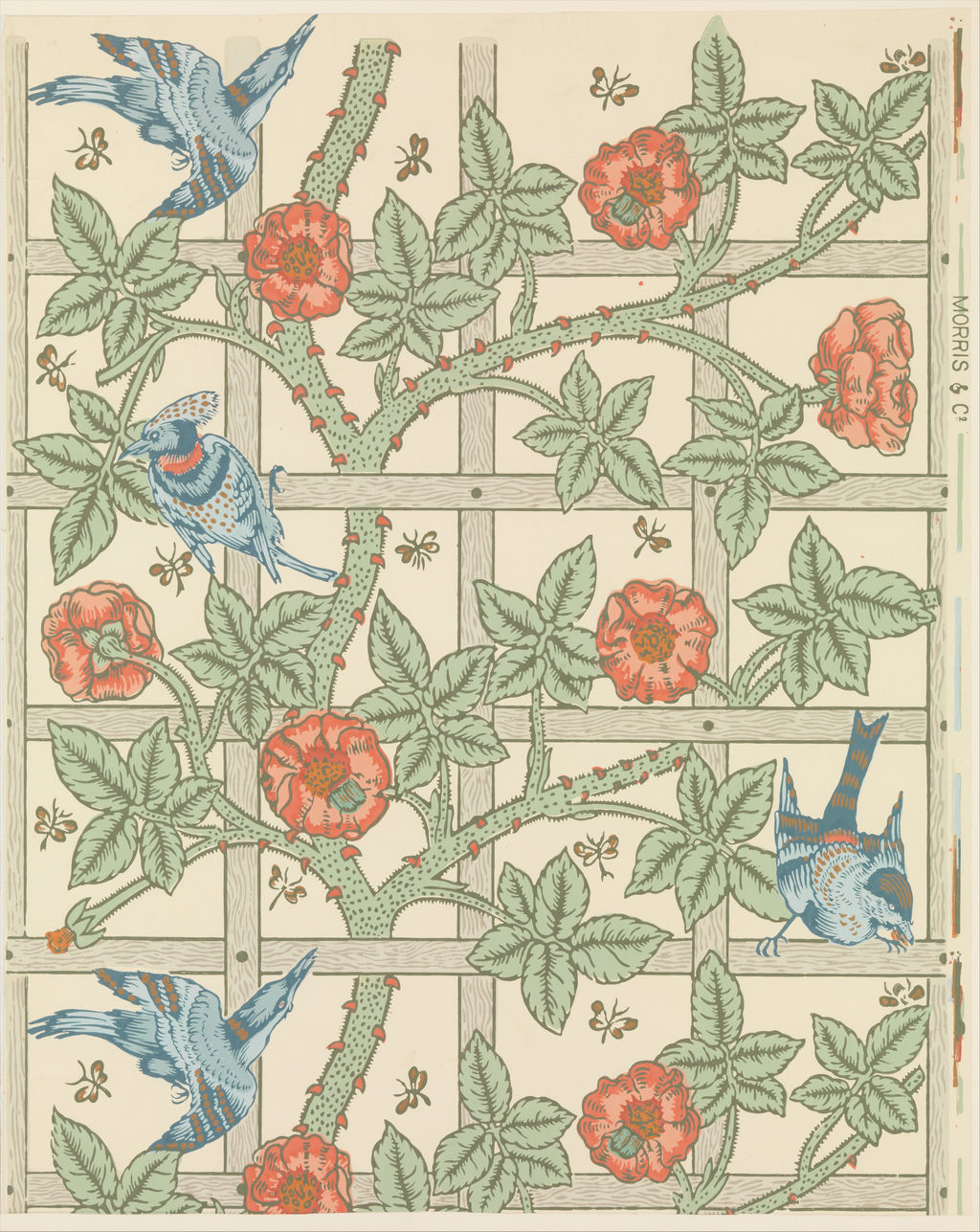
Trellis wallpaper in the Metropolitan Museum of Art. Morris designed the pattern; Philip Webb supplied its birds. The sheet is distinct from the original working drawing. Purchase, Edward C. Moore Jr. Gift, 1923. Image source. CC0 / Public domain.
A working drawing exposes the decisions
The drawing for Wreath in the Art Gallery of South Australia makes the transformation from outlined proposal to coloured ornament especially visible. Its central painted area contains curling foliage and blue, pink and pale flower heads. Around it, outlined flowers and leaves continue across unpainted paper. The coloured passages let us see the effect of closely packed growth; the unfinished passages make individual shapes easier to follow. Handwritten notes also occupy the margins. The object is a gouache and pencil drawing, catalogued around 1876, rather than a sheet of printed wallpaper. [3]
Here, colour is part of the structure. The dark intervals separate the lighter flower heads and leaf edges, while differently coloured flowers shift the emphasis from one position to another. An outline alone cannot show that balance. Moving between the painted centre and the unfinished edges makes the designer’s problem tangible: each motif has to work both as an individual shape and as a contribution to a larger field. The corresponding 1876 wallpaper at the V&A is a separate object, printed by Jeffrey & Co.; its catalogue describes entwined green leaves and blue flowers. [3] [9]
The William Morris Gallery’s Chrysanthemum design, A33, provides more explicit evidence of repeat construction. Its account of the 1877 pencil and watercolour drawing explains that the unfinished lower portion exposes a pencil grid used to help repeat and transfer elements by hand. The grid is therefore documented evidence for this sheet, rather than a technique to assume beneath every Morris drawing. It gives a practical counterpart to the lecture’s leading lines: the apparently effortless growth had to be located and repeated accurately. [10]
In the digitally enhanced Smithsonian-derived Chrysanthemum reproduction, large light flower heads turn in different directions among broad, deeply cut leaves. A finer network of small leaves continues behind them. The large blooms create intervals of emphasis, the broad foliage carries movement between them, and the small background growth prevents those intervals becoming empty holes. This reproduction is useful for tracing the arrangement, although its enhancement cannot establish the original colour of A33 or any particular Victorian printed specimen. [11]
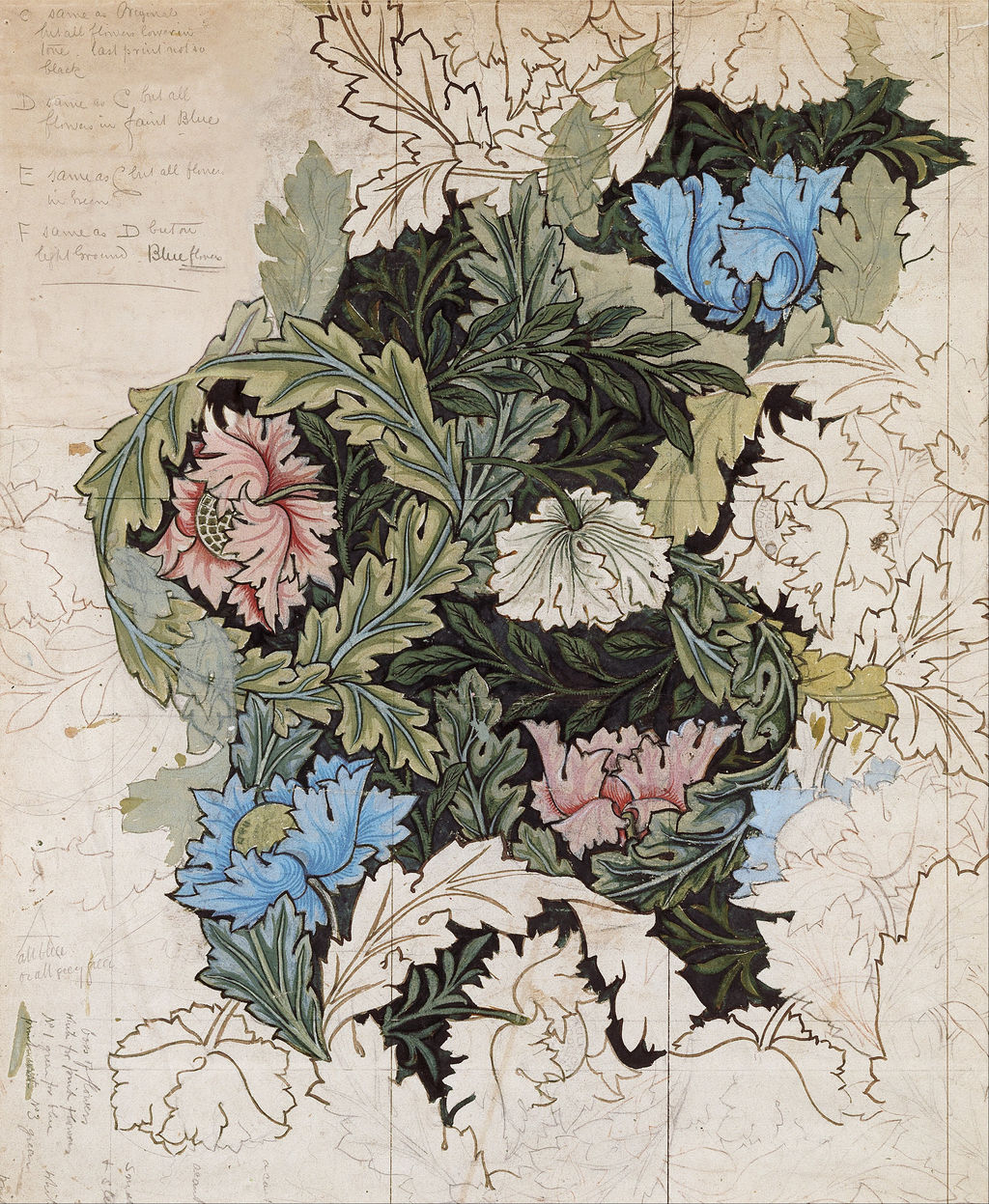
Working design for Wreath wallpaper, Art Gallery of South Australia 20032D1. Coloured passages sit beside uncoloured outlines and written notes. MORRIS & COMPANY, London (1861 - 1940) (Britain) Details on Google Art Project. Image source. Public domain.
Paper flowers, woven flowers and flowers made with a needle
A flower’s shape had to answer to its material. Morris’s lecture asks for flowers and leaves suited to woodblock printing when discussing wallpaper. Printed colour needs definite boundaries. On a flat wall the designer must also distribute the pattern evenly and disguise the repeat sufficiently to avoid making the occupant count it. The richness of a flower head, the direction of a branch and the little forms filling a gap all contribute to this larger task. Elaborate detail is useful only when it serves the surface. [2]
Marigold shows how much can happen within a restricted palette. The Met’s blue-and-cream specimen combines large pale flowers and sweeping narrow leaves with a smaller, closely packed floral ground. The eye can distinguish the principal stems without losing the activity between them. Fine lines inside the pale leaves give them texture while retaining their broad silhouette. What initially looks like dense botanical abundance depends on the contrast between a few larger movements and many smaller incidents. [12]
The William Morris Gallery records Marigold as registered for wallpaper in 1875, possibly designed around 1873, and registered as a chintz later in 1875. It identifies the pattern as one of the few Morris deliberately intended for both paper and textile. That exceptional crossover is a reminder to consider the intended medium of each design, even when modern reproductions make floral patterns readily available on many different products. [13]
Morris explained why cloth raised different questions. Printed cotton generally folds or turns around furniture, breaking up the pattern and adding changing light and shade. Its design therefore need not hide its underlying structure as anxiously as a flat paper. He welcomed a more fantastic treatment of plants and animals for chintz, while insisting that every extra manufacturing process should add enough beauty to justify the labour. Complexity was something to earn. It was not automatically an artistic achievement. [2]
African Marigold is a separate design, not a longer name for Marigold. The William Morris Gallery presents its 1876 drawing as a design for printed cotton and notes the alterations and erased lines on the sheet. It records printing by Wardle & Co. at Leek. This example brings revision into the story: the flow of the pattern was worked out, adjusted and coloured, with a specific form of manufacture in view. Their similar names conceal different design histories. [14]
For repeating woven cloth, Morris asked for bolder scale, clear details and a concentrated structure. The weave and the play of light on folds would contribute effects that the designer of a flat paper had to supply through drawing alone. He treated tapestry separately. Its rich dyed threads and capacity for successive planes of foliage could, he suggested, bring a wall close to the experience of a rose hedge or forest. These distinctions matter when looking across textiles: a repeated woven furnishing fabric and a tapestry do not give a flower the same technical possibilities. [2]
Embroidery offered another kind of freedom. Morris described it as “gardening with silk and gold-thread”, but also insisted that its recognisable roses, jonquils and tulips should respect the needlework and its beautiful materials. His pottery discussion made a related demand. A painted flower had to answer to the confined or unusual shape of a plate or tile, the available pigments and the handling of the loaded brush. Botanical observation entered a sequence of decisions about thread, surface, contour and execution. Knowledge of the flower alone could not supply those decisions. [2]
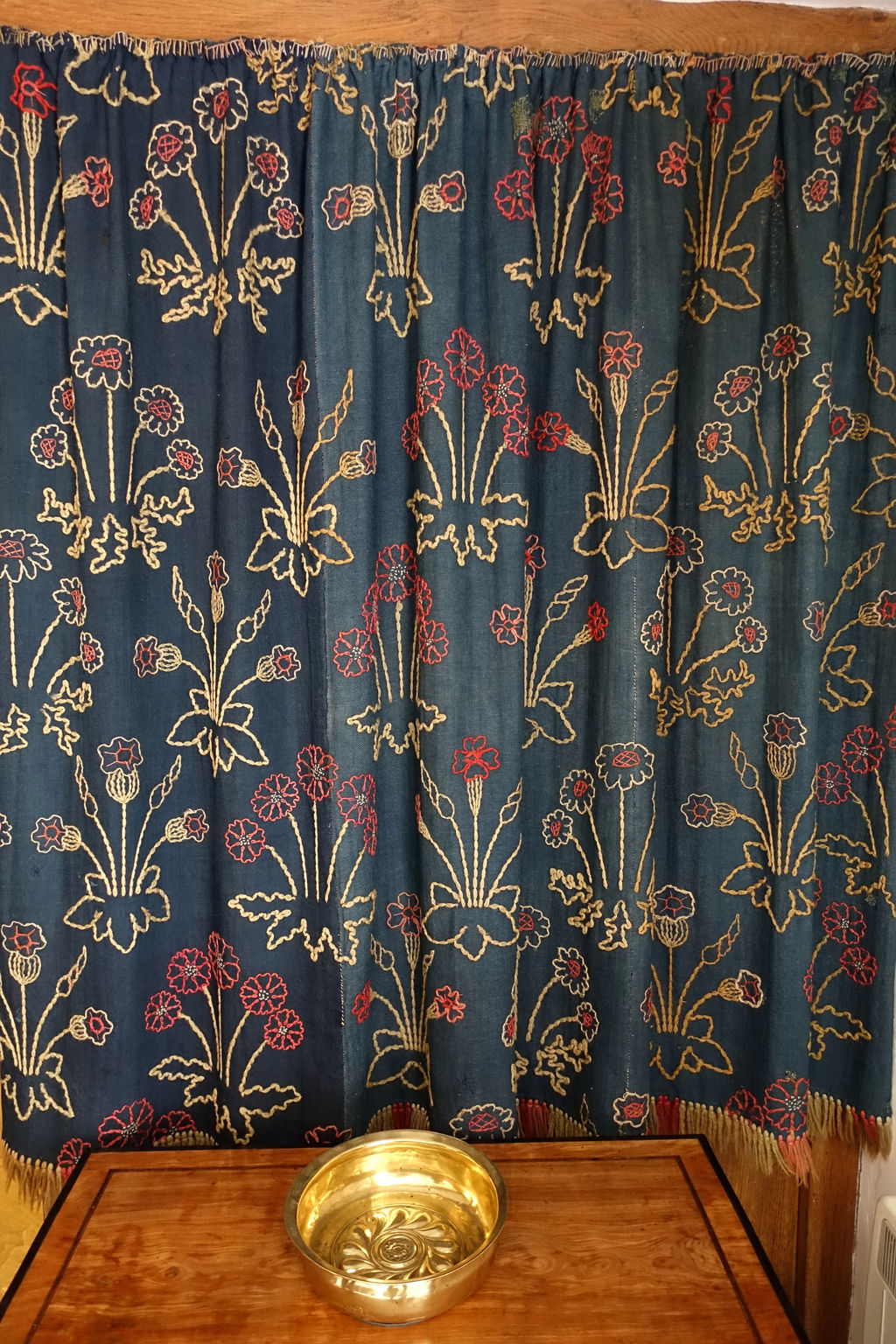
Daisy embroidered hanging photographed in an interior setting. The flower motifs and their stitched outlines remain distinct from printed pattern. Daderot. Image source. Public domain.
English landscapes and a wider history of ornament
Morris’s familiar plants existed alongside a sustained study of historical design. In the 1881 lecture he urged designers to study the history of their craft while making a style of their own. His examples of diagonal branches and nets included Sicilian and Italian patterns. His broader historical rankings belong to his Victorian argument, but the practical point remains clear: studying old ornament could reveal ways of organising growth. Familiarity with local plants did not exclude learning from other places or periods. [2]
Evenlode brings these interests together. The William Morris Gallery records its 1883 design as named after a Thames tributary and based on a seventeenth-century Italian cut velvet acquired for the South Kensington Museum’s historical textile collection. Its curtain specimen is cotton, made with indigo discharge and block printing. The river name, historical model and manufacturing method each explain something different about the design. A name associated with an English landscape does not establish an exclusively English source for its construction. [15]
The V&A’s account of woven furnishings traces Morris’s models to sixteenth- and seventeenth-century Italian silks. It also identifies Granada, designed in 1884, with his attempt to reproduce the complex structures of earlier brocaded Flemish velvets. Its discussion of carpets connects his hand-knotted rugs with the study of Persian examples. Historical learning thus concerned the making and texture of a patterned surface as well as the shapes placed upon it. A recognisable garden flower could enter a textile whose structural ideas came from a much wider geographical and historical world. [16]
Leaves could carry the nature reference without showy flower heads. The William Morris Gallery describes Willow, designed in 1874, as stylised branches on a plain background, and Willow Bough, from 1887, as a more naturalistic development. Its comparison suggests a range of choices within plant ornament, from simplification towards fuller growth. “Naturalistic” remains a relative description here: both are wallpapers whose branches must form a repeat. They are separate designs, not alternative dates for one unchanged arrangement. [17]
Look at the plant, then check the name
Names guide attention but cannot do all the looking. In the Met’s Fruit, branches carry recognisable fruits and blossoms across a blue ground. The exposed seeds of split pomegranates and the pointed oval fruits provide distinct shapes, while their stems organise a continuous field. The museum identifies the mixture as lemons, oranges, pomegranates and peaches. Such an invented combination has decorative coherence without being a record of one tree, one season or an English hedgerow. [18]
The same care applies to the designer’s name. Horn Poppy, designed around 1885, is May Morris’s work. The William Morris Gallery describes horned poppy flowers against a dotted ground and credits Jeffrey & Co. with printing. Lynn Hulse’s Ashmolean account of May’s practice includes her 1882 study of a yellow-horned poppy and explains her translation of observed plants into embroidery patterns. The study and wallpaper are valuable comparisons, but their shared subject does not by itself prove that the drawing was preparatory for the paper. [19] [20]
Blackberry and Hyacinth belong to John Henry Dearle. The Gallery’s Hyacinth account describes an ogee framework connecting the repeat: here again, plant forms depend on a designed system. These individual credits make the company’s floral output more intelligible. A family resemblance among patterns sold by Morris & Co. is compatible with different designers making their own decisions about line, density and growth. [21] [22]
Morris’s claim that ornament should suggest something beyond itself leaves room for memory and association. It does not supply a dictionary in which each species has a fixed secret meaning. His rose hedge offers a more useful way to look: follow how the stems support their flowers, how the gaps are filled, where one layer passes behind another and how the material makes those relationships possible. The living world enters the room through those constructed relationships. [2]
Works and designs directory
This directory brings together 365 design, edition and collection records, plus 208 individually listed samples from three historical sample books. Design families, surviving objects, later printings and book editions have separate entries. It covers the research assembled for these articles, rather than the full output of Morris and his associates. Dates and attributions follow the named catalogues; differences are retained where they matter. Search by title, designer, material, collection, accession or colourway.
| Name | Date | Medium |
|---|---|---|
| Blackberry | Design: early twentieth century; specimens catalogued 1903 | Wallpaper |
| Hyacinth | Design: c.1900–12 | Wallpaper |
| Horn Poppy | Design: c.1885 | Wallpaper |
| Chrysanthemum | Design: 1877; some later catalogues say 1876 | Wallpaper |
| Fruit or Pomegranate | Design dates reported: 1862 / 1865–66 | Wallpaper |
| Jasmine | Design: 1871–72; wallpaper issued 1872 | Wallpaper |
| Larkspur | Design/issue dates reported: 1872–75 | Wallpaper |
| Marigold | Design: 1873–75; registered 1875 | Wallpaper |
| Pimpernel | Design/registration: 1876 | Wallpaper |
| Willow | Design: 1874 | Wallpaper |
| Wreath | Design: c.1876 | Wallpaper |
| Trellis | Design: November 1862; registered 1864 | Wallpaper |
| Bird | Design: 1877–78; registered 1878 | Textile |
| Bird — Met 23.163.15 | Design: 1877–78; registered 1878; specimen: unknown | Textile |
| Bird — DIA F1986.48 | Specimen: 1878 | Textile |
| Bird — WMG F283b | Design: 1877–78; registered 1878; specimen: unknown | Textile |
| Bird — Orsay OAO 1249 1 | Design: 1877–78; registered 1878; specimen: unknown | Textile |
| Cabbage and Vine | Design: 1879 | Textile |
| Cabbage and Vine — SAL KM032 | Specimen: 1879 | Textile |
| Cabbage and Vine — V&A E.45-1940 | Drawing/cartoon: 1879 | Drawing |
| Cabbage and Vine — V&A E.3472-1932 | Drawing/cartoon: 1879 | Drawing |
| Evenlode | Registered: 2 September 1883 | Textile |
| Evenlode — WMG F325a | Registered: 2 September 1883; specimen: unknown | Textile |
| Evenlode — Cincinnati 1993.144 | Specimen: 1883–1900 | Textile |
| La Belle Iseult | Painting: conventionally dated 1858 | Painting |
| Study for La Belle Iseult — Christie’s lot 5807506 | Study date: unknown | Drawing |
| Membland Hall Tile Panel | Design: 1876; Orsay model c.1876–77 | Drawing |
| Membland Hall Tile Panel — V&A C.36-1972 | Design/panel: 1876 | Ceramics |
| Membland Hall Tile Panel — WMG C176 | Design/panel: 1876 | Ceramics |
| Design for Membland Hall tile panel — WMG A31 | Drawing: 1876 | Drawing |
| Membland Hall Tile Panel — Orsay OAO 1210 | Model: c.1876–77; specimen: unknown | Ceramics |
| Membland Hall Tile Panel — Cologne E04941 | Design: 1876; specimen: unknown | Ceramics |
| Peacock and Dragon | Design: 1878 | Textile |
| Peacock and Dragon — WMG F26cii | Design: 1878; specimen: unknown | Textile |
| Peacock and Dragon — Met 30.95.52 | Design: 1878; specimen: unknown | Textile |
| Snakeshead | Design: 1876 | Textile |
| Snakeshead — WMG F345 | Design: 1876; specimen: unknown | Textile |
| Snakeshead — Huntington 2000.5.525 | Specimen: c.1876 | Textile |
| Snakeshead — Birmingham 1941M398 | Specimen: 1876–77 | Textile |
| Snakeshead — WMG F366 | Design: 1876; specimen printed after 1917 | Textile |
| Strawberry Thief | Design: 1883 | Textile |
| Strawberry Thief — WMG F422b | Design: 1883; specimen: unknown | Textile |
| Strawberry Thief — Huntington 2000.5.523 | Specimen: c.1883 | Textile |
| Strawberry Thief — Cleveland 1937.696 | Specimen: c.1936 | Textile |
| Tulip and Willow | Design: 1873 | Textile |
| Tulip and Willow — WMG F3 | Design: 1873; specimen printed after 1883 | Textile |
| Tulip and Willow — V&A CIRC.91-1933 | Catalogue date: 1873; manufacture unknown | Textile |
| The Attainment or Vision of the Holy Grail | Design cycle: 1890–91 | Textile |
| The Attainment or Vision of the Holy Grail — Birmingham 1907M131 | Specimen: 1895–96 | Textile |
| The Attainment or Vision of the Holy Grail — Stanmore original Attainment | Woven by 1893 (original Attainment) | Textile |
| The Attainment or Vision of the Holy Grail — McCulloch repeat group | Specimen: 1898–99 | Textile |
| The Attainment or Vision of the Holy Grail — Beecham Attainment/Summons | Specimen: 1927–32 | Textile |
| Wandle | Design: 1884 | Textile |
| Wandle — WMG F50 | Design: 1884; specimen: unknown | Textile |
| The Kelmscott Chaucer | Edition: 1896; issued 26 June | Book |
| The Kelmscott Chaucer — WMG K20 | Specimen: 1896 | Book |
| The Kelmscott Chaucer — Morgan PML76849 | Edition: 1896; issued 26 June; specimen: unknown | Book |
| The Kelmscott Chaucer — Birmingham special-bound copy | Edition: 1896; issued 26 June; specimen: unknown | Book |
| The Kelmscott Chaucer — UMD2010acquisition | Edition: 1896; issued 26 June; specimen: unknown | Book |
| Woodpecker Tapestry | Design/tapestry: 1885 | Textile |
| Woodpecker Tapestry — WMG F139 | Specimen: 1885 | Textile |
| Larkspur — V&A E.468-1919 | Design/issue dates reported: 1872–75; specimen: unknown | Wallpaper |
| Marigold — V&A E.478-1919 | Design: 1873–75; registered 1875; specimen: unknown | Wallpaper |
| Willow — V&A E.488-1919 | Specimen: 1874 (Produced) | Wallpaper |
| Pimpernel — V&A E.497-1919 | Design/registration: 1876; specimen: unknown | Wallpaper |
| Wreath — V&A E.501-1919 | Specimen: 1876 (Produced) | Wallpaper |
| Chrysanthemum — V&A E.802-1915 | Specimen: 1877 (made) | Wallpaper |
| Fruit — V&A E.2210-1913 | Specimen: 1866 (produced) | Wallpaper |
| Blackberry — V&A E.2793-1980 | Specimen: 1903 (made) | Furniture |
| Blackberry — V&A E.2794-1980 | Specimen: 1903 (made) | Furniture |
| Blackberry — V&A E.2839-1980 | Specimen: 1903 (made) | Furniture |
| Blackberry — V&A E.1415-1979 | Specimen: c. 1955 (printed) | Wallpaper |
| Hyacinth — V&A E.1416-1979 | Specimen: c. 1955 (printed) | Wallpaper |
| Trellis — V&A E.452-1919 | Specimen: 1864 (manufactured) | Wallpaper |
| Willow Bough | Design: 1887 | Wallpaper |
| Willow Bough — V&A E.558-1919 | Specimen: 1887 (made) | Wallpaper |
| Blackberry — B179 | Specimen: c.1960s | Wallpaper |
| Hyacinth — B101 | Specimen: 1968 | Wallpaper |
| Horn Poppy — B155 | Specimen: 1885–1920 | Wallpaper |
| Horn Poppy — B112b | Design: c.1885; specimen: unknown | Wallpaper |
| Chrysanthemum — B172 | Specimen: c.1960 | Wallpaper |
| Fruit — B9a | Design dates reported: 1862 / 1865–66; specimen: unknown | Wallpaper |
| Larkspur — B11c | Design/issue dates reported: 1872–75; specimen: unknown | Wallpaper |
| Marigold — B40 | Specimen: before 1940 | Wallpaper |
| Pimpernel — B13 | Specimen: before 1940 | Wallpaper |
| Willow — B69 | Specimen: before 1940 | Wallpaper |
| Willow Bough — B22 | Specimen: after 1940; presented 1950 | Wallpaper |
| Poppy or Wreath — B15 | Specimen: c.1950 | Wallpaper |
| Wreath — 20032D1 | Specimen: c.1876 | Drawing |
| Design for Chrysanthemum — A33 | Drawing: 1877 | Drawing |
| Design for Trellis — BLA472 | Drawing: 1862 | Drawing |
| Trellis — B31 | Specimen: before 1940 | Wallpaper |
| Larkspur printing block — R253 | Design/issue dates reported: 1872–75; specimen: unknown | Printing block |
| Jasmine — 23.163.4j | Catalogue date: 1872; manufacture unknown | Wallpaper |
| Marigold — 23.163.4c | Catalogue date: 1875; manufacture unknown | Wallpaper |
| Willow Bough — 23.163.4k | Catalogue date: 1887; manufacture unknown | Wallpaper |
| Larkspur — 23.163.4i | Catalogue date: 1875; manufacture unknown | Wallpaper |
| Fruit or Pomegranate — 23.163.4g | Catalogue date: c.1866; manufacture unknown | Wallpaper |
| Chrysanthemum drawing — 2000.5.61 | Specimen: c.1877 | Drawing |
| The Pimpernel — HH3016 | Specimen: c.1876 | Wallpaper |
| Marigold — M.2003.6.2 | Design: 1873–75; registered 1875; specimen: unknown | Wallpaper |
| Marigold textile — 1937.699 | Specimen: twentieth century | Textile |
| An Angel with a Harp — Tate A00815 | Work date: unknown | Drawing |
| An Angel with a Pipe — Tate A00816 | Work date: unknown | Drawing |
| A Girl with a Flute — Tate A00817 | Work date: unknown | Drawing |
| Design for Tapestry — Tate A00818 | Work date: unknown | Drawing |
| The Archangel Raphael — Tate A00819 | Work date: unknown | Drawing |
| The Archangel Gabriel — Tate A00820 | Work date: unknown | Drawing |
| La Belle Iseult — Tate N04999 | Work: 1858 | Painting |
| The Archangel Gabriel — Tate N05219 | Work date: unknown | Drawing |
| Figure of Guinevere — Tate N05221 | Work: c.1858 | Drawing |
| Guinevere and Iseult: Cartoon for Stained Glass — Tate N05222 | Work: 1862 | Drawing |
| Angel of the Resurrection: Cartoon for Stained Glass — Tate N05223 | Work: 1862 | Drawing |
| Daisy tile | Specimen: c. 1870 | Ceramics |
| Alceste tile | Specimen: c. 1862 | Ceramics |
| The Labours of the Month | Specimen: 1862 | Ceramics |
| Trellis — Met 23.163.4h | Catalogue date: 1864; manufacture unknown | Wallpaper |
| Trellis — William Morris Gallery B132a | Design: November 1862; registered 1864; specimen: unknown | Wallpaper |
| Trellis — Standen NT1213907 | Design: November 1862; registered 1864; specimen: unknown | Wallpaper |
| Trellis — loose sample-book page B133 | Specimen: printed before 1917 | Wallpaper |
| Sussex armchair — G29 | Design: c.1860s; specimen: unknown | Furniture |
| Sussex chair — G51 | Specimen: c.1868 | Furniture |
| Round-seated Sussex chair — 1214043.2 | Specimen: c.1870 | Furniture |
| Oval centre table — 1213993 | Specimen: c.1870 | Furniture |
| The Backgammon Players — 26.54 | Specimen: 1861 | Painting |
| Table de travail — OAO450 | Specimen: c.1860–68 | Furniture |
| King David the Poet — 1998.231 | Specimen: 1863 | Stained glass |
| Eve and the Virgin cartoon — A8 | Drawing: 1864 drawing; window installed 1865 | Drawing |
| Design for Mermaid woven fabric — A32b | Drawing: c.1880; mermaid figures 1875 | Drawing |
| Wreath carpet point paper — BlA477 | Drawing: c.1870 | Drawing |
| A Note by William Morris on His Aims in Founding the Kelmscott Press — K260 | Edition: March 1898; exact date statements differ | Book |
| Oak cabinet for Kelmscott Press books — no accession supplied | Design: unknown; specimen: unknown | Furniture |
| Stained-glass quarry design, Diplacus punicus / Nihil Desperandum — WMG BLA444 | Drawing date: unknown | Drawing |
| House of Retreat, Crowborough: rose window design — WMG BlA405 | Drawing: c.1913 | Drawing |
| Circular embroidery design with flower and butterfly — WMG A993 | Drawing date: unknown | Drawing |
| Aquilegia quarry design — WMG BLA447 | Drawing date: unknown | Drawing |
| Carnation textile design — WMG A1070 | Drawing: c.1875 | Drawing |
| Wallpaper design with roses and acanthus — WMG BlA503 | Drawing: c. 1880-1900 | Drawing |
| Rottingdean Grail cartoon, fourth panel — WMG A208.4 | Drawing: 1886 | Drawing |
| Rottingdean Grail cartoon, second panel — WMG A208.2 | Drawing: 1886 | Drawing |
| Rottingdean Grail cartoon, third panel — WMG A208.3 | Drawing: 1886 | Drawing |
| Thisbe embroidery design — WMG A211 | Drawing: c. 1863-4 | Drawing |
| Prophet predella cartoon for Jesus College Chapel — WMG A256 | Drawing: 1877 | Drawing |
| Rottingdean Grail cartoon, first panel — WMG A208.1 | Drawing: 1886 | Drawing |
| Designs for embroidery frames — WMG A307 | Drawing: c.1910s | Drawing |
| Flower Garden embroidery design — WMG A218 | Drawing: c.1892 | Drawing |
| Design possibly for painted panelling — WMG A476 | Drawing: 2.1.1886 | Drawing |
| Annunciation cartoon for St Michael and All Angels, Brighton — WMG A4 | Drawing: 1862 | Drawing |
| Design for reversible embroidered table cover — WMG BlA456 | Drawing: c. 1880 | Drawing |
| Combe Court panelled ceiling design — WMG A294 | Drawing: 1890s | Drawing |
| Circular embroidery design with flowers and leaves — WMG A249 | Drawing: 1880-90s | Drawing |
| Carpet design for Miss Beardmore — WMG BLA458 | Drawing: 1875-1877 | Drawing |
| Acanthus embroidery design — WMG A459 | Drawing: 1870s | Drawing |
| Stained-glass quarry design for Jesus College, Cambridge — WMG BlA439 | Drawing: 1873 | Drawing |
| Stained-glass quarry design for Duke of Westminster — WMG BlA440 | Drawing: 1876 | Drawing |
| Stained-glass roundel design with seated young man — WMG BLA487a | Drawing: c. 1930s | Drawing |
| Design for tapestry sofa upholstery — WMG A34 | Drawing: 1880s/early 1900s | Drawing |
| King Arthur and Sir Lancelot stained-glass design — WMG A262 | Drawing: 1862 | Drawing |
| Peacock embroidery-frieze design — WMG A209 | Drawing: c.1875 | Drawing |
| Drawing-room cornice, 9 Chesterfield Gardens — WMG A301 | Drawing: 1880s | Drawing |
| The Flight into Egypt stained-glass design — WMG A260 | Drawing: 1872 | Drawing |
| Lily and Pomegranate wallpaper design — WMG A30 | Drawing: 1886 | Drawing |
| Sideboard inlay design — WMG A1071 | Drawing: c1890 | Drawing |
| Pelican design from the Brampton east window — WMG A136 | Drawing: c.1880 | Drawing |
| African Marigold textile design — WMG BLA464 | Drawing: 1876 | Drawing |
| Medway textile design — WMG A38 | Drawing: 1885 | Drawing |
| East-window canopy, St John the Apostle — WMG BLA413 | Drawing: 1865 | Drawing |
| Window canopy for Christ Church — WMG BLA416 | Drawing: 1865 | Drawing |
| Canopy tracery design — WMG BlA410 | Drawing: 1863 | Drawing |
| Architectural canopy for All Saints Church — WMG A429 | Drawing: 1862 | Drawing |
| The Orchard embroidery design — WMG D294vi | Drawing: 1888 | Drawing |
| Medway working design for block cutters — WMG BLA453 | Drawing: 1885 | Drawing |
| Swivel woven-textile design — WMG BLA465 | Drawing: 1877 | Drawing |
| Red House corridor stained-glass panel designs — WMG BLA436a & b | Drawing: c.1861 | Drawing |
| Two-light window scale drawing — WMG BLA342 | Drawing date: unknown | Drawing |
| Dundee Parish Church memorial-window design — WMG BLA371 | Drawing: c.1874 | Drawing |
| Good Shepherd and Caritas cartoon — WMG BLA364 | Drawing date: unknown | Drawing |
| St Paul’s Montreal window design — WMG BLA354 | Drawing date: unknown | Drawing |
| Honeycomb carpet design — WMG A39 | Drawing: 11.02.1876 | Drawing |
| Wreath three-ply Kidderminster carpet design — WMG BLA480 | Drawing: 1875-1880 | Drawing |
| St Cecilia, Halewood window design — WMG A519 | Drawing: 1881 | Drawing |
| Stained-glass quarry design for 17 Charles Street — WMG BlA438 | Drawing: 1874 | Drawing |
| Parable of the Vineyard cartoon, A268 — WMG A268 | Drawing: 1861 | Drawing |
| Sailing-ship embroidery design — WMG A250 | Drawing date: unknown | Drawing |
| Parable of the Vineyard cartoon, A267 — WMG A267 | Drawing: c.1861 | Drawing |
| Formal net pattern with leaves and flowers — WMG BLA483 | Drawing date: unknown | Drawing |
| Wallpaper design and tracing with pink flowers — WMG A1424:1 | Drawing: 1908-1910 | Drawing |
| Panel-and-tile scheme for 1 Palace Green — WMG A25 | Drawing: c. 1879-80 | Drawing |
| Frieze scheme for 1 Palace Green — WMG A26 | Drawing: 1868-81 | Drawing |
| The Story of the Glittering Plain (first Kelmscott edition) — A1 | Edition: 1891 | Book |
| Poems by the Way — A2 | Edition: 1891 | Book |
| The Love-Lyrics and Songs of Proteus — A3 | Edition: 1892 | Book |
| The Nature of Gothic — A4 | Edition: 1892 | Book |
| The Defence of Guenevere and Other Poems — A5 | Edition: 1892 | Book |
| A Dream of John Ball and A King's Lesson — A6 | Edition: 1892 | Book |
| The Golden Legend — A7 | Edition: 1892 | Book |
| The Recuyell of the Historyes of Troye — A8 | Edition: 1892 | Book |
| Biblia Innocentium — A9 | Edition: 1892 | Book |
| The History of Reynard the Fox — A10 | Edition: 1892 | Book |
| The Poems of William Shakespeare — A11 | Edition: 1893 | Book |
| News from Nowhere — A12 | Edition: 1893 | Book |
| The Order of Chivalry, and L'Ordene de Chevalrie — A13 | Issued: 12 April 1893; catalogue year 1892 | Book |
| The Life of Thomas Wolsey, Cardinal Archbishop of York — A14 | Issued: 3 May 1893; catalogue year 1892 | Book |
| The History of Godefrey of Boloyne and of the Conquest of Iherusalem — A15 | Issued: 24 May 1893; catalogue year 1892 | Book |
| Utopia. — A16 | Edition: 1893 | Book |
| Maud: A Monodrama — A17 | Edition: 1893 | Book |
| Gothic Architecture: A Lecture for the Arts and Crafts Exhibition Society — A18 | Edition: 1893 | Book |
| Sidonia the sorceress — A19 | Edition: 1893 | Book |
| Ballads and Narrative Poems by Dante Gabriel Rossetti — A20 | Edition: 1893 | Book |
| Sonnets and Lyrical Poems — A20a | Edition: 1894 | Book |
| Of King Florus and the fair Jehane — A21 | Edition: 1893 | Book |
| The Story of the Glittering Plain (illustrated edition) — A22 | Edition: 1894 | Book |
| Of the Friendship of Amis and Amile — A23 | Edition: 1894 | Book |
| The Poems of John Keats — A24 | Edition: 1894 | Book |
| Atalanta in Calydon: a Tragedy — A25 | Edition: 1894 | Book |
| The Tale of the Emperor Coustans and of Over Sea — A26 | Edition: 1894 | Book |
| The Wood Beyond the World — A27 | Edition: 1894 | Book |
| The Book of Wisdom and Lies — A28 | Edition: 1894 | Book |
| The Poetical Works of Percy Bysshe Shelley — A29 | Edition: 1895 | Book |
| Psalmi penitentiales — A30 | Edition: 1894 | Book |
| Epistola de contemptu mundi — A31 | Edition: 1894 | Book |
| The tale of Beowulf — A32 | Edition: 1895 | Book |
| Syr Perecyvelle of Gales — A33 | Edition: 1895 | Book |
| The Life and Death of Jason. A Poem — A34 | Edition: 1895 | Book |
| Child Christopher and Goldilind the Fair — A35 | Edition: 1895 | Book |
| Hand & Soul — A36 | Edition: 1895 | Book |
| Poems Chosen Out of the Works of Robert Herrick — A37 | Edition: 1895 | Book |
| Poems Chosen Out of the Works of Samuel Taylor Coleridge — A38 | Edition: 1896 | Book |
| The Well at the World's End — A39 | Edition: 1896 | Book |
| The Earthly Paradise — A41 | Edition: 1896 | Book |
| Laudes Beatae Mariae Virginis — A42 | Edition: 1896 | Book |
| The Floure and the Leafe / The Boke of Cupide — A43 | Issued: 2 November 1896 | Book |
| The Shepheardes Calendar — A44 | Edition: 1896 | Book |
| The Water of the Wondrous Isles — A45 | Edition: 1897 | Book |
| Froissart Chronicles: specimen pages — A46 | Edition: 1896, 1897 | Book |
| Sire Degrevaunt — A47 | Edition: 1896 | Book |
| Syr Ysambrace — A48 | Edition: 1897 | Book |
| Some German Woodcuts of the Fifteenth Century — A49 | Edition: 1898 | Book |
| The Story of Sigurd the Volsung and the Fall of the Niblungs — A50 | Issued: 25 February 1898 | Book |
| The Sundering Flood — A51 | Issued: 25 February 1898; catalogue year 1897 | Book |
| Love is Enough, or the Freeing of Pharamond — A52 | Issued: 24 March 1898; catalogue year 1897 | Book |
| A Note on Aims / A Short Description of the Press — A53 | Issued: 24 March 1898 | Book |
| Wandle — 23.163.10 | Specimen: printed 1917–23 | Textile |
| Snakeshead — 1937.695 | Specimen: early twentieth century | Textile |
| Evenlode curtain — F325b | Registered: 2 September 1883; specimen: unknown | Textile |
| Snakeshead — 1972.395 | Specimen: manufactured 1925–40 | Textile |
| Helen (Flamma Troiae) drawing — E.571-1940 | Caption date: c. 1860; manufacture date unknown | Drawing |
| Lotus wall hanging — T.192-1953 | Caption date: 1875–1880; manufacture date unknown | Textile |
| Wall hanging made by Ada Phoebe Godman — T.166-1978 | Caption date: 1877; manufacture date unknown | Textile |
| Acanthus wall hanging — T.153-1979 | Caption date: c. 1880; manufacture date unknown | Textile |
| Flowerpot embroidered picture — T.68-1939 | Caption date: 1878–1880; manufacture date unknown | Textile |
| Small Stem furnishing textile — T.37-1979 | Caption date: c. 1868; manufacture date unknown | Textile |
| Jasmine Trellis — T.70-1953 | Caption date: 1868–1870; manufacture date unknown | Textile |
| Marigold textile — CIRC.496-1965 | Caption date: 1875; manufacture date unknown | Textile |
| Honeysuckle textile — CIRC.491-1965 | Caption date: 1876; manufacture date unknown | Textile |
| Rose and Thistle — T.634-1919 | Caption date: 1881; manufacture date unknown | Textile |
| Strawberry Thief — T.586-1919 | Caption date: 1883; manufacture date unknown | Textile |
| Cray — CIRC.82-1953 | Caption date: 1884; manufacture date unknown | Textile |
| Tulip and Rose — CIRC.390A-1970 | Caption date: 1876; manufacture date unknown | Textile |
| Peacock and Dragon curtains — T.64&A-1933 | Caption date: 1878; manufacture date unknown | Textile |
| Granada — T.4-1919 | Caption date: 1884; manufacture date unknown | Textile |
| The Forest — T.111-1926 | Caption date: 1887; manufacture date unknown | Textile |
| The Orchard tapestry — 154-1898 | Caption date: 1890; manufacture date unknown | Textile |
| Tulip and Lily — T.101-1953 | Caption date: 1875; manufacture date unknown | Textile |
| Artichoke carpet — T.188-1984 | Caption date: 1875–1880; manufacture date unknown | Textile |
| Floral tile — C.58-1931 | Caption date: 1862; manufacture date unknown | Ceramics |
| Sleeping Beauty tile panel — CIRC.520-1953 | Caption date: 1862–1865; manufacture date unknown | Ceramics |
| Table designed by Philip Webb — W.45-1926 | Caption date: c. 1865; manufacture date unknown | Furniture |
| St George Cabinet — 341:1–8-1906 | Caption date: 1861–1862; manufacture date unknown | Furniture |
| Sideboard — CIRC.540:1–5-1963 | Caption date: c. 1862; manufacture date unknown | Furniture |
| Sunflower — E.513-1919 | Caption date: 1879; manufacture date unknown | Wallpaper |
| St James’s — E.528-1919 | Caption date: 1881; commission 1880; manufacture date unknown | Wallpaper |
| Balmoral — CIRC.16-1961 | Work date: unknown | Wallpaper |
| Pink and Rose — E.708-1915 | Caption date: c. 1890; manufacture date unknown | Wallpaper |
| Compton — CIRC.290-1959 | Caption date: 1896; manufacture date unknown | Wallpaper |
| Tulip frieze (wallpaper design) | Design: unknown | Wallpaper |
| Branch (wallpaper design) | Design: unknown | Wallpaper |
| Daisy (wallpaper design) | Design: 1862 | Wallpaper |
| Scroll (wallpaper design) | Design: c. 1872 | Wallpaper |
| Lily (wallpaper design) | Design: unknown | Wallpaper |
| Powdered (wallpaper design) | Design: c. 1874 | Wallpaper |
| Vine (wallpaper design) | Design: c. 1873 | Wallpaper |
| Acanthus (wallpaper design) | Design: unknown | Wallpaper |
| Honeysuckle (wallpaper design) | Design: 1883 | Wallpaper |
| Wild Tulip (wallpaper design) | Design: unknown | Wallpaper |
| Garden Tulip (wallpaper design) | Design: 1885 | Wallpaper |
| Iris (wallpaper design) | Design: c. 1887 | Wallpaper |
| Autumn Flowers (wallpaper design) | Design: unknown | Wallpaper |
| Norwich (wallpaper design) | Design: c. 1862-96 | Wallpaper |
| Double Bough (wallpaper design) | Design: c. 1884 | Wallpaper |
| Flora (wallpaper design) | Design: late nineteenth century | Wallpaper |
| Blackthorn (wallpaper design) | Design: unknown | Wallpaper |
| Compton (wallpaper design) | Design: 1896 | Wallpaper |
| Celandine (wallpaper design) | Design: late nineteenth century | Wallpaper |
| Golden Lily (wallpaper design) | Design: c. 1880-1917 | Wallpaper |
| Orchard (wallpaper design) | Design: unknown | Wallpaper |
| Seaweed (wallpaper design) | Design: early twentieth century | Wallpaper |
| Daffodil (wallpaper design) | Design: unknown | Wallpaper |
| Meadow Sweet (wallpaper design) | Design: c. 1904 | Wallpaper |
| Persian (wallpaper design) | Design: late 19th century | Wallpaper |
| Sweet Pea (wallpaper design) | Design: c. 1908 | Wallpaper |
| Harebell (wallpaper design) | Design: c. 1911 | Wallpaper |
| Leicester (wallpaper design) | Design: c. 1911-12 | Wallpaper |
| Sweet Briar (wallpaper design) | Design: c. 1912 | Wallpaper |
| Arbutus (wallpaper design) | Design: unknown | Wallpaper |
| Bird and Pomegranate (wallpaper design) | Design: unknown | Wallpaper |
| Brentwood (wallpaper design) | Design: unknown | Wallpaper |
| Indian (wallpaper design) | Design: c. 1868-70 | Wallpaper |
| Morris & Co. Ltd. Wallpaper Pattern Book (post 1917) — B46 | Specimen: after 1917 | Wallpaper |
| Christchurch (wallpaper design) | Design: c. 1882 | Wallpaper |
| Rambler (wallpaper design) | Design: late nineteenth/early twentieth century | Wallpaper |
| Rose (wallpaper design) | Design: 1877 | Wallpaper |
| Brocade (wallpaper design) | Design: late nineteenth century | Wallpaper |
| Triple Net (wallpaper design) | Design: late nineteenth century | Wallpaper |
| Lechlade (wallpaper design) | Design: late nineteenth century | Wallpaper |
| Woodland Weeds (wallpaper design) | Design: late 19th century/early twentieth century | Wallpaper |
| Granville (wallpaper design) | Design: late nineteenth century | Wallpaper |
| Bower (wallpaper design) | Design: c. 1870s | Wallpaper |
| Clover (wallpaper design) | Design: 1903 | Wallpaper |
| Morris & Co. Ltd Wallpaper Pattern Book (c.1913–17) — BlB90 | Specimen: c.1913–17 | Wallpaper |
| Bruges (wallpaper design) | Design: c.1887 (catalogue states 1887–87) | Wallpaper |
| Planet (wallpaper design) | Design: late nineteenth century | Wallpaper |
| Net ceiling (wallpaper design) | Design: 1895 | Wallpaper |
| Sunflower (wallpaper design) | Design: 1879 | Wallpaper |
| Bachelor’s Button (wallpaper design) | Design: 1892 | Wallpaper |
| Bird and Anemone (wallpaper design) | Design: 1881 | Wallpaper |
| Michaelmas Daisy (wallpaper design) | Design: 1912 | Wallpaper |
| Queen Anne (wallpaper design) | Design: c.1868–70 | Wallpaper |
| Borage ceiling (wallpaper design) | Design: 1888-89 | Wallpaper |
| Pink and Rose (wallpaper design) | Design dates reported: c.1890 / 1891 | Wallpaper |
| Poppy (Pink and Poppy) (wallpaper design) | Design: 1880 | Wallpaper |
| Mallow (wallpaper design) | Design: 1879 (Sanderson sample-book catalogue) | Wallpaper |
| Acorn (wallpaper design) | Design: 1879 | Wallpaper |
| Sanderson & Sons Wallpaper Pattern Book (1964) — B89 | Specimen: 1964 | Wallpaper |
| Design for Honeysuckle wallpaper — D7 | Specimen: 1881 (current collection title) | Drawing |
| Arcadia | Design: 1886 | Wallpaper |
| Study of yellow-horned poppy | Specimen: 1882 | Drawing |
| Lily carpet sample — CIRC.65B-1959 | Caption date: c. 1875; manufacture date unknown | Textile |
| Bullerswood carpet — T.31-1923 | Caption date: c. 1889; manufacture date unknown | Textile |
| Design for Oxford Union Ceiling (curved rib of roof) — William Morris Society highlight | Index date: unknown | Drawing |
| Design for Bird, woven wool — William Morris Society highlight | Index date: 1878 | Drawing |
| Design for Windrush printed cotton — William Morris Society highlight | Index date: c.1881 | Drawing |
| Strawberry Thief printed cotton — William Morris Society highlight | Index date: design 1883 | Textile |
| Hammersmith rug — William Morris Society highlight | Index date: 1879 | Textile |
| Design for St Radagunda stained-glass window — William Morris Society highlight | Index date: 1866 | Drawing |
| Design for Ecce Agnus Dei embroidered altar frontal — William Morris Society highlight | Index date: 1868 | Drawing |
| Design for Lamb and Flag embroidered altar frontal — William Morris Society highlight | Index date: 1868 | Drawing |
| Westward Ho! embroidery — William Morris Society highlight | Index date: 1885 | Textile |
| Minstrel with Cymbals embroidery — William Morris Society highlight | Index date: 1885 | Textile |
| Sussex chair — William Morris Society highlight | Index date: c.1865 | Furniture |
| Socialist League membership card — William Morris Society highlight | Index date: 1885 | |
| Stained-glass quarries for Sandroyd — William Morris Society highlight | Index date: 1861 | Stained glass |
| Sussex chair — 2003.14 | Specimen: c.1870 | Furniture |
| Violet and Columbine reclining chair — 2005.2 | Specimen: c.1880 | Furniture |
| Cinderella tile panel — 2000.5.1872 | Specimen: 1862–65 | Ceramics |
| David Healey memorial window, Heywood — 2000.5.530 | Specimen: 1898 | Stained glass |
| Invitation for tapestry viewing — 2000.5.1554 | Design: unknown; specimen: unknown | |
| Pink and Rose printing block — 2000.5.1874 | Design: unknown; specimen: unknown | Printing block |
| Flower Garden embroidered panel — 1983.160a | Commissioned: 30 May 1892 | Textile |
| Flower Garden companion panel — 1983.160b | Commissioned: 30 May 1892 | Textile |
| Fruit Garden pair — Boston accession reported as 1893.160c & d | Design: before 1890; commissioned 30 May 1892 | Textile |
| The Orchard embroidered panel — CIRC.206-1964 | Specimen: 1894 | Textile |
| Peacock embroidery frieze — F430 | Design: unknown; specimen: unknown | Textile |
| Hammersmith rug belonging to Dorothy Walker — 02344 | Design: unknown; specimen: unknown | Textile |
| Garden Tulip original design — 1941p412 | Drawing date: unknown; related textile design 1885 | Drawing |
| Tulip frieze — B46, sample 1 | Sample book: after 1917 | Wallpaper |
| Tulip frieze — B46, sample 2 | Sample book: after 1917 | Wallpaper |
| Willow — B46, sample 3 | Sample book: after 1917 | Wallpaper |
| Willow — B46, sample 4 | Sample book: after 1917 | Wallpaper |
| Willow — B46, sample 5 | Sample book: after 1917 | Wallpaper |
| Willow — B46, sample 6 | Sample book: after 1917 | Wallpaper |
| Willow — B46, sample 7 | Sample book: after 1917 | Wallpaper |
| Willow — B46, sample 8 | Sample book: after 1917 | Wallpaper |
| Willow — B46, sample 9 | Sample book: after 1917 | Wallpaper |
| Willow — B46, sample 10 | Sample book: after 1917 | Wallpaper |
| Willow Bough — B46, sample 11 | Sample book: after 1917 | Wallpaper |
| Willow Bough — B46, sample 12 | Sample book: after 1917 | Wallpaper |
| Willow Bough — B46, sample 13 | Sample book: after 1917 | Wallpaper |
| Willow Bough — B46, sample 14 | Sample book: after 1917 | Wallpaper |
| Branch — B46, sample 15 | Sample book: after 1917 | Wallpaper |
| Daisy — B46, sample 16 | Sample book: after 1917 | Wallpaper |
| Daisy — B46, sample 17 | Sample book: after 1917 | Wallpaper |
| Daisy — B46, sample 18 | Sample book: after 1917 | Wallpaper |
| Daisy — B46, sample 19 | Sample book: after 1917 | Wallpaper |
| Fruit (Four Fruits or Pomegranate) — B46, sample 20 | Sample book: after 1917 | Wallpaper |
| Fruit (Four Fruits or Pomegranate) — B46, sample 21 | Sample book: after 1917 | Wallpaper |
| Fruit (Four Fruits or Pomegranate) — B46, sample 22 | Sample book: after 1917 | Wallpaper |
| Fruit (Four Fruits or Pomegranate) — B46, sample 23 | Sample book: after 1917 | Wallpaper |
| Fruit (Four Fruits or Pomegranate) — B46, sample 24 | Sample book: after 1917 | Wallpaper |
| Trellis — B46, sample 25 | Sample book: after 1917 | Wallpaper |
| Scroll — B46, sample 26 | Sample book: after 1917 | Wallpaper |
| Scroll — B46, sample 27 | Sample book: after 1917 | Wallpaper |
| Jasmine — B46, sample 28 | Sample book: after 1917 | Wallpaper |
| Jasmine — B46, sample 29 | Sample book: after 1917 | Wallpaper |
| Lily — B46, sample 30 | Sample book: after 1917 | Wallpaper |
| Larkspur — B46, sample 31 | Sample book: after 1917 | Wallpaper |
| Larkspur — B46, sample 32 | Sample book: after 1917 | Wallpaper |
| Larkspur — B46, sample 33 | Sample book: after 1917 | Wallpaper |
| Powdered — B46, sample 34 | Sample book: after 1917 | Wallpaper |
| Vine — B46, sample 35 | Sample book: after 1917 | Wallpaper |
| Acanthus — B46, sample 36 | Sample book: after 1917 | Wallpaper |
| Acanthus — B46, sample 37 | Sample book: after 1917 | Wallpaper |
| Pimpernel — B46, sample 38 | Sample book: after 1917 | Wallpaper |
| Chrysanthemum — B46, sample 39 | Sample book: after 1917 | Wallpaper |
| Honeysuckle — B46, sample 40 | Sample book: after 1917 | Wallpaper |
| Honeysuckle — B46, sample 41 | Sample book: after 1917 | Wallpaper |
| Honeysuckle — B46, sample 42 | Sample book: after 1917 | Wallpaper |
| Wild Tulip — B46, sample 43 | Sample book: after 1917 | Wallpaper |
| Wild Tulip — B46, sample 44 | Sample book: after 1917 | Wallpaper |
| Wild Tulip — B46, sample 45 | Sample book: after 1917 | Wallpaper |
| Wild Tulip — B46, sample 46 | Sample book: after 1917 | Wallpaper |
| Garden Tulip — B46, sample 47 | Sample book: after 1917 | Wallpaper |
| Garden Tulip — B46, sample 48 | Sample book: after 1917 | Wallpaper |
| Garden Tulip — B46, sample 49 | Sample book: after 1917 | Wallpaper |
| Iris — B46, sample 50 | Sample book: after 1917 | Wallpaper |
| Iris — B46, sample 51 | Sample book: after 1917 | Wallpaper |
| Autumn Flowers — B46, sample 52 | Sample book: after 1917 | Wallpaper |
| Autumn Flowers — B46, sample 53 | Sample book: after 1917 | Wallpaper |
| Norwich — B46, sample 54 | Sample book: after 1917 | Wallpaper |
| Norwich — B46, sample 55 | Sample book: after 1917 | Wallpaper |
| Double Bough — B46, sample 56 | Sample book: after 1917 | Wallpaper |
| Double Bough — B46, sample 57 | Sample book: after 1917 | Wallpaper |
| Double Bough — B46, sample 58 | Sample book: after 1917 | Wallpaper |
| Flora — B46, sample 59 | Sample book: after 1917 | Wallpaper |
| Blackthorn — B46, sample 60 | Sample book: after 1917 | Wallpaper |
| Compton — B46, sample 61 | Sample book: after 1917 | Wallpaper |
| Compton — B46, sample 62 | Sample book: after 1917 | Wallpaper |
| Celandine — B46, sample 63 | Sample book: after 1917 | Wallpaper |
| Golden Lily — B46, sample 64 | Sample book: after 1917 | Wallpaper |
| Golden Lily — B46, sample 65 | Sample book: after 1917 | Wallpaper |
| Golden Lily — B46, sample 66 | Sample book: after 1917 | Wallpaper |
| Orchard — B46, sample 67 | Sample book: after 1917 | Wallpaper |
| Seaweed — B46, sample 68 | Sample book: after 1917 | Wallpaper |
| Daffodil — B46, sample 69 | Sample book: after 1917 | Wallpaper |
| Meadow Sweet — B46, sample 70 | Sample book: after 1917 | Wallpaper |
| Persian — B46, sample 71 | Sample book: after 1917 | Wallpaper |
| Sweet Pea — B46, sample 72 | Sample book: after 1917 | Wallpaper |
| Harebell — B46, sample 73 | Sample book: after 1917 | Wallpaper |
| Harebell — B46, sample 74 | Sample book: after 1917 | Wallpaper |
| Leicester — B46, sample 75 | Sample book: after 1917 | Wallpaper |
| Sweet Briar — B46, sample 76 | Sample book: after 1917 | Wallpaper |
| Arbutus — B46, sample 77 | Sample book: after 1917 | Wallpaper |
| Bird and Pomegranate — B46, sample 78 | Sample book: after 1917 | Wallpaper |
| Bird and Pomegranate — B46, sample 79 | Sample book: after 1917 | Wallpaper |
| Brentwood — B46, sample 80 | Sample book: after 1917 | Wallpaper |
| Indian — B46, sample 81 | Sample book: after 1917 | Wallpaper |
| Indian — B46, sample 82 | Sample book: after 1917 | Wallpaper |
| Indian — B46, sample 83 | Sample book: after 1917 | Wallpaper |
| Christchurch — BlB90, sample 1 | Sample book: c.1913–17 | Wallpaper |
| Powdered — BlB90, sample 2 | Sample book: c.1913–17 | Wallpaper |
| Powdered — BlB90, sample 3 | Sample book: c.1913–17 | Wallpaper |
| Powdered — BlB90, sample 4 | Sample book: c.1913–17 | Wallpaper |
| Celandine — BlB90, sample 5 | Sample book: c.1913–17 | Wallpaper |
| Rambler — BlB90, sample 6 | Sample book: c.1913–17 | Wallpaper |
| Blackberry — BlB90, sample 7 | Sample book: c.1913–17 | Wallpaper |
| Blackberry — BlB90, sample 8 | Sample book: c.1913–17 | Wallpaper |
| Blackberry — BlB90, sample 9 | Sample book: c.1913–17 | Wallpaper |
| Meadow Sweet — BlB90, sample 10 | Sample book: c.1913–17 | Wallpaper |
| Meadow Sweet — BlB90, sample 11 | Sample book: c.1913–17 | Wallpaper |
| Willow — BlB90, sample 12 | Sample book: c.1913–17 | Wallpaper |
| Willow — BlB90, sample 13 | Sample book: c.1913–17 | Wallpaper |
| Willow — BlB90, sample 14 | Sample book: c.1913–17 | Wallpaper |
| Willow — BlB90, sample 15 | Sample book: c.1913–17 | Wallpaper |
| Willow — BlB90, sample 16 | Sample book: c.1913–17 | Wallpaper |
| Willow — BlB90, sample 17 | Sample book: c.1913–17 | Wallpaper |
| Willow Bough — BlB90, sample 18 | Sample book: c.1913–17 | Wallpaper |
| Willow Bough — BlB90, sample 19 | Sample book: c.1913–17 | Wallpaper |
| Willow Bough — BlB90, sample 20 | Sample book: c.1913–17 | Wallpaper |
| Willow Bough — BlB90, sample 21 | Sample book: c.1913–17 | Wallpaper |
| Willow — BlB90, sample 22 | Sample book: c.1913–17 | Wallpaper |
| Daisy — BlB90, sample 23 | Sample book: c.1913–17 | Wallpaper |
| Daisy — BlB90, sample 24 | Sample book: c.1913–17 | Wallpaper |
| Daisy — BlB90, sample 25 | Sample book: c.1913–17 | Wallpaper |
| Willow — BlB90, sample 26 | Sample book: c.1913–17 | Wallpaper |
| Sweet Briar — BlB90, sample 27 | Sample book: c.1913–17 | Wallpaper |
| Daisy — BlB90, sample 28 | Sample book: c.1913–17 | Wallpaper |
| Sweet Pea — BlB90, sample 29 | Sample book: c.1913–17 | Wallpaper |
| Sweet Pea — BlB90, sample 30 | Sample book: c.1913–17 | Wallpaper |
| Iris — BlB90, sample 31 | Sample book: c.1913–17 | Wallpaper |
| Iris — BlB90, sample 32 | Sample book: c.1913–17 | Wallpaper |
| Iris — BlB90, sample 33 | Sample book: c.1913–17 | Wallpaper |
| Rose — BlB90, sample 34 | Sample book: c.1913–17 | Wallpaper |
| Larkspur — BlB90, sample 35 | Sample book: c.1913–17 | Wallpaper |
| Larkspur — BlB90, sample 36 | Sample book: c.1913–17 | Wallpaper |
| Garden Tulip — BlB90, sample 37 | Sample book: c.1913–17 | Wallpaper |
| Honeysuckle — BlB90, sample 38 | Sample book: c.1913–17 | Wallpaper |
| Hyacinth — BlB90, sample 39 | Sample book: c.1913–17 | Wallpaper |
| Brocade — BlB90, sample 40 | Sample book: c.1913–17 | Wallpaper |
| Leicester — BlB90, sample 41 | Sample book: c.1913–17 | Wallpaper |
| Honeysuckle — BlB90, sample 42 | Sample book: c.1913–17 | Wallpaper |
| Rose — BlB90, sample 43 | Sample book: c.1913–17 | Wallpaper |
| Harebell — BlB90, sample 44 | Sample book: c.1913–17 | Wallpaper |
| Harebell — BlB90, sample 45 | Sample book: c.1913–17 | Wallpaper |
| Scroll (or Scroll and Flower) — BlB90, sample 46 | Sample book: c.1913–17 | Wallpaper |
| Garden Tulip — BlB90, sample 47 | Sample book: c.1913–17 | Wallpaper |
| Garden Tulip — BlB90, sample 48 | Sample book: c.1913–17 | Wallpaper |
| Triple Net — BlB90, sample 49 | Sample book: c.1913–17 | Wallpaper |
| Lechlade — BlB90, sample 50 | Sample book: c.1913–17 | Wallpaper |
| Persian — BlB90, sample 51 | Sample book: c.1913–17 | Wallpaper |
| Persian — BlB90, sample 52 | Sample book: c.1913–17 | Wallpaper |
| Woodland Weeds — BlB90, sample 53 | Sample book: c.1913–17 | Wallpaper |
| Chrysanthemum — BlB90, sample 54 | Sample book: c.1913–17 | Wallpaper |
| Double Bough — BlB90, sample 55 | Sample book: c.1913–17 | Wallpaper |
| Scroll (or Scroll and Flower) — BlB90, sample 56 | Sample book: c.1913–17 | Wallpaper |
| Honeysuckle — BlB90, sample 57 | Sample book: c.1913–17 | Wallpaper |
| Garden Tulip — BlB90, sample 58 | Sample book: c.1913–17 | Wallpaper |
| Granville — BlB90, sample 59 | Sample book: c.1913–17 | Wallpaper |
| Granville — BlB90, sample 60 | Sample book: c.1913–17 | Wallpaper |
| Flora — BlB90, sample 61 | Sample book: c.1913–17 | Wallpaper |
| Flora — BlB90, sample 62 | Sample book: c.1913–17 | Wallpaper |
| Bower — BlB90, sample 63 | Sample book: c.1913–17 | Wallpaper |
| Bower — BlB90, sample 64 | Sample book: c.1913–17 | Wallpaper |
| Clover — BlB90, sample 65 | Sample book: c.1913–17 | Wallpaper |
| Compton — B89, sample 1 | Sample book: 1964 | Wallpaper |
| Norwich — B89, sample 2 | Sample book: 1964 | Wallpaper |
| Pimpernel — B89, sample 3 | Sample book: 1964 | Wallpaper |
| Golden Lily — B89, sample 4 | Sample book: 1964 | Wallpaper |
| Seaweed — B89, sample 5 | Sample book: 1964 | Wallpaper |
| Fruit (Four Fruits or Pomegranate) — B89, sample 6 | Sample book: 1964 | Wallpaper |
| Honeysuckle — B89, sample 7 | Sample book: 1964 | Wallpaper |
| Vine — B89, sample 8 | Sample book: 1964 | Wallpaper |
| Celandine — B89, sample 9 | Sample book: 1964 | Wallpaper |
| Chrysanthemum — B89, sample 10 | Sample book: 1964 | Wallpaper |
| Persian — B89, sample 11 | Sample book: 1964 | Wallpaper |
| Garden Tulip — B89, sample 12 | Sample book: 1964 | Wallpaper |
| Garden Tulip — B89, sample 13 | Sample book: 1964 | Wallpaper |
| Harebell — B89, sample 14 | Sample book: 1964 | Wallpaper |
| Sweet Briar — B89, sample 15 | Sample book: 1964 | Wallpaper |
| Bruges — B89, sample 16 | Sample book: 1964 | Wallpaper |
| Bruges — B89, sample 17 | Sample book: 1964 | Wallpaper |
| Planet — B89, sample 18 | Sample book: 1964 | Wallpaper |
| Planet — B89, sample 19 | Sample book: 1964 | Wallpaper |
| Indian — B89, sample 20 | Sample book: 1964 | Wallpaper |
| Indian — B89, sample 21 | Sample book: 1964 | Wallpaper |
| Net ceiling — B89, sample 22 | Sample book: 1964 | Wallpaper |
| Net ceiling — B89, sample 23 | Sample book: 1964 | Wallpaper |
| Sunflower — B89, sample 24 | Sample book: 1964 | Wallpaper |
| Sunflower — B89, sample 25 | Sample book: 1964 | Wallpaper |
| Sunflower — B89, sample 26 | Sample book: 1964 | Wallpaper |
| Willow Bough — B89, sample 27 | Sample book: 1964 | Wallpaper |
| Willow — B89, sample 28 | Sample book: 1964 | Wallpaper |
| Willow — B89, sample 29 | Sample book: 1964 | Wallpaper |
| Horn Poppy — B89, sample 30 | Sample book: 1964 | Wallpaper |
| Horn Poppy — B89, sample 31 | Sample book: 1964 | Wallpaper |
| Marigold — B89, sample 32 | Sample book: 1964 | Wallpaper |
| Marigold — B89, sample 33 | Sample book: 1964 | Wallpaper |
| Marigold — B89, sample 34 | Sample book: 1964 | Wallpaper |
| Bachelor’s Button — B89, sample 35 | Sample book: 1964 | Wallpaper |
| Bachelor’s Button — B89, sample 36 | Sample book: 1964 | Wallpaper |
| Bird and Anemone — B89, sample 37 | Sample book: 1964 | Wallpaper |
| Bird and Anemone — B89, sample 38 | Sample book: 1964 | Wallpaper |
| Bird and Anemone — B89, sample 39 | Sample book: 1964 | Wallpaper |
| Michaelmas Daisy — B89, sample 40 | Sample book: 1964 | Wallpaper |
| Michaelmas Daisy — B89, sample 41 | Sample book: 1964 | Wallpaper |
| Queen Anne — B89, sample 42 | Sample book: 1964 | Wallpaper |
| Queen Anne — B89, sample 43 | Sample book: 1964 | Wallpaper |
| Indian — B89, sample 44 | Sample book: 1964 | Wallpaper |
| Indian — B89, sample 45 | Sample book: 1964 | Wallpaper |
| Indian — B89, sample 46 | Sample book: 1964 | Wallpaper |
| Larkspur — B89, sample 47 | Sample book: 1964 | Wallpaper |
| Larkspur — B89, sample 48 | Sample book: 1964 | Wallpaper |
| Larkspur — B89, sample 49 | Sample book: 1964 | Wallpaper |
| Larkspur — B89, sample 50 | Sample book: 1964 | Wallpaper |
| Borage ceiling — B89, sample 51 | Sample book: 1964 | Wallpaper |
| Borage ceiling — B89, sample 52 | Sample book: 1964 | Wallpaper |
| Pink and Rose — B89, sample 53 | Sample book: 1964 | Wallpaper |
| Pink and Rose — B89, sample 54 | Sample book: 1964 | Wallpaper |
| Poppy (Pink and Poppy) — B89, sample 55 | Sample book: 1964 | Wallpaper |
| Poppy (Pink and Poppy) — B89, sample 56 | Sample book: 1964 | Wallpaper |
| Poppy (Pink and Poppy) — B89, sample 57 | Sample book: 1964 | Wallpaper |
| Mallow — B89, sample 58 | Sample book: 1964 | Wallpaper |
| Mallow — B89, sample 59 | Sample book: 1964 | Wallpaper |
| Acorn — B89, sample 60 | Sample book: 1964 | Wallpaper |
Frequently Asked Questions
The largest flowers are tulips. Smaller flowers help give Pimpernel its name, while the broad tulip leaves organise much of the visible movement. [1]
His pattern lecture begins with observation but asks the designer to organise it for a particular material and use. A rose hedge offers living growth to study rather than a complete ready-made repeat. [2]
Its coloured passages, uncoloured outlines and working marks make stages of decision visible. They show a pattern being organised rather than only its finished decorative effect. [3]
Discussion
Look again at the images and ideas explored in Flowers and Nature in Morris Designs. These editorial prompts invite your observations.
Use the details, comparisons and questions below to begin your own reading of Flowers and Nature in Morris Designs.
Reader Insights
Follow the tulip leaves in Pimpernel. How do they connect the flowers into a larger movement?
Compare a flower in Trellis with one in embroidered Daisy. What changes with the material?
How does the gap between a pattern’s name and its visible plants affect the way you look?
Join the Conversation
Share a detail, comparison or question about Flowers and Nature in Morris Designs below.
References
- William Morris Gallery, Pimpernel wallpaper, B13, design 1876, printed before 1940; object description and metadata. Accessed 29 October 2026. View source.
- William Morris, “Some Hints on Pattern-Designing”, delivered at the Working Men’s College, Queen Square, 10 December 1881; reported in The Architect, 17 and 24 December 1881; digital transcription, Marxists Internet Archive. Construction, material-specific advice and concluding design principles consulted. Accessed 29 October 2026. View source.
- Art Gallery of South Australia, Wreath, 20032D1, c.1876, gouache and pencil on paper; object record and Google Art Project reproduction inspected. Accessed 29 October 2026. View source.
- Sarah Mead Leonard, “Printed Ecologies: William Morris and the Rural Thames”, British Art Studies, issue 22, April 2022, especially “The Patterns and the Landscape”; PDF pp. 7–12. Accessed 29 October 2026. View source.
- Metropolitan Museum of Art, Trellis, 23.163.4h, collection image inspected. Accessed 29 October 2026. View source.
- William Morris Gallery, Design for Trellis wallpaper, BLA472, 1862; object description and designer credits. Accessed 29 October 2026. View source.
- Museo Nacional de Artes Decorativas, Madrid, Pimpernel, reproduction via Google Art Project and Wikimedia Commons, reproduced roll inspected; no accession identification inferred from the reproduction. Accessed 29 October 2026. View source.
- Les Arts Décoratifs, Paris, Papier peint à motif répétitif à raccord droit [The Pimpernel], HH 3016, c.1876; technique fields, in French. Accessed 29 October 2026. View source.
- Victoria and Albert Museum, Wreath, E.501-1919, 1876; catalogue identity, description and maker fields. Accessed 29 October 2026. View source.
- William Morris Gallery, Design for Chrysanthemum wallpaper, A33, 1877; pencil-grid and transfer process described in the collection record. Accessed 29 October 2026. View source.
- William Morris, Smithsonian Institution source, Chrysanthemum, digitally enhanced reproduction by Rawpixel, design dated 1877; reproduction inspected for arrangement, not original colour. Accessed 29 October 2026. View source.
- Metropolitan Museum of Art, Marigold, 23.163.4c, 1875, block-printed in distemper colours; collection metadata and image. Accessed 29 October 2026. View source.
- William Morris Gallery, Marigold wallpaper, B40, design and registration history, wallpaper and chintz relationship. Accessed 29 October 2026. View source.
- William Morris Gallery, “About William Morris,” Design for African Marigold, 1876, “William Morris in 5 Objects” section. Accessed 29 October 2026. View source.
- William Morris Gallery, Evenlode curtain, F325a, design registered 1883; source textile, medium and name. Accessed 29 October 2026. View source.
- Victoria and Albert Museum, “William Morris textiles”, “Woven fabrics” and “Carpets and floor coverings” sections. Accessed 29 October 2026. View source.
- William Morris Gallery, Willow wallpaper, B69, designed 1874; comparison with Willow Bough, 1887. Accessed 29 October 2026. View source.
- Metropolitan Museum of Art, Fruit (or Pomegranate), 23.163.4g, collection description and image. Accessed 29 October 2026. View source.
- William Morris Gallery, Horn Poppy wallpaper, B155, May Morris, c.1885; object description and production credits. Accessed 29 October 2026. View source.
- Lynn Hulse, Ashmolean Museum, “The Many Talents of May Morris”, botanical studies and design process, including Study of a yellow-horned poppy, 1882, WA1941.108.160. Accessed 29 October 2026. View source.
- William Morris Gallery, Blackberry wallpaper, B179, John Henry Dearle; later Sanderson printing. Accessed 29 October 2026. View source.
- William Morris Gallery, Hyacinth wallpaper, B101, Dearle, c.1900–12, specimen printed 1968; design attribution and ogee structure. Accessed 29 October 2026. View source.
- Splash image, Flowers and Nature in Morris Designs.


 William Morris.jpg)