by Tom Gurney
Tom Gurney BSc (Hons) is an art history expert with over 20 years experience
Published on June 19, 2020 / Updated on November 3, 2026
Email: tomgurney1@gmail.com / Phone: +44 7429 011000
Biography: Introduction
In January 1891, William Morris began printing books in a cottage near his home beside the Thames at Hammersmith. He was fifty-six, already a manufacturer, poet, translator, conservation campaigner and socialist organiser. Learning another trade made sense within a life spent asking how things were made, what pleasure they afforded and who had the opportunity to enjoy them. The new Kelmscott Press brought questions he had pursued in houses, workshops and public meetings into the proportions of a printed page. [1]
Morris was born in Walthamstow on 24 March 1834 and died at Hammersmith on 3 October 1896. His career extended from the Oxford friendships of the 1850s to the collaborative achievement of the Kelmscott Chaucer in 1896. Familiar floral patterns belong within that larger history: they were products of a business, results of technical experiment and part of an argument about the quality of ordinary life. His writing and political activity developed alongside the decorated interiors for which his firm became famous. [1] [2]
Following the chronology makes the connections clearer. The young man who abandoned a career in the Church did not immediately become the Morris of wallpaper samples and socialist lectures. He tried architecture and painting, established a household with Jane Burden, built a company with friends and became a widely read narrative poet. Later came Iceland, dyeing, building conservation, revolutionary politics and the press. Each undertaking involved other people whose skill, friendship or disagreement helped determine its course. [1]
At a Glance
- Life dates24 March 1834–3 October 1896 [1] [2]
- OxfordMatriculated June 1852; entered residence January 1853 [1]
- Red HouseCommissioned from Philip Webb in 1859; occupied June 1860 [3]
- Icelandic collaborationBegan studying with Eiríkr Magnússon in 1868 [1] [4]
William Morris in context
William Morris
1834–1896 [5]Medieval and Gothic arts
Historical models [6]Pre-Raphaelite Brotherhood
Original Brotherhood founded 1848 [7]Arts and Crafts Exhibition Society
Founded 1887 [8]Edward Burne-Jones
Oxford friendship from 1853 [5]Dante Gabriel Rossetti
Painting circle, 1856 [5]Philip Webb
Red House commission, 1859 [5]May Morris
Embroidery department leadership, 1885 [9]La Belle Iseult
1858 (conventional date) [10]Peacock and Dragon
Design 1878 [13]Strawberry Thief
Design 1883 [14]The Attainment or Vision of the Holy Grail
Designs 1890–1891; Birmingham repeat 1895–1896 [16]The Kelmscott Chaucer
Issued 1896 [17]Contents
- A prosperous childhood in Walthamstow
- Oxford friendships and a change of vocation
- Painting, poetry and meeting Jane Burden
- Red House and the beginnings of a shared enterprise
- The early firm: friendship becomes organised work
- Becoming known as a poet
- Iceland, translation and a complicated private life
- Sole ownership and the search for better colour
- Conserving buildings and speaking about art
- Hammersmith and the Merton Abbey workshops
A prosperous childhood in Walthamstow
Morris grew up with advantages that remained consequential throughout his life. His father was a wealthy City financier; the family could afford substantial houses, education and travel. This security later gave Morris room to experiment with occupations and support enterprises whose returns were uncertain. His position also distinguished him from the workers whose circumstances he would eventually campaign to change. [2] [18]
The places of his childhood need distinguishing. Elm House in Walthamstow was his birthplace. In 1840 the family moved to Woodford Hall. His father died in 1847, and in 1848 the family moved to Water House, the Georgian building that now contains the William Morris Gallery. Water House was a home of his adolescence, not the house in which he was born. The Gallery dates the family's residence there to 1848–56. [1] [19]
Books, the countryside and old buildings formed an early combination of interests. The Society for the Protection of Ancient Buildings records childhood excursions to Essex churches and more distant cathedrals, particularly Canterbury. His later attachment to historical architecture thus preceded his professional training. At Marlborough College, which he entered in 1848, the surrounding Wiltshire landscape offered another kind of history in places such as Avebury and Silbury Hill. He left school at Christmas 1851, following a school rebellion that November. [1] [18]
These experiences help explain the range of his attention without making childhood a complete explanation of adulthood. A church could be a building to explore, an accumulation of skilled work and a surviving record of earlier lives. A book could supply a story and a physical object to study. When Morris later wrote about decorative art, he treated familiar manufactured things as evidence of human choices and social conditions. His mature ideas gave an organised argument to interests that had begun much earlier. [18] [20]
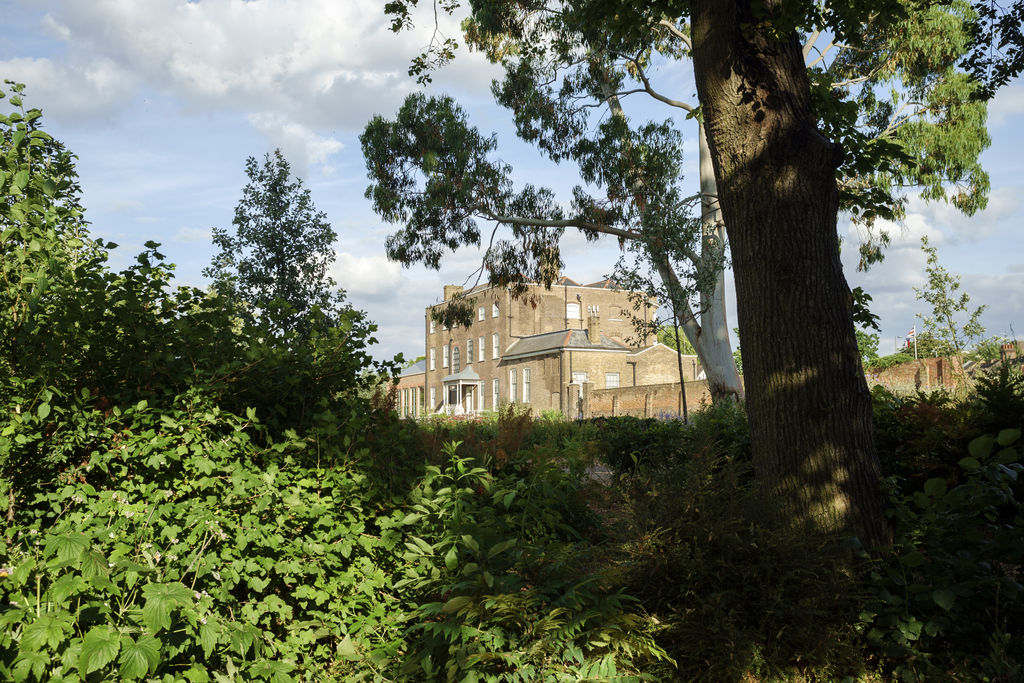
William Morris Gallery at Water House, viewed from the garden. The house was Morris’s adolescent home, rather than a building he designed. Dimitri Hon. Image source. CC BY-SA 4.0. Resized only; supplied image appearance and documentary edges retained. No colour, sharpening, reconstruction or other appearance changes.
Four stages of William Morris’s career
These overlapping groups help navigate the career. Later work continued to develop earlier materials, friendships and questions.
Oxford, painting and Red House
Oxford friendships, medieval reading and an early ambition to paint led towards the collaborative making of a home. Webb designed Red House; its furnishings brought painting, architecture and needlework together. [5]
Many skills within one enterprise
The partnership founded in 1861 supplied glass, furniture, tiles and patterned surfaces. In 1875 Morris took sole ownership, while the practical work continued to involve designers and specialist makers. [5]
Workshops, design and social questions
Woven furnishings, printed cloth and tapestry expanded through technical experiment and the Merton Abbey workshops. Morris’s public arguments about labour developed alongside that manufacturing activity. [9]
A late project and its completion
The Kelmscott Press began printing in 1891. Type, paper, ornament and illustrations became parts of a designed whole. After Morris’s death in 1896, Cockerell and colleagues completed the remaining programme in 1898. [21]
Oxford friendships and a change of vocation
Morris matriculated at Exeter College, Oxford, in June 1852 and went into residence in January 1853. He initially intended to prepare for the Church. At Oxford he met Edward Burne-Jones, who became his closest artistic friend, and a circle including Charles Faulkner, R. W. Dixon, Harry Macdonald and William Fulford. Their friendship was sustained by reading and shared enthusiasms as much as by formal university study. [1]
Ruskin's The Stones of Venice and Carlyle's Past and Present were among the books they read. Morris also turned to Chaucer, Malory and northern mythology. The attraction of the Middle Ages extended beyond the appearance of Gothic buildings or the costumes of romance. Ruskin's account of Gothic craftsmanship connected the character of an object with the freedom and intelligence of its maker. Morris would later acknowledge this debt openly, directing readers of his own lectures to Ruskin's discussion of the workman in “The Nature of Gothic.” [1] [20]
Travel gave these readings a material setting. In 1854 Morris visited Belgium and northern France, seeing paintings by Memling and Van Eyck and the cathedrals of Amiens, Beauvais and Rouen. A second French journey in 1855, with Burne-Jones and Fulford, coincided with the decision to abandon ordination and pursue art. The circle's earlier vision of a religious brotherhood gave way to artistic work, although shared purpose and fellowship remained important to their projects. [1]
In 1856 Morris edited and financed the Oxford and Cambridge Magazine. Writing was therefore part of his public activity before his decorating business existed. The same year he entered the office of the Gothic Revival architect George Edmund Street, where he met Philip Webb. Architectural training introduced him to a friend and collaborator whose practical understanding of buildings and furnishings would prove more durable than Morris's own professional commitment to architecture. By the end of 1856 he had left that path for painting. [1]
Dante Gabriel Rossetti encouraged the change. Morris and Burne-Jones entered the younger circle around the Pre-Raphaelite artists, taking part in Rossetti's Oxford Union mural project in 1857. Morris was not a founding member of the Brotherhood established in 1848: his involvement belonged to a later network of friendships, commissions and artistic experiments. The distinction matters because collaboration, rather than membership in one fixed group, shaped much of his career. [1]
Painting, poetry and meeting Jane Burden
Morris met Jane Burden in Oxford in 1857. She modelled for the painting now known as La Belle Iseult, associated with his work of about 1857–58. It is his only surviving easel painting. That careful description leaves room for works recorded in documents but no longer known, and for the surviving picture's complicated history: Jan Marsh's study traces evidence that it was still described as unfinished in 1874. Calling it his only completed painting makes a certainty of something the evidence does not support. [1] [22]
The picture draws on the Tristram and Iseult tradition, part of the imaginative world of the Oxford murals and his early poems. Marsh follows its later confusion with Queen Guenevere and the importance of Jane's recollection of Morris's own title. Its complicated history involves periods in the keeping of other artists, although their possible interventions in the painting remain unproven. [22]
Morris's first poetry collection, The Defence of Guenevere and Other Poems, appeared in 1858. Macmillan had rejected it; Bell and Daldy published it at his expense. Its dramatic voices and medieval subjects brought his literary ambitions before a public that did not respond uniformly well. Florence S. Boos describes the hostile reception of its abruptness, archaic language and perceived obscurity, while emphasising qualities that later readers have valued in its intense and unsettled scenes. [1] [23]
Painting did not become Morris's principal occupation, but it would be misleading to make this period a mere failure before the “real” career began. The murals, painted furniture, poems and experiments with textiles were related attempts to make imagined worlds tangible. His eventual concentration on pattern also emerged through working beside people with stronger commitments to figure painting. Burne-Jones and Rossetti remained collaborators rather than careers he simply left behind. [22] [24]
William and Jane married on 26 April 1859. Their first daughter, Jane Alice, known as Jenny, was born in January 1861; Mary, known as May, followed in March 1862. The household became one of the settings in which Morris's ideas about domestic life met the practical demands of work, money and family. Jane's contribution to that history included skilled embroidery, as well as her familiar role as an artist's model. [1] [25]
Red House and the beginnings of a shared enterprise
For their home Morris commissioned Webb to design Red House at Bexleyheath in 1859. William and Jane moved in during June 1860. Morris took an active part in its conception, but Webb was the architect. Its planning brought domestic purpose into conversation with the medieval buildings they admired: rooms, windows, construction and furnishings were considered together. The house offered an unusually extensive opportunity to develop the contents of a home in relation to the building itself. [3]
The furnishing involved a circle of friends. Webb designed furniture; Burne-Jones, Rossetti and Elizabeth Siddal contributed to decoration. William and Jane made and commissioned work for the interiors, including embroidered hangings. The V&A records that an embroidery stitched by Jane won an award for the new firm at the 1862 International Exhibition. The achievement depended on the translation of ideas into material by more than one pair of hands. [25] [3]
This household activity helped prompt the establishment of Morris, Marshall, Faulkner & Co. in April 1861. Its seven partners were Morris, Peter Paul Marshall, Charles Faulkner, Burne-Jones, Rossetti, Webb and Ford Madox Brown. The business turned shared dissatisfaction with available furnishings into an offer to clients. Glass, furniture, tiles, embroidery and interior decoration could draw on complementary artistic and technical skills. It was a commercial enterprise from the outset, even when its friendships and ambitions gave it a different atmosphere from a conventional manufacturer. [2] [24]
Red House also exposed the difficulty of combining that enterprise with a household outside London. Travelling between the house and the firm's premises was burdensome. In 1864 Webb prepared an extension intended to accommodate the Burne-Jones family and additional workshops. The project promised closer daily collaboration but involved expense and demanding family circumstances. After the Burne-Joneses withdrew, the larger scheme was abandoned. [3]
The Morrises left Red House in 1865 and moved to Queen Square in London; its sale followed in 1866. The National Trust's account distinguishes departure from the later sale. The change ended the family's brief residence, but the practical experiment of designing a whole environment continued through the firm. Queen Square placed domestic life and the business in immediate proximity, while Red House remained an important early example of their collaborative method. [3] [26]
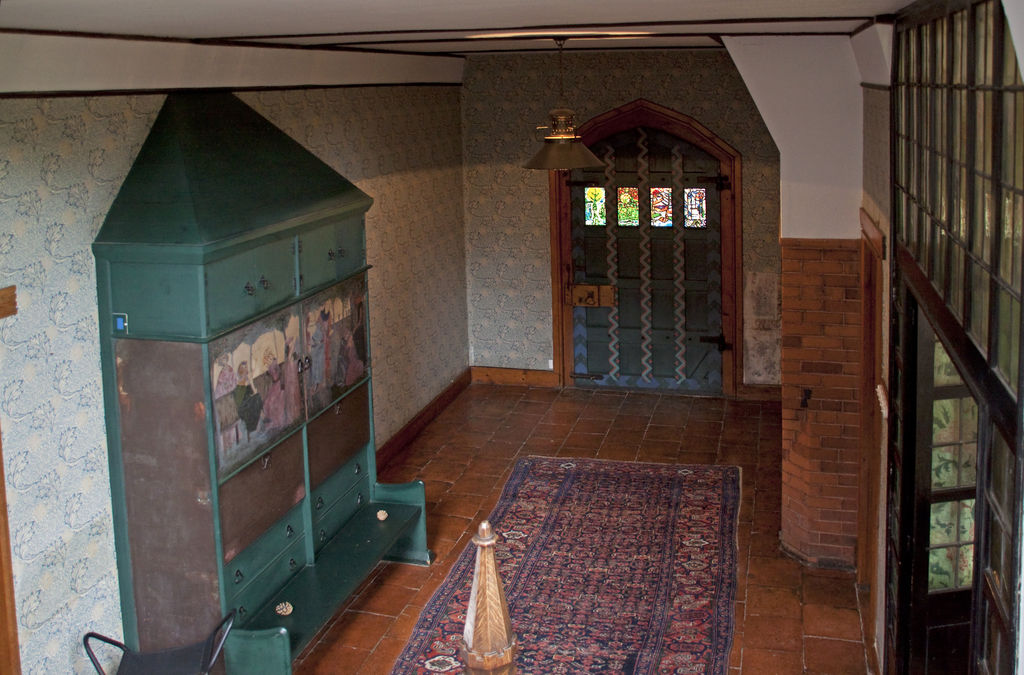
An interior view of Red House, including the decorated settle and a window. The photograph records the house’s later presentation, not an untouched Victorian room. Tony Hisgett from Birmingham, UK. Image source. CC BY 2.0. Resized only; supplied image appearance and documentary edges retained. No colour, sharpening, reconstruction or other appearance changes.
The early firm: friendship becomes organised work
The original partnership benefited from the demand for church furnishings associated with the Gothic Revival. Stained glass was particularly important. This required a coordinated sequence from design to painted glass and assembled window, and it could involve different artists in a single scheme. The V&A's historical account emphasises Burne-Jones's figurative contribution and Morris's concern with the character and production of the glass. Architecture and decoration were connected through actual commissions, rather than existing only as a principle discussed among friends. [24] [26]
Furniture likewise demonstrates how misleading the firm's name can become if it is read as an individual signature. The St George Cabinet, made for the 1862 International Exhibition, combined Webb's constructional design with Morris's painting. Other furniture depended on other designers. Tiles were painted on blanks supplied by manufacturers, and the V&A identifies Lucy Faulkner as the painter of a Sleeping Beauty panel incorporating designs by Burne-Jones and Morris. These divisions of labour were essential to the firm's ability to offer varied products. [24]
Women worked throughout this enterprise as makers and designers. Embroidery made within the household could demonstrate the firm's skill to exhibition audiences, while Lucy Faulkner's painting carried collaborative designs into ceramic panels. Later, May Morris would direct embroidery production and develop an independent professional reputation. The commercial name brought their work together, although it could also obscure the people responsible for particular objects. [24] [25]
The company also found prestigious public clients. Its decoration of the West Dining Room at the South Kensington Museum began a long relationship between Morris and the institution later renamed the V&A. Morris, Webb and Burne-Jones contributed to a coordinated room scheme. The commission mattered both as work and as public exposure: visitors could encounter the firm's approach in a substantial interior rather than judge it from isolated samples. [27]
Growth brought questions of management, production and market. The William Morris Gallery describes Morris's efforts to diversify the range after difficulties in the later 1860s. Alongside costly interior commissions and hand-printed fabrics, the business offered simpler furnishings and embroidery work that customers could complete themselves. Such products broadened access, but a range of prices did not mean that the whole programme was affordable to everyone. The company had to find buyers within the society Morris increasingly criticised. [2]
Becoming known as a poet
During the years of building the business, Morris also established a substantial literary reputation. The Life and Death of Jason appeared in 1867. It had begun as a story for the larger project that became The Earthly Paradise, but developed into a separate long narrative poem. The contrast with the compressed and frequently difficult dramatic poems of 1858 was considerable. The Argonauts' voyage supplied a sustained narrative through which Morris could explore action, desire and disappointment. [1] [23]
The Earthly Paradise, published in 1868–70, was even more expansive. Its twenty-four principal tales are paired through the twelve months of a year, with classical and medieval material held within a frame of storytelling. Travellers who have fled the Black Death encounter a community descended from Greeks; the groups exchange stories inherited from their different cultures. Readers also hear a contemporary poetic voice outside these narrated meetings. The work moves between stories, listeners and the passage of time. [23]
Boos's account explains why the structure matters. She reads the poem as an exploration of shared grief, memory and consolation, in which telling and listening can themselves become forms of fellowship. That interpretation offers a fuller account than the idea of Morris seeking uncomplicated escape into a beautiful past. The imagined communities must live with failure and mortality. Historical distance provides a means of examining those conditions, even when the tales are remote from Victorian everyday life. [23]
Morris began The Earthly Paradise before the Red House years ended, and it occupied him through a period of substantial commercial development. Its many voices and communities show an interest in collective life well before his organised socialist activity. The connection is suggestive, although the speakers, structures and emotional uncertainties of a poem differ from a political programme. [1] [23]
His engagement with books included their physical making. In 1870 he completed the illuminated A Book of Verse as a gift for Georgiana Burne-Jones. Other manuscript projects followed. Sydney Cockerell's later history of the Kelmscott Press records an unrealised plan for an illustrated Earthly Paradise, involving Burne-Jones's designs and wood engraving by Morris and several collaborators. These experiments placed writing, illustration and the designed book in contact long before the press opened. [1] [28]
Iceland, translation and a complicated private life
In 1868 Morris began studying Icelandic with Eiríkr Magnússon. Their collaboration led to The Story of Grettir the Strong in 1869 and the Völsunga Saga in 1870, followed by further translations. Magnússon was an essential linguistic and literary partner. The sustained work of translation connected Morris's enthusiasm for northern stories with close attention to language and with a living collaborator who knew the culture he was encountering. [1] [4]
Northern literature remained one strand within wider interests. His translation of Virgil's Aeneid appeared in 1875 and of Homer's Odyssey in 1887; a version of Beowulf followed in 1895. The Saga Library, begun in 1891 with Magnússon, extended work undertaken years earlier. Translation continued across the periods in which other occupations became especially prominent, giving his readers access to narratives from several historical traditions. [1] [4]
Morris travelled to Iceland in 1871 and again in 1873. On the first journey his companions included Magnússon, Charles Faulkner and W. H. Evans. They travelled on horseback and camped or stayed in available accommodation. His journal was initially intended for Georgiana Burne-Jones, a particular sympathetic reader, rather than prepared as a commercial travel book. The journals were published in 1911, after his death. Their original audience helps explain why scholars value them as a comparatively intimate form of his writing. [4]
Travel brought saga places into the experience of landscape. Martin Stott's introduction to the journals follows the relationship between Morris's reading, the routes he took and his descriptions of Iceland. Old stories shaped what he noticed, while weather, distance and the conditions of travel complicated an imagined northern world. This encounter fed a lasting engagement that included poems, translations and the long narrative Sigurd the Volsung, published in 1876. [1] [4]
The journeys also belong to a difficult period in his marriage. In 1871 Morris and Rossetti took a joint tenancy of Kelmscott Manor, the country house by the upper Thames that became central to the family's life. Jane and Rossetti's intimate relationship is part of the history discussed by scholars of this period. Stott interprets Morris's travel partly in relation to that strain. His stronger explanations of the journey as a personal ordeal, however, are interpretations of motive rather than facts that can be read directly from an itinerary. [1] [4]
Morris's Icelandic interests had a documented intellectual history before the first trip, giving the travel a purpose beyond his difficult personal circumstances. His relationships with Jane, Rossetti and Georgiana existed alongside practical work, enduring friendships and obligations to his children. Rossetti relinquished his share of the Kelmscott Manor tenancy in 1874. The family retained its connection with the house, whose name Morris later carried to his London home and his press. [1] [4]
Sole ownership and the search for better colour
In 1875 Morris, Marshall, Faulkner & Co. was dissolved and re-established as Morris & Co., with Morris as sole owner. The reorganisation consolidated his control, while collaboration with artists and dependence on specialist manufacturers continued. A change in ownership did not make every product an individual work by William Morris. [1] [27]
The middle 1870s were also a period of concentrated technical investigation. Earlier printed textiles had been produced with outside manufacturers, including Clarkson in Lancashire. Morris was dissatisfied with aspects of their colour. His designs could not achieve the intended effect merely by being drawn beautifully: dyes, cloth, printing and finishing altered the result. In 1875 he began working closely with Thomas Wardle at Leek, exploring natural dyes and ways to improve the printed fabrics. [25]
The significance of the collaboration is clearest when colour is understood as a process. A blue on cloth depended on chemistry, preparation and the sequence of manufacture. Morris's later indigo-discharge printing began with dyed cloth and removed colour where a block-applied substance required it; further stages could introduce additional colours. This differed from applying wallpaper pigments to a paper surface. It required dedicated facilities and experienced people as well as the pattern designer's decisions. [25] [26]
Morris's work with Wardle developed at the same time as his output of patterns expanded. The William Morris Gallery quotes a humorous 1876 letter to Aglaia Coronio about dreaming that he had to draw a sausage. The anecdote is useful less as an emblem of effortless inspiration than as a reminder of persistent professional work. Designing, revising and adapting patterns occupied his days, while commercial demand required materials that could be manufactured consistently. [2]
A shop and showroom opened in Oxford Street in 1877, giving the enlarged range a more accessible retail setting. The firm's work now reached customers through a coordinated offer of furnishings and complete decorative schemes. The shop increased the need for stock, dependable production and management. The chronology of Morris & Co. is consequently a history of organisational change as well as artistic invention. [1] [25]
Conserving buildings and speaking about art
Morris's public campaigning gathered force in the later 1870s. He became treasurer of the Eastern Question Association in 1876, entering political activity before joining a socialist organisation. In 1877 he helped establish the Society for the Protection of Ancient Buildings and became its first secretary. The campaign against destructive restoration grew from the same close interest in historical workmanship that informed his design studies, but it demanded a different response to old buildings. [1] [18]
The SPAB's founding manifesto, produced by Morris, Webb and other founders, argued that a building's alterations belonged to its history. A restorer who chose an ideal moment and removed everything thought inconsistent with it destroyed evidence while claiming to recover authenticity. The manifesto called instead for maintenance, support and repairs that honestly declared their purpose. Its protection extended to buildings of different periods and styles, not solely to a favoured Gothic moment. [29]
This position makes a useful distinction within Morris's medievalism. For new work he could learn from an old technique or a historical design. For an old building he objected to replacing surviving fabric with a modern guess about what should once have existed. Preservation allowed successive generations' work to remain legible. His concern was therefore with the survival of material history, rather than the production of an immaculate medieval-looking scene. [29]
Morris was also becoming a public lecturer. The lectures collected in Hopes and Fears for Art in 1882 connected decorative objects with the circumstances of making and using them. In “The Lesser Arts,” delivered in 1877, he set out two related pleasures: the pleasure people receive from useful things and the pleasure they might experience in making them. Decoration mattered because ordinary surroundings and ordinary labour occupied so much of life. Art could not flourish securely as a luxury detached from that experience. [20]
His famous household rule appeared in “The Beauty of Life,” delivered in 1880: “Have nothing in your houses that you do not know to be useful or believe to be beautiful.” The surrounding argument attacks burdensome display, unnecessary possessions and class differences. It also allows patterned walls, paintings and tapestry when valued for beauty. The sentence belongs to an attempt to improve domestic life and the work supporting it; it does not prescribe an empty room or reject elaborate ornament in principle. [20]
Hammersmith and the Merton Abbey workshops
The family moved to Kelmscott House at Hammersmith in 1878. This was Morris's London home until his death, distinct from Kelmscott Manor in Oxfordshire. Water House, the home of his youth in Walthamstow, is a third building. The repeated names can obscure their different functions: the Manor was a country retreat; Kelmscott House was a working London household, a setting for experiments and later socialist meetings. The press was another enterprise, established nearby. [1] [26]
At Hammersmith Morris pursued weaving in an unusually direct way. His tapestry Acanthus and Vine, also called Cabbage and Vine, was completed in 1879. The V&A describes his early-morning work at the loom as part of learning the craft amid commercial responsibilities. Hand-knotted carpets were also made in outbuildings at the house before production moved to Merton. These experiments show personal making serving as a way to understand processes that a larger workshop would subsequently undertake. [25]
In 1881 the firm leased premises at Merton Abbey beside the River Wandle. The site supplied space for workshops and for washing and drying cloth, together with water suited to textile production. Dyeing, fabric printing, weaving, tapestry, carpets and stained glass could be organised across a much larger works. Queen Square and earlier workshops had become restrictive as the range expanded. Merton allowed greater control over parts of production without bringing every product into one factory. Wallpaper, for example, continued to be printed by Jeffrey & Co. elsewhere. [25] [26]
The successful Strawberry Thief furnishing fabric of 1883 demonstrates what this investment made possible. Its indigo-discharge process was demanding and costly, but technical control supported the rich multicoloured design. At the same time, other products required different systems: woven furnishing cloth, embroidered panels and high-warp tapestry could not be treated as variants of one printing method. Morris's practical curiosity crossed these boundaries, and the workshop depended on people able to work within each craft. [25]
Nor was this an environment without mechanisms or commercial calculation. The firm sold machine-woven carpets alongside hand-knotted ones and used Jacquard pattern control in weaving. The meaningful question was how a method affected the work, the material and the maker. In his 1881 lecture “Some Hints on Pattern-Designing,” Morris insisted that the intended material and use should be understood before designing began. Constraints could stimulate invention: a hanging cloth, a tiled surface and a flat wall posed different problems. [25] [26] [30]
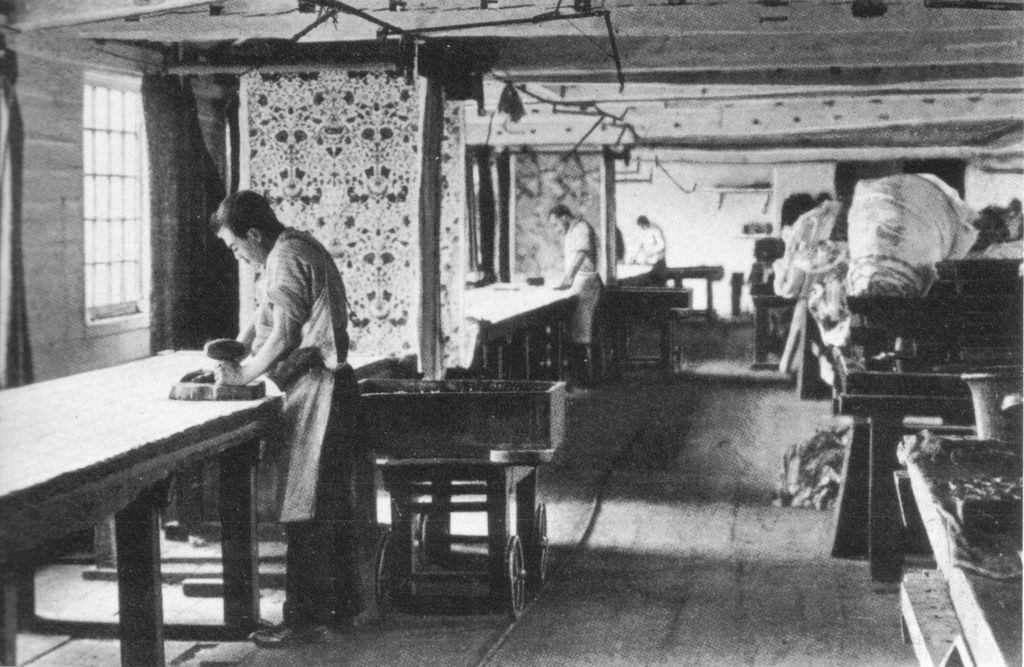
Textile printing at Merton Abbey, about 1890, in a photograph published in 1911. Long tables and hanging cloth place pattern within a working room. Not identified for original photograph. Image source. Public domain.
Joining the socialist movement
Morris's socialist campaigning entered a new phase when he joined the Democratic Federation on 13 January 1883. The organisation became the Social Democratic Federation in 1884, but disagreements with its leadership led Morris and others to resign late that year. They formed the Socialist League in December 1884; its newspaper, Commonweal, began in February 1885 with Morris as editor. These changes placed him within the organisational arguments of an emerging movement, as well as giving him a platform for lectures and writing. [1] [31]
J. Bruce Glasier, writing later about the early movement, remembered parliamentary strategy as a central source of the split. Morris and his allies prioritised socialist education while the movement remained small, objecting to the leadership's electoral tactics. The League brought together people with differing positions, including Eleanor Marx, Edward Aveling, Bax and Morris's old Oxford friend Charles Faulkner. Its formation was a collective undertaking, followed by further disputes about how revolutionary aims could become effective action. [31]
He committed time and money to public propaganda. Meetings, speeches, journalism and campaigning became substantial parts of his life. In September 1885 he was arrested after protesting against the sentencing of free-speech demonstrators; the charge against him was dismissed the next day. In November 1887 the attack on demonstrators in Trafalgar Square known as Bloody Sunday brought further evidence of the conflicts surrounding public assembly. Morris later acted as a pallbearer at the funeral of Alfred Linnell, who had been fatally injured in the demonstration. [1]
His politics cannot be reduced to a preference for handmade things. In “How I Became a Socialist,” published in 1894, he described a society without rich and poor, masters and dependent workers, or the division between overburdened intellectual and manual labour. Equality of condition and a shared responsibility for welfare were central. Looking back, he explained that art and history had supplied a reason for discontent, while the possibility of collective change had given that discontent practical direction. [32]
The essay is a retrospective self-explanation, written by a committed socialist, rather than an impartial record of each stage of conversion. Its candour nevertheless complicates the idea of a fully formed doctrine present from youth. Morris recalled knowing little economics when he joined the movement, struggling with parts of Marx's Capital and learning through conversations with colleagues such as E. Belfort Bax, H. M. Hyndman and Andreas Scheu. Political education took place through meetings and disagreement as well as solitary reading. [32]
The contradiction between his business and his politics was real. He supplied expensive goods to wealthy clients while seeking a society that would abolish the inequalities supporting that market. The firm's less costly products and its skilled workshop practice did not dissolve the contradiction. His socialist argument went beyond the hope that conscientious consumers could purchase a better world: it concerned the organisation of production and the conditions in which people could live and work. [2] [25] [32]
Morris eventually left the Socialist League in 1890 as its direction became increasingly uncongenial to him, and helped form the Hammersmith Socialist Society. This change did not mark the end of his political commitments. In 1893 he collaborated with Bax on Socialism: Its Growth and Outcome and took part in a joint socialist manifesto with Shaw and Hyndman. His organisations and tactical alliances changed; the ambition of a shared, less wasteful and less anxious life remained prominent. [1] [32]
Fiction in the years of campaigning
Political work generated new literary forms and audiences. The Pilgrims of Hope appeared in Commonweal in 1885–86, followed by A Dream of John Ball in 1886–87. Morris's lectures were gathered in Signs of Change in 1888. The newspaper gave writing a place within ongoing argument, where poems, fiction and essays encountered readers engaged with immediate questions of social change. These works were part of the same working years as manufacturing and public speaking. [1]
News from Nowhere was serialised in Commonweal from January to October 1890. A book edition followed in 1891, and the illustrated Kelmscott edition appeared in 1893. The dates describe different forms of circulation. The William Morris Gallery's copy of the Kelmscott book includes Charles March Gere's view of Kelmscott Manor, joining an imagined future with a real house that mattered to the author. The book's later fine-press form should not erase its first life in a socialist newspaper. [33]
Its opening grows out of a contentious discussion about the society that might follow revolution. The protagonist returns to Hammersmith, sleeps and encounters a transformed Thames. Clearer water, altered buildings and a friendly waterman make change perceptible through daily experience. The visitor's surprise also reveals the habits he brings from his own society: he struggles to understand people and surroundings that no longer fit his assumptions about work or class. [34]
At the end he cannot remain within the happiness he has witnessed. Returned to his own Hammersmith, he understands the experience as a reason to continue striving. This structure gives the imagined future a task in the imperfect present. The reader is not left inside a securely achieved paradise. For a biographical understanding of Morris, the ending connects imaginative pleasure with the difficult labour of pursuing change. [34]
His other late fiction also deserves a place beside the political writing. The House of the Wolfings appeared in 1888, The Roots of the Mountains in 1889, The Wood Beyond the World in 1894 and The Well at the World's End in 1896. These works extended his writing into prose romance, while translation continued. He did not exchange literature for politics and then politics for printing; the occupations repeatedly overlapped. [1]
The Kelmscott Press and a final collaboration with Burne-Jones
Morris's concern with the printed book had a long preparation in calligraphy, collecting, engraving and earlier unrealised publishing schemes. During the later 1880s, discussion with his neighbour Emery Walker sharpened his attention to typography. Cockerell's history of the press describes Walker's practical knowledge and continuing advice. Morris began developing his own type before the press opened in 1891; The Story of the Glittering Plain became its first published book that May. [1] [28]
The Kelmscott Press was established near Kelmscott House in Hammersmith, not at the Oxfordshire Manor. A cottage at 16 Upper Mall was taken in January 1891. William Bowden and his son W. H. Bowden supplied professional printing experience, and a pressman named Giles joined the work on the first book. The familiar name at the head of the enterprise covered another collaboration requiring specialised craft knowledge. [28]
Morris explained his aims in a note dated November 1895. He wanted books that were beautiful and readable, and considered paper, the shape of letters, spacing and the position of the printed matter on the page. The two facing pages formed the governing unit. Borders and initials had to participate in that arrangement. The account is valuable because it locates his ambition in the relationships among ordinary elements of a book, beyond the addition of conspicuous decoration. [28]
Golden, his roman type, developed through the study of early Venetian printing, particularly Jenson. Troy and the smaller Chaucer type answered different needs in the press's books. Edward Prince cut the punches, and J. Batchelor supplied handmade paper. Photography helped in the study and translation of designs, while recurring ornament could be printed from electrotypes. The historical inspiration coexisted with selective modern means of reproduction. [28]
The press's publications reached beyond Morris's own writing and beyond one illustrator. Medieval and early printed texts appeared alongside work by later poets and contemporaries. Burne-Jones, Walter Crane and Charles March Gere supplied illustrations for different books; engravers and intermediary draughtspeople carried drawings into reproducible form. These distinctions recall the early firm's decorated cabinets and windows, where several kinds of authorship and making met in one object. [28]
The Works of Geoffrey Chaucer, published in 1896, brought Morris and Burne-Jones's long friendship into an exceptionally sustained book project. Chaucer had belonged to Morris's reading since his Oxford years. Now type, ornament and Burne-Jones's pictures were coordinated within an extensive printed volume. Morris's note on the press, written as the book approached completion, praised his friend's ability to make illustrations form part of the page. Their late collaboration continued a conversation begun more than forty years earlier. [1] [28]
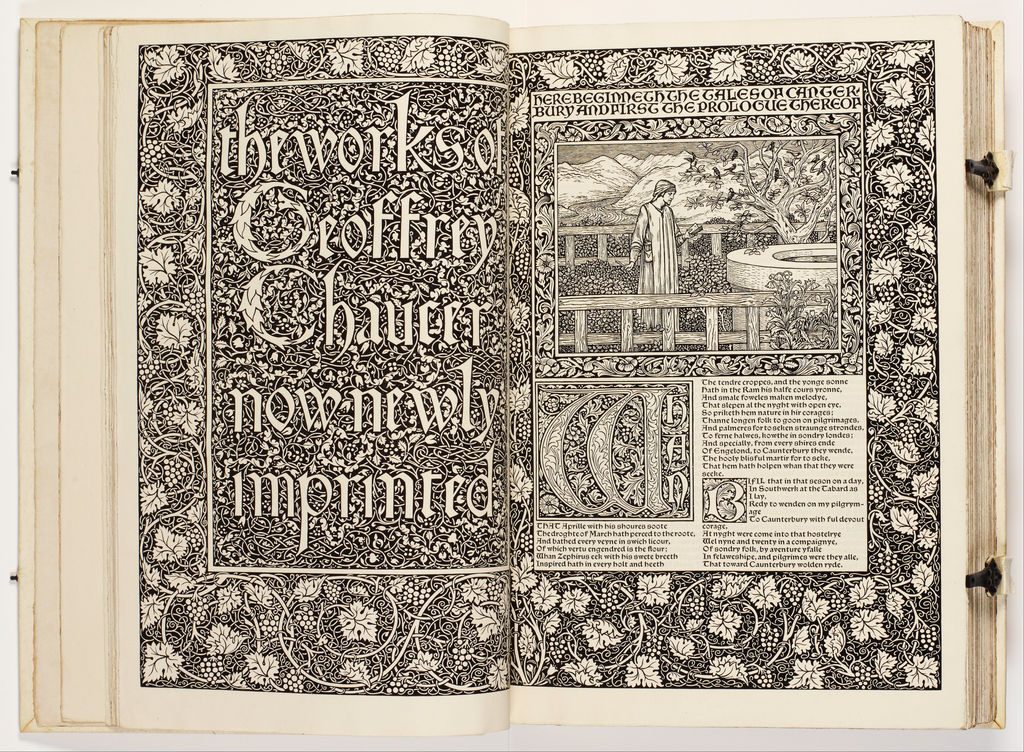
The Kelmscott Chaucer, 1896: a complete opening brings the decorated title page together with the facing illustration, initial and text. William Morris. Image source. Public domain.
Final years and the work of remembering Morris
Morris remained active across several fields during the press years, although illness increasingly interrupted his work. He was elected Master of the Art Workers' Guild for 1892, a recognition of his standing among other practitioners. His relationship with the South Kensington Museum also continued. He advised on acquisitions including the Ardabil carpet in 1893 and gave a small loom used to teach carpet weavers at Merton Abbey. Study, collecting and education remained connected with manufacture. [1] [27]
His place in the Arts and Crafts movement involved influence across a network of practitioners. The Arts and Crafts Exhibition Society was founded in 1887 with Walter Crane as its first president and held its first exhibition in 1888. Morris lectured on tapestry in connection with that exhibition. The societies and workshops that gave the movement its public identity drew on his example without forming a single organisation under his direction. Their interest in the status of decorative art, the integrity of materials and the experience of makers extended questions he had pursued for decades. [1] [35]
The business increasingly depended on other designers and managers. May had taken responsibility for embroidery production in 1885. John Henry Dearle, already important in weaving and tapestry, carried an expanding share of design work and became art director after Morris's death. These developments belong within Morris's lifetime as well as the firm's later history. The continuity of the brand could otherwise conceal the professional achievements of people whose work reached customers under the company's name. [25] [26] [27]
In 1896 Morris made a sea journey to Norway in an attempt to improve his health. He died at Kelmscott House on 3 October, aged sixty-two, and was buried in the churchyard at Kelmscott. His death did not immediately close either the company or the press. Morris & Co. continued trading until its liquidation in May 1940. The press completed outstanding work and issued its final books in 1898. Cockerell's account and catalogue distinguish that continuation from the period of Morris's personal direction. [1] [3] [26] [28]
Remembering him involved choices about what to preserve and how to describe it. La Belle Iseult returned to the family after its rediscovery in 1897 and appeared publicly under a different title; Jane's recollection later helped secure its identification as Iseult. May undertook the enormous editorial work of the Collected Works, published in 1910–15, and the journals of Iceland became available in 1911. The record through which later readers encountered Morris was shaped by surviving family members, editors and custodians. [22] [4]
May's contribution also extended to the physical evidence of design. Her 1938 bequest to the V&A included thirty designs for wallpaper, textiles and embroidery; much of the museum's Morris design collection derives from it. These working drawings preserve decisions and revisions that finished products alone cannot show. May was herself a designer, embroiderer and teacher, and her stewardship should be understood alongside that independent career. [27]
Different parts of Morris's work have had different subsequent lives. His firm's products continued after 1896, while the conservation society preserved a public role for the principles set out in 1877. His poetry's standing changed: Boos describes both its Victorian success and its later critical neglect, alongside renewed attention to its complexity. The survival of recognisable patterns does not measure the reception of every poem or political argument. [2] [18] [23]
The William Morris Gallery opened at Water House in 1950, transforming one of his youthful homes into a place for studying his work and that of his associates. Its history includes gifts by Frank Brangwyn and Arthur Mackmurdo, making the collection another product of relationships across generations. Together with May's editorial and collecting work, this institutional history explains how so much remains available to examine: a career preserved through books, objects, buildings and the deliberate work of other people. [19] [27]
Further reading
Continue with historical writing and institutional research available to read online.
Morris on art and everyday life. William Morris, Hopes and Fears for Art (1882), in a transcription of the 1919 edition.
Read the lectures behind his arguments about decoration, useful objects and the pleasure of making. Read the historical text.
The workshop behind the book. William Morris and Sydney Cockerell, The Art and Craft of Printing (Elston Press, 1902).
This reprint joins Morris’s Note with Cockerell’s history and catalogue of the Kelmscott Press. Read the historical account.
Works and designs directory
This directory brings together 365 design, edition and collection records, plus 208 individually listed samples from three historical sample books. Design families, surviving objects, later printings and book editions have separate entries. It covers the research assembled for these articles, rather than the full output of Morris and his associates. Dates and attributions follow the named catalogues; differences are retained where they matter. Search by title, designer, material, collection, accession or colourway.
| Name | Date | Medium |
|---|---|---|
| Blackberry | Design: early twentieth century; specimens catalogued 1903 | Wallpaper |
| Hyacinth | Design: c.1900–12 | Wallpaper |
| Horn Poppy | Design: c.1885 | Wallpaper |
| Chrysanthemum | Design: 1877; some later catalogues say 1876 | Wallpaper |
| Fruit or Pomegranate | Design dates reported: 1862 / 1865–66 | Wallpaper |
| Jasmine | Design: 1871–72; wallpaper issued 1872 | Wallpaper |
| Larkspur | Design/issue dates reported: 1872–75 | Wallpaper |
| Marigold | Design: 1873–75; registered 1875 | Wallpaper |
| Pimpernel | Design/registration: 1876 | Wallpaper |
| Willow | Design: 1874 | Wallpaper |
| Wreath | Design: c.1876 | Wallpaper |
| Trellis | Design: November 1862; registered 1864 | Wallpaper |
| Bird | Design: 1877–78; registered 1878 | Textile |
| Bird — Met 23.163.15 | Design: 1877–78; registered 1878; specimen: unknown | Textile |
| Bird — DIA F1986.48 | Specimen: 1878 | Textile |
| Bird — WMG F283b | Design: 1877–78; registered 1878; specimen: unknown | Textile |
| Bird — Orsay OAO 1249 1 | Design: 1877–78; registered 1878; specimen: unknown | Textile |
| Cabbage and Vine | Design: 1879 | Textile |
| Cabbage and Vine — SAL KM032 | Specimen: 1879 | Textile |
| Cabbage and Vine — V&A E.45-1940 | Drawing/cartoon: 1879 | Drawing |
| Cabbage and Vine — V&A E.3472-1932 | Drawing/cartoon: 1879 | Drawing |
| Evenlode | Registered: 2 September 1883 | Textile |
| Evenlode — WMG F325a | Registered: 2 September 1883; specimen: unknown | Textile |
| Evenlode — Cincinnati 1993.144 | Specimen: 1883–1900 | Textile |
| La Belle Iseult | Painting: conventionally dated 1858 | Painting |
| Study for La Belle Iseult — Christie’s lot 5807506 | Study date: unknown | Drawing |
| Membland Hall Tile Panel | Design: 1876; Orsay model c.1876–77 | Drawing |
| Membland Hall Tile Panel — V&A C.36-1972 | Design/panel: 1876 | Ceramics |
| Membland Hall Tile Panel — WMG C176 | Design/panel: 1876 | Ceramics |
| Design for Membland Hall tile panel — WMG A31 | Drawing: 1876 | Drawing |
| Membland Hall Tile Panel — Orsay OAO 1210 | Model: c.1876–77; specimen: unknown | Ceramics |
| Membland Hall Tile Panel — Cologne E04941 | Design: 1876; specimen: unknown | Ceramics |
| Peacock and Dragon | Design: 1878 | Textile |
| Peacock and Dragon — WMG F26cii | Design: 1878; specimen: unknown | Textile |
| Peacock and Dragon — Met 30.95.52 | Design: 1878; specimen: unknown | Textile |
| Snakeshead | Design: 1876 | Textile |
| Snakeshead — WMG F345 | Design: 1876; specimen: unknown | Textile |
| Snakeshead — Huntington 2000.5.525 | Specimen: c.1876 | Textile |
| Snakeshead — Birmingham 1941M398 | Specimen: 1876–77 | Textile |
| Snakeshead — WMG F366 | Design: 1876; specimen printed after 1917 | Textile |
| Strawberry Thief | Design: 1883 | Textile |
| Strawberry Thief — WMG F422b | Design: 1883; specimen: unknown | Textile |
| Strawberry Thief — Huntington 2000.5.523 | Specimen: c.1883 | Textile |
| Strawberry Thief — Cleveland 1937.696 | Specimen: c.1936 | Textile |
| Tulip and Willow | Design: 1873 | Textile |
| Tulip and Willow — WMG F3 | Design: 1873; specimen printed after 1883 | Textile |
| Tulip and Willow — V&A CIRC.91-1933 | Catalogue date: 1873; manufacture unknown | Textile |
| The Attainment or Vision of the Holy Grail | Design cycle: 1890–91 | Textile |
| The Attainment or Vision of the Holy Grail — Birmingham 1907M131 | Specimen: 1895–96 | Textile |
| The Attainment or Vision of the Holy Grail — Stanmore original Attainment | Woven by 1893 (original Attainment) | Textile |
| The Attainment or Vision of the Holy Grail — McCulloch repeat group | Specimen: 1898–99 | Textile |
| The Attainment or Vision of the Holy Grail — Beecham Attainment/Summons | Specimen: 1927–32 | Textile |
| Wandle | Design: 1884 | Textile |
| Wandle — WMG F50 | Design: 1884; specimen: unknown | Textile |
| The Kelmscott Chaucer | Edition: 1896; issued 26 June | Book |
| The Kelmscott Chaucer — WMG K20 | Specimen: 1896 | Book |
| The Kelmscott Chaucer — Morgan PML76849 | Edition: 1896; issued 26 June; specimen: unknown | Book |
| The Kelmscott Chaucer — Birmingham special-bound copy | Edition: 1896; issued 26 June; specimen: unknown | Book |
| The Kelmscott Chaucer — UMD2010acquisition | Edition: 1896; issued 26 June; specimen: unknown | Book |
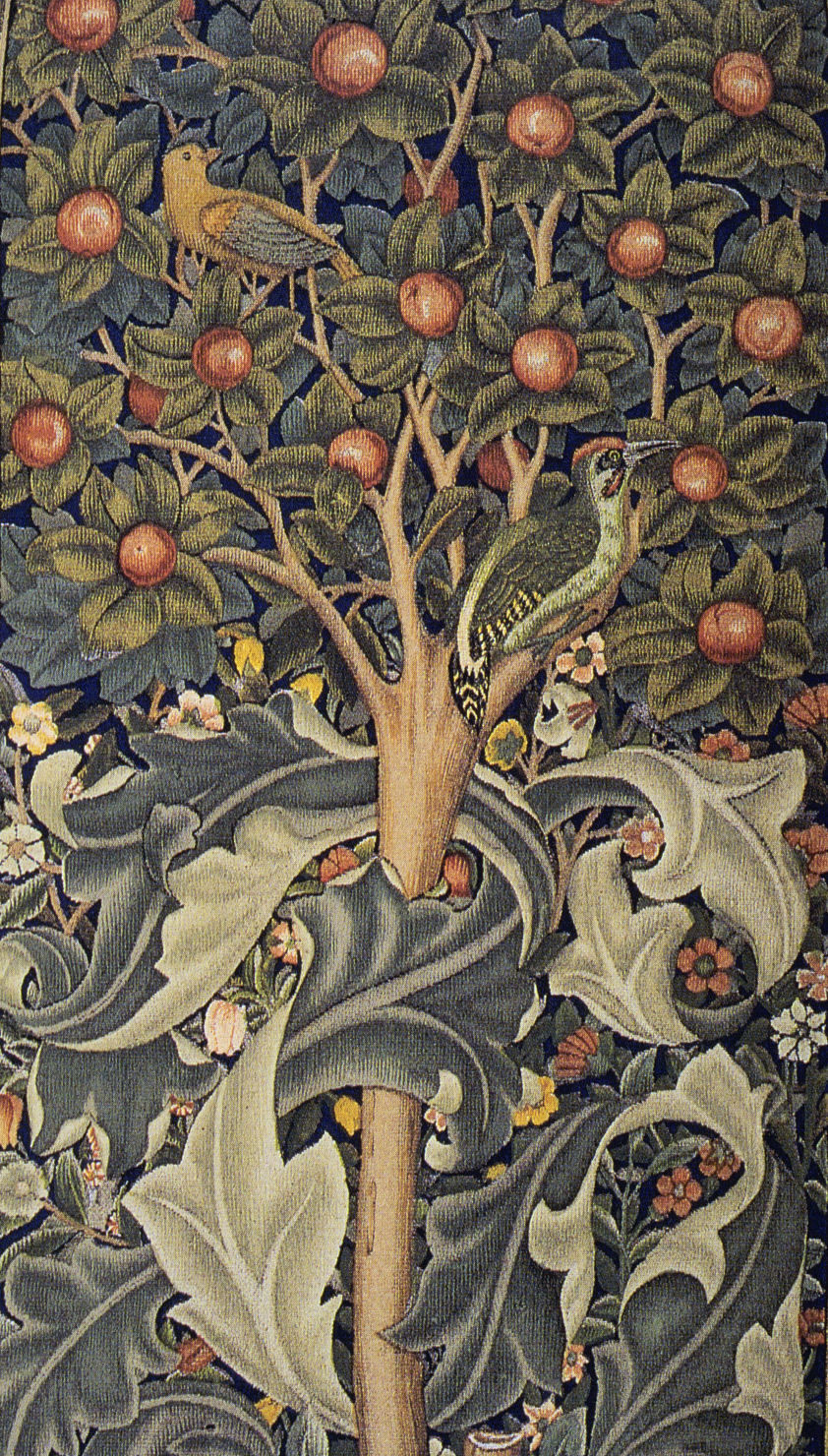
| Woodpecker Tapestry | Design/tapestry: 1885 | Textile |
| Woodpecker Tapestry — WMG F139 | Specimen: 1885 | Textile |
| Larkspur — V&A E.468-1919 | Design/issue dates reported: 1872–75; specimen: unknown | Wallpaper |
| Marigold — V&A E.478-1919 | Design: 1873–75; registered 1875; specimen: unknown | Wallpaper |
| Willow — V&A E.488-1919 | Specimen: 1874 (Produced) | Wallpaper |
| Pimpernel — V&A E.497-1919 | Design/registration: 1876; specimen: unknown | Wallpaper |
| Wreath — V&A E.501-1919 | Specimen: 1876 (Produced) | Wallpaper |
| Chrysanthemum — V&A E.802-1915 | Specimen: 1877 (made) | Wallpaper |
| Fruit — V&A E.2210-1913 | Specimen: 1866 (produced) | Wallpaper |
| Blackberry — V&A E.2793-1980 | Specimen: 1903 (made) | Furniture |
| Blackberry — V&A E.2794-1980 | Specimen: 1903 (made) | Furniture |
| Blackberry — V&A E.2839-1980 | Specimen: 1903 (made) | Furniture |
| Blackberry — V&A E.1415-1979 | Specimen: c. 1955 (printed) | Wallpaper |
| Hyacinth — V&A E.1416-1979 | Specimen: c. 1955 (printed) | Wallpaper |
| Trellis — V&A E.452-1919 | Specimen: 1864 (manufactured) | Wallpaper |
| Willow Bough | Design: 1887 | Wallpaper |
| Willow Bough — V&A E.558-1919 | Specimen: 1887 (made) | Wallpaper |
| Blackberry — B179 | Specimen: c.1960s | Wallpaper |
| Hyacinth — B101 | Specimen: 1968 | Wallpaper |
| Horn Poppy — B155 | Specimen: 1885–1920 | Wallpaper |
| Horn Poppy — B112b | Design: c.1885; specimen: unknown | Wallpaper |
| Chrysanthemum — B172 | Specimen: c.1960 | Wallpaper |
| Fruit — B9a | Design dates reported: 1862 / 1865–66; specimen: unknown | Wallpaper |
| Larkspur — B11c | Design/issue dates reported: 1872–75; specimen: unknown | Wallpaper |
| Marigold — B40 | Specimen: before 1940 | Wallpaper |
| Pimpernel — B13 | Specimen: before 1940 | Wallpaper |
| Willow — B69 | Specimen: before 1940 | Wallpaper |
| Willow Bough — B22 | Specimen: after 1940; presented 1950 | Wallpaper |
| Poppy or Wreath — B15 | Specimen: c.1950 | Wallpaper |
| Wreath — 20032D1 | Specimen: c.1876 | Drawing |
| Design for Chrysanthemum — A33 | Drawing: 1877 | Drawing |
| Design for Trellis — BLA472 | Drawing: 1862 | Drawing |
| Trellis — B31 | Specimen: before 1940 | Wallpaper |
| Larkspur printing block — R253 | Design/issue dates reported: 1872–75; specimen: unknown | Printing block |
| Jasmine — 23.163.4j | Catalogue date: 1872; manufacture unknown | Wallpaper |
| Marigold — 23.163.4c | Catalogue date: 1875; manufacture unknown | Wallpaper |
| Willow Bough — 23.163.4k | Catalogue date: 1887; manufacture unknown | Wallpaper |
| Larkspur — 23.163.4i | Catalogue date: 1875; manufacture unknown | Wallpaper |
| Fruit or Pomegranate — 23.163.4g | Catalogue date: c.1866; manufacture unknown | Wallpaper |
| Chrysanthemum drawing — 2000.5.61 | Specimen: c.1877 | Drawing |
| The Pimpernel — HH3016 | Specimen: c.1876 | Wallpaper |
| Marigold — M.2003.6.2 | Design: 1873–75; registered 1875; specimen: unknown | Wallpaper |
| Marigold textile — 1937.699 | Specimen: twentieth century | Textile |
| An Angel with a Harp — Tate A00815 | Work date: unknown | Drawing |
| An Angel with a Pipe — Tate A00816 | Work date: unknown | Drawing |
| A Girl with a Flute — Tate A00817 | Work date: unknown | Drawing |
| Design for Tapestry — Tate A00818 | Work date: unknown | Drawing |
| The Archangel Raphael — Tate A00819 | Work date: unknown | Drawing |
| The Archangel Gabriel — Tate A00820 | Work date: unknown | Drawing |
| La Belle Iseult — Tate N04999 | Work: 1858 | Painting |
| The Archangel Gabriel — Tate N05219 | Work date: unknown | Drawing |
| Figure of Guinevere — Tate N05221 | Work: c.1858 | Drawing |
| Guinevere and Iseult: Cartoon for Stained Glass — Tate N05222 | Work: 1862 | Drawing |
| Angel of the Resurrection: Cartoon for Stained Glass — Tate N05223 | Work: 1862 | Drawing |
| Daisy tile | Specimen: c. 1870 | Ceramics |
| Alceste tile | Specimen: c. 1862 | Ceramics |
| The Labours of the Month | Specimen: 1862 | Ceramics |
| Trellis — Met 23.163.4h | Catalogue date: 1864; manufacture unknown | Wallpaper |
| Trellis — William Morris Gallery B132a | Design: November 1862; registered 1864; specimen: unknown | Wallpaper |
| Trellis — Standen NT1213907 | Design: November 1862; registered 1864; specimen: unknown | Wallpaper |
| Trellis — loose sample-book page B133 | Specimen: printed before 1917 | Wallpaper |
| Sussex armchair — G29 | Design: c.1860s; specimen: unknown | Furniture |
| Sussex chair — G51 | Specimen: c.1868 | Furniture |
| Round-seated Sussex chair — 1214043.2 | Specimen: c.1870 | Furniture |
| Oval centre table — 1213993 | Specimen: c.1870 | Furniture |
| The Backgammon Players — 26.54 | Specimen: 1861 | Painting |
| Table de travail — OAO450 | Specimen: c.1860–68 | Furniture |
| King David the Poet — 1998.231 | Specimen: 1863 | Stained glass |
| Eve and the Virgin cartoon — A8 | Drawing: 1864 drawing; window installed 1865 | Drawing |
| Design for Mermaid woven fabric — A32b | Drawing: c.1880; mermaid figures 1875 | Drawing |
| Wreath carpet point paper — BlA477 | Drawing: c.1870 | Drawing |
| A Note by William Morris on His Aims in Founding the Kelmscott Press — K260 | Edition: March 1898; exact date statements differ | Book |
| Oak cabinet for Kelmscott Press books — no accession supplied | Design: unknown; specimen: unknown | Furniture |
| Stained-glass quarry design, Diplacus punicus / Nihil Desperandum — WMG BLA444 | Drawing date: unknown | Drawing |
| House of Retreat, Crowborough: rose window design — WMG BlA405 | Drawing: c.1913 | Drawing |
| Circular embroidery design with flower and butterfly — WMG A993 | Drawing date: unknown | Drawing |
| Aquilegia quarry design — WMG BLA447 | Drawing date: unknown | Drawing |
| Carnation textile design — WMG A1070 | Drawing: c.1875 | Drawing |
| Wallpaper design with roses and acanthus — WMG BlA503 | Drawing: c. 1880-1900 | Drawing |
| Rottingdean Grail cartoon, fourth panel — WMG A208.4 | Drawing: 1886 | Drawing |
| Rottingdean Grail cartoon, second panel — WMG A208.2 | Drawing: 1886 | Drawing |
| Rottingdean Grail cartoon, third panel — WMG A208.3 | Drawing: 1886 | Drawing |
| Thisbe embroidery design — WMG A211 | Drawing: c. 1863-4 | Drawing |
| Prophet predella cartoon for Jesus College Chapel — WMG A256 | Drawing: 1877 | Drawing |
| Rottingdean Grail cartoon, first panel — WMG A208.1 | Drawing: 1886 | Drawing |
| Designs for embroidery frames — WMG A307 | Drawing: c.1910s | Drawing |
| Flower Garden embroidery design — WMG A218 | Drawing: c.1892 | Drawing |
| Design possibly for painted panelling — WMG A476 | Drawing: 2.1.1886 | Drawing |
| Annunciation cartoon for St Michael and All Angels, Brighton — WMG A4 | Drawing: 1862 | Drawing |
| Design for reversible embroidered table cover — WMG BlA456 | Drawing: c. 1880 | Drawing |
| Combe Court panelled ceiling design — WMG A294 | Drawing: 1890s | Drawing |
| Circular embroidery design with flowers and leaves — WMG A249 | Drawing: 1880-90s | Drawing |
| Carpet design for Miss Beardmore — WMG BLA458 | Drawing: 1875-1877 | Drawing |
| Acanthus embroidery design — WMG A459 | Drawing: 1870s | Drawing |
| Stained-glass quarry design for Jesus College, Cambridge — WMG BlA439 | Drawing: 1873 | Drawing |
| Stained-glass quarry design for Duke of Westminster — WMG BlA440 | Drawing: 1876 | Drawing |
| Stained-glass roundel design with seated young man — WMG BLA487a | Drawing: c. 1930s | Drawing |
| Design for tapestry sofa upholstery — WMG A34 | Drawing: 1880s/early 1900s | Drawing |
| King Arthur and Sir Lancelot stained-glass design — WMG A262 | Drawing: 1862 | Drawing |
| Peacock embroidery-frieze design — WMG A209 | Drawing: c.1875 | Drawing |
| Drawing-room cornice, 9 Chesterfield Gardens — WMG A301 | Drawing: 1880s | Drawing |
| The Flight into Egypt stained-glass design — WMG A260 | Drawing: 1872 | Drawing |
| Lily and Pomegranate wallpaper design — WMG A30 | Drawing: 1886 | Drawing |
| Sideboard inlay design — WMG A1071 | Drawing: c1890 | Drawing |
| Pelican design from the Brampton east window — WMG A136 | Drawing: c.1880 | Drawing |
| African Marigold textile design — WMG BLA464 | Drawing: 1876 | Drawing |
| Medway textile design — WMG A38 | Drawing: 1885 | Drawing |
| East-window canopy, St John the Apostle — WMG BLA413 | Drawing: 1865 | Drawing |
| Window canopy for Christ Church — WMG BLA416 | Drawing: 1865 | Drawing |
| Canopy tracery design — WMG BlA410 | Drawing: 1863 | Drawing |
| Architectural canopy for All Saints Church — WMG A429 | Drawing: 1862 | Drawing |
| The Orchard embroidery design — WMG D294vi | Drawing: 1888 | Drawing |
| Medway working design for block cutters — WMG BLA453 | Drawing: 1885 | Drawing |
| Swivel woven-textile design — WMG BLA465 | Drawing: 1877 | Drawing |
| Red House corridor stained-glass panel designs — WMG BLA436a & b | Drawing: c.1861 | Drawing |
| Two-light window scale drawing — WMG BLA342 | Drawing date: unknown | Drawing |
| Dundee Parish Church memorial-window design — WMG BLA371 | Drawing: c.1874 | Drawing |
| Good Shepherd and Caritas cartoon — WMG BLA364 | Drawing date: unknown | Drawing |
| St Paul’s Montreal window design — WMG BLA354 | Drawing date: unknown | Drawing |
| Honeycomb carpet design — WMG A39 | Drawing: 11.02.1876 | Drawing |
| Wreath three-ply Kidderminster carpet design — WMG BLA480 | Drawing: 1875-1880 | Drawing |
| St Cecilia, Halewood window design — WMG A519 | Drawing: 1881 | Drawing |
| Stained-glass quarry design for 17 Charles Street — WMG BlA438 | Drawing: 1874 | Drawing |
| Parable of the Vineyard cartoon, A268 — WMG A268 | Drawing: 1861 | Drawing |
| Sailing-ship embroidery design — WMG A250 | Drawing date: unknown | Drawing |
| Parable of the Vineyard cartoon, A267 — WMG A267 | Drawing: c.1861 | Drawing |
| Formal net pattern with leaves and flowers — WMG BLA483 | Drawing date: unknown | Drawing |
| Wallpaper design and tracing with pink flowers — WMG A1424:1 | Drawing: 1908-1910 | Drawing |
| Panel-and-tile scheme for 1 Palace Green — WMG A25 | Drawing: c. 1879-80 | Drawing |
| Frieze scheme for 1 Palace Green — WMG A26 | Drawing: 1868-81 | Drawing |
| The Story of the Glittering Plain (first Kelmscott edition) — A1 | Edition: 1891 | Book |
| Poems by the Way — A2 | Edition: 1891 | Book |
| The Love-Lyrics and Songs of Proteus — A3 | Edition: 1892 | Book |
| The Nature of Gothic — A4 | Edition: 1892 | Book |
| The Defence of Guenevere and Other Poems — A5 | Edition: 1892 | Book |
| A Dream of John Ball and A King's Lesson — A6 | Edition: 1892 | Book |
| The Golden Legend — A7 | Edition: 1892 | Book |
| The Recuyell of the Historyes of Troye — A8 | Edition: 1892 | Book |
| Biblia Innocentium — A9 | Edition: 1892 | Book |
| The History of Reynard the Fox — A10 | Edition: 1892 | Book |
| The Poems of William Shakespeare — A11 | Edition: 1893 | Book |
| News from Nowhere — A12 | Edition: 1893 | Book |
| The Order of Chivalry, and L'Ordene de Chevalrie — A13 | Issued: 12 April 1893; catalogue year 1892 | Book |
| The Life of Thomas Wolsey, Cardinal Archbishop of York — A14 | Issued: 3 May 1893; catalogue year 1892 | Book |
| The History of Godefrey of Boloyne and of the Conquest of Iherusalem — A15 | Issued: 24 May 1893; catalogue year 1892 | Book |
| Utopia. — A16 | Edition: 1893 | Book |
| Maud: A Monodrama — A17 | Edition: 1893 | Book |
| Gothic Architecture: A Lecture for the Arts and Crafts Exhibition Society — A18 | Edition: 1893 | Book |
| Sidonia the sorceress — A19 | Edition: 1893 | Book |
| Ballads and Narrative Poems by Dante Gabriel Rossetti — A20 | Edition: 1893 | Book |
| Sonnets and Lyrical Poems — A20a | Edition: 1894 | Book |
| Of King Florus and the fair Jehane — A21 | Edition: 1893 | Book |
| The Story of the Glittering Plain (illustrated edition) — A22 | Edition: 1894 | Book |
| Of the Friendship of Amis and Amile — A23 | Edition: 1894 | Book |
| The Poems of John Keats — A24 | Edition: 1894 | Book |
| Atalanta in Calydon: a Tragedy — A25 | Edition: 1894 | Book |
| The Tale of the Emperor Coustans and of Over Sea — A26 | Edition: 1894 | Book |
| The Wood Beyond the World — A27 | Edition: 1894 | Book |
| The Book of Wisdom and Lies — A28 | Edition: 1894 | Book |
| The Poetical Works of Percy Bysshe Shelley — A29 | Edition: 1895 | Book |
| Psalmi penitentiales — A30 | Edition: 1894 | Book |
| Epistola de contemptu mundi — A31 | Edition: 1894 | Book |
| The tale of Beowulf — A32 | Edition: 1895 | Book |
| Syr Perecyvelle of Gales — A33 | Edition: 1895 | Book |
| The Life and Death of Jason. A Poem — A34 | Edition: 1895 | Book |
| Child Christopher and Goldilind the Fair — A35 | Edition: 1895 | Book |
| Hand & Soul — A36 | Edition: 1895 | Book |
| Poems Chosen Out of the Works of Robert Herrick — A37 | Edition: 1895 | Book |
| Poems Chosen Out of the Works of Samuel Taylor Coleridge — A38 | Edition: 1896 | Book |
| The Well at the World's End — A39 | Edition: 1896 | Book |
| The Earthly Paradise — A41 | Edition: 1896 | Book |
| Laudes Beatae Mariae Virginis — A42 | Edition: 1896 | Book |
| The Floure and the Leafe / The Boke of Cupide — A43 | Issued: 2 November 1896 | Book |
| The Shepheardes Calendar — A44 | Edition: 1896 | Book |
| The Water of the Wondrous Isles — A45 | Edition: 1897 | Book |
| Froissart Chronicles: specimen pages — A46 | Edition: 1896, 1897 | Book |
| Sire Degrevaunt — A47 | Edition: 1896 | Book |
| Syr Ysambrace — A48 | Edition: 1897 | Book |
| Some German Woodcuts of the Fifteenth Century — A49 | Edition: 1898 | Book |
| The Story of Sigurd the Volsung and the Fall of the Niblungs — A50 | Issued: 25 February 1898 | Book |
| The Sundering Flood — A51 | Issued: 25 February 1898; catalogue year 1897 | Book |
| Love is Enough, or the Freeing of Pharamond — A52 | Issued: 24 March 1898; catalogue year 1897 | Book |
| A Note on Aims / A Short Description of the Press — A53 | Issued: 24 March 1898 | Book |
| Wandle — 23.163.10 | Specimen: printed 1917–23 | Textile |
| Snakeshead — 1937.695 | Specimen: early twentieth century | Textile |
| Evenlode curtain — F325b | Registered: 2 September 1883; specimen: unknown | Textile |
| Snakeshead — 1972.395 | Specimen: manufactured 1925–40 | Textile |
| Helen (Flamma Troiae) drawing — E.571-1940 | Caption date: c. 1860; manufacture date unknown | Drawing |
| Lotus wall hanging — T.192-1953 | Caption date: 1875–1880; manufacture date unknown | Textile |
| Wall hanging made by Ada Phoebe Godman — T.166-1978 | Caption date: 1877; manufacture date unknown | Textile |
| Acanthus wall hanging — T.153-1979 | Caption date: c. 1880; manufacture date unknown | Textile |
| Flowerpot embroidered picture — T.68-1939 | Caption date: 1878–1880; manufacture date unknown | Textile |
| Small Stem furnishing textile — T.37-1979 | Caption date: c. 1868; manufacture date unknown | Textile |
| Jasmine Trellis — T.70-1953 | Caption date: 1868–1870; manufacture date unknown | Textile |
| Marigold textile — CIRC.496-1965 | Caption date: 1875; manufacture date unknown | Textile |
| Honeysuckle textile — CIRC.491-1965 | Caption date: 1876; manufacture date unknown | Textile |
| Rose and Thistle — T.634-1919 | Caption date: 1881; manufacture date unknown | Textile |
| Strawberry Thief — T.586-1919 | Caption date: 1883; manufacture date unknown | Textile |
| Cray — CIRC.82-1953 | Caption date: 1884; manufacture date unknown | Textile |
| Tulip and Rose — CIRC.390A-1970 | Caption date: 1876; manufacture date unknown | Textile |
| Peacock and Dragon curtains — T.64&A-1933 | Caption date: 1878; manufacture date unknown | Textile |
| Granada — T.4-1919 | Caption date: 1884; manufacture date unknown | Textile |
| The Forest — T.111-1926 | Caption date: 1887; manufacture date unknown | Textile |
| The Orchard tapestry — 154-1898 | Caption date: 1890; manufacture date unknown | Textile |
| Tulip and Lily — T.101-1953 | Caption date: 1875; manufacture date unknown | Textile |
| Artichoke carpet — T.188-1984 | Caption date: 1875–1880; manufacture date unknown | Textile |
| Floral tile — C.58-1931 | Caption date: 1862; manufacture date unknown | Ceramics |
| Sleeping Beauty tile panel — CIRC.520-1953 | Caption date: 1862–1865; manufacture date unknown | Ceramics |
| Table designed by Philip Webb — W.45-1926 | Caption date: c. 1865; manufacture date unknown | Furniture |
| St George Cabinet — 341:1–8-1906 | Caption date: 1861–1862; manufacture date unknown | Furniture |
| Sideboard — CIRC.540:1–5-1963 | Caption date: c. 1862; manufacture date unknown | Furniture |
| Sunflower — E.513-1919 | Caption date: 1879; manufacture date unknown | Wallpaper |
| St James’s — E.528-1919 | Caption date: 1881; commission 1880; manufacture date unknown | Wallpaper |
| Balmoral — CIRC.16-1961 | Work date: unknown | Wallpaper |
| Pink and Rose — E.708-1915 | Caption date: c. 1890; manufacture date unknown | Wallpaper |
| Compton — CIRC.290-1959 | Caption date: 1896; manufacture date unknown | Wallpaper |
| Tulip frieze (wallpaper design) | Design: unknown | Wallpaper |
| Branch (wallpaper design) | Design: unknown | Wallpaper |
| Daisy (wallpaper design) | Design: 1862 | Wallpaper |
| Scroll (wallpaper design) | Design: c. 1872 | Wallpaper |
| Lily (wallpaper design) | Design: unknown | Wallpaper |
| Powdered (wallpaper design) | Design: c. 1874 | Wallpaper |
| Vine (wallpaper design) | Design: c. 1873 | Wallpaper |
| Acanthus (wallpaper design) | Design: unknown | Wallpaper |
| Honeysuckle (wallpaper design) | Design: 1883 | Wallpaper |
| Wild Tulip (wallpaper design) | Design: unknown | Wallpaper |
| Garden Tulip (wallpaper design) | Design: 1885 | Wallpaper |
| Iris (wallpaper design) | Design: c. 1887 | Wallpaper |
| Autumn Flowers (wallpaper design) | Design: unknown | Wallpaper |
| Norwich (wallpaper design) | Design: c. 1862-96 | Wallpaper |
| Double Bough (wallpaper design) | Design: c. 1884 | Wallpaper |
| Flora (wallpaper design) | Design: late nineteenth century | Wallpaper |
| Blackthorn (wallpaper design) | Design: unknown | Wallpaper |
| Compton (wallpaper design) | Design: 1896 | Wallpaper |
| Celandine (wallpaper design) | Design: late nineteenth century | Wallpaper |
| Golden Lily (wallpaper design) | Design: c. 1880-1917 | Wallpaper |
| Orchard (wallpaper design) | Design: unknown | Wallpaper |
| Seaweed (wallpaper design) | Design: early twentieth century | Wallpaper |
| Daffodil (wallpaper design) | Design: unknown | Wallpaper |
| Meadow Sweet (wallpaper design) | Design: c. 1904 | Wallpaper |
| Persian (wallpaper design) | Design: late 19th century | Wallpaper |
| Sweet Pea (wallpaper design) | Design: c. 1908 | Wallpaper |
| Harebell (wallpaper design) | Design: c. 1911 | Wallpaper |
| Leicester (wallpaper design) | Design: c. 1911-12 | Wallpaper |
| Sweet Briar (wallpaper design) | Design: c. 1912 | Wallpaper |
| Arbutus (wallpaper design) | Design: unknown | Wallpaper |
| Bird and Pomegranate (wallpaper design) | Design: unknown | Wallpaper |
| Brentwood (wallpaper design) | Design: unknown | Wallpaper |
| Indian (wallpaper design) | Design: c. 1868-70 | Wallpaper |
| Morris & Co. Ltd. Wallpaper Pattern Book (post 1917) — B46 | Specimen: after 1917 | Wallpaper |
| Christchurch (wallpaper design) | Design: c. 1882 | Wallpaper |
| Rambler (wallpaper design) | Design: late nineteenth/early twentieth century | Wallpaper |
| Rose (wallpaper design) | Design: 1877 | Wallpaper |
| Brocade (wallpaper design) | Design: late nineteenth century | Wallpaper |
| Triple Net (wallpaper design) | Design: late nineteenth century | Wallpaper |
| Lechlade (wallpaper design) | Design: late nineteenth century | Wallpaper |
| Woodland Weeds (wallpaper design) | Design: late 19th century/early twentieth century | Wallpaper |
| Granville (wallpaper design) | Design: late nineteenth century | Wallpaper |
| Bower (wallpaper design) | Design: c. 1870s | Wallpaper |
| Clover (wallpaper design) | Design: 1903 | Wallpaper |
| Morris & Co. Ltd Wallpaper Pattern Book (c.1913–17) — BlB90 | Specimen: c.1913–17 | Wallpaper |
| Bruges (wallpaper design) | Design: c.1887 (catalogue states 1887–87) | Wallpaper |
| Planet (wallpaper design) | Design: late nineteenth century | Wallpaper |
| Net ceiling (wallpaper design) | Design: 1895 | Wallpaper |
| Sunflower (wallpaper design) | Design: 1879 | Wallpaper |
| Bachelor’s Button (wallpaper design) | Design: 1892 | Wallpaper |
| Bird and Anemone (wallpaper design) | Design: 1881 | Wallpaper |
| Michaelmas Daisy (wallpaper design) | Design: 1912 | Wallpaper |
| Queen Anne (wallpaper design) | Design: c.1868–70 | Wallpaper |
| Borage ceiling (wallpaper design) | Design: 1888-89 | Wallpaper |
| Pink and Rose (wallpaper design) | Design dates reported: c.1890 / 1891 | Wallpaper |
| Poppy (Pink and Poppy) (wallpaper design) | Design: 1880 | Wallpaper |
| Mallow (wallpaper design) | Design: 1879 (Sanderson sample-book catalogue) | Wallpaper |
| Acorn (wallpaper design) | Design: 1879 | Wallpaper |
| Sanderson & Sons Wallpaper Pattern Book (1964) — B89 | Specimen: 1964 | Wallpaper |
| Design for Honeysuckle wallpaper — D7 | Specimen: 1881 (current collection title) | Drawing |
| Arcadia | Design: 1886 | Wallpaper |
| Study of yellow-horned poppy | Specimen: 1882 | Drawing |
| Lily carpet sample — CIRC.65B-1959 | Caption date: c. 1875; manufacture date unknown | Textile |
| Bullerswood carpet — T.31-1923 | Caption date: c. 1889; manufacture date unknown | Textile |
| Design for Oxford Union Ceiling (curved rib of roof) — William Morris Society highlight | Index date: unknown | Drawing |
| Design for Bird, woven wool — William Morris Society highlight | Index date: 1878 | Drawing |
| Design for Windrush printed cotton — William Morris Society highlight | Index date: c.1881 | Drawing |
| Strawberry Thief printed cotton — William Morris Society highlight | Index date: design 1883 | Textile |
| Hammersmith rug — William Morris Society highlight | Index date: 1879 | Textile |
| Design for St Radagunda stained-glass window — William Morris Society highlight | Index date: 1866 | Drawing |
| Design for Ecce Agnus Dei embroidered altar frontal — William Morris Society highlight | Index date: 1868 | Drawing |
| Design for Lamb and Flag embroidered altar frontal — William Morris Society highlight | Index date: 1868 | Drawing |
| Westward Ho! embroidery — William Morris Society highlight | Index date: 1885 | Textile |
| Minstrel with Cymbals embroidery — William Morris Society highlight | Index date: 1885 | Textile |
| Sussex chair — William Morris Society highlight | Index date: c.1865 | Furniture |
| Socialist League membership card — William Morris Society highlight | Index date: 1885 | |
| Stained-glass quarries for Sandroyd — William Morris Society highlight | Index date: 1861 | Stained glass |
| Sussex chair — 2003.14 | Specimen: c.1870 | Furniture |
| Violet and Columbine reclining chair — 2005.2 | Specimen: c.1880 | Furniture |
| Cinderella tile panel — 2000.5.1872 | Specimen: 1862–65 | Ceramics |
| David Healey memorial window, Heywood — 2000.5.530 | Specimen: 1898 | Stained glass |
| Invitation for tapestry viewing — 2000.5.1554 | Design: unknown; specimen: unknown | |
| Pink and Rose printing block — 2000.5.1874 | Design: unknown; specimen: unknown | Printing block |
| Flower Garden embroidered panel — 1983.160a | Commissioned: 30 May 1892 | Textile |
| Flower Garden companion panel — 1983.160b | Commissioned: 30 May 1892 | Textile |
| Fruit Garden pair — Boston accession reported as 1893.160c & d | Design: before 1890; commissioned 30 May 1892 | Textile |
| The Orchard embroidered panel — CIRC.206-1964 | Specimen: 1894 | Textile |
| Peacock embroidery frieze — F430 | Design: unknown; specimen: unknown | Textile |
| Hammersmith rug belonging to Dorothy Walker — 02344 | Design: unknown; specimen: unknown | Textile |
| Garden Tulip original design — 1941p412 | Drawing date: unknown; related textile design 1885 | Drawing |
| Tulip frieze — B46, sample 1 | Sample book: after 1917 | Wallpaper |
| Tulip frieze — B46, sample 2 | Sample book: after 1917 | Wallpaper |
| Willow — B46, sample 3 | Sample book: after 1917 | Wallpaper |
| Willow — B46, sample 4 | Sample book: after 1917 | Wallpaper |
| Willow — B46, sample 5 | Sample book: after 1917 | Wallpaper |
| Willow — B46, sample 6 | Sample book: after 1917 | Wallpaper |
| Willow — B46, sample 7 | Sample book: after 1917 | Wallpaper |
| Willow — B46, sample 8 | Sample book: after 1917 | Wallpaper |
| Willow — B46, sample 9 | Sample book: after 1917 | Wallpaper |
| Willow — B46, sample 10 | Sample book: after 1917 | Wallpaper |
| Willow Bough — B46, sample 11 | Sample book: after 1917 | Wallpaper |
| Willow Bough — B46, sample 12 | Sample book: after 1917 | Wallpaper |
| Willow Bough — B46, sample 13 | Sample book: after 1917 | Wallpaper |
| Willow Bough — B46, sample 14 | Sample book: after 1917 | Wallpaper |
| Branch — B46, sample 15 | Sample book: after 1917 | Wallpaper |
| Daisy — B46, sample 16 | Sample book: after 1917 | Wallpaper |
| Daisy — B46, sample 17 | Sample book: after 1917 | Wallpaper |
| Daisy — B46, sample 18 | Sample book: after 1917 | Wallpaper |
| Daisy — B46, sample 19 | Sample book: after 1917 | Wallpaper |
| Fruit (Four Fruits or Pomegranate) — B46, sample 20 | Sample book: after 1917 | Wallpaper |
| Fruit (Four Fruits or Pomegranate) — B46, sample 21 | Sample book: after 1917 | Wallpaper |
| Fruit (Four Fruits or Pomegranate) — B46, sample 22 | Sample book: after 1917 | Wallpaper |
| Fruit (Four Fruits or Pomegranate) — B46, sample 23 | Sample book: after 1917 | Wallpaper |
| Fruit (Four Fruits or Pomegranate) — B46, sample 24 | Sample book: after 1917 | Wallpaper |
| Trellis — B46, sample 25 | Sample book: after 1917 | Wallpaper |
| Scroll — B46, sample 26 | Sample book: after 1917 | Wallpaper |
| Scroll — B46, sample 27 | Sample book: after 1917 | Wallpaper |
| Jasmine — B46, sample 28 | Sample book: after 1917 | Wallpaper |
| Jasmine — B46, sample 29 | Sample book: after 1917 | Wallpaper |
| Lily — B46, sample 30 | Sample book: after 1917 | Wallpaper |
| Larkspur — B46, sample 31 | Sample book: after 1917 | Wallpaper |
| Larkspur — B46, sample 32 | Sample book: after 1917 | Wallpaper |
| Larkspur — B46, sample 33 | Sample book: after 1917 | Wallpaper |
| Powdered — B46, sample 34 | Sample book: after 1917 | Wallpaper |
| Vine — B46, sample 35 | Sample book: after 1917 | Wallpaper |
| Acanthus — B46, sample 36 | Sample book: after 1917 | Wallpaper |
| Acanthus — B46, sample 37 | Sample book: after 1917 | Wallpaper |
| Pimpernel — B46, sample 38 | Sample book: after 1917 | Wallpaper |
| Chrysanthemum — B46, sample 39 | Sample book: after 1917 | Wallpaper |
| Honeysuckle — B46, sample 40 | Sample book: after 1917 | Wallpaper |
| Honeysuckle — B46, sample 41 | Sample book: after 1917 | Wallpaper |
| Honeysuckle — B46, sample 42 | Sample book: after 1917 | Wallpaper |
| Wild Tulip — B46, sample 43 | Sample book: after 1917 | Wallpaper |
| Wild Tulip — B46, sample 44 | Sample book: after 1917 | Wallpaper |
| Wild Tulip — B46, sample 45 | Sample book: after 1917 | Wallpaper |
| Wild Tulip — B46, sample 46 | Sample book: after 1917 | Wallpaper |
| Garden Tulip — B46, sample 47 | Sample book: after 1917 | Wallpaper |
| Garden Tulip — B46, sample 48 | Sample book: after 1917 | Wallpaper |
| Garden Tulip — B46, sample 49 | Sample book: after 1917 | Wallpaper |
| Iris — B46, sample 50 | Sample book: after 1917 | Wallpaper |
| Iris — B46, sample 51 | Sample book: after 1917 | Wallpaper |
| Autumn Flowers — B46, sample 52 | Sample book: after 1917 | Wallpaper |
| Autumn Flowers — B46, sample 53 | Sample book: after 1917 | Wallpaper |
| Norwich — B46, sample 54 | Sample book: after 1917 | Wallpaper |
| Norwich — B46, sample 55 | Sample book: after 1917 | Wallpaper |
| Double Bough — B46, sample 56 | Sample book: after 1917 | Wallpaper |
| Double Bough — B46, sample 57 | Sample book: after 1917 | Wallpaper |
| Double Bough — B46, sample 58 | Sample book: after 1917 | Wallpaper |
| Flora — B46, sample 59 | Sample book: after 1917 | Wallpaper |
| Blackthorn — B46, sample 60 | Sample book: after 1917 | Wallpaper |
| Compton — B46, sample 61 | Sample book: after 1917 | Wallpaper |
| Compton — B46, sample 62 | Sample book: after 1917 | Wallpaper |
| Celandine — B46, sample 63 | Sample book: after 1917 | Wallpaper |
| Golden Lily — B46, sample 64 | Sample book: after 1917 | Wallpaper |
| Golden Lily — B46, sample 65 | Sample book: after 1917 | Wallpaper |
| Golden Lily — B46, sample 66 | Sample book: after 1917 | Wallpaper |
| Orchard — B46, sample 67 | Sample book: after 1917 | Wallpaper |
| Seaweed — B46, sample 68 | Sample book: after 1917 | Wallpaper |
| Daffodil — B46, sample 69 | Sample book: after 1917 | Wallpaper |
| Meadow Sweet — B46, sample 70 | Sample book: after 1917 | Wallpaper |
| Persian — B46, sample 71 | Sample book: after 1917 | Wallpaper |
| Sweet Pea — B46, sample 72 | Sample book: after 1917 | Wallpaper |
| Harebell — B46, sample 73 | Sample book: after 1917 | Wallpaper |
| Harebell — B46, sample 74 | Sample book: after 1917 | Wallpaper |
| Leicester — B46, sample 75 | Sample book: after 1917 | Wallpaper |
| Sweet Briar — B46, sample 76 | Sample book: after 1917 | Wallpaper |
| Arbutus — B46, sample 77 | Sample book: after 1917 | Wallpaper |
| Bird and Pomegranate — B46, sample 78 | Sample book: after 1917 | Wallpaper |
| Bird and Pomegranate — B46, sample 79 | Sample book: after 1917 | Wallpaper |
| Brentwood — B46, sample 80 | Sample book: after 1917 | Wallpaper |
| Indian — B46, sample 81 | Sample book: after 1917 | Wallpaper |
| Indian — B46, sample 82 | Sample book: after 1917 | Wallpaper |
| Indian — B46, sample 83 | Sample book: after 1917 | Wallpaper |
| Christchurch — BlB90, sample 1 | Sample book: c.1913–17 | Wallpaper |
| Powdered — BlB90, sample 2 | Sample book: c.1913–17 | Wallpaper |
| Powdered — BlB90, sample 3 | Sample book: c.1913–17 | Wallpaper |
| Powdered — BlB90, sample 4 | Sample book: c.1913–17 | Wallpaper |
| Celandine — BlB90, sample 5 | Sample book: c.1913–17 | Wallpaper |
| Rambler — BlB90, sample 6 | Sample book: c.1913–17 | Wallpaper |
| Blackberry — BlB90, sample 7 | Sample book: c.1913–17 | Wallpaper |
| Blackberry — BlB90, sample 8 | Sample book: c.1913–17 | Wallpaper |
| Blackberry — BlB90, sample 9 | Sample book: c.1913–17 | Wallpaper |
| Meadow Sweet — BlB90, sample 10 | Sample book: c.1913–17 | Wallpaper |
| Meadow Sweet — BlB90, sample 11 | Sample book: c.1913–17 | Wallpaper |
| Willow — BlB90, sample 12 | Sample book: c.1913–17 | Wallpaper |
| Willow — BlB90, sample 13 | Sample book: c.1913–17 | Wallpaper |
| Willow — BlB90, sample 14 | Sample book: c.1913–17 | Wallpaper |
| Willow — BlB90, sample 15 | Sample book: c.1913–17 | Wallpaper |
| Willow — BlB90, sample 16 | Sample book: c.1913–17 | Wallpaper |
| Willow — BlB90, sample 17 | Sample book: c.1913–17 | Wallpaper |
| Willow Bough — BlB90, sample 18 | Sample book: c.1913–17 | Wallpaper |
| Willow Bough — BlB90, sample 19 | Sample book: c.1913–17 | Wallpaper |
| Willow Bough — BlB90, sample 20 | Sample book: c.1913–17 | Wallpaper |
| Willow Bough — BlB90, sample 21 | Sample book: c.1913–17 | Wallpaper |
| Willow — BlB90, sample 22 | Sample book: c.1913–17 | Wallpaper |
| Daisy — BlB90, sample 23 | Sample book: c.1913–17 | Wallpaper |
| Daisy — BlB90, sample 24 | Sample book: c.1913–17 | Wallpaper |
| Daisy — BlB90, sample 25 | Sample book: c.1913–17 | Wallpaper |
| Willow — BlB90, sample 26 | Sample book: c.1913–17 | Wallpaper |
| Sweet Briar — BlB90, sample 27 | Sample book: c.1913–17 | Wallpaper |
| Daisy — BlB90, sample 28 | Sample book: c.1913–17 | Wallpaper |
| Sweet Pea — BlB90, sample 29 | Sample book: c.1913–17 | Wallpaper |
| Sweet Pea — BlB90, sample 30 | Sample book: c.1913–17 | Wallpaper |
| Iris — BlB90, sample 31 | Sample book: c.1913–17 | Wallpaper |
| Iris — BlB90, sample 32 | Sample book: c.1913–17 | Wallpaper |
| Iris — BlB90, sample 33 | Sample book: c.1913–17 | Wallpaper |
| Rose — BlB90, sample 34 | Sample book: c.1913–17 | Wallpaper |
| Larkspur — BlB90, sample 35 | Sample book: c.1913–17 | Wallpaper |
| Larkspur — BlB90, sample 36 | Sample book: c.1913–17 | Wallpaper |
| Garden Tulip — BlB90, sample 37 | Sample book: c.1913–17 | Wallpaper |
| Honeysuckle — BlB90, sample 38 | Sample book: c.1913–17 | Wallpaper |
| Hyacinth — BlB90, sample 39 | Sample book: c.1913–17 | Wallpaper |
| Brocade — BlB90, sample 40 | Sample book: c.1913–17 | Wallpaper |
| Leicester — BlB90, sample 41 | Sample book: c.1913–17 | Wallpaper |
| Honeysuckle — BlB90, sample 42 | Sample book: c.1913–17 | Wallpaper |
| Rose — BlB90, sample 43 | Sample book: c.1913–17 | Wallpaper |
| Harebell — BlB90, sample 44 | Sample book: c.1913–17 | Wallpaper |
| Harebell — BlB90, sample 45 | Sample book: c.1913–17 | Wallpaper |
| Scroll (or Scroll and Flower) — BlB90, sample 46 | Sample book: c.1913–17 | Wallpaper |
| Garden Tulip — BlB90, sample 47 | Sample book: c.1913–17 | Wallpaper |
| Garden Tulip — BlB90, sample 48 | Sample book: c.1913–17 | Wallpaper |
| Triple Net — BlB90, sample 49 | Sample book: c.1913–17 | Wallpaper |
| Lechlade — BlB90, sample 50 | Sample book: c.1913–17 | Wallpaper |
| Persian — BlB90, sample 51 | Sample book: c.1913–17 | Wallpaper |
| Persian — BlB90, sample 52 | Sample book: c.1913–17 | Wallpaper |
| Woodland Weeds — BlB90, sample 53 | Sample book: c.1913–17 | Wallpaper |
| Chrysanthemum — BlB90, sample 54 | Sample book: c.1913–17 | Wallpaper |
| Double Bough — BlB90, sample 55 | Sample book: c.1913–17 | Wallpaper |
| Scroll (or Scroll and Flower) — BlB90, sample 56 | Sample book: c.1913–17 | Wallpaper |
| Honeysuckle — BlB90, sample 57 | Sample book: c.1913–17 | Wallpaper |
| Garden Tulip — BlB90, sample 58 | Sample book: c.1913–17 | Wallpaper |
| Granville — BlB90, sample 59 | Sample book: c.1913–17 | Wallpaper |
| Granville — BlB90, sample 60 | Sample book: c.1913–17 | Wallpaper |
| Flora — BlB90, sample 61 | Sample book: c.1913–17 | Wallpaper |
| Flora — BlB90, sample 62 | Sample book: c.1913–17 | Wallpaper |
| Bower — BlB90, sample 63 | Sample book: c.1913–17 | Wallpaper |
| Bower — BlB90, sample 64 | Sample book: c.1913–17 | Wallpaper |
| Clover — BlB90, sample 65 | Sample book: c.1913–17 | Wallpaper |
| Compton — B89, sample 1 | Sample book: 1964 | Wallpaper |
| Norwich — B89, sample 2 | Sample book: 1964 | Wallpaper |
| Pimpernel — B89, sample 3 | Sample book: 1964 | Wallpaper |
| Golden Lily — B89, sample 4 | Sample book: 1964 | Wallpaper |
| Seaweed — B89, sample 5 | Sample book: 1964 | Wallpaper |
| Fruit (Four Fruits or Pomegranate) — B89, sample 6 | Sample book: 1964 | Wallpaper |
| Honeysuckle — B89, sample 7 | Sample book: 1964 | Wallpaper |
| Vine — B89, sample 8 | Sample book: 1964 | Wallpaper |
| Celandine — B89, sample 9 | Sample book: 1964 | Wallpaper |
| Chrysanthemum — B89, sample 10 | Sample book: 1964 | Wallpaper |
| Persian — B89, sample 11 | Sample book: 1964 | Wallpaper |
| Garden Tulip — B89, sample 12 | Sample book: 1964 | Wallpaper |
| Garden Tulip — B89, sample 13 | Sample book: 1964 | Wallpaper |
| Harebell — B89, sample 14 | Sample book: 1964 | Wallpaper |
| Sweet Briar — B89, sample 15 | Sample book: 1964 | Wallpaper |
| Bruges — B89, sample 16 | Sample book: 1964 | Wallpaper |
| Bruges — B89, sample 17 | Sample book: 1964 | Wallpaper |
| Planet — B89, sample 18 | Sample book: 1964 | Wallpaper |
| Planet — B89, sample 19 | Sample book: 1964 | Wallpaper |
| Indian — B89, sample 20 | Sample book: 1964 | Wallpaper |
| Indian — B89, sample 21 | Sample book: 1964 | Wallpaper |
| Net ceiling — B89, sample 22 | Sample book: 1964 | Wallpaper |
| Net ceiling — B89, sample 23 | Sample book: 1964 | Wallpaper |
| Sunflower — B89, sample 24 | Sample book: 1964 | Wallpaper |
| Sunflower — B89, sample 25 | Sample book: 1964 | Wallpaper |
| Sunflower — B89, sample 26 | Sample book: 1964 | Wallpaper |
| Willow Bough — B89, sample 27 | Sample book: 1964 | Wallpaper |
| Willow — B89, sample 28 | Sample book: 1964 | Wallpaper |
| Willow — B89, sample 29 | Sample book: 1964 | Wallpaper |
| Horn Poppy — B89, sample 30 | Sample book: 1964 | Wallpaper |
| Horn Poppy — B89, sample 31 | Sample book: 1964 | Wallpaper |
| Marigold — B89, sample 32 | Sample book: 1964 | Wallpaper |
| Marigold — B89, sample 33 | Sample book: 1964 | Wallpaper |
| Marigold — B89, sample 34 | Sample book: 1964 | Wallpaper |
| Bachelor’s Button — B89, sample 35 | Sample book: 1964 | Wallpaper |
| Bachelor’s Button — B89, sample 36 | Sample book: 1964 | Wallpaper |
| Bird and Anemone — B89, sample 37 | Sample book: 1964 | Wallpaper |
| Bird and Anemone — B89, sample 38 | Sample book: 1964 | Wallpaper |
| Bird and Anemone — B89, sample 39 | Sample book: 1964 | Wallpaper |
| Michaelmas Daisy — B89, sample 40 | Sample book: 1964 | Wallpaper |
| Michaelmas Daisy — B89, sample 41 | Sample book: 1964 | Wallpaper |
| Queen Anne — B89, sample 42 | Sample book: 1964 | Wallpaper |
| Queen Anne — B89, sample 43 | Sample book: 1964 | Wallpaper |
| Indian — B89, sample 44 | Sample book: 1964 | Wallpaper |
| Indian — B89, sample 45 | Sample book: 1964 | Wallpaper |
| Indian — B89, sample 46 | Sample book: 1964 | Wallpaper |
| Larkspur — B89, sample 47 | Sample book: 1964 | Wallpaper |
| Larkspur — B89, sample 48 | Sample book: 1964 | Wallpaper |
| Larkspur — B89, sample 49 | Sample book: 1964 | Wallpaper |
| Larkspur — B89, sample 50 | Sample book: 1964 | Wallpaper |
| Borage ceiling — B89, sample 51 | Sample book: 1964 | Wallpaper |
| Borage ceiling — B89, sample 52 | Sample book: 1964 | Wallpaper |
| Pink and Rose — B89, sample 53 | Sample book: 1964 | Wallpaper |
| Pink and Rose — B89, sample 54 | Sample book: 1964 | Wallpaper |
| Poppy (Pink and Poppy) — B89, sample 55 | Sample book: 1964 | Wallpaper |
| Poppy (Pink and Poppy) — B89, sample 56 | Sample book: 1964 | Wallpaper |
| Poppy (Pink and Poppy) — B89, sample 57 | Sample book: 1964 | Wallpaper |
| Mallow — B89, sample 58 | Sample book: 1964 | Wallpaper |
| Mallow — B89, sample 59 | Sample book: 1964 | Wallpaper |
| Acorn — B89, sample 60 | Sample book: 1964 | Wallpaper |
Frequently Asked Questions
He matriculated at Exeter College in June 1852 and entered residence in January 1853. There he met Edward Burne-Jones and the friends whose shared reading helped shape his artistic direction. [1]
Philip Webb was the architect. Morris commissioned the house in 1859 and participated actively in its conception; William and Jane moved in during June 1860. [3]
Discussion
Look again at the images and ideas explored in Biography. These editorial prompts invite your observations.
Which episode most changes your understanding of Morris’s work? Consider how the places, people and practical experiments connect.
Reader Insights
Compare Red House’s rooms with the Merton printing workshop. What different needs shaped each place?
Choose a collaboration in the biography. Which decisions and skills belonged to each participant?
How does a childhood home differ from a working home in Morris’s story?
Join the Conversation
Share a detail, comparison or question about Biography below.
References
- Norman Kelvin, ed., The Collected Letters of William Morris, vol. III, 1889–1892 (Princeton University Press, 1996), “Morris Chronology,” pp. xlvii–liii, consulted in the publisher-distributed preview. Chronology consulted, not the volume's complete letters. Accessed 29 October 2026. View source.
- William Morris Gallery, “About William Morris”, biography and five-object commentary. The account's business reorganisation date is corrected here to 1875 using references 1 and 12. Accessed 29 October 2026. View source.
- National Trust, “The artistic history of Red House”, historical account from the 1859 commission to departure in 1865 and sale in 1866. Accessed 29 October 2026. View source.
- Martin Stott, “Icelandic Journals Introduction: Why Morris Went to Iceland and Why It Matters”, William Morris Archive, University of Iowa Libraries; journeys, collaboration, journals' intended audience and publication, and discussion of literary and personal contexts. Accessed 29 October 2026. View source.
- Norman Kelvin, ed., The Collected Letters of William Morris, vol. III, 1889–1892 (Princeton University Press, 1996), “Morris Chronology,” pp. xlvii–liii, consulted in the publisher-distributed preview. Chronology consulted, not the volume's complete letters. Accessed 29 October 2026. View source.
- Victoria and Albert Museum, “William Morris and historical design”, updated 17 April 2024; stained glass, tiles, pattern and furniture sections, including St George Cabinet, museum no. 341:1–8-1906, and Sleeping Beauty, CIRC.520-1953. Accessed 29 October 2026. View source.
- Jennifer Meagher, “The Pre-Raphaelites”, Heilbrunn Timeline of Art History, The Metropolitan Museum of Art, October 2004. Accessed 29 October 2026. View source.
- Victoria and Albert Museum, “Arts and Crafts: an introduction”, updated 30 September 2026; movement ideals, the Exhibition Society and the relationship with Morris. Accessed 29 October 2026. View source.
- Victoria and Albert Museum, “William Morris textiles”, updated 23 March 2026; embroidery, printed and woven fabrics, tapestry and carpet sections. Accessed 29 October 2026. View source.
- Tate, La Belle Iseult, William Morris, 1858, N04999, oil paint on canvas. Historical Tate collection metadata, record n04999-10322, including acquisition year and credit line. This is Tate’s published collection dataset, not a consultation of its current online catalogue or conservation file. Accessed 29 October 2026. View source.
- Victoria and Albert Museum. “Trellis.” Wallpaper, museum no. E.452-1919, system no. O78220. Detailed collection record: pattern designed November 1862; registered 1 February 1864; manufactured 1864. Collection entry; complete museum catalogue data. Accessed 28 October 2026. View source.
- William Morris Gallery, Pimpernel wallpaper, B13, designed 1876, manufactured before 1940. Object record and its quotation from May Morris's 1936 recollection; the original book passage has not been independently consulted. Accessed 29 October 2026. View source.
- The Metropolitan Museum of Art, “Peacock and Dragon”, designed by William Morris, manufactory Morris & Company, designed 1878, wool, 133.3 × 170.8 cm, object 30.95.52; Theodore M. Davis Collection, Bequest of Theodore M. Davis, 1915. Collection record, Open Access API metadata and four object photographs. Accessed 29 October 2026. View source.
- Cleveland Museum of Art, Strawberry Thief, c.1936, accession 1937.696; plain-weave cotton, discharge printed; object details, description and image. Accessed 29 October 2026. The account quotes May Morris retrospectively; her original publication has not been independently checked here. View source.
- William Morris Gallery, “Woodpecker Tapestry”, 1885, catalogue F139. Complete collection text and object fields; source for the inscription transcription and the gallery’s report of the 1888 exhibition catalogue, no. 50h. Accessed 29 October 2026. View source.
- Birmingham Museums Trust, 1907M131 Quest for the Holy Grail Tapestries — Panel 6 — The Attainment, object description, maker fields, dimensions and credit line. Accessed 29 October 2026. View source.
- William Morris Gallery, The Works of Geoffrey Chaucer, 1896, K20; full object description and catalogue fields. Accessed 29 October 2026. View source.
- Society for the Protection of Ancient Buildings, “William Morris & Philip Webb”. Its description of the painting as “only completed” is superseded here by reference 22. Accessed 29 October 2026. View source.
- William Morris Gallery, “Our history”, foundation, architectural history and Water House residents. Accessed 29 October 2026. View source.
- William Morris, Hopes and Fears for Art: Five Lectures, first collected 1882; Project Gutenberg transcription of the Longmans 1919 edition. “The Lesser Arts,” opening argument, and “The Beauty of Life,” domestic-furnishings passage, pp. 108–113; lecture-date footnotes. Accessed 29 October 2026. View source.
- William Morris and Sydney C. Cockerell, The Art and Craft of Printing (Elston Press, 1902), Project Gutenberg transcription; Morris's “Note” dated 11 November 1895, Cockerell's history of the Kelmscott Press, and catalogue entries 52–53. A later reprint of the press account, not an independently inspected final colophon. Accessed 29 October 2026. View source.
- Jan Marsh, “La Belle Iseult”, The Journal of William Morris Studies 19.2 (Summer 2011), pp. 9–19. Accessed 29 October 2026. View source.
- Florence S. Boos, “General Introduction to The Earthly Paradise”, William Morris Archive, University of Iowa Libraries; opening, “Among Morris's Works,” early reception, and “The Poem's Message and Design,” especially pp. 3–16; selected reception discussion, pp. 26–30. Accessed 29 October 2026. View source.
- Victoria and Albert Museum, “William Morris and historical design”, updated 17 April 2024; stained glass, tiles, pattern and furniture sections, including St George Cabinet, museum no. 341:1–8-1906, and Sleeping Beauty, CIRC.520-1953. Accessed 29 October 2026. View source.
- Victoria and Albert Museum, “William Morris textiles”, updated 23 March 2026; embroidery, printed and woven fabrics, tapestry and carpet sections. Accessed 29 October 2026. View source.
- Merton Priory Trust, “William Morris”, business history and production processes. The text's lease evidence is followed rather than its inconsistent description of a site purchase. Accessed 29 October 2026. View source.
- Victoria and Albert Museum, “William Morris and the V&A”, updated 23 March 2026; dining room, 1875 reorganisation, appointments, acquisitions, loom donation and May Morris's bequest. Exact teaching function follows the Loom, 293-1893, object record, consulted through the museum API. Accessed 29 October 2026. View source 1. View source 2.
- William Morris and Sydney C. Cockerell, The Art and Craft of Printing (Elston Press, 1902), Project Gutenberg transcription; Morris's “Note” dated 11 November 1895, Cockerell's history of the Kelmscott Press, and catalogue entries 52–53. A later reprint of the press account, not an independently inspected final colophon. Accessed 29 October 2026. View source.
- Society for the Protection of Ancient Buildings, “The SPAB Manifesto”, manifesto of 1877 and institutional introduction crediting Morris, Webb and other founders. Accessed 29 October 2026. View source.
- William Morris, “Some Hints on Pattern-Designing”, lecture delivered 10 December 1881; transcription of the report published in The Architect, 17 December 1881. Opening discussion of ornament, imagination, order and the constraints of materials; the report is not identical to the surviving lecture manuscript. Accessed 29 October 2026. View source.
- J. Bruce Glasier, William Morris and the Early Days of the Socialist Movement (1921), chapter II, “The Socialist League,” particularly the account of the December 1884 split and the February 1885 first issue of Commonweal. Retrospective participant testimony; the joining date follows Kelvin in reference 1. Accessed 29 October 2026. View source.
- William Morris, “How I Became a Socialist”, Justice, 16 June 1894; complete primary transcription, William Morris Internet Archive. Accessed 29 October 2026. View source.
- William Morris Gallery, News From Nowhere: Or, An Epoch of Rest, Being Some Chapters from a Utopian Romance, Kelmscott Press, 1893, catalogue no. K5; object record and publication history. Accessed 29 October 2026. View source.
- William Morris, News from Nowhere; or, An Epoch of Rest, Project Gutenberg transcription of the 1908 Longmans edition; chapter I, the opening of chapter II, and chapter XXXII. Publication chronology follows the exact Gallery record in reference 33 where the later edition's preliminary matter differs. Accessed 29 October 2026. View source.
- Victoria and Albert Museum, “Arts and Crafts: an introduction”, updated 30 September 2026; movement ideals, the Exhibition Society and the relationship with Morris. Accessed 29 October 2026. View source.
- Splash image, William Morris, photographic portrait.


 William Morris.jpg)