


 by Tom Gurney
Tom Gurney BSc (Hons) is an art history expert with over 20 years experience
Published on June 19, 2020 / Updated on November 5, 2026
Email: tomgurney1@gmail.com / Phone: +44 7429 011000
William Morris Ceramics
William Morris’s ceramics begin with the decorated tile: a small, hard surface that could carry a flower, a figure or part of a much larger pattern into a room. The subject also opens a window onto his working circle. A tile associated with Morris may have been designed by him, painted by someone in his firm, manufactured in another workshop or sold alongside the independent work of William De Morgan. These distinctions reveal the people and practical decisions behind the finished surface. De Morgan, who joined Morris’s circle in 1863, developed a substantial ceramic career of his own. [1]
The surviving objects range from modest squares of daisies to elaborate panels intended for a bathroom. They invite two kinds of looking. From a distance, leaves and stems establish the movement of a whole wall; close up, the painted ornament meets the edges of individual tiles. Between those views lies much of the pleasure of Morris’s ceramic design: the transformation of separate pieces into a coherent decorative field.
At a Glance
Contents
Morris and the painted tile
A Daisy tile in the William Morris Gallery, dated about 1870, offers a useful starting point. The gallery identifies Morris as its designer and describes earthenware painted in enamels. Its account of production is surprisingly practical. The firm bought Dutch tiles that had already been glazed and fired, added the decoration in London and fired them again in a stained-glass kiln. Results varied; painting was later commissioned in the Netherlands as well, giving greater consistency. This was a business learning how to achieve a reliable ceramic surface, with imported materials and shared facilities contributing to the result. [2]
The little clumps of daisies suit the square format. A recognisable plant becomes a compact decorative unit, able to retain its character when repeated. A flowering stem can be read by itself, yet another tile beside it makes the motif part of a larger rhythm. This is a different task from painting a flower as the central subject of an easel picture: the pattern has to sustain attention across a surface without requiring every square to act as a separate scene.
The gallery’s Daisy tile also records the effects of use. Its foliage was originally blue, but heat from a fire changed exposed colour towards green. Colour therefore carries a history as well as a design. Looking at an old tile today, we may be seeing the consequences of its position in a fireplace alongside the choices made in the workshop. [2]
Explore the Membland Hall tile panel
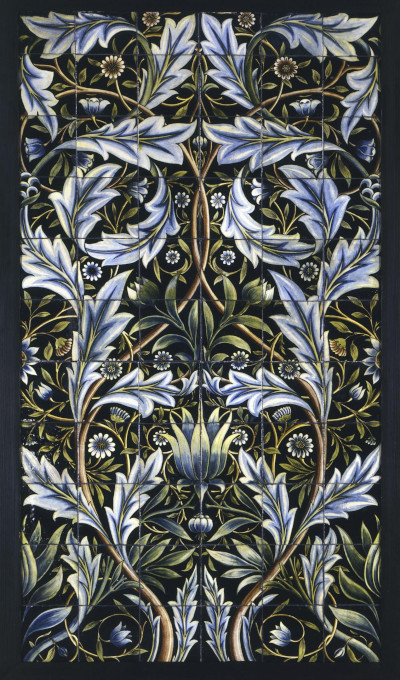
Membland Hall tile panel
1876, V&A C.36-1972. Morris design; De Morgan production.
Pictures made by several hands
Floral ornament formed only part of the firm’s early ceramic output. The Alceste tile, about 1862, introduces a figure from Chaucer’s Legend of Good Women. Its credits identify Edward Burne-Jones as designer and Lucy Faulkner, later Lucy Orrinsmith, as painter. The William Morris Gallery explains that Dutch blanks were painted by workshop members, including Lucy and her sister Kate, after designs by Morris, Burne-Jones and others. Morris’s firm provided a setting in which different skills could meet on the same object. [3]
This division of work gives the tiles a particularly human interest. A drawing sets the figure’s pose and the shape of a garment; the painter must translate those decisions into lines and areas of ceramic colour. The final object belongs to a chain of actions. Naming the painter makes that act of translation visible, while preserving the distinction between inventing a composition and carrying it onto the tile.
The gallery’s Labours of the Month panel makes the collaboration especially clear. Dated 1862 in its current collection record, it brings together seasonal figures designed by several members of the circle, including Morris, Burne-Jones, Ford Madox Brown, Dante Gabriel Rossetti and Philip Webb. Lucy Faulkner painted the tiles. Her LJF monogram appears on February, a small mark that anchors the panel in a named person’s work. Individual figure designs retain some uncertain attributions: the gallery assigns April to Morris but describes July as possibly his. [4]
The subject comes from medieval and early Renaissance traditions in which the year unfolds through appropriate activities. A comparable series was commissioned for the dining hall at Queens’ College, Cambridge, in 1862. The two versions differ in details, including the treatment of June and the presence of zodiac images in the gallery’s set. A familiar seasonal scheme could thus be adjusted to a particular commission. The panel invites us to move from figure to figure, reading the year across a sequence of framed images. [4]
Curator Esmé Whittaker places such work within Morris’s wider interest in decorated walls as places where stories could be shared. Her exhibition essay, Reading the Walls, connects his use of textiles, stained glass and ceramic tiles with a wish to make narrative part of a building’s everyday life. That perspective helps explain why a tiled picture belongs in this history alongside a repeating plant. One offers an episode to recognise; the other gives the eye a recurring path through ornament. Both enrich a surface encountered repeatedly by the people who live with it. [5]
The Membland Hall panel
The grandest example here is the floral panel designed for Membland Hall in Devon in 1876. The V&A’s record, published through Museum With No Frontiers, identifies Morris as designer and states that the tiles were painted in De Morgan’s studios. Its panel, C.36-1972, measures 160 by 91.5 centimetres. The medium is slip-covered earthenware, hand-painted and glazed: a substantial ceramic object assembled from a grid of smaller units. The commission was intended for bathroom decoration. [6]
Look first at the broad leaves. Their pale surfaces catch the eye against the dark ground, and their pointed lobes turn in different directions. Some leaves curve around the spaces between stems; others spread sideways, offering a wide shape before narrowing into a curling tip. Smaller flowers punctuate the intervals. Their fine scale prevents the large foliage from becoming an unbroken mass, while their light heads carry the eye into areas that might otherwise recede into darkness.
The balance of large and small forms is essential. The biggest leaves provide an immediate structure, but the thin stems keep that structure moving. Follow a stem and the design begins to open: a tendril bends, a blossom appears, another leaf overlaps the route. The surface feels abundant because several scales of growth coexist within it. Its richness depends on those differences in size and direction as much as on the number of plants.
The William Morris Gallery holds Morris’s paper design, A31, made in pencil, ink and watercolour. Its record explains that the panel contains sixty-six tiles and describes a drop arrangement of foliage with Persian inspiration. It also draws a useful distinction from Morris’s contemporary wallpapers: the tile scheme gives larger motifs more open space. At its edges, the design allows the pattern to continue sideways into an adjoining panel. A tall rectangular unit could become part of an extended wall. [7]
The joints add another structure beneath the foliage. Horizontal and vertical lines divide the surface evenly, while the plants cross them with curves and diagonals. A leaf can begin on one tile and continue on the next, asking the viewer to complete its shape across a narrow interruption. Step back and the leaf becomes whole; move closer and the assembly reappears. The pattern holds together at both distances.
That relationship is especially engaging in a domestic interior. As someone moves through the room, the panel changes from a broad arrangement of light and dark into a surface of individual painted details. The bathroom destination gives the lavish foliage an intimate setting. It belongs to a room used in ordinary daily life, where repeated encounters could gradually disclose its smaller flowers and intricate stems.
De Morgan and the work of making
De Morgan’s contribution involved specialist ceramic knowledge. His early work for Morris was in stained glass, and the V&A connects his interest in lustrous ceramics with effects he observed during glass production. At his Chelsea pottery, Frank Iles managed the kiln, while painters including Fred and Charles Passenger translated designs onto wares. These were skilled collaborators within De Morgan’s own enterprise. A vase or dish designed by De Morgan remains his work even when its floral vocabulary recalls Morris’s patterns. [1]
The V&A describes one of De Morgan’s transfer methods in detail. A guide design was fixed to one side of glass; a painter worked on another piece of tissue on the opposite side. The painted tissue was then laid face down onto a slip-coated tile and covered with transparent glaze. Firing destroyed the tissue and left the painted design. Such a method allowed a repeated outline to be followed while the decoration was still painted by hand. [8]
There was flexibility in the tile body too. De Morgan used purchased blanks and also began making his own tiles by 1876. Factory blanks continued to be useful for some lustre designs and for customers who preferred their regular shape. A ready-made blank could support ambitious hand decoration. [8]
Contemporary exhibition credits show how openly these contributions could be distinguished. The Arts and Crafts Exhibition Society’s 1888 catalogue, transcribed by the Furniture History Society, lists a chimney-piece designed by Halsey Ricardo with a ship panel designed by De Morgan and painted by Fred Passenger. Another exhibit identifies a vase’s designer, thrower and painter separately. Those credits provide an excellent way of reading the ceramics now: ask who supplied the form, who supplied the image and who executed it. [9]
Tiles within an interior
Ceramics were part of a broader furnishing world. The William Morris Gallery records that the firm sold both its own ceramic designs and De Morgan’s, and that by the 1880s he was the Morris shop’s main ceramic supplier. His pottery stood at Merton Abbey from 1882 to 1888, close to Morris’s works. The association was close without making the two businesses or their authorship interchangeable. A customer could encounter De Morgan’s ceramics through Morris’s shop. [10]
The uses were equally varied. The V&A describes De Morgan tiles in fireplaces, bathrooms, kitchens, dados and furniture such as washstands. A tiled area could be wiped clean while carrying colour into a heavily used room. These settings help recover the scale of the design problem: ornament had to work around a hearth, against furniture or across a band of wall. The square was a flexible building block within a larger arrangement. [8]
The original destination of an object also needs care. The William Morris Gallery’s account of its Membland panel, C176, says the surviving sets had apparently never been mounted and were found in a cupboard before the house’s demolition. A design intended for a bathroom is therefore evidence of a planned interior; it does not prove that every surviving panel once stood on that bathroom wall. The same account documents blanks supplied by the Architectural Pottery Company at Poole, adding another participant to the panel’s manufacture. [11]
Reading a ceramic label
A useful museum label can restore these relationships in a few words. For the Membland design, Morris’s name identifies the pattern and De Morgan’s identifies the workshop that realised it, with the Poole pottery supplying the blanks. For Alceste, Burne-Jones and Lucy Faulkner describe a different partnership. For De Morgan’s own designs, his name and those of his painters tell another story. Each combination gives a more precise account of the object. [3] [9] [11]
That precision deepens the enjoyment of Morris’s ceramics. The flower on a small tile, the seasonal figure and the sweeping foliage of a bathroom panel offer distinct experiences, yet each depends on an image being translated into a durable surface. Looking across their joins, painted outlines and changing colours brings us close to the central achievement: decoration made to belong to a room, and shaped by the hands of the people who made it.
Artworks directory
Designs, printed papers and collaborative ceramic objects documented in the linked collections. Designer, decorator and manufacturer are distinguished where known. Design and manufacturing dates are different kinds of evidence; a dash means that no object date is supplied here. Additional entries labelled “Tate” come from the museum’s October 2014 catalogue. They retain its historical titles, dates and attributions; newer collection records are used where available. The list brings together selected records from these sources. [13]
| Name | Date | Medium |
|---|---|---|
| Daisy tile (Morris design) | about 1870 | Ceramic |
| Alceste tile (Burne-Jones design; Lucy Faulkner painting) | about 1862 | Ceramic |
| The Labours of the Month (several designers; Lucy Faulkner painting) | 1862 | Ceramic |
| Membland Hall tile panel (Morris design; De Morgan production) | 1876 | Ceramic |
| Design for Membland Hall tile panel | 1876 | Drawing |
| Membland Hall tile panel (William Morris Gallery) | 1876 | Ceramic |
| Trellis (V&A pattern-book specimen) | manufactured 1864; design 1862 | Wallpaper |
| Trellis (Met specimen) | 1864 | Wallpaper |
| Design for Trellis Wallpaper (William Morris Gallery) | 1862 | Drawing |
| Trellis (William Morris Gallery specimen) | design 1862 | Wallpaper |
| Trellis (Standen specimen) | — | Wallpaper |
| Trellis (loose sample-book page) | printed before 1917; design 1862 | Wallpaper |
| An Angel with a Harp (Tate A00815) | date not known | Drawing |
| An Angel with a Pipe (Tate A00816) | date not known | Drawing |
| A Girl with a Flute (Tate A00817) | date not known | Drawing |
| Design for Tapestry (Tate A00818) | date not known | Drawing |
| Attributed to William Morris: The Archangel Raphael (Tate A00819) | date not known | Drawing |
| Attributed to William Morris: The Archangel Gabriel (Tate A00820) | date not known | Drawing |
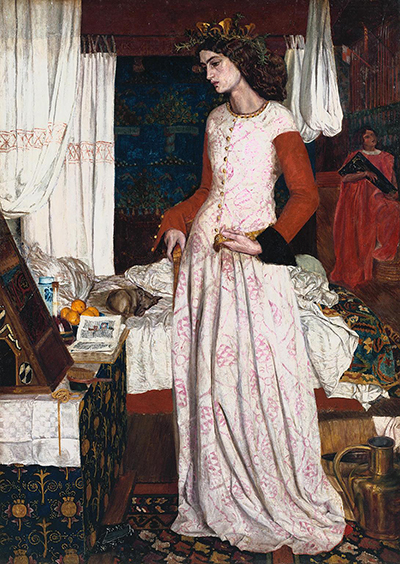
| La Belle Iseult (Tate N04999) | 1858 | Painting |
| The Archangel Gabriel (Tate N05219) | date not known | Drawing |
| Figure of Guinevere (Tate N05221) | c.1858 | Drawing |
| Guinevere and Iseult: Cartoon for Stained Glass (Tate N05222) | 1862 | Drawing |
| Angel of the Resurrection: Cartoon for Stained Glass (Tate N05223) | 1862 | Drawing |
Frequently Asked Questions
Lucy Faulkner painted the William Morris Gallery’s Labours of the Month set; the February tile bears her monogram. [4]
Discussion
Compare the flow of stems and flowers with the grid of tile joints, then consider the people named in the object records.
Reader Insights
Where do the plants seem to cross the tile boundaries?
How does knowing the designer and decorator change the object?
What differs between a wallpaper repeat and the larger panel?
Join the Conversation
Share a detail, comparison or question about William Morris Ceramics below.
References
- Victoria and Albert Museum. “William De Morgan – an introduction.” Updated 17 April 2024. V&A, London. English. View source.
- William Morris Gallery. “Daisy tile (c.1870).” Collection record C192; undated web record. London Borough of Waltham Forest. English. View source.
- William Morris Gallery. “Alceste tile (c.1862).” Collection record C175a; undated web record. London Borough of Waltham Forest. English. View source.
- William Morris Gallery. “The Labours of the Month (1862).” Collection record C216; undated web record. London Borough of Waltham Forest. English. View source.
- Esmé Whittaker. “Reading the Walls: William Morris and the Art of Storytelling.” In William Morris: Story, Memory, Myth, pp. 6–23. Two Temple Place, London, 2011; exhibition 28 October 2011–29 January 2012. English. View source.
- Victoria and Albert Museum. “Tile panel.” Collection record C.36-1972, MWNF working number UK 162. Sharing History, Museum With No Frontiers; undated record, site citation displays 2026. English. View source.
- William Morris Gallery. “Design for Membland Hall tile panel (1876).” Collection record A31; undated web record. London Borough of Waltham Forest. English. View source.
- Victoria and Albert Museum. “William De Morgan: master of Arts and Crafts tile design.” Updated 5 January 2026. V&A, London. English. View source.
- Furniture History Society, British and Irish Furniture Makers Online. “William De Morgan,” Arts and Crafts Exhibition Society database, including 1888 exhibits 53 and 53a. Transcriptions of contemporary exhibition catalogues; undated database record. English. View source.
- William Morris Gallery. “Object Type: ceramic,” page 2, contextual collection text on De Morgan and Morris, including records C5 and C10. Undated web records. London Borough of Waltham Forest. English. View source.
- William Morris Gallery. “Membland Hall tile panel.” Collection record C176, published through Google Arts & Culture; undated web record. London Borough of Waltham Forest. English. View source.
- Victoria and Albert Museum, Trellis, E.452-1919, detailed collection record: design November 1862, registered 1 February 1864. Accessed 28 October 2026. View source.
- Tate, Tate Collection metadata, artwork_data.csv, October 2014 snapshot, released under CC0. Repository readme states that this dataset is no longer maintained. Downloaded and artist rows inspected 28 October 2026. View source.
 William Morris.jpg)