 by Tom Gurney
Tom Gurney BSc (Hons) is an art history expert with over 20 years experience
Published on June 19, 2020 / Updated on October 27, 2026
Email: tomgurney1@gmail.com / Phone: +44 7429 011000
The Three Tetons: Introduction
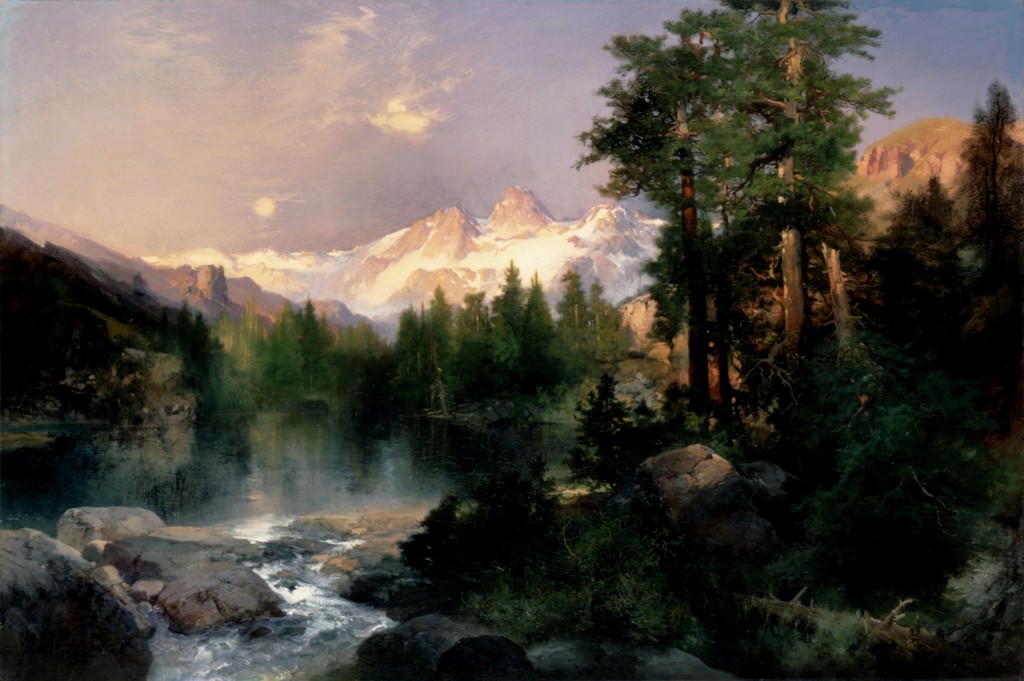
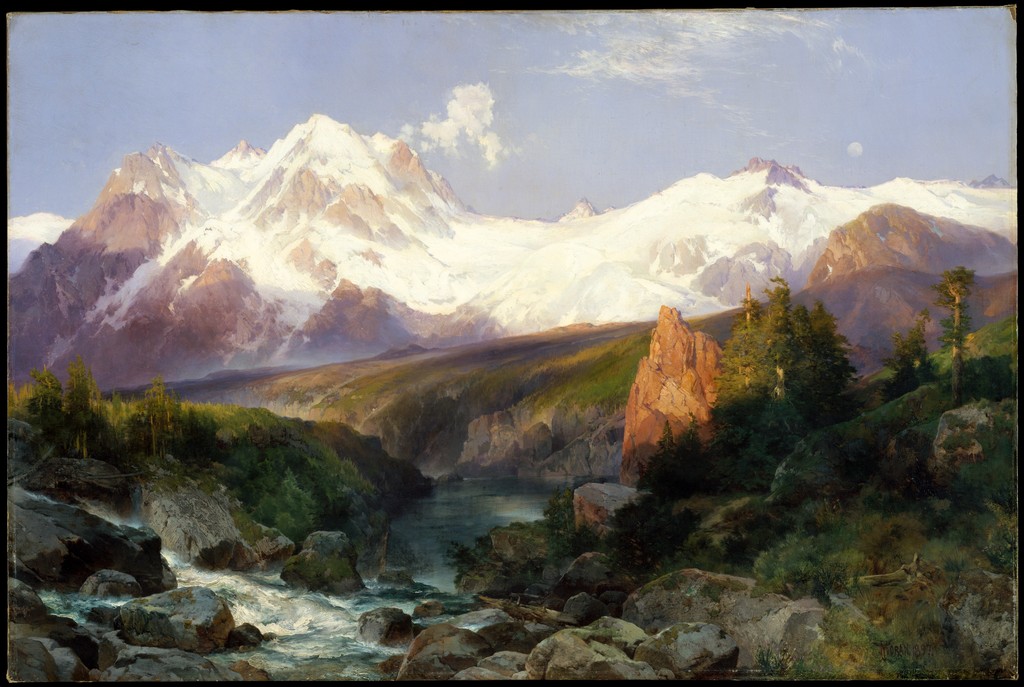
Thomas Moran's The Three Tetons, dated 1895, is an oil on canvas in the White House Collection. Illuminated peaks rise beyond a wooded body of water, while tall trees occupy the right foreground. A rocky stream at the bottom of the picture gives the viewer a close and active entrance into the mountain landscape. [1]
The painting rewards attention to the difference between that entrance and the distant summits. Near rocks and trees have substantial darkness and texture. The peaks are much lighter, with warm colours meeting white snow. Their brilliance depends partly on the foreground forms through which we approach them.
At a Glance
- ArtistThomas Moran
- TitleThe Three Tetons
- Date1895
- MediumOil on canvas
- Dimensions52.4 × 77.5 cm
- CollectionWhite House Collection
- GiftC. R. Smith
- InscriptionSigned and dated at the lower left
- Related workThe Teton Range, 1897, Metropolitan Museum of Art
- Documented travel contextMoran's Teton journey of August 1879
Where this work sits in Moran’s career
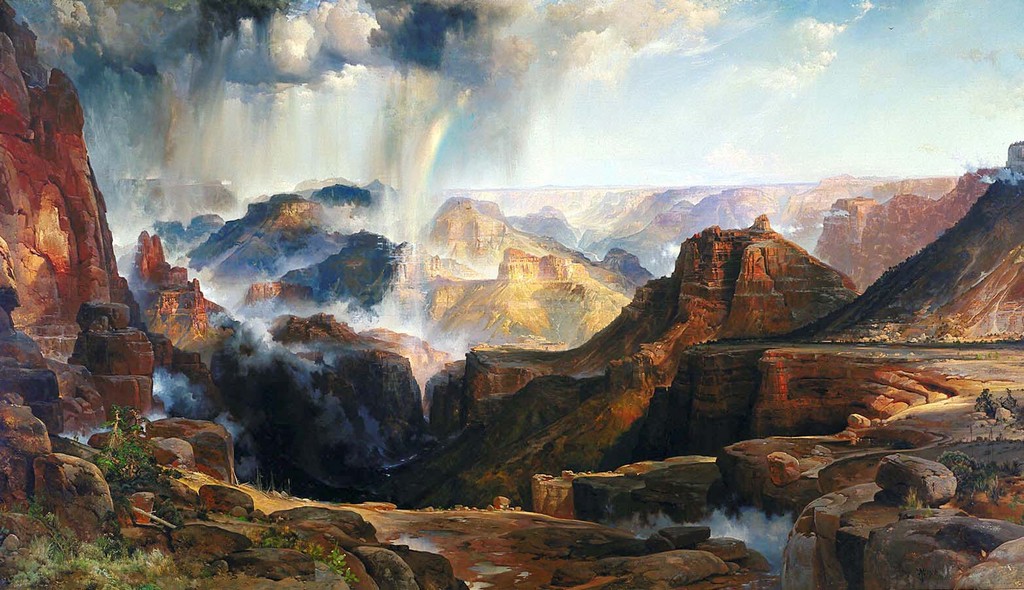
The Chasm of the Colorado
1873–1874; completed in 1874A View of Venice
1891Point Lobos, Monterey, California
1912, signed and datedThe Three Tetons
1895Contents
- A mountain group beyond the trees
- The dominant trees on the right
- The water between near and far
- Boulders and the foreground stream
- Warm light in the sky and peaks
- The 1895 canvas and its collection
- Travel, atmosphere and later composition
- A comparison with the Met's 1897 view
A mountain group beyond the trees
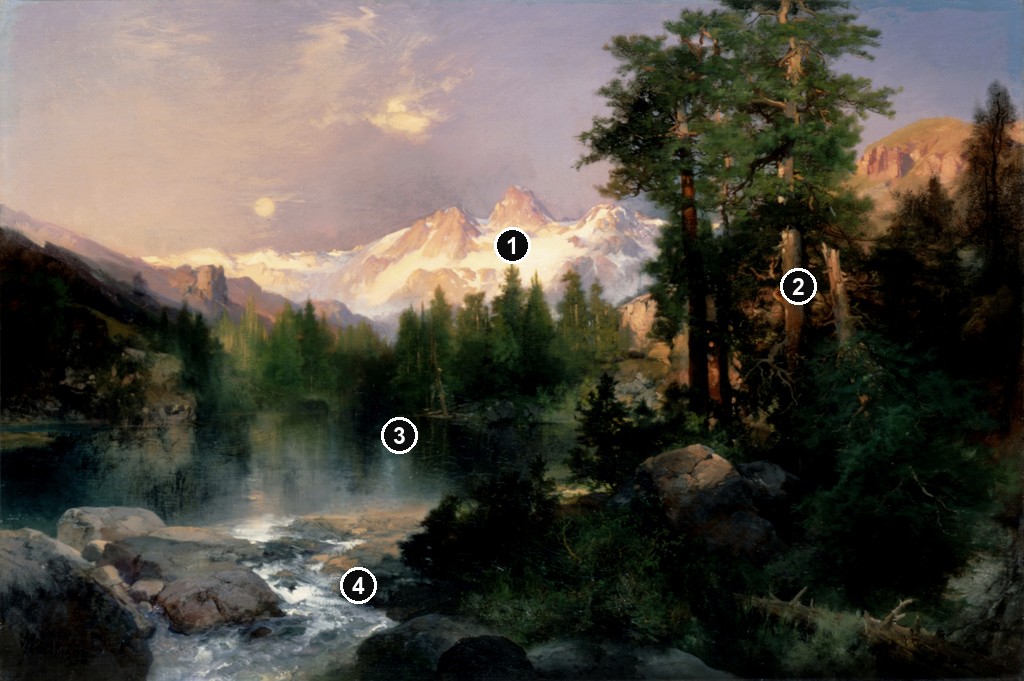
The prominent peaks appear around the centre of the distant view. Their irregular outlines rise above a much darker wooded area. Snow links them through broad pale passages, while warm exposed faces distinguish their separate forms. The mountain group becomes a centre of attention without filling the whole canvas.
The tallest-looking peak sits slightly right of centre in that group. Its pointed summit is particularly clear against the softer sky. Other peaks rise at different heights around it, creating an uneven rhythm. Their arrangement gives the range a recognisable character without making every form equally prominent.
Below the summits, snow spreads across more complicated slopes. Pale areas pass behind nearer trees and become less clearly divided at a distance. That partial concealment matters. The viewer sees enough to understand a mountainous expanse, while the lower parts continue beyond the immediately visible openings.
The composition therefore makes the mountains both a destination and a partially withheld view. Trees, slopes and atmosphere stand between the spectator and the peaks. The picture has depth because the range is approached through intervening forms, rather than presented as a single isolated emblem.
Annotated Details from The Three Tetons
Compare these details with the full composition. The numbered overview and crops come from the same original image.
Details from THE THREE TETONS
Open a detail to see it more closely.
A mountain group beyond the trees
The prominent peaks appear around the centre of the distant view. Their irregular outlines rise above a much darker wooded area. Snow links them through broad pale passages, while warm exposed faces distinguish their separate forms. The mountain group becomes a centre of attention without filling the whole canvas.
The dominant trees on the right
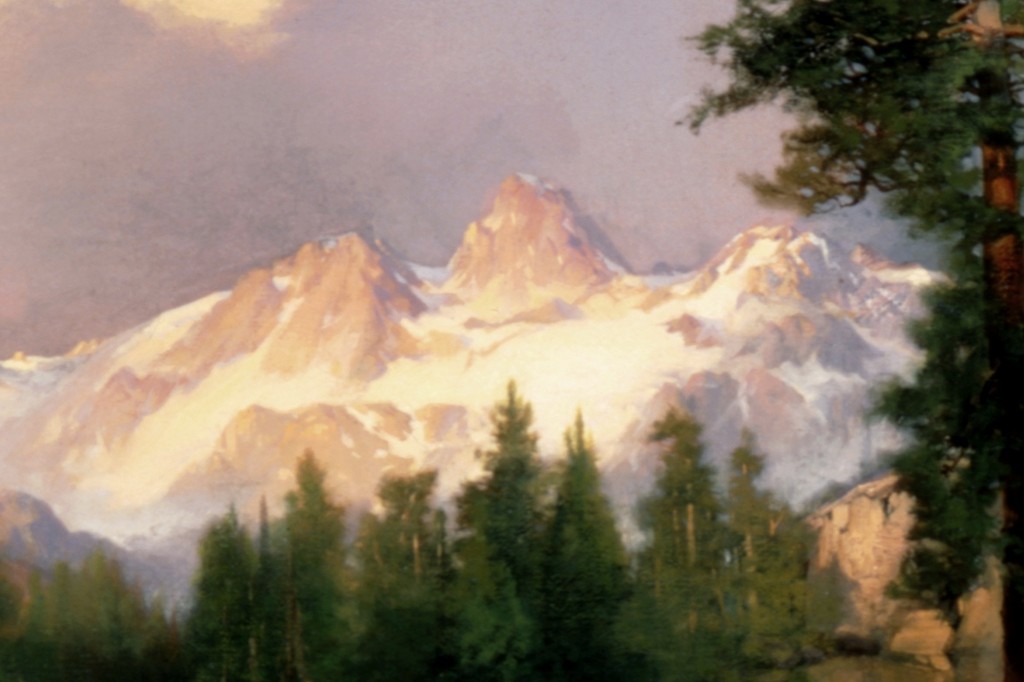
A large group of trees rises close to the right-hand edge. Several trunks receive warm light, while foliage forms substantial dark areas around them. Their height gives the foreground a forceful upright movement within a broad canvas. They compete with the mountains in size but differ strongly in distance and colour.
The water between near and far
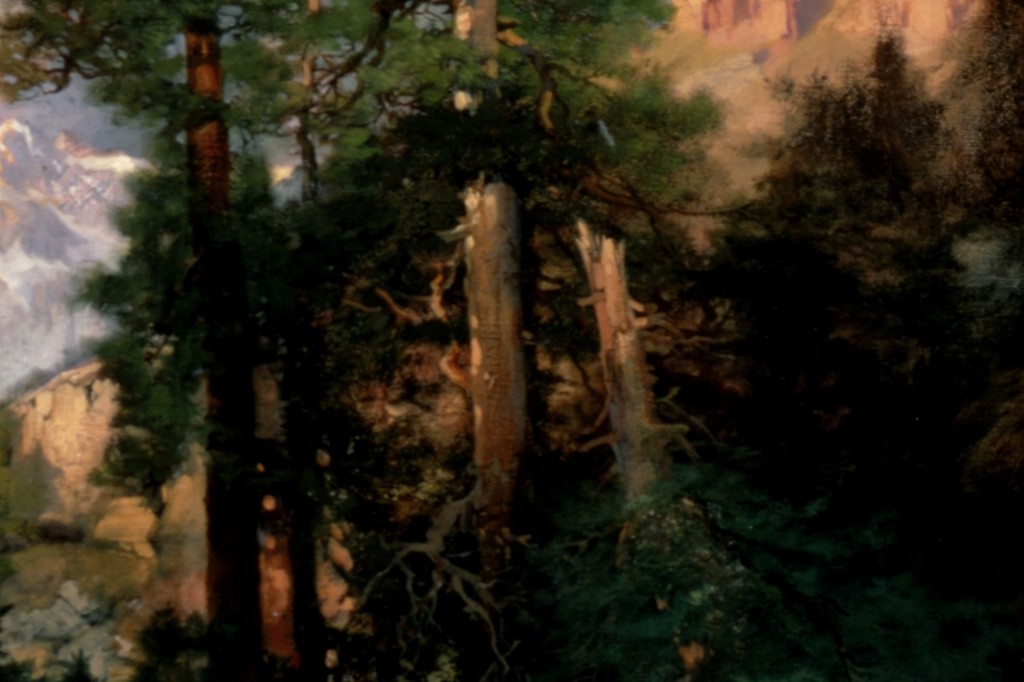
The central body of water has a calmer appearance than the foreground stream. Its darker blue-green surface receives reflections from the trees and light above. These reflections are softened and interrupted, joining the water to its surroundings without turning it into a perfect mirror.
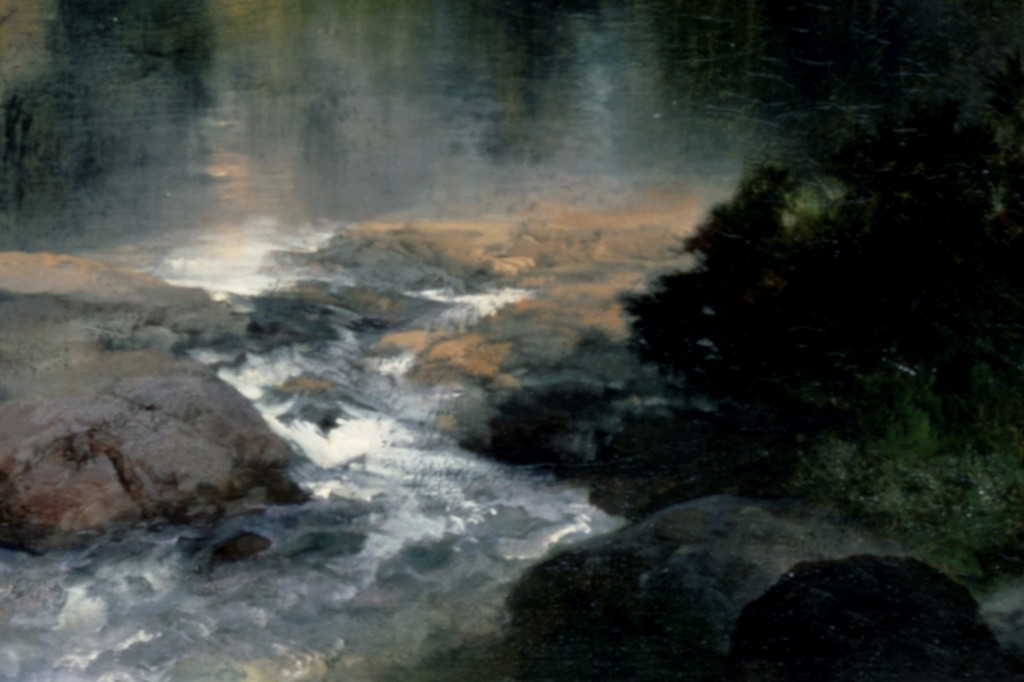
Boulders and the foreground stream
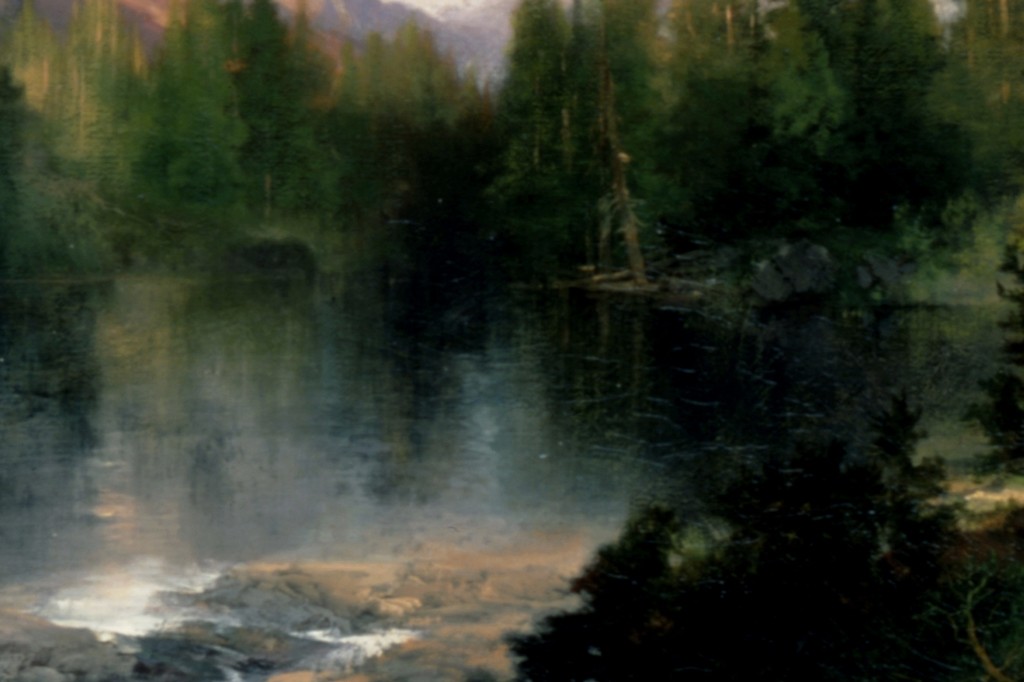
Large rocks occupy the lower left and extend across the bottom of the painting. Their pale surfaces catch the light more firmly than many of the surrounding trees. Cracks and darker gaps divide them into separate masses. These close forms give the spectator something tangible against which to measure the broader view.
The dominant trees on the right
A large group of trees rises close to the right-hand edge. Several trunks receive warm light, while foliage forms substantial dark areas around them. Their height gives the foreground a forceful upright movement within a broad canvas. They compete with the mountains in size but differ strongly in distance and colour.
Some branches are clearly separated against the sky, while others merge into the darker group. This variation keeps the trees from becoming a simple repeated pattern. Their structure can be followed in places, then lost where several forms overlap. The forest feels dense without every branch receiving equal description.
The warm trunks also connect foreground and distance. Their reddish-brown passages answer the warmer faces of the mountain peaks. The connection is made through colour rather than scale: the trunks remain close and substantial, while the peaks are separated by a broad atmospheric interval.
At the base of the group, foliage and rocks create a much heavier dark area. This anchors the right side of the painting. It also makes the open water towards the left and centre feel relatively spacious. Moran balances a dense, enclosed foreground with a more accessible interval beside it.
The water between near and far
The central body of water has a calmer appearance than the foreground stream. Its darker blue-green surface receives reflections from the trees and light above. These reflections are softened and interrupted, joining the water to its surroundings without turning it into a perfect mirror.
Vertical reflections suggest the presence of trunks and foliage beyond the bank. Their shapes stretch downwards, but become less definite as they meet changing passages of light. This gives the woodland a second, more fluid appearance. The landscape is experienced through both solid forms and their unstable reflected images.
A brighter reflection appears nearer the lower central area. It links the sky's light with the water, drawing attention away from the heaviest shadows. The passage helps connect the calmer surface with the moving stream at the front. Light supplies continuity where the water changes character.
The far bank is partly obscured by trees. Some forms stand clearly above the water; others merge into a darker woodland band. This uneven clarity makes the distance feel layered. The viewer looks across a surface towards a forest, then beyond the forest to the much brighter mountains.
Boulders and the foreground stream
Large rocks occupy the lower left and extend across the bottom of the painting. Their pale surfaces catch the light more firmly than many of the surrounding trees. Cracks and darker gaps divide them into separate masses. These close forms give the spectator something tangible against which to measure the broader view.
Water runs between the rocks in narrow, bright passages. Foam breaks into small, irregular shapes, contrasting with the quieter surface beyond. The stream introduces movement near the viewer while the peaks remain comparatively still. The difference makes the landscape active at more than one visual scale.
The channel bends through the foreground rather than offering a straight central route. Its changes of direction correspond to the positions of the rocks. The eye follows white water around obstacles, then moves towards the calmer interval further back. The composition gains a path of attention through uneven ground.
Dark foliage on the right almost meets the stream. That closeness strengthens the contrast between bright moving water and densely occupied land. The foreground feels enclosed, even though the mountains beyond are open and luminous. The painting's sense of expansiveness develops through this difference.
Watch: Thomas Moran
Choose a film to explore the artist’s work, its interpretation and its wider setting.
The painting that inspired a National Park
A close discussion of Moran’s landscape and its relationship to the idea of Yellowstone.
Watch on YouTubeWarm light in the sky and peaks
The sky contains soft clouds and a pale yellow disc towards the left. Warm brightness is strongest near the distant peaks, while cooler and greyer passages occupy other areas. The effect suggests low light without establishing an exact hour, season or astronomical circumstance.
The mountain faces receive that warmth unevenly. Some exposed surfaces appear pink or orange, while snow retains much paler passages. Shadowed sides make the brighter areas more distinct. The peaks are luminous because light encounters a varied surface, not because the whole range is covered in one uniform colour.
The clouds are less sharply bounded than the summits. At several points, mountain and atmosphere approach one another in tone. The eye must separate their forms by following changes in edge and colour. This gives the distance a softer character than the emphatic rocks and trunks close to the spectator.
The painting's light consequently works across several depths. It touches a foreground trunk, passes through a reflection and returns in the mountain faces. Those connections bring the near forest and distant range into one arrangement. Their physical separation remains clear even where related colours join them.
The 1895 canvas and its collection
The faithful-reproduction record sourced from the White House Art Collection identifies the painting as an 1895 oil and records the gift of C. R. Smith. Its lower-left inscription includes Moran's monogram and the date. The National Gallery's 1997 catalogue independently includes the canvas as number 80, with dimensions of 52.4 × 77.5 cm. [2]
These particulars distinguish the work from other Moran mountain pictures and similarly named Teton views. A shared subject does not establish an identical object. Date, measurements, inscription and collection provide a more specific foundation for comparison than the general appearance of snowy mountains and trees.
The White House association is part of the canvas's collection history. It does not establish a permanent room assignment or a present display arrangement. The painting's identity can be discussed securely without attaching it to a time-sensitive interior. The image itself remains the clearest basis for understanding its foreground and mountain distance.
Travel, atmosphere and later composition
The catalogue places Moran's Teton observations in August 1879, travelling with his brother Peter. Transcribed diary passages describe the peaks appearing through mist and being partly or entirely obscured by smoke. On one occasion, the conditions made sketching impossible. The mountains were encountered through changing weather and visibility. [2]
That account gives valuable context for a painting made many years later. It shows the artist attending to atmospheric colour and to the difficulty of seeing a distant range clearly. It does not identify this canvas with one exact diary moment or prove that every foreground feature was observed from one position.
The finished painting organises a legible encounter with the peaks. Trees partly conceal them, but their brightest outlines remain prominent. The viewer is given both an obstacle and a clear destination. Moran turns the variability of a mountain subject into an arrangement that can be explored repeatedly.
A comparison with the Met's 1897 view
The Teton Range, dated 1897, is a separate, larger oil in the Metropolitan Museum of Art. The museum records 76.2 × 114.3 cm and accession 39.47.2. Its broad snow-covered range and prominent warm rock projection create a different balance of forms. [3]
Both canvases place moving water and rocky ground near the spectator. In the White House picture, however, the right-hand trees are particularly commanding and the peaks occupy a narrower opening beyond woodland. In the Met work, the snow spreads much further across the width. The mountain subject is related, while the experience of approaching it changes.
The comparison helps make The Three Tetons specific. Its effect depends on a close forest, a reflective interval and a brilliant group of summits beyond. The viewer moves through changing levels of darkness and clarity. The mountains become more powerful because the painting gives them a nearer world to rise above.
Artworks directory
Selected documented works and distinct versions. This directory is not a comprehensive catalogue raisonné. Dates and media retain the distinctions explained in the articles and museum records.
| Name | Date | Medium |
|---|---|---|
| An Arizona Sunset near the Grand Canyon | Date not securely established | Oil painting |
| Autumn Afternoon, the Wissahickon by Thomas Moran | 1864 | Oil on canvas |
| Cascade Falls, Yosemite | Commonly catalogued as 1905 | Catalogued as oil on canvas |
| The Chasm of the Colorado | 1873–1874; completed in 1874 | Oil on canvas, currently mounted on aluminium |
| Children of the Mountain | 1866 in the current museum title; 1867 in the 1997 National Gallery catalogue | Oil on canvas |
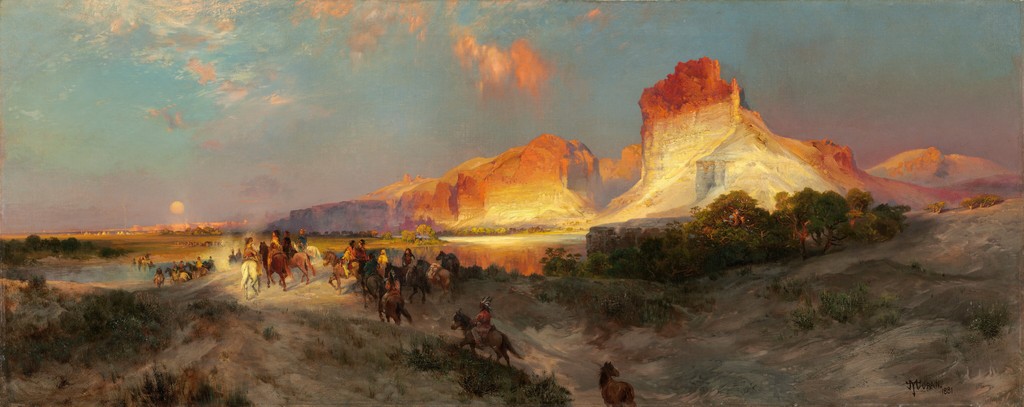
| Cliffs of Green River | 1874 | Oil on canvas |
| Cliffs of the Upper Colorado River, Wyoming Territory | 1882 | Oil on canvas |
| East Hampton, Long Island , also captioned Easthampton, L.I | 1897 | Oil on canvas laid on board, according to the reproduction record |
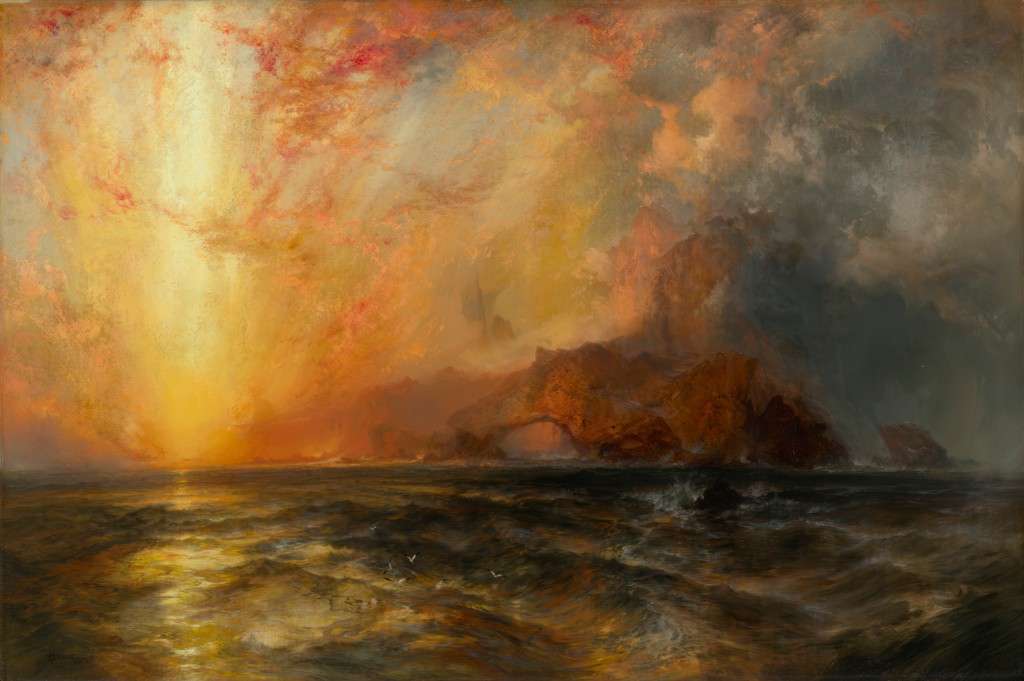
| Fiercely the red sun descending, Burned his way along the heavens | 1875–76 | Oil on canvas |
| Forest Scene | 1870 | Oil on canvas |
| Grand Canyon of the Colorado River | 1892 and 1908 | Oil on canvas |
| Green River Cliffs, Wyoming | 1881 | Oil on canvas |
| Green River, Wyoming | 1878 | Oil on panel |
| The Juniata, Evening | 1864 | Oil on canvas |
| Mosquito Trail, Rocky Mountains of Colorado | 1875 in the 1997 National Gallery exhibition catalogue | Watercolour |
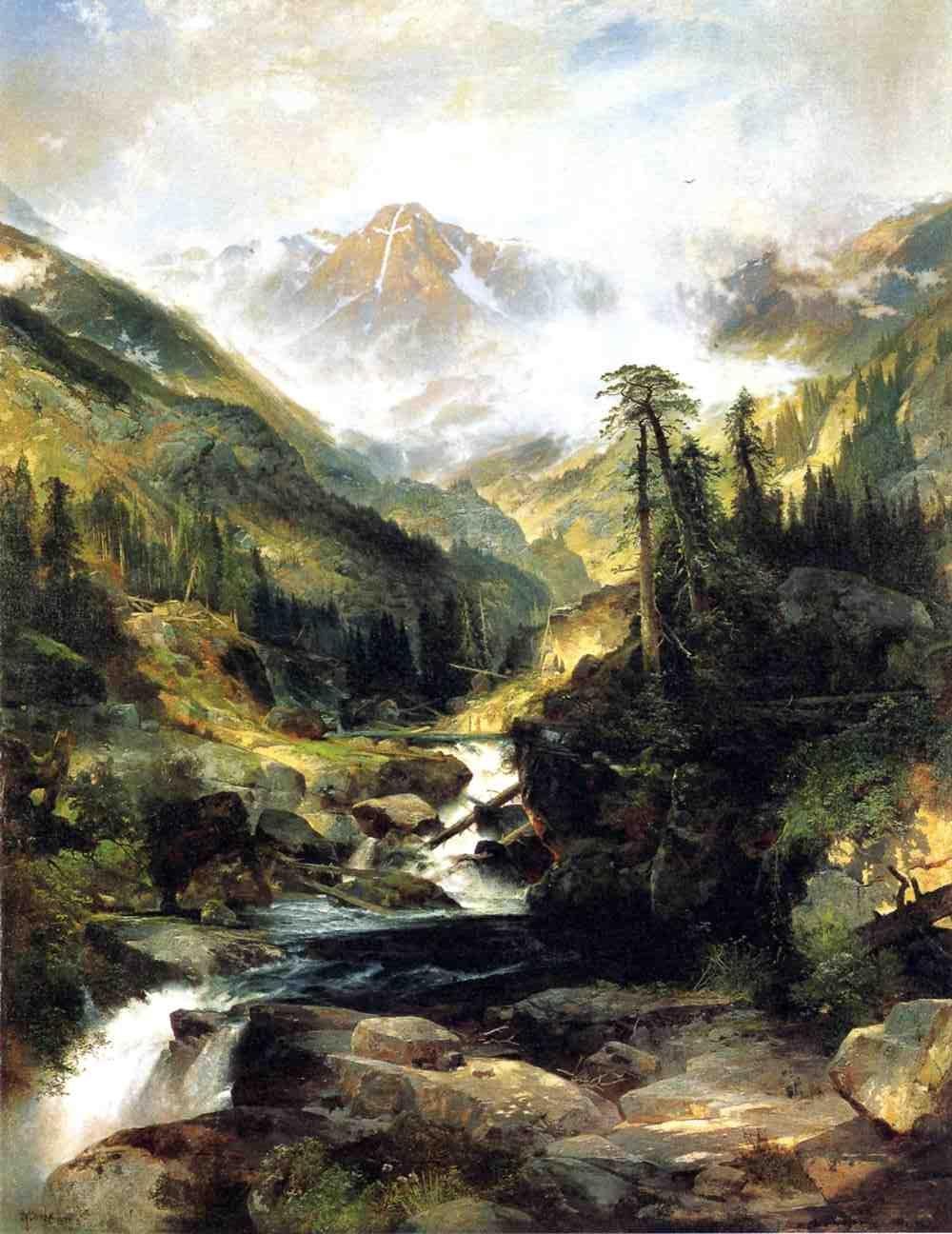
| Mountain of the Holy Cross | 1875 | Oil on canvas |
| The Much Resounding Sea | 1884 | Oil on canvas |
| Point Lobos, Monterey, California | 1912, signed and dated | Oil on canvas |
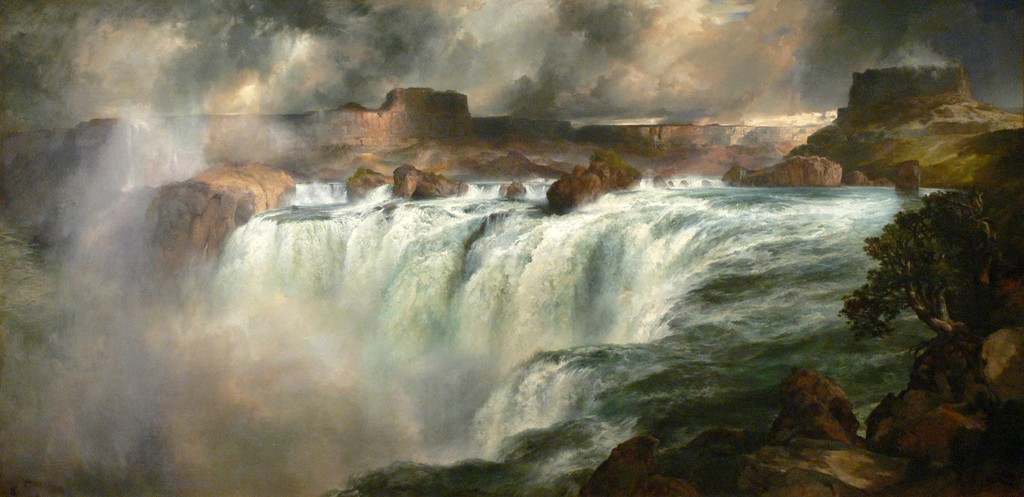
| Shoshone Falls on the Snake River | 1900 | Oil on canvas |
| Summit of the Sierras | 1872/75, as catalogued by the Art Institute of Chicago | Gouache over graphite on cream laid paper |
| The Teton Range | 1897 | Oil on canvas |
| The Three Tetons | 1895 | Oil on canvas |
| Tower Falls, Yellowstone | 1872 | Watercolour and gouache over graphite on blue laid paper |
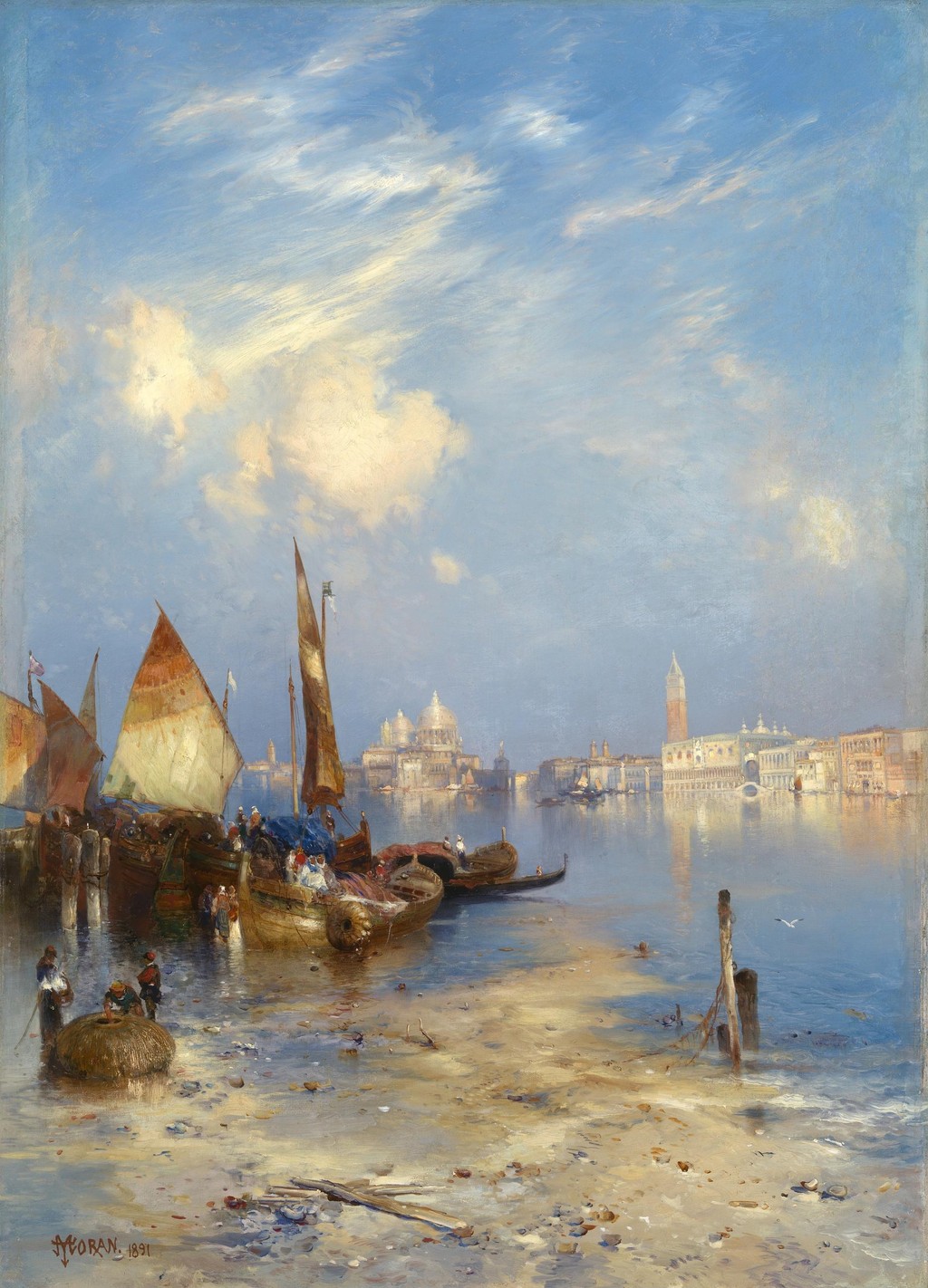
| A View of Venice | 1891 | Oil on canvas |
| The Grand Canyon of the Yellowstone | 1872 | Oil on canvas, currently recorded as mounted on aluminium |
| Mountain of the Holy Cross, Colorado (etching) | 1888 | Etching, roulette and aquatint |
| The Resounding Sea (etching) | 1880 | Etching |
| The Much Resounding Sea (later etching) | 1886 in heading; 1888 on plate | Etching, drypoint and roulette |
| Tower Falls (Prang print) | c. 1875; portfolio issued 1876 | Chromolithograph |
| Shoshone Falls (early watercolour) | 1874 | Watercolour |
| Venice (watercolour) | 1888 | Watercolour over graphite |
Frequently Asked Questions
1895, the date recorded in its inscription and collection sources.
Oil on canvas, 52.4 × 77.5 cm.
The White House Collection; it was the gift of C. R. Smith.
No. The Met owns a separate 1897 canvas with different dimensions and composition.
Its recorded date is 1895. The earlier journey supplies context rather than the finished canvas's date.
Discussion
Compare the illuminated mountain faces with the warm trunks in the right foreground. How does related colour connect forms that are very different in size and distance?
Reader Insights
Editorial prompts for close looking and discussion.
Compare the illuminated mountain faces with the warm trunks in the right foreground. How does related colour connect forms that are very different in size and distance?
Which source or image helps you assess the interpretation?
How does this page compare with the related works linked above?
Join the Conversation
Share your reading of this page below.
References
- White House Art Collection source, The Three Tetons, object and faithful-reproduction record at Wikimedia Commons, 1895, inscription and gift credit.
- Nancy K. Anderson and contributors, Thomas Moran, 1997, catalogue no. 80, p. 151, including selected 1879 diary transcriptions; selected chronology, p. 226.
- Metropolitan Museum of Art, The Teton Range, 1897, object record, 39.47.2.
- Splash image source.
The Three Tetons, 1895. The White House Collection, Gift of C. R. Smith; faithful reproduction via Wikimedia Commons. Image source. Public Domain Mark; faithful reproduction of a two-dimensional public-domain work. Resized only; complete source image retained.
- Splash image source.
The Three Tetons, 1895. The White House Collection, Gift of C. R. Smith; faithful reproduction via Wikimedia Commons. Image source. Public Domain Mark; faithful reproduction of a two-dimensional public-domain work. Numbered circles added to the overview; details cropped from the original reproduction. No colour adjustment or sharpening.
- Splash image source.
The Teton Range, 1897. The Metropolitan Museum of Art, Bequest of Moses Tanenbaum, 1937, 39.47.2. Image source. CC0 1.0; Met-donated file. Resized only; complete source image retained.
- Splash image source.
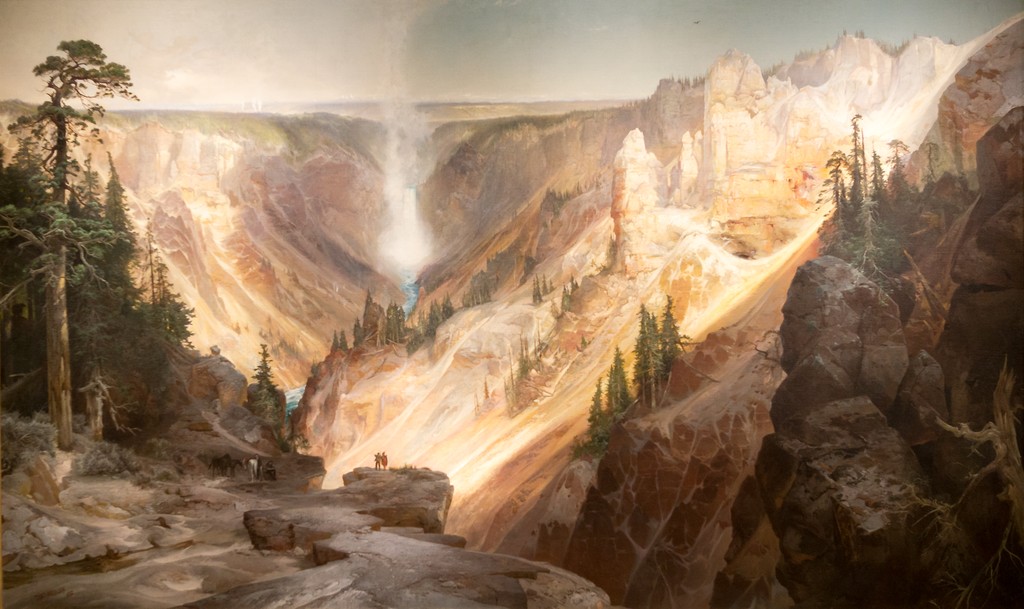
The Grand Canyon of the Yellowstone, 1872. Wuselig / Wikimedia Commons, CC BY-SA 4.0; U.S. Department of the Interior Museum painting. Image source. CC BY-SA 4.0; also marked PD-Art. Outer museum frame cropped; resized. Painted composition retained; photographic perspective unchanged. This image derivative is available under the same licence.
- Splash image source.
The Chasm of the Colorado, 1873–1874. U.S. Department of the Interior Museum; faithful reproduction via Smithsonian American Art Museum / Wikimedia Commons. Image source. Public Domain Mark; faithful two-dimensional reproduction. Resized only; complete source image retained.
- Splash image source.
Mountain of the Holy Cross, 1875. Autry Museum of the American West; faithful reproduction via Wikimedia Commons. Image source. Public Domain Mark; faithful two-dimensional reproduction. Resized only; complete source image retained.
- Splash image source.
Shoshone Falls on the Snake River, 1900. Wolfgang Sauber / Wikimedia Commons, CC BY-SA 3.0; Gilcrease Museum painting. Image source. CC BY-SA 3.0; also marked PD-Art. Resized only; complete source image retained. This image derivative is available under the same licence.
- Splash image source.
Green River Cliffs, Wyoming, 1881. National Gallery of Art, Gift of the Milligan and Thomson Families. Image source. Public domain; NGA Open Access. Resized only; complete source image retained.
- Splash image source.
A View of Venice, 1891. Smithsonian American Art Museum, Transfer from the U.S. Department of the Interior, National Park Service, 1968.120.1. Image source. Free to use; Smithsonian Open Access. Resized only; complete source image retained.
- Splash image source.
The Three Tetons, 1895. The White House Collection, Gift of C. R. Smith; faithful reproduction via Wikimedia Commons. Image source. Public Domain Mark; faithful reproduction of a two-dimensional public-domain work. Resized only; complete source image retained.