 by Tom Gurney
Tom Gurney BSc (Hons) is an art history expert with over 20 years experience
Published on June 19, 2020 / Updated on October 27, 2026
Email: tomgurney1@gmail.com / Phone: +44 7429 011000
Mountain of the Holy Cross by Thomas Moran: Introduction
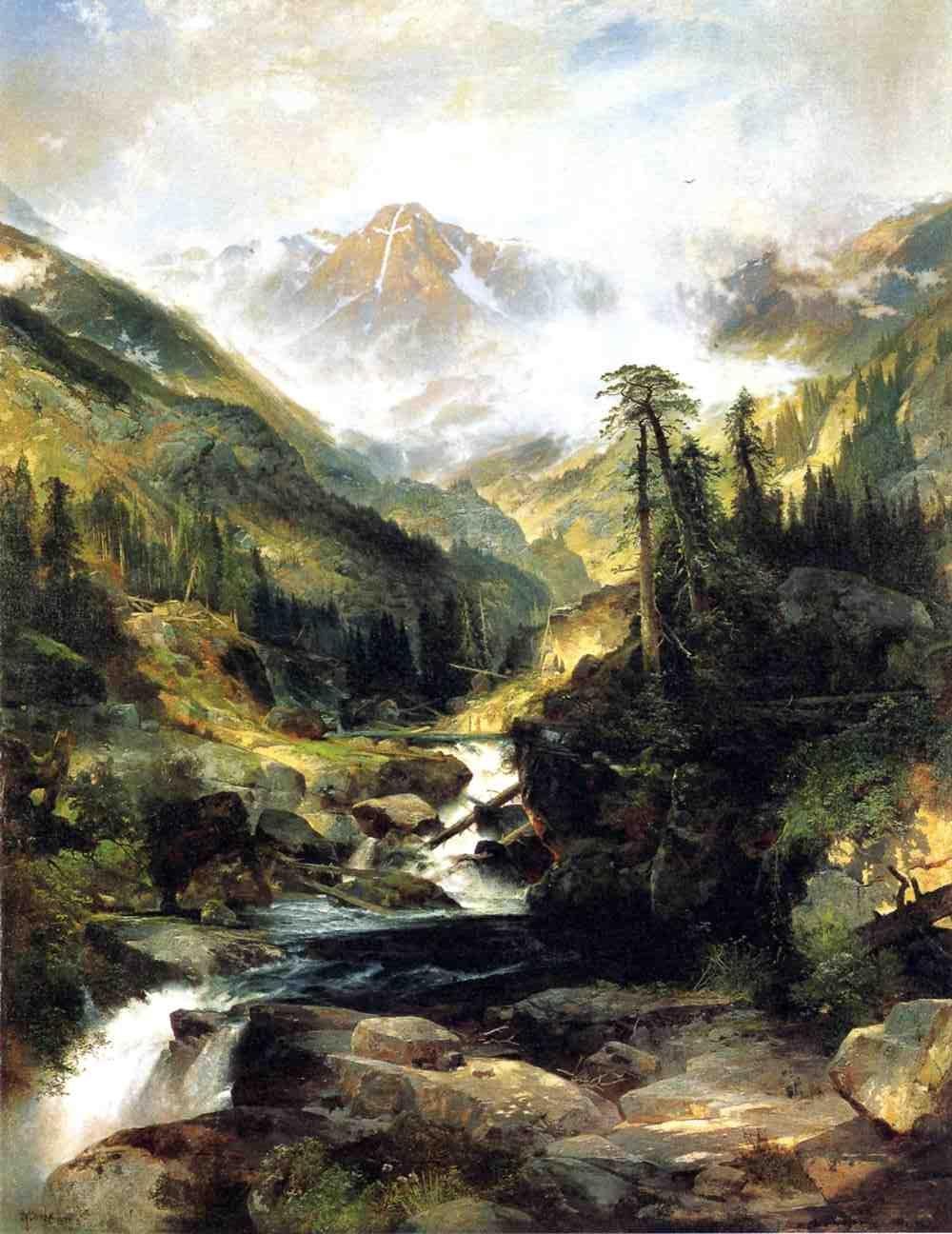
Thomas Moran’s Mountain of the Holy Cross leads the eye along rushing water towards a distant Colorado summit marked by a cross of snow. Completed in 1875, the oil painting followed his journey to the mountain the previous summer. It belongs to the Autry Museum of the American West, which records it as a donation from the collection of Jackie and Gene Autry. [1]
The cross gives the work its title, but the picture’s force depends on much more than the summit. Broken rocks, shadowed trees, cascades and a belt of mist create a long approach through the landscape. Moran made the foreground an active part of that approach: correspondence records his intention to use a waterfall seen on the journey in the eventual painting. Observation and compositional choice meet in the route from moving water to snow-covered height. [2]
At a Glance
- ArtistThomas Moran
- TitleMountain of the Holy Cross
- Date1875
- MediumOil on canvas
- CollectionAutry Museum of the American West
- CreditDonated from the collection of Jackie and Gene Autry
- JourneyColorado, summer 1874
- First New York exhibitionW. Schaus’s gallery, April 1875
- Later related workMountain of the Holy Cross, Colorado, 1888, a print in different media
Where this work sits in Moran’s career
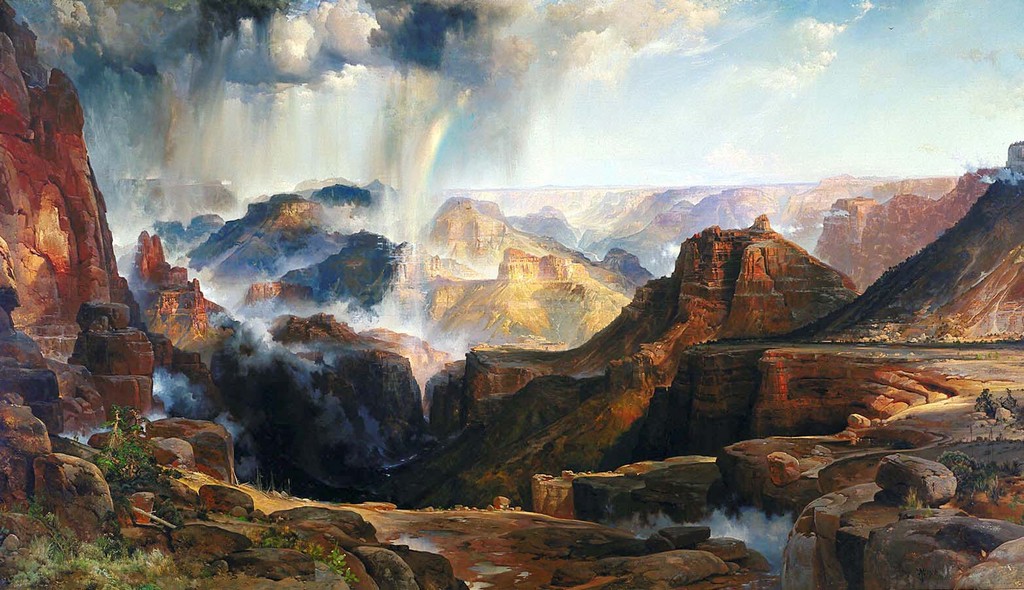
The Chasm of the Colorado
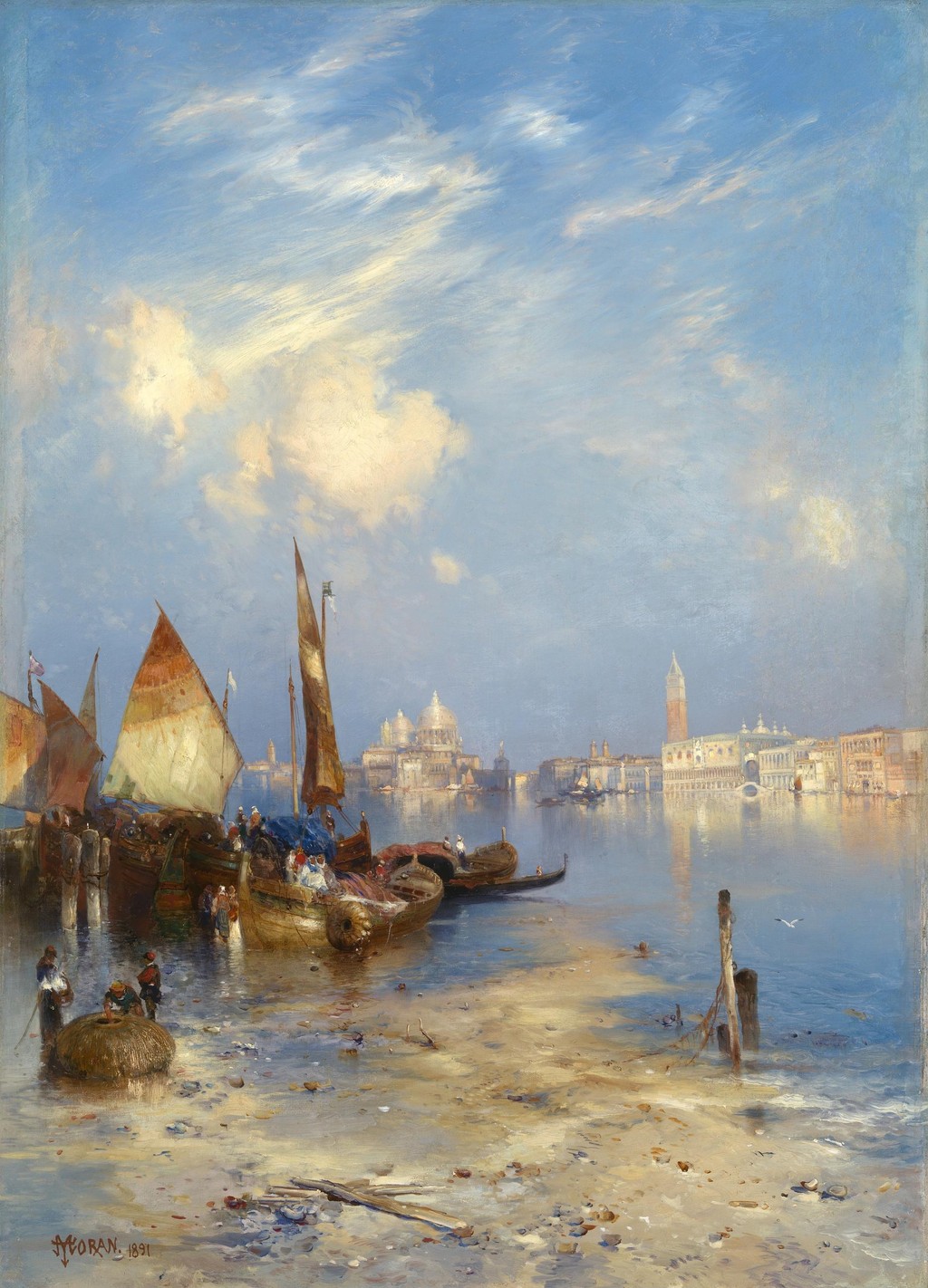
1873–1874; completed in 1874A View of Venice
1891Point Lobos, Monterey, California
1912, signed and datedContents
- Seeing the summit through the valley
- The journey of 1874
- A landscape assembled for the picture
- Water, rock and the impression of movement
- Mist, light and the problem of distance
- The cross and its nineteenth-century meanings
- Schaus’s exhibition and the first responses
- The Boston argument about atmosphere
- Sale, ownership and the Autry collection
- A later print of the subject
Seeing the summit through the valley
The painting has an upright format. The summit lies high within it, while the stream and foreground rocks occupy much of the lower half. This arrangement makes the distant mountain something approached through a sequence of nearer experiences. We do not begin with an isolated peak against a blank sky. Water, stone, trees and cloud all intervene before the eye arrives at the cross.
Near the bottom left, bright water drops beyond the edge of a rocky shelf. Behind it, a dark pool and further cascades lead back towards the middle distance. The stream is repeatedly interrupted by boulders and fallen wood. Its course has to be followed in stages, with light passages connecting areas that would otherwise merge into the shadowed valley.
A large, dark rock mass occupies the right centre. Tall trees rise beside and above it, including one prominent trunk with a sparse, spreading crown. The contrast with the water is strong: the rock appears heavy and fixed, while the stream makes a restless path around obstacles. These nearer vertical shapes also prepare the eye for the summit’s greater height.
Across the opposite slope, trees and patches of illuminated ground descend towards the valley. Darker forms overlap lighter ones, creating an irregular succession of screens. The view opens between them rather than offering an unobstructed road. The mountain becomes visible beyond this enclosure, lifted above a band of pale cloud and mist.
The cross itself is slender. A long white line runs down the face of the peak, met by a shorter transverse arm. It stands out against warm rock, but does not occupy a large proportion of the canvas. Its importance comes from its shape, position and naming. A small mark can organise the meaning of a broad landscape without becoming its largest painted feature.
The journey of 1874
Moran’s interest in the subject preceded his visit. William Henry Jackson photographed the mountain during Hayden’s 1873 expedition, and those photographs helped bring the formation to wider attention. The National Gallery catalogue places Moran’s subsequent journey within that exchange of images and information. He travelled to Colorado in the summer of 1874, after completing his large Colorado canyon painting. [2]
The order of events matters. A photograph could make a distant subject worth pursuing before an artist had seen it himself. Moran’s journey then allowed him to gather his own sketches and impressions. His finished picture came from both prior knowledge of the mountain and the experience of travelling towards it. Neither the photograph nor the journey alone explains every part of the composition.
In an August 1874 letter to Mary, transcribed in the catalogue, he reported seeing the mountain and an especially picturesque waterfall along the way. He already intended to incorporate that waterfall in the foreground. This is unusually helpful evidence because it identifies a compositional decision while the subject was still developing. It gives a firmer basis for discussing artistic arrangement than resemblance between a painting and a modern photograph could provide.
The autumn brought him back to his work in Newark. The finished canvas was exhibited in April 1875. Its title and subject connect it with the summer journey, but its date belongs to the subsequent studio production. An artist’s travel year and a painting’s completion year need not be identical. Here the surviving exhibition announcement supplies a clear anchor for the latter.
A landscape assembled for the picture
Moran’s stated intention to use a waterfall is central to understanding the view. It shows him considering how a feature encountered on the journey could help organise the eventual image. The foreground was not an incidental addition after the summit had been painted. Moving water offered a route towards the mountain and an active counterpart to its stillness.
This does not supply a precise modern location for every rock or cascade. The letter establishes intention, not a complete topographical key. It is more accurate to describe the painting as a composition informed by observed places than to pretend that a viewer can stand at one exact position and see every relationship reproduced without change.
Moran’s general explanation in G. W. Sheldon’s American Painters, published in 1879, supports that distinction. He described his tendencies as directed towards idealisation and rejected literal transcription as the goal of his art. The passage belongs to his broader practice; the 1874 letter is the more specific evidence for a decision relating to this canvas. [3]
Together, they show how observation could supply an artist with material without dictating a finished design. The summit, water and enclosing slopes needed to work across one upright surface. Bringing a waterfall into the foreground gave the eye a starting point and made the lower half more than a dark base beneath the mountain.
The difference between an observed feature and its role in a painting is worth retaining. A waterfall can be recognised as water descending over rock while also operating as a compositional link. Calling that arrangement artistic licence need not make it arbitrary. The decision can be judged by what it allows the spectator to see and how convincingly the spaces relate.
Water, rock and the impression of movement
The foreground water is among the brightest passages in the painting. White cascades stand against dark stones and blue-green pools, making the stream visible even where trees and rock threaten to close the view. Its changing width prevents it from becoming a uniform stripe. It expands into a pool, narrows between obstructions and breaks again into falling water.
The rocks differ in their orientation. Some show broad horizontal upper surfaces; others present steep, shadowed faces. Their angular edges make the water’s changes of direction understandable. At the lower left, the cascade passes beyond a shelf; farther back, white water cuts through an opening between masses. The stream seems to find a course through a landscape that resists it.
Fallen trunks and branches add another scale of interruption. Unlike the great blocks, these slender forms cross the water or lie along the foreground. They make the scene less orderly than a valley drawn around an unobstructed central axis. Moran keeps the spectator’s attention on encounters between materials: water against stone, wood against water, trees against mist.
The movement is inferred from shape and contrast. A still canvas cannot produce the sound or continuous motion of a cascade, but it can suggest them through breaks, foaming passages and changes in direction. This effect does not justify attaching an exact speed or volume to the stream. The achievement belongs to the way a painted surface makes an event legible.
The water also sets a pace for looking. Close to us, its course contains many small incidents. Farther away, individual obstructions become less distinct and the stream contributes to a broader passage through the valley. The picture gradually asks the spectator to shift from nearby detail to a more expansive view. That change of attention is one of the means by which the summit acquires distance.
Mist, light and the problem of distance
A belt of pale mist crosses the valley below the summit. It partly obscures the transition between the wooded slopes and the higher rock, separating the peak from the foreground’s darker enclosure. The effect is not simply decorative. Where a hard boundary might flatten the space, the mist introduces an interval whose edges are uncertain.
Light falls unevenly through the scene. It catches slopes and rocks on the left, appears near the stream’s middle course and brightens parts of the upper mountain. Large areas of shadow remain at the right. These changes make the eye move through separated passages rather than through one evenly illuminated corridor.
The summit’s warm rock and white cross stay comparatively clear above the mist. That clarity strengthens recognition of the subject, but it also creates a difficulty. If the mountain is meant to be very distant, how sharply should its surface be defined? Moran had to balance the visibility of the title-bearing feature with the impression of a long valley between it and the viewer.
Contemporary reviewers disagreed about the result. Some found the stream’s perspective persuasive; others believed that the summit looked too near. The disagreement is not merely a quarrel about whether the mountain was beautiful. It concerns how a painting translates space into a surface and how much information the eye expects to lose with distance. [2]
This remains a productive way to look. Follow the stream towards the mountain, then return to the nearer trees and rocks. The movement tests the relationship between scales. A reproduction gives access to the design, although its reduced size changes the encounter. It cannot reproduce the experience of inspecting the original large canvas from different positions.
The cross and its nineteenth-century meanings
The snow cross is a natural formation within the subject, rather than an object erected on the mountain in the painting. Moran’s April 1875 exhibition announcement described intersecting snow-filled crevices. Its language also supplied a historical story about the mountain’s naming. Such nineteenth-century promotional material should be read as a document of the exhibition’s framing, not accepted automatically as a complete history of the place. [2]
The shape invited Christian interpretation. The Autry discusses the mountain as an emblem that some European American viewers associated with divine approval of western settlement. That is a historical reading of the image and its reception. It should not be presented as a religious truth proved by the snow, or as evidence that everyone who encountered the place shared the same interpretation. [1]
The composition makes that interpretation possible without reducing the whole picture to a diagram. The cross rises over flowing water and wooded slopes, surrounded by light and mist. A viewer could read the landscape as an approach to a sacred emblem. Another could concentrate on the mountain view, the handling of the foreground or the contrasts of weather. The painted structure accommodates more than one focus of attention.
Nor does the emblem establish Moran’s personal creed in detail. His choice of a subject that carried religious associations is not the same as a surviving declaration of every belief it might suggest. Artist intention, public reception and later museum interpretation are related kinds of evidence, but they should remain distinguishable.
The western settlement reading also belongs to a particular cultural viewpoint. A picture that shows no people does not establish an empty country available without prior histories or claims. The painting’s fame can be understood alongside that limitation: it made a dramatic landscape visible to new audiences while organising it through the conventions and interests of its own period.
Watch: Thomas Moran
Choose a film to explore the artist’s work, its interpretation and its wider setting.
The painting that inspired a National Park
A close discussion of Moran’s landscape and its relationship to the idea of Yellowstone.
Watch on YouTubeSchaus’s exhibition and the first responses
The surviving announcement gives 6 April 1875 for the painting’s New York exhibition at W. Schaus’s gallery on Broadway. A private viewing in Newark preceded it. These details support the accepted 1875 completion date, despite a conflicting year within the explanatory remarks of the Autry’s online record. The museum’s date field itself also gives 1875. [1] [2]
The New York Times review of 10 April praised the picture as an advance over Moran’s earlier western canvases. It emphasised the foreground, the solidity of rock and the way the stream led towards the distant summit. The writer also compared the treatment with Alexandre Calame’s mountain landscapes while recognising Moran’s individuality. That comparison located the American subject within an established European landscape tradition.
Other responses found the composition more satisfying than the Yellowstone painting. A Scribner’s review admired the succession of interests along the stream before the eye reached the cross. Yet it retained reservations about cloud and the definition of some distant heights. Praise could therefore include a judgement that particular parts remained unresolved.
These reviews were concerned with organisation as well as novelty. The cross offered a striking subject, but the question was whether it worked within a landscape. The foreground gave critics something more substantial to assess than the unusual summit alone. Rocks, water and recession could demonstrate pictorial skill even to a viewer unconvinced by the subject’s symbolism.
The reviews quoted and discussed here survive in the National Gallery catalogue’s transcriptions. Their names and dates distinguish the responses; they are not a claim that every original newspaper issue has been independently examined. Their value is the disagreement and specificity they preserve, rather than a supposed unanimous contemporary verdict.
The Boston argument about atmosphere
When the painting reached Boston later in 1875, reviewers again admired its technical execution. The Boston Evening Gazette praised the foreground rocks and the handling of vegetation, but found a weakness in the representation of distance. Its central objection was concise: “The picture seems to lack atmosphere.” The statement appears in the catalogue’s transcription of the 14 November review. [2]
The critic’s point was that distant objects remained too strongly defined. An explanation based on unusually clear mountain air did not entirely satisfy the reviewer, who wanted the painting itself to establish space. The argument separates a reported natural condition from the demands of representation. Knowing that air could be clear would not necessarily make the canvas feel deep.
A later Boston Transcript response raised a related concern about the mountain’s apparent distance while praising tone, composition and the perspective along the river. Here the lower course and the upper summit seemed to succeed differently. The criticism did not require rejection of the whole picture. It identified a particular relationship between its parts as the source of difficulty.
Seen beside the warmer New York responses, the Boston reviews complicate the familiar story of a steadily triumphant career. Moran’s reputation was growing, but each large picture remained open to judgement. The same clear summit that makes the snow cross immediately recognisable could be regarded as a problem for recession. An artistic strength and a perceived weakness could emerge from one decision.
Sale, ownership and the Autry collection
Unlike the two canyon canvases, Mountain of the Holy Cross did not enter the congressional collection. It was exhibited at the Corcoran, and later at the 1876 Centennial Exposition in Philadelphia, but remained unsold. According to the catalogue, Moran had hoped to bring the Yellowstone and Colorado pictures to the Centennial as well; permission to borrow those works was refused. [2]
That attempted grouping suggests a relationship among three major western pictures without making them identical in purpose. The two canyon paintings share a broad format and a public purchase history. Holy Cross uses an upright valley and a title-bearing emblem. Showing them together would have allowed viewers to compare different forms of grandeur, not merely three samples of the same scenery.
In 1880 the painting was purchased by William Bell, a physician and railway entrepreneur, and became associated with his home in Manitou, Colorado. The Autry’s account connects its subsequent display with the region’s mineral-spring tourism and Bell’s promotion of it. The painting’s religious associations thus acquired another setting, beyond the art galleries in which it had first been judged. [1] [2]
The current museum credit identifies the donation from Jackie and Gene Autry’s collection. The canvas’s long history therefore includes several different kinds of encounter: an exhibition picture judged by metropolitan critics, a work associated with a Colorado home and tourism, and an object held within a museum collection. Its meaning did not remain fixed at the first exhibition.
A later print of the subject
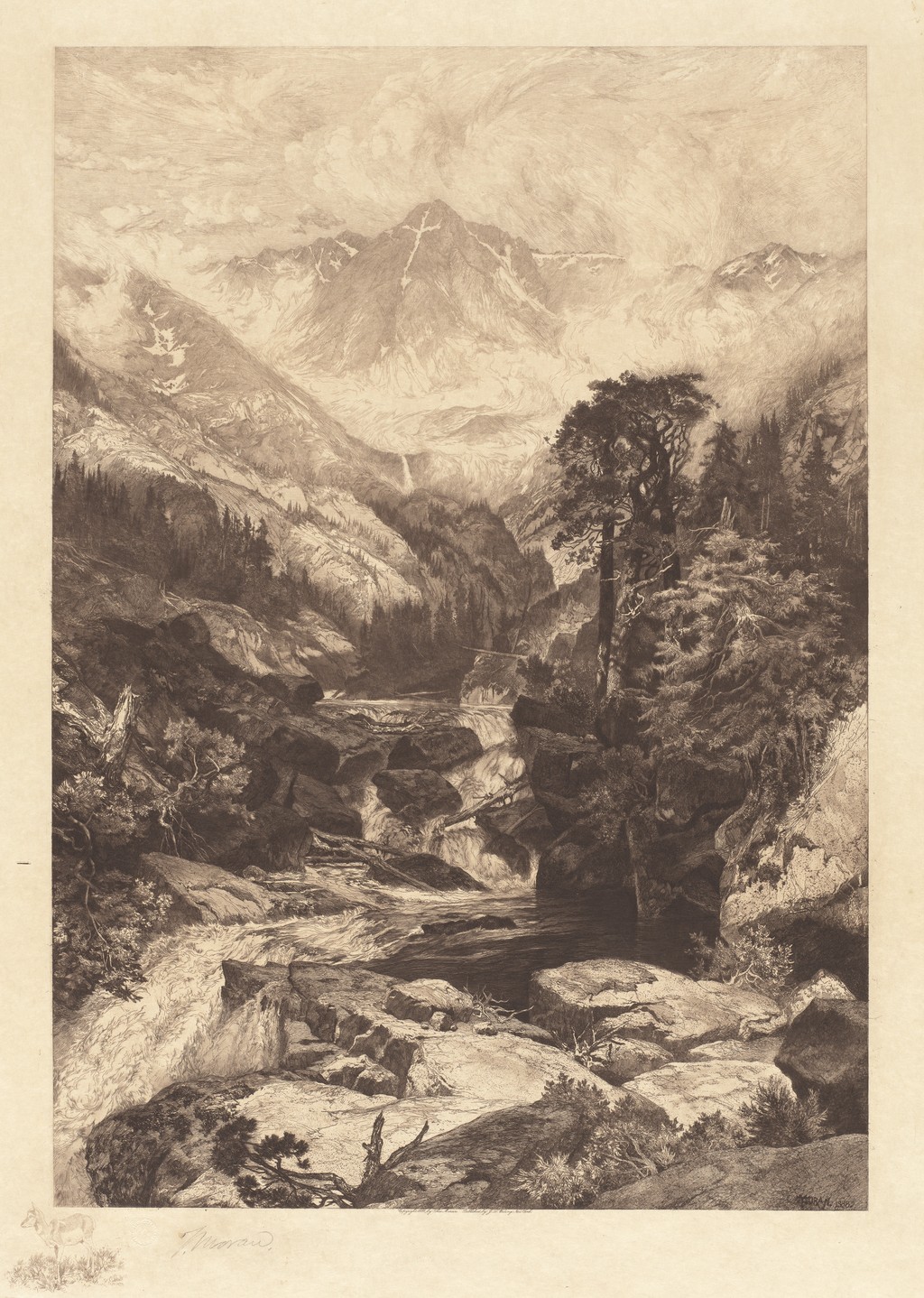
Moran returned to the composition through printmaking. The National Gallery of Art holds Mountain of the Holy Cross, Colorado, dated 1888, described as etching, roulette and aquatint in brown on wove paper. Its recorded inscription names a publisher and copyright date. This is a separate work in a different medium, not another date for the 1875 oil. [4]
The print invites comparison because it translates a landscape associated with colour and light into lines and tonal passages. Looking between the two, the question becomes how trees, rock, mist and water remain distinguishable when the medium changes. Similarity of subject does not mean identical material effects. A print’s paper, margins and inscriptions also belong to the object’s presentation.
Moran’s later interview in Brush and Pencil, published in 1903, argued for the importance of knowledge and treated technical skill as a means towards an artistic end. Those remarks do not explain every etched mark, but they offer context for a career in which a subject could be revisited through different processes. The medium mattered because it offered particular ways to make a landscape visible. [5]
The prints and watercolours show further aspects of that practice. Holy Cross is especially revealing because its title remains recognisable across versions while its material identity changes. The 1875 canvas, the 1888 print and other related works need their own dates and descriptions. Keeping them distinct allows a comparison of artistic choices rather than a confusion of catalogue entries.
Artworks directory
Selected documented works and distinct versions. This directory is not a comprehensive catalogue raisonné. Dates and media retain the distinctions explained in the articles and museum records.
| Name | Date | Medium |
|---|---|---|
| An Arizona Sunset near the Grand Canyon | Date not securely established | Oil painting |
| Autumn Afternoon, the Wissahickon by Thomas Moran | 1864 | Oil on canvas |
| Cascade Falls, Yosemite | Commonly catalogued as 1905 | Catalogued as oil on canvas |
| The Chasm of the Colorado | 1873–1874; completed in 1874 | Oil on canvas, currently mounted on aluminium |
| Children of the Mountain | 1866 in the current museum title; 1867 in the 1997 National Gallery catalogue | Oil on canvas |
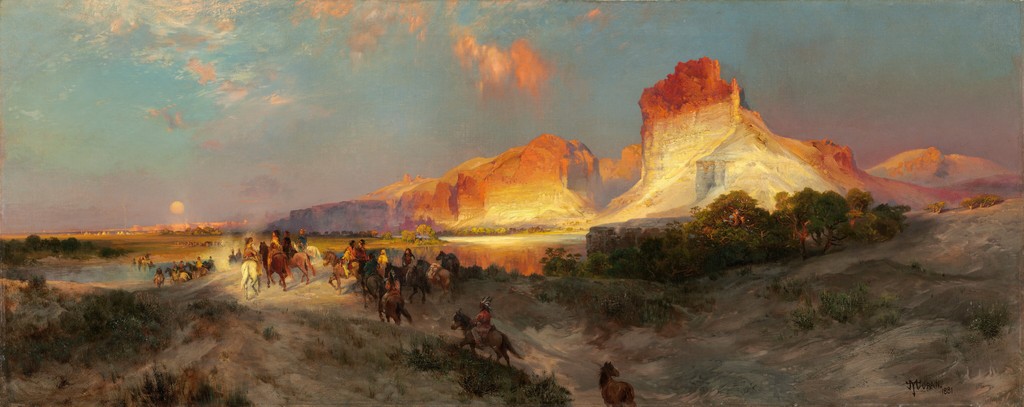
| Cliffs of Green River | 1874 | Oil on canvas |
| Cliffs of the Upper Colorado River, Wyoming Territory | 1882 | Oil on canvas |
| East Hampton, Long Island , also captioned Easthampton, L.I | 1897 | Oil on canvas laid on board, according to the reproduction record |
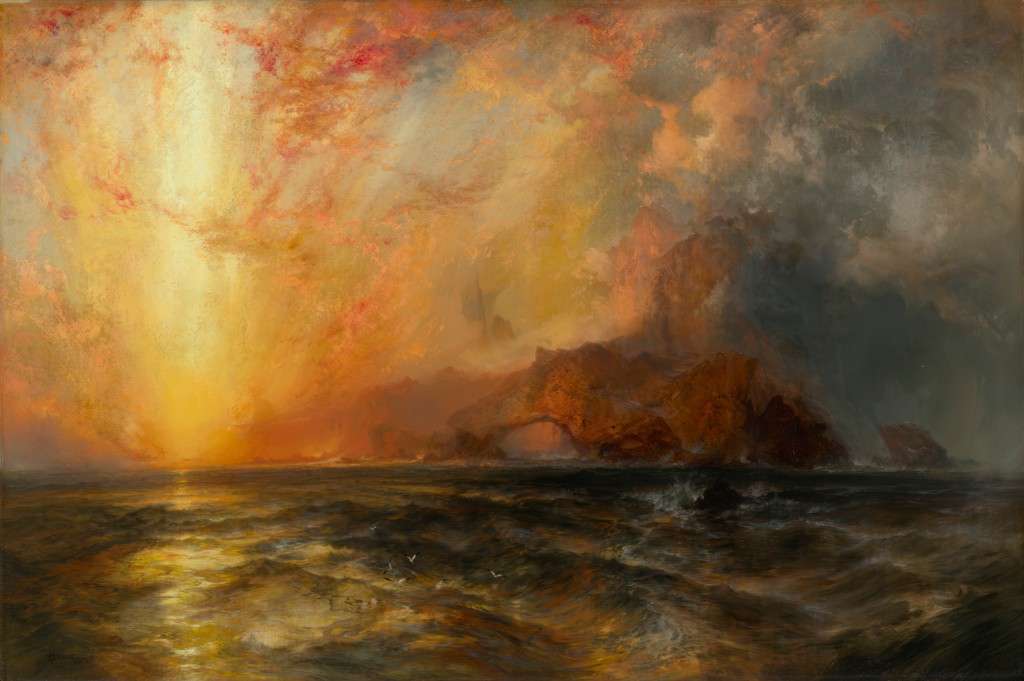
| Fiercely the red sun descending, Burned his way along the heavens | 1875–76 | Oil on canvas |
| Forest Scene | 1870 | Oil on canvas |
| Grand Canyon of the Colorado River | 1892 and 1908 | Oil on canvas |
| Green River Cliffs, Wyoming | 1881 | Oil on canvas |
| Green River, Wyoming | 1878 | Oil on panel |
| The Juniata, Evening | 1864 | Oil on canvas |
| Mosquito Trail, Rocky Mountains of Colorado | 1875 in the 1997 National Gallery exhibition catalogue | Watercolour |
| Mountain of the Holy Cross | 1875 | Oil on canvas |
| The Much Resounding Sea | 1884 | Oil on canvas |
| Point Lobos, Monterey, California | 1912, signed and dated | Oil on canvas |
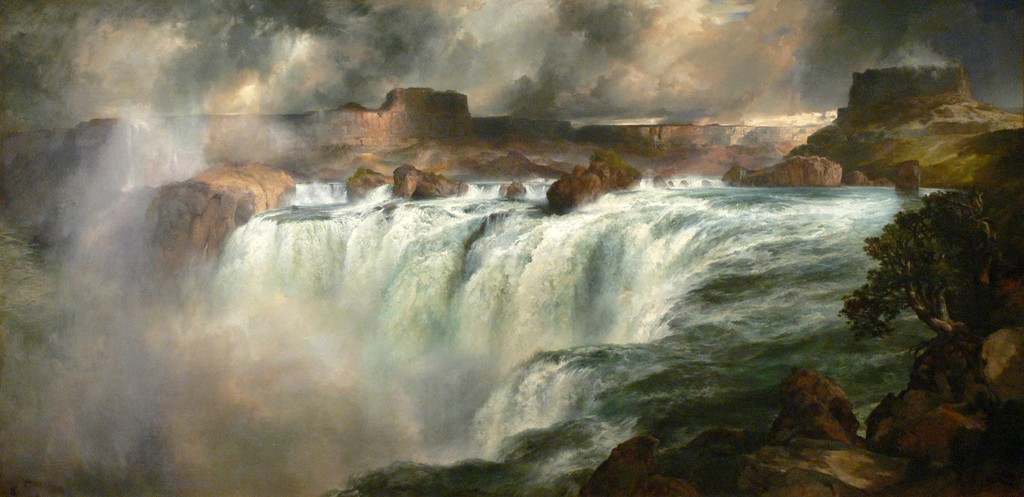
| Shoshone Falls on the Snake River | 1900 | Oil on canvas |
| Summit of the Sierras | 1872/75, as catalogued by the Art Institute of Chicago | Gouache over graphite on cream laid paper |
| The Teton Range | 1897 | Oil on canvas |
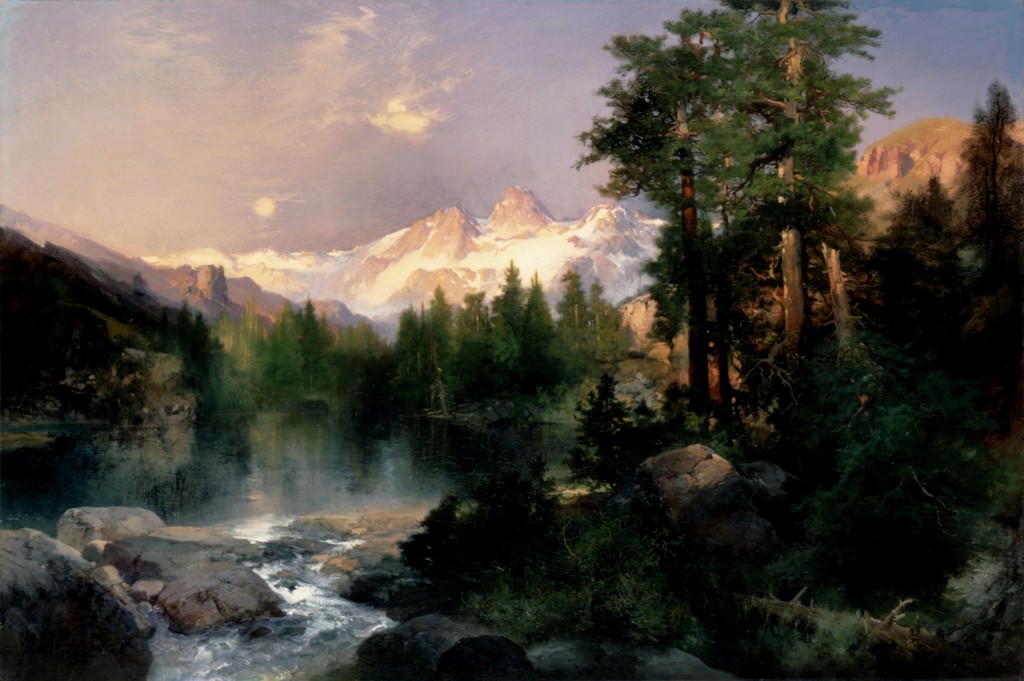
| The Three Tetons | 1895 | Oil on canvas |
| Tower Falls, Yellowstone | 1872 | Watercolour and gouache over graphite on blue laid paper |
| A View of Venice | 1891 | Oil on canvas |
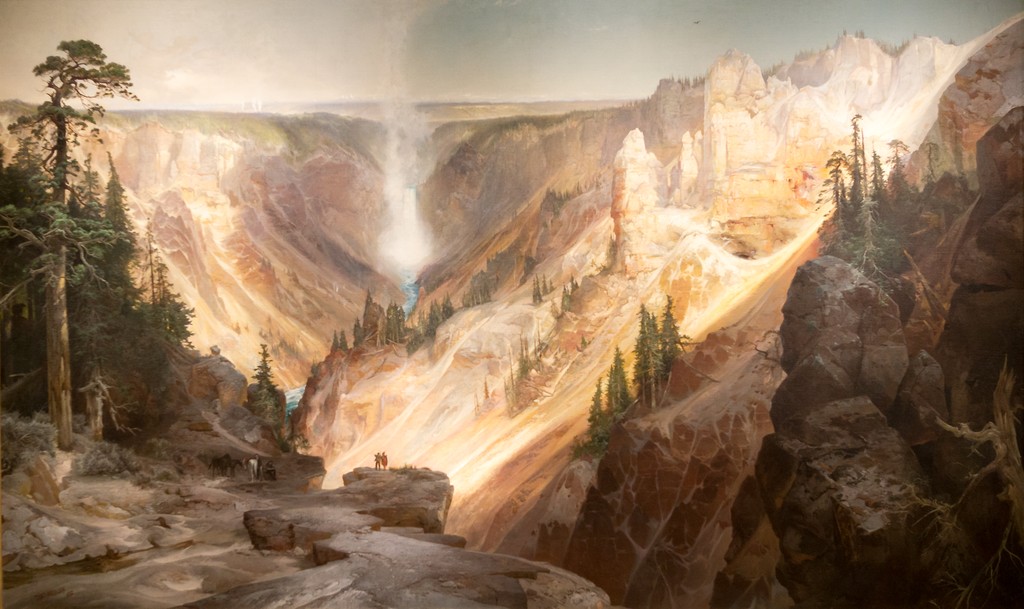
| The Grand Canyon of the Yellowstone | 1872 | Oil on canvas, currently recorded as mounted on aluminium |
| Mountain of the Holy Cross, Colorado (etching) | 1888 | Etching, roulette and aquatint |
| The Resounding Sea (etching) | 1880 | Etching |
| The Much Resounding Sea (later etching) | 1886 in heading; 1888 on plate | Etching, drypoint and roulette |
| Tower Falls (Prang print) | c. 1875; portfolio issued 1876 | Chromolithograph |
| Shoshone Falls (early watercolour) | 1874 | Watercolour |
| Venice (watercolour) | 1888 | Watercolour over graphite |
Frequently Asked Questions
It belongs to the Autry Museum of the American West, donated from the collection of Jackie and Gene Autry. [1]
It is represented as intersecting snow-filled fissures on the mountain face. The shape attracted religious interpretations, which should be distinguished from the natural formation itself. [2]
His correspondence records a plan to use a waterfall seen on the journey in the foreground. The finished landscape should therefore be understood through both observation and composition, rather than as a photograph-like record of one position. [2]
Discussion
Does the stream draw you gradually towards the cross, or does the summit attract your attention immediately? How convincing do you find the distance between the foreground and mountain?
Reader Insights
Editorial prompts for close looking and discussion.
Does the stream draw you gradually towards the cross, or does the summit attract your attention immediately?
How convincing do you find the distance between the foreground and mountain?
How does this page compare with the related works linked above?
Join the Conversation
Share your reading of this page below.
References
- Autry Museum of the American West, Mountain of the Holy Cross, current collection record. The 1875 date field is corroborated by the contemporary exhibition announcement.
- Nancy K. Anderson and contributors, Thomas Moran, National Gallery of Art, 1997; targeted Holy Cross narrative, entry, transcribed letter, exhibition announcement and contemporary reviews. Newspaper responses cited here were read through the catalogue’s transcriptions.
- G. W. Sheldon, American Painters, D. Appleton and Company, 1879, Moran chapter, especially printed p. 125.
- National Gallery of Art, Mountain of the Holy Cross, Colorado, 1888, etching, roulette and aquatint in brown on wove paper, 2008.115.3589.
- Thomas Moran, Knowledge a Prime Requisite in Art, Brush and Pencil 12, April 1903, pp. 14–16; identified in the publication as part of an interview.
- Splash image source.
Mountain of the Holy Cross, 1875. Autry Museum of the American West; faithful reproduction via Wikimedia Commons. Image source. Public Domain Mark; faithful two-dimensional reproduction. Resized only; complete source image retained.
- Splash image source.
Mountain of the Holy Cross, Colorado, 1888, etching, roulette and aquatint. National Gallery of Art, Reba and Dave Williams Collection, Gift of Reba and Dave Williams, 2008.115.3589. Image source. CC0 1.0. Resized only; complete source image retained.
- Splash image source.
The Grand Canyon of the Yellowstone, 1872. Wuselig / Wikimedia Commons, CC BY-SA 4.0; U.S. Department of the Interior Museum painting. Image source. CC BY-SA 4.0; also marked PD-Art. Outer museum frame cropped; resized. Painted composition retained; photographic perspective unchanged. This image derivative is available under the same licence.
- Splash image source.
The Chasm of the Colorado, 1873–1874. U.S. Department of the Interior Museum; faithful reproduction via Smithsonian American Art Museum / Wikimedia Commons. Image source. Public Domain Mark; faithful two-dimensional reproduction. Resized only; complete source image retained.
- Splash image source.
Mountain of the Holy Cross, 1875. Autry Museum of the American West; faithful reproduction via Wikimedia Commons. Image source. Public Domain Mark; faithful two-dimensional reproduction. Resized only; complete source image retained.
- Splash image source.
Shoshone Falls on the Snake River, 1900. Wolfgang Sauber / Wikimedia Commons, CC BY-SA 3.0; Gilcrease Museum painting. Image source. CC BY-SA 3.0; also marked PD-Art. Resized only; complete source image retained. This image derivative is available under the same licence.
- Splash image source.
Green River Cliffs, Wyoming, 1881. National Gallery of Art, Gift of the Milligan and Thomson Families. Image source. Public domain; NGA Open Access. Resized only; complete source image retained.
- Splash image source.
A View of Venice, 1891. Smithsonian American Art Museum, Transfer from the U.S. Department of the Interior, National Park Service, 1968.120.1. Image source. Free to use; Smithsonian Open Access. Resized only; complete source image retained.
- Splash image source.
The Three Tetons, 1895. The White House Collection, Gift of C. R. Smith; faithful reproduction via Wikimedia Commons. Image source. Public Domain Mark; faithful reproduction of a two-dimensional public-domain work. Resized only; complete source image retained.