 by Tom Gurney
Tom Gurney BSc (Hons) is an art history expert with over 20 years experience
Published on June 19, 2020 / Updated on October 27, 2026
Email: tomgurney1@gmail.com / Phone: +44 7429 011000
Fiercely the Red Sun Descending, Burned His Way Along the Heavens: Introduction
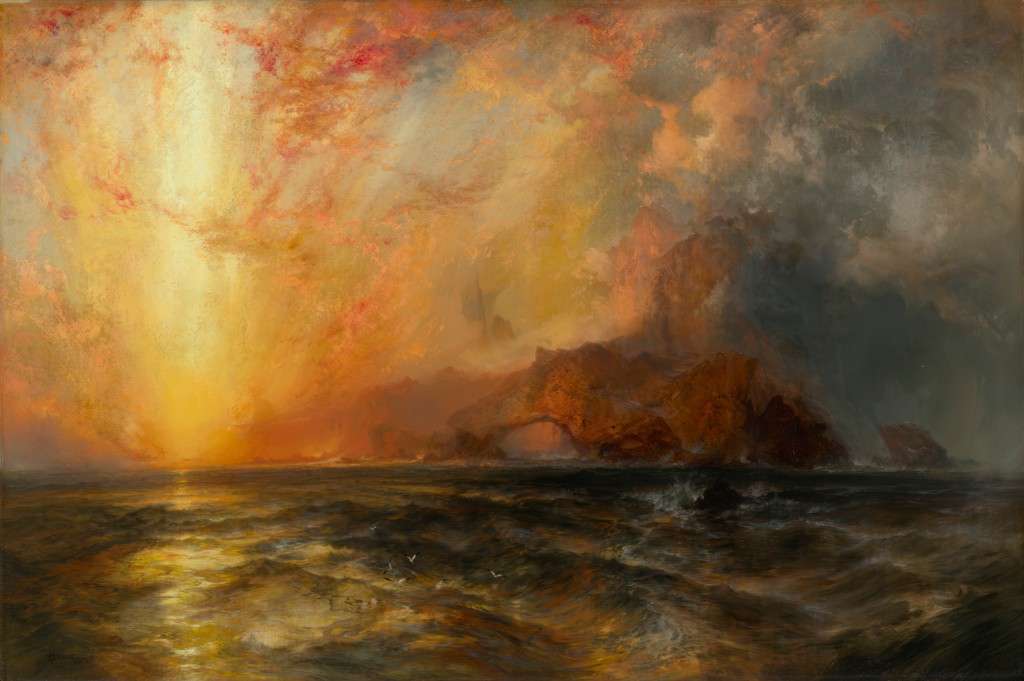
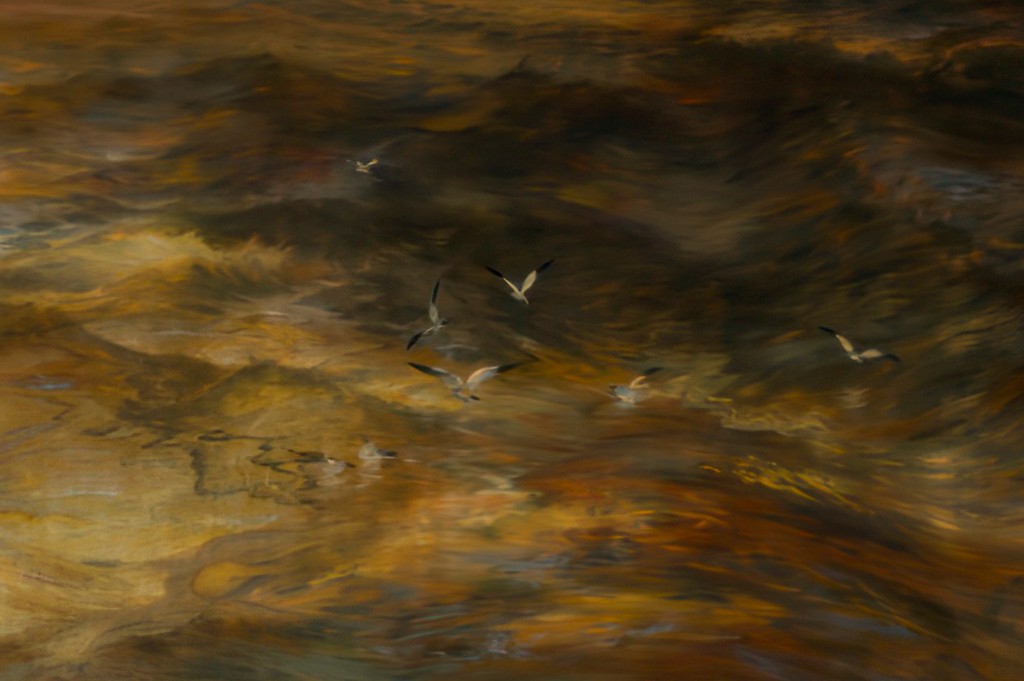
Thomas Moran's Fiercely the red sun descending, Burned his way along the heavens transforms a literary sunset into a seascape of intense light. A yellow-gold opening fills the left side of the sky, while darker clouds gather over the rocky land to the right. Below, moving water carries the brightness towards the spectator. The title suggests an event in the heavens; the painting makes that event felt across the water.
The North Carolina Museum of Art dates the oil to 1875–76. Its long title comes from Henry Wadsworth Longfellow's The Song of Hiawatha, and the museum's record connects it with the Centennial exhibition of 1876. A later contemporary review praised the water while disputing the success of the sunset, making the canvas an unusually revealing example of the difficulty of representing brilliant light. [1]
At a Glance
- ArtistThomas Moran
- TitleFiercely the red sun descending, Burned his way along the heavens
- Date1875–76
- MediumOil on canvas
- Dimensions84.8 × 127.2 cm
- CollectionNorth Carolina Museum of Art
- Accession52.9.34
- CreditPurchased with funds from the North Carolina State Art Society, Robert F. Phifer Bequest
- Literary sourceThe Song of Hiawatha, Canto IX
- Historical alternative titleMarine Sunset
Where this work sits in Moran’s career
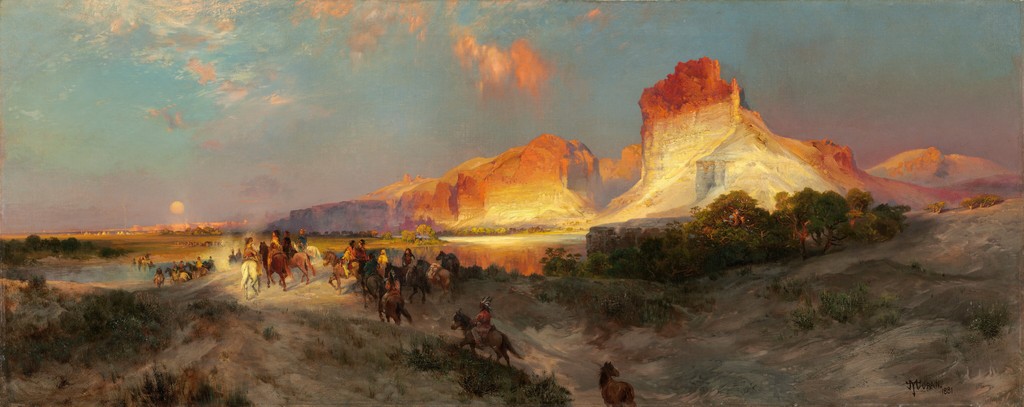
The Chasm of the Colorado
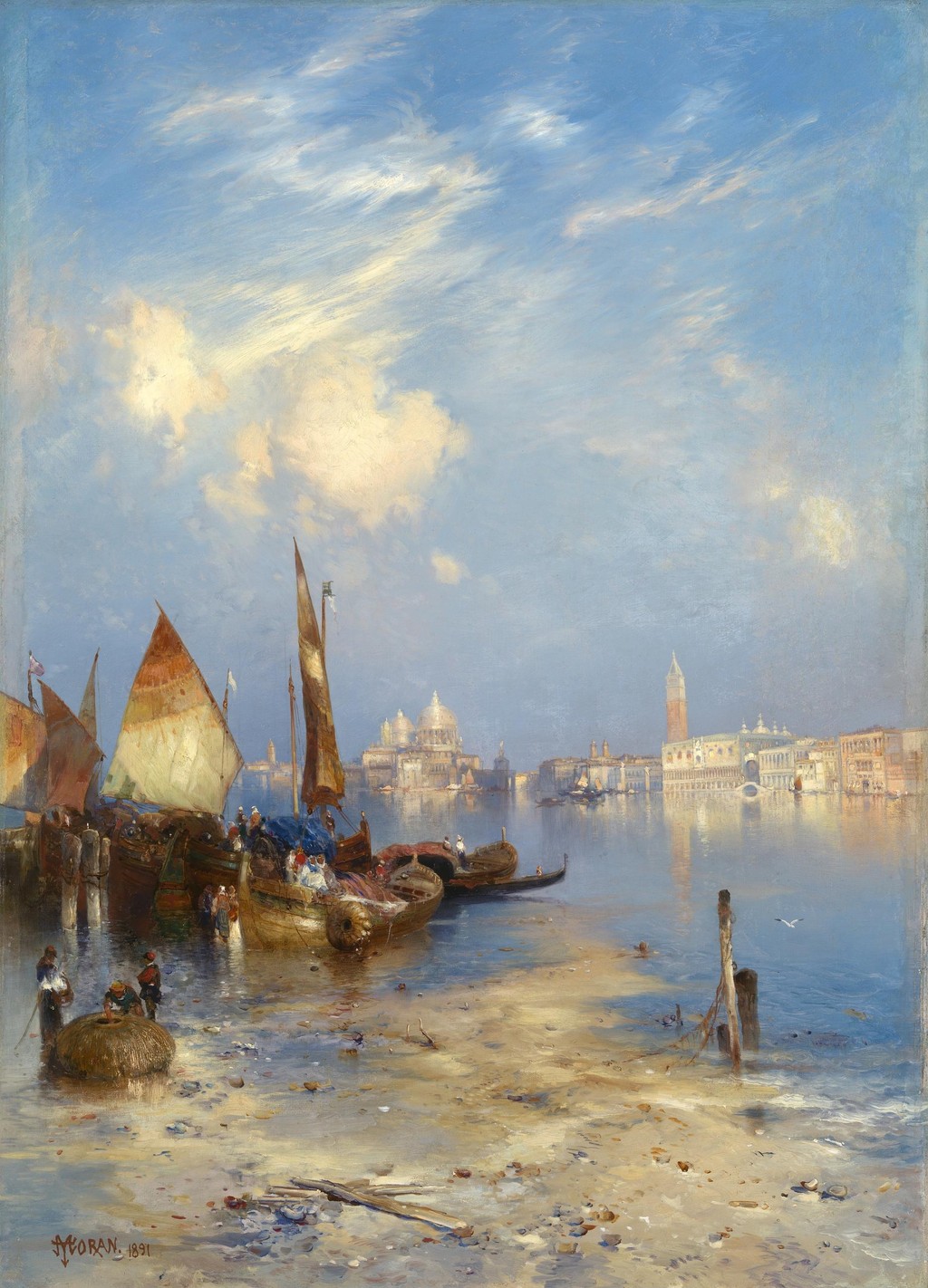
1873–1874; completed in 1874A View of Venice
1891Point Lobos, Monterey, California
1912, signed and datedContents
- The lines behind the title
- A moment drawn from a sequence
- Longfellow as literary context
- A sky divided by brightness and cloud
- The dark coast on the right
- Water carries the sunset forward
- Colour and the problem of luminosity
- Exhibition and a divided contemporary response
- From private ownership to the museum
- Beside The Much Resounding Sea
The lines behind the title
The words occur near the beginning of Canto IX, Hiawatha and the Pearl-Feather. Nokomis points westward over Gitche Gumee towards the sunset. Longfellow describes the sun setting the sky on fire, then compares its passage with retreating war parties burning the prairie. The moon follows in this imagined trail. The scene leads into Nokomis's account of the dangerous Pearl-Feather. [2]
Moran's title selects the two lines that concentrate on the descending sun. It retains Longfellow's word along. The phrase gives the light direction and agency: the sun does something, rather than merely occupying a place in the sky. The painting similarly makes brightness seem to move through cloud and across the water.
That connection should not turn every visible form into a named character or episode. The canvas does not organise its foreground around an identifiable Nokomis pointing out the scene. Its primary action lies in the relationship between sky, water and rock. The literary title supplies an imaginative frame through which those forms can be experienced.
Longfellow's text is a nineteenth-century poem, not a documentary account of the communities and traditions it represents. Reading Moran's picture as an interpretation of that poem keeps the immediate connection clear. It does not require treating a painted sunset as ethnographic evidence or identifying its coast as a securely documented view of the poem's named water.
Annotated Details from Fiercely the red sun descending, Burned his way along the heavens
Compare these details with the full composition. The numbered overview and crops come from the same original image.
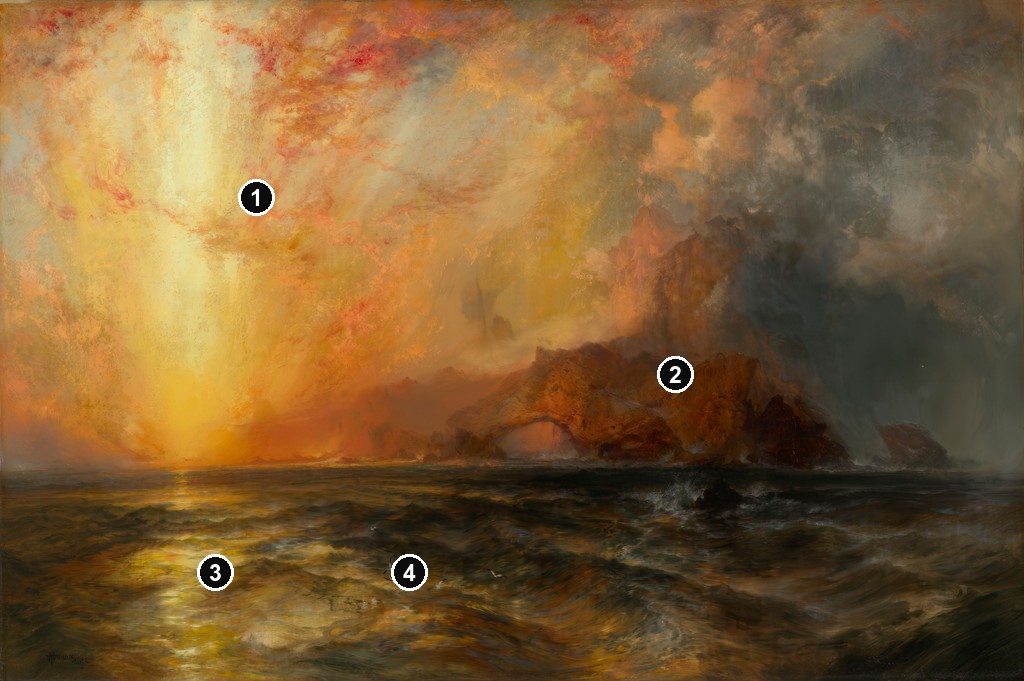
Details from FIERCELY THE RED SUN DESCENDING, BURNED HIS WAY ALONG THE HEAVENS
Open a detail to see it more closely.
A sky divided by brightness and cloud
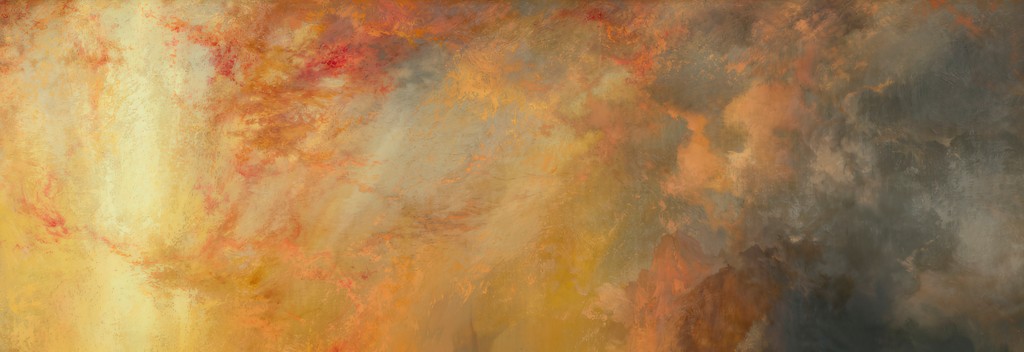
The largest change across the canvas occurs in the sky. On the left, pale yellow and gold spread through an illuminated opening. Farther right, grey-green and darker cloud masses seem to close over the scene. Between them, warm orange passages connect the brilliance with the subdued atmosphere above the rocks.
The dark coast on the right
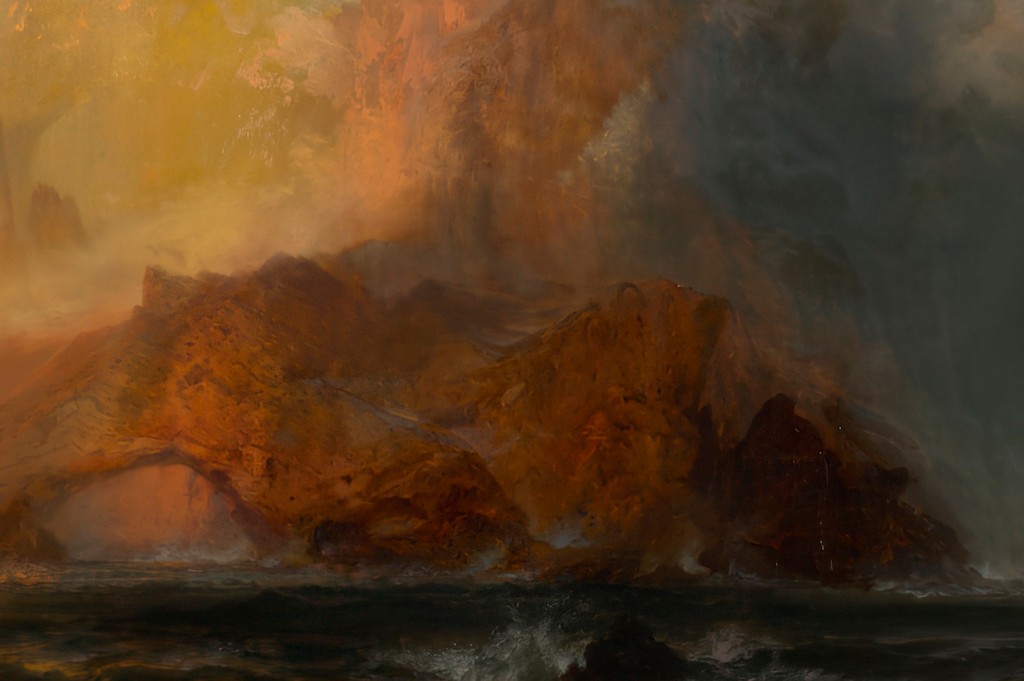
A substantial rocky mass occupies the right-hand middle distance. Its irregular summit and darker face provide a firmer outline than the illuminated clouds. Smaller rocks continue towards the water, helping connect the main mass with the surrounding sea. The coast gives the eye a stable shape beside an atmosphere that is harder to grasp.
Reflected light on moving water
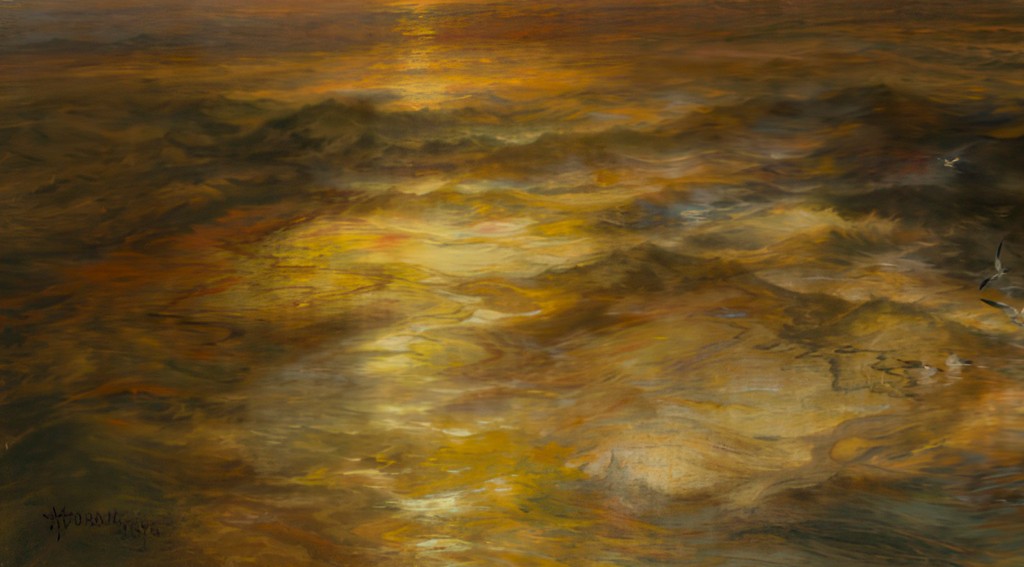
The strongest warm reflection lies below the illuminated left-hand sky. It advances towards the lower edge through a succession of broken marks. The eye therefore connects the distant light with the near water without following a perfectly straight path. Brightness seems to arrive through movement, repeatedly interrupted by darker hollows.
Small birds in the foreground
Small white birds near the lower centre add another scale to the scene. Their light shapes are distinct from the broader reflections, yet belong to the same area of changing water. They draw attention to a particular foreground passage without becoming the principal narrative. The sunset remains larger than any one living presence within it.
A moment drawn from a sequence
Reading the poem gives the sunset a before and an after. Nokomis points, the sun descends, the moon follows and her speech develops the episode. The painting offers its principal effects together. The spectator can begin with the dark coast or the nearest waves, then return to the sky, rather than following an obligatory order of lines.
The title provides a connection between these different experiences of time. It names descent, an action that the still canvas cannot literally perform. Cloud shapes and broken reflections give the viewer reasons to imagine change. The words add a direction to that change without dictating every movement of the eye through the picture.
The result is a literary landscape whose meaning is not exhausted by identifying its source. Knowing the lines explains the title; looking closely reveals how Moran makes a sustained visual encounter from them. The spectator can linger over a minor crest or a dark interval in the water long after reading has carried the poem beyond its opening sunset.
Longfellow as literary context
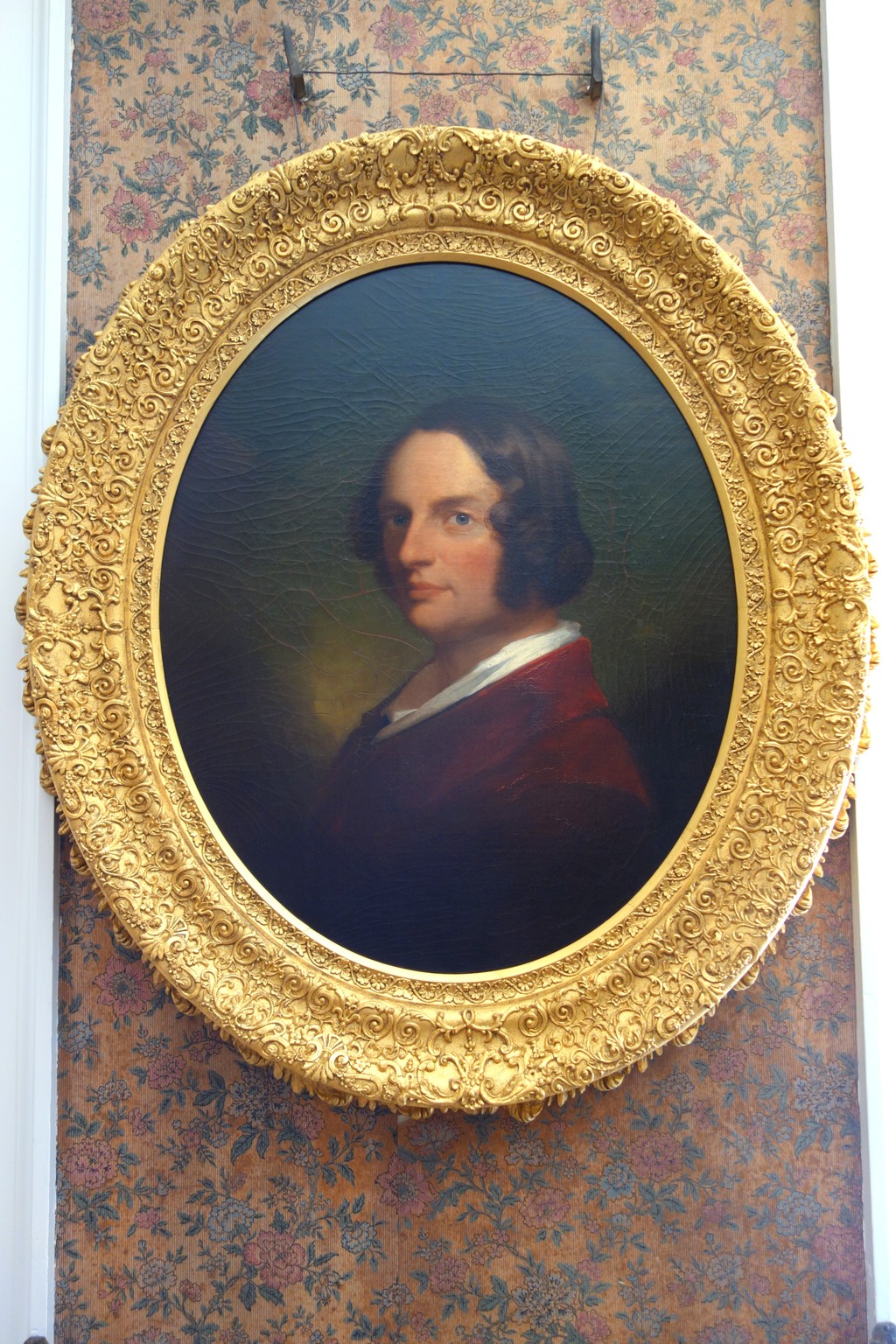
Joseph Alexander Ames's 1841 portrait of Longfellow provides a separate image of the writer behind the title. The dark-haired sitter, wearing a red coat and white collar, appears against a subdued painted background. The photograph illustrated with this article shows the portrait at the Longfellow National Historic Site, including its oval gold frame and surrounding wallpaper. [3]
The portrait predates The Song of Hiawatha and Moran's painting. It therefore supplies context for the author rather than illustrating the moment of either work's creation. Its quiet, concentrated presentation offers a useful pause beside the seascape's restless atmosphere: one image identifies the writer, while the other translates words into an expansive experience of light.
A sky divided by brightness and cloud
The largest change across the canvas occurs in the sky. On the left, pale yellow and gold spread through an illuminated opening. Farther right, grey-green and darker cloud masses seem to close over the scene. Between them, warm orange passages connect the brilliance with the subdued atmosphere above the rocks.
The light is not contained within a small, clearly outlined solar disc. Its effect extends through a substantial area of cloud. This gives the sunset a broad presence and makes it difficult to locate one neat boundary between the source of illumination and the atmosphere receiving it. The sky appears to be undergoing a change rather than displaying a fixed emblem.
Near the horizon, the brightest passage approaches the water. Above it, cloud edges are broken and irregular. The eye can follow an upward spread of warm colour, but cannot trace one continuous outline around it. That uncertainty helps the painting suggest something more extensive than a solid object placed behind the landscape.
The darker right side is essential to this effect. It gives the illuminated area a neighbouring field against which to appear intense. If the whole sky were equally bright, the spectator would have fewer means of judging the contrast. Moran gives the sunset force through unequal illumination across a scene large enough to contain both extremes.
The dark coast on the right
A substantial rocky mass occupies the right-hand middle distance. Its irregular summit and darker face provide a firmer outline than the illuminated clouds. Smaller rocks continue towards the water, helping connect the main mass with the surrounding sea. The coast gives the eye a stable shape beside an atmosphere that is harder to grasp.
Some warmer light reaches this land, but it remains markedly darker than the opening on the left. That difference creates a strong lateral movement. Looking from bright sky towards dark rock, the spectator encounters a gradual reduction in visibility. Looking back, the same distance feels like an emergence into light.
The rock also prevents the scene from being an entirely open horizon. It interrupts the meeting of sky and water and makes the space uneven. The picture contains both a broad luminous distance and an enclosed, shadowed area. Their coexistence gives the seascape a more complex mood than an uninterrupted strip of sunset colour would produce.
These solid forms keep the atmospheric drama connected to a material environment. Clouds may appear to dissolve into brightness, but rock maintains weight and resistance. The spectator can compare their different boundaries within the same image. The sky's apparent instability becomes clearer beside something that seems able to hold its form.
Water carries the sunset forward
The sea occupies a wide foreground beneath a comparatively low horizon. Dark passages alternate with warmer reflections, and small crests interrupt the surface. The water is neither a motionless mirror nor one continuous field of surf. Its changing texture divides the reflected brightness into shorter, uneven stretches.
The strongest warm reflection lies below the illuminated left-hand sky. It advances towards the lower edge through a succession of broken marks. The eye therefore connects the distant light with the near water without following a perfectly straight path. Brightness seems to arrive through movement, repeatedly interrupted by darker hollows.
On the right, pale crests stand out against darker greenish water. Their scale is much smaller than the broad cloud masses above. This difference makes the spectator feel close to the surface while looking towards a much larger atmospheric event. The picture combines intimate signs of motion with an extensive field of light.
Small white birds near the lower centre add another scale to the scene. Their light shapes are distinct from the broader reflections, yet belong to the same area of changing water. They draw attention to a particular foreground passage without becoming the principal narrative. The sunset remains larger than any one living presence within it.
The sea is also where the painting's two main zones meet. It receives warmer light from the left and darker tones beneath the right-hand atmosphere. Rather than leaving the sky and coast as separate halves, Moran allows their effects to mingle across the foreground. Water becomes the surface through which the composition holds together.
Watch: Thomas Moran
Choose a film to explore the artist’s work, its interpretation and its wider setting.
The painting that inspired a National Park
A close discussion of Moran’s landscape and its relationship to the idea of Yellowstone.
Watch on YouTubeColour and the problem of luminosity
The title calls the sun red, but the visible effect depends on several neighbouring colours. Yellow-gold brightness, warmer orange, darker grey-green cloud and deep water contribute different roles. The picture does not rely on one uniform red area to communicate the sunset's force. It establishes intensity through the relationships among these passages.
A painted surface cannot emit sunlight in the manner of the scene it depicts. Its apparent brilliance depends on what surrounds the lighter areas and on how the spectator's eye moves among them. This makes a sunset a demanding subject: increasing the amount of warm colour alone does not necessarily reproduce the experience of looking towards bright light.
Moran's arrangement addresses the difficulty by distributing illumination through more than one substance. Cloud seems to receive and disperse it; rock partially resists it; water breaks and carries it. The viewer encounters several consequences of the same atmospheric event, rather than one isolated patch expected to stand for all its effects.
The distinction between visual colour and a material recipe matters here. The reproduction shows contrasts that can be described and compared, but it does not identify the pigments used in every passage. The critical question is how the painting makes brightness appear to occupy space, not which undocumented mixture produced a particular yellow or green.
Exhibition and a divided contemporary response
The museum's bibliography lists the painting in the official catalogue of the Centennial exhibition in Philadelphia in 1876, under the literary title. That early listing connects the words with the work's public presentation. The title was not merely a recent explanation attached to an otherwise anonymous sunset. [1]
An 1881 review in the Newark Daily Advertiser, transcribed in Nancy Anderson's 1997 catalogue, offered a more divided response. The writer recognised Moran's power and grandeur but judged the sunset unsuccessful, arguing that red paint could not by itself reproduce such light. The same review praised the sea and its subdued illumination. [4]
The disagreement is more specific than a simple rejection of the picture. The critic distinguished between two problems within it: depicting brilliant sunset and representing water beneath that sunset. A viewer could admire one part while questioning another. The review makes the painting useful for thinking about how different substances ask different things of an artist.
It also directs renewed attention towards the foreground. The water's darker intervals, broken reflections and pale crests may appear more convincing to a particular spectator than the expansive sky. That response would not necessarily mean that the sea is unrelated to the literary title. The reflected light makes it part of the event even when attention settles below the horizon.
The critic's standard was demanding: the experience of a great sunset was treated as something painting might fail to equal. The canvas invites another kind of judgement as well. Its colour and arrangement can be studied as a deliberately composed image, with effects that do not depend on perfectly duplicating the sensation of direct sunlight.
From private ownership to the museum
The North Carolina record traces the work from Moran to Edwin Eugene Howell, then through members of Howell's family and the Macbeth Gallery before the museum acquired it in 1952. The purchase credit names the North Carolina State Art Society and the Robert F. Phifer Bequest. Those details identify the history of this particular canvas. [1]
The museum also records Marine Sunset as the title used in twentieth-century publications. That shorter name emphasises the visible genre and setting, while the longer title preserves the literary connection. Both can help a reader recognise the work, but the present collection title restores the words that shaped its early public identity.
The difference affects how the picture is approached. Marine Sunset encourages attention to coast, weather and waves. The Longfellow title introduces movement, fire and a passage through the heavens before the viewer begins to inspect the canvas. The visual scene remains the same, yet the verbal invitation changes the first expectations brought to it.
Beside The Much Resounding Sea
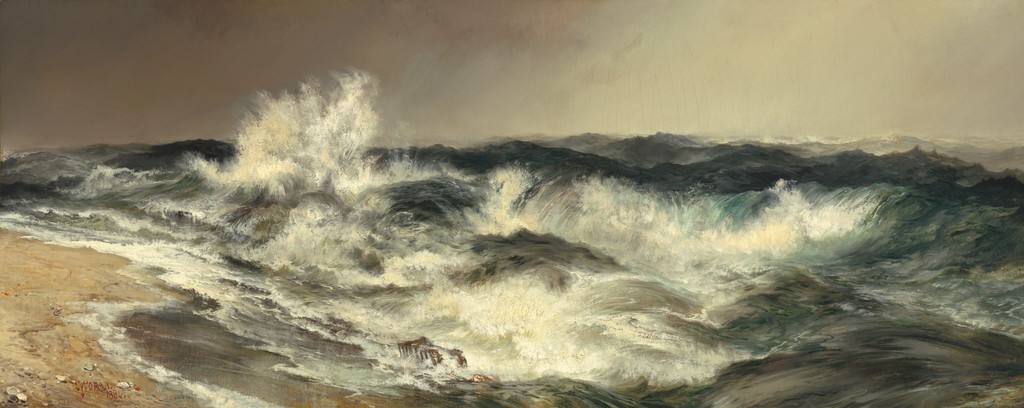
Moran's The Much Resounding Sea offers a distinct marine comparison. The National Gallery of Art dates that oil to 1884. It uses a much lower, wider format, with breaking waves occupying most of the field and a relatively shallow strip of sky above them. [5]
In the Longfellow-inspired picture, the sky's transformation controls the strongest contrast, and the water carries its effects forward. In the later seascape, the wave itself becomes the main rising mass. Pale foam and dark hollows give the sea a physical drama that depends less on one extensive opening of sunset light.
The pair shows why Moran's marine work deserves attention beside his western landscapes. Water could support a literary atmosphere, establish a reflective distance or confront the spectator through breaking surf. Here it performs the first two functions together. The title lifts attention towards the heavens, while the foreground continually returns the sunset to the moving surface below.
Artworks directory
Selected documented works and distinct versions. This directory is not a comprehensive catalogue raisonné. Dates and media retain the distinctions explained in the articles and museum records.
| Name | Date | Medium |
|---|---|---|
| An Arizona Sunset near the Grand Canyon | Date not securely established | Oil painting |
| Autumn Afternoon, the Wissahickon by Thomas Moran | 1864 | Oil on canvas |
| Cascade Falls, Yosemite | Commonly catalogued as 1905 | Catalogued as oil on canvas |
| The Chasm of the Colorado | 1873–1874; completed in 1874 | Oil on canvas, currently mounted on aluminium |
| Children of the Mountain | 1866 in the current museum title; 1867 in the 1997 National Gallery catalogue | Oil on canvas |
| Cliffs of Green River | 1874 | Oil on canvas |
| Cliffs of the Upper Colorado River, Wyoming Territory | 1882 | Oil on canvas |
| East Hampton, Long Island , also captioned Easthampton, L.I | 1897 | Oil on canvas laid on board, according to the reproduction record |
| Fiercely the red sun descending, Burned his way along the heavens | 1875–76 | Oil on canvas |
| Forest Scene | 1870 | Oil on canvas |
| Grand Canyon of the Colorado River | 1892 and 1908 | Oil on canvas |
| Green River Cliffs, Wyoming | 1881 | Oil on canvas |
| Green River, Wyoming | 1878 | Oil on panel |
| The Juniata, Evening | 1864 | Oil on canvas |
| Mosquito Trail, Rocky Mountains of Colorado | 1875 in the 1997 National Gallery exhibition catalogue | Watercolour |
| Mountain of the Holy Cross | 1875 | Oil on canvas |
| The Much Resounding Sea | 1884 | Oil on canvas |
| Point Lobos, Monterey, California | 1912, signed and dated | Oil on canvas |
| Shoshone Falls on the Snake River | 1900 | Oil on canvas |
| Summit of the Sierras | 1872/75, as catalogued by the Art Institute of Chicago | Gouache over graphite on cream laid paper |
| The Teton Range | 1897 | Oil on canvas |
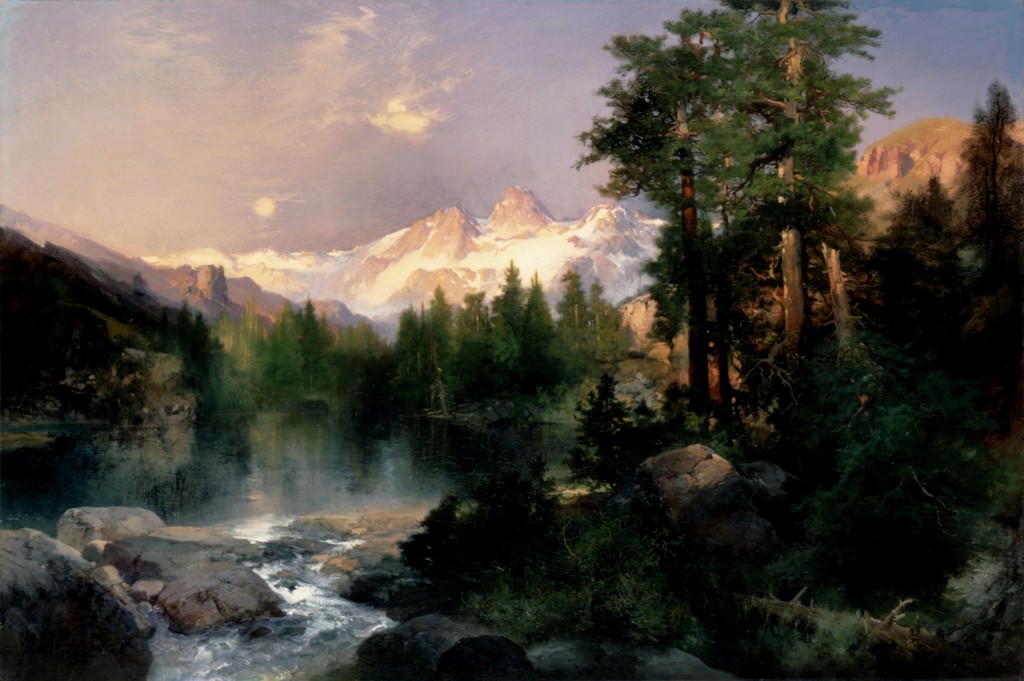
| The Three Tetons | 1895 | Oil on canvas |
| Tower Falls, Yellowstone | 1872 | Watercolour and gouache over graphite on blue laid paper |
| A View of Venice | 1891 | Oil on canvas |
| The Grand Canyon of the Yellowstone | 1872 | Oil on canvas, currently recorded as mounted on aluminium |
| Mountain of the Holy Cross, Colorado (etching) | 1888 | Etching, roulette and aquatint |
| The Resounding Sea (etching) | 1880 | Etching |
| The Much Resounding Sea (later etching) | 1886 in heading; 1888 on plate | Etching, drypoint and roulette |
| Tower Falls (Prang print) | c. 1875; portfolio issued 1876 | Chromolithograph |
| Shoshone Falls (early watercolour) | 1874 | Watercolour |
| Venice (watercolour) | 1888 | Watercolour over graphite |
Frequently Asked Questions
The North Carolina Museum of Art dates it to 1875–76.
It comes from two lines near the beginning of Canto IX of Longfellow's The Song of Hiawatha. The poem uses the word “along”.
The title connects the canvas with Longfellow's literary setting, but the sources cited here do not establish a precisely documented painting location.
No. The 1881 Newark review praised Moran's water while questioning whether the sunset successfully conveyed brilliant light.
The museum lists that shorter title in twentieth-century publications. Its current title preserves the earlier literary wording.
Discussion
Compare the bright opening in the sky with its broken reflection in the sea. Which seems more convincing or compelling to you? Does reading the Longfellow lines change where you first look, or how you understand the dark coast?
Reader Insights
Editorial prompts for close looking and discussion.
Compare the bright opening in the sky with its broken reflection in the sea. Which seems more convincing or compelling to you?
Does reading the Longfellow lines change where you first look, or how you understand the dark coast?
How does this page compare with the related works linked above?
Join the Conversation
Share your reading of this page below.
References
- North Carolina Museum of Art, Fiercely the red sun descending, Burned his way along the heavens, 1875–76, object 52.9.34, provenance and published exhibition references.
- Henry Wadsworth Longfellow, The Song of Hiawatha, 1855, Canto IX opening, Project Gutenberg text.
- Wikimedia Commons, Henry W. Longfellow by Joseph Alexander Ames, 1841, photograph by Daderot, 2013, Longfellow National Historic Site, CC0.
- Nancy K. Anderson and contributors, Thomas Moran, 1997, catalogue no. 50, p. 103; transcription of the Newark Daily Advertiser, 3 December 1881 review.
- National Gallery of Art, The Much Resounding Sea, 1884, oil on canvas, 1967.9.1.
- Image source.
Henry Wadsworth Longfellow in Joseph Alexander Ames’s 1841 portrait. The photograph includes its oval frame and surrounding wallpaper; it provides literary context for Moran’s later Hiawatha-inspired painting. Joseph Alexander Ames, Henry Wadsworth Longfellow, 1841. Longfellow National Historic Site. Photograph: Daderot, 2013, CC0.. Image source. CC0 1.0 photograph by Daderot; Joseph Alexander Ames painting public domain. Resized only; complete source image retained.
- Image source.
The Much Resounding Sea, 1884. National Gallery of Art, Gift of the Avalon Foundation. Image source. Public domain; NGA Open Access. Resized only; complete source image retained.
- Image source.
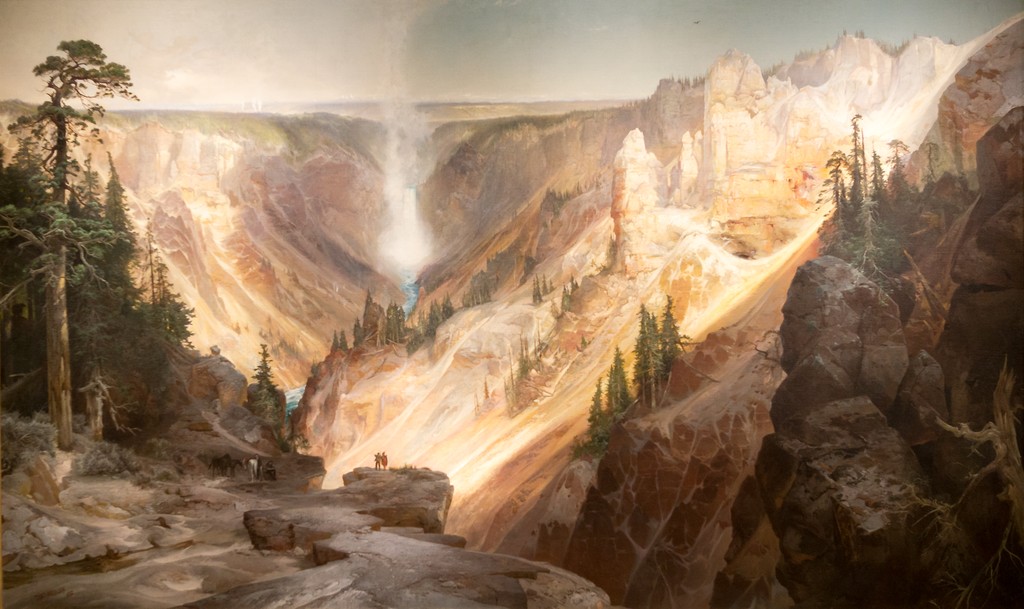
The Grand Canyon of the Yellowstone, 1872. Wuselig / Wikimedia Commons, CC BY-SA 4.0; U.S. Department of the Interior Museum painting. Image source. CC BY-SA 4.0; also marked PD-Art. Outer museum frame cropped; resized. Painted composition retained; photographic perspective unchanged. This image derivative is available under the same licence.
- Image source.
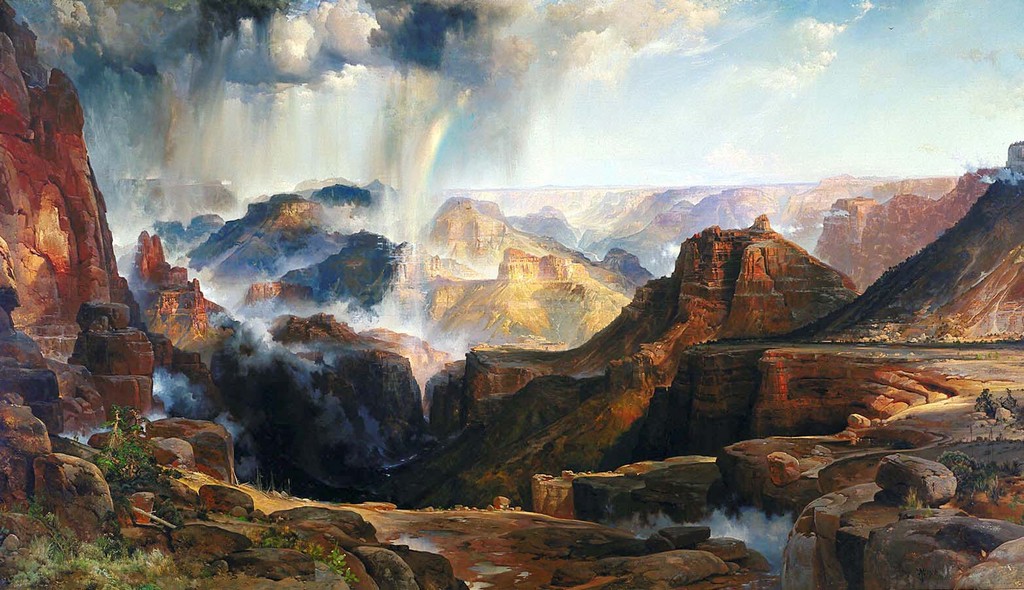
The Chasm of the Colorado, 1873–1874. U.S. Department of the Interior Museum; faithful reproduction via Smithsonian American Art Museum / Wikimedia Commons. Image source. Public Domain Mark; faithful two-dimensional reproduction. Resized only; complete source image retained.
- Image source.
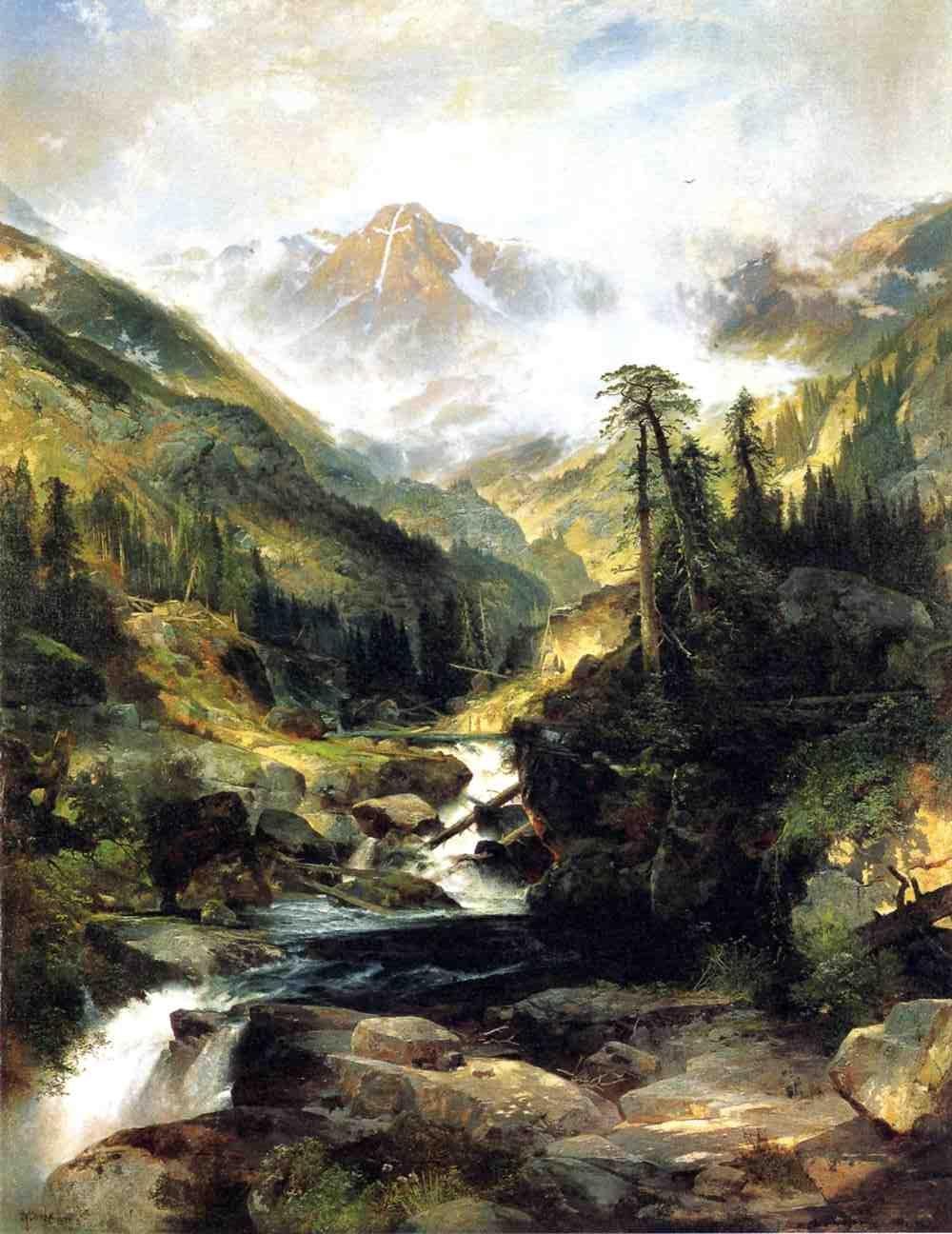
Mountain of the Holy Cross, 1875. Autry Museum of the American West; faithful reproduction via Wikimedia Commons. Image source. Public Domain Mark; faithful two-dimensional reproduction. Resized only; complete source image retained.
- Image source.
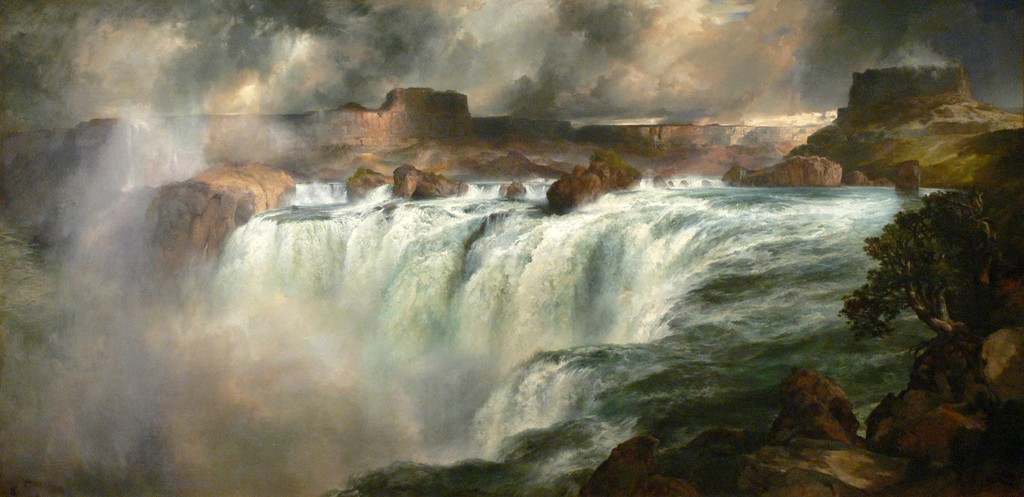
Shoshone Falls on the Snake River, 1900. Wolfgang Sauber / Wikimedia Commons, CC BY-SA 3.0; Gilcrease Museum painting. Image source. CC BY-SA 3.0; also marked PD-Art. Resized only; complete source image retained. This image derivative is available under the same licence.
- Image source.
Green River Cliffs, Wyoming, 1881. National Gallery of Art, Gift of the Milligan and Thomson Families. Image source. Public domain; NGA Open Access. Resized only; complete source image retained.
- Image source.
A View of Venice, 1891. Smithsonian American Art Museum, Transfer from the U.S. Department of the Interior, National Park Service, 1968.120.1. Image source. Free to use; Smithsonian Open Access. Resized only; complete source image retained.
- Image source.
The Three Tetons, 1895. The White House Collection, Gift of C. R. Smith; faithful reproduction via Wikimedia Commons. Image source. Public Domain Mark; faithful reproduction of a two-dimensional public-domain work. Resized only; complete source image retained.
- Splash image source.
Thomas Moran, Fiercely the red sun descending, Burned his way along the heavens, 1875–76. North Carolina Museum of Art. Collection record.