 by Tom Gurney
Tom Gurney BSc (Hons) is an art history expert with over 20 years experience
Published on June 19, 2020 / Page Updated on November 5, 2026
Email: tomgurney1@gmail.com / Phone: +44 7429 011000
Introduction
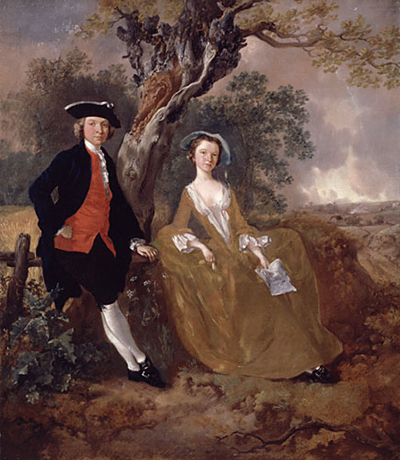
Thomas Gainsborough's A Couple in a Landscape is an early outdoor double portrait in which likeness, courtship, land, weather and painterly experiment sit unusually close together. Dulwich Picture Gallery dates the work to about 1753, identifies it as oil on canvas, gives the dimensions as 76.2 × 67 cm, records the accession number as DPG588, and lists it as the Fairfax Murray Gift of 1911.[1] Dulwich currently describes it as on display in Room 10.[1]
The title matters. A Couple in a Landscape is Dulwich's title, and it is more useful than older or looser wording that makes the pair merely “unknown.” The sitters are indeed not named in the object record, but the painting is not only a puzzle about lost identity. It is a conversation piece: a small-scale social portrait in which two people are presented together within an outdoor setting. The landscape is not a neutral surround. It helps define how the couple appear, how they relate to one another and how Gainsborough was already fusing portraiture with his first love, landscape.
The work belongs to the Ipswich years, shortly after Gainsborough returned from London training and before Bath transformed his clientele. Gainsborough's House notes that he moved to Ipswich in 1752 and worked for local gentry after exhausting the smaller Sudbury market.[2] Dulwich's dating of about 1753 places this picture at the beginning of that Ipswich phase, when Gainsborough was still building a career among provincial patrons and testing how far a portrait could become a landscape picture too.
At a Glance
- ArtistThomas Gainsborough
- Museum titleA Couple in a Landscape [1]
- DateAbout 1753 [1]
- MediumOil on canvas [1]
- Dimensions76.2 × 67 cm [1]
- Current holderDulwich Picture Gallery [1]
- AccessionDPG588 [1]
- SittersUnidentified couple
- Collection historyFairfax Murray Gift, 1911 [1]
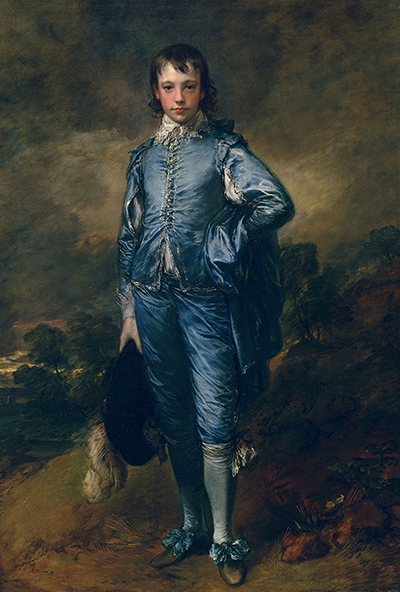
- ExploreBiography; The Blue Boy; Mr and Mrs Andrews; Paintings; Portraits
Contents
- Introduction
- The Dulwich Object
- A Conversation Piece Outdoors
- Landscape as Character
- The Reused Canvas
- Before Mr and Mrs Andrews
- Suffolk, Ipswich and Early Ambition
- How to Look at the Couple
- Why the Painting Matters
The Dulwich Object
Dulwich's record gives a compact but rich account of the painting. The couple rest near a wooden fence, beside an aged oak, with a field and changing season around them.[1] The man wears formal dark clothing with a red waistcoat, while the woman is dressed in brownish tones that sit more closely with the earth colours around her.[1] She holds drawing materials, which Dulwich suggests may point to amateur artistic activity.[1]
Those details make the picture more than a pair of likenesses. The man's clothing seems slightly displaced outdoors, as if the urban or interior world has stepped into the fields. The woman appears more absorbed into the setting, both through the colour of her dress and through the way she sits below the tree. Their crossed feet point in harmony, giving the composition a small gesture of togetherness without turning the image into a romantic anecdote.
The oak is central. Dulwich gives special attention to the tree's gnarled trunk and to the branch that frames the woman.[1] That emphasis is crucial because the tree is not background furniture. It is a compositional actor. Its age, texture and twisting forms make the landscape feel older and less polite than the sitters' social display. The couple may be young, but the tree makes the scene feel rooted in longer natural time.
The setting also carries seasonal pressure. Dulwich describes ripening corn to one side and autumnal tones elsewhere.[1] This does not require a strict harvest narrative, but it does make the landscape active. The picture is not simply a generic green outdoors. It is a turning season, balanced between summer warmth and autumnal change. That balance suits an image of a young pair whose exact relationship remains unstated.
A Conversation Piece Outdoors
A conversation piece usually depends on relation. It shows two or more figures in a setting that tells the viewer something about family, friendship, marriage, taste or social ease. A Couple in a Landscape belongs to that tradition, but it is unusually alert to the landscape part of the formula. The pair matter, yet the oak, fence, field, sky and ground compete for attention in a way that makes the image feel less like a simple social record.
This matters for Gainsborough's development. Gainsborough's House describes him as a portrait painter by profession but a landscape painter by deep inclination, and notes his habit of combining the two fields within single compositions.[2] Dulwich's painting shows that fusion early. The sitters may have commissioned a likeness, but Gainsborough gives the land, tree and weather enough force to become co-subjects.
The couple do not converse dramatically. They sit together, their bodies angled and their feet aligned, but there is no strong narrative exchange. The woman looks out with a slight smile; the man rests beside her with a more contained presence. Their relation is conveyed through proximity, rhythm and shared setting rather than through theatrical gesture. That restraint is one of the painting's strengths.
The woman's drawing materials are especially suggestive. They may imply leisure, amateur accomplishment or polite taste, but they should not be overread. Dulwich phrases the point cautiously, and the interpretation should follow that caution.[1] The crayon and drawing do not identify her as a professional artist, nor do they prove a specific episode. They show how refinement can be made visible in a rural setting.
The man, by contrast, carries his status through dress rather than activity. His dark coat and red waistcoat stand apart from the surrounding browns and greens. He appears in the landscape, but not fully of it. Gainsborough uses that slight mismatch to create pictorial interest: social polish meets rural texture, and neither side completely absorbs the other.
Landscape as Character
The most striking thing about A Couple in a Landscape is how much character the landscape has. The old oak is not decorative foliage; it is a massive, irregular presence. Its trunk bends and swells, its branch frames the woman, and its roughness gives the image a kind of tactile intelligence. The sitters are refined, but the tree is stubbornly particular.
This emphasis connects the painting to Gainsborough's long-standing admiration for Dutch landscape. Dulwich explicitly links the soft foliage, clouds, brooding sky and decaying tree texture to seventeenth-century Dutch masters, including Jacob van Ruisdael.[1] Gainsborough's House also notes the importance of Dutch landscape painting for his early development.[2] In this picture, that influence is not a borrowed formula alone. It becomes a way of giving outdoor space a seriousness equal to portraiture.
The sky deserves attention too. It is not just an atmospheric cap. The cloud and light help bind the couple to the landscape. In a more formal portrait, architecture might stabilise the figures and announce rank. Here, weather creates the setting's mood. The result is less grand but more mobile. The couple seem placed within a living outdoors rather than against a fixed backdrop.
The fence adds another quiet note. It suggests boundary, field edge and rural property without making ownership as explicit as it later becomes in Mr and Mrs Andrews. The couple are not shown surveying a large estate, and the painting does not invite the same strong social reading of land possession. Still, the fence reminds us that even a pastoral setting is organised and inhabited. This is countryside shaped by use.
Gainsborough's early landscape intelligence lies in these balances. The outdoor setting is beautiful but not empty. The tree is picturesque but also awkward. The couple are socially legible but not named. The season glows but also turns. The whole picture depends on the meeting of refinement and roughness.
The Reused Canvas
Dulwich's x-ray evidence gives the painting an unusually vivid material history. Imaging revealed that Gainsborough painted this work over an earlier half-length portrait of a woman in a floppy cap holding a rose corsage.[1] Dulwich dates that underlying image to 1750 and notes that Gainsborough turned the canvas upside down for the later couple scene.[1] The broad shape of the woman's skirt in the visible painting helped cover what had been beneath.[1]
This discovery should be handled carefully. It does not automatically prove that Gainsborough painted the earlier portrait, because Dulwich leaves open whether he reused one of his own canvases or used an existing one for economy.[1] That uncertainty is important. The x-ray finding gives a real glimpse of studio practice, but it should not be inflated into a neat story of rejected likeness, hidden sitter or psychological symbolism.
What it does show is practical invention. Canvases cost money. Young artists had to manage materials. Reuse could be economical, experimental or simply convenient. If Gainsborough was working for a provincial market in the early 1750s, the idea of turning an available canvas into a new composition is not surprising. What is remarkable is how successfully the later picture absorbs the old structure into a new design.
The oddness of the woman's dress becomes more interesting in this light. Dulwich connects its unusual shape to the need to cover the earlier portrait beneath.[1] The skirt is therefore both costume and solution. It belongs to the visible scene, but it also records a hidden problem. The painting is not only an image of a couple outdoors; it is a surface negotiated over another image.
This material fact suits Gainsborough's early career. The painting is elegant, but it is not effortless. Under the pastoral ease lies adjustment, reuse and problem-solving. That makes the work feel less like a simple provincial charm and more like a young painter's tactical experiment: how to turn limited means into pictorial richness.
Before Mr and Mrs Andrews
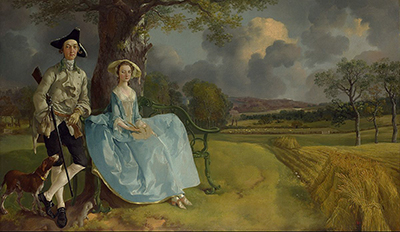
It is tempting to treat every Gainsborough couple in a landscape as a prelude to Mr and Mrs Andrews, but that would make the earlier painting smaller than it is. The National Gallery presents the Andrews portrait as the outstanding achievement of Gainsborough's early career and stresses that the land itself is part of the image's identity.[3] That later painting makes property, marriage, agriculture and local standing intensely visible. A Couple in a Landscape works more quietly.
The comparison is still useful. Both works ask how figures and land can share meaning. Both place a young pair outdoors. Both emerge from the early part of Gainsborough's career and from the world of local patrons. But Mr and Mrs Andrews expands the relation between people and possession into a grander, sharper statement. Dulwich's picture is smaller, more intimate and less declarative.
The unnamed couple do not dominate their surroundings in the same way. The oak holds the composition as much as they do. The field and season matter, but they do not open into the same survey of estate and status. If Mr and Mrs Andrews is a portrait of landownership, A Couple in a Landscape is closer to a portrait of social ease tested against natural irregularity.
This difference matters because it shows Gainsborough experimenting rather than repeating. He was not simply developing one formula and scaling it up. He was trying several ways of placing people in the countryside. Sometimes land becomes property; sometimes it becomes mood; sometimes it becomes a stage for sociability; sometimes it becomes the painter's real subject, with the sitters folded into it.
The Dulwich painting therefore deserves to be read on its own terms. It is not important only because a more famous double portrait followed. It matters because it shows the problem before it hardened into a canonical solution. A couple, a tree, a field, a fence and a reused canvas become a testing ground for Gainsborough's future.
Suffolk, Ipswich and Early Ambition
The date of about 1753 places the work close to Gainsborough's Ipswich move. Gainsborough's House records that after his early training in London and return to Suffolk, he moved to Ipswich in 1752, where his portrait skill grew before the move to Bath in 1759 brought more fashionable patrons.[2] Dulwich also places the painting within this early Suffolk career, when he was establishing himself among local landowning gentry.[1]
That context helps explain the picture's scale and tone. It is not yet the grand Bath or London society portrait. It does not seek the full-dress brilliance of later aristocratic likenesses. Its ambition lies elsewhere: in joining a modest social image to a landscape of real pictorial weight. The outdoor setting is not an accessory to a future court style; it is already a serious concern.
The painting also shows how early Gainsborough was willing to blur categories. Is this a double portrait, a conversation piece, a landscape with figures, or a social image in rustic dress? The answer is that it borrows from all of these. The categories overlap because Gainsborough wanted them to overlap. He was learning how a painting could earn its keep as portraiture while satisfying his attachment to landscape.
Rosenthal's Paul Mellon Centre study is helpful as a wider frame because it treats Gainsborough's career within the practical business of looking, patronage and artistic self-positioning in eighteenth-century Britain.[4] A work such as A Couple in a Landscape belongs exactly to that world. It is charming, but it is also a professional object: a picture made for patrons, shaped by materials, and alive to the visual expectations of a local elite.
Ipswich is important because it stands between training and fashion. Gainsborough had absorbed London lessons and Dutch landscape interests, but he had not yet become the Bath portraitist whose clients expected high polish and social glamour. The Dulwich painting preserves that in-between energy. It is polished enough to serve patrons, but still exploratory enough to show the artist thinking visibly through the relation between people and place.
How to Look at the Couple
Begin with the two bodies. They sit together, but they do not merge into a sentimental unit. The aligned feet suggest companionship. The different clothing separates their social and pictorial roles. Her dress answers the landscape; his coat asserts contrast. Their relation is therefore built through both harmony and difference.
Then look at the woman’s hands. The drawing and crayon introduce an act of looking inside the image. If she is sketching or has been sketching, she becomes a viewer as well as a sitter. That possibility suits Gainsborough, who was deeply invested in drawing and outdoor perception. Yet the detail remains suggestive rather than explanatory. The painting does not tell a complete story of her activity.
Next, look at the tree. Its branch reaches over her, while its trunk gives weight to the left side of the image. The oak frames, shelters and almost competes with the couple. It is older, rougher and more sculptural than the human figures. If the couple bring social presence, the tree brings pictorial authority.
The ground is also worth noticing. The woman's dress merges with earthy tones, making her body both prominent and absorbed. The man sits more sharply against the environment. Gainsborough uses colour to establish two different relations to nature: sympathy in her case, contrast in his. That does not prove personality, but it creates pictorial tension.
Finally, remember the hidden painting underneath. The visible scene is already an image of relation, leisure and landscape; the x-ray finding adds another relation, between surface and support. The present couple sits on top of a displaced earlier portrait. That material history gives the painting a double life: one image visible, another suppressed but still shaping the surface.
Why the Painting Matters
A Couple in a Landscape matters because it shows Gainsborough discovering how elastic portraiture could be. A portrait did not have to be a head, a body and a neutral setting. It could become a conversation between sitters and weather, costume and tree, social polish and rural texture. That discovery would become one of his great strengths.
It also matters because it keeps the early Gainsborough from seeming merely preliminary. The painting is not a rough step toward later fame. Its small scale and provincial setting are part of its intelligence. It shows the artist working with local patrons, available materials and inherited pictorial models while already producing something distinctively his own.
The x-ray evidence makes the picture especially valuable. Few early works reveal so plainly the practical underside of composition. The reused canvas reminds us that paintings are not only ideas or images; they are objects made under constraints. Gainsborough's art often looks fluent, but fluency can include resourcefulness, revision and concealment.
The unnamed sitters also matter. Their lost identities prevent the painting from becoming a straightforward biography, but they do not reduce its force. Instead, they shift attention to relation: between two people, between people and land, between social life and artistic making. The couple remain enigmatic, yet the painting is not vague. It is precise about mood, season, texture and pictorial balance.
Its final importance lies in its quietness. Mr and Mrs Andrews has become the sharper, more famous statement about marriage, land and English identity. A Couple in a Landscape speaks in a lower register. It gives us a young pair under an old tree, a field at a turning season, a woman with drawing materials, a man in town-like dress, and a canvas carrying the ghost of an earlier portrait beneath. That is more than enough. In this early work, Gainsborough already understood that a landscape could hold people, memory, social ambition and painterly wit at once.
Frequently Asked Questions
Discussion
How do the couple, landscape and reused canvas share the painting’s meaning?
Reader Insights
How do aligned feet, different dress and shared setting suggest companionship without supplying biography?
Where does the old tree become a character rather than a backdrop?
How does the x-ray discovery change the way the visible composition is understood?
Join the Conversation
Share your reading below.
References
- Dulwich Picture Gallery, “Thomas Gainsborough, A Couple in a Landscape.” View source.
- Gainsborough's House, “About Thomas Gainsborough.” View source.
- National Gallery, London, “Thomas Gainsborough, Mr and Mrs Andrews.” View source.
- Michael Rosenthal, The Art of Thomas Gainsborough: "A Little Business for the Eye" (New Haven and London: Yale University Press for the Paul Mellon Centre for Studies in British Art, 1999). Publication record.