 by Tom Gurney
Tom Gurney BSc (Hons) is an art history expert with over 20 years experience
Published on June 19, 2020 / Page Updated on November 5, 2026
Email: tomgurney1@gmail.com / Phone: +44 7429 011000
Introduction
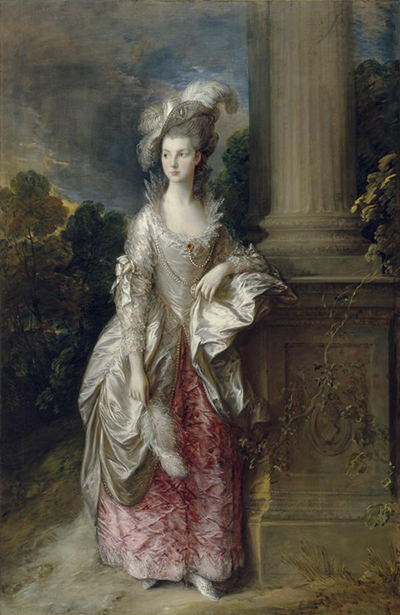
Thomas Gainsborough's The Honourable Mrs Graham is one of the portraits in which elegance becomes almost theatrical, but not empty. A young woman stands in an imagined landscape, leaning beside a column, dressed in a shimmering white Van Dyck-style costume and a broad feathered hat. The pose is composed, the costume magnificent, the surface lively, and the mood more fragile than the costume first suggests. It is a society portrait, a performance of fashion, a dialogue with seventeenth-century court portraiture, and a painting whose later history was shaped by bereavement, concealment and bequest.
The National Galleries of Scotland identifies the sitter as the Honourable Mary Cathcart Graham, who lived from 1757 to 1792. The painting is titled The Honourable Mrs Graham (1757 - 1792), dated 1775-1777, oil on canvas, measuring 237 by 154 centimetres, framed 265 by 182.5 by 11 centimetres, with accession number NG 332. It is on display in the Scottish National Gallery, and its credit line records the bequest of Robert Graham of Redgorton in 1859.[1] These object facts matter because the painting has become so strongly associated with grace and beauty that the actual sitter, the current collection and the unusual terms of its later public life can be overshadowed.
Mary Cathcart was the daughter of the 9th Lord Cathcart, a soldier and diplomat who in 1768 became Ambassador to Catherine the Great in St Petersburg. In 1774 she married Thomas Graham, a young Scottish laird who later became Lord Lynedoch, and in 1787 the couple bought Lynedoch House near Methven in Perthshire.[1] Gainsborough painted her when she was about eighteen, a few months after that marriage.[1] The portrait therefore belongs to the beginning of her married life, not to the later sorrow through which it became famous.
At a Glance
- ArtistThomas Gainsborough
- Date1775–1777 [1]
- MediumOil on canvas [1]
- Dimensions237 × 154 cm [1]
- SitterThe Honourable Mary Cathcart Graham (1757–1792) [1]
- CollectionScottish National Gallery, Edinburgh, NG 332 [1]
- ExhibitionRoyal Academy, 1777 [1]
- Visual traditionVan Dyck-style costume and grand-manner portraiture [1][2]
- BequestRobert Graham of Redgorton, 1859; the portrait must remain in Edinburgh [1]
- ExploreBiography; Paintings; Portraits; The Blue Boy; Mr and Mrs Andrews
Contents
- Introduction
- A Full-Length Society Portrait
- Mary Cathcart Graham
- Van Dyck, Costume and Historical Elegance
- Landscape and Brushwork
- Royal Academy Reception
- Grief, Concealment and Afterlife
- Bequest and Scottish National Gallery
- Society Beauty Without Simplification
- Why The Honourable Mrs Graham Matters
A Full-Length Society Portrait
The painting's first effect is scale. At 237 centimetres high, it presents Mary Graham full length, with the body, costume, accessories and setting all participating in the portrait's meaning.[1] This is not a compact likeness designed only to preserve facial identity. It is a portrait of public presence. Mary is given the height, vertical elegance and pictorial space associated with elite portraiture, and Gainsborough makes that format feel both grand and mobile.
The National Galleries of Scotland calls it one of Gainsborough's finest full-length portraits.[1] That description is justified by the way the painting handles grandeur without stiffness. Mary stands near a column, yet the architecture does not dominate her. She wears historical costume, yet the picture does not freeze into antiquarian display. The landscape setting opens behind her, and the brushwork keeps the figure alive. The painting is formal, but not rigid.
Full-length portraiture carries social force. It shows the sitter not only as a face but as a body in space, dressed and staged for recognition. Mary's costume, hat, column and landscape all speak to status. Yet Gainsborough softens the pressure of display through lightness of handling and poetic atmosphere. The viewer sees a prominent young woman presented according to high social expectation, but the paint gives that expectation air.
This is a crucial difference between elegance and formula. The portrait uses conventions that could have become merely decorative: white dress, plumes, column, landscape, historicising costume. Gainsborough turns them into a living arrangement. The figure is poised, but the image around her breathes. The portrait's power lies in that balance between social theatre and painterly freshness.
That balance also explains why the portrait belongs near the centre of Gainsborough's achievement rather than at the edge of it. The National Gallery, London summarises him as an artist who was celebrated for portraits while retaining a deep attachment to landscape.[4] In Mrs Graham, those two reputations are not separate. The sitter's social identity requires the commanding format of portraiture, but the surrounding air, foliage and softened distance come from a painter for whom landscape feeling remained essential. Rosenthal's Paul Mellon Centre study places Gainsborough within the professional and visual culture of late eighteenth-century Britain, where portraiture involved patrons, public reputation, pleasure, rivalry and economic necessity rather than likeness alone.[5] This painting makes that wider situation visible. It is a portrait made for social recognition, yet its lasting force depends on painterly delight as much as rank.
Mary Cathcart Graham
Mary Cathcart's biography gives the portrait its human centre. The National Galleries of Scotland records that she was born into an aristocratic diplomatic family, that she became a prominent figure in Georgian London society, and that contemporaries admired her intelligence, charm and beauty.[1] Those details explain the portrait's ambition. Gainsborough was not painting an anonymous model dressed for spectacle. He was painting a young woman already visible within elite social circles.
At the same time, the evidence should not be stretched into psychological certainty. The painting has often been read through the story of Mary's early death and her husband's grief, but that grief belongs to the portrait's later life. In the image itself she is young, newly married and presented as a society beauty. It is tempting to read vulnerability backward from biography into every feature of the face, yet doing so risks making the sitter a symbol before looking at the painting as a portrait.
What Gainsborough does give is a powerful tension between magnificence and distance. Mary is elaborately dressed and prominently staged, yet she does not seem easily accessible. The National Galleries of Scotland text describes her as distant, aloof and somehow vulnerable within an imagined landscape.[1] That combination is more useful than a sentimental reading. The painting's emotional charge comes from poise under pressure, not from overt expression.
The sitter's marriage also matters. Thomas Graham was a Scottish landowner who later became an important military figure after Mary's death.[1] The portrait, however, belongs to the couple's early married period rather than to that later military history. Gainsborough's image is not a widow's memorial. It became associated with mourning later because Thomas Graham reportedly could not bear to contemplate it after Mary died.[1] That later history intensifies the painting without changing its original moment.
Van Dyck, Costume and Historical Elegance
The portrait's costume looks backward. The National Galleries of Scotland notes that the costume and accessories evoke the age of King Charles I and the opulent court portraits of Sir Anthony van Dyck.[1] This is not a casual style label. Van Dyck mattered deeply for British portraiture because his images of courtly elegance, long bodies, rich fabrics and aristocratic ease provided later painters with a powerful model of social grace.
Gainsborough's relationship to Van Dyck should be handled precisely. The National Galleries of Scotland artist biography says that Gainsborough continued to build on the grand manner of Van Dyck while introducing informality through imaginative landscape backgrounds and fluid, lively brushwork.[2] The Honourable Mrs Graham makes that balance visible. The costume and format carry Van Dyckian memory; the handling and atmosphere make the image recognisably Gainsborough's.
Mary's dress is therefore more than costume. It is a bridge between past and present. By dressing a fashionable eighteenth-century woman in a mode recalling the seventeenth-century court, Gainsborough gives her inherited aristocratic glamour without painting her as a strict historical figure. The effect is imaginative, not archaeological. She is modern society seen through old-master theatre.
The feathered hat is central to that theatre. It expands the silhouette, lifts the figure's presence, and helps connect the portrait to a broader language of elegance and display. The white dress catches light and breaks into movement, while the darker landscape and column give the pale figure contrast. Gainsborough uses costume to organise the whole picture. Fabric, plumes and pose become pictorial architecture.
Van Dyck influence can become a lazy shorthand if applied only to any grand costume portrait. Here, however, the source is specific and productive. The costume, full-length format, column, landscape and aristocratic poise all help explain why the comparison matters.[1][2] Gainsborough is not copying Van Dyck; he is using Van Dyck's authority to make Mary Graham appear both contemporary and timeless.
Landscape and Brushwork
The landscape in The Honourable Mrs Graham is imagined rather than topographical. The National Galleries of Scotland text describes her as presented in an imagined landscape setting.[1] That matters because it prevents the background from being read as a literal record of a place. Gainsborough is not mapping Lynedoch, London or a family estate. He is creating an atmospheric world in which the sitter can appear with heightened grace.
The National Galleries of Scotland artist summary gives the larger context: Gainsborough excelled as both portrait and landscape painter, concentrating on portraiture for income while bringing imaginative landscape backgrounds and fluid brushwork into his grand-manner portraiture.[2] This is one of the keys to the painting. The setting is not detachable scenery. It is how Gainsborough softens the grand manner, making the sitter's elegance feel airy rather than architectural alone.
Brushwork does much of the emotional work. Gainsborough's House describes his later portraits as using thin paint applied in light, feathery strokes, celebrated for naturalism and fluidity.[3] In Mrs Graham, that kind of handling suits the sitter's costume and atmosphere. The dress can shimmer without becoming hard; the landscape can remain suggestive; the whole image can carry delicacy without losing scale.
The National Galleries of Scotland text also links the delicacy and spontaneity of Gainsborough's technique with the portrait's evocation of Mary Graham's fragile beauty.[1] That phrase should not be used to over-psychologise her, but it identifies a real visual effect. The painting's technique makes splendour feel perishable. The costume is sumptuous, yet the surface seems animated by touch rather than sealed by finish.
This is one reason the portrait differs from a purely ceremonial image. A harder painter might have made the column, costume and social rank feel monumental. Gainsborough gives them movement. The figure stands in elegance, but the brush refuses complete fixity. The viewer senses fabric, air, foliage, plume and skin as different forms of touch. The portrait's grandeur is held inside painterly motion.
Royal Academy Reception
The painting was highly acclaimed when exhibited at the Royal Academy in 1777.[1] This public reception is important because the portrait did not become famous only through later mourning or collection history. It attracted attention in Gainsborough's own lifetime. In 1777, he was working in London after returning from Bath and was deeply engaged with the public visibility that Royal Academy exhibition could offer.
Gainsborough's House records that he moved to London by 1774, probably in relation to the foundation of the Royal Academy, of which he was a founding member.[3] The National Galleries of Scotland artist biography also notes his founding membership in 1768 and his return to London in 1774.[2] Mrs Graham belongs to this London moment: a major society portrait shown publicly in the Academy's competitive exhibition culture.
Royal Academy display mattered because portraits could be judged not only by patrons but by artists, critics and a broader public. A full-length portrait of a fashionable young woman had to perform across distance and social expectation. Gainsborough's painting did so through scale, costume, elegance and the painterly freshness that distinguished him from more heavily classical approaches to portraiture.
The NGS account says the 1777 exhibition secured Mary's reputation as an icon of contemporary beauty.[1] That statement should be read as reception history, not as the whole meaning of the painting. Beauty was certainly part of its public impact, but Gainsborough's achievement is not reducible to flattery. The portrait made beauty into a pictorial event: historical costume, landscape atmosphere, full-length format and social performance brought together in one image.
The Academy context also clarifies the role of Van Dyck. Gainsborough's use of historical costume and courtly elegance would have been legible to viewers familiar with portrait traditions. The picture did not simply show a pretty sitter; it showed Gainsborough's ability to compete in the grand manner while retaining his own lightness. That artistic ambition is part of the portrait's success.
The National Gallery, London notes that Gainsborough was elected a founder member of the Royal Academy in 1768, even though his relations with its exhibition world were not always smooth.[4] Mrs Graham therefore sits inside a useful tension. The Academy gave his work public visibility, but public exhibition also exposed portraiture to comparison, judgement and fashionable chatter. A portrait like this needed to satisfy a sitter's circle while also demonstrating the painter's command before a wider artistic audience. Rosenthal's study is valuable here because it keeps Gainsborough's art close to the pressures of business, taste and public appetite.[5] The painting's glamour is not an escape from those pressures. It is one of the ways Gainsborough mastered them.
Grief, Concealment and Afterlife
The later story of the painting is unusually moving, but it needs careful handling. Mary Graham suffered from tuberculosis, travelled to Portugal and France in search of warmer climates, and died in 1792 at the age of thirty-five.[1] Her husband Thomas Graham never remarried, and according to tradition he could not bear to look at Gainsborough's portrait of her, which was kept out of sight in storage.[1]
This history has shaped how later viewers approach the painting. Knowing that the portrait was hidden after Mary's death makes the image feel haunted. The young woman who stands in such splendour becomes inseparable from the knowledge that her life was short and that her husband avoided the painting because it was too painful to contemplate. Yet the evidence remains a later account of reception and grief, not a direct guide to every painted detail.
The distinction matters. The portrait was painted before Mary's illness and death had become its public story. Gainsborough was not painting a memorial image. Later events changed the painting's emotional charge, but they did not determine its original purpose. The strongest reading holds both moments together: the young society figure of 1775-1777 and the hidden image after 1792.
Thomas Graham's later life adds another layer. After Mary's death he became a celebrated military commander under Wellington in the Peninsular War.[1] That later public career contrasts sharply with the private grief associated with the portrait. The painting's afterlife therefore moves between intimate loss and national history. Mary remains the sitter, but the story of the object also touches her husband's long widowhood and public life.
The concealment of the picture may also explain part of its later aura. A portrait designed for display became an image too painful for private viewing. Its full-length splendour was removed from sight. That reversal gives the work an unusual emotional history: what had once secured public admiration became a private wound.
Bequest and Scottish National Gallery
After Thomas Graham died in 1843, his estate passed to a second cousin, Robert Graham of Redgorton. The portrait was retrieved from a London repository and bequeathed to the new National Gallery in Scotland with the binding condition that it should never leave Edinburgh.[1] The NGS object record gives the credit line as Robert Graham of Redgorton's bequest in 1859 and notes that the painting was among the first works to enter the Gallery's collection.[1]
That bequest condition is central to the portrait's modern identity. The painting is not only in the Scottish National Gallery; it is bound to the building by the terms of the gift.[1] This makes its current display history unusually specific. Many famous works travel for exhibitions or loans, but this one carries a condition of place. Its public life is tied to Edinburgh.
The condition also transforms a private family image into a public Scottish treasure. The painting began as a portrait of Mary Graham, moved through family grief and storage, then entered a national collection under strict terms. That passage from private mourning to public identity is one of the reasons the picture has such resonance. Its history is not simply provenance. It is emotional transfer.
The National Galleries of Scotland describes the portrait as one of the images most closely associated with the Scottish National Gallery.[1] That association depends partly on the bequest condition and partly on the painting's visual power. A work by an English painter of a Scottish sitter, given through a Scottish family line and bound to Edinburgh, became one of the institution's defining images.
This institutional story should not be treated as an afterthought. The painting's meaning today includes its place, its immobility, its role in the collection and its long association with the Gallery. To see Mrs Graham in Edinburgh is to encounter not only Gainsborough's portraiture but the nineteenth-century act of gift and remembrance that placed it there.
Society Beauty Without Simplification
The most dangerous way to write about The Honourable Mrs Graham is to leave it at beauty. The painting certainly depends on beauty: the sitter's face, dress, hat, posture and setting are designed for admiration. The National Galleries of Scotland records that her looks captivated contemporaries and that the Academy exhibition helped make her an icon of contemporary beauty.[1] But beauty in this portrait is not simple ornament. It is a social, artistic and historical construction.
Mary's image is made through costume, lineage, marriage, painterly style and public display. She is shown as a young aristocratic woman in a role shaped by Georgian society and old-master memory. Gainsborough's art gives that role grace, but it also gives it distance. The viewer may admire the sitter while sensing that the portrait's elegance is a performance under social expectation.
This is why the painting should not be reduced to biography either. Mary's early death and Thomas Graham's grief give the portrait later poignancy, but the work is not only a tragic love story. It is also a major London exhibition portrait, a Van Dyck-inflected society image, a work of technical delicacy, and a foundational object in a national collection. The grief matters, but it is one layer among several.
Nor should Van Dyck be treated as a decorative tag. The costume and accessories deliberately evoke an earlier aristocratic world, and Gainsborough's grand-manner portraiture develops from that visual inheritance.[1][2] Yet the painting remains eighteenth-century in its social context and Gainsboroughian in its touch. It uses the past to heighten the present.
The portrait's strength lies in the pressure among these identities. Mary Graham is a person, a society figure, a young wife, an admired beauty, a painted performance, a memory of grief and a defining image for a collection. Gainsborough gives each of those identities room without letting any one of them fully close the picture.
Rosenthal's title, A Little Business for the Eye, is apt for a portrait such as this because it points to visual pleasure as something active, cultivated and purposeful rather than merely pretty.[5] Gainsborough gives the eye plenty to do: the sweep of the dress, the lift of the hat, the shift from pale fabric into darker air, the long vertical line of the body, and the small reserve of the face within a grand surrounding. Beauty here is not a single quality resting in the sitter. It is produced through successive acts of looking. The viewer moves between likeness, costume, landscape, touch and history, discovering that the portrait's elegance has been built from many small decisions.
Why The Honourable Mrs Graham Matters
The Honourable Mrs Graham matters because it shows Gainsborough at a point where society portraiture, landscape imagination and old-master memory could be made to serve a single image. The painting has the height and elegance of grand portraiture, the historical glamour of Van Dyck costume, and the atmospheric softness of Gainsborough's own landscape-inflected manner. It is grand without being ponderous.
It also matters because its later history is inseparable from how it is seen. Few portraits carry such a strong arc from public acclaim to private concealment to national bequest. The 1777 Academy success, Mary Graham's death in 1792, Thomas Graham's inability to look at the portrait, the retrieval after his death, and the 1859 bequest to the National Galleries of Scotland all become part of the painting's life.[1]
The work also gives a necessary counterpoint to Gainsborough's better-known English society portraits. It involves a Scottish sitter, Scottish family memory and a Scottish national collection, while still belonging to Gainsborough's London exhibition world. Its identity is therefore not confined to one place. It links Georgian London, Scottish aristocratic history, Van Dyck's pictorial legacy and the institutional story of the Scottish National Gallery.
The National Gallery, London's short account of Gainsborough stresses both his portrait practice and his landscape interests, a dual identity that helps explain the painting's continuing fascination.[4] If the picture were only a display of rank, it would be impressive but colder. If it were only an atmospheric fantasy, it would lose the social precision that gives Mary Graham her historical presence. Gainsborough holds those claims together. The result is a portrait that can stand as evidence of fashionable Georgian society and as evidence of the artist's refusal to let portraiture become merely administrative likeness.
Above all, the painting matters because it makes elegance feel unstable. Mary Graham stands in splendour, yet the image does not feel merely triumphant. The imagined landscape, pale costume, distant poise and later history of loss make the portrait hover between display and vulnerability. Gainsborough's art turns society portraiture into something more poetic than social record. The result is a painting that can be admired for beauty, studied for technique, read through history and still felt as a living presence.
Frequently Asked Questions
Discussion
Which tension most changes your understanding of Mary Graham's portrait?
Reader Insights
How do costume, pose and expression balance social display with emotional reserve?
Where does the imagined setting soften or heighten the full-length society portrait?
How does the history of grief, concealment and bequest change the way the painting is seen?
Join the Conversation
Share your reading below.
References
- National Galleries of Scotland, “Thomas Gainsborough, The Honourable Mrs Graham (1757 - 1792).” View source.
- National Galleries of Scotland, “Thomas Gainsborough.” View source.
- Gainsborough's House, “About Thomas Gainsborough.” View source.
- National Gallery, London, “Thomas Gainsborough.” View source.
- Michael Rosenthal, The Art of Thomas Gainsborough: "A Little Business for the Eye" (New Haven and London: Yale University Press for the Paul Mellon Centre for Studies in British Art, 1999). Publication record.