 by Tom Gurney
Tom Gurney BSc (Hons) is an art history expert with over 20 years experience
Published on June 19, 2020 / Page Updated on November 5, 2026
Email: tomgurney1@gmail.com / Phone: +44 7429 011000
Introduction
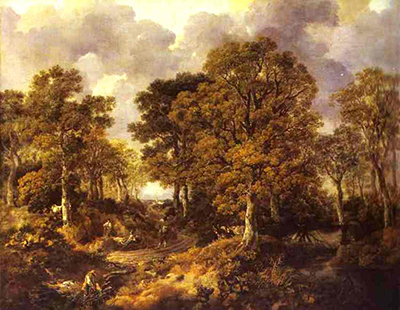
Thomas Gainsborough's Cornard Wood, near Sudbury, Suffolk is an early landscape with an unusually long afterlife. Painted around the artist's native Sudbury, it shows a wooded common animated by people, animals, paths, ponds and distant architecture. The picture looks local, but it is not a simple topographical report. It is shaped by Dutch landscape painting, by the young Gainsborough's training, by the practical life of common land, and by the older artist's memory of his own beginnings.
The National Gallery, London records the full title as Cornard Wood, near Sudbury, Suffolk, by Thomas Gainsborough, dated 1748. It is oil on canvas, 122 by 155 centimetres, inventory number NG925, bought with the Lewis Fund in 1875 and held in the Main Collection.[1] Those facts place the painting at the start of Gainsborough's career rather than among the more familiar Bath and London society portraits. They also make it one of the essential works for understanding why landscape remained so powerful for him.
The subject is a place near home, but the painting's meaning depends on more than birthplace. Cornard Wood stood on the edge of Great Cornard, about two miles from Sudbury, where Gainsborough was born.[1] The view is from Abbas Hall toward Great Henny, with the church of St Mary's Great Henny in the distance.[1] Yet the National Gallery also notes that Great Henny appears nearer than it is in reality, and that the painted tower differs slightly from the actual church tower.[1] From the beginning, then, the picture asks to be read as a place-based invention: anchored in Suffolk, but adjusted by pictorial imagination.
At a Glance
- ArtistThomas Gainsborough
- Date1748 [1]
- MediumOil on canvas [1]
- Dimensions122 × 155 cm [1]
- CollectionNational Gallery, London, NG925 [1]
- ViewpointAbbas Hall toward Great Henny [1]
- Land useA working common used for grazing, wood, marl, sand and passage [1]
- InfluencesSeventeenth-century Dutch landscape painting [1][3]
- ConditionThe sky appears grey because its Prussian blue has faded [1][2]
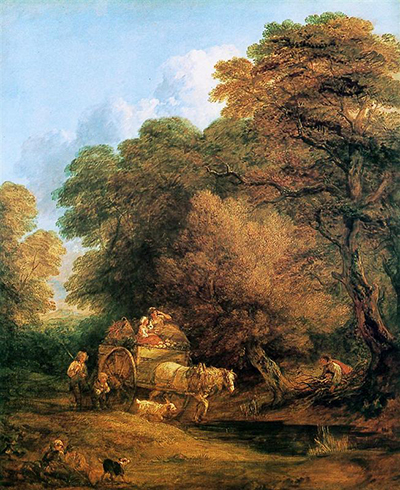
- ExploreLandscapes; Paintings; Technique; The Market Cart
Contents
- Introduction
- An Early Landscape with a Long Memory
- The View from Abbas Hall
- Common Land and Everyday Use
- Dutch Models and Suffolk Ground
- Figures, Paths, Trees and Water
- Colour, Condition and the Faded Sky
- The 1788 Letter and the Question of Beginnings
- Sale, Dealers and Collection History
- Why Cornard Wood Matters
An Early Landscape with a Long Memory
Cornard Wood matters partly because Gainsborough himself later remembered it. In a letter of 11 March 1788, discussed in the National Gallery catalogue, he said that the picture was "actually painted at Sudbury" in 1748.[2] The same letter presented the work as an early proof of his deep attachment to landscape, written when he was near the end of his life and known chiefly as one of England's leading portrait painters.[2]
That retrospective moment is moving, but it needs discipline. The painting should not be turned into a misty autobiography simply because the artist looked back on it affectionately. Gainsborough's memory gives the work special authority as an early landscape, but the painting still has to be understood through its structure, subject and visual language. It is not only a relic of youth. It is a serious attempt to make local land into a large, complex picture.
The date has also been discussed. The National Gallery uses 1748, following Gainsborough's own statement.[1] Judy Egerton's catalogue entry notes that John Hayes preferred a slightly earlier date on stylistic grounds, but Egerton argues that there is no strong reason to reject the artist's own recollection.[2] This is a useful caution. Early Gainsborough landscapes are not always easily dated, and the stylistic sequence is uncertain. In the public title and basic chronology, the National Gallery's 1748 date should therefore carry the weight.
The uncertainty around early landscape chronology makes the painting more interesting, not less. Egerton notes that supporting evidence for Gainsborough's early landscapes is sparse, and that stylistic ordering can become circular when few works are firmly dated.[2] Cornard Wood therefore stands out because the artist himself remembered a date, a place and an emotional connection. Even if the letter was written decades later, it gives the picture a documentary density rare among his early landscapes. The responsible reading is neither blind trust in memory nor dismissal of it. It is to recognise that the National Gallery's date rests on the painter's own retrospective testimony, while the catalogue records why scholars have discussed the matter.
The painting sits at a hinge in the young artist's life. Gainsborough had trained in London, returned to Sudbury after his marriage to Margaret Burr in 1746, and then worked for local patrons before moving to Ipswich in 1752.[3] Gainsborough's House describes his childhood in the woods and fields around Sudbury as formative for his love of landscape, while also noting that he returned to Sudbury as a young working painter.[3] Cornard Wood belongs to that early world of local knowledge, ambition and experiment.
The View from Abbas Hall
The National Gallery identifies the viewpoint as Abbas Hall, on a hillside above Great Cornard, looking south and slightly west toward Great Henny.[1] This matters because the painting is not merely called Cornard by tradition; it is linked to an identifiable prospect. The winding path carries the eye into the wooded scene and toward the distant church. The path is therefore both a local track and a compositional device, binding near foreground activity to the further village.
The setting is spacious without being empty. Trees frame the left side, while the right side opens toward spring-fed ponds and shaded water.[1] The church in the distance gives the landscape a human destination, but it does not dominate the picture. Gainsborough lets the viewer move gradually: from figures and animals in the foreground, through the shifting wood, along the path, and finally outward to the pale distance.
The accuracy of the view is deliberately limited. Great Henny is closer in the painting than in the actual prospect, and the church tower is not exact.[1] Rather than weakening the work, this difference explains how Gainsborough's landscape imagination operates. He begins with local recognition, then compresses and adjusts the scene so that it works as a painting. The result is not false geography, but pictorial geography.
That distinction is essential for looking at Gainsborough landscapes. A named place can be real without being surveyed. A view can carry memory, local identification and observable features while still bending distance, scale and emphasis. Cornard Wood is neither pure invention nor strict topography. It occupies the productive space between them.
Common Land and Everyday Use
One of the painting's strongest features is that Cornard Wood was common land rather than a private estate.[1] The National Gallery explains that villagers had long-standing rights there: they could gather wood, graze animals, dig marl for manure, dig sand for building, take the path toward Great Henny or simply walk.[1] Those uses help explain why the painting is populated by purposeful figures rather than empty rural decoration.
In the scene, two donkeys stand on a hillock; one man rests from digging beside a seated woman; another cuts and ties firewood; travellers move on foot and horseback along the way toward Great Henny.[1] These details are not random ornaments scattered across a woodland view. They identify the common as a place of shared work, passage and small economic activity. The landscape is alive because it is being used.
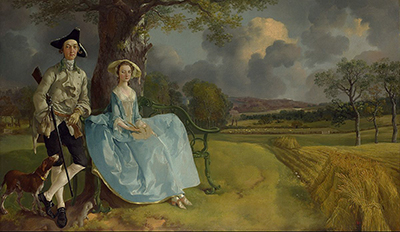
This separates Cornard Wood from an estate portrait such as Mr and Mrs Andrews, where land helps define property, marriage and social position. Here the emphasis falls on access and use. People pass through the common, take material from it, rest within it and graze animals on it. The woodland is therefore social, but not in the same way as a country-house park or a landed prospect.
The picture still has a constructed quality. Egerton notes that some critics found the scene crowded, but she argues that the figures have distinct purposes rather than being merely unrelated motifs.[2] That point is persuasive. The common is dense because it gathers many rights and activities into one image. Gainsborough compresses the everyday life of the place until the landscape becomes a small world of use.
This should not be exaggerated into a modern political manifesto. The painting does not announce a programme about land rights, and Gainsborough was not making a legal diagram of the common. But the National Gallery's account of ancient uses gives the figures a social clarity that purely decorative readings miss.[1] Digging marl, cutting wood, grazing animals and walking across the common are modest actions, yet together they define the land as a shared resource. Gainsborough's achievement is to let those actions remain practical while making them visually graceful.
The scale of the canvas supports that ambition. At 122 by 155 centimetres, the painting is large enough for the viewer to move through it mentally rather than simply glance at a picturesque corner.[1] The common becomes an environment with zones of activity: open rise, wooded shade, path, water and distance. This breadth helps explain why the picture has remained central to accounts of the young Gainsborough. It does not offer one motif; it offers a whole lived prospect.
Dutch Models and Suffolk Ground
The National Gallery connects Gainsborough's early landscape practice with seventeenth-century Dutch painters, especially Jan Wijnants and Jacob van Ruisdael.[1] Gainsborough's House also stresses the importance of Dutch landscape painting for him, explaining that during his early London years he could have encountered continental examples through the art trade and private collections.[3] These influences help explain the trees, paths, water, ordinary figures and recognisable rural setting of Cornard Wood.
Dutch influence should not be treated as a label that solves the painting. Gainsborough was not copying a Dutch formula and dropping Suffolk scenery into it. He was learning how a local landscape could be made legible as art. Dutch examples offered ways to organise woodland, tracks, light, water and working figures without needing the heroic ruins or classical order associated with ideal landscape.
The National Gallery makes this contrast directly by noting that Dutch landscapes appealed to viewers who preferred recognisable reality over ideal classical landscape associated with Claude and Poussin.[1] That distinction helps locate the young Gainsborough's ambition. He was not rejecting artifice; he was choosing a kind of artifice that made ordinary-looking rural ground pictorially serious.
East Anglia itself helped the process. The National Gallery observes that the countryside of East Anglia, with river meadows, ponds and windmills, had affinities with the Netherlands.[1] Gainsborough could therefore find in his native region the sort of terrain that Dutch painting had already taught collectors and painters to value. Cornard Wood becomes English and Dutch at once: English in location and social use, Dutch-inflected in pictorial grammar.
Egerton's catalogue entry sharpens this point by resisting the idea that the picture is simply an immature heap of motifs. She links its common-land subject to Dutch woodland precedents in which roads, figures and labour structure the scene.[2] That does not reduce Gainsborough to a pupil of Dutch art. It shows how he could use an inherited landscape language to organise a specific Suffolk subject. The interest lies in translation: a continental pictorial habit is made to serve a local common, with its own workers, travellers, animals and distant church.
The comparison also helps explain the painting's delicacy. Dutch models could offer strong spatial construction and closely observed rural detail, but Gainsborough's touch is lighter and his mood less emphatic. The National Gallery describes the picture as dreamlike in contrast with the realistic Dutch examples he studied.[1] That dreamlike quality is not weakness. It is the sign of a young artist already turning models into something more personal.
Figures, Paths, Trees and Water
The painting is best approached slowly. The path is the great organiser. It does not simply lead to the distant church; it gathers the different activities of the common and turns them into movement. Travellers, workers and animals occupy the track or its edges, so that looking becomes a kind of walking. The viewer follows the path into the depth of the picture, but repeatedly pauses over labour, rest and shade.
The left side carries the brighter woodland effect. The National Gallery describes the trees and common on that side as dappled with sunlight, while the spring-fed ponds on the right are in shade.[1] This opposition gives the painting much of its life. Light is not spread evenly across the surface. It appears in patches, withdraws into pools, and allows the eye to move between warmth and coolness.
The trees are not only scenic. They create a screen, a stage and a rhythm. Their trunks and branches divide the view without sealing it. They allow glimpses through to the distance and help make the church appear as a discovered object rather than a central monument. The wood is both a subject and a means of structuring sight.
The figures have a similar double role. They show local rights and activities, but they also measure scale and guide attention. The donkeys give a small rise in the foreground its weight. The digger and seated woman slow the movement of the eye. The woodcutter links the human use of the common to the trees themselves. The travellers extend the path's narrative into distance. Gainsborough turns rural activity into pictorial order.
Colour, Condition and the Faded Sky
The present colour of Cornard Wood is not exactly the colour Gainsborough painted. The National Gallery identifies the sky's grey appearance as the result of faded Prussian blue.[1] The catalogue's technical notes explain the issue more fully: cross-section examination showed that the sky was made from a weak tint of Prussian blue and lead white, and that the blue survived where it had been protected from light by overlying foliage or by being turned over the stretcher.[2]
This matters for interpretation because the painting's atmosphere has changed. A grey sky may encourage a viewer to see the scene as quieter, older or more subdued than it once appeared. Knowing about the faded blue does not let us reconstruct the original view in every detail, but it prevents us from treating the present grey as wholly intentional. Conservation evidence changes the emotional temperature of looking.
The technical notes also record that the condition is generally good, with no major loss or damage, though thin foliage paint is affected by drying cracks.[2] The picture therefore carries both stability and visible aging. It remains readable as an early Gainsborough landscape, but its surface has lived through time. The present viewer sees the young artist's work through later material change.
The pigment evidence is also useful because it keeps the painting from becoming merely literary. It is tempting to write about Cornard Wood only through childhood, memory and Suffolk. The blue pigment reminds us that this is an object made from eighteenth-century materials, vulnerable to light, stretching, cleaning, surface change and examination. Gainsborough's landscape is poetic, but it is also physical paint on canvas.
The 1788 Letter and the Question of Beginnings
The 1788 letter gives Cornard Wood a rare kind of self-commentary. Gainsborough remembered the picture as early work and described its "schoolboy stile", but he also claimed that its touch and closeness to nature stood comparison with later works.[2] The self-deprecation and pride belong together. The older painter could see immaturity in the composition, yet still recognise in the painting a quality of looking that mattered to him after forty years.
The same letter connected the sale of the picture with his father sending him to London.[2] That claim is important but should be handled carefully. It shows how Gainsborough understood the painting's role in his own story, not necessarily every practical detail of his training. What matters for the painting is the way he made it stand for the beginning of a lifelong commitment to landscape.
By 1788, Gainsborough was famous as a portrait painter, but the reappearance of this early landscape prompted him to speak of landscape as a deep inclination.[2] That makes Cornard Wood more than a youthful exercise. It becomes, in retrospect, a witness to the continuity of his artistic desire. The young painter at Sudbury and the dying painter in Pall Mall are joined through one landscape.
The letter also reminds us that early works can change meaning over time. In 1748, the picture belonged to a young artist testing his abilities and his market. In 1788, it became evidence of origin, persistence and self-recognition. Today it also carries National Gallery collection history, technical study and later landscape reception. Its identity has been layered by time.
Sale, Dealers and Collection History
The painting's early movement through the market was unusually lively. According to the National Gallery provenance and catalogue, Gainsborough said the picture passed through "twenty dealers", and that he had once bought it back for 19 guineas.[1][2] It was sold by Richard Morrison at Greenwood's in March 1788, bought by Alderman John Boydell, and later associated with Boydell's circle.[1]
Boydell is significant because he was not only a collector but a major print publisher. The catalogue notes that Mary Catherine Prestel etched and aquatinted the painting in reverse, under the title Gainsborough's Forest, published by J. and J. Boydell in 1790.[2] That engraved afterlife helped the picture circulate beyond the original canvas. It also shows how a Suffolk woodland could enter the visual economy of prints, collecting and public display.
The title history is revealing. The work was exhibited and described under different names before the present title settled. The catalogue explains that titles ranged from woody scene descriptions to the engraved Gainsborough's Forest, but that Cornard Wood became the preferred key phrase because the work is not really a forest.[2] The modern full title preserves both the familiar name and the geographical clarification.
Those shifting titles show how later viewers tried to understand what kind of picture they had inherited. A general title such as Landscape or a romantic title such as Gainsborough's Forest pulls the painting away from local specificity. A descriptive title naming Cornard and Sudbury pushes it back toward Suffolk. The National Gallery's present title holds both needs together: the familiar short identity and the more exact geographical frame.[1][2] That matters because title is not cosmetic. It guides whether the work is read as a generic woodland, a dealer's commodity, a print publisher's subject or a remembered local place.
The painting later belonged to David Pike Watts, uncle of John Constable, and was in that collection by 1814.[1] Constable, who was born within ten miles of Gainsborough's birthplace, admired Gainsborough's landscapes.[1] This connection does not make Cornard Wood a Constable painting in embryo, but it does place it within a later Suffolk landscape memory. One Suffolk painter's early woodland became part of the world known to the family of another.
The National Gallery acquired the painting in 1875, bought through the Lewis Fund.[1] By then it had moved from local image to market object, print model, private collection work and national acquisition. That long passage is part of its significance. A painting remembered by Gainsborough as an early proof of landscape inclination eventually became a public anchor for British landscape history.
Local, Dreamlike and Not Quite Literal
One of the finest tensions in Cornard Wood is that it feels both specific and dreamlike. The National Gallery uses the language of dreaminess to distinguish it from the more strictly realistic Dutch landscapes Gainsborough studied.[1] That does not mean the picture is vague. Its geography, common-land use and distant church are all concrete. The dreamlike quality comes from compression, light, density and the slightly suspended relation between observation and arrangement.
The distant church is a good example. It gives the eye a destination and confirms the landscape's local identity, but its distance and form are adjusted.[1] The church is therefore factual enough to matter and altered enough to remind us that painting is not measurement. It stands at the far end of a visual journey rather than at the end of a surveyed road.
The common-land figures also combine observation and staging. Their activities are plausible and historically grounded, but the scene gathers so many uses into one view that the wood seems almost encyclopaedic. Cutting, digging, resting, grazing and travelling are compressed into one painted moment. The result is not a casual snapshot of rural life. It is a composed account of a working common.
This is why nostalgic readings need restraint. The painting is connected to Gainsborough's birthplace, but it is not merely a sentimental return home. It is also a young painter's negotiation with Dutch models, local land use, market ambition and compositional experiment. Its tenderness lies in the delicacy of the arrangement, not in any simple idea that the countryside is innocent.
Why Cornard Wood Matters
Cornard Wood matters because it shows Gainsborough discovering how much could be held inside landscape. The painting contains local geography, common rights, rural work, Dutch example, early ambition, later memory, technical change and collection history. It is not a large picture by accident. Its scale allows the common to become a whole social and pictorial environment.
It also matters because it complicates the familiar contrast between portraiture and landscape. Gainsborough became one of the leading portrait painters of later eighteenth-century England, but the National Gallery and Gainsborough's House both make clear that landscape remained a deep inclination and lasting concern.[3][4] Cornard Wood is the early evidence. It shows that before the fashionable Bath sitters and London full-lengths, he was already trying to make trees, water, figures and paths carry serious pictorial meaning.
Rosenthal's The Art of Thomas Gainsborough: "A Little Business for the Eye" is helpful because it frames Gainsborough's career within a changing world of commerce, artistic variety and professional pressure rather than separating visual pleasure from business.[5] Cornard Wood fits that wider picture. It is a landscape of rural use, but it also moved through dealers, print publication, private ownership and national collecting. The eye's pleasure and the art market's movement are not separate stories.
Above all, the painting matters because it teaches a way of looking at Gainsborough landscape. Trust the place, but do not demand literal topography. Notice the figures, but do not turn them into rustic sentiment. See the Dutch influence, but do not make the picture derivative. Attend to the present grey sky, but remember the faded blue beneath its history. Cornard Wood is young, local, learned, crowded, delicate and materially altered. Its quietness is full of work.
Frequently Asked Questions
Discussion
Which tension most changes your understanding of Cornard Wood?
Reader Insights
Where does recognisable Suffolk end and pictorial rearrangement begin?
How do work, passage and shared land use organise the scene?
How do the faded sky and Gainsborough’s 1788 recollection alter the painting’s mood?
Join the Conversation
Share your reading below.
References
- National Gallery, London, “Thomas Gainsborough, Cornard Wood, near Sudbury, Suffolk.” View source.
- Judy Egerton, “Cornard Wood, near Sudbury, Suffolk,” in National Gallery Catalogues: The British Paintings (London: National Gallery Company and Yale University Press, 2000), National Gallery, London. View source.
- Gainsborough's House, “About Thomas Gainsborough.” View source.
- National Gallery, London, “Thomas Gainsborough.” View source.
- Michael Rosenthal, The Art of Thomas Gainsborough: "A Little Business for the Eye" (New Haven and London: Yale University Press for the Paul Mellon Centre for Studies in British Art, 1999). Publication record.